New Field Editor for Eighteenth-Century Art at ‘caa.reviews’
From the Editor
 I am thrilled to announce that I’ll be stepping in as the new field editor for Eighteenth-Century Art at caa.reviews, succeeding Laura Auricchio who has brilliantly filled the position since 2007. I am especially grateful to both Laura and the editor-in-chief of caa.reviews, Sheryl Reiss, for all they’ve done to facilitate what, I hope, will be a smooth transition.

Published by the College Art Association, caa.reviews plays a valuable role for the scholarly community, keeping a pulse on art historical discourse but also — crucially, to my thinking — helping shape that discourse with more reviews and more timely reviews than would have ever been possible from CAA’s paper-based publications. As I’ve often said in my capacity as editor at Enfilade, I now say in this new role as a caa.reviews editor: the success of the publication depends upon you, the readers. I’ll do my best to invite thoughtful, engaged responses to a selection of the most striking and substantive scholarship addressing the eighteenth century, to give you good cause to keep reading. While promising neither revolutions (glorious or otherwise) nor sweeping societal enlightenment — certainly no guarantees regarding the sublime — I can affirm that I approach the position as an amateur, in the best sense of the eighteenth-century designation, as one who finds much to love in this period, a period as central as ever for grappling with questions of what it means to be human, what it means to make and use art, what it means to be modern, and what it means to address the past productively.
-Craig Ashley Hanson
◊ ◊ ◊ ◊ ◊
About caa.reviews
Founded in 1998, caa.reviews publishes timely scholarly and critical reviews of studies and projects in all areas and periods of art history, visual studies, and the fine arts, providing peer review for the disciplines served by the College Art Association. Publications and projects reviewed include books, articles, exhibitions, conferences, and other works as appropriate. It also publishes essays on these subjects, as well as on art education and policy and related topics. In reviewing and publishing recent texts and projects, caa.reviews fosters timely, worldwide access to the intellectual and creative materials and issues of art-historical, critical, curatorial, and studio practice, and promotes the highest standards of discourse in the disciplines of art and art history. The journal is published on a continual basis by the College Art Association. Access to caa.reviews is a benefit of membership in the College Art Association. For details about becoming a CAA member, please visit CAA’s membership pages.
Huguenot Conference October 6
From The Huguenot Society of Great Britain and Ireland:
London’s Huguenot Heritage: A Colloquium in Honour of Robin Gwynn
Orange Street Congregational Church, London, 6 October 2012
Robin Gwynn is one of the most prolific and capable historians of the Huguenots in England, dealing (among other things) with patterns of migration, the nature of the Huguenot community, and the relationship between the Huguenots and their fellow citizens. He has also sought to integrate the findings of his detailed research into a coherent overall picture, and to highlight the contribution of the refugees to English life, which (he has suggested) has traditionally been underestimated. Much of Dr Gwynn’s work has been on Huguenots in London, which makes London’s Huguenot Heritage an appropriate title for a conference to celebrate his achievements.
The conference takes place on Saturday, 6 October 2012, starting at 10:00am at the Orange Street Congregational Church, the site of the former Leicester Fields French Church (Orange Street, London WC2H 7HR). For details and a booking form click here»
◊ ◊ ◊ ◊ ◊
P R O G R A M M E
• Robin Gwynn — Conformity and non-conformity: Refugees’ dilemma, historian’s nightmare
• Anthony and Daniel Chamier — Daniel Chamier (1660/61-1698): A founder minister of Leicester Fields
• Greig Parker — Through the keyhole: Seeking Huguenot identity through domestic material culture
• David McKinley — Huguenot silversmiths in London
• Tessa Murdoch — A French noble household in London: Montagu House, Bloomsbury 1689-1709
• Charles Littleton — Huguenots in London scientific communities: From medical guilds to the Royal Society
• Barry Hoffbrand — Dr John Misaubin, Hogarth’s ‘quack’
• Angela Lloyd — ‘The Stage is my world’: David Garrick, Shakespeare and the making of modern theatre
Exhibition | ‘Canaletto in Venice’ at the Musée Maillol
It’s a busy autumn for eighteenth-century Venice — whether you’re in Venice or Paris. Along with the exhibition at the Musée Jacquemart-André, Canaletto–Guardi: The Two Masters of Venice, museum-goers in Paris can also see Canaletto in Venice at the Musée Maillol. The latter is loosely connected with the Guardi exhibition, opening in Venice at the Correr Museum on September 28. Continuing this theme of pairs, Canaletto in Venice will include the Venetian Notebook, shown earlier this year at the Palazzo Grimani. Thanks to Pierre-Henri Biger for pointing out this latest Parisian offering. The full press release is available as a PDF file here.
◊ ◊ ◊ ◊ ◊
Canaletto in Venice
Musée Maillol, Paris, 19 September 2012 — 10 February 2013
Curated by Annalisa Scarpa
 The Musée Maillol pays homage to Venice with the first exhibition devoted exclusively to Canaletto’s Venetian works. The exhibition will be presented in partnership with the Foundation of Venice Civic Museums which is preparing to put on a Francesco Guardi retrospective at the Correr Museum in Venice to mark the 300th anniversary of that Venetian painter’s birth. Canaletto in Venice will be an exclusive occasion for visitors to enjoy the master’s vision of his city, brought to life through his paintbrush. Along the canals we discover places, islands, squares and monuments, views of a city that still retains its 18th-century charm. The Venetian painter certainly didn’t invent the veduta, or detailed cityscape, a genre that has ancient origins, but he helped to develop it by giving his paintings a modernity that allowed him to overtake his masters.
Canaletto (1697-1768) is the most famous of the Venetian vedutisti of the 18th century. Over the centuries Antonio Canal has never fallen from favour; his works have always been eagerly sought after by collectors. They seem to have an endless charm, unaffected by trends. Canaletto has the crystal clarity of a man who was faithful to the spirit of the Enlightenment, with a very personal vision of reality. His painting manages to capture the very essence of the light; it conveys a unique and sensual shimmering.
The exhibition will bring together more than 50 carefully selected works, from the greatest museums and some historic private collections. On display too will be his drawings and also the famous sketchbook from about 1731, a rare loan by the Gabinetto dei Disegni e Stampe Gallerie the Cabinet of Prints and Drawings of the Accademia Gallery in Venice, which will be displayed open but which can be fully explored on computers.
Visitors will also be able to see a copy, made by Venetian master craftsmen, of the optical chamber used by Canaletto to make his drawings, thanks to a partnership with the superintendence of the Polo Museale of the City of Venice and the research of Dario Maran. It is taken from Canaletto’s original device, which was often used on a boat, made with carefully placed lenses that offered highly precise images that were unique at that time. Visitors will be able to see for themselves just how effective it was.
In recent times Canaletto has had a central role in a series of ground-breaking exhibitions about the vedutisti, including the one in Rome curated by the much-missed Alessandro Bettagno with Bozena Anna Kowalczyk; The Splendours of Venice in Treviso in 2009, by Giuseppe Pavanello and Alberto Craievich; and more recently the outstanding shows in London and Washington, curated by Charles Beddington. The exhibition at the Musée Maillol aims to be the last in this decade-long cycle by allowing Canaletto alone to lead the spectator around his city through his view paintings. The works on display will show how the artist developed his style. The juxtapositioning of his paintings of the same view will show how his early style, heavily influenced by the artist Marco Ricci and also by his training as a theatrical scenery painter, gradually evolved into interpretations of reality. These were imbued with an atmosphere that was both subtle and sublime, paving the way for painting that was to conquer Europe.
◊ ◊ ◊ ◊ ◊
Annalisa Scarpa specialises in Venetian painting of the 18th century and Venetian view painting. After teaching at the University of Ca’ Foscari in Venice, alongside authorities on Venetian art such as Pietro Zampetti, Alessandro Brettagno and especially Terisio Pignatti, she spent many years studying Canaletto’s graphic art. With Ludovico Mucchi she published Nella Profondità dei Dipinti: La Radiografia nell’indagine Pittorica (The Profundity of Painting: Radiography in Art Research), analyzing more than 200 Venetian view paintings using radiography. She is the author of important works on 18th-century Venetian art, Marco Ricci, Sebastiano Ricci and Jacopo Amigoni. She has curated a number of major recent exhibitions: Settecento Veneciano at the Academia of San Fernando in Madrid and at the Museo ode Bellas Artes in Seville, as well as From Canaletto to Tiepolo at the Palazzo Reale in Milan. She is the curator of the Fondazione A. F. Terruzzi in Milan.
S C I E N T I F I C C O M M I T T E E
• Irina Artemieva, Curator of Venetian painting, the State Hermitage Museum, St Petersburg
• Charles Beddington, Art historian who was curator of two of the most recent and important exhibitions dedicated to Canaletto: Canaletto in England: A Venetian Artist Abroad 1746-1755 at Yale Centre for British Art, New Haven, 2006, and the Dulwich Picture Gallery, London, 2007; as well as Venice: Canaletto and His Rivals at the National Gallery in London, 2010 and the National Gallery of Art in Washington, D.C. in 2011.
• Alberto Craievich, Curator, Museo del Settecento Veneziano, Ca’ Rezzonico, Venice, and Professore Emerito of the University of Ca’ Foscari
• Alastair Laing, Curator of Paintings and Sculpture, the National Trust, London
• Filippo Pedrocco, Director, Museo del Settecento Veneziano, Ca’ Rezzonico, Venice
• Lionello Puppi, President of the Centro Studi Tiziano e Cadore, Pieve di Cadore
• Alain Tapié, Chief Curator of Cultural Heritage
New Title | Invaluable Trees: Cultures of Nature, 1660-1830
Just out from SVEC (formerly Studies on Voltaire and the Eighteenth Century), available from the Voltaire Foundation:
Laura Auricchio, Elizabeth Heckendorn Cook and Giulia Pacini, eds., Invaluable Trees: Cultures of Nature, 1660-1830 — SVEC 2012:08 (Oxford: Voltaire Foundation, 2012), 360 pages, ISBN 9780729410489, £65 / €95 / $110.
 Trees and tree products have long been central to human life and culture, taking on intensified significance during the long eighteenth century. In this interdisciplinary volume, contributors trace changes in early modern theories of resource management and ecology across European and North American landscapes, and show how different and sometimes contradictory practices were caught up in shifting conceptions of nature, social identity, physical health and moral wellbeing.
◊ ◊ ◊ ◊ ◊
C O N T E N T S
Introduction
• Laura Auricchio — Elizabeth Heckendorn Cook and Giulia Pacini, Invaluable trees
I. Arboreal Lives
• Hamish Graham — ‘Alone in the forest’? Trees, charcoal and charcoal burners in eighteenth-century France
• J. L. Caradonna — Conservationism avant la lettre,? Public essay competitions on forestry and deforestation in eighteenth-century France
• Paula Young Lee — Land, logs and liberty: the Revolutionary expansion of the Muséum d’histoire naturelle during the Terror
• Peter Mcphee — ‘Cette anarchie dévastatrice’: the légende noire of the French Revolution
• Paul Elliott — Erasmus Darwin’s trees
• Giulia Pacini — At home with their trees: arboreal beings in the eighteenth-century French imaginary
II. Strategic Trees
• Elizabeth Heckendorn Cook — The vocal stump: the politics of tree-felling in Swift’s ‘On cutting down the old thorn at Market Hill’
• Michael Guenther — Tapping nature’s bounty: science and sugar maples in the age of improvement
• Meredith Martin — Bourbon renewal at Rambouillet
• Susan Taylor-Leduc — Assessing the value of fruit trees in the marquis de Fontanes’s poem Le Verger
• Elizabeth Hyde — Arboreal negotiations, or William Livingston’s American perspective on the cultural politics of trees in the Atlantic world
• Lisa Ford — The ‘naturalisation’ of François André Michaux’s North American sylva: patriotism in early American natural history
III. Arboreal Enlightenments
• Tom Williamson — The management of trees and woods in eighteenth-century England
• Steven King — The healing tree
• Nicolle Jordan — ‘I writ these lines on the body of the tree’: Jane Barker’s arboreal poetics
• Waltraud Maierhofer — Goethe and forestry
• Paula R. Backscheider — Disputed value: women and the trees they loved
• Aaron S. Allen — ‘Fatto di Fiemme’: Stradivari’s violins and the musical trees of the Paneveggio
Summaries
Bibliography
Index
◊ ◊ ◊ ◊ ◊
Laura Auricchio is Associate Professor of Art History and Chair of Humanities at The New School in New York. Her current research addresses Franco-American cultural exchanges in the Age of Revolution.
Elizabeth Heckendorn Cook is Associate Professor of English at the University of California, Santa Barbara. She studies the history of environmental ethics and early modern representations of trees and forests.
Giulia Pacini is Associate Professor of French at The College of William & Mary. Her current research focuses on the political and material significance of trees in early modern France.
Exhibition | The Princely Furniture of the Roentgens
Press release (15 August 2012) for the upcoming exhibition at The Met:
Extravagant Inventions: The Princely Furniture of the Roentgens
The Metropolitan Museum of Art, New York, 30 October 2012 — 27 January 2013
Curated by Wolfram Koeppe
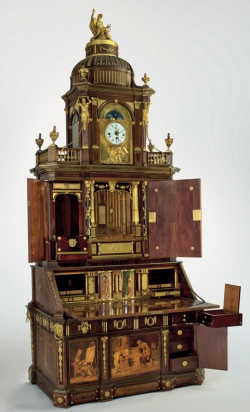
David Roentgen, Berlin Secretary Cabinet, ca. 1778–79. 11 ft. 9 in. (Kunstgewerbemuseum, Staatliche Museen zu Berlin)
Extravagant Inventions: The Princely Furniture of the Roentgens will be the first comprehensive survey of the Roentgen family’s cabinetmaking firm from 1742 to its closing in the early 1800s. Some 60 pieces of furniture, many of which have never before been lent outside Europe, and several clocks will be complemented by paintings, including portraits of the Roentgen family, and prints that depict the masterpieces of furniture in contemporary interiors. The exhibition and catalogue are made possible by the Anna-Maria and Stephen Kellen Foundation.
The meteoric rise of the workshop of Abraham Roentgen (1711-93) and his son David (1743-1807) is the most spectacular chapter in the history of innovative 18th–century Continental furniture-making. Their original designs, combined with their use of intriguing mechanical devices, revolutionized traditional French and English furniture types. From its base in Germany, the workshop served an international clientele. The Roentgens utilized a sophisticated business model, combined with intensive research on potential patrons’ personal taste and forward-looking marketing and production techniques.
In 1742 Abraham Roentgen opened a cabinetmaker’s workshop in the tiny village of Herrnhaag, in the Wetterau region near Frankfurt am Main. With only one journeyman on staff, the shop was concerned principally with the production of furniture for daily use. Abraham distinguished himself by adhering to the highest standards of quality, and soon he was producing veneered show-off pieces in the English Queen Anne style, which he had learned during his years as a journeyman in the Netherlands and England. The local nobility recognized the furnishings’ unusual appearance and quality. Abraham’s progressive designs and types, such as his fashionable tea chest and multi-functional table, were novelties in Germany and were an immediate success. Following his move to Neuwied-at-the-Rhine in 1750, Abraham took his innovative designs even further by adapting elegant French-inspired outlines that, combined with superb marquetry, fine carving, intricate gilded bronze mounts, and multiple mechanical devices, came to be recognized by contemporaries as hallmarks of the Roentgen brand. Roentgen’s playful and perfectly executed inventions became a favored status symbol in princely interiors throughout Europe.
Abraham’s son, David Roentgen, graduated quickly from his apprenticeship in his father’s workshop and eventually took over the enterprise between 1765 and 1768. He perfected the sophisticated structure and intricate marquetry designs of the furniture, and was appointed Ebéniste-Méchanicien du Roi et de la Reine at the court of Queen Marie Antoinette and King Louis XVI at Versailles in 1779. Having conquered the Western market, David revised his designs and reinvented his product line’s appearance as he looked eastward. Focusing on his new target, the Imperial residences of Catherine the Great in St. Petersburg, David Roentgen developed specific models catering to Russian taste. He caught the fancy of the Empress herself with his Apollo Desk (1783-84), which depicted her favorite dog as a gilded mount, and which David produced on pure speculation. After Catherine the Great paid a huge sum for the piece, Russian nobility hurried to catch up with its sovereign, ordering examples of ‘Neuwied Furniture’ by the dozens.
Abraham and David Roentgen’s story is a tale of international success, fame, luxury, and high honor but, in the case of David, it is also the tragedy of a deeply pious man who struggled to balance his ambitions and his glorious achievements with the regulations of his religious community, the Moravian brotherhood. At the pinnacle of David’s career, the workshop employed more than 130 specialists and the annual production amounted to that of the famous Meissen porcelain factory. His fortune shifted dramatically with the progress of the French Revolution, as Europe’s nobility struggled to stay afloat, and the market for luxurious furnishings collapsed.
Many of the works in Extravagant Inventions will be lent from distinguished international museums and royal collections. Six pieces from the Metropolitan Museum’s own collection of Roentgen furniture will be featured, in addition to two that are on long-term loan to the Museum. The exhibition will showcase many outstanding pieces, including a Writing Desk (ca. 1758-62) designed by Abraham Roentgen and considered to be one of the finest creations of his workshop; a spectacular Automaton of Queen Marie Antoinette (1784), a likeness of the queen at a clavichord that still functions and will be played at select times during the exhibition; and six intriguing objects from the Berlin Kunstgewerbe Museum that have never before traveled, most notably a mechanical Secretary Cabinet (1779) made for King Friedrich Wilhelm II of Prussia that is one of the most complex pieces of royal furniture ever produced.
The most complicated mechanical devices in the exhibition will be illustrated through virtual video animations. Additionally, working drawings and portraits of the cabinetmakers, their family, and important patrons—as well as a series of documents owned by the Metropolitan Museum that originated from the Roentgen estate—will underline the long-overlooked significance and legacy of the Roentgens as Europe’s principal cabinetmakers of the ancien régime.
◊ ◊ ◊ ◊ ◊
From Yale UP:
Wolfram Koeppe, ed., Extravagant Inventions: The Princely Furniture of the Roentgens (New Haven: Yale University Press, 2012), 304 pages, ISBN: 9780300185027, $75.
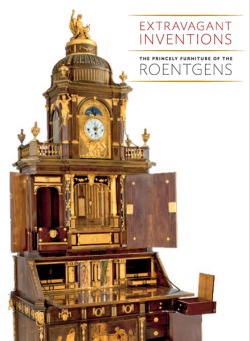 During the second half of the 18th century, the German workshop of Abraham and David Roentgen was among Europe’s most successful cabinetmaking enterprises. The Roentgens’ pieces combined innovative designs with intriguing mechanical devices that revolutionized traditional types of European furniture. An important key to their success was the pairing of the skilled craftsman Abraham with his brashly entrepreneurial son David, whose clients included Louis XVI and Marie Antoinette of France as well as Catherine the Great of Russia. This landmark publication is the first comprehensive survey, in nearly four decades, of the firm from its founding in about 1742 to its closing in the late 1790s.
The Roentgen workshop perfected the practice of adapting prefabricated elements according to the specifications of the customers. Detailed discussions of these extraordinary pieces are complemented by illustrations showing them in their contemporary interiors, design drawings, portraits, and previously unpublished historical documents from the Roentgen estate. This fascinating book provides an essential contribution to the study of European furniture.
Wolfram Koeppe is the Marina Kellen French Curator in the Department of European Sculpture and Decorative Arts at The Metropolitan Museum of Art.
◊ ◊ ◊ ◊ ◊
Lecture | The Legacy of David Roentgen
The Metropolitan Museum of Art, New York, 15 November 2012
David Linley (Chairman, Christie’s, UK), and Charles Cator (Deputy Chairman, Christie’s International)
David Roentgen (1743–1807) was known throughout Europe for his inventive and ingenious mechanical furniture, which found favor in the courts of France and Russia through the patronage of Marie Antoinette and Catherine the Great respectively. He was also famed for pioneering a new method of marquetry, created to give the impression of pietra dura. To mark the occasion of an extensive exhibition of Roentgen’s work, David Linley will share personal insights into Roentgen’s influence on his own furniture designs and his enduring influence on furniture makers today. Charles Cator will examine the collectors’ market for Roentgen from his rediscovery in the nineteenth century to today.
Exhibition | ‘England’s Green and Pleasant Land’ at Fan Museum
From London’s Fan Museum:
England’s Green and Pleasant Land
The Fan Museum, Greenwich, 11 September 2012 — 6 January 2013
 Drawing from The Fan Museum’s unrivalled collection of fans and fan leaves, England’s Green & Pleasant Land strikes a particularly jubilant note as Her Majesty Queen Elizabeth II’s Diamond Jubilee year draws to a close.
Beginning with a rare wood-block printed fan, The Hapy [sic.] Restoration, c. 1661, visitors are taken on an evocative journey through England’s cultural, social and political landscape, covering a period of some 250 years. The exhibition includes a number of fine 18th-century fans, upon which formal city squares, stately houses, and idyllic scenes of rural life are imaginatively depicted. Also on show is a delectable assortment of early printed commemorative fans with themes as diverse as political trials, royal births and even fortune telling!
Stipends | Garden and Landscape Studies at Dumbarton Oaks
Stipends |Garden and Landscape Studies
Dumbarton Oaks, Washington, D.C.
Dumbarton Oaks Research Library and Collection is an institute in Washington, DC, administered by the Trustees for Harvard University. It supports research and learning internationally in Byzantine, Garden and Landscape, and Pre-Columbian studies through fellowships and internships, meetings, and exhibitions.
Changes are in the works for two of our research programs. The category of project grants is being expanded in Garden and Landscape Studies; we will now accept applications for a broad array of projects in heritage conservation, including field research, site analysis, botanical surveys, and restoration planning, with the goal of promoting the preservation and understanding of historic gardens and other significant designed landscapes. Watch for new language on the website soon. As before, applicants must contact the Director of Studies at Landscape@doaks.org no later than October 1, 2012, to determine if the project is within the purview of Dumbarton Oaks.
Applications for one-month research stipends, which used to be accepted on a rolling basis, are now accepted according to the following deadlines prior to the applicant’s preferred period of residency:
– June 1 for residencies commencing September 1 or later
– October 1 for residencies commencing January 1 or later
– March 1 for residencies commencing June 1 or later
Information on continuing opportunities for fellowships, summer fellowships, and pre-doctoral residencies is also available online.
Exhibition Celebrates Ferguson Gang’s Secretive Preservation Efforts
From the UK’s National Trust:
Taming the Tentacles
Shalford Mill, Surrey — 19, 23, 26, 30 September 2012

Shalford Mill, Surrey
Wearing masks and chanting Latin verse, the Ferguson Gang collected money to preserve buildings at risk of demolition. By the time the Gang’s activities wound down in 1946 they had preserved Shalford Mill, in Surrey, Newtown Old Town Hall on the Isle of Wight, Priory Cottages in Oxfordshire and donated some of the most beautiful stretches of the Cornish coastline to the National Trust. The exhibition is built on their essential strategy for life.
◊ ◊ ◊ ◊ ◊
The following account is excerpted from an August 2011 article from Surrey Life magazine:
Shalford Mill has been in the National Trust’s care since the early 1930s when it was bought for the organisation by an intriguing group of preservationists, called the Ferguson Gang. This group of mainly well-educated young women got together in the 1920s to raise money for philanthropic projects, which included saving Shalford Mill from demolition in 1932.
The members of the gang guarded their anonymity fiercely; giving each other various nicknames such as ‘Erb the Smasher’, ‘Bill Stickers’, ‘Red Biddy’ and ‘See Mee Run’. When it came to handing over the funds to the National Trust to purchase Shalford Mill, they did so secretly, wearing cloaks to deliver the money to the National Trust’s headquarters at Queen Anne’s Gate in London, and carrying bulging sacks packed with Victorian coins.
Having safeguarded its future, the gang went on to use Shalford Mill to hold their clandestine meetings. In fact, membership was limited to the number of people that could fit inside the mill. Here, they discussed future fund-raising tactics in private, while sitting around the drum of the millstones and enjoying picnics delivered from Fortnum and Mason.
Having eaten, the eccentric group would have a collection of all the coins they had managed to find. They would then wander round the mill in the small hours, searching for what they called ‘the four colours of the dawn’ (to this day, no one really knows what that meant), wrapped in veils and cloaks. . . .
The full article is available here»
Call for Essays | Spaces of Work and Knowledge
Spaces of Work and Knowledge in The Long Eighteenth Century
Proposals due by 15 September 2012
Abstracts are invited for proposed submissions for publication in a forthcoming collection of essays based on the proceedings of the Spaces of Work 1770-1830 conference held at the University of Warwick April 2012. The publication will follow the broad themes of the conference, but is expanded to include articles focusing on any time within the Long Eighteenth Century, and beyond being focused on Britain to include all geographical locations. Further, the overall headings of ‘space’ and ‘work’ are to be examined in relation to forms of knowledge, broadly conceived.
We are particularly interested in interrogating under-analyzed types of work and space. For example, we hope to develop the theorization of types of work that critics have not conventionally understood as ‘work’ (the performance of music as practical activity, for instance). We also aim to bring attention to under-analysed spaces. For example, due to Romanticism’s traditionally rural focus, literary critics of this period have only recently begun to interrogate urban spaces; interdisciplinary discussion of urbanism in this period would therefore be particularly valuable.
In terms of knowledge, we are particularly interested in forms of knowledge often essentialized and therefore not understood as knowledge as such. The traditionally male knowledge of utilising a commanding voice and demeanour to assert a seemingly innate authority, for example; or the traditionally female knowledge of being able to correctly ascertain the freshness of produce. We aim to elucidate the complex nuances of the interfacing of work, space, and knowledge as three factors that fundamentally shape everyday life in order to gain a greater understanding of material life in the period.
Possible questions which articles might tackle could include:
· How do workers and their work uniquely shape space?
· How does space facilitate or hinder workers and their work?
· How is knowledge acquired, employed, or altered by types of work and working locations?
· How do the social relationships between workers and their supervisors/masters alter according to the work they are doing and the spaces in which they perform it? How does the knowledge encoded in levels of expertise affect the dynamic between supervisors and workers?
· How is knowledge encoded in gender, race, and/or class across working space?
Possible approaches could include, but are not limited to: genteel work and the city; the work of acquiring the necessary knowledge for genteel status; work in spaces of ‘leisure’ and the forms of knowledge encoded therein; work, knowledge, and (sub)urban domestic spaces; gendered working knowledge in the home; space and female accomplishment and the forms of knowledge encoded; working knowledge in relation to emergent manufacturing/industrial spaces.
Pickering & Chatto have expressed an interest in publishing the collection. The exact word length may change, but we expect articles will be approximately 8000 words in length. Abstracts for proposed articles should be 500 words in length, and be submitted no later than 15 September 2012. Please send abstracts to spacesofwork@gmail.com
Conference | Castles and Manor Houses in the Baltic Sea Region
From the Verband Deutscher Kunsthistoriker:
Castles and Manor Houses in the Baltic Sea Region: Components of a European Cultural Heritage
Greifswald, 3-6 October 2012
The post-medieval castles and manors, up to the present, are a central piece of the cultural landscape of the Baltic Sea region. They are spread over altogether 10 countries: Germany, Poland, Russian region Kaliningrad, Lithuania, Latvia, Estonia, Finland, Sweden, Norway and Denmark. The central theme of the symposium (Schlösser und Gutshäuser in der Ostseeregion: Bausteine einer Europäischen Kulturlandschaft) will be the characteristic architecture of castles and manor houses in the Baltic Sea region from the early modern period to the present. Furthermore the symposium will focus on history and cultural history. The functional, sociological and political differences and similarities of the manors of the landed gentry in the different countries will be analysed as well as the cooperation of architects and other artists. It will be examined if there is a transcultural history of art of castles and manor houses in the Baltic Sea region and, finally, how the reception and adoption of castles and manors in the different countries is proceeding.
◊ ◊ ◊ ◊ ◊
W E D N E S D A Y , 3 O C T O B E R 2 0 1 2
16.00 Begrüßung
16.15 Führung durch Herrenhaus und Gutskapelle
17.30 Abendvortrag: Göran Ulväng (Uppsala), Manor House Building and Economic Growth in Sweden in the 18th and 19th Centuries
19.00 Empfang
T H U R S D A Y , 4 O C T O B E R 2 0 1 2
Typologien und Perioden
9.00 Dorota Piramidowicz (Warschau), Seats of a Lithuanian Magnate in the First Half of the 17th Century
9.30 Carsten Porskrog Rasmussen (Aarhus), Epochen der Gutsbauten in Dänemark und ihr gesellschaftlicher Hintergrund
10.00 Diskussion
10.30 Pause
10.45 Ulrich Lange (Göteborg), Aspects on Closed and Open Forms in the Nordic Manors Renaissance and Neo-Renaissance Period
11.15 Diskussion
Das ‘internationale’ 18. Jahrhundert
11.30 Ants Hein (Tallin), From War Destruction to the Golden Era: The Development of the Architecture of Estonian Manor Houses in the Beginning and in the Middle of the 18th Century
12.00 Diskussion
12.15 Mittagspause
14.00 Anna Oleska (Warschau), Maisons de plaisance in 18th-Century Poland: Fashionable Architecture, New Social Mode
14.30 Sigrid Puntigam (Schwerin), Ludwigslust – Schlossbau in der Spätphase des Ancien Régime
15.00 Diskussion
15.30 Pause
Verspätungen – Traditionalismen – Anachronismen
15.45 Vytautas Volungevicius (Vilnius), Das 16. Jahrhundert und die Entstehung der Adelsburg im Großfürstentum Litauen: soziopolitische Umstände und ‚verspätetes‘ Phänomen
16.15 Malgorzata Buchholz-Todoroska (Sopot), The Pomeranian Manors at the Turn of 19th and 20th Centuries: Living a Peaceful Life in the Picturesque Landscape
16.45 Michael Lissok (Greifswald), Letzte Vertreter einer anachronistischen Baugattung: Beispiele für die Landschloss- und Herrenhausarchitektur der 1920er und 1930er Jahre in Brandenburg und Pommern
17.15 Diskussion
F R I D A Y , 5 O C T O B E R 2 0 1 2
Transkulturalitäten im Ostseeraum?
9.00 Carsten Neumann (Schwerin), Das Herrenhaus Bothmer in Klütz – Ein englisch-holländischer Landsitz in Mecklenburg
9.30 Cynthia Osiecki (Apeldoorn), A Cultural History of the Baltic Area: The Sixteenth-Century Migration of Dutch Sculptors into the Baltic Area
10.00 Diskussion
10.30 Pause
10.45 Ojars Sparitis (Riga), Beziehungen zwischen der Familie von Behr und dem Hof von Rudolph II. und deren Auswirkung auf die Kultur Kurlands
11.15 Rafal Makala und Monika Frankowska-Makala (Stettin), Das Residenzschloss der Herzöge von Pommern in Stettin als Kunstwerk und Ort von Kunstsammlungen
11.45 Diskussion
12.15 Mittagspause
Funktionswandel in der Moderne: Umnutzungen und Aneignungen
14.00 Dorota Sikora (Warschau), Historic Residences of the Puck (Putzig) Region and the Wejherowo (Neustadt) Region: Their Present Condition, Function and Surroundings
14.30 Herle Forbrich (Hamburg), Herrenhäuser ohne Herren. Ostelbische Geschichtsorte im 20. Jahrhundert
15.00 Diskussion
15.30 Pause
Erberezeption – Erbediskussion
15.45 Michael Paarmann (Kiel), Historische Gutsanlagen in Schleswig-Holstein – Ein ausgeschlagenes Erbe oder Chance für die Zukunft?
16.15 Salvijus Kuleviiius (Vilnius), Cultural Memory and Reconstruction of Castles in Lithuanian in the Second Half of the 20th and 21st Centuries
16.45 Diskussion
18.00 Führung durch Herrenhaus (in zwei Gruppen)
19.00 Abendvortrag: Sabine Bock (Schwerin), Haben Häuser einen Stammbaum? Wie sich der Bautyp ‚Herrenhaus’ entwickelt hat Kleiner Empfang
S A T U R D A Y , 6 O C T O B E R 2 0 1 2
9.30 Malgorzata Rozbicka (Warschau), Manor Houses of the Lower Landed Gentry in Village Inventory Albums from the Collection of the Department of Polish Architecture, Warsaw University of Technology
10.00 Kilian Heck (Greifswald), Von der Ordensburg zum Barockschloss. Steinort/Sztynort in Masuren
10.30 Oliver B. Hauck und Piotr Kuroczynski (Frankfurt am Main), Virtuelle Rekonstruktion des kulturellen Erbes – Ein räumliches Informationssystem
11.00 Abschlussdiskussion
12.30 Exkursion auf die Insel Rügen — Geplant sind Besichtigungen unter anderem folgender Häuser: Boldevitz, Kartzitz, Spyker, Venz










 Enfilade
3 comments