Call for Papers | Eastern Resonances 2: India and the Far East
From the conference website:
Eastern Resonances 2: India and the Far East, 16th-18th Centuries
University of Paris Diderot (Paris 7), 5-7 December 2013
Proposals due by 31 October 2012
Contrary to the echo or the trace, which both imply an enduring, but fading prolongation of a presence, resonance suggests not only a continuation, but a reinforcement of a sound or image, provoked by a reflection on another surface. Taking from Stephen Greenblatt’s definition of resonance as the power of the object displayed to reach out beyond its formal boundaries to a larger world, to evoke in the viewer the complex, dynamic cultural forces from which it has emerged (“Resonance and Wonder,” in Learning to Curse, p. 170), this conference aims at studying the moves, shifts, transformations and translations through which the idea of the East resonated in Europe in general, and Britain in particular, from the early modern period to the romantic age.
Calling into question the adversarial nature of Orientalism as defined by Edward Said, our conference will address the deterritorializations and reterritorializations (to borrow the concepts developed by Deleuze and Guattari in Anti-Oedipus) through which the East reshaped itself in the West through its many reflections and reverberations. Our focus will not just be on what was lost and what was gained along the routes of such recuperations, but we also wish to chart in greater detail the routes themselves, the people who crossed them and the motivations underpinning these attempts at reaching, understanding and picturing the East.
The first of our series of two conferences on Eastern Resonances, to be held at the University of Montpellier 3 (30 May-1 June 2013), will focus on the Ottoman Empire and Persia. We are now welcoming proposals for the second conference, on India and the Far East, to be held at the University of Paris Diderot, Paris 7 (5-7 December 2013). Suggested areas of reflection for this conference could include:
1) Texts and their circulation/translation: What were the Sanskrit, Chinese and other texts that resonated in the West in this period? Through what channels did manuscripts and books travel? Why and how did they reach Britain in adapted or translated forms?
2) Places and their memories: What did travellers look back to in historical and cultural terms as they embarked on their journeys to the East? What images did they bring back with them from their eastern encounters? How did these reverberate as literary and artistic artefacts at the receiving end of the journey?
3) Actors and intermediaries: Who went East or West, and why did they? Who were their interlocutors or mediators there? Why and how were contact zones created? On what terms was trust granted and collaborative research carried on?
For Eastern Resonances 2: India and the Far East, short proposals in English (250 words) and a brief biographical statement are to be sent by October 31, 2012 to the conference organisers:
-Dr Claire Gallien, University of Montpellier 3 claire.gallien@univ-montp3.fr
-Pr Jean-Marie Fournier, University of Paris 7 jean-marie.fournier@univ-paris-diderot.fr
-Pr Ladan Niayesh, University of Paris 7 niayesh@univ-paris-diderot.fr
Papers should be 30 minutes in length and may be presented either in French or in English. We intend to publish a selected number of papers from the two conferences in a volume of essays on the topic of Eastern Resonances.
Universite Paul Valery – Montpellier III
IRCL (UMR5186)
Site Saint-Charles
Rue Henri Serre
34000 Montpellier
Email: claire.gallien@univ-montp3.fr
Visit the website at http://easternresonances.jimdo.com/
At Auction | American Furniture at Christie’s, 24 September 2012
Press release from Christie’s:
Important American Furniture, Folk Art, and Decorative Arts (Sale #2584)
Christie’s, New York, 24 September 2012
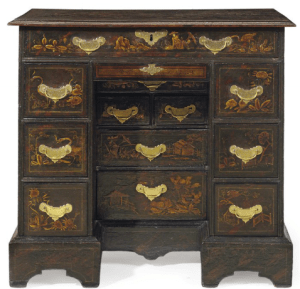
Queen Anne Japanned Maple Bureau Table, ornament attributed to Robert Davis (d. 1739), ca. 1735.
On September 24, Christie’s presents the sale of Important American Furniture, Folk Art & Decorative Arts (Sale #2584). This sale features over 100 diverse examples of American art and craftsmanship from the 18th and 19th centuries. Highlights include furniture from the Wunsch Americana Foundation, the Philadelphia Museum of Art, as well as a selection of American folk art and maritime paintings.
Leading the sale is a Chippendale Carved Mahogany Easy Chair, Philadelphia, 1760-65 (estimate: $600,000-900,000). One of the most successful creations of the renowned ‘Garvan’ carver, this easy chair is a triumph of Philadelphia design and artistry. Unidentified and known solely through his body of work spanning from the early 1750s to the mid-1760s, this craftsman was the city’s most accomplished and influential carver of his day and this easy chair, made during the his mature style, reflects the culmination of this remarkable carver’s talents. Similarly, the chair’s frame, expertly crafted with a number of distinctive features, can be linked to a larger body of work and placed within the oeuvre of a known, but also unidentified, cabinetmaking shop. Long hailed as a Philadelphia masterpiece, the Philadelphia Museum of Art purchased the chair in 1925, and is now deaccessioning it to provide funds for acquisitions.
Resplendent and extraordinarily rare, another sale highlight is a Queen Anne Japanned Maple Bureau Table, Boston, circa 1735, which is one of about forty known examples of japanned furniture from colonial America, most of which are in public collections today (estimate: $60,000-90,000). The only bureau table known to exist, this piece stands as a survival of the form with distinctive chinoiserie ornament. The japanned ornament is attributed to Robert Davis, a prominent craftsman in colonial Boston. The table’s decoration remains largely intact and reveals the full beauty of the sparking gem-like appearance intended by its eighteenth-century creator.
The sale also features a selection of property from the Wunsch Americana Foundation, including a Pair of Federal Eagle-Inlaid Mahogany Side Chairs, Attributed to William Singleton (w. 1789-1803, d. 1803), Baltimore, 1790-1800 (estimate: $60,000-90,000). This pair of chairs was lent to the Diplomatic Reception Rooms at the Department of State in 1968 and remained in the Monroe Reception Room as part of a larger set of four related chairs until they were returned to the Wunsch Americana Foundation. Until now, the location of this pair has been unknown. . .
Call for Papers | Art History and Sound
From The Courtauld:
Art History and Sound – Workshop Series: ‘The Listening Art Historian’
The Courtauld Institute of Art, London, 6 December 2012, 14 March and 30 May 2013
Proposals due by 28 September 2012
Organised by Irene Noy and Michaela Zöschg with Katie Scott
Art historians constantly encounter traces of sound. These can take the form of notes in an illuminated manuscript, a textual echo of past noise and lost voices, or depictions of instruments, singers and dancers, captured on panel, canvas, paper, film or in wood, marble and bronze or spaces that have been specifically designed and built to embrace and amplify sound: pulpits, choir stalls, opera houses, the floor of the stock exchange. The aural is continuously intertwined with visual arts as content or context. In the 20th and 21st centuries especially artists have variously incorporated sounds, live and recorded, in their performances, happenings and multi-media installations putting into question the silence and fixity of visual art.
As a result of the collapse in the Enlightenment of the Renaissance notion of the unity of the arts and the substitution of a modern division of temporal from spatial art forms, art historians have generally limited their research and interpretation exclusively to the visual aspects of art and have disregarded the existence, never mind the significance, of the aural. Despite the recent broadening of art history’s disciplinary boundaries to include ‘non-traditional’ media as well as related fields, art historians are primarily trained to analyse and explain the non-ephemeral dimensions of art. When the visual approaches the transient qualities of the aural it raises problems of methodology and terminology.
This workshop series aims to explore both historical and contemporary instances of sound in art history, as well as some of the theoretical and methodological questions arising from this preoccupation. It is designed to provide an open platform for all art historians concerned with collecting, analysing, interpreting and describing sound(s) to meet and discuss ways of hearing visual art. Topics for discussion may include, but are not limited to:
• In what kind of media do art historians encounter notions of sound such as music, voice or noise and with what methods do they explore these traces of the aural?
• How do art historians, with their specific background in the analysis of visual arts, collect, listen to, ‘process’ and write about sound?
• In regards to aurality, can research fields such as soundscape, Klangkunst, acousmatic voice, developed by neighbouring disciplines, be fruitfully used in and adapted for art history?
• How does our preoccupation with the aural inform or perhaps change our understanding of the visual, and vice versa?
This workshop series will be hosted at the The Courtauld Institute of Art on three different occasions throughout the academic year 2012/13. Each workshop will consist of four papers that will function as catalysts for a subsequent round table discussion, and each workshop will address the dynamics existing between aurality and art historical material, tools and methods from a different angle, generated around the proposals we receive. We welcome proposals of 20 minutes long papers in all periods, media and regions that deal either with case studies or broader methodological questions. Please send your abstracts of 250–300 words and a short biography to irene.noy@courtauld.ac.uk and michaela.zoschg@courtauld.ac.uk by 28 September 2012. For organisational purposes, we also kindly ask you to indicate on which of the dates (indicated above) you would like to present and whether you will be able to attend all three workshops. We cannot offer travel subsidies for speakers, and therefore students from outside London are encouraged to apply to their institutions for funding to attend the workshops.
Lecture | Dining in 18th-Century France
This fall at The Getty:
Charissa Bremer-David — Of Cauliflower and Crayfish:
The High Art of Dining in 18th-Century France
Getty Center, Los Angeles, 25 October 2012

Lidded Tureen (detail), Thomas Germain, 1744–50 (Los Angeles: The J. Paul Getty Museum)
In mid-18th-century France, decorative sculptural elements on many luxurious serving vessels and tablewares actually portrayed, quite naturalistically, ingredients of the food contained within. Identifiable representations of vegetables, fish, and game can be compared to the recipes from period cookbooks.
Charissa Bremer-David, curator of Sculpture and Decorative Arts at the Getty Museum, discusses the naturalism of these miniature sculptures and how they reflected the broader interests of the Enlightenment as well as the latest culinary developments. Discover how these visualizations were meant to awaken and enhance the palate. This talk, part of the Tracey Albainy Lecture Series, commemorates the life and career of Tracey Albainy, a specialist of European silver and ceramics.
◊ ◊ ◊ ◊ ◊
Tracey Albainy, a senior curator at Boston’s Museum of Fine Arts, died in 2007 at the age of 45. More information is available here»
William Morris Gallery Reopens after Renovation
Yes, I realize William Morris stretches the long eighteenth century to the breaking point. I note the reopening of the museum because of the building itself, which dates to around 1744. The official ceremony marking the completion of the renovation took place on 2 August 2012. The following is an excerpt from Alastair’s Sooke’s response for The Telegraph. -CH
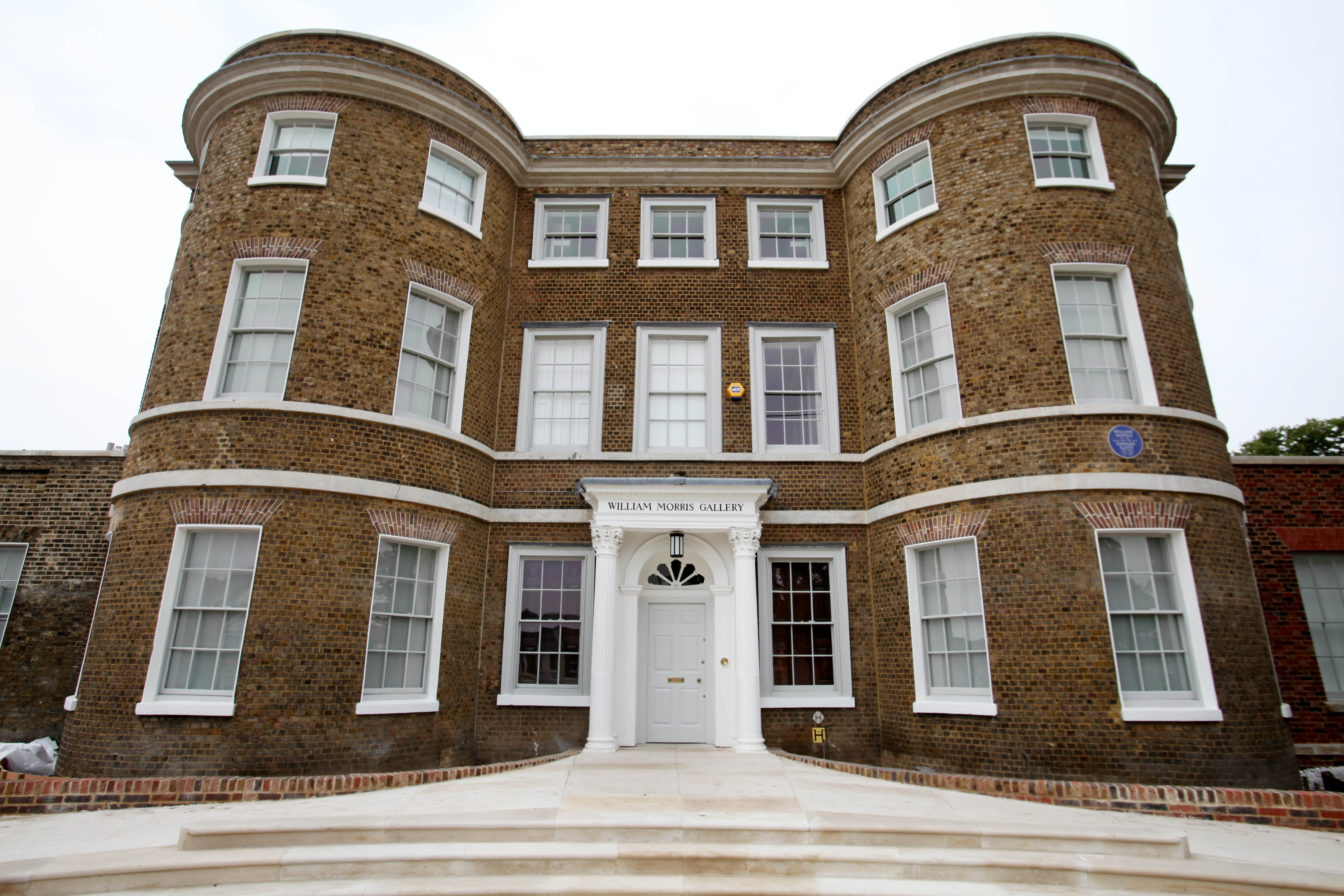
William Morris Gallery, Walthamstow, London © Oliver Dixon / Imagewise — The building dates to ca. 1744
. . . Making sense of the personality, achievements and legacy of such a visionary polymath is a complicated task. Yet that is what the new-look William Morris Gallery, which reopens this week following a year-long £5 million refurbishment, manages to do. The gallery occupies a magnificent Grade II-listed Georgian villa, with a front boasting full-height semicircular bays and a white-painted timber porch with Corinthian columns. Situated in Lloyd Park in Walthamstow in northeast London, like a beacon of beauty amid the local asphalt-benighted urban sprawl, the three-storey building was home to the Morris family between 1848 and 1856, when William was at Marlborough College and then Oxford University, where he met his lifelong friend and collaborator, the painter Edward Burne-Jones, as well as Jane Burden, whom he married in 1859. . .
The full review is available here»
Small Exhibition | Gems of European Lace, ca. 1600–1920
Press release (20 July 2012) for this exhibition now on at The Met:
Gems of European Lace, ca. 1600–1920
The Metropolitan Museum of Art, New York, 24 July 2012 — 13 January 2013
Oorganized by Devon Thein and Gunnel Teitel
Cravat End or Rabat (det.), mid-18th century, Flemish, Linen, bobbin lace (point d’Angleterre). The quality of workmanship in this cravat end is consistent with its presumed exalted provenance. It is said to have been made for the Austrian empress Maria Theresa; given to her daughter the French queen Marie Antoinette; and then passed to the marquis de Chabert, a French admiral and astronomer, after which it descended in his family. The possibility of this association is supported by the crown at center resembling the Austrian archducal crown, though no further proof of the connection has been discovered. . . click on the image for more
A selection of 13 exceptional examples of handmade lace from the collection of The Metropolitan Museum of Art—one of the finest such collections in the United States—will be featured in the exhibition Gems of European Lace, ca. 1600–1920, opening July 24 in the Museum’s Antonio Ratti Textile Center. These delicate luxury textiles, created between 100 and 400 years ago, represent techniques and styles associated with some of the preeminent lacemaking centers of Europe.
Included in the installation are examples of the two major lacemaking techniques: needle lace (built up from a single thread that is worked in a variety of looping, or buttonhole, stitches) and bobbin lace (woven—or braided—together from multiple threads organized on individual bobbins). Beyond the two basic technical categories, lace is also often described with the name of the town or region where a particular style was first made.
The exhibition will include outstanding examples of Venetian (needle) lace, Brussels (bobbin) lace, and Devon (bobbin) lace. Of particular interest is a 19th-century handkerchief associated with King Leopold II and Queen Marie-Henriette of Belgium. The queen was a patron of the local lace industry. The best-quality lace was extremely expensive, due to the time-consuming and painstaking process of transforming fine linen thread into such intricate openwork structures. Rather surprisingly, the 17th-century English clergyman Thomas Fuller defended the wearing of lace and the nascent English lacemaking industry, writing that it cost “nothing save a little thread descanted on by art and industry,” and “saveth some thousands of pounds yearly, formerly sent over to fetch lace from Flanders.”
In the late 19th century, American women began to recycle antique lace for use in fashion. The American socialite and style setter Rita de Acosta Lydig, for example, often wore garments with insertions of antique lace. On view will be one of her dresses from 1920, completely made of lace in a horse-and-rider motif. As a result, many women began to collect and study lace, taking an interest not only in its artistry and complexity of construction but also in the historical and cultural contexts in which it was made and used. In large part, the collection of the Metropolitan Museum reflects the interest of these women who became serious collectors and who graciously donated their collections to the Museum.
The installation was organized by Devon Thein and Gunnel Teitel, volunteers in the Department of European Sculpture and Decorative Arts, under the supervision of Melinda Watt, Associate Curator, European Sculpture and Decorative Arts, and Supervising Curator, Antonio Ratti Textile Center. Established in 1995, the Antonio Ratti Textile Center at the Metropolitan Museum is one of the largest, most technically advanced, and well-equipped centers for the study, storage, and conservation of textiles in any art museum. Objects from the Metropolitan Museum’s collection of textiles are featured, on a rotating basis, in a small gallery at the entrance of the center.
Call for Papers | ASECS Proposals Due Next Week
2013 American Society for Eighteenth-Century Studies Conference
Cleveland, 4-7 April 2013
Proposals due by 15 September 2012 — Next Saturday!
The 2013 ASECS conference takes place in Cleveland, at the Renaissance Cleveland Hotel, 4-7 April. Along with our annual luncheon and business meeting, HECAA will be represented by two panels chaired by Christopher Johns and Heather McPherson. In addition to these, a wide selection of sessions that might be relevant for HECAA members are also included below. A full list of panels is available here.
◊ ◊ ◊ ◊ ◊
Anne Schroder New Scholar’s Session (Historians of Eighteenth-Century Art and Architecture)
Christopher M.S. Johns, 1112 Wildwind Ct., Nashville, TN 37209; Tel: (615) 516 9337; Christopher.Johns@vanderbilt.edu
Named in honor of the late Anne Schroder, this seminar will feature outstanding new research by emerging scholars.
◊ ◊ ◊ ◊ ◊
Interiors as Space and Image (Historians of Eighteenth-Century Art and Architecture)
Heather McPherson, Dept. of Art and Art History, 113 HUM , 900 13th St. South, U. of Alabama at Birmingham, Birmingham, AL 35294; Tel: (205) 934-4942, Fax: (205)-996-6986; hmcphers@uab.edu
In recent years scholars have reconsidered the significance of the eighteenth-century interior as a complex site of social interaction and nexus of display associated with daily life, exhibition practices, and conspicuous consumption. This session invites papers on eighteenth-century interiors as actual spaces experienced in multiple ways (socially, aesthetically, temporally, etc.) OR as represented in paintings, prints, or other art forms. Topics might include functions of different types of interior spaces, furnishings, decorative arts, display of artworks or other objects, etc. in any geographical area during the long eighteenth century.
◊ ◊ ◊ ◊ ◊
There are numerous other panels that should prove interesting for art and architectural historians. A full list of panels is available at the ASECS website, but a couple of dozen are included here»
September 2012 Issue of ‘The Art Bulletin’
In the current issue of The Art Bulletin, the “Notes from the Field” feature addresses the theme of contingency. Making a strong case for the proposition that it is possible to say something worthwhile in less than two pages, many of the essays are insightful and stimulating. The following two particularly address the eighteenth century. -CH
Gloria Kury, “On Contingency,” The Art Bulletin 94 (September 2012): 352-54.
Invoking Charles Le Brun, Emma and William Hamilton (“the first spell-binding teacher of art history was . . . a husband-wife duo”), and Dr. James Graham (famous for his sexual prescriptions involving the Celestial Bed at his Temple of Health and Hymen), Kury urges “scholars to start giving due heed to the significance of the spellbinding lecturer and / or master of the slide show, from the Hamiltons through Leo Steinberg and T. J. Clark, in the establishment and vitality of their discipline” . . . (354).
Mark Ledbury, “On Contingency,” The Art Bulletin 94 (September 2012): 354-55.
Addressing the “brilliant, but infuriating essay,” Charles Baudelaire’s “The Painter of Modern Life,” Ledbury draws readers’ attention to the critic’s coupling of “the contingent” with “the other half of art . . . the eternal and the immovable,” arguing that, in fact, modernity “has no monopoly over the contingent: wherever specialists look, the eternal and the immutable are thin on the ground” (354). Turning his attention then to eighteenth-century France (with reference to Richard Rorty’s Contingency, Irony, and Solidarity), Ledbury contends “that compelling history is always aware of the gravitational forces of contingency tugging it from its lofty heights. . . . Certainly, in my own scholarship, to even begin to chart the fortunes of the Neoclassical generation is to appreciate both the force and unpredictability of contingency in the making of lives, works, and careers” . . . (355).
Bard Graduate Center’s 2012-2013 Seminar Series
The following list offers a sample of events at the Bard Graduate Center during the 2012-13 academic year that might be of interest to Enfilade readers. A flyer listing all events is available as a PDF file here.
◊ ◊ ◊ ◊ ◊
Bard Graduate Center’s Seminar Series
Bard Graduate Center, New York City, 2012-2013
 All events take place in the Lecture Hall at 38 West 86th Street, between Columbus Avenue and Central Park West, in New York City. Seminars begin at 6pm. RSVP is required. For general information or to reserve your place, please visit the BGC website.
September 27-29
Symposium — Beyond Representation: an Interdisciplinary Approach to the Nature of Things
October 15
Symposium — Circus and the City: New York, 1793–2010
November 14
Steven Pincus (History, Yale University) — Spanish American Trade, Patriot Politics and the Shaping of the British Empire
November 27
Laura Auricchio (Art History/Humanities, The New School) — Hero and Villain: Lafayette’s Legacies
February 12
Tobias Locker (Art History, Saint Louis University-Madrid) — Paris / Potsdam / Paris: Gilt Bronzes ‘à la française’ in Prussia and the Circulation of Knowledge
February 13
Christopher Brown (Director, Ashmolean Museum of Art and Archaeology, University of Oxford) — The New Ashmolean
February 20
Béla Kapossy (History, University of Lausanne, Switzerland) — Rousseau’s, and Other Relics: Material Memories in Later Eighteenth-Century Switzerland
Display | Jean-Henri Riesener (1734–1806)
Based on press releases from VisitParis and Art Media Agency:
Jean-Henri Riesener (1734–1806)
Biennale des Antiquaires, Grand Palais, Paris, 14-23 September 2012
Organized by Kraemer & Cie
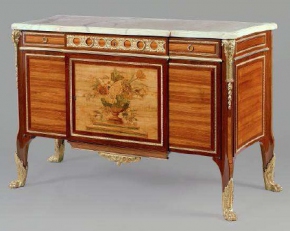 The Maison Kraemer, a Parisian gallery specialising in pieces from the 17th and 18th centuries, is organising the first ever exhibition to be entirely dedicated to the cabinet-maker Jean-Henri Riesener (1734-1806). It will run from the 14 to the 23 of September at stall 32 during the 26th Biennale des Antiquares. The solo exhibition is then to go on tour.
Introduced to the art of cabinetmaking by Jean-Francois Oeben, Riesener became a master in 1768, and was designated ‘carpenter to the King’ in 1774. He also supplied Queen Marie-Antoinette with furniture, creating for the Court and the Royal Family a collection of stunningly beautiful pieces of furniture, characterized the remarkable finesse in his use of gilt bronzes and precious inlay decorations. Riesener is one of the most commonly displayed cabinet-makers in museums throughout the world. Examples include the Louvre museum, the Château de Versailles, the Nassim de Camondo museum, the New York Metropolitan Museum and the Getty Museum in Los Angeles. At auction, his pieces regularly sell for remarkable prices:
• In 1999 a chest of drawers was sold by Christie’s for £7,041,500 or €8.5 million (with fees)
• In 2007 a chest of drawers was sold by Sotheby’s for €3,952,250 (with fees)
• In 2000, a desk was sold by Christie’s for £1,214,750 or €1.5 million (with fees)
• Recently, a chest of draws put up for sale by the auction house Sotheby’s in October 2011, estimated to be worth between €20-30 million, was sold for only €24,750.
Also see the article by Susan Moore for Apollo Magazine (September 2012) and the coverage (in French) at Artistik Rezo.










 Enfilade
leave a comment