Exhibition | Bronze at The Royal Academy
Reviewed for Enfilade by Craig Ashley Hanson
Bronze
Royal Academy of Arts, London, 15 September — 9 December 2012
Curated by David Ekserdjian and Cecilia Treves
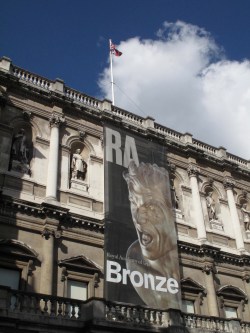 Critics have been raving about Bronze since it opened last month at the Royal Academy of Arts in London. Notwithstanding the exhibition’s sweeping coverage–in terms of geography and history–I didn’t initially include it here at Enfilade as I had trouble finding eighteenth-century points of relevance. Indeed, out of dozens of objects shown across ten rooms, only a handful of works were produced during the period. And yet, now that I’ve seen the exhibition, I’m convinced dix-huitièmistes should pay attention.
Organized by theme rather than time and place, the range of works is staggering. If, in keeping with traditional historiographical models, the show begins with an achingly beautiful example from ancient Greece–a recently recovered Dancing Satyr–it quickly brings an international array of work into open and productive dialogue. On display are works from Ghana and Nigeria, Eturia and Rome, China and Japan, Northern Europe and the United States. Categories one might expect to see are well represented: ritual dining vessels from Shang dynasty tombs, classicizing work from Renaissance Florence, Buddhist work from India (including an extraordinary sixth-century Buddha Shakyamuni from Bihar). Rodin’s Age of Bronze is, of course, included. But there are surprises, too: ancient court objects from Israel (a crown, scepter, and vulture standard), sixteenth-century French spurs, a basketball by Jeff Koons. Works by Giambologna appear next to an oversized spider by Louise Bourgeois (climbing the wall, no less).

François Girardon, Laocoön and His Sons, ca. 1690 Houghton Hall, Norfolk/Photo © Royal Academy of Arts, London, Roy Fox (click for more info)
While it all could have gone horribly wrong, the experience of viewing the exhibition appears to be, for most viewers, one of coherence rather than confusion, coherence derived from the thoughtful attention to the possibilities of bronze as a material. The medium is the subject in an entirely convincing, indeed revelatory manner. The varieties of objects, selected from a global vision of art history, work thanks to careful attention to exploration of seven thematic categories: figures, animals, groups, objects, reliefs, gods, and heads. Scale and texture, color and composition, the tensile strength and resulting artistic flexibility of bronze all become matters of first, rather than passing, interest.
And for the eighteenth-century? The final room of heads includes original choices: Massimiliano Soldani-Benzi’s Damned Soul of 1705 after Bernini and Anne Damer’s Mary Berry from 1793, while François Girardon’s Laocoön from Houghton Hall, ca. 1690, exerts a commanding presence in the gallery dedicated to groups. Particularly compelling for me, in that same room, is the sensitive installation of Francesco Bertos’s 1730s allegorical group of Sculpture, Arithmetic, and Architecture from the Prado. Placed alongside Giambologna’s 1576 Nessus and Deianira (a centaur abduction scene) and Alessandro Algardi’s 1647 St. Michael Overcoming the Devil, Bertos’s work appears as an entirely legible development from Renaissance humanism, to forceful Baroque religious expression, to refined Enlightened optimism. Adrian de Vries’s Hercules, Nessus and Deianira of 1622 dominates the center of the gallery, making the relationships–the similarities and differences within this 150-year period–all the more striking.
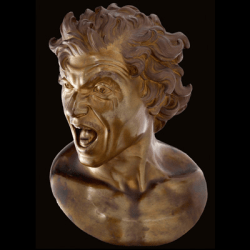
Massimiliano Soldani-Benzi, after Bernini, Damned Soul (‘Anima Dannata’), 1705-07. Bronze with golden-red lacquer patina, 39.5 cm. Liechtenstein Museum, Vienna. Photo © Liechtenstein. The Princely Collections, Vaduz-Vienna
And so historical arguments do exist within the exhibition, even if there’s no obvious central argument based on tracking change over time (it is I think one reason material from all over the world can be placed side by side so effectively). One may wish there were more eighteenth-century offerings–I’ll leave those criticisms to the sound judgment of my colleagues. But, for me, it is an exhibition that likely would make a lot more sense to eighteenth-century connoisseurs than the much more tightly focused, monographic approaches dominating exhibitions in the present age. No only is it a show I think many eighteenth-century viewers would understand (with admittedly a bit of instruction), it’s a show I think they would like.
Alongside it, the catalogue offers innovative models for thinking about different ways exhibitions generally might succeed. The book pairs beautifully with the catalogue for the 2009 exhibition Cast in Bronze: French Sculpture from Renaissance to Revolution, available–for anyone regretting that there aren’t more eighteenth-century works on
display–in the Royal Academy gift shop on the way out.
◊ ◊ ◊ ◊ ◊
Catalogue: Bronze (London: Royal Academy Publications, 2012), 248 pages, ISBN: 9781907533280, $65.
 Bronze, long celebrated for its durability and the wide range of effects that it offers, has been prized as an artistic material in many parts of the world throughout the ages. Magnificent bronze sculptures from the ancient times have emerged unscathed after millennia on the sea bed. It is a material that has been used on all scales, from the minute to the monumental. This sumptuous catalogue examines bronze’s earliest beginnings in North Africa, the Middle East and China as it transcended tools and weaponry to become a medium of fine art. Expert authors chart the virtuousity of artists in ancient Greece and Rome; developments in Asia and Africa; bronze’s great flowering in the European Renaissance and its use in the modern era by artists such as Rodin, Picasso, Brancusi and Bourgeois.
A unique testament to the works of art that one medium has inspired, Bronze contains lavish colour plates of over 150 masterworks arranged chronologically to take the reader on a voyage through time, tracing the work of sculptors, casters and chasers through the centuries.










 Enfilade
leave a comment