Fellowships | Amsterdam’s National Maritime Museum
As noted by Hélène Bremer, the Scheepvaartmuseum in Amsterdam welcomes an international pool of scholars to apply for its fellowships:
Amsterdam’s National Maritime Museum Fellowships
Het Scheepvaartmuseum (the National Maritime Museum) and the Society Dutch Historical Maritime Museum promote scientific research on the museum’s collection. A special foundation has been set up and every year three fellowships are granted to students and academics from the Netherlands and abroad: the Dr. Ernst Crone fellowship, the Mr. Peter Rogaar fellowship and the Prof. J.C.M. Warnsinck fellowship.
Het Scheepvaartmuseum develops its collection around five main themes and has defined five research areas connected to the five main themes: Sailing folk, Water recreation, Art and the maritime world, The Dutch and the other and Innovation in shipbuilding. We kindly ask candidates who wish to apply for a fellowship to submit a proposal within these frameworks.
Study Day in Sydney To Celebrate Major Ceramics Gift
To celebrate a major gift of maiolica and porcelain, the Art Gallery of New South Wales in Sydney is presenting a study day toward the end of this month. From the museums’ website:
◊ ◊ ◊ ◊ ◊
Renaissance and Rococo Ceramics Study Day: The Arts of Maiolica and Porcelain
Art Gallery of New South Wales, Sydney, 28 October 2012
Discover two of the most significant material innovations in the history of European decorative arts with this study day focused on the extraordinary Kenneth Reed Collection, in the European galleries. Comprising 16th- and 17th-century maiolica (tin-glazed earthenware) and 18th-century porcelain, the Reed Collection offers insight into Renaissance and rococo art and material culture.
Curator Richard Beresford and art historian Mark de Vitis outline the history of the two ceramic traditions, illustrated with examples from the Reed Collection, followed by a demonstration of materials and processes by noted Sydney ceramicist Bronwyn Kemp.
◊ ◊ ◊ ◊ ◊
From the press release (16 October 2012) . . .

Meissen (Germany), Parrots, 1745, hard-paste porcelain, 39 x 27 x 18 cm (on loan from Kenneth Reed) The group was originally modeled by Joseph Joachim Kändler in April 1745 for Augustus III’s consort Maria Josepha of Austria.
Kenneth Reed today announced his intention to bequeath to the Art Gallery of New South Wales his entire private collection of 200 pieces of rare and valuable 18th-century European porcelain valued at $5.4 million. Mr Reed also helped the Gallery acquire an important Italian renaissance maiolica masterpiece, Francesco Xanto Avelli’s Sack of Rome plate of 1530 with his generous donation of $550,000.
‘This most generous gift to the Gallery represents a significant addition to the Gallery’s European collection. Ken has been one of our most generous benefactors in the history of this Gallery’, said Michael Brand, director, Art Gallery of New South Wales.
Mr Reed, a Sydney-based retired lawyer, has been a collector of European paintings and decorative arts for more than 25 years. He says that he was inspired by visits as a child to the Art Gallery of New South Wales where his father used to take the family on Sunday afternoons.
The Gallery is to receive a spectacular group of parrots originally modelled at Meissen by Joseph Joachim Kändler for Augustus III’s consort, Maria Josepha of Austria, superlative examples of Vincennes and Sèvres porcelain, including a rare rose marbré tea service, a unique piece of experimental hard paste from the early 1760s, plus
exquisite Chelsea figures and wares from all periods of the factory’s
production.
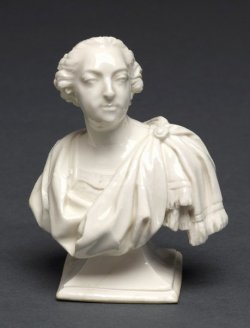
Sèvres, Bust of Louis XV, ca. 1762-63, hard-paste porcelain, 11 x 9 x 6 cm
(on loan from Kenneth Reed)
In the words of Richard Beresford, senior curator of European art, “This promised gift transforms the Gallery’s presentation of European art. We have never owned anything comparable in range and quality to this collection but now the Gallery will be able to show some of the highest quality 18th-century porcelain in the world. The Gallery has had neglected holdings of European decorative arts until now. The decision to show 16th-18th-century ceramics alongside paintings of the same period will add a new dimension to the Gallery’s collection display. The Gallery is now also better placed to respond to an expected rise in public interest in ceramic history.”
In 2010 Kenneth Reed announced a bequest to the Gallery which then consisted of 25 old master paintings, 25 pieces of 18th-century porcelain and 22 pieces of Italian maiolica from the 16th and 17th centuries. The addition to his bequest of this European porcelain brings the total value of the bequest to almost $13 million, ranking Mr Reed among the top benefactors in the Gallery’s history.
Lecture | Jeffrey Collins at University of Bern’s ‘Interior’ Series
Jeffrey Collins offers the second in a three-part lectures series at the University of Bern’s 2012-13 lecture series:
Lecture Series: The Interior
University of Bern/Switzerland, 2012-13
This lecture series is part of the SNSF Sinergia project The Interior: Art, Space, and Performance (Early Modern to Postmodern) which is based at the Institute of Art History, University of Bern, and is conducted in cooperation with the Institute of Media Culture and Theatre, University of Cologne. Proceeding from a heterogeneous and dynamic conception of the interior drawn from various media, styles, and contexts, this interdisciplinary project investigates diverse theoretical and interpretative models of interiors in art, theatre, and visual culture from the Early Modern to the Contemporary eras.
12 December 2012
‘Interior Designs: Imagining the Museum in Eighteenth-Century Italy’
Jeffrey L. Collins, (Bard Graduate Center: Decorative Arts, Design History, Material Culture, New York)
More information is available at the project website»
New Title | The Origins of the Royal Academy
From The Royal Academy:
Charles Saumarez Smith, The Company of Artists: The Origins of the Royal Academy of Arts in London (London: Bloomsbury, 2012), 192 pages, ISBN: 9781408182109, $32.
 On Friday 9th September 1768 an almighty row broke out within the Society of Artists. At its heart was a disagreement over the practice of art in Britain, and no amount of good humour on the part of the Society’s ‘jolly president’ could ‘persuade the disputants to lay aside their mutual Bickerings, and drown their Heartburnings in bumpers of wine’.
From this eruption emerged the Royal Academy of Arts.
An elegant and often amusing day-to-day account of these events and the two years that followed, The Company of Artists reveals the opposing models of a continental and a British art academy that divided leading artists of the day. As he explores their attempts to outmanoeuvre their fellows and win the support of King George III, Charles Saumarez Smith brings to life the characters involved and shows how they shaped the new Royal Academy of Arts, thereby changing the practice and perception of art in Britain for good.
Former director of the National Portrait Gallery and the National Gallery, Charles Saumarez Smith is Secretary and Chief Executive of the Royal Academy of Arts. His previous publications include The National Gallery: A Short History (2009), The National Portrait Gallery (1997) and The Building of Castle Howard (1990).
◊ ◊ ◊ ◊ ◊
In Charles Saumarez Smith’s blow-by-blow account of the early days, I recognise the Royal Academy as it still is today. The big ego’s. How to teach art. The status of drawing. Whether or not art stems from genius, ambition or sheer hard work. Everything that is still important and good about the Royal Academy was discussed and debated in those first few weeks.
Christopher Le Brun, President, Royal Academy of Arts
An enthralling behind the scenes look at the egos, the politics and the good and bad intentions that led to the founding of one of our most enduring cultural establishments.
Loyd Grossman, Broadcaster and heritage campaigner
In this short, neat, thorough and readable history, Charles Saumarez Smith, the current secretary and chief executive of the RA, has attempted to identify [the Royal Academy’s] unique quality… Saumarez Smith is smitten, as you will be after reading this touching and passionate love letter.
Brian Appleyard, Literary Review
◊ ◊ ◊ ◊ ◊
Note (added 17 October 2012) — On Thursday, 25 October, from 6:30 to 8:00 PM at Sotheby’s New York (570 Lexington Avenue), Charles Saumarez Smith will be presenting remarks on the project and signing copies of the book. RSVP to Andrew Gardner at a.gardner@sothebysinstitute.com.
New Title | The Origins of Sex
Dabhoiwala’s book appeared earlier this year, building on a 2010 Past and Present article, and I should have noted it months ago. I’m not sure scholarly reviews of it are yet in (please add what I’ve overlooked), but it was reviewed widely in the popular press. Here’s one of those from The Literary Review:
Faramerz Dabhoiwala, The Origins of Sex: A History of the First Sexual Revolution (Oxford University Press, 2012), 496 pages, ISBN: 9780199892419, $35.
Reviewed by Norma Clarke, Kingston University
A woman born in 1600 grew up being told she was the most lustful of God’s creatures. Come 1800 and the message was reversed: she was ‘naturally’ delicate and pure. No longer having lusts of her own to manage, her role was to control the ‘natural’ lust of men and thus preserve civilisation. Dogmas about sexuality had undergone remarkable change. What remained the same was female subordination.
In this ambitious and wide-ranging book, Faramerz Dabhoiwala charts what he calls ‘a history of the first sexual revolution’. He examines the religious, economic, intellectual and social pressures that provided the context for a shift in attitudes towards sexuality. The move from pre-modern to modern times was towards sexual permissiveness and privacy, and away from external controls of individual sexual behaviours. . . .
The full review is available here»
Fellowships | Mellon Funds Critical Bibliography at Rare Book School
Fellowships for Critical Bibliography at Rare Book School
Rare Book School, University of Virginia, Charlottesville
Applications due by 1 December 2012
Rare Book School welcomes applications from scholars of 18th-century studies to The Andrew W. Mellon Fellowship of Scholars in Critical Bibliography. The aim of this new Mellon Foundation-funded fellowship program is to reinvigorate bibliographical studies within the humanities by introducing doctoral candidates, postdoctoral fellows, and junior faculty to specialized skills, methods, and professional networks for conducting advanced research with material texts.
Fellows will receive funding for Rare Book School course attendance, as well as generous stipends, and support for research-related travel to special collections, over the course of three years. Week-long intensive courses at Rare Book School include The Printed Book in the West to 1800 (taught by Martin Antonetti), The History of the Book in America, c.1700-1800 (taught by James Green), Book Illustration Processes to 1900 (taught by Terry Belanger), and Scholarly Editing (taught by David Vander Meulen).
The deadline for application to the program is December 1, 2012. Applicants must be doctoral candidates (post-qualifying exams), postdoctoral fellows, or junior (untenured) faculty in the humanities at a U.S. institution at time of application. Interested scholars are encouraged to apply as soon as possible. Details are available at the RBS website.
◊ ◊ ◊ ◊ ◊
Rare Book School Receives Mellon Foundation Grant to Fund Fellowships in Critical Bibliography
New fellowship program seeks to reinvigorate bibliographical studies within the humanities
Rare Book School (RBS) at the University of Virginia has been awarded an $896,000 grant from The Andrew W. Mellon Foundation to support a new three-year fellowship program, The Andrew W. Mellon Fellowship of Scholars in Critical Bibliography, whose aim is to reinvigorate bibliographical studies within the humanities. (more…)
Exhibition | American Furniture from the Kaufman Collection
Guest curator Wendy Cooper of Winterthur Museum is scheduled to speak at the National Gallery on October 28, at 2pm. The talk is entitled, “Triumphs in Craftsmanship: Masterpieces of American Furniture from the Kaufman Collection, 1700–1830.”
◊ ◊ ◊ ◊ ◊
Press release from the National Gallery in Washington, D.C.:
Masterpieces of American Furniture from the Kaufman Collection, 1700–1830
The National Gallery of Art, Washington, D.C., opening 7 October 2012
Curated by Wendy Cooper
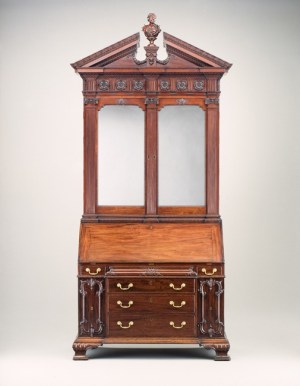
Philadelphia, Desk and Bookcase, 1755-65,
mahogany, glass, brass; 290 x 137 x 68 cm (114 x 54 x 27 in). Washington, D.C.: National Gallery of Art
The National Gallery of Art presents Masterpieces of American Furniture from the Kaufman Collection, 1700–1830. When this installation opens on October 7, 2012, on the Ground Floor of the West Building, it will be a landmark moment for the nation’s capital, which until this time has had no major presentation of early American furniture and related decorative arts on permanent public view. The installation follows the promised gift in October 2010 of one of the largest and most refined collections of early American furniture in private hands, acquired with great connoisseurship over five decades by George M. (1932–2001) and Linda H. Kaufman (b. 1938).
The Kaufman Collection comprises more than 200 works of art, including American furniture, major Dutch paintings, American paintings, and works on paper, among them some 40 floral watercolors by Pierre-Joseph Redouté (1759–1840). Many of these objects were featured in 1986–1987 when the Gallery first exhibited American Furniture from the Kaufman Collection. The upcoming installation will highlight more than 100 of the finest examples of early American furniture and decorative arts, shown with a selection of American, European, and Chinese porcelains and a number of choice Redouté watercolors—all from the Kaufman Collection. Paintings by American artists from the Gallery’s collection will also be integrated into the presentation.
“The Gallery is extremely grateful to George and Linda Kaufman, who chose to give their collection to the nation so that the public can view the finest works of some of America’s greatest artisans here in the nation’s capital,” said Earl A. Powell, director, National Gallery of Art. “This unparalleled gift dramatically amplifies the great American achievements in painting and sculpture long represented at the Gallery, while also transforming our collection of decorative arts by augmenting its fine holdings of European decorative arts with equally important American examples.” (more…)
Call for Papers | Fontainebleau Art History Festival — The Ephemeral
Conference call for papers:
Third Annual Art History Festival — The Ephemeral
Fontainebleau, 31 May — 2 June 2013
Proposals due by 31 December 2012
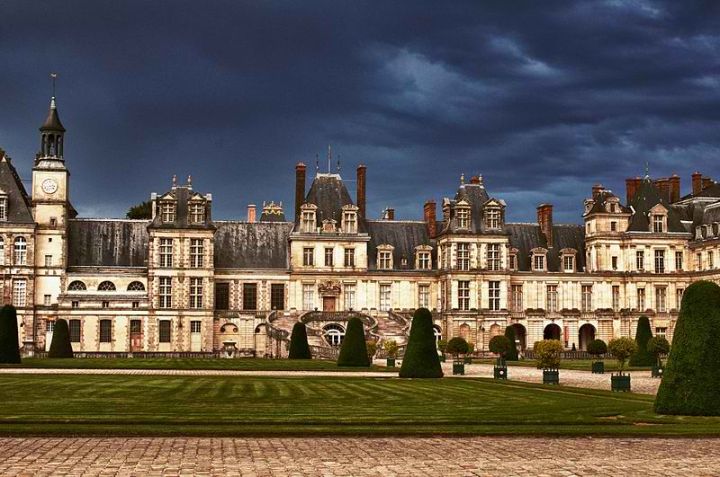
Château de Fontainebleau (Wikimedia Commons)
◊ ◊ ◊ ◊ ◊
he Ministry of Culture and Communications, the National Institute of Art History and the Chateau of Fontainebleau, with the support of the Ministry of Higher Education and Research are jointly organising the third Art History Festival. Originally conceived as a meeting point and knowledge crossroads, these three days will include conferences, debates, concerts, exhibitions, film shows, lectures and meetings in the chateau and at several sites in the town of Fontainebleau. The Festival explores a different theme every year, in 2013 it will be The Ephemeral and there will be three annual meetings: The Art History Forum, a rendezvous for all the latest news in the world of the arts; the Book Salon and art reviews; and Art & Camera, a wide-ranging look at cinema and art and future prospects.
The Festival also includes training offerings for art history teachers in schools in the form of Spring University sessions and training workshops provided and supported by the Ministry of Education.All these events are viewed from the perspective of a guest country: in 2013 this guest country will be the United Kingdom. Work involving British research or concentrating wholly or partly on the United Kingdom will be particularly welcome. This Call for Papers is intended for preferably French-speaking, experienced and novice French and foreign researchers. Contributions by young researchers, conservation specialists or restorers will be given especially careful consideration.
The Ephemeral
Art first manifested itself in the earliest standing stones or paintings as an attempt to either amplify the ephemeral (festive celebrations, temporary body ornamentation, etc.) or to defy it (by seeking to capture the fleeting nature of movement as in parietal art; or as an attempt to leave a durable, even eternal mark by building monumental structures for instance).The history of art therefore swings between permanence and transience, between two opposite extremes: the monumental and performance, the stillness of an image and art that focuses on moving images, a fixed gaze and a gaze that lingers as time passes (ephemeral sequence). (more…)
Seminar Series | Gobelins Seminars, 2012-2013
As noted at Le Blog de l’ApAhAu:
Rencontres des Gobelins
Galerie des Gobelins, Paris, 2012-2013
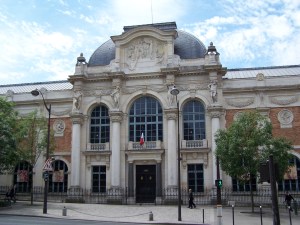
Manufacture des Gobelins, Paris (Wikimedia Commons)
Les Rencontres des Gobelins constituent des rendez-vous hebdomadaires qui invitent un large public à partager les connaissances actuelles de l’histoire et des activités du Mobilier national et des manufactures nationales (tapisseries des Gobelins et de Beauvais, tapis de la Savonnerie et dentelles du Puy et d’Alençon).
Pour cette année, trois axes sont explorés : une pratique de l’art contemporain (l’art textile), une question esthétique (le décoratif) et un métier de la décoration (l’art du tapissier).
◊ ◊ ◊ ◊ ◊
Selected offerings addressing the late seventeenth and eighteenth centuries (please see the full listing at Le Blog de l’ApAhAu)
Mardi, 4 décembre : La mode des intérieurs au XVIIe siècle
• Nicolas Courtin (Commission du Vieux Paris) — L’activité des tapissiers au travers des inventaires des hôtels particuliers parisiens du XVIIe siècle
• Annabel Westman (chercheur indépendant) — Les tapissiers français à la cour du Roi d’Angleterre à la fin du XVIIesiècle
Mardi, 15 janvier : Le marché des étoffes (XVIIIe siècle – 1)
• Natacha Coquery (Université Lumière Lyon 2) — L’art du tapissier à Paris au XVIIIe siècle : de la réparation à l’innovation
• Richard Cartigny (Collège Anceau de Garlande, Roissy-en-Brie) — Les fournisseurs des tapissiers parisiens au XVIIIe siècle : entre proximité spatiale et professionnelle
Mardi, 22 janvier : Le décoratif et les arts du décor : matériaux et esthétique
• Sophie Mouquin (École du Louvre/Université Lille 3) — Marbres et bois : matières du décor au XVIIIe siècle
• Charlotte Guichard (CNRS/Université Lille 3) — Arts et sciences : dispositifs matériels, esthétiques et savants dans les collections du XVIIIe siècle
Un programme de recherche
L’histoire des Garde-Meubles en Europe(XVIe-XIXesiècle)
Mise en place d’un programme de recherche sur plusieurs années visant à écrire l’histoire des Garde-Meubles dans les cours européennes de la Renaissance au XIXe siècle.
Exhibition | Dark Romanticism: From Goya to Max Ernst
Press release from the Städel Museum:
Schwarze Romantik: Von Goya bis Max Ernst
The Städel Museum, Frankfurt am Main, 26 September 2012 — 20 January 2013
Musée d’Orsay, Paris, 4 March — 9 June 2013
Curated by Felix Krämer
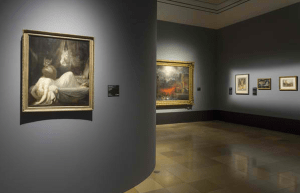 The Städel Museum’s major special exhibition Dark Romanticism: From Goya to Max Ernst is the first German exhibition to focus on the dark aspect of Romanticism and its legacy, mainly evident in Symbolism and Surrealism. Comprising over 200 paintings, sculptures, graphic works, photographs and films, it presents the fascination that many artists felt for the gloomy, the secretive and the evil. Using outstanding works in the museum’s collection on the subject by Francisco de Goya, Eugène Delacroix, Franz von Stuck or Max Ernst as a starting point, the exhibition is also presenting important loans from internationally renowned collections, such as the Musée d’Orsay, the Musée du Louvre, both in Paris, the Museo del Prado in Madrid and the Art Institute of Chicago. The works on display by Goya, Johann Heinrich Fuseli and William Blake, Théodore Géricault and Delacroix, as well as Caspar David Friedrich, convey a Romantic spirit which by the end of the 18th century had taken hold all over Europe. In the 20th century artists such as Salvador Dalí, René Magritte or Paul Klee and Max Ernst continued to think in this vein. The art works speak of loneliness and melancholy, passion and death, of the fascination with horror and the irrationality of dreams. After Frankfurt the exhibition, conceived by the Städel Museum, will travel to the Musée d’Orsay in Paris.
The exhibition’s take on the subject is geographically and chronologically comprehensive, thereby shedding light on the links between different centres of Romanticism, and thus retracing complex iconographic developments of the time. It is conceived to stimulate interest in the sombre aspects of Romanticism and to expand understanding of this movement. Many of the artistic developments and positions presented here emerge from a shattered trust in enlightened and progressive thought, which took hold soon after the French Revolution – initially celebrated as the dawn of a new age – at the end of the 18th century. Bloodstained terror and war brought suffering and eventually caused the social order in large parts of Europe to break down. The disillusionment was as great as the original enthusiasm when the dark aspects of the Enlightenment were revealed in all their harshness. Young literary figures and artists turned to the reverse side of Reason. The horrific, the miraculous and the grotesque challenged the supremacy of the beautiful and the immaculate. The appeal of legends and fairy tales and the fascination with the Middle Ages competed with the ideal of Antiquity. The local countryside became increasingly attractive and was a favoured subject for artists. The bright light of day encountered the fog and mysterious darkness of the night.
The exhibition is divided into seven chapters. It begins with a group of outstanding works by Johann Heinrich Fuseli. The artist had initially studied to be an evangelical preacher in Switzerland. With his painting The Nightmare (Frankfurt Goethe-Museum) he created an icon of dark Romanticism. This work opens the presentation, which extends over two levels of the temporary exhibition space. Fuseli’s contemporaries were deeply disturbed by the presence of the incubus (daemon) and the lecherous horse – elements of popular superstition – enriching a scene set in the present. In addition, the erotic-compulsive and daemonic content, as well as the depressed atmosphere, catered to the needs of the voyeur. The other six works by Fuseli – loans from the Kunsthaus Zürich, the Royal Academy London and the Staatsgalerie Stuttgart – represent the characteristics of his art: the competition between good and evil, suffering and lust, light and darkness. Fuseli’s innovative pictorial language influenced a number of artists – among them William Blake, whose famous watercolour The Great Red Dragon from the Brooklyn Museum will be on view in Europe for the first time in ten years.
The second room of the exhibition is dedicated to the Spanish artist Francisco de Goya. The Städel will display six of his works – including masterpieces such as The Witches’ Flight from the Prado in Madrid and the representations of cannibals from Besançon. A large group of works on paper from the Städel’s own collection will be shown, too. The Spaniard blurs the distinction between the real and the imaginary. Perpetrator and victim repeatedly exchange roles. Good and evil, sense and nonsense – much remains enigmatic. Goya’s cryptic pictorial worlds influenced numerous artists in France and Belgium, including Delacroix, Géricault, Victor Hugo and Antoine Wiertz, whose works will be presented in the following room. Atmosphere and passion were more important to these artists than anatomical accuracy. . .
The full press release is available here»
◊ ◊ ◊ ◊ ◊
Available from the publisher:
Catalogue: Felix Krämer, ed., Dark Romanticism: From Goya to Max Ernst (Ostfildern: Hatje-Cantz-Verlag, 2012), 305 pages, ISBN 9783775733731 (German edition ISBN: 9783775733724), $70 / 35€.
 The exhibition, which presents the Romantic as a mindset that prevailed throughout Europe and remained influential beyond the 19th century, is accompanied by a substantial catalogue with contributions by Roland Borgards, Ingo Borges, Claudia Dillmann, Dorothee Gerkens, Johannes Grave, Mareike Hennig, Hubertus Kohle, Felix Krämer, Franziska Lentzsch, Manuela B. Mena Marqués and Nerina Santorius. As is true for any designation of an epoch, Romanticism too is nothing more than an auxiliary construction, defined less by the exterior characteristics of an artwork than by the inner sentiment of the artist. The term ‘dark Romanticism’ cannot be traced to its origins, but – as is also valid for Romanticism per se – comes from literary studies. The German term is closely linked to the professor of English Studies Mario Praz and his publication La carne, la morte e il diavolo nella letteratura romantica of 1930, which was published in German in 1963 as Liebe, Tod und Teufel:
Die schwarze Romantik (literally: Love, Death and Devil: Dark
Romanticism).










 Enfilade
leave a comment