Seminar Series | Eighteenth-Century Studies at Queen Mary University
From the QM Centre for Eighteenth-Century Studies:
Eighteenth-Century Studies Seminar Series, 2012-2013
Queen Mary University of London
All are welcome to attend this year’s Eighteenth-Century Studies Seminars at Queen Mary University of London. Sessions meet on Wednesdays from 5:00 to 7:00 pm in the Seminar Room, Lock-Keepers Cottage Graduate Centre, Queen Mary University of London, Mile End, London. For updates and more information, see our website.
◊ ◊ ◊ ◊ ◊
10 October 2012
Charles Saumarez-Smith (Royal Academy) with Mark Hallett (Paul Mellon Centre for Studies in British Art)
‘The Company of Artists’: On the Origins of the Royal Academy of Arts
21 November 2012
Charles Walton (Yale)
The Fall from Eden: The Free-Trade Origins of the French Revolution
30 January 2013
Malcolm Baker (U California Riverside)
Celebrating the Illustrious: Roubiliac, Newton, Handel and Pope
13 February 2013
John Barrell (Queen Mary)
‘I know where that is’: The Place of Edward Pugh
27 February 2013
Naomi Tadmor (Lancaster)
The Nuclear Hardship Hypothesis: An Eighteenth-Century Case Study
13 March 2013
Tony LaVopa (North Carolina)
David Hume in Paris: Reading a Friendship
27 March 2013
Susan Manning (Edinburgh)
Becoming a Character
◊ ◊ ◊ ◊ ◊
Convenors: Markman Ellis, English (m.ellis@qmul.ac.uk); Colin Jones, History (c.d.h.jones@qmul.ac.uk); Miles Ogborn, Geography (m.j.ogborn@qmul.ac.uk); Barbara Taylor (English and History); and Amanda Vickery, History (a.vickery@qmul.ac.uk).
Travel instructions: Central Line or District Line to Mile End. Exit tube station, turn left down Mile End Road, cross Burdett Road, go under the Mile End Green Bridge (a large yellow bridge), over the canal, and the college is on the left. Enter East Gate, and the Lock-Keepers Cottage is the second building on the right.
Showcasing Versaille’s Image Bank
As Hélène Bremer notes, the CRCV Image Bank will be of interest to many Enfilade readers, and perhaps some of you will even make it to Thursday’s event showcasing the collection. From the Centre de recherche du château de Versailles:
Patrimoine écrit et numérique avec Raphaël Masson, Isabelle Pluvieux, et Elisabeth Maisonnier
L’Atelier numérique, Versailles, 11 October 2012

Singe. Aquarelle extraite du Livre des oiseaux de la Ménagerie de Versailles, 1710 (MS F 930, folio 7). © Bib. Municipale de Versailles
Depuis 2005, le Centre de recherche du château de Versailles et la Bibliothèque municipale se sont engagés dans un partenariat visant à numériser les ressources concernant le château et la vie à la cour aux XVII et XVIIIe siècles ; au cours de deux campagnes successives de numérisation, ce sont près de 16 300 pages ou images qui ont été numérisées provenant des collections de la Bibliothèque (manuscrits, estampes et imprimés), complétant ainsi les 26 000 images issues des collections iconographiques ou des archives du château de Versailles.
Cette immense base de données permet de découvrir des images différentes et singulières du château de Versailles, de ses jardins, des fêtes, des personnages qui s’y côtoyaient… Quelques thèmes y sont plus particulièrement développés : la vie à la cour, les fêtes, le costume… On y trouve aussi bien des estampes, des dessins, des manuscrits que des plans, des documents d’archives ou des périodiques. On peut ainsi y découvrir les plus belles images du Carrousel de Louis XIV, l’un des plus magnifiques livres de fêtes jamais réalisé, que feuilleter l’un des Almanachs de Versailles, ces petits vade-mecum annuels où l’éditeur Blaizot résumait tout ce qu’il fallait savoir de la vie à Versailles, à la cour ou à la ville, à la fin de l’Ancien Régime. La banque d’images mise en œuvre par le CRCV est ainsi un outil précieux pour l’historien, l’éditeur, l’amateur ou le simple curieux.
◊ ◊ ◊ ◊ ◊
Soirée — Patrimoine écrit et numérique
Présentation des fonds numérisés de la Bibliothèque municipale de Versailles présents dans la banque d’images du Centre de recherche du château de Versailles avec :
• Raphaël MASSON, conservateur du patrimoine et adjoint au directeur du Centre de recherche du château de Versailles,
• Élisabeth MAISONNIER, conservateur en charge du pôle patrimoine de la Bibliothèque municipale de Versailles,
• Isabelle PLUVIEUX, responsable des sites web et des bases de données du Centre de recherche du château de Versailles.
Jeudi 11 octobre 2012 à 19 heures
Atelier numérique, 8, rue Saint Simon – 78 000 Versailles
Tél. : 01 39 24 19 85 – clotilde.despres@versailles.fr
Entrée libre dans la limite des places disponibles
Exhibition | Napoléon and the Art of Propaganda
From the UIMA:
Napoléon and the Art of Propaganda: Art from the Collection of Pierre-Jean Chalençon
University of Iowa Museum of Art, Iowa City, 13 September 2012 — 29 January 2013
Curated by Heidi Kraus and Sean O’Harrow, with Dorothy Johnson
The masses… must be guided without their knowing it.
— Napoléon I to Joseph Fouché, his minister of police
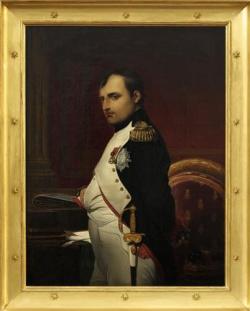
Hippolyte (Paul) Delaroche, Portrait of Emperor Napoleon the First in his Office,
(Collection of Pierre-Jean Chalençon)
From approximately 1800-1815, Napoléon Bonaparte used official propaganda to control artistic autonomy and manipulate public perceptions of his regime both in France and throughout Europe. As a result, government-sponsored art created during the Consulate and Empire is frequently dismissed by art historians as lacking in experimentation, complexity, and beauty. In this extraordinary traveling exhibition, Napoléon and the Art of Propaganda, the aesthetic value and social history of so-called ‘propagandistic art’ created during the First Empire is critically re-examined through the use of visual display, close analysis, and scholarly research. Despite strict censorship laws and a dictatorial arts administration, this exhibition demonstrates that many artists working in the service of Napoléon were deeply inspired by and passionately engaged with their prescribed ‘official’ subjects. Less of a literal presentation, this aesthetic cornucopia shows off the stunning visual aspects of this luxurious Age of Empire.
Napoléon and the Art of Propaganda is a visual chronology of more than 120 drawings, prints, paintings, works of sculpture, manuscripts, medals, and objets d’art from the remarkable private Parisian collection of Pierre-Jean Chalençon. This exhibition considers the full range of official art created under Napoléon I and emphasizes the aesthetic qualities of the period. Some of the most important artists, architects, and sculptors are included, such as Jacques-Louis David, Andrea Appiani, Anne-Louis Girodet, François Gérard, Charles Percier, and Pierre-François-Léonard Fontaine. The selected works display the visual power of the Napoléonic propaganda ‘machine’ and its scope of influence both politically and artistically; illustrate how Napoléon, his ministers, and artists fabricated and produced an imperial iconography; and provide the viewer with an understanding through the use of images of the legend or myth of Napoléon that persisted after his death in exile.
◊ ◊ ◊ ◊ ◊
An exciting array of city-wide programs has been planned to complement the exhibition: lectures (by Bernard Chevallier, Christopher Johns, and Susan Taylor Leduc), concerts, films (Sokurov’s Hubert Robert: A Fortunate Life and Patrice Jean’s Napoléon, David Le sacre de I’image), and readings. The full schedule is available here»
Call for Papers | Restoration Knowledge
Restoration Knowledge: Reception Models for Museology and Art History
Sapienza — University of Rome, April 2013
Proposals due by 30 October 2012
It seems to be essential, at this moment, to confirm that which not long ago may have been considered paradoxical, that is to say the need to interpret the history of restoration, of conservation, of safeguard, as a process closely related to art history, art criticism and the history of museum institutions. Furthermore, in order to cope with various different shifts, one feels the necessity to go back to the beginning and analyse the subject from different angles, alternating philological analysis with different historiographical sources and traditions in order to be able to interpret art works in the context of their true historical stratification so that theoretical, practical and scientific considerations can also gain meaning in the light of the operative, cultural and institutional positions referred to.
The conference, foreseen for April 2013, has the purpose of presenting research revealing the dynamic, reciprocally influential relationship between historic-artistic forms of thought, museum history and safeguard of the patrimony and history of restoration, being a pause for reflection after about fifteen years of studies carried out in the context of Projects of Important National Interest (PRIN), nationally coordinated by the Sapienza University of Rome, in collaboration with the Historical Archive and Data Bank of Italian Restorers (Giovanni Secco Suardo Association) for the project named Culture of restoration and restorers: reception models for museology and ancient and modern art history.
Contributions on the following subjects are required:
1. Works and References Considerations focusing on conservation matters of single works or decorative complexes proving to be particularly significant as examples of how restoration choices are intimately connected to changes of reception, critical acclaim and increased knowledge of that work. Furthermore it could be useful to consider art criticism history texts as reference for restoration history and visa versa.
2. Roles and Biographies Contributions dedicated to connoisseurs, art historians, scholars, scientific experts, restorers who have had to deal with the problem of restoration from a theoretical and practical point of view, in relation, or not, to a specific institutional situation.
3. Museums Contributions in order to understand if some museums have had a precise role in the guidelines of the restoration and conservation policy and, this being the case, how much these guidelines have met with the planning and installation criteria applied.
Those interested are invited to send, by the 30th October 2012, a brief abstract of the contribution they wish to propose (maximum 2.000 characters, spaces included), sending it to convegnorestauro2013@gmail.com. Abstracts and papers will be accepted in both English and Italian. By the 30 November 2012, after a selection carried out by the scientific committee, possible acceptance of the proposal will be communicated by e-mail.
Conference Curators
Maria Beatrice Failla (Turin University)
Susanne Adina Meyer (Macerata University)
Chiara Piva (Ca’ Foscari University Venice)
Scientific Committee: Giuseppe Basile, Olivier Bonfait, Giorgio Bonsanti, Gisella Capponi, Silvia Cecchini, Marco Ciatti, Gianluigi Colalucci, Paola D’Alconzo, Helen Glanville, Michela di Macco, Massimo Ferretti, Carlo Giantomassi, Donata Levi, Mario Micheli, Marina Righetti, Lidia Rissotto, Pilar Roig Picazo, Orietta Rossi Pinelli, Ursula Schaedler-Saub, Lanfranco Secco Suardo, Bruno Toscano, Nathalie Volle
At Auction | One of Only Three Original Fahrenheit Thermometers
Christie’s press release for an upcoming sale:
Travel, Science, and Natural History Sale [6911]
Christie’s, South Kensington, London, 9 October 2012

Mercury thermometer, invented by Daniel Gabriel Fahrenheit
◊ ◊ ◊ ◊ ◊
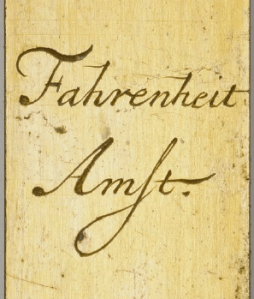
Christie’s is proud to announce that an original mercury thermometer, invented by Daniel Gabriel Fahrenheit in 1714 and the only remaining example in private hands, is to be offered at auction in October 2012. One of only three thermometers ever created by the famous physicist, the others are owned by Museum Boerhaave, in Leiden, the Netherlands, and until recently, these were thought to be the only examples in existence. When offered at auction within Christie’s sale of Travel, Science, and Natural History including the Polar Sale to commemorate the Scott Centenary, 1912-2012 on 9 October 2012 [Sale 6911, Lot 69], the thermometer is expected to fetch between £70,000 and £100,000.
James Hyslop, Scientific Specialist, Christie’s commented, “It is very exciting to be able to offer at auction such an incredibly important scientific instrument, and one which collectors would never have believed would come to market. Inscribed on the back by Fahrenheit himself, this is an exceptional piece which has no precedent, and which I expect to cause a real buzz with connoisseurs and institutions on every continent around the globe.”
Daniel Gabriel Fahrenheit (24 May 1686 – 16 September 1736)
 A household name during his lifetime and even more so in the centuries since, Daniel Gabriel Fahrenheit was a physicist, engineer, and glass blower, best known for the temperature scale bearing his name which is still used today in many countries, as well as for his improvements on the mercury thermometer (1714). Born in the Polish-Lithuanian Commonwealth, he spent most of his life in the Dutch Republic. At the age of fifteen, following the death of his parents through mushroom poisoning, Fahrenheit began training as a chemist, and his personal interest in natural science led to his studies and experimentation in the field.
Things: Material Culture at Cambridge, Michaelmas Term 2012
Programming from CRASSH at the University of Cambridge:
Things: Material Cultures of the Long Eighteen Century
Centre for Research in the Arts, Social Sciences and Humanities (CRASSH), Cambridge, ongoing series
The seminar meets alternate Tuesdays 12.30-2.30pm in the Seminar Room, Alison Richard Building, West Road. A light lunch will be provided.
 The early-modern period was the age of ‘stuff.’ Public production, collection, display and consumption of objects grew in influence, popularity, and scale. The form, function, and use of objects, ranging from scientific and musical instruments to weaponry and furnishings were influenced by distinct and changing features of the period. Early-modern knowledge was not divided into strict disciplines, in fact practice across what we now see as academic boundaries was essential to material creation. This seminar series uses an approach based on objects to encourage us to consider the unity of ideas of this period, to emphasise the lived human experience of technology and art, and the global dimension of material culture. We will build on our success discussing the long eighteenth century in 2012-13 to look at the interdisciplinary thinking through which early modern material culture was conceived, adding an attention to the question of what a ‘thing’ is, to gain new perspectives on the period through its artefacts.
Each seminar will feature two talks each considering the same type of object from different perspectives
Tuesday, 9 October 2012 – Thinking Things
Jonathan Lamb (Vanderbilt University) and Elizabeth Eger (King’s College London)
Tuesday, 23 October 2012 – Worshipping Things
Mary Laven (University of Cambridge) and Maia Jessop (University of Cambridge)
Tuesday, 6 November 2012 – Stilling Things
Hanneke Grootenboer (Oxford) and Joserra Marcaida Lopez (Cambridge)
Tuesday, 20 November 2012 – Curing Things
Simon Chaplin (Wellcome Library) and Christelle Rabier (London School of Economics)
Visit the external blog or subscribe to the group mailing list.
Exhibition | Pride and Prejudice: Female Artists in France and Sweden
Press release from Sweden’s Nationalmuseum in Stockholm:
Pride and Prejudice: Female Artists in France and Sweden 1750–1860
Nationalmuseum, Stockholm, 27 September 2012 — 20 January 2013

Constance Marie Charpentier, Melancholy, 1810
(Amiens: Musée de Picardie)
◊ ◊ ◊ ◊ ◊
Pride and Prejudice – Female Artists in France and Sweden 1750–1860 explores conditions for female artists in France and Sweden during a period of revolutionary social change. The exhibition presents works by some of the French and Swedish women who managed to establish themselves as artists and create a name for themselves at this time. Works by amateurs are also on display, since women of higher standing were expected to master skills such as drawing and embroidery.
The exhibition includes six works by Marie Suzanne Giroust. She was married to artist Alexander Roslin and is The Lady with the Veil in his well-known painting of that name. During her lifetime, she was also a recognised figure, but she later came to be omitted from art history, a fate that she shares with many other female artists. Today only 19 of her works can be identified with any certainty. Giroust was one of the few women to be inducted into France’s Royal Academy of Painting and Sculpture in the late 18th century. Its members had the exclusive opportunity to showcase works at the Salon in Paris, the most important exhibition in France at the time. Within the Royal Academy, there was staunch opposition to female artists. In the mid-18th century, a ceiling was introduced that permitted no more than four members of this gender at any one time.

Adélaïde Labille-Guiard, Portrait of a Woman, 1787 (Musée des beaux-arts de Quimper)
During this period, family ties or social relations to male artists were crucial in determining women’s opportunities for training and inclusion in the art establishment. Giroust was accepted into the Royal Academy for her high artistic quality, but her husband’s prominence was no doubt also a significant factor. The same was true for other female members: Anne Vallayer-Coster, Elisabeth Louise Vigée-Lebrun and Adélaïde Labille-Guiard were all under Royal patronage and Marie Thérèse Reboul was married to the director of the French Academy in Rome. In Sweden too, female artists were unable to access the training offered by the Royal Swedish Academy of Fine Arts. Ulrica Fredrica Pasch became the first female member of the Royal Academy in 1773. She was apprenticed to her father, portraitist Lorens Pasch the Elder, and her brother Lorens Pasch the Younger was a professor and director of the Royal Academy. Once again, family ties and relations to established artists were a precondition for admission.
After the French Revolution, the Salon was opened up to all artists. Art was broadened out, enabling women to exhibit on the same terms as men. At the same time, the revolution caused the well-heeled customers to disappear, which affected incomes and the chances of finding good patrons. Women were also still excluded from all public art-related education. Their only chance was to enrol at private art schools such as the studios of Jacques-Louis David and Jean-Baptiste Regnauld. Some of the most eminent female artists had their own students, but these were all women. Soon these exclusively female studios in Paris also began to attract Swedish students.
During the first half of the 19th century, more and more women were able to step out of the shadows and see their career follow an increasingly professional course. In certain areas, such as French miniature painting, women led the field. Portraits were a path to both fame and fortune and, coupled with genre painting, came to form an important area for women artists. Leading figures during the first half of the 17th century include Cécile Hortense Haudebourt-Lescot and Marguerite Gérard in France, and Maria Röhl, Sophie Adlersparre and Amalia Lindegren in Sweden. Women gained the formal right to become fully-fledged students at the Royal Swedish Academy of Fine Arts in 1864, which is why the exhibition has taken this particular decade as its cut-off point.
Pride and Prejudice is a joint venture with Washington’s National Museum of Women in the Arts, where several of the French works have featured in the exhibition Royalists to Romantics. In Stockholm, they will be complemented with key loans from France plus works from Nationalmuseum and other collections. For many of the works, this will be their first appearance before a Swedish audience. The exhibition comprises around 250 objects, from works in oils and pastels to drawings, miniatures and embroidered artworks. The artists on show include Marie Suzanne Giroust, Anne Vallayer-Coster, Elisabeth Louise Vigée-Lebrun, Adélaïde Labille-Guiard, Marie Thérèse Reboul, Cécile Hortense Haudebourt-Lescot, Marguerite Gérard, Ulrica Fredrica Pasch, Maria Röhl, Sophie Adlersparre and Amalia Lindegren.
The exhibition is accompanied by a fully illustrated catalogue containing articles written by various Swedish and international specialists. Magnus Olausson, Eva-Lena Bengtsson, Barbro Werkmäster, Eva-Lena Bergström, Eva-Lena Karlsson and Solfrid Söderlind are among the Swedish authors.
◊ ◊ ◊ ◊ ◊
Theme Day
Sunday, 14 October, 1–3 pm
(Program will be announced later in September)
Lecture
Thursday, 17 January, 6 pm
Royalists and Revolutionaries: Women Artists and the French Revolution, lecture by Laura Auricchio, Associate Professor of Art History, Parsons The New School for Design. In English.










 Enfilade
leave a comment