Call for Papers | Perceptions of Pregnancy
From the conference website:
Perceptions of Pregnancy: From the Medieval to the Modern
University of Hertfordshire, 16 – 18 July 2014
Proposals due by 1 February 2014
This three-day conference aims to bring together scholars working across a range of disciplines, time periods and global perspectives to examine perceptions of pregnancy throughout history. Papers are welcomed on a range of issues, including, but not limited to:
· Pregnancy, including the pregnant body and the experience of pregnancy
· Unlawful pregnancy, including rape, incest and sexual abuse
· Fertility and infertility, including IVF, miscarriage and still-birth
· Abortion and contraception, including pro-life and pro-choice debate
· Parenthood, single parenthood, and infanticide
Potential themes for discussion are:
· Magic, ritual and religion
· Technology and medicine
· Gender, including male involvement and experiences
· Government policy and politics
· Work life, domesticity and childcare
The keynote speakers will be Professor Joanne Bailey (Oxford Brooks Univeristy) and Dr Elaine Farrell (Queen’s University Belfast). 300-word proposals for twenty-minute papers should be sent to the conference organisers by 1 February 2014. We welcome postgraduate papers. Informal enquiries can be directed to Dr Jennifer Evans (j.evans5@herts.ac.uk) and Dr Ciara Meehan (c.meehan2@herts.ac.uk).
New Book | Exhibiting Englishness: John Boydell’s Shakespeare Gallery
From Yale UP:
Rosie Dias, Exhibiting Englishness: John Boydell’s Shakespeare Gallery and the Formation of a National Aesthetic (London: The Paul Mellon Centre for Studies in British Art, 2013), 288 pages, ISBN: 978-0300196689, $85.
 In the late 18th century, as a wave of English nationalism swept the country, the printseller John Boydell set out to create an ambitious exhibition space, one devoted to promoting and fostering a distinctly English style of history painting. With its very name, the Shakespeare Gallery signaled to Londoners that the artworks on display shared an undisputed quality and a national spirit. Exhibiting Englishness explores the responses of key artists of the period to Boydell’s venture and sheds new light on the gallery’s role in the larger context of British art.
Tracking the shift away from academic and Continental European styles of history painting, the book analyzes the works of such artists as Joshua Reynolds, Henry Fuseli, James Northcote, Robert Smirke, Thomas Banks, and William Hamilton, laying out their diverse ways of expressing notions of individualism, humor, eccentricity, and naturalism. Exhibiting Englishness also argues that Boydell’s gallery radically redefined the dynamics of display and cultural aesthetics at that time, shaping both
an English school of painting and modern exhibition
practices.
Rosie Dias is associate professor in the history of art at
the University of Warwick.
Exhibition | Strange and Wondrous: Prints of India
From the exhibition press release:
Strange and Wondrous: Prints of India From the Robert J. Del Bontà Collection
Smithsonian’s Arthur M. Sackler Gallery, Washington, D.C., 19 October 2013 — 5 January 2014
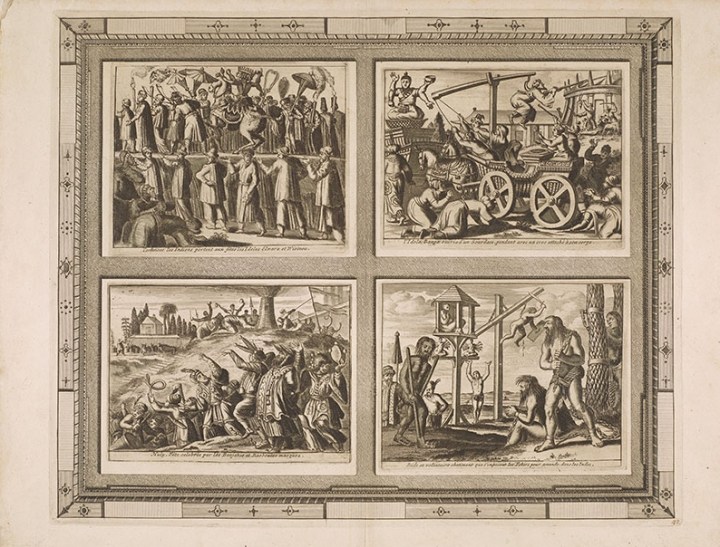
Four Scenes from India. After Jacob van Meurs (ca. 1619–before 1680). Copperplate engraving with etching on paper. From a French copy of Pieter van der Aa (1659–1733), La Galerie Agréable du Monde (The Pleasurable Gallery of the World),vol. 19: Persia, Mogol, Chine, Tartaria (Leyden: Pieter van der Aa, ca. 1725). Robert J. Del Bontà collection, E1431.
◊ ◊ ◊ ◊ ◊
Strange and Wondrous: Prints of India From the Robert J. Del Bontà Collection, on view at the Smithsonian’s Arthur M. Sackler Gallery, presents 50 printed works that trace European and American documentation of Indian ascetics, deities and religious ceremony.
As global travel boomed from the 16th to the 20th century, Europeans and Americans became increasingly fascinated with Indian culture. Merchants, missionaries and soldiers alike documented their encounters in India and foreign lands through detailed texts and illustrations. These accounts—regularly edited, amended and reprinted in publications as varied as atlases, trading cards, memoirs and magazines—became the paradigm for all that Europeans and Americans found strange, exotic, repulsive or remarkable in India.

“Hindoo devottees of the Gosannee & Jetty tribes,” James Shury, after James Forbes (1749–1819). Drawn by James Forbes, 1780, and published by White, Cochrane & Co., June 1812. Engraving with etching on paper. From an English copy of James Forbes, Oriental Memoirs, vol. 2 (London: Richard Bentley, 1834).
Created using a wide variety of techniques, such as engraving, aquatint, lithography and photogravure, these prints demonstrate how perceptions of Indian culture shifted through the centuries, from the European Enlightenment to the period of colonial expansion and into modernity.
“As a collector, Del Bontà not only pays immense attention to the subjects that captivated Europeans and Americans, but also to the multiple versions of popular prints as they travelled across countries, languages and time,” said Holly Shaffer, guest curator and Yale University doctoral candidate. “His collection allows scholars to trace how Europeans and Americans learned about India, and reminds us to always question the ‘truth-value’ of images that often have a very long train to their visual history.”
The spread of images represented in Strange and Wondrous led to broader knowledge and interest in Indian culture—but also to the creation and proliferation of negative stereotypes. Ascetics, or religious figures (often termed “yogis and “fakirs”), with their otherworldly, naked appearance and austere practices, were depicted as supernatural beings, devout penitents, militants, tricksters and beggars. Religious ceremonies, such as swinging from hooks (charak puja), were often interpreted in a Christian framework, rather than a Hindu one, leading to misconceptions of devotees as sinners and fanatics. Deities such as the Hindu god Shiva were cataloged as lovers and drug users feeding generalizations of India as a sensual, spiritual land.
American publications added another layer of satire to their interpretation of exotic cultural practices. A 1943 cover of the Saturday Evening Post illustrated by Norman Rockwell shows the beloved World War II character Willie Gillis outwitting an Indian ascetic with the children’s game “cat’s cradle,” a visual pun of the infamous “Indian rope trick.” Here an American GI has duped the once-powerful Indian yogi, and while it is perhaps a nod to American soldiers’ wily abilities during wartime, the stereotype of India remains intact.
Strange and Wondrous will be on view in conjunction with Yoga: The Art of Transformation—the world’s first exhibition on the art of yoga—also at the Sackler Gallery.
The 50 works on view in Strange and Wondrous are part of Del Bontà’s bequest of 100 printed works to the Freer and Sackler archives. The collection will be a resource for scholars and educators to evaluate and understand early European and American perspectives of Indian culture through print. Del Bontà—a polymath scholar, curator, collector and jeweler—began to collect prints related to India while completing his doctorate in South Asian art history at the University of Michigan in the 1970s. His extensive collection includes more than 2,000 loose prints and thousands more bound within books, spanning genres from Indian calendar prints, ephemera, painting and sculpture to British Raj-era publications and subjects such as ornament, flora and fauna, Indian ascetics, deities and religious ceremony.
Exhibition | Yoga: The Art of Transformation
From the exhibition press release:
Yoga: The Art of Transformation
Smithsonian’s Arthur M. Sackler Gallery, Washington, D.C., 19 October 2013 — 26 January 2014
San Francisco Asian Art Museum, 21 February — 25 May 2014
Cleveland Museum of Art, 22 June — 7 September 2014

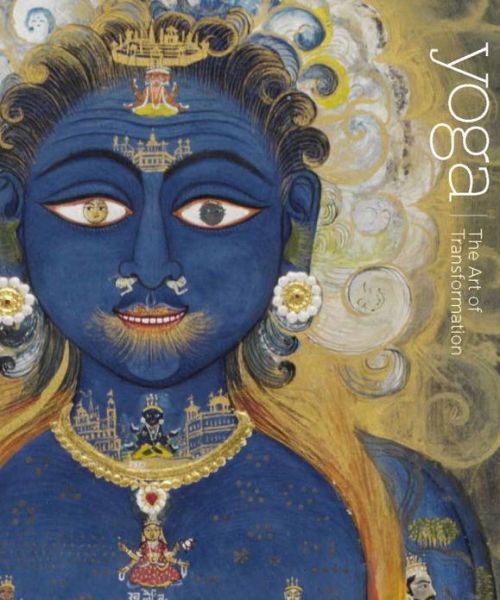
Krishna Vishvarupa (detail), ca. 1740. India, Himachal Pradesh, Bilaspur. Collection of Catherine and Ralph Benkaim.
◊ ◊ ◊ ◊ ◊
Yoga: The Art of Transformation, the first exhibition about the visual history of yoga explores yoga’s rich diversity and historical transformations during the past 2,000 years.
On view through January 26, 2014, The Art of Transformation examines yoga’s fascinating meanings and histories through more than 130 objects from 25 museums and private collections in India, Europe and the U.S. Highlights include three monumental stone yogini goddesses from a 10th-century south Indian temple, reunited for the first time, 10 folios from the first illustrated compilation of asanas (yogic postures) making their U.S. debut, and a Thomas Edison film, Hindoo Fakir (1906), the first movie produced about India.
“This exhibition looks at yoga’s ancient roots, and how people have been trying to master body and spirit for millennia,” said Julian Raby, The Dame Jillian Sackler Director of the Arthur M. Sackler Gallery and Freer Gallery of Art. “By applying new scholarship to both rarely seen artworks and recognized masterpieces, we’re able to shed light on practices that evolved over time—from yoga’s ancient origins to its more modern emergence in India, which set the stage for today’s global phenomenon.
 A free public festival, Diwali and the Art of Yoga, Saturday, October 26, will mark both the opening of the exhibition and Diwali, the Indian festival of lights. Visitors can discover exhibition highlights through spotlight tours, play games from across Asia, attempt intricate rangoli (rice powder) drawings and make their own yoga-inspired art in hands-on workshops. Indian classical musician K. Sridhar will demonstrate the yoga of sound, and storyteller Louise Omoto Kessel will share tales of Indian deities. Free yoga classes will be offered throughout, and the day will conclude with a traditional lamp-lighting ceremony and a classical Indian music concert.
In conjunction with The Art of Transformation, the Freer and Sackler galleries will also host Yoga and Visual Culture, a free interdisciplinary symposium for scholars and yoga enthusiasts November 21–23. Seventeen scholars from a range of disciplines will present cutting-edge research on diverse aspects of yoga’s visual culture, organized around such topics as “Yoga and Place” and “Yoga and Print Culture.” A full schedule and registration is available at asia.si.edu/events/yoga-symposium/.
Yoga classes in the galleries will be offered through “Art in Context,” an interactive 90-minute workshop combining tours of the exhibition with the practice of yoga. Led by a teaching team of a museum docent and guest yoga teachers, the workshops will be held on Wednesdays and Sundays throughout the exhibition, with special sessions offered for ages 50-plus, teens and families. Advance registration is required, and visitors can find a full schedule at asia.si.edu/events/workshops.asp.
These programs are made possible in part due to the Smithsonian’s first major crowdfunding campaign, “Together We’re One.” Launched in May 2013, the campaign raised more than $174,000 over 6 weeks to support public programs, yoga classes in the galleries, and an exhibition catalogue, as well as the behind—the—scenes aspects of the exhibition. Campaign donors and exhibition ambassadors, called “Yoga Messengers,” are invited to be special guests during the October 26 “Art of Yoga” festival, and will be featured in exhibition signage.
Following its Washington, D.C., debut, The Art of Transformation will travel to the San Francisco Asian Art Museum and the Cleveland Museum of Art.
Support for the exhibition is provided by the Friends of the Freer|Sackler, Whole Foods Market, Art Mentor Foundation Lucerne, the Alec Baldwin Foundation, the Ebrahimi Family Foundation, IndiaTourism, Catherine Glynn Benkaim, media partner Yoga Journal, and “Together We’re One” donors.
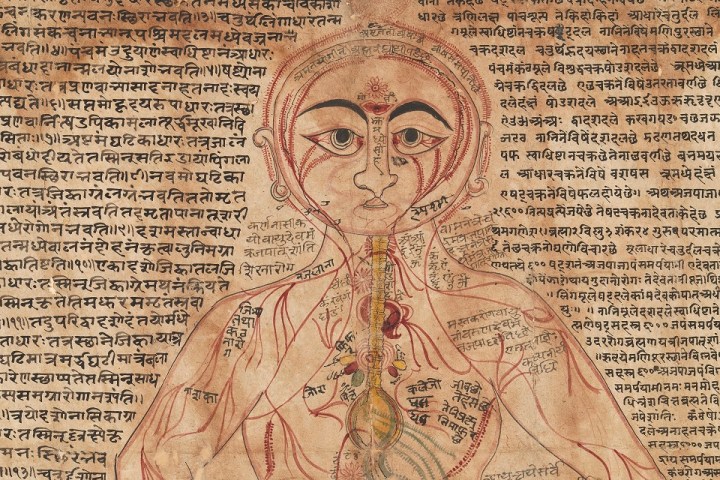
Anatomical Body, 18th century, India, Gujarat (Wellcome Library, London, Asian Collections, MS Indic Delta 74).
◊ ◊ ◊ ◊ ◊
Debra Diamond, ed., Yoga: The Art of Transformation (Washington, D.C.: Smithsonian Books, 2013), 360 pages, ISBN-13: 978-1588344595, $55.
An exploration of yoga’s meanings and transformations over time; the discipline’s goals of spiritual enlightenment, worldly power, and health and well-being; and the beauty and profundity of Indian art.
Debra Diamond is Associate curator of South and Southeast Asian art, Freer Gallery of Art and Arthur M. Sackler Gallery. Her exhibition catalogue for Garden and Cosmos (fall 2008) received two major awards for scholarship: the College Art Association’s Alfred H. Barr award and the Smithsonian Secretary’s Award for Research. She has published on yoga imagery, new methods in Indian art history, contemporary Asian art, and various aspects of the Freer|Sackler collections.
Lecture | Diplomacy and Decoration in France and Siam
From The New School:
Meredith Martin | Mirror Reflections: Diplomacy and Decoration in France and Siam, 1680 / 1860s
Parsons The New School for Design, New York, 25 October 2013

◊ ◊ ◊ ◊ ◊
Friday October 25, 2013 at 6:15 PM
Glass Corner (Room E206), Parsons East Building
25 East 13th Street, 2nd Floor, NYC
This talk given by Meredith Martin, associate professor of Art History at New York University, explores the circulation, use, and interior display of images and art objects associated with diplomatic missions that traveled between France and Siam (Thailand) in the 1680s and 1860s. In analyzing these two different but related episodes of diplomatic and cross-cultural exchange, Martin will show how art and architectural display were crucial to articulating the political and commercial aims of each power as well as how those aims were interpreted by French and Siamese audiences.
Meredith Martin received her M.A. and Ph.D. from Harvard University and her B.A. from Princeton. She is the author of Dairy Queens: The Politics of Pastoral Architecture from Catherine de’ Medici to Marie-Antoinette (Harvard University Press, 2011), and a co-editor of Architectural Space in Eighteenth-Century Europe: Constructing Identities and Interiors (Ashgate, 2010). Martin has published numerous articles, essays, and reviews on 18th and 19th century French architectural history and decoration as well as contemporary art. Her current project focuses on art, diplomacy, and intercultural encounter in France from the reign of Louis XIV to the era of Napoleon.
INSIDE (hi) STORIES is a Histories & Theories series, curated by design historian Sarah Lichtman, assistant professor of Art and Design Studies in the School of Art and Design History and Theory, and architectural historian Ioanna Theocharopoulou, assistant professor of Interior Design in the School of Instructed Environments.
Call for Papers | Tuscan Painting in the Eighteenth Century
Predella: Journal of Visual Arts | June 2014 Issue: Tuscan Painting in the Eighteenth Century
Proposals due by 15 December 2013
The Predella issue scheduled for June 2014 (no. 35) will be dedicated to Tuscan painting in the eighteenth century. It will be edited by Emanuele Pellegrini and Stefano Renzoni. This issue aims to bring new contributions on the activity of Tuscan painters in their homeland and abroad, and at the same time to shed light on foreign painters active in Tuscany throughout the Settecento. Furthermore, this Predella monograph intends to offer new evidences on less studied topics, both individual artists (like Luigi Garzi, Vincenzo Meucci, Giovanni Battista Tempesti), and general problems (the relationships of Tuscan artists with other capital cities like Rome or Venice, the diffusion of ‘popular painting’). Proposals of no more than 300 words should be submitted, with a cover letter or a 2 page CV, by December 15, 2013 to the attention of Emanuele Pellegrini and Stefano Renzoni to the following email address: emanuele.pellegrini@unive.it. Selected papers will be announced by January 15, 2014.
2014 Terra Foundation Awards, Fellowships, and Grants
2014 Terra Foundation Academic Awards, Fellowships, and Grants
A wide range of Terra Foundation academic awards, fellowships, and grants help scholars realize their academic and professional goals and support the worldwide study and presentation of the art of the United States.
The deadline for all academic award, fellowship, and grant applications is January 15, 2014 unless otherwise indicated.
Doctoral and Postdoctoral Research Travel Grants to the United States
International Essay Prize for American Art, Smithsonian American Art Museum
Smithsonian American Art Museum Fellowships in Washington, D.C.
Terra Summer Residency Fellowships in Giverny, France
Conference | Working Wood in the 18th Century: Dining in Style
In January at Colonial Williamsburg. . .
Working Wood in the 18th Century: Dining in Style
Colonial Williamsburg, 19–22 and 23–26 January 2014
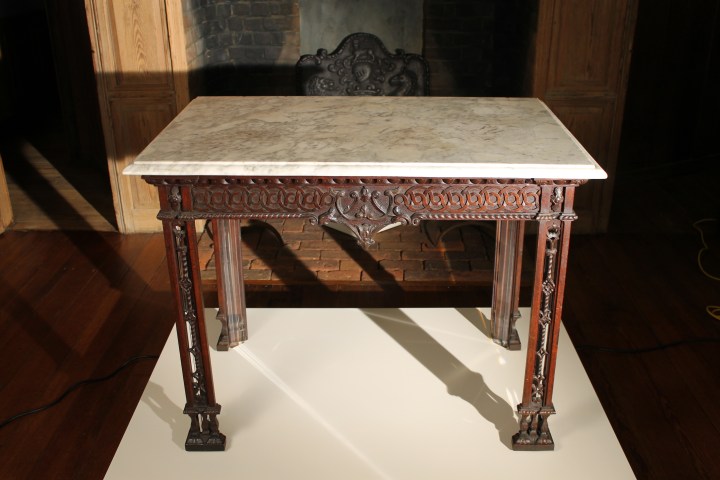
William Buckland (designer) and William Bernard Sears (carver), sideboard made for the Tayloe family of Mount Airy plantation (MESDA collection at Old Salem in Winston Salem, North Carolina). Photo from the Williamsburg blog Anthony Hay’s, Cabinetmaker; click on the image for more information.
◊ ◊ ◊ ◊ ◊
Colonial Williamsburg, The Museum of Early Southern Decorative Arts (MESDA), and Fine Woodworking
present the 16th annual Working Wood in the 18th Century conference at Williamsburg, January 19–22 and 23–26, 2014. Projects and presentations will explore the design and construction of dining room furniture, based on original pieces selected from the collections of the Museum of Early Southern Decorative Arts at Old Salem Museums and Gardens in Winston-Salem, North Carolina.
The pieces to be built cover a range of complexities. Colonial Williamsburg’s Hay Shop staff will reproduce one of the icons of Virginia and southern high-style furniture, the elaborate sideboard table made by William Buckland and William Bernard Sears for the Tayloe family of Mount Airy plantation. The Hay Shop also will make a turned, gate-leg, walnut table, based on the earliest southern gate-leg table known. Steve Latta will demonstrate constructing and decorating a veneered and inlaid, Winchester, Virginia, sideboard. Brian Coe of Old Salem will produce a corner cupboard from the Davidson County, North Carolina, Swisegood school of cabinetmakers. Colonial Williamsburg joiner Ted Boscana will complement Brian’s presentation with a joiner-made, paneled cupboard from the Virginia Eastern Shore. And, Robert Leath, MESDA’s chief curator (first session), and Daniel Ackermann, MESDA’s associate curator (second session), will start things off with an introduction to dining rooms and their furnishings. Partnering with MESDA gives us a chance to focus on southern regional styles and construction, a theme of the new “Masterworks” gallery being installed in the DeWitt Wallace Decorative Arts Museum. Yet, the overall form and decoration of these pieces, whether Baroque in inspiration—drawn directly from Chippendale—or inspired by neo-classical taste, offer approaches and detailing applicable to many examples of Anglo-American furniture made throughout the 18th and into the early 19th centuries.
As last year, Session One runs Sunday through Wednesday and Session Two Thursday through Sunday.
Speakers Include
Daniel Ackermann, associate curator, the Museum of Early Southern Decorative Arts, Old Salem, Winston-
Salem, North Carolina
Ted Boscana, supervisor, journeyman joiner and carpenter, Colonial Williamsburg
Brian Coe, director of exhibition buildings and furniture maker, Old Salem, Winston-Salem, North Carolina
Steve Latta, educator and craftsman, Thaddeus Stevens College, Lancaster, Pennsylvania, and contributing
editor, Fine Woodworking magazine
Robert Leath, chief curator and vice president of collections and research for the Museum of Early Southern
Decorative Arts, Old Salem, Winston-Salem, North Carolina
Kaare Loftheim, journeyman cabinetmaker, Colonial Williamsburg
Bill Pavlak, apprentice cabinetmaker, Colonial Williamsburg
Brian Weldy, apprentice cabinetmaker, Colonial Williamsburg
As always, the conference will be informal. Participants’ comments and questions are welcomed. During morning and afternoon breaks, speakers display their work, tools, and materials; demonstrate techniques; and chat with participants. To include more participants while keeping the conferences small enough for everyone to be involved, two identical programs are offered.
More information is available here»
Symposium | Painters and Paintings in the Early American South
From Colonial Willamsburg:
Painters and Paintings in the Early American South
Colonial Williamsburg, 3–5 November 2013

Robert Feke, Portrait of William Nelson, 1749–51
(Colonial Williamsburg)
The groundbreaking exhibition Painters and Paintings in the Early American South opened March 23, 2013 at the Art Museums of Colonial Williamsburg. The exhibition is the first of its kind to explore in-depth the scope of early art in this region and the myriad connections between art and artists of the early South, New England, the Middle Atlantic, and Europe. It features more than 80 works created in or for the South between 1735 and 1800, 40 of which are on loan from well-known and respected museums and private collections. Painters and Paintings in the Early American South is made possible by generous support from The Grainger Foundation of Lake Forest, Illinois. In conjunction with the exhibition, the Colonial Williamsburg Foundation will sponsor a symposium November 3–5, 2013, featuring lectures on the painters who created the objects and the people they depicted. Speakers will include Graham Hood, Carlisle H. Humelsine Chief Curator Emeritus, Colonial Williamsburg; Ellen G. Miles, curator emerita, Department of Painting and Sculpture, Smithsonian National Portrait Gallery; Angela Mack, executive director and chief curator, Gibbes Museum of Art, Charleston, South Carolina; and Maurie D. McInnis, vice provost for academic affairs and professor of art history, University of Virginia. The conference begins with a keynote lecture and reception Sunday evening followed by two days of lectures, Monday and Tuesday. We are offering a discounted student rate of $250 to qualifying full-time students. For more information on the event and/or to register, please visit the symposium website.
◊ ◊ ◊ ◊ ◊
S U N D A Y , 3 N O V E M B E R 2 0 1 3
5:00 Keynote address, Introduction to the Theme, by Graham Hood, Carlisle H. Humelsine Chief Curator Emeritus, Colonial Williamsburg
6:00 Reception
M O N D A Y , 4 N O V E M B E R 2 0 1 3
9:00 Welcome and opening remarks, Ronald L. Hurst, vice president, collections, conservation, and museums, and Carlisle H. Humelsine Chief Curator, Colonial Williamsburg
The Social and Cultural Importance of Painting in the South, Maurie D. McInnis, vice provost for academic affairs and professor of art history, University of Virginia, Charlottesville
Charlestonians Abroad: Painters and Paintings in the Carolina Low Country, Angela Mack, executive director and chief curator, Gibbes Museum of Art, Charleston, South Carolina.
10:45 Coffee break
11:15 Back in the Day: The Mystery Behind the Watercolor of Drayton Hall, Matthew Webster, director, historic architectural resources, Colonial Williamsburg
John Drayton’s Watercolors, Margaret Pritchard, senior curator, and curator of prints, maps, and wallpaper, Colonial Williamsburg
Jeremiah Theus: A Swiss Artist in Colonial Charleston, Laura Pass Barry, Juli Grainger curator of paintings, drawings, and sculpture, Colonial Williamsburg
12:00 Lunch break
1:30 Degrees of Separation: English Portraiture and the American South, Ellen G. Miles, curator emerita, Department of Painting and Sculpture, Smithsonian National Portrait Gallery, Washington, D.C.
2:15 Wollaston and Hesselius: Their Art and Influence in the Early South, Carolyn J. Weekley, Juli Grainger Curator Emerita, Colonial Williamsburg
3:00 Robert Feke, William Dering, and Other Case Studies in the Conservation of Early Southern Art, Shelley Svoboda, paintings conservator, Colonial Williamsburg
4:00 Gallery tours with curators and conservators in exhibition.
T U E S D A Y , 5 N O V E M B E R 2 0 1 3
8:30 Thomas Coram: Charleston’s Earliest Landscape Artist, Sara Arnold, curator of collections, Gibbes Museum of Art, Charleston, South Carolina
Charles Willson Peale in Maryland and Virginia, Carol Soltis, project associate curator, Peale Collection Catalog, Philadelphia Museum of Art
Southern Synergy: The Philadelphia – Charleston Connection, Elle Shushan, Elle Shushan Fine Portrait Miniatures, Philadelphia
10:15 Coffee break
10:45 Early Virginia Paintings at the Virginia Historical Society, William M. S. Rasmussen, lead curator and Lora M. Robins Curator, Virginia Historical Society, Richmond
John Durand: His Origins Revealed, Carolyn J. Weekley
Frederick Kemmelmeyer: From Hessian Soldier to American Artist, Arthur Nicholas Powers, fellow, Winterthur Program in American Material Culture, Winterthur, Delaware
12:00 Lunch break
1:30 Early Portraiture in the South and the West Indies, Katelyn Crawford, doctoral candidate, University of Virginia, Charlottesville
José Francisco Xavier de Salazar y Mendoza and the Visual Culture of Spanish Colonial New Orleans, Cybèle Gontar, doctoral candidate in American art, Graduate Center, City University of New York
3:00 Coffee break
3:30 Art Collecting in Virginia and Maryland, 1790–1830: Expectations and Aspirations, Lance Humphries, independent scholar, Baltimore, Maryland
Southern Culture: Where Scholarship is Heading, Robert Leath, chief curator and vice president, Museum of Early Southern Decorative Arts, Winston-Salem, North Carolina
New Book | Breast Cancer in the Eighteenth Century
In the U.S., October is National Breast Cancer Awareness Month, and Friday, October 18th, is National Mammography Day. From the publisher:
Marjo Kaartinen, Breast Cancer in the Eighteenth Century (London: Pickering & Chatto, 2013), 256 pages, ISBN: 978-1848933644, £60 / $99.
 Early modern physicians and surgeons tried desperately to understand breast cancer, testing new medicines and radically improving operating techniques. In this study, the first of its kind, Marjo Kaartinen explores the emotional responses of patients and their families to the disease in the long eighteenth century.
Using a wide range of primary sources, she examines the ways in which knowledge about breast cancer was shared through networks of advice that patients formed with fellow sufferers. By focusing on the women who struggled with the disease as well as the doctors that treated them, much is revealed about early modern attitudes to cancer and how patients experienced – and were considered to experience – the cancerous body.
C O N T E N T S
Preface
‘One of the Most Grievous and Rebellious Diseases’: Defining, Diagnosing and the Causes of Cancer
2 ‘But Sad Resources’: Treating Cancer in the Eighteenth Century
3 Women’s Agency and Role in Choice of Treatment
4 ‘So Frightful to the Very Imagination’: Pain, Emotions and Cancer in the Breast
Epilogue










 Enfilade
leave a comment