2013–14 Fellows at the YCBA and the Beinecke Library
A selection of 2014 Visiting Scholars at the Yale Center for British Art in New Haven:
January 6 – January 31
Robert Wellington is an independent researcher and a casual academic in the Department of Art History and Film at the University of Sydney. He will pursue research for a project entitled “A War of Visual Histories: British Appropriations of French Triumphal Imagery at Marlborough House.” This project will provide the first in-depth account of Louis Laguerre’s cycle of paintings at Marlborough House, London, depicting the victories of the Duke of Marlborough against the French in the War of Spanish Succession (1701–1714). Wellington’s research will involve an examination of prints and other material in the Center’s collections relating to Laguerre’s cycle.
February 3 – February 28
Henrietta McBurney Ryan is the Keeper of Fine and Decorative Art at Eton College. Her book project, Illuminating Natural History: The Art and Science of Mark Catesby, will present Catesby’s work as pioneering in a number of ways, including how it represents one of the last great pre-Linnaean enterprises. Among other things, this project will make extensive use of the Center’s unique collection of seventeenth- and eighteenth-century drawing manuals and related treatises in order to further a discussion of Catesby’s techniques as an artist and his place in the history of natural history illustrators.
April 7 – May 2
Alexis Cohen is a PhD candidate in the Department of Art and Archaeology at Princeton University. She will conduct research for a dissertation entitled “Lines of Utility: Outlines, Architecture, and Design in Britain, c. 1800.” Cohen’s project studies the proliferation of the outline drawing in British architectural and design publications and explores how neoclassical design discourses were shaped by notions of utility advanced in publications that privileged the outline drawing as a graphic idiom. Materials to be consulted include the Center’s rich collection of eighteenth- and nineteenth-century architectural drawings by Robert Adam, C. R. Cockerell, A. W. N. Pugin, George Richardson, and James Wyatt, among others.
May 5 – June 27
Katelyn Crawford is a PhD candidate in the History of Art and Architecture, McIntire Department of Art at the University of Virginia. She will pursue research for her dissertation, “Transient Painters, Traveling Canvases: Portraiture and Mobility in the British Atlantic, 1750–1780.” Crawford’s project examines paintings by portraitists working within the eighteenth-century British Atlantic world in order to demonstrate the impact of mobility on artistic practice and portraiture on identity construction. Materials to be consulted at the Center include paintings, drawings, and prints by marine artists and portraitists whose practices further illuminate the connections between these genres and the culture of artistic mobility in the British Atlantic. The Center’s Rare Books and Manuscripts collection will also be explored for mention of itinerant portraitists in Britain and the Atlantic, and discussions of travel, mobility, and portrait production.
◊ ◊ ◊ ◊ ◊
A selection 2013–2014 Visiting Fellows at the Beinecke Library:
Thierry Rigogne (Fordham University), French Cafes in the Eyes of British Travelers, 1660–1800
Kathleen Lubey (St. John’s University), Marginal Conversations: Form and Feminism in Eighteenth-Century Textual Culture
Kevin Bourque (Southwestern University), Seriality, Singularity and Celebrity: Pictures in Motion from 1680 to 1810
Katherine Hunt (Birkbeck College, University of London), Shuffled Knowledge: Didactic Playing Cards in Early Modern Britain
Rupert Goulding (The National Trust, United Kingdom), William Blathwayt’s Acquisition of Goods and Materials from the Colonies for Use in Building and Furnishing Dyrham Park during the Late Seventeenth Century
Diana Barnes (University of Western Australia), The Politics of Emotion and Stoicism in the Writings of William Temple
Margaret Dalivalle, Osborn MS fb122 “Cooper Drawings”: A Technical Examination and Identification of the Models for an Important Group of Seventeenth-Century English Traced Drawings Deriving from the Studio of Richard Gibson, Miniaturist
New Book | Ornamenting the Cold Roast
Distributed by Columbia University Press:
Dorothee Wagner von Hoff, Ornamenting the Cold Roast: The Domestic Architecture and Interior Design of Upper-Class Boston Homes, 1760–1880 (Bielefeld: Transcript-Verlag, 2013), 340 pages, ISBN: 978-3837622768, $62.
 This book presents the meticulous case studies of three individual houses from different eras, which serve to depict the social, political, and cultural effects that domestic architecture and interior design had on the upper class, the city of Boston, and a national American identity. It takes the reader on a journey to 18th- and 19th-century Boston and provides insight into the lives of these prominent men and women as seen through the perspective of their homes. It is a novel examination of the cultural significance of domestic architecture and interior design; and, because of its story-telling character and extensive attention to detail, it is fascinating for curious readers and cultural historians alike.
Dorothee Wagner von Hoff received her PhD at the University of Munich. Her research interests include Colonial and Victorian Architecture and interior design, as well as urban studies and American literature.
Exhibition | Bordeaux-Dublin Letters, 1757: Voice of an Irish Community
From NYU’s Center for Irish and Irish-American Studies:
The Bordeaux-Dublin Letters, 1757: The Voice of an Irish Community Abroad
The Elmer Holmes Bobst Library, New York University, 25 October 2013 — 1 April 2014
 More than two hundred and fifty years ago—in the midst of the world’s first global war—an Irish wine ship returning home from the French port of Bordeaux was captured at sea by a British warship. In January 2011, the mailbag from that ship, the Two Sisters of Dublin, was discovered by a New York University professor. These letters, most of them only recently opened for the first time, are the basis of a major exhibition in the Mamdouha S. Bobst Gallery at New York University’s Bobst Library — The Bordeaux-Dublin Letters, 1757: The Voice of an Irish Community Abroad.
Drawing on world-class collections of art and never-before-seen historical documents, the exhibition takes you back to a time when thriving communities of Irishmen played a prominent role on the European continent. The Bordeaux-Dublin Letters reconstructs the early years of the Seven Years’ War, tells the story of the fateful voyage of the Two Sisters of Dublin, and underscores the significance of the Irish presence in Europe and America. The heart of the exhibit is the extraordinary collection of letters discovered in 2011. Through them, the voice of an Irish community abroad comes alive, and we enter into a private and intimate world inhabited by ordinary men and women separated from their homeland by war.
New Book | Making of a Cultural Landscape: The English Lake District
From Ashgate:
John K. Walton and Jason Wood, eds., The Making of a Cultural Landscape: The English Lake District as Tourist Destination, 1750–2010 (Aldershot: Ashgate, 2013), 292 pages, 978-1409423683, £70 / $135.
 For centuries, the English Lake District has been renowned as an important cultural, sacred and literary landscape. It is therefore surprising that there has so far been no in-depth critical examination of the Lake District from a tourism and heritage perspective. Bringing together leading writers from a wide range of disciplines, this book explores the tourism history and heritage of the Lake District and its construction as a cultural landscape from the mid eighteenth century to the present day.
It critically analyses the relationships between history, heritage, landscape, culture and policy that underlie the activities of the National Park, Cumbria Tourism and the proposals to recognise the Lake District as a UNESCO World Heritage Site. It examines all aspects of the Lake District’s history and identity, brings the story up to date and looks at current issues in conservation, policy and tourism marketing. In doing so, it not only provides a unique and valuable analysis of this region, but offers insights into the history of cultural and heritage tourism in Britain and beyond.
Professor John K. Walton is IKERBASQUE Research Professor at the Department of Contemporary History, University of the
Basque Country, Leoia, Bilbao, Spain. Jason Wood, is Director
of Heritage Consultancy Services, Lancaster, UK.
◊ ◊ ◊ ◊ ◊
C O N T E N T S
List of Figures and Tables, vii
List of Contributors, xi
Foreword, xiii
Preface and Acknowledgements, xv
Part I: Lake District History and Identity
1 Susan Denyer, The Lake District Landscape: Cultural or Natural?, 3
2 John K. Walton, Setting the Scene, 31
3 Angus J. L. Winchester, The Landscape Encountered by the First Tourists, 49
4 John K. Walton, Landscape and Society: The Industrial Revolution and Beyond, 69
5 Melanie Hall, American Tourists in Wordsworthshire: From ‘National Property’ to ‘National Park’, 87
Part II: Lake District Tourism Themes
6 Keith Hanley, The Imaginative Visitor: Wordsworth and the Romantic Construction of Literary Tourism, 113
7 Adam Menuge, ‘Inhabited by Strangers’: Tourism and the Lake District Villa, 133
8 Jonathan Westaway, The Origins and Development of Mountaineering and Rock Climbing Tourism in the Lake District, c. 1800–1914, 155
Part III: Lake District Tourism Case Studies
9 Mike Huggins and Keith Gregson, Sport, Tourism and Place Identity in the Lake District, 1800–1950, 181
10 Sarah Rutherford, Claife Station and the Picturesque in the Lakes, 201
11 Jason Wood, Furness Abbey: A Century and a Half in the Tourists’ Gaze, 1772–1923, 219
12 David Cooper, The Post-Industrial Picturesque? Placing and Promoting Marginalised Millom, 241
Select Bibliography
Index
Call for Papers | Questioning the Masterpiece?
Questioning the Masterpiece?
Sainsbury Centre for Visual Arts, University of East Anglia, Norwich, 20–22 February 2014
Proposals due by 25 November 2013
On the occasion of a major exhibition, Masterpiece: Art and East Anglia, held to celebrate the 50th anniversary of the University of East Anglia, this conference will interrogate notions of artistic value by focusing on the very concept of the ‘masterpiece’. The exhibition is itself ambitious and wide-ranging, takes a broad view of what constitutes a masterpiece, albeit in terms of a single region. For the conference we wish to tackle the concept in terms of its implications for considering works of art from different parts of the world.
The term ‘Masterpiece’ has moved between being a valuable term for marking out artworks which display exceptional skill and virtuosity, to one which signals an overwhelming aesthetic response in the viewer. The production of a masterpiece may be a primary goal for an artist who may decide upon his or her own criteria for judgement. To others it is a social construct used to further the interests of cultural elites. In the definition of a ‘masterpiece’, what is the relative importance of the character of the work itself – including the techniques and materials used – and the political, economic and social factors shaping its production and display?
In the past, especially within the Western art canon, the term, having had its origins in craft practice, has tended to refer only to a limited category of artworks – mostly sculpture and painting. We would like to raise questions about the universality of its application. For instance, what are the implications of an artefact having been disregarded in its own time and place, being reassessed and elevated to masterpiece status by a subsequent critic or culture? Is this likely to amount to culturally imperialistic value judgement or de-contextualisation? Or is it redressing a systemic bias, usefully widening and democratising a concept, to include what might previously have been overlooked? How important is consensus in the definition of a masterpiece and to what extent is its existence determined by the economics of the market, its reputation enhanced by competition among collectors and museums? Is the masterpiece a sign of luxury, or can it be applied to the most humble artefact? Does the concept lose all analytic utility when confronted with the conceptual art of the twentieth century?
Papers are welcome from a range of disciplinary backgrounds – including art history, archaeology, anthropology and art practice – which critically engage with the idea of the ‘masterpiece’ and will normally be 30 minutes long within a 40 minute slot, allowing for discussion. We regret that we cannot offer a speaker fee, however conference attendance fees will be waived (Normal fees: £100 / £75 concessions; UEA students free). There may be some assistance with expenses available. Please enquire if you need help.
Please submit a title and an abstract of 200 words and brief cv. by 25 November, to worldart@uea.ac.uk with the subject heading Masterpieces conference. For any further enquiries in the meantime contact reddish.jenny@gmail.com, conference assistant.
Colloquium | Sculpture: Exchanges in Northern Europe
Penser la Sculpture: Échanges artistiques et culturels dans le Nord de l’Europe, XVIe–XVIIIe
Paris, 2–4 December 2013
Colloque international organisé par Frédérique Brinkerink (Rijksmuseum/ Galerie Perrin/ GHAMU) & Gaylord Brouhot (Université Paris 1 Sorbonne/ HICSA/ CHAR). Sous la direction de Colette Nativel avec la collaboration de Luisa Capodieci (Université Paris 1 Sorbonne/ HICSA/ GRANIT) Avec la participation d’Alexander Dencher (Université Paris 1 Sorbonne/ HICSA/ GRANIT) Avec le soutien de la Fondation Custodia
Depuis quelques années, une réflexion de fond a été engagée sur la nature et les modalités des échanges entre les artistes du Nord de l’Europe aux XVIe, XVIIe et XVIIIe siècles. Cette question de l’interaction artistique relève d’un enjeu majeur puisqu’elle entend notamment faire la lumière sur les liens qui se sont tissés entre la France et les Pays-Bas et qui ont participé à entrelacer leurs identités culturelles. Au sein d’une telle approche, l’art de la sculpture, trop rarement étudié pour cette période, hors du champ italien, permet de porter un regard original sur une création qui dépasse les frontières territoriales et l’évolution chronologique des styles.
Nombreuses sont les œuvres inventées et sculptées dans le Nord et entre le Nord et le Sud à révéler une vision transnationale de l’art qui touche les sources d’inspiration, les méthodes de travail, les stratégies de carrière du sculpteur. Il s’agira de préciser l’impact de ces échanges artistiques et culturels sur une transversalité des disciplines qui s’initie dans l’Europe des Temps Modernes, en particulier sur la façon dont les artistes sculpteurs mettent en dialogue littérature, peinture, architecture et sculpture.
Des spécialistes de ces divers champs de recherche enrichiront la réflexion autour de plusieurs thématiques : du réseau d’influences entre les différentes disciplines aux modes de création dans le contexte politico-culturel du Nord de l’Europe, de l’invention de l’oeuvre d’art à sa réception, sans oublier le statut de l’artiste et ses stratégies de carrière.
Le bicentenaire de la mort du sculpteur français Joseph Chinard (1756–1813) est un moment propice pour discuter ces questions : suite à une découverte récente, se pose la question du lien entre l’oeuvre de jeunesse de Chinard et une des œuvres majeures du sculpteur anversois Artus Quellinus le vieux (1609–1668).
Cette rencontre franco-néerlandaise sera aussi l’occasion d’honorer la mémoire de deux grandes historiennes d’art : Madeleine Rocher-Jauneau, conservatrice émérite du Musée des Beaux-arts de Lyon, et Marijke Spies, professeur émérite à la Free University d’Amsterdam.
◊ ◊ ◊ ◊ ◊
2 D E C E M B R E 2 0 1 3
Auditorium de la Galerie Colbert
13.30 Ouverture, Colette Nativel, directrice du GRANIT Groupe de Recherches sur l’Art du Nord. Images-Textes (Université Paris 1 Sorbonne/ HICSA)
14.00 Session 1 | Au-delà du métier : la transversalité des disciplines
Modérateur : Christian Michel (Université de Lausanne)
• Oliver Kik (Katholieke Universiteit Leuven), Defining Boundaries of Sculptural Design in the Sixteenth-century Low Countries
• Bertrand Bergbauer (Musée national de la Renaissance – Château d’Ecouen) & Pauline Lurçon (Institut national du Patrimoine), La circulation en France des plaquettes de bronze des Pays-Bas du XVe au XVIIe siècle
• Eelco Nagelsmit (Université de Leyden), Parading a Palladium: Jacques Francart’s Reliquary Altar of the Blessed Sacrament of Miracles in Brussels and the Siege of Valenciennes in 1656
16.30 Session 2 | Aux frontières de la création : études de cas
Modérateur : Daniel Rabreau (Université Paris 1 Sorbonne)
• Christophe Henry (Université Paris 1 Sorbonne/ GHAMU), Plaisirs de l’homologie : la copie par Bourchardon du Faune Barberini
• Sabine Cartuyvels (GHAMU), Souvenirs romains, sources égyptiennes : des projets de fontaines d’Edme Bouchardon dans « La Théorie et la Pratique du Jardinage »
3 D E C E M B R E 2 0 1 3
Fondation Custodia
9.30 Ouverture, Ger Luijten, directeur de la Fondation Custodia
10.00 Session 3 | Transmission et diffusion des modèles
Modérateur : Gaylord Brouhot (Université Paris 1 Sorbonne/ CHAR)
• Cécile Tainturier (Fondation Custodia), Leçons de dessin ? Moulages de sculpture représentés dans les scènes d’atelier hollandaises du XVIIe siècle
• Guilhem Scherf (Musée du Louvre), Sources d’inspiration et nouveaux thèmes chez Jean-Baptiste Stouf (1742–1826)
• Muriel Barbier (Musée national de la Renaissance – Château d’Ecouen), De la gravure au meuble : l’interprétation des modèles par les artisans de la Renaissance
• Frédérique Brinkerink (Rijksmuseum / Galerie Perrin), Une œuvre de Quellinus dans les collections de Joseph Chinard ? Modèles et inspirations
14.30 Session 4 | Spécialités et thèmes de prédilection
Modérateur : Ger Luijten (Fondation Custodia)
• Aleksandra Lipinska (Technische Universität Berlin), Landscape with King Numa Pompilius and Nymph Egeria: The Development of the Genre of all Antica Relief in the Netherlands and France in the Sixteenth Century
• Étienne Jollet (Université Paris 1 Sorbonne), Les bustes en hermès dans l’œuvre de Chinard
• Tomas Macsotay (UAB, Barcelona), Character, enargeia and the Return of Flemishness in the Salons of 1699 and 1704
17.00 Hans Buijs (Fondation Custodia), Lettres autour de la sculpture dans le fonds Custodia
18.00 Visite libre de l’exposition Hieronimus Cock : La gravure à la Renaissance
4 D E C E M B R E 2 0 1 3
Auditorium de la Galerie Colbert
9.30 Session 5 | Au-delà des frontières : réseaux politiques et artistiques
Modérateur : Luisa Capodieci (Université Paris 1 Sorbonne/ GRANIT)
• Alain Jacobs (Bibliothèque Royale de Belgique), La statue royale ou princière élevée dans les Pays-Bas méridionaux
• Frits Scholten (Rijksmuseum), Etienne-Maurice Falconet (1716–1791) in Holland
• Leon Lock (Université de Leuven), Quelques réflexions sur les relations de travail entre sculpteurs des anciens Pays-Bas et de France aux XVIIe et XVIIIe siècles
• Stéphanie Levert (Université Paris IV / RKD), La présence des sculpteurs des Pays-Bas en France : méthodologie et recherches
14.00 Session 6 | Déterminations du goût
Modérateur : Philippe Bordes (Université Lyon 2)
• Alexander Dencher (Université Paris 1 Sorbonne / GRANIT), Inventer pour le Roi-Stadhouder : la sculpture dans l’oeuvre de Daniel Marot
• Charles Avery (Victoria & Albert Museum), Collecting Gerard van Opstal’s Sculpture and Ivories
• Aline Magnien (Musée Rodin), Le temps des œuvres : l’exemple de Rodin
Seminar on the History of Libraries, London, 2013–14
Information on the full 2013–14 seminar series on the History of Libraries is available from the Institute of English Studies:
John Goldfinch: The Survival of the Old Royal Library Collections, 1660–1760
British Library, London, 3 December 2013
A series of research seminars on the history of libraries, freely open for anyone to attend, has been organized by the Institute of English Studies, School of Advanced Study, University of London. They are jointly sponsored by the Institute of English Studies, the Institute of Historical Research, and the Library & Information History Group of CILIP. The December 3rd session is to be held in the Board Room of the British Library, Euston Rd., St. Pancras. Everyone attending is asked to meet at 5.20 at the British Library’s reception desk on the ground floor. As the Library needs to know numbers in advance, if you are intending to attend, please send a message to Jon Millington, john.millington@sas.sc.uk.
Exhibition | Making It in America
From the exhibition press release:
Making It in America
RISD Museum, Rhode Island School of Design, Providence, 11 October 2013 — 9 February 2014
Curated by Maureen O’Brien and Elizabeth Williams; designed by Thomas Jayne
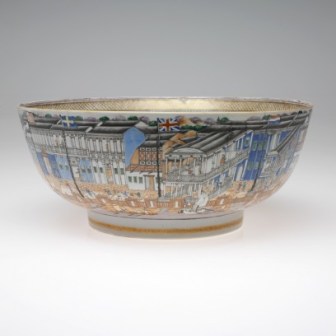

Punch Bowl, 1785–1800, Porcelain with enamel (RISD Museum). The bowl depicts warehouses along the waterfront of the city of Canton, the only port open to foreign merchants, whom the Chinese government confined to the waterfront areas. The western proprietor of each warehouse (hong) was identified by his national flag; Denmark, Spain, France, America, Sweden, England, and Holland are pictured.
◊ ◊ ◊ ◊ ◊
More than 100 outstanding works of painting, sculpture, and decorative arts from the RISD Museum’s collection illuminate connections between American ambitions and the making of art in Making It in America. The exhibition is on view through Sunday, February 9, 2014.
“American art has played a central role at the RISD Museum since its earliest days, and we celebrate this legacy with Making It in America,” says Museum director John W. Smith. “Drawn exclusively from our phenomenal permanent collection, this show is our first in-depth exploration of this subject in many years.”
Making It in America liberates artworks from the Museum’s galleries, storage vaults, and the historic period rooms of its Pendleton House wing, repositioning them within the broader context of American styles. These exceptional pieces, created between the early 1700s and early 1900s, are presented as examples of both artistic processes and aspirations. Just as individual accounts of American life revolve around searches for freedom, fulfillment, and identity, these stories are also embedded in objects that comprise the history of American art.
“The title is a double entendre that asks our viewers to think about art making and about how American art demonstrates American ideas about success,” explain exhibition co-curators Maureen O’Brien, curator of painting and sculpture, and Elizabeth Williams, curator of decorative arts and design. John Singleton Copley’s grand manner portrait of Moses Gill, for instance, illustrates the escalating wealth, social standing, and political capital of the 30-year-old merchant and future Massachusetts lieutenant governor. The land of opportunity is seen in painter Thomas Cole’s striking depictions of the American wilderness unspoiled nature ripe with promise. Closer to home, finely designed furniture with hand-carved motifs from Newport’s Townsend and Goddard workshops rivaled European examples in the 18th century, while the glorious excess of monumental silver works by Providence’s Gorham Manufacturing Company represented the city’s ambitions into the 19th and 20th centuries.
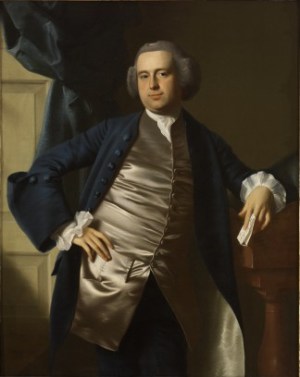
John Singleton Copley, Portrait of the Honorable Moses Gill, Esq., 1764, oil on canvas (RISD Museum)
Making It in America also touches on a theme for which the Rhode Island School of Design (RISD) is best known: the process of making art, a subtext of the show which provides a loose timeline of what happened in American art making and when. The exhibition’s intertwined threads of making art and representing achievement are woven into RISD and the RISD Museum’s own history. Inspired by the international display of art and commerce at the 1876 Centennial Exhibition, the College and Museum were established in 1877 with the mission to train American designers and publicly promote American art. The Museum’s earliest ‘contemporary’ purchase, in 1901, was Winslow Homer’s thundering seascape On a Lee Shore (1900), soon followed by the acquisition of important colonial portraits and American landscape paintings. In 1906, the RISD Museum built Pendleton House, the country’s first museum wing devoted to the display of American decorative arts, thus elevating the importance of native craftsmanship in the study of material culture.
The co-curators note that this exhibition provides exciting opportunities for visitors to explore the Museum’s rich holdings, closely examining objects that may have been behind ropes in period rooms or held in storage. Williams, who joined the RISD Museum in January and has spent much of her first year exploring the diverse decorative arts collection, looks forward to presenting 60 pieces of silver, furniture, glass, ceramics, and jewelry—more than half of which haven’t been on view in decades.
“Although many of the works in Making It in America have been on view in galleries throughout the Museum, visitors who see discrete selections rarely get a sense of the scope and quality of our collections,” says O’Brien.
Exhibition designer Thomas Jayne is a renowned decorator, decorative arts historian, and principal of Jayne Design Studio—specializing in interior decoration and product development. Jayne, who trained in the Winterthur Museum’s graduate program for American material culture, incorporates historic—and unexpected—patterns and colors to create a stunning installation that highlights the evolution of color and pattern in American design. Jayne’s previous clients include Winterthur; Edith Wharton’s country home, The Mount; the Brick House at the Shelburne Museum; and private collectors. Jayne was recently honored with the 2013 Arthur Ross Award for Interior Decoration from the Institute of Classical Architecture & Art. Drawing upon the past, he seeks details that deepen and enliven a room, exquisitely connecting history and place.
Launch of the Centre for Enlightenment Studies at King’s College
Please forgive the short notice, but news of the event is a useful marker of the launch of the Centre for Enlightenment Studies at King’s College London in partnership with the British Museum (stay-tuned for the Centre’s website). –CH
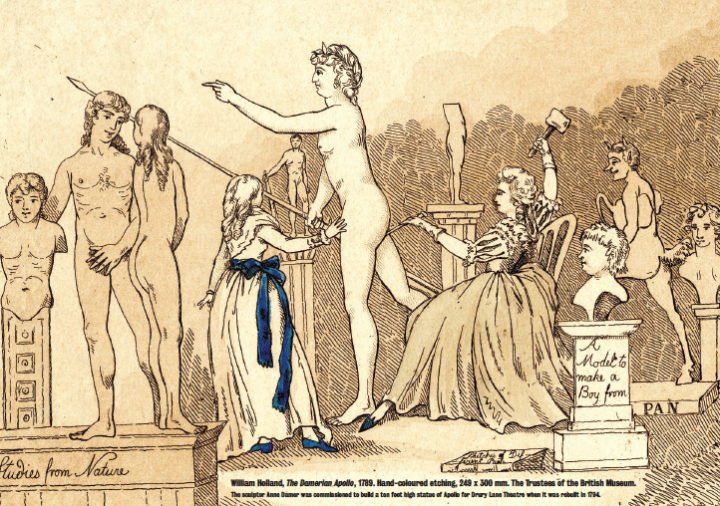
Enlightenment Bodies – from Apollo to Automata
King’s College London, The Strand, London, 15 October 2013
◊ ◊ ◊ ◊ ◊
The Centre for Enlightenment Studies at King’s in partnership with the British Museum, presents Enlightenment Bodies – from Apollo to Automata, on Tuesday, 15 October 2013, 19.30–20.30 at the Edmond J Safra Lecture Theatre, Strand Campus, King’s College London.
Both the aesthetics and the workings of the human body were key themes of the eighteenth-century European Enlightenment. This is, therefore, an ideal topic with which to launch King’s College’s new interdisciplinary research centre, which will bring together our expertise in this area across a wide range of departments, and will build on our close relationship with the Enlightenment Gallery curatorial team at the British Museum. Join us for an exploration of the importance of the human body to Enlightenment life and thought with a panel of experts:
Athena Leoussi, University of Reading, Co-director of European Studies, University of Reading and author of
Nationalism and Classicism: The Classical Body as National Symbol in Nineteenth-Century England and France (1998);
Anna Maerker, Senior Lecturer in History of Medicine, King’s College London, author of Model Experts: Wax Anatomies and Enlightenment in Florence and Vienna, 1775–1815 (2011);
Simon Schaffer, Professor of History of Science, University of Cambridge and TV presenter of Mechanical Marvels and Clockwork Dreams, a recent programme for BBC 4.
The panel discussion will be followed by a drinks reception. The event is free, though booking is required.
Exhibition | Naples’s Treasure: The Museum of Saint Januarius
Press release from the Museo Fondazione:
Naples’s Treasure: Masterpieces of the Museum of Saint Januarius
Il Tesoro Di Napoli: I Capolavori del Museo di San Gennaro
Museo Fondazione, Palazzo Sciarra, Rome, 30 October 2013 — 16 February 2014
Musée Maillol, Paris, 19 March — 20 July 2014
Curated by Paolo Jorio and Ciro Paolillo

Michele Dato, Necklace of Saint Januarius, gold, silver,
and precious stones, 1679, with additions made in the
eighteenth, nineteenth, and twentieth centuries.
◊ ◊ ◊ ◊ ◊
Never before have such masterpieces from the most important collection of goldsmith art in the world, together with original documents, paintings, drawings, vestments and church plate, been exhibited beyond the walls of Naples. This exhibition offers an opportunity to investigate the inestimable artistic and cultural value of the treasure of Saint Januarius from a scientific point of view.
The exhibition, curated by Paolo Jorio, Director of the Museo del Tesoro di San Gennaro, and Ciro Paolillo, a professional gemmologist and professor of history, economics and the production of jewellery in the Sapienza University of Rome, with the advice of Franco Recanatesi, will be an event of great historic and artistic importance: over seventy works belonging to one of the most important collections of goldsmith’s art will be displayed for the first time beyond the walls of the Parthenopean city, beside original documents, paintings, drawings, vestments and church plate. The exhibition will offer an opportunity to investigate the inestimable artistic and cultural worth of the treasure of Saint Januarius from a scientific point of view, in order to rediscover, pass down and re-experience Naples on a journey through time and to protect its name, history, artists and, above all, this priceless heritage that has been collected over seven centuries.
 With twenty-five million devotees scattered throughout the globe, Januarius is the most famous Roman Catholic Saint in the world. Amidst devotion and prejudice, faith and disbelief, his long history is closely connected to Naples, the citizens of which – periodically threatened by natural catastrophes and historical events – even closely identify themselves with their patron saint. The exhibition to be held in Palazzo Sciarra will have both a scientific and an emotional approach, in order to explain the evolution of the cult of Saint Januarius in Naples, why the Treasure belongs to a secular institution and how Parthenopean goldsmithery was perfected over the centuries, thus creating most of the masterpieces on show.
In order to understand the impact of this event, suffice it to say that the historical value of the Treasure of Saint Januarius, formed throughout seven centuries of donations from Popes, Emperors, Kings and popular ex-votos, is higher than that of the Crown Jewels of the United Kingdom and those of the Tsar of Russia, as found during a research project conducted by a team of gemmologists led by Professor Ciro Paolillo, curator of the exhibition, the results of which were published in 2010. The team investigated several precious jewels donated to the Saint, which will be exhibited in Rome, for three years. Moreover, unlike other dynastic and ecclesiastical heritages, the Treasure has remained in tact ever since it was formed and has never endured spoliation, nor have the jewels ever been sold to fund wars. It has constantly been increased by means of acquisitions and accessions.

Matteo Treglia, Mitre in gilded silver, 3326 diamonds, 164 rubies, 198 emeralds and 2 garnets, 1714.
Professor Emmanuele F. M. Emanuele, Chair of the Fondazione Roma, says, “I believe it is essential to spread knowledge of this priceless heritage belonging to our country, the preservation and enhancement of which constitutes a strategic asset for the culture market. It is precisely due to its commitment in this field that the Fondazione Roma, by means of the activities performed by Fondazione Roma-Arte-Musei, has, in time, become a point of reference for the balance of the demand and supply of culture in the Eternal City. The exhibition devoted to Saint Januarius fully qualifies to be included in the cultural project promoted by our institution, which aims to spread all forms of art as an element of social development. The attention we pay to the relationship between culture and the community constitutes the link between the activities performed by the Foundation and those of the Museo di San Gennaro, which has led to the accomplishment of this important exhibition that will allow the public to admire, for the first time, works which, due to their preciousness and strong connotations of identity, have never been shown beyond the walls of Naples.”
 Paolo Jorio says that, “Each work of art belonging to the Treasure of Saint Januarius expresses its intrinsic artistic wealth, fruit of the unequaled craftsmanship of sculptors, silversmiths, chasers, welders and ‘put togetherers’ (as the assemblers were called in those days) who were capable of creating masterpieces of rare beauty using their technical know-how and creativity, and also tells the extraordinary story of a people and its ancient civilization. An account that places the Neapolitan people and European monarchs on the same level, since they all paid homage to Saint Januarius in a secular way and donated priceless masterpieces to the city of Naples.”
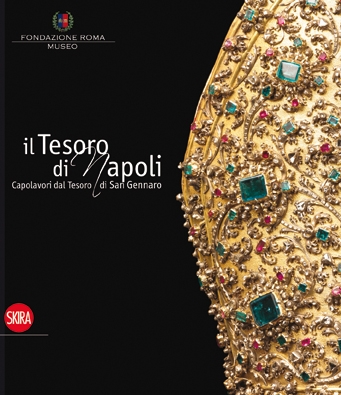
The exhibition will revolve around the two most extraordinary masterpieces of the Treasure: the Necklace of Saint Januarius, in gold, silver and precious stones created by Michele Dato in 1679, and the Mitre, in gilded silver, 3326 diamonds, 164 rubies, 198 emeralds and 2 garnets, created by Matteo Treglia in 1714, the
Tricentennial of which is celebrated this year.
The Necklace of Saint Januarius is one of the most precious jewels in the world and its history inextricably interweaves with the trail of constant devotion the city and monarchs have paid to this saint over the centuries. In 1679, the Members of the Deputation decided to use several jewels (crosses studded with sapphires and emeralds hanging from thirteen large solid gold links) in order to create a magnificent ornament for the bust, appointing Michele Dato, with the aid of other craftsmen, to enable the execution of such an exacting piece of work in only five months. The necklace is now comprised of other jewels of illustrious provenance created by various craftsmen at different times: a cross donated by Charles de Bourbon in 1734, a cross offered by Maria Amalia of Saxony, a three piece clasp with diamonds and emeralds, a cross with diamonds and sapphires dated 1775 bestowed by Maria Carolina of Austria, a crescent shaped broach dated 1799 donated by the Duchess of Casacalenga, a cross and a broach with diamonds and chrysolite offered by Victor Emmanuel II of Italy and other artefacts. Interestingly, Queen Marie Josè, consort of Umberto II of Italy, was attending a private visit to the Chapel of San Gennaro in 1933 and having nothing to donate, she removed the ring she was wearing and offered it to the saint. This regal gift is now to be found on the necklace.
When landing in Naples, even Napoleon, who plundered everywhere, not only refrained from stealing but, for once in his life, actually donated. In fact, when entering Naples in 1806 Joseph Bonaparte donated, as advised by his brother, a cross of diamonds and emeralds of rare beauty which the Deputation then included amongst the jewels bestowed by sovereigns that compose the priceless Necklace of Saint Januarius. Napoleon’s brother-in-law, Joachim Murat, who married beautiful Caroline Bonaparte, also paid heed to the advice of the French Emperor and donated a monstrance in gold and silver with precious stones in 1808. Both masterpieces will be exhibited in Rome. The arrival of the French in Naples is witnessed in only one known artwork: a painting by the French artist, Hoffman, depicted in 1800 and retrieved in Paris by the Deputation, in which the high altar in the Dome may be distinguished. The armed and threatening French troops, commanded by Championnet and Macdonald, stand on the altar ‘demanding’ Saint Januarius to perform the miracle of the liquefaction of his blood in front of the people. This painting will also be exhibited in Rome, as likewise the canvas of Saint Januarius depicted in 1707 by Solimena, the most famous authentic chromatic masterpiece in the world since, as from that year, all the holy pictures of the patron saint of Naples have been inspired by this painting.
The Mitre, the Tricentennial of which is celebrated this year, was commissioned by the Deputation in order to be placed on the bust during the festive procession held in April 1713. It was created in the Antico Borgo Orefici, established by the Anjou monarchs, which was an authentic mine of talents including the author, the maestro goldsmith, Matteo Treglia. The Mitre has an enormous material and symbolic value. The Mitre is adorned with 3964 precious stones including diamonds, rubies and emeralds, according to the traditional construction of ecclesiastical items in relation to the symbolic meaning of the gems: emeralds represented the union between the sanctity of the Saint and the emblem of eternity and power; rubies the blood of martyrs and diamonds an irreprehensible faith. The gemstones also reveal another fascinating affair. Several gems have been found to come from the ancient quarries in Latin America. Ciro Paolillo affirms that “thanks to Treglia’s devotion, today we are looking at one of the world’s most beautiful collections of emeralds belonging to the ancient people of South America; consequently, these gems are valuable both for their preciousness and history.” (more…)










 Enfilade
leave a comment