Call for Papers | The Production of Ornament: Reassessing the Decorative
From H-ArtHist:
The Production of Ornament: Reassessing the Decorative in History and Practice
University of Leeds, 21–22 March 2014
Proposals due by 13 December 2013
Keynote speakers
· Susanne Kuechler, Professor of Material Culture in the Department of Anthropology, UCL
· Alina Payne, Professor of the History of Art and Architecture, Harvard
The descriptive terms ‘decorative’ and ‘ornamental’ are in many ways synonymous with superfluity and excess; they refer to things or modalities that are ‘supplementary’ or ‘marginal’ by their very nature. In the West, such qualitative associations in made objects intersect with long-standing and inter-related philosophical oppositions between ‘form’ and ‘matter’, ‘body’ and ‘surface’, the ‘proper’ and the ‘cosmetic’. Accordingly, this has weighed both on determinations of value in artistic media, and on the inflexions of related histories – particularly histories of ‘non-Western’ art, design and culture, where a wide range of decorative traditions are deemed unworthy of critical attention.
Yet such frameworks are no more historically stable than they are culturally universal. To take one very clear and ‘central’ counter-example, decoration in some strands of Renaissance architectural theory (Filarete, Alberti) emerged as a rigorous codification of meaning, as an essentially functional (political) language. In many ways the history of ornament may itself be seen as a process of marginalisation of such ways of thinking, and the separation of ornament from any form of social practice.
This two-day conference seeks to explore the various ways in which ornament might be regarded as itself productive of its objects and sites. How might the technologies, techniques, and materials of ornament be related to the conception and transformation of modes of object-making? How might ornament be understood to inform its objects, disrupting the spatial categories of ‘surface’ and ‘structure’, and the temporal models in which ornament ‘follows’ making? What are the relations between ornament and representation, and what is at stake in the conventional oppositions between these categories? What are the roles of ornament in larger dynamics of copying, hybridisation and appropriation between things? In what ways have practices and thinking on ornament staged cultural encounters, and engendered larger epistemological and social models?
The conference will explore the production of ornament across a broad range of historical and geographical contexts. We invite proposals from researchers and postgraduates working in any discipline, as well as practitioners, conservators and curators. Proposals of no more than 300 words, along with a CV, should be sent to Dr Richard Checketts and Dr Lara Eggleton at production.of.ornament@gmail.com by Friday the 13th of December 2013.
New Book | The Decoration of a Palace in Genoa
Anne Perrin Khelissa, Gênes au xviiie siècle. Le décor d’un palais (Paris: INHA/CTHS, Collection L’art et l’essai, 2013), 400 pages, ISBN : 978-2735508013, 33€.
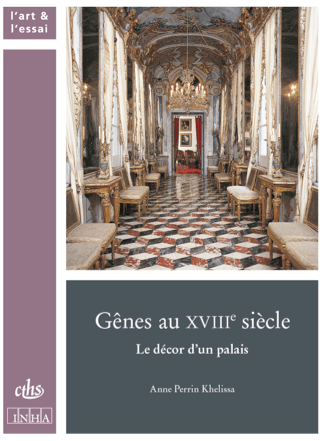 Au xviiie siècle, au cœur d’évènements qui mettent à mal la souveraineté et le prestige de Gênes, l’aristocratie parvient à maintenir sa place économique et politique. Les palais que les familles de la noblesse de l’époque meublent et donnent à voir au public en sont la preuve incontestable : le décor installé dans ces demeures répond au décorum et à une stratégie qui vise à consolider l’établissement des familles par le moyen de l’héritage.
Le palais Spinola à Pellicceria est paradigmatique de ces stratégies. Cet ouvrage éclaire les usages que l’aristocratie fait du décor, en analysant les meubles et les objets qui le composent, sous un angle à la fois social, juridique et esthétique. Il met aussi en évidence la cohérence des collections, enjeu majeur pour les familles, contraintes potentielles pour les artistes et artisans auxquels elles passent commande.
Anne Perrin Khelissa est maître de conférences en histoire de l’art moderne à l’Université Toulouse II – Le Mirail.
◊ ◊ ◊ ◊ ◊
S O M M A I R E
Remerciements
Préface de Peter Fuhring
Introduction
Première Partie: Hériter, transmettre
I. Le palais Spinola à Pellicceria et ses propriétaires
II. Pérennité des valeurs du clan
III. La sauvegarde du patrimoine
Deuxième Partie: Dépenser, commander
I. L’élaboration du décor
II. L’organisation du chantier
III. Aux origines de la commande : le mariage du fils aîné
IV. Les changements opérés par les héritiers
Troisième Partie: Habiter, séjourner
I. La distribution des intérieurs
II. Permanence et changements dans l’ameublement
III. Un parangon des styles européens
IV. Échapper au décorum de la résidence urbaine
Conclusion
Annexes
Les passages de propriété du palais à Pellicceria
Lexique
Sources manuscrites
Bibliographie
Index
Call for Papers | Colonial Spaces: Female Responses to Empire
From the Call for Papers:
Visualising and Materialising Colonial Spaces: Female Responses to Empire
University of Warwick, 11 January 2014
Proposals due by 31 October 2013
Proposals are invited for 20-minute papers for Visualising and Materialising Colonial Spaces: Female Responses to Empire, a conference organized by Dr. Rosie Dias (Art History, University of Warwick) and Dr. Kate Smith (History, University College London) and funded by The Paul Mellon Centre for Studies in British Art. Confirmed keynote speakers include David Arnold, Emeritus Professor, Department of History, University of Warwick and Caroline Jordan, Honorary Associate in the Humanities and Social Sciences, La Trobe University Melbourne.
In recent years scholars working in the field of British art history have increasingly broadened their approach to include transnational and imperial topics. Despite such interest, however, little attention has been paid to the gendered nature of such artistic productions. The majority of research on Anglo-Indian visual culture for example, has focused upon work created by men and as yet little research has considered the role of women in the creation and dissemination of visual and material culture. Visualising and Materialising Colonial Spaces: Female Responses to Empire demonstrates the significance of women’s cultural productions upon ideas of empire at home and abroad by examining the rich visual and archival sources created by British women in imperial spaces. It examines the paintings, sketches, writings, collections, and objects that women created to capture and record their experiences of empire. In doing so it questions the role women played in constructing particular understandings of and narratives about imperial experiences in the eighteenth, nineteenth and twentieth centuries.
Please send a 250-word abstract and a brief biographical note to visualisingcolonialspaces@gmail.com by October 31, 2013.
Exhibition | Rome in Your Pocket: Sketchbooks and Artistic Learning
From the Prado:
Rome in Your Pocket: Sketchbooks and Artistic Learning in the Eighteenth Century
Roma en el bolsillo: Cuadernos de dibujo y aprendizaje artístico en el siglo XVIII
Museo Nacional del Prado, Madrid, 15 October 2013 — 19 January 2014

José del Castillo, Allegory of the Arts, Italian sketchbook I, p. 3, 1762
(Madrid, Museo Nacional del Prado)
Curated by José Manuel Matilla, Head of the Department of Prints and Drawings at the Museo del Prado, Studying Rome focuses on a group of artists’ sketchbooks that the Museum has acquired over the past few decades, produced by a series of Spanish artists including Goya and José del Castillo during their formative years in Rome in the last quarter of the 18th century. These sketchbooks allow for a study of the type of training experienced by young Spanish artists in Italy as they used them to set down their artistic interests. On occasions they also include later works directly inspired by the motifs that they studied.
The exhibition includes 6 of the small sketchbooks that accompanied these artists in Rome and 23 more from various Spanish and international institutions, in addition to 22 independent drawings that offer a complete overview of the artistic practice that was common to European culture at this period. As such, this material provides a source of first-hand information for understanding the artistic and personal context of the period.
The exhibition also provides a unique opportunity for seeing the complete contents of the sketchbooks belonging to the Prado through electronic screens sponsored by Samsung, which visitors can consult in the exhibition space.
Forthcoming Book | Painting in Latin America, 1550–1820
Available in December from Yale UP:
Luisa Elena Alcala and Jonathan Brown, ed., Painting in Latin America, 1550–1820: From Conquest to Independence (New Haven: Yale University Press, 2013), 480 pages, ISBN: 978-0300191011, $75.
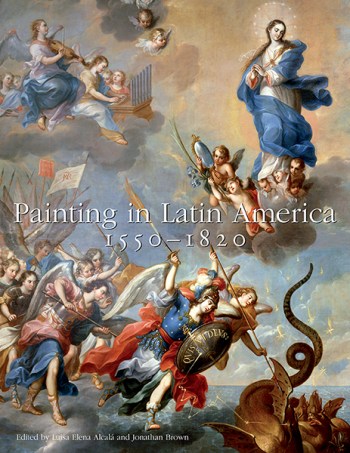 Painting in Latin America, 1550–1820: From Conquest to Independence surveys the diverse styles, subjects, and iconography of painting in Latin America between the 16th and 19th centuries. While European art forms were widely disseminated, copied, and adapted throughout Latin America, colonial painting is not a derivative extension of Europe. The ongoing debate over what to call it—mestizo, hybrid, creole, indo-hispanic, tequitqui—testifies to a fundamental yet unresolved question of identity.
Comparing and contrasting the Viceroyalties of New Spain, with its center in modern-day Mexico, and Peru, the authors explore the very different ways the two regions responded to the influence of the Europeans and their art. A wide range of art and artists are considered, some for the first time. Rich with new photography and primary research, this book delivers a wealth of new insight into the history of images and the history of art.
Luisa Elena Alcala is a professor titular at the department of history and theory of art, Universidad Autónoma of Madrid. Jonathan Brown is Carroll and Milton Petrie Professor of Fine Arts at New York University.
Call for Papers | AAH 2014
In April of 2014 the Royal College of Art in London will host the 40th annual meeting of the Association of Art Historians (AAH). Panels will address a wide variety of themes. Here’s one example, the Museums & Exhibitions Group Annual Session (a full list is available here).
AAH Annual Conference | Challenging Conventions: Exploring Hierarchies
within the Historiography of the Fine and Decorative Arts
Royal College of Art, London, 10–12 April 2014
Proposals due by 11 November 2013
 This session explores hierarchies within the discipline of art history, tracing the separation of the ‘fine’ and ‘decorative/applied’ arts and examining the impact of this division on the research, display and use of art objects within academic and museum contexts. Even before Kant subdivided the arts into ‘mechanical’ and ‘aesthetic’ groupings, the ‘decorative’ arts were somehow deemed lesser due to their inherent functionality, allied to base manual labour and divorced from the purity and higher appeal/role of the ‘fine’ arts. This approach was perpetuated throughout the 18th and 19th centuries, and continues to influence modes
of practice to the present day.
Within this session questions may include, but are not limited to, exploring how these historiographies affect perceptions within the study of art history and the presentation of objects within museums. Have they actively shaped the way we research, collect and display objects? Have these exclusions/inclusions limited or facilitated ways of working within the discipline generally, or affected the way specific fields have been shaped more particularly? And what impact has this legacy had on contemporary practice, in modes of working, forms of display or the evolution of funding streams?
The Museums & Exhibitions Group represents a wide range of practitioners, including art historians, curators and artists/makers, from all eras and cultures, and invites a similarly wide range of responses. Papers may examine specific areas within this topic, examples of interdisciplinarity or case studies within museum/gallery or academic contexts.
Please send proposals (maximum 250 words) to the session convenors Dr Marika Leino, Oxford Brookes University mleino@brookes.ac.uk and Marie-Therese Mayne, Laing Art Gallery, Tyne & Wear Archives & Museums marie-therese.mayne@twmuseums.org.uk by 11th November 2013.
Re-Released Title | American Indians in British Art, 1700–1840
While the book appeared in hardback in 2005, a paperback edition (priced extraordinarily enough at just $22) was published earlier this year by the University of Oklahoma Press:
Stephanie Pratt, American Indians in British Art, 1700–1840 (Norman: University of Oklahoma Press, 2013), 240 pages, ISBN: 978-00806142005, $22.
 Ask anyone the world over to identify a figure in buckskins with a feather bonnet, and the answer will be “Indian.” Many works of art produced by non-Native artists have reflected such a limited viewpoint. In American Indians in British Art, 1700–1840, Stephanie Pratt explores for the first time an artistic tradition that avoided simplification and that instead portrayed Native peoples in a surprisingly complex light.
During the eighteenth century, the British allied themselves with Indian tribes to counter the American colonial rebellion. In response, British artists produced a large volume of work focusing on American Indians. Although these works depicted their subjects as either noble or ignoble savages, they also represented Indians as active participants in contemporary society.
Pratt places artistic works in historical context and traces a movement away from abstraction, where Indians were symbols rather than actual people, to representational art, which portrayed Indians as actors on the colonial stage. But Pratt also argues that to view these images as mere illustrations of historical events or individuals would be reductive. As works of art they contain formal characteristics and ideological content that diminish their documentary value.
Colloquium | Choosing Paris: Large Museum Donations
From Paris Musées:
Choisir Paris: Les grandes donations aux musées de la Ville de Paris
Institut national d’histoire de l’art et Petit Palais, Paris, 11–12 October 2013
L’Institut national d’histoire de l’art organise en collaboration avec Paris Musées un colloque intitulé Choisir Paris: Les grandes donations aux musées de la Ville de Paris. Il aura lieu le vendredi 11 octobre à l’Inha et le samedi 12 octobre au Petit Palais.
La Ville de Paris est l’un des premiers collectionneurs de France. Ses quatorze musées, réunis depuis 2013 au sein de l’établissement public Paris Musées conservent une part importante de ce patrimoine. Nées de l’intérêt porté par la Ville à sa propre mémoire et à sa vie artistique, ces collections sont aussi le fruit du rapport passionné que de nombreux amateurs et collectionneurs ont entretenu avec la capitale, qu’ils ont choisie pour conserver leurs trésors patiemment assemblés. Ce « choix de Paris » répond à des motifs qui, pour divers qu’ils soient, font sens et écrivent une manière d’histoire de l’art. Hommage aux donateurs, ce colloque se donne pour objectif de mieux faire connaître cette histoire, d’éclairer la genèse des collections des musées de la Ville de Paris et de témoigner de l’actualité de la recherche sur les grandes donations qui les ont enrichis. Il témoigne aussi du souhait de Paris Musées de renforcer la recherche au sein de
ses différentes activités.
◊ ◊ ◊ ◊ ◊
V E N D R E D I , 1 1 O C T O B R E 2 0 1 3
Institut national d’histoire de l’art – Salle Vasari
9.00 Accueil des participants
9.30 Ouverture du colloque par Antoinette Le Normand-Romain (directeur général de l’INHA) et Delphine Levy (directrice générale de Paris Musées)
9.45 Introduction : La formation des musées de la ville de Paris et le développement de l’administration des Beaux-Arts. Georges Brunel (conservateur général du patrimoine honoraire)
Matinée présidée par Pascal Griener (professeur à l’Université de Neuchâtel) À l’origine des musées de la Ville de Paris
10.45 Carnavalet, une collection à l’origine de plusieurs musées. Jean-Marc Léri (conservateur général,directeur du musée Carnavalet, de la crypte archéologique et des Catacombes)
11.15 Pause
11.30 Jules Cousin et la création du musée Carnavalet. Thierry Sarmant (conservateur en chef, musée Carnavalet)
11.50 Le comte de Liesville, collectionneur. Jean-Marie Bruson (conservateur général, musée Carnavalet)
12.15 Débat et questions. Bilan de la matinée par Pascal Griener Après-midi présidée par Chantal Georgel (conseiller scientifique à l’INHA) Les donations fondatrices de musées
14.30 Quand donner c’est créer. Paul Meurice et la Maison de Victor Hugo. Gérard Audinet (conservateur général, directeur des Maisons de Victor Hugo, Paris/Guernesey)
14.50 La collection Cognacq, entre legs et dispersion. Benjamin Couilleaux (conservateur, musée Cognacq-Jay)
15.10 A l’origine du musée Bourdelle : 1949, une donation fondatrice. Amélie Simier (conservateur en chef, directrice des musées Bourdelle et Zadkine)
15.30 Débat et questions
16.15 Pause
16.30 La donation Valentine Prax, fondatrice du musée Zadkine. Véronique Gautherin (responsable des collections du musée Zadkine)
16.40 Le legs de la famille Jean Moulin. Christine Levisse-Touzé (conservateur en chef, directrice du musée du général Leclerc de Hauteclocque et de la Libération de Paris – musée Jean Moulin)
17.00 Débat et questions. Bilan de l’après-midi par Chantal Georgel
S A M E D I , 1 2 O C T O B R E 2 0 1 3
Petit Palais, Auditorium
9.00 Accueil des participants
9.30 Ouverture de la journée par Christophe Leribault (conservateur général, directeur du musée du Petit
Palais)
Matinée présidée par François-René Martin(professeur à l’École nationale supérieure des Beaux-Arts) Donations décisives et Donations complémentaires
9.40 La collection des frères Dutuit. Deux vies, un musée. José de Los Llanos (conservateur en chef, directeur du musée des Beaux-arts de Bordeaux) et Paulette Hornby (conservateur en chef, musée du Petit Palais)
10.00 La Société de l’histoire du costume et le Palais Galliera. Pascale Gorguet-Ballesteros (conservateur en chef, Palais Galliera) et Marie Bonin (étudiante chercheuse), avec la collaboration de Charlotte Piot (responsable du service de conservation-restauration, Palais Galliera)
10.20 Débat et questions
10.40 Pause
11.10 Le legs Girardin ou la collection d’un amateur. Sophie Krebs (conservateur en chef, musée d’Art moderne de la Ville de Paris)
11.25 « Témoigner de l’effort de nos sculpteurs modernes » : Henry Lapauze et l’acquisition de fonds d’atelier au Petit Palais. Cécilie Champy (conservateur, musée du Petit Palais)
11.45 Débat et questions. Bilan de la matinée par François-René Martin
Après-midi présidée par Jean-Marc Léri (directeur du musée Carnavalet)
Fin de la session : Donations décisives et Donations complémentaires
14.30 Le fonds Théophile Gautier de la Maison de Balzac. Candice Brunerie (chargée des collections et de la communication de la Maison de Balzac)
14.50 Les Donations de peintures chinoises, anciennes et contemporaines, au musée Cernuschi. Maël Bellec (conservateur, musée Cernuschi)
15.10 Pause
15.30 La donation de la garde-robe d’Alice Alleaume au Palais Galliera. Sophie Grossiord (conservateur général, Palais Galliera)
15.50 « Il n’y a pas de beauté exquise sans une certaine étrangeté. » La singularité de la donation Michael Werner. Julia Garimorth (conservateur, musée d’Art moderne de la Ville de Paris)
16.10 Débat et questions. Bilan de l’après-midi par Jean-Marc Léri
16.35 Bilan et conclusions générales du colloque par Dominique Poulot (professeur, université de Paris 1 Panthéon-Sorbonne)
17.30 Cocktail
Call for Papers | Eighteenth-Century Hospitalities
From IU:
Eighteenth-Century Hospitalities | The Bloomington Eighteenth-Century Studies Workshop
The Center for Eighteenth-Century Studies at Indiana University, Bloomington, 14–16 May 2014
Proposals due by 13 January 2014
An enduring controversy in eighteenth-century studies—how to interpret the death of Captain Cook—turns on questions of stranger and self, hostility and hospitality. Canonical eighteenth-century European texts defined hospitality as something individuals, states, and institutions extended to strangers. (“Hospitality,” wrote Kant, “means the right of a stranger not to be treated as an enemy when he arrives in the land of another.”) Other cultures understood the workings of hospitality, hostility, and the stranger in different fashions, however. Natives of North America, for instance, organized their worlds in terms of kinship, fictive and otherwise, which structured lines of peace and conflict. If for Kant, hospitality was a technique for managing hostility (for preventing strangers from becoming enemies), this was not always the case. When incommensurable hospitalities clashed, hostility could easily arise.
We invite scholars to reflect on the ways that hospitality and self-stranger relations were thought, negotiated, represented, imagined, and lived across the eighteenth century. Questions to be addressed might include everything from how and why different categorizations of stranger-ness arose to daily practices of hospitable interaction. What conceptual, social, legal, etc. arrangements regulated the ways that those seen as socially distinct (the strangers) inhabited one’s own or an alien space?
We welcome papers on topics ranging from forced confinement (e.g., captivity, quarantine, servitude, ghettoization) and the eighteenth-century hospitality industry (coffee shops, restaurants, hospitals, etc.) to ideas and models of refuge, asylum, sanctuary, and contact. Evidence might be found in ethnographies and travelogues (fictional or factual, pictorial or textual) but also in novels, private correspondence, international treaties, etiquette manuals, or works of architecture. Cross- or interdisciplinary approaches are especially welcome.
During the Workshop, we will discuss 4–6 pre-circulated papers each day and have an occasional lecture. Expanded abstracts of papers will be published in the Center’s The Workshop, along with discussion transcripts.
The application deadline is January 13, 2014. Please send a paper proposal (1–2 pages) and current brief CV (3 pages, max) to Dr. Barbara Truesdell, Weatherly Hall North, room 122, Bloomington, IN 47405; 812–855–2856, voltaire@indiana.edu. We will acknowledge all submissions within a fortnight: if you do not receive an acknowledgment by January 27, 2014, please contact Barbara Truesdell or the Center’s Director, Professor Rebecca L. Spang (rlspang@indiana.edu).
Exhibition | High Spirits: The Comic Art of Thomas Rowlandson
Press release from The Royal Collection:
High Spirits: The Comic Art of Thomas Rowlandson
The Queen’s Gallery, Palace of Holyroodhouse, Edinburgh, 22 November 2013 — 2 March 2014
The Holburne Museum, Bath, 27 September 2014 — 8 February 2015
The Queen’s Gallery, Buckingham Palace, London, 13 November 2015 — 14 February 2016
![High Spirits lead crop 810584-lpr[1]_0](https://enfilade18thc.com/wp-content/uploads/2013/07/high-spirits-lead-crop-810584-lpr1_0.jpg?w=720&h=257)
◊ ◊ ◊ ◊ ◊
The absurdities of fashion, the perils of love, political machinations and royal intrigue were the daily subject-matter of Thomas Rowlandson (1757–1827), one of the wittiest and most popular caricaturists of Georgian Britain. Blunt, sometimes bawdy and often irreverent, his work offers a new perspective on an era best known through the novels of Jane Austen. Along with his contemporaries, James Gillray, James Sayers and the Cruikshank family, Rowlandson shaped the visual comedy of the period, and his colourful prints and drawings are as amusing today as when they were first produced some 200 years ago.
Rowlandson made his name poking fun at politicians, foreign enemies and even members of the royal family. Despite this, it was the young George, Prince of Wales (1762–1830), later George IV, who began the collection of around 1,000 caricature prints by Rowlandson in the Royal Collection today. Around 100 works by Rowlandson will go on display in High Spirits: The Comic Art of Thomas Rowlandson at The Queen’s Gallery, Palace of Holyroodhouse in November. The exhibition will explore Rowlandson’s life and art, and the perhaps surprising popularity of his work with George IV, and with Queen Victoria and Prince Albert.
Thomas Rowlandson studied at the Royal Academy Schools, sponsored by a wealthy aunt. A keen draughtsman, he developed a talent for portraiture and an ability to capture likeness in a couple of strokes of the pen. This skill was combined with a lively sense of humour and an eye for the absurd, and he soon found work designing and making comical prints for London publishers. In a life that would itself make an appropriate subject for satire, Rowlandson gambled and drank away his inheritance, staving off poverty through hard work and an enviable talent.
Satirical printmaking was a venerable tradition in Georgian Britain, where freedom of the press had long been exploited by artists. Satirical prints were collected by the fashionable elite and pasted into albums, on to walls and decorative screens, and laughed over at dinner parties and in coffee houses. George IV shared the taste for collecting prints, even though the royal family often found themselves the subject of the joke, and in extreme cases the butt of attacks on their lifestyle and affairs. Conversely, while George IV was collecting caricatures, he was also attempting to suppress and censor prints that showed him in a bad light, caught in a never-ending game of cat-and-mouse with inventive and mischievous printmakers.
Few of the leading political personalities of the day escaped Rowlandson’s scrutiny. The artist turned his pen on Napoleon, the licentious politician Charles James Fox and the ambitious William Pitt the Younger. In The Two Kings of Terror, Napoleon and Death sit face to face on the battlefield after Napoleon’s defeat at Leipzig in 1813. London high society too was the focus of many of Rowlandson’s caricatures. The glamorous and scandalous Georgiana, Duchess of Devonshire, who it was claimed had traded kisses for votes in the cut-throat Westminster election of 1784, is shown kissing a butcher in The Devonshire, or Most Approved Method of Securing Votes.
Other highlights of the exhibition include Dr Convex and Lady Concave, which pokes fun at two very different characters; Money Lenders, thought to be the earliest satire on the Prince of Wales’s increasingly large debts; and Sketches at – an Oratorio!, showing Rowlandson’s talent for capturing human faces and expressions. In A York Address to the Whale. Caught lately off Gravesend, the Duke of York thanks a 23 metre-long whale for distracting attention from accusations that his mistress was paid by army officers for securing their promotions from the Duke, as well as her threats to publish their love letters.
Rowlandson produced a number of highly finished watercolours, and two of his largest and most important works in this medium will be on display. The exhibition also includes a number of the artist’s landscapes, which, although never intended as satire, are infused with the humour that permeates all of Rowlandson’s work.
◊ ◊ ◊ ◊ ◊
Kate Heard, High Spirits: The Comic Art of Thomas Rowlandson (London: Royal Collection, 2013), 272 pages, ISBN: 978-1905686766, £16.
 Portly squires and young dandies. Jane Austenesque heroines and their gruesome chaperones. Dashing young officers and corrupt politicians. The keenly observant satires by English caricaturist Thomas Rowlandson (1757–1827) make clear his sharp eye for current affairs as well as his appreciation of the humour in everyday life.
High Spirits brings together nearly one hundred comic works by Rowlandson, with subjects spanning the entire range of English society. Full-colour illustrations are accompanied by new archival research on both the works and their royal collectors, from George IV to Queen Victoria and Prince Albert.
Kate Heard is Curator of Prints and Drawings, Royal Collection Trust. She is the co-author of The Northern Renaissance: Dürer to Holbein (2011) and is Deputy Editor of the Journal of the History of Collections.










 Enfilade
leave a comment