Exhibition | Gods and Heroes: European Drawings of Classical Mythology
From the exhibition press release (24 October 2013) . . .
Gods and Heroes: European Drawings of Classical Mythology
J. Paul Getty Museum, Getty Center, Los Angeles, 19 November 2013 — 9 February 2014
Curated by Edouard Kopp
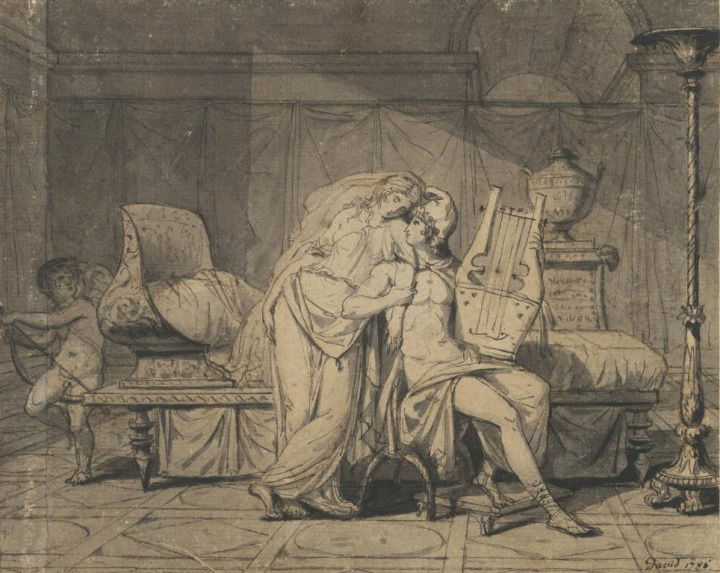
Jacques-Louis David, Paris and Helen, 7 x 9 inches, 1786
(Los Angeles: The Getty, 83.GA.192)
◊ ◊ ◊ ◊ ◊
The stories involving the mythical gods and heroes of Greco-Roman antiquity have inspired artists for centuries, testing their abilities to represent complex narratives in visual form. The likes of Venus and Apollo, Hercules and Achilles, have proved to be particularly rich artistic subjects not only because they had extraordinary qualities―such as beauty, creativity, strength and courage―but also for the imperfections that made these characters even more compelling. Involved in love and lust, rivalry and treachery, crime and punishment, they possessed all the passions and flaws of mere mortals, but on a much larger scale. Featuring a selection of close to 40 drawings dating from the Renaissance to the 19th century, Gods and Heroes: European Drawings of Classical Mythology, on view November 19, 2013–February 9, 2014 at the J. Paul Getty Museum, Getty Center, explores the pictorial representation of myths that have been instrumental in the formation of Western culture.
“The Getty’s collection of drawings provides an almost endless supply of images representing figures from classical mythology,” explains Timothy Potts, director of the J. Paul Getty Museum. “Those chosen for this exhibition bring these myths to life for today’s audience in works of outstanding artistic quality. The exhibition also nicely complements the Museum’s collection at the Getty Villa, which is dedicated to the arts and culture of the ancient Mediterranean. Many of the gods and heroes that will be on view at the Getty Center in this exhibition find their counterparts in ancient representations there.”
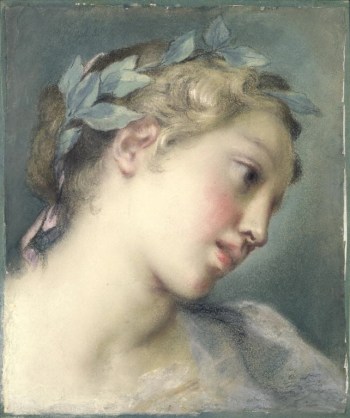
Rosalba Carriera, A Muse, 12 x 10 inches, mid-1720s
(Los Angeles: The Getty, 2003.17)
Depending on when and where they worked, artists have approached mythical figures very differently, sometimes treating them as pretexts for visual experimentation. Consistently, these subjects have provided artists with the opportunity to demonstrate their ability to render human anatomy. While Agostino Carracci’s Triton Blowing a Conch Shell (1600) was made in preparation for an elaborate frescoed scene on the vault of Palazzo Farnese in Rome, the drawing stands alone as a powerful depiction of the triton’s twisting body, which is depicted with striking illusionism. In a subtle display of skill, Rosalba Carriera’s Muse (mid-1720s) exemplifies the artist’s mastery of the pastel technique, which is most evident in the rendering of the young woman’s ivory skin, flushed cheeks, and rosy lips. By contrast, Gustave Courbet used a tonal medium to represent the Head of a Sleeping Bacchante (1847). His smudged, painterly application of charcoal suggests the heaviness of the subject’s slumber.
Themes of love and lust are common in classical myths, as shown by Agostino Carracci’s drawing of Cupid Overpowering Pan (about 1590). In accord with the Roman poet Virgil’s statement that “love conquers all,” Cupid, symbolic of virtuous love, is shown subduing Pan, the embodiment of carnal desire. Cupid’s crucial role in matters of love is, by comparison, merely hinted at in Jacques-Louis David’s Paris and Helen (1786). According to legend, the Trojan prince Paris abducted the Spartan princess Helen, but she fell in love with him after Cupid shot her with an arrow of desire―events that led to the Trojan War. As for mortals, love was no easy thing for mythological figures; indeed, it often ended in tragedy.
The world of gods and heroes could also be a violent one, and drawings such as those depicting the labors of Hercules, attest to this. Hercules had to perform twelve feats as punishment for having killed his wife and children in a fit of temporary insanity. Giulio Romano’s Hercules Resting after Killing the Hydra (about 1535) shows the hero with an unusually lanky body, exhausted after he has killed the Hydra of Lerna, a multiheaded water serpent that was wreaking havoc. Victorious yet weary, Hercules rests on a large rock, with bits of the slain monster lying around him on the ground. For his part, Gustave Moreau represents another of Hercules’s labors, namely when the hero had to capture the flesh-eating mares of Diomedes, the evil king of Thrace. Hercules, having succeeded in seizing the animals, feeds Diomedes’s body to his own horses. Moreau situated the atrocious episode in a dim setting that offsets the brilliant tones of the delicately executed watercolor―a refined technique that could hardly be in starker contrast with the gory nature of the subject it serves to represent.
“This exhibition showcases a beautiful and highly interesting part of the Getty drawings collection in a meaningful way that invites the viewer to explore the fascinating world of Greco-Roman mythology and its artistic representations,” says Edouard Kopp, associate curator of drawings at the J. Paul Getty Museum and curator of the exhibition.
The illustrated checklist is available as a PDF file here»
Arches Software for Cultural Heritage Sites
Press release (4 December 2013) from The Getty:
Getty Conservation Institute and World Monuments Fund Release Arches Software To Help Safeguard Cultural Heritage Sites Worldwide
The Getty Conservation Institute (GCI) and World Monuments Fund (WMF) today announced the public release of Arches (version 1.0), a user-friendly, open source information management software system built specifically to help heritage organizations safeguard cultural heritage sites worldwide.
Arches has been created to help inventory and manage heritage places, and by incorporating a broad range of international standards, meets a critical need in terms of gathering, making accessible and preserving key information about cultural heritage.
“Knowing what you have is the critical first step in the conservation process. Inventorying heritage assets is a major task and a major investment,” said Bonnie Burnham, President and CEO of World Monuments Fund.
Cultural heritage inventories are difficult to establish and maintain. Agencies often rely on costly proprietary software that is frequently a mismatch for the needs of the heritage field or they create custom information systems from scratch. Both approaches remain problematic and many national and local authorities around the world are struggling to find resources to address these challenges.
The GCI and WMF have responded to this need by partnering to create Arches, which is available at no cost. Arches can present its user interface in any language or in multiple languages, and is configurable to any geographic location or region. It is web-based to provide for the widest access and requires minimal training. The system is freely available for download from the Internet so that institutions may install it at any location in the world.
“Our hope is that by creating Arches we can help reduce the need for heritage institutions to expend scarce resources on creating systems from the ground up, and also alleviate the need for them to engage in the complexities and constantly changing world of software development,” said Tim Whalen, Director of the Getty Conservation Institute in Los Angeles.
In developing Arches, the GCI and WMF consulted international best practices and standards, engaging nearly 20 national, regional, and local government heritage authorities from the US, England, Belgium, France, and the Middle East, as well as information technology experts from the US and Europe. The contributions of English Heritage and the Flanders Heritage Agency have played a particularly important role during the development process. Data provided by English Heritage has been valuable for system development, and it is incorporated as a sample data set within the demonstration version of Arches.
The careful integration of standards in Arches also will encourage the creation and management of data using best practices. This makes the exchange and comparison of data between Arches and other information systems easier, both within the heritage community and related fields, and it will ultimately support the longevity of important information related to cultural sites.
Once the Arches system is installed, institutions implementing it can control the degree of visibility of their data. They may choose to have the system and its data totally open to online access, partially open, accessible with a log-in, not accessible at all, or somewhere in between.
“Shared understanding of cultural heritage sites is essential for their successful management and for their enjoyment, too. English Heritage has been really proud to contribute to the development of Arches, and believes it to offer a fresh and readily applicable solution to the challenges of data management. It’s been a great international partnership, and has overcome real complexities,” said Dr. Gillian Grayson, Head of Heritage Data Management at English Heritage.
The GCI and WMF are committed to providing resources to support the Arches open-source community during its formative period.
Arches is not the first joint initiative for the GCI and WMF. The partners previously developed the Middle Eastern Geodatabase for Antiquities, or MEGA, to help the Kingdom of Jordan manage archeological sites. In 2010, MEGA was deployed as Jordan’s National Heritage Documentation and Management System. Different from MEGA, Arches has taken advantage of new semantic technologies and that it is designed to help inventory and manage all types of cultural heritage information, not only archaeological sites. As well, Arches is intended for application anywhere in the world rather than simply one geographic area.
Arches has been developed by the GCI and WMF in conjunction with Farallon Geographics Inc., who also provided expertise for MEGA.
◊ ◊ ◊ ◊ ◊
From the FAQ page:
Does Arches record movable heritage?
Arches has been designed to record all types of immovable heritage, based on the CIDOC Core Data Standard for Archaeological and Architectural Heritage. In conformance with this standard, Arches provides the ability to record artifacts discovered at a site, but it has not been designed as a collections management tool. For a discussion of this question in greater detail, including ways to achieve additional functionality that may be required for movable heritage, please visit the Arches forum.
New Book | History of Design, 1400–2000
From Yale UP:
Pat Kirkham and Susan Weber, eds., History of Design: Decorative Arts and Material Culture, 1400–2000 (New Haven: Yale University Press for the Bard Graduate Center, 2013), 712 pages, ISBN: 978-0300196146, $80.
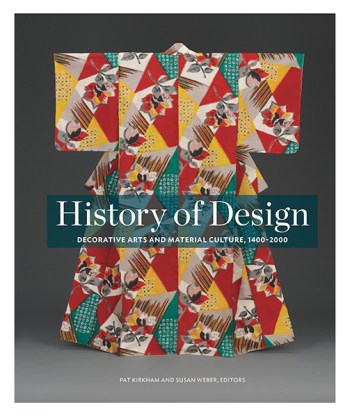 Spanning six centuries of global design, this far-reaching survey is the first to offer an account of the vast history of decorative arts and design produced in Africa, the Americas, Asia, Europe, the Indian subcontinent, and the Islamic world, from 1400 to the present. Meticulously documented and lavishly illustrated, the volume covers interiors, furniture, textiles and dress, glass, graphics, metalwork, ceramics, exhibitions, product design, landscape and garden design, and theater and film design. Divided into four chronological sections, each of which is subdivided geographically, the authors elucidate the evolution of style, form, materials, and techniques, and address vital issues such as gender, race, patronage, cultural appropriation, continuity versus innovation, and high versus low culture.
Leading authorities in design history and decorative arts studies present hundreds of objects in their contemporary contexts, demonstrating the overwhelming extent to which the applied arts have enriched customs, ceremony, and daily life worldwide over the past six hundred years. This ambitious, landmark publication is essential reading, contributing a definitive classic to the existing scholarship on design, decorative arts, and material culture, while also introducing these subjects to new readers in a comprehensive, erudite book with widespread appeal.
Pat Kirkham is a professor at the Bard Graduate Center, where Susan Weber is founder and director.
Exhibition | The Tapestry Collection of the Petit Palais
Now on view in Nancy, as noted at Arachné, a research group blog dedicated to tapestries:
Chefs-d’œuvre de la tapisserie: La collection du Petit Palais, Paris
Nancy, Musée des Beaux-Arts, 25 October 2013 — 27 January 2014
Curated by Charles Villeneuve de Janti and Patrick Lemasson
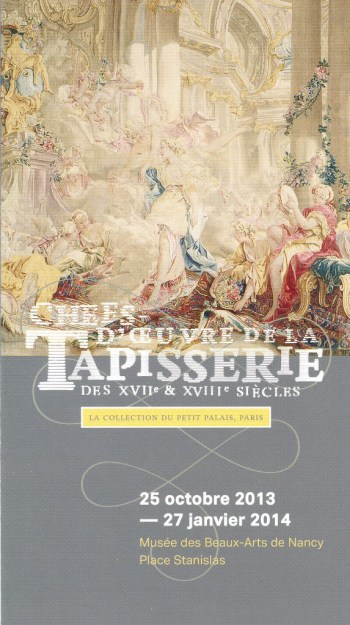 Le Petit Palais, Musée des Beaux-Arts de la Ville de Paris, possède l’une des plus belles collections de tapisseries des XVIIe et XVIIIe siècles. Issues de grandes manufactures européennes, elles furent élaborées et tissées en matériaux précieux d’après les cartons de peintres majeurs tels que Le Brun, Champaigne, Boucher, à l’instar du carton pour La Destruction du Palais d’Armide par Charles Coypel, l’un des chefs-d’œuvre du Musée des Beaux-Arts de Nancy.
Ces œuvres, pouvant mesurer jusqu’à 5 mètres de hauteur, permettront aux visiteurs de découvrir un art de cour spectaculaire faisant écho à celui dévoilé dans l’exposition L’Automne de la Renaissance : d’Arcimboldo à Caravage. Pour des raisons de conservation, ces pièces sont très rarement présentées au public. Ce prêt du Petit Palais constitue donc une faveur exceptionnelle.
Didier Rykner provides a review at La Tribune de l’Art (4 November 2013).
◊ ◊ ◊ ◊ ◊
The catalogue is available from Artbooks.com:
Patrick Lemasson, Chefs d’oeuvres de la Tapisserie: La collection du Petit Palais, Paris (Milan: Silvana, 2013), 72 pages, ISBN: 978-8836627257, $29.
University of Buckingham, MA in Decorative Arts and Historic Interiors
Partial studentships for the MA in Decorative Arts and Historic Interiors at the University of Buckingham
Applications are invited for partial studentships for the MA in Decorative Arts and Historic Interiors at the University of Buckingham to start in September 2014. This unique MA focuses on the development of interiors and decorative arts in England and France in the long eighteenth century (c.1660–c.1830) and their subsequent rediscovery and reinterpretation in the nineteenth and twentieth centuries.
The course is taught by the University of Buckingham, with contributions from leading international experts and curatorial staff from the Wallace Collection. A key element is the emphasis on the first-hand study of decorative arts within the context of historic interiors. There are frequent trips to collections in and around London, as well as a study week in Paris.
The programme provides a vocational and academic training which has enabled students to pursue careers in museums and galleries, auction houses, interior design, and institutions such as the National Trust and English Heritage.
Eligibility: applicants should hold a first or second class honours degree.
Informal enquiries can be made to the course director Jeremy Howard, Jeremy.howard@buckingham.ac.uk; the course tutor Dr Barbara Lasic, Barbara.lasic@buckingham.ac.uk; or Linda Waterman, Linda.waterman@buckingham.ac.uk.
Further details are available here»
New Book | Placing Faces: The Portrait and the English Country House
From Manchester UP:
Gill Perry, Kate Retford and Jordan Vibert, eds., Placing Faces: The Portrait and the English Country House in the Long Eighteenth Century (Manchester: Manchester University Press, 2013), 320 pages, ISBN: 978-0719090394, £70.
 This book explores the rich but understudied relationship between English country houses and the portraits they contain. It features essays by well-known scholars such as Alison Yarrington, Gill Perry, Kate Retford, Harriet Guest, Emma Barker and Desmond Shawe-Taylor. Works discussed include grand portraits, intimate pastels and imposing sculptures. Moving between residences as diverse as Stowe, Althorp Park, the Vache, Chatsworth, Knole and Windsor Castle, it unpicks the significance of various spaces—the closet, the gallery, the library—and the ways in which portraiture interacted with those environments. It explores questions around gender, investigating narratives of family and kinship in portraits of women as wives and daughters, but also as mistresses and celebrities. It also interrogates representations of military heroes in order to explore the wider, complex ties between these families, their houses, and imperial conflict.
Gill Perry is Professor of Art History at the Open University. Kate Retford is Senior Lecturer in History of Art at Birkbeck College, University of London. Jordan Vibert is a freelance researcher
specialising in eighteenth-century art and culture.
◊ ◊ ◊ ◊ ◊
Introduction: Placing faces in the country house
Part 1: A Walk around the House
1. The topography of the conversation piece: A walk around Wanstead – Kate Retford
2. Life in the library – Susie West
3. Marble, memory and theatre: Portraiture and the sculpture gallery at Chatsworth – Alison Yarrington
Part 2: Women’s Space?
4. Dirty dancing at Knole: Portraits of Giovanna Baccelli and the performance of ‘Public Intimacy’ – Gill Perry
5. ‘Necessary, usefull, easy and delightfull’: The production and display of pastel portraits in the English country house – Ruth Kenny
6. Georgiana at Althorp: Spencer family portraits 1755–1783 – Emma Barker
Part 3: Imperial Designs
7. Commemorating Captain Cook in the country estate – Harriet Guest
8. Framing Sir Francis: Lady Anne Stanhope and the corruption of civic masculinity – Jordan Vibert
9. The Waterloo Chamber before the Battle of Waterloo – Desmond Shawe Taylor
Bibliography
Index
Display | Gainsborough and the Landscape of Refinement
As noted at ArtDaily (2 December 2013) . . .
Master Drawings New York | Gainsborough and the Landscape of Refinement
Lowell Libson at Mitchell-Innes & Nash, New York, 24 January — 1 February 2014

Thomas Gainsborough, Figures Resting in Woodland Landscape, signed 1784, 232 x 291 (Lowell Libson)
The exhibition is centered round a group of landscape drawings made by Gainsborough in the last two decades of his life but includes twelve drawings by Gainsborough spanning the full length of his career, from Gainsborough’s earliest recorded landscape study—completed when the artist was only 18—to a preparatory drawing for one of his last ‘Fancy pictures’ A Boy with a Cat, now in the Metropolitan Museum of Art in New York, which was completed the year before his death. Three of the drawings are previously unpublished and exhibited to the public for the first time here.
Thomas Gainsborough (1727–1788) was one of the Britain’s greatest artists, famed for his engaging portraits and evocative landscape paintings, he is also universally acknowledged as one of the finest European draughtsman of the eighteenth century. Despite this reputation, there have been very few exhibitions dedicated to Gainsborough’s drawings. These are not topographical works but imagined landscapes which Gainsborough created by drawing models he created using rocks and wood found in his garden and, as one writer noted, ‘distant woods of broccoli.’
Gainsborough was fascinated by a limited number of landscape features—herds of cattle, serpentine roads, clumps of trees and hilly horizons—often obsessively playing with these features time and time again, each time creating completely new works. This creative repetition—or refinement—was given expression in Gainsborough’s fascination with different techniques.
No two drawings in the exhibition are handled in the same way as Gainsborough explored different combinations of chalks, pencil, ink washes and watercolour in each work. Many of the drawings in the exhibition have provenances stretching back to the eighteenth century, one is inscribed as a present from ‘the ingenious artist’ to the daughter of a friend, another was in the collection of the celebrated surgeon, Dr John Hunter, who treated Gainsborough in his final illness. This group is the largest concentration of Gainsborough drawings to be offered by an art gallery since the celebrated exhibition mounted by Knoedler in 1914. It is accompanied by a fully illustrated catalogue with scholarly entries written by the leading Gainsborough authority, Hugh Belsey.
The exhibition is free and open daily from Friday 24 January to Saturday 1 February, 2014 Mitchell-Innes & Nash, 1018 Madison Avenue, New York. Monday to Saturday, 11–6; Sunday, January 26, 2–6; Tuesday, 28 and Thursday, 30 January, 11–8.
◊ ◊ ◊ ◊ ◊
Press release (15 August 2013) from Master Drawings New York:
Master Drawings New York
New York, 25 January — 1 February 2014

◊ ◊ ◊ ◊ ◊
In a fifteen block stretch of the Upper East Side’s ‘Gold Coast’ in New York, close to 30 of the most acclaimed international dealers in master drawings will show the latest artworks entering the market during the eighth edition of Master Drawings New York, January 25th through February 1, 2014 with a Preview Friday January 24th from 4 to 8pm. Timed to coincide with New York’s major January art-buying events, including the Old Master auctions and The Winter Antiques Show, Master Drawings New York includes top dealers from the US as well as the UK, France, Germany, Spain, and Italy. Originally conceived as an annual walkthrough, Master Drawings New York has grown into a ‘must see’ event with a number of New York dealers making their galleries available to their overseas colleagues for the week. (more…)
Call for Papers | Carlo Fontana (1638–1714), A Celebrated Architect
Carlo Fontana (1638–1714), A Celebrated Architect
Palazzo Carpegna, Accademia Nazionale di San Luca, Rome, 22–23 October 2014
Proposals due by 15 February 2014
The conference is dedicated to the architect Carlo Fontana (Rancate 1638 – Roma 1714) on the occasion of the 300th anniversary of his death. The protagonist of Roman architecture as the Baroque was waning, Fontana—descending from a famous dynasty of Ticinese architects—organized the teaching and the practice of architecture based on the exercise of drawing and geometry. His workshop thus prefigured modern design studios. The propagandistic usage of graphic sheets and printed volumes illustrating and diffusing Fontana’s works and ideas constituted yet another factor of his modernity. In fact, Fontana understood perfectly the dimension of intellectual and creative freedom of print, liberating himself from a dependence on patrons and from morphological and typological conventions of his time.
The projects of Carlo Fontana range from artifacts of domestic use, interiors, civil, religious and military architecture to the most challenging urban and territorial infrastructures (ports, aqueducts, grain warehouses, etc.). These design and entrepreneurial features are comparable, then, to the great architectural studios of the 19th and 20th century, confirming Fontana’s actuality. Such an innovative organization of his workshop attracted students from all over Europe: Johann Bernhard Fischer von Erlach, Nicodemus Tessin, Lucas von Hildebrandt, Filippo Juvarra, Francesco Specchi, and James Gibbs, to name a few. In Fontana’s studio, students could learn innovative typologies, modern and experimental techniques, at the same time measuring themselves up to the great Roman construction tradition, both ancient and modern. Their direct contact with monuments was favored by the works Fontana executed on antique buildings to make them fit for new usages and new representations.
Proposals should thus encompass and explore, but by no means be limited to, the above mentioned aspect always bearing in mind the cosmopolite and European horizon that characterizes the production, the teaching and the thought of architect Carlo Fontana. Abstracts (3000 characters with spaces) together with a short CV (500 characters with spaces) containing principal publications, should be sent by e-mail with the subject CFP-Fontana before 15 February 2014 to Giuseppe Bonaccorso at the following addresses: convegnofontana2014@gmail.com; bonaccorso@ing.uniroma2.it.
Languages: Italian and English
Call for Papers | British Country Houses, CAA in 2014
Historians of British Art Session at CAA 2014 in Chicago
British Country Houses: Architecture, Collections, and Gardens
Chicago, Thursday, 13 February 2014, 12:30–2:00
Proposals due by 10 January 2014
In a spirit of nimble experimentation, the Historians of British Art invite proposals for an informal lunchtime session in Chicago at the 2014 meeting of the College Art Association on the subject of “British Country Houses: Architecture, Collections, and Gardens.” As a midday session, it is open to the public without the usual CAA membership or conference registration requirements. Speakers need belong only to HBA (or become a member soon!). Extended abstracts will be available digitally before the conference to encourage more productive discussion during the 90-minute slot.
Papers might address material aspects as well as larger contextual approaches that situate particular families and houses within narratives of patronage, the history of taste, or British identity. Please email a 200-word proposal and a CV to CraigAshleyHanson@gmail.com by 10 January 2014. In light of the unusually quick turn-around, early responses are encouraged. Questions are most welcome.
Call for Papers | Eighteenth-Century Europe at MAHS in St. Louis
Midwest Art History Society Annual Conference 2014
Open Session: Eighteenth-Century Europe
Saint Louis Art Museum, 3–5 April 2014
Proposals due by 16 December 2013 — extended to 2 January 2014
CAAH members are invited to submit proposals for sessions at the Midwest Art History Society Annual Conference, which will convene in St. Louis, April 3-5, 2014 at the Saint Louis Art Museum. In addition to five thematic sessions, there are seventeen ‘open’ sessions addressing broad periods and general topics. This session on Eighteenth-Century Europe invites papers on all aspects of the art, architecture, and decorative arts of the period. Please email a 200-word proposal and a CV to CraigAshleyHanson@gmail.com by 16 December 2013. Questions are most welcome.










 Enfilade
leave a comment