Exhibition | Medicine and the Eighteenth Century
As noted by Hélène Bremer, from the Château de Seneffe:
Le XVIIIe et la Médecine
Château de Seneffe, Hainaut, Belgium, 5 October 2013 — 21 April 2014
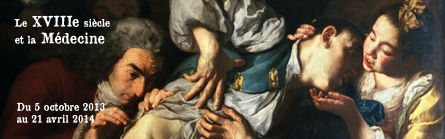 L’exposition « Le XVIIIe et la Médecine » sort des sentiers battus par son contenu et son approche scientifique. Elle présente le thème de la médecine non pas uniquement du point de vue purement médical mais bien dans le contexte de la vie de l’époque. En tant que témoins privilégiés- et avec l’apport des instruments scientifiques, d’objets mis en relation avec les thématiques abordées, d’extraits littéraires,…-nous racontons l’existence d’une société en pleine évolution sociologique.
Découvrir ce que signifie la médecine au XVIIIe siècle c’est lever le voile sur différentes pratiques peu conventionnelles, c’est aborder le corps et l’esprit sous différents angles, c’est observer les avancées en la matière qui vont bousculer les tabous et révolutionner les façons de penser et de voir d’une façon plus rationnelle. C’est comme un kaléidoscope de découvertes inattendues et surprenantes. Le XVIIIe avait à cœur de replacer l’homme, en tant qu’être humain, au centre de la société. Les individus sont alors en quête de bien être, comme aujourd’hui. Et depuis, tout continue.
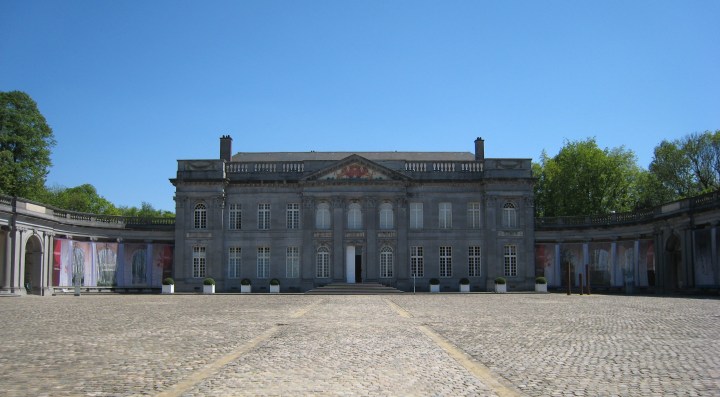
Château de Seneffe
(Photo: Wikimedia Commons, May 2007)
◊ ◊ ◊ ◊ ◊
According to Wikipedia:
In 1758 the ‘Seigneurie de Seneffe’ was bought by Joseph Depestre, a Walloon merchant who earned a fortune by selling goods to the Imperial Austrian troops stationed in the Austrian Netherlands. Depestre’s new status as a wealthy and influential individual was also confirmed by the acquisition of noble titles such as ‘Seigneur de Seneffe’ (Lord of Seneffe) and ‘Count of Turnhout’. The new castle designed by Laurent-Benoît Dewez had to match with Depestre’s new noble status. It was erected between 1763 and 1768 in a novel neoclassical style. When Joseph Depestre died in 1774 the decoration of the château and the embellishment of the park were continued by his widow and his eldest son Joseph II Depestre. . .
Exhibition | Unflinching Vision: Goya’s Rare Prints
From the exhibition press release (August 2013):
Unflinching Vision: Goya’s Rare Prints
Norton Simon Museum, Pasadena, 6 December 2013 — 3 March 2014
Curated by Leah Lehmbeck
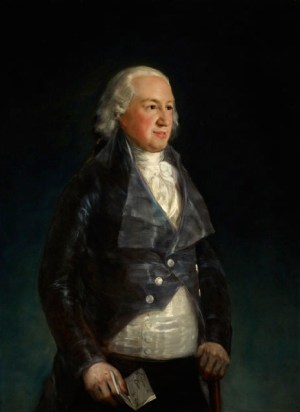
Francisco de Goya y Lucientes, Don Pedro, Duque de Osuna, ca.1790s. Oil on canvas, 54 x 43 x 4 inches (137.8 x 109.2 x 10.2 cm). The Frick Collection; photo: Michael Bodycomb.
In celebration of the rare loan of The Frick Collection’s Don Pedro, Duque de Osuna by Spanish master Francisco de Goya y Lucientes (1746–1828), the Norton Simon Museum presents the exhibition Unflinching Vision: Goya’s Rare Prints. While the majority of the artist’s prints were published posthumously, this exhibition presents a selection of works that Goya himself worked on during his lifetime. More than 30 working proofs, trial proofs and published prints made under his supervision are on view, as well as a small selection of posthumous examples from his later numbered editions. With exceptional examples from his series Los Caprichos, The Disasters of War, La Tauromaquia, and Los Proverbios, these artworks demonstrate Goya’s mastery of printmaking and, most significantly, his care in meaningfully capturing the spirit of his time.
From royal portraiture to scenes in a bullring, Goya infused his keen vision of the observed world with his own creative impulses. This delicate dance is visible throughout the artist’s incredible output of prints. Goya began to experiment with printmaking well after he had established himself as a successful painter to the royal court in Madrid. He started, tentatively, etching a few religious subjects, yet rather quickly he began his first ambitious series of etchings: 11 copies after masterpieces by the father of Spanish painting, Diego Velázquez. Goya’s skill as a draftsman is pronounced in these prints, as is his facility with working on a copper plate, for it is in this series that he first experiments with aquatint, a technique that allows the artist to create subtle tonal areas in the image rather than just scratched lines. “Un Infante de España,” on view in this exhibition, not only presents the formality of Velázquez’s composition but also exhibits Goya’s growing skill with intaglio techniques. Though aquatint is used here primarily in the background, Goya came to master its use, harnessing its subtlety to create depth and even to draw entire compositions.
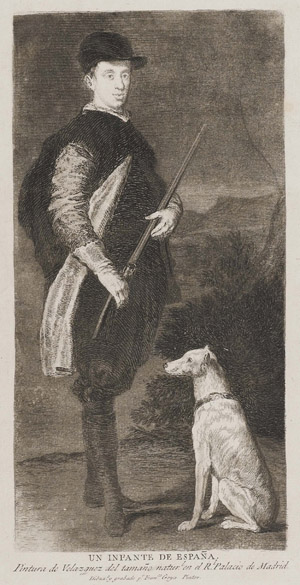
Francisco de Goya y Lucientes, Copies After Velázquez: Un Infante de España, Infante Don Fernando, ca. 1778–79, etching with burnished aquatint and drypoint
(Norton Simon Art Foundation)
By the mid-1790s, Goya began to work on Los Caprichos, the first of four major print series that came to define his career as a printmaker. Images of people, witches and imagined creatures identifying specific social and cultural problems, with titles carefully narrating the scenes, make up this series. An early working proof of plate 6, “Nobody Knows Himself,” presents Goya’s concerns with deception and artifice, and it shows the print before numbering and with the title handwritten in ink. In plate 20, “There They Go Plucked (i.e. Fleeced),” prostitutes sweep out their customers, cowering and pathetic, as the women prepare for the next group of clients who hover above. The drama of the scene is enhanced by the contrast between completely uninked areas and the various gradations of aquatint that define recessional space, but as the edition was printed, this contrast was lost as the aquatint faded nearly completely. Exhibiting the working proof alongside the first, second and eighth editions of the same plate highlights this degradation.
While Los Caprichos describes a time before the turn of the century, when the French monarchy fell and Napoleon rose to power, Goya’s next series tells of the grueling six-year war between France and Spain that began in 1808. In addition to its cruel, disorganized and prolonged combat (the term ‘guerilla’ warfare was coined from this war), it caused a disastrous famine. Many of its battles and events, including torture and starvation, are depicted brutally in the 82 plates of Goya’s print series The Disasters of War. “One Can’t Look,” plate 26, is a triumph of Goya’s compositional acumen. Men and women cower, plead and surrender in desperation within a web of dramatic shadows, and only the tips of the executioners’ bayonets reveal the reason for their suffering.
Perhaps due to the sensitivity of the subject, Goya decided not to publish an edition of The Disasters during his lifetime. Turning instead to a public project that was more benign, Goya prepared a series of bullfighting scenes, equally brilliantly executed and known ultimately as La Tauromaquia. This group of 33 prints traces the history of bullfighting in the country and can be read as being both respectful and critical of the pastime. In plate 20, the theatrical physical feats accomplished by a torero are on display. Yet, in the following plate, Goya reminds us of the deadly nature of the sport. His interest in the popular subject matter and its connection to his national identity were further illuminated when Goya was living in exile in Bordeaux, France. There, in 1825, he used lithography for the first time. The technique is very similar to drawing, and Goya was immediately able to create lively compositions with greater ease than aquatint, in a series of four prints with the same theme, known as The Bulls of Bordeaux.
Whereas the two intaglio series—La Tauromaquia and The Disasters—depict real-life events, Goya continued to create wildly imaginative scenes that comment on contemporary behavior as in Los Caprichos. In the group of 18 prints gathered together and sold as Los Proverbios upon their first publication in 1864, Goya magnificently illustrates a number of human follies. Two-headed women, animals, giants and monsters are all situated in a world with no setting, no real context. The scenes are executed with brilliant technical facility: etched lines creating dynamic scenarios set off against the rich darkness of a field of aquatint, as in “A Way of Flying,” a fantastical illustration of the idea that “Where there’s a will, there’s a way.”
Unflinching Vision: Goya’s Rare Prints is organized by Curator Leah Lehmbeck. It is presented in conjunction with The Frick Collection’s loan of Goya’s Don Pedro, Duque de Osuna, and in anticipation of the scholarly catalogue Goya in the Norton Simon Museum, to be published in 2014.
New Book | Gardens of a Chinese Emperor
From Lehigh UP:
Victoria M. Cha-Tsu Siu with the posthumous assistance of Kathleen L. Lodwick, Gardens of a Chinese Emperor: Imperial Creations of the Qianlong Era, 1736–1796 (Bethlehem, PA: Lehigh University Press, 2013), 300 pages, ISBN: 978-1611461282, $85.
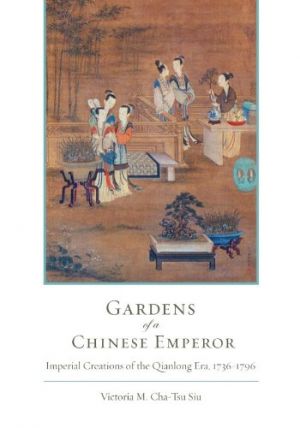 The Garden of Perfect Brightness (Yuanming Yuan) in the western suburbs of a Qing capital, Beijing, was begun by the great Kangxi emperor (r. 1661–1722), expanded by his son, the Yongzheng emperor (r. 1722–1736), and brought to its greatest glory by his grandson, the Qianlong emperor (r. 1736–1796). A lover of literature and art, the Qianlong emperor sought an earthly reflection of his greatness in his Yuanming Yuan. For many years he designed and directed an elaborate program of garden arrangements. Representing two generations of painstaking research, this book follows the Qianlong emperor as he ruled his empire from within his garden. In a landscape of lush plants, artificial mountains and lakes, and colorful buildings, he sought to represent his wealth and power to his diverse subjects and to the world at large. Having been looted and burned in the mid-nineteenth century by Western forces, it now lies mostly in ruins, but it was the world’s most elaborate garden in the eighteenth century. The garden suggested a whole set of concepts—religious, philosophical, political, artistic, and popular—represented in landscapes and architecture. Just as bonsai portrays a garden in miniature, the imperial Yuanming Yuan at the height of its splendor represented the Qing Empire in microcosm.
Victoria M. Siu (1935–2010), a member of the Religious of the Sacred Heart, U.S. province (RSCJ), held a Ph.D. from Georgetown University where her dissertation was on U.S.-Chinese relations.
Exhibition | From Veronese to Casanova: Italian Paintings from Brittany
From the Musée des Beaux-Arts de Rennes:
De Véronèse à Casanova: Parcours italien dans les collections de Bretagne
Musée des Beaux-Arts de Quimper, 19 April — 30 September 2013
Musée des Beaux-Arts de Rennes, 14 December 2013 — 2 March 2014
Curated by Mylène Allano
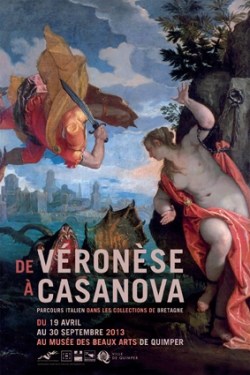 Les musées des beaux-arts de Rennes et de Quimper présentent successivement une grande exposition des peintures italiennes conservées dans la région. La manifestation a pour vocation de mettre en valeur et de faire connaître le patrimoine de la Bretagne historique, en exposant les fleurons des collections italiennes des musées de Brest, Dinan, Morlaix, Nantes, Quimper, Rennes, Vannes et ainsi que les plus belles œuvres des églises bretonnes ; soit 85 peintures de tout premier ordre offrant un panorama représentatif de la peinture italienne des XVIe au XVIIIe siècles.
Didier Rykner provides an exhibition review at La Tribune de l’Art (13 May 2013). . .
. . . L’exposition s’est basée sur une thèse de Mylène Allano—commissaire scientifique de cette exposition—qui cataloguait toutes les peintures italiennes conservées en Bretagne. Le parcours aurait pu être chronologique, par école ou par thèmes. C’est cette dernière présentation qui a été choisie. . .
◊ ◊ ◊ ◊ ◊
The catalogue is available from Artbooks.com:
Mylène Allano, ed., De Véronèse à Casanova: Parcours italien dans les collections de Bretagne (Lyon: Lieux Dits, 2013), 199 pages, ISBN: 978-2362190742, $47.50.
 Italian paintings held in Brittany are well known and appreciated by art specialists, and are characterised by their quality and by the variety of places represented (Venice, Rome, Naples…). This exhibition enables access to a remarkable set of works collected by museums, which have never previously received such attention. There are no less than eighty works which, for the first time, are the subject of an original display underlying the extraordinary vitality of artistic creation in Italy from the 16th century until the end of the 18th century.
Programming at the 2014 New York Ceramics Fair
Coinciding with New York’s Winter Antiques Week is the city’s Ceramics Fair, which will feature approximately “36 galleries offering all things ‘fired’—porcelain, pottery, glass, cloisonné and enamels, in a setting perfect for the exhibition and sale of important small objects.” A press release outlines programming, which will include an exhibition combining historic and contemporary pieces:
The Bacchanalistas: Passions + Pleasures
15th New York Ceramics Fair, Bohemian National Hall, New York, 22–26 January 2014
Curated by Leslie Ferrin
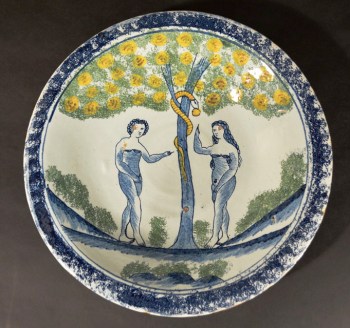
Large English Delftware Adam & Eve Dish, Bristol, ca. 1700–20
(Photo: Earle Vandekar of Knightsbridge)
The fifteenth edition of New York Ceramics Fair promises not only a dazzling array of traditional and contemporary treasures to entice the eye, but also thought-provoking lectures, panel discussions with top interior designers, and an exhibition called The Bacchanalistas: Passions + Pleasures, curated by Leslie Ferrin, the contemporary ceramics specialist.
The Bacchanalistas: Passions + Pleasures will present an overview of contemporary ceramics by living artists whose art draws inspiration from ceramic history. Themes of passion, eroticism, sexuality, abundance and excess of food and wine will be shown through figural sculpture, animated painted vessels and still life from the 16th century through today. To convey her theme, Ms. Ferrin invited the participating dealers at the New York Ceramics Fair to submit historic objects to juxtapose with the contemporary artists.
“Bacchanalia, the Roman festival of Bacchus, the Greco-Roman god of wine, freedom, intoxication and ecstasy were attended by a secret society and became legendary,” says Ms. Ferrin. “Ancient ceramic objects were in use during these parties and then later created to commemorate such events. Today a generation of artists is inspired by those objects and create their own for celebratory experiences. Decorative arts and fine art worlds collide with references to feast, sexuality and over the top pleasures. While not exactly a mystery cult, our contemporary art scene appears to some to operate today as the Bacchanalia did during Roman times, wild parties and excess in the name of pleasure and culture.”
The fair has designated Friday as their Designer Day featuring Alexa Hampton, Kitty Hawks, and David Scott on a panel called “Porcelain Perfect: How Top Decorators Accessorize with Ceramics,” in cooperation with the New York School of Interior Design, and moderated by Judith Gura, noted author and member NYSID. Mario Buatta, the highly acclaimed interior designer, will entertain his audience with “If You Can’t Hide It, Decorate It” followed by a book-signing of his best-seller Mario Buatta: 50 Years of American Style and Decoration, published by Rizzoli.
W E D N E S D A Y , 2 2 J A N U A R Y
12:00 “Tortoise Shell Ware Made in This Town: A Re-examination of the Benjamin Leigh and John Allman Partnership in Boston” Angelika Kuettner, Associate Registrar for Imaging and Assistant Curator of Ceramics, Colonial Williamsburg.
2:00 “English and Continental Glassware in Early America” Leslie B. Grigsby, Winterthur’s Curator of Ceramics and Glass.
4:00 “Perfected in New York City: Jean-Pierre Colné and the Origins of Mechanized Glass Cutting,” Ian Simmonds, antiques dealer and researcher.
F R I D A Y , 2 4 J A N U A R Y
12:00 “Porcelain Perfect: How Top Decorators Accessorize with Ceramics,” prominent interior decorators Alexa Hampton, David Scott and Kitty Hawks will discuss the importance of ceramics in decorating. Sponsored in co-operation with The New York School of Interior Design, the discussion will be moderated by Judith Gura, author and NYSID member and area co-ordinator.
2:00 “If You Can’t Hide It, Decorate It,” Mario Buatta, the internationally acclaimed interior designer. Mr. Buatta will sign copies of his new book, Mario Buatta: Fifty Years of American Style and Decoration.
S A T U R D A Y , 2 5 J A N U A R Y
12:00 “Making Pottery Tell Its Own Story: Royal Worcester’s Vases with Scenes of Chinese Porcelain Production,” Ron Fuchs II, Curator of the Reeves Collections at Washington and Lee University.
2:00 “Angels and Demons: The Pleasures of Pottery and Porcelain” Robert Hunter, the editor of Ceramics in America.
4:00 “The Bacchanalistas: Passions + Pleasure,” Leslie Ferrin, Director, Ferrin Contemporary. Coinciding with the exhibition, Ms. Ferrin’s lecture will present an overview of contemporary ceramics by living artists whose art practice draws inspiration from ceramic history. Themes of passion, eroticism, sexuality, abundance and excess of food and wine will be shown through figural sculpture, animated painted vessels, and still life.
All the lectures are free with show admission and are sponsored by the Chipstone Foundation.
◊ ◊ ◊ ◊ ◊
The New York Ceramics Fair, which takes place in the Grand Ballroom of the Bohemian National Hall, 321 East 73rd Street (between 1st and 2nd Avenues), opens with a private preview on Tuesday evening, from 5 to 8:30 PM. Tickets are $90 each. The show opens to the public on Wednesday, January 22 and runs through Sunday, January 26. Hours are 11 AM–7 PM and on Sunday, 11 AM–4 PM. Ticket price with catalogue is $20 per person and can be used throughout the duration of the fair.
The New York Ceramics Fair is produced by Meg Wendy/MCG Events LLC and Liz Lees/Caskey Lees Inc.
In addition to the New York CeramicsFair, Caskey-Lees currently produces the San Francisco Tribal & Textile Arts Show in San Francisco.
Exhibition | Winter Antiques Show in New York to Highlight the PEM
Press release (13 August 2013) from the Winter Antiques Show:
Fresh Take, Making Connections at the Peabody Essex Museum
60th Winter Antiques Show, Park Avenue Armory, New York, 24 January — 2 February 2014

Pair of carp tureens, 1760–80, Porcelain, Jingdezhen, China, with gilded bronze mounts, possibly from Spain (Peabody Essex Museum)
The Winter Antiques Show’s 2014 loan exhibition will celebrate the Peabody Essex Museum (PEM) in Salem, Massachusetts. Fresh Take, Making Connections at the Peabody Essex Museum is comprised of more than 50 paintings, sculptures, textiles, and decorative objects. One of America’s oldest and fastest growing museums, PEM was founded in 1799 and its collection showcases an unrivaled spectrum of American art as well as outstanding Asian, Asian export, Native American, African, Oceanic, maritime, and photography collections. The exhibition will be on view during the run of the Winter Antiques Show, from January 24 to February 2, 2014.
PEM celebrates its 215th year in 2014, and has recently embarked on a $650 million capital campaign and expansion that will place the museum among the top 10 art museums in the country in terms of gallery space and total endowment. The museum’s campus boasts 22 historic buildings celebrating Salem’s rich architectural and garden heritage and Yin Yu Tang, a 200-year old Chinese house that is the only example of its kind in the United States. PEM offers a vibrant schedule of changing exhibitions, a lively contemporary art program, performances, and an interactive education center.

Painted Side Chair, ca. 1795, Salem, MA, wood, paint, reproduction
upholstery (Peabody Essex Museum)
Fresh Take, Making Connections at the Peabody Essex Museum is a microcosm of the PEM experience. Works of art from diverse cultures and time periods are grouped together, uniting and contrasting objects of creative expression in unexpected ways. Highlights of the exhibition range from a spectacular inlaid ivory chair from India (18th century) to a mahogany dressing chest by Thomas Seymour (c. 1810); from an English brass mariner’s astrolabe used to determine time and latitude by the stars (late 1500s) to a stick chart used by Micronesian sailors navigating the Pacific Ocean (early 20th century); from a view of Salem Common by George Ropes (1808) to a Joseph Cornell collage inspired by Magritte’s surrealist landscape (c.1964); from a bronze Japanese reliquary from the Koki-ji Temple, Kawachi-gun, Osaka Prefecture (1679) to a Chinese bridal headdress made of Kingfisher feathers, silk, pearls, and semi-precious stones (c. 1800s).
One of the many highlights is a striking portrait of Nathaniel Hawthorne by Charles Osgood (1809– 1890). The 1840 portrait was painted when Hawthorne worked in the Boston Custom House, ten years before The Scarlet Letter was published. It is the best-known likeness of the young author.
The founding organization of today’s Peabody Essex Museum was the East India Marine Society. A centerpiece of the exhibit is the 1803 sign painted by Michele Felice Cornè (1752–1845) for the original Society’s exhibition hall. The sign depicts Salem Harbor and a ship, probably the Mount Vernon, on which the artist emigrated from Naples to America in 1800. Banner and letters were added in 1825 by sign painter Samuel Bartol for the new East India Marine Hall, where it was placed over the door.
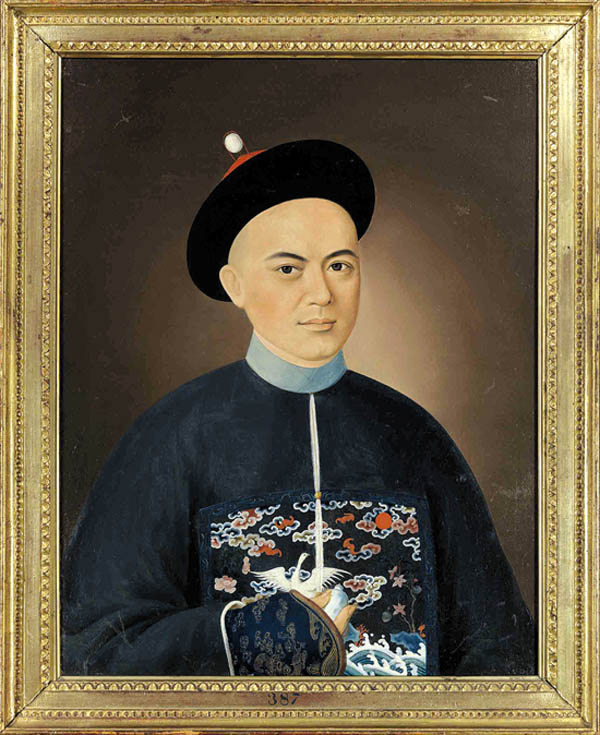
Spoilum, Portrait of Eshing, ca. 1805, Guangzhou (Canton).
Oil on canvas (Peabody Essex Museum)
A Spoilum portrait of a prominent Cantonese silk merchant is also included in the exhibition (1805). Spoilum (active 1785–1810) was one of the first Chinese artists to work in a Western style, and though he never traveled outside of China, his paintings often resemble early American portraiture. The artist is best known for his portraits of English and American merchants, so this portrait of Eshing (a Chinese merchant) is particularly rare. Eshing frequently did business with Salem merchants, and this portrait was acquired as a gift from one of these merchants to the East India Marine Society in 1809.
Demonstrating the wide travels of Salem’s wealthy merchants is a Brazilian headdress collected by Michael W. Shepherd on a trip up the Amazon River in 1847. The mid 19th-century headdress is made primarily of red and blue macaw feathers, an important expression of wealth for many indigenous people of South America. This type of headdress would have been worn by caciques (Native chiefs).
Jeff Daly, formerly senior design advisor to the director at the Metropolitan Museum of Art, will design the Winter Antiques Show’s loan exhibition and plans to create a modern kuntskammer to hold the many treasures from PEM, much like they were displayed in the original East India Marine Society exhibition hall.
The exhibition is sponsored by Chubb Personal Insurance for the 18th consecutive year.
About the Winter Antiques Show
The Winter Antiques Show celebrates its 60th year Diamond Jubilee as America’s most prestigious antiques show, featuring 73 renowned experts in American, English, European, and Asian fine and decorative arts in a fully vetted show. The show was established in 1955 by East Side House Settlement, a social services institution located in the South Bronx. All net proceeds from the show benefit East Side House Settlement. The Winter Antiques Show will run from January 24 to February 2, 2014, at the Park Avenue Armory, 67th Street and Park Avenue, New York City. The Winter Antiques Show hours are 12–8pm daily except Sundays and Thursday, 12–6 pm. Daily admission to the show is $25, which includes the show’s award-winning catalogue. To purchase tickets for the Opening Night Party on January 23, 2014, or Young Collectors Night on January 30, 2014, call (718) 292-7392 or visit the show’s website.
About East Side House Settlement
East Side House Settlement was founded in 1891 to help immigrants and lower income families on the East Side of Manhattan. In 1962, it moved to the South Bronx where it serves 8,000 residents annually within one of America’s poorest congressional districts, the Mott Haven section of the South Bronx. Among the initiatives that focus on educational attainment as the gateway out of poverty is the innovative and highly acclaimed Mott Haven Village Preparatory School.
Aronson Antiquairs Presents Puzzle Jugs at the Winter Antiques Show
Regular readers may recall my irrationally exuberant affection for puzzle jugs. -CH
As noted at Art Daily (4 January 2014)
Delft Puzzle Jugs from Aronson Antiquairs of Amsterdam
60th Winter Antiques Show, Park Avenue Armory, New York, 24 January — 2 February 2014

◊ ◊ ◊ ◊ ◊
At the 60th Annual Winter Antiques Show in New York, January 23 – February 2, 2014, Aronson Antiquairs of Amsterdam will showcase an amusing collection of Suijgkannen or Delft Puzzle Jugs. “Delft Puzzle Jugs from the 17th and 18th centuries are among the most prized examples of the amusing novelty, but Delft examples were seen as early as 1650. The style gained popularity throughout Europe. Puzzle Jugs were designed with hollow rims and handles and diverting spouts and tubes. They challenged and entertained guests at both homes and taverns. You never knew if a dinner party would be a success and whether your guests would like the food and wine and have a good time. But with a variety of Puzzle Jugs on hand you could get a good laugh out of those trying their dexterity and luck by making a game of it,” says Robert Aronson, fifth generation Dutch Delft dealer of Aronson Antiquairs of Amsterdam.
 Puzzle Jugs got their name from their ingenious design which could include a perforated neck, and hollow handle and rim. Sometimes as many as five or six concealed tubes or pipes were incorporated into the jug, making it even more difficult to imbibe the liquid, most often ale or wine. The trick was to drink the liquid without spilling the jug’s contents all over your shirt. It was common for tavern-keepers to offer these jugs in various drinking games, with guests wagering on who would master the puzzle. It helped to be highly dexterous and clever—itself a challenge during a night of merriment.
The oldest known, the Exeter Puzzle Jug, was produced in western France around 1300 and discovered in England in 1899. It was given to the Royal Albert Memorial Museum in Exeter, Devon. Many Puzzle Jugs had inscriptions on the body of the jug that ranged from simple to poetic, typically something along the lines of “Here gentlemen, come try your skill. I’ll hold a wager, if you will, that you don’t drink this liquid all without your spill or let some fall.”. . .
Highlights at the Aronson Antiquairs stand will include nine outstanding Delft Puzzle Jugs from a private collection including a Blue and White Delft Puzzle Jug from the Ten Tooren-Smith Collection, The Netherlands, which dates to 1760 and portrays an elegant couple on the body. The gallant gentleman is doffing his hat and approaching his sweetheart who holds a fan. The 22.8cm puzzle jug features a baluster-form body and panels of trellis diaperwork beneath the floral and foliate-pierced neck. The puzzle is in the tubular rim affixed with three nozzles which interrupts a flowering vine border continuing onto a hollow loop handle.
A second Blue and White Ring-Form Delft Jug dates to 1725–35 and features a circular body painted with a Chinese pheasant perched on a c-scroll forming the stem of a flowering leafy peony branch. It is pierced with three roundels, each centering a six petal flowerhead below three teardrop-shaped nozzles issuing from the tubular neck (24.4cm).
A third Delft Blue and White Puzzle Jug (23.4cm high) is from an earlier period, 1688–92, and was in Dr Gunther Grethe’s Hamburg Collection. Aronson says, “This jug has a GV mark in blue, probably is from Gijsbrecht Claesz, Verhaast. The spherical body is painted with a large insect and birds in flight above a chrysanthemum border. The cylindrical neck is pierced with three four-petal blossoms and eight dots against a foliate-patterned blue ground between floral borders, and affixed beneath the rim with a tubular device molded with seven blossoms, one of them pierced, and continuing into the flower and scroll-patterned hollow loop handle.”
Aronson says that the whimsical characteristics of Delft Puzzle Jugs appeal to collectors now because, “These are novelty pieces with amusing stories to tell that reveal how people lived centuries ago. Those who enjoy having a peek at what brought a smile to the face of our ancestors collect Delft Puzzle Jugs now. We are lucky to have acquired this collection of nine examples.” Prices range from $16,000 to $25,000.
New Book | Shapely Bodies: The Image of Porcelain
From the University of Delaware Press:
Christine A. Jones, Shapely Bodies: The Image of Porcelain in Eighteenth-Century France (Newark: University of Delaware Press, 2013), 216 pages, 978-1611494082, $85.
 Shapely Bodies: The Image of Porcelain in Eighteenth-Century France constructs the first cultural history of porcelain making in France. It takes its title from two types of ‘bodies’ treated in this study: the craft of porcelain making shaped clods of earth into a clay body to produce high-end commodities and the French elite shaped human bodies into social subjects with the help of makeup, stylish patterns, and accessories. These practices crossed paths in the work of artisans, whose luxury objects reflected and also influenced the curves of fashion in the eighteenth century.
French artisans began trials to reproduce fine Chinese porcelain in the 1660s. The challenge proved impossible until they found an essential ingredient, kaolin, in French soil in the 1760s. Shapely Bodies differs from other studies of French porcelain in that it does not begin in the 1760s at the Sèvres manufactory when it became technically possible to produce fine porcelain in France, but instead ends there. Without the secret of Chinese porcelain, artisans in France turned to radical forms of experimentation. Over the first half of the eighteenth century, they invented artificial alternatives to Chinese porcelain, decorated them with French style, and, with equal determination, shaped an identity for their new trade that distanced it from traditional guild-crafts and aligned it with scientific invention. The back story of porcelain making before kaolin provides a fascinating glimpse into the world of artisanal innovation and cultural mythmaking. To write artificial porcelain into a history of ‘real’ porcelain dominated by China, Japan, and Meissen in Saxony, French porcelainiers learned to describe their new commodity in language that tapped into national pride and the mythic power of French savoir faire. Artificial porcelain cut such a fashionable image that by the mid-eighteenth century, Louis XV appropriated it for the glory of the crown. When the monarchy ended, revolutionaries reclaimed French porcelain, the fruit of a century of artisanal labor, for the Republic. Tracking how the porcelain arts were depicted in documents and visual arts during one hundred years of experimentation, Shapely Bodies reveals the politics behind the making of French porcelain’s image.
Christine A. Jones is associate professor of French and Comparative Literary and Cultural Studies in the Department of Languages and Literature at the University of Utah.
Call for Papers | New Eyes on the Eighteenth Century Dinner Symposium
For graduate students and new PhDs in and around the Boston/New England region:
Fifth Annual New Eyes on the Eighteenth Century Dinner Symposium
Harvard University, Cambridge, MA, 10 February 2014
Proposals due by 17 January 2014
We are pleased to announce the fifth annual symposium featuring new work from emerging scholars (graduate students and new PhDs) living or studying in the region. This year we are again adopting a hybrid model, and we therefore invite abstracts for either of two formats:
• a 5-minute presentation of a specific problem, challenge, or conundrum in your research, followed by a dedicated time for problem-solving, discussion, and advice
• a 10-minute paper drawn from a larger piece of work: a seminar paper, your dissertation, or another current project, followed by a brief time for questions.
We aim to represent in a lively forum a broad spectrum of disciplines, national cultures, and intellectual approaches to eighteenth-century studies. Graduate students and new PhDs who wish to participate are asked to submit a one-page abstract electronically to Ruth Perry (rperry@mit.edu) and Sue Lanser (lanser@brandeis.edu) by Friday, January 17. Those selected will be notified within a week so that you will have time to prepare your brief presentation.
We ask all our colleagues to circulate this notice widely, to encourage graduate students to participate, and to make plans to join us on Monday, February 10. And please remember that ours is a long eighteenth century.
Monday, February 10, 2014, 6:00–8:30, Barker Center, Room 133
Sponsored by the Harvard Humanities Seminar on Eighteenth-Century Studies
New Book | Eighteenth-Century Thing Theory in a Global Context
Due out this month from Ashgate:
Ileana Baird and Christina Ionescu, eds., Eighteenth-Century Thing Theory in a Global Context: From Consumerism to Celebrity Culture (Aldershot: Ashgate, 2014), 386 pages, ISBN: 978-1472413307, $130.
 Exploring Enlightenment attitudes toward things and their relation to human subjects, this collection offers a geographically wide-ranging perspective on what the eighteenth century looked like beyond British or British-colonial borders. To highlight trends, fashions, and cultural imports of truly global significance, the contributors draw their case studies from Western Europe, Russia, Africa, Latin America, and Oceania. This survey underscores the multifarious ways in which new theoretical approaches, such as thing theory or material and visual culture studies, revise our understanding of the people and objects that inhabit the phenomenological spaces of the eighteenth century. Rather than focusing on a particular geographical area, or on the global as a juxtaposition of regions with a distinctive cultural footprint, this collection draws attention to the unforeseen relational maps drawn by things in their global peregrinations, celebrating the logic of serendipity that transforms the object into some-thing else when it is placed in a new locale.
Ileana Baird is a Postdoctoral Preceptorship Fellow at the University of Virginia, and Christina Ionescu is an Associate Professor of French Studies at Mount Allison
University in Canada.
C O N T E N T S
Introduction
• Peregrine things: rethinking the global in 18th-century studies, Ileana Baird
• Through the prism of thing theory: new approaches to the 18th-century world of objects, Christina Ionescu
I. Western European Fads: Porcelain, Fetishes, Museum Objects, Antiques
• Caution, contents may be hot: a cultural anatomy of the tasse trembleuse, Christine A. Jones
• Cultural currency: Chrysal, or The Adventures of a Guinea and the material shape of 18th-century celebrity, Kevin Bourque
• Feather cloaks and English collectors: Cook’s voyages and the objects of the museum, Sophie Thomas
• Imagining Ancient Egypt as the idealized self in 18th-century Europe, Kevin M. McGeough
II. Under Eastern Eyes: Garments, Portraits, Books
• Frills and perils of fashion: politics and culture of the 18th-century Russian court through the eyes of La Mode, Victoria Ivleva
• From Russia with love: souvenirs and political alliance in Martha Wilmot’s The Russian Journals, Pamela Buck
• ‘The battle of the books’ in Catherine the Great’s Russia: from a jousting tournament to a tavern brawl, Rimma Garn
III. Latin American Encounters: Coins, Food, Accessories, Maps
• From Peruvian gold to British Guinea: tropicopolitanism and myths of origin in Charles Johnstone’s Chrysal, Mauricio E. Martinez
• Eating turtle, eating the world: comestible things in the 18th century, Krystal McMillen
• The fur parasol: masculine dress, prosthetic skins, and the making of the English umbrella in Robinson Crusoe, Irene Fizer
• Terra Incognita on maps of 18th-century Spanish America: commodification, consumption and the transition from inaccessible to public space, Lauren Beck
IV. Imagining Other Spaces: Trinkets, Collectibles, Ethnographic Artifacts, Scientific Objects
• (Re-)appropriating trinkets: how to civilize Polynesia with a jack-in-the-box, Laure Marcellesi
• Images of exotic objects in the Abbé Prévost’s Histoire Générale des Voyages, Antoine Eche
• Souvenirs of the South Seas: objects of imperial critique in Jonathan Swift’s Gulliver’s Travels, Jessica Durgan
Select Bibliography and Index










 Enfilade
leave a comment