New Book | Early Modern Things: Objects and their Histories
Collected here are papers that originated from the Early Modern Things Workshop (Stanford, 29–30 January 2010). From Routledge:
Paula Findlen, ed., Early Modern Things: Objects and their Histories, 1500–1800 (New York: Routledge, 2013), 392 pages, ISBN: 978-0415520508 (hardcover), $160 / ISBN: 978-0415520515 (paperback), $45.
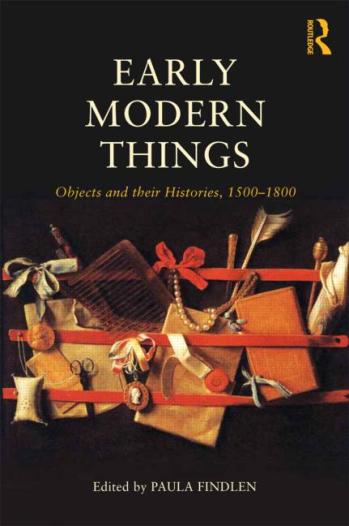 What can we learn about the past by studying things? How does the meaning of things, and our relationship to them, change over time? This fascinating collection taps a rich vein of recent scholarship to explore a variety of approaches to the material culture of the early modern world (c.1500–1800).
Divided into six parts, this book explores the ambiguity of things, representing things, making things, empires of things, consuming things, and lastly the power of things. Spanning across the early modern world, from Ming dynasty China to Georgian England, and from Ottoman Egypt to Spanish America, the authors provide a generous set of examples in how to study the circulation, use, consumption and, most fundamentally, the nature of things themselves.
Drawing on a broad range of disciplinary perspectives and lavishly illustrated, Early Modern Things supplies fresh and provocative insights into how objects—ordinary and extraordinary, secular and sacred, natural and man-made—came to define some of the key developments of the early modern world.
C O N T E N T S
Paula Findlen, Introduction: Early Modern Things: Setting Objects in Motion, 1500–1800
Part One: The Ambiguity of Things
1. Carla Nappi, Surface Tension: Objectifying Ginseng in Chinese Early Modernity
2. Marcy Norton, Going to the Birds: Animals as Things and Beings in Early Modernity
3. Jessica Riskin, The Restless Clock
Part Two: Representing Things
4. Julie Hochstrasser, ‘Stil-staende dingen’: Picturing Objects in the Dutch Golden Age
5. Giorgio Riello, ‘Things Seen and Unseen’: The Material Culture of Early Modern Inventories and Their Representation of Domestic Interiors
6. Chandra Mukerji, Costume and Character in the Ottoman Empire: Dress as Social Agent in Nicolay’s Navigations
Part Three: Making Things
7. Pamela H. Smith, Making Things: Techniques and Books in Early Modern Europe
8. Corey Tazzara, Capricious Demands: Artisanal Goods, Business Strategies, and Consumer Behavior in Seventeenth-Century Florence
Part Four: Empires of Things
9. Erika Monahan, Locating Rhubarb: Early Modern Russia’s Relevant Obscurity
10. Mark A. Peterson, The World in a Shilling: Silver Coins and the Challenge of Political Economy in the Early Modern Atlantic World
11. Alan Mikhail, Anatolian Timber and Egyptian Grain: Things That Made the Ottoman Empire
Part Five: Consuming Things
12. Morgan Pitelka, The Tokugawa Storehouse: Ieyasu’s Encounters with Things
13. Anne E.C. McCants, Porcelain for the Poor: The Material Culture of Tea and Coffee Consumption in Eighteenth-Century Amsterdam
14. Amanda Vickery, Fashioning Difference in Georgian England: Furniture for Him and for Her
Epilogue: The Power of Things
15. Renata Ago, Denaturalizing Things: A Comment
16. Timothy Brook, Something New: A Comment
17. Erin K. Lichtenstein, Identities through Things: A Comment
Historic Heston / Jas. Townsend & Son
This discussion with Heston Blumenthal, Ivan Day, and Bee Wilson is one of the events I would have most liked to have attended in 2013 (I’m a huge Bee Wilson fan). Alas, Blumenthal’s tome is available for purchase. Paula Forbes provides a thorough review at Eater (16 October 2013), with this brilliant summary: “if Willy Wonka ran Hogwarts, Historic Heston would be the history textbook.” -CH
As noted by Barley Blyton at the British Library’s Social Science Blog, “Historic Heston at the British Library” (29 November 2013) . . .
[On November 8] as part of the Georgians Revealed exhibition, the British Library hosted a discussion between Heston Blumenthal—one of Britain’s most acclaimed chefs and exponent of the egg and bacon ice-cream—and Ivan Day—food historian, broadcaster, writer and confectioner. Centring on Heston’s new book and using the Georgian period as the frame for their discussion, Blumenthal and Day wound their way through history and their own pasts, expertly guided by food writer and historian Bee Wilson as Chair. . .
◊ ◊ ◊ ◊ ◊
Heston Blumenthal, Historic Heston (London: Bloomsbury, 2013), 432 pages, ISBN: 978-1620402344, £125 / $200 (currently discounted to $125 on Amazon).
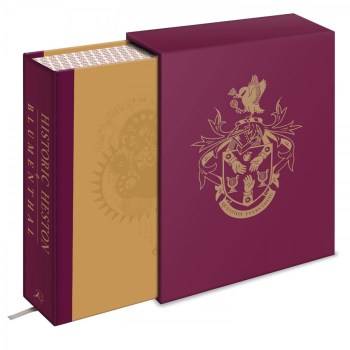 British gastronomy has a grand old tradition that has been lost over time. Now England’s most inventive chef is out to reclaim it. Heston Blumenthal, whose name is synonymous with cutting-edge cuisine, nonetheless finds his greatest source of inspiration in the unique and delicious food that the sceptered isle once produced. This has been the secret to his success at world-famous restaurants The Fat Duck and Dinner, where a contrast between old and new, modern and historic, is key.
Historic Heston charts a quest for identity through the best of British cooking that stretches from medieval to late-Victorian recipes. Start with thirty historic dishes, take them apart, put them together again, and what have you got? A sublime twenty-first-century take on delicacies including meat fruit (1500), quaking pudding (1660), and mock-turtle soup (1892). Heston examines the history behind each one’s invention and the science that makes it work. He puts these dishes in their social context and follows obscure culinary trails, ferreting out such curious sources as The Queen-like Closet from 1672 (which offers an excellent method for drying goose). What it adds up to is an idiosyncratic culinary history of Britain.
This glorious tome also gives a unique insight into the way that Heston works, with signature dishes from both The Fat Duck and Dinner. Illustrated by Dave McKean and with some of the most superb food photography you’ll ever see, Historic Heston is a book to treasure. You think you know about British cooking? Think again.
◊ ◊ ◊ ◊ ◊
If any of this gets you in the mood for exploring eighteenth-century food, you might also be interested in the blog Savoring the Past along with the accompanying video series 18th-Century Cooking with Jas. Townsend & Son. Both are connected to the Indiana-based, online retailer Jas. Townsend & Son. With food goods comprising only a portion of the company’s business, the store, has “helped historical reenactors, movie makers, theatrical companies, pirates, and regular people find items including clothing, tents, books, knives, tomahawks, oak barrels, and lots of other goods appropriate for 1750 to 1840,” for over 35 years. Perhaps just the thing as you get ready for ASECS in Williamsburg . . .
Here Jonathan Townsend makes mushroom ketchup:
Exhibition | Fragonard: Poetry and Passion
From the Staatliche Kunsthalle Karlsruhe:
Fragonard: Poetry and Passion / Poesie und Leidenschaft
Staatliche Kunsthalle Karlsruhe, 30 November 2013 — 23 February 2014
You could say that the drawings are the diary of his imagination.
–Edmond and Jules de Goncourt, 1865
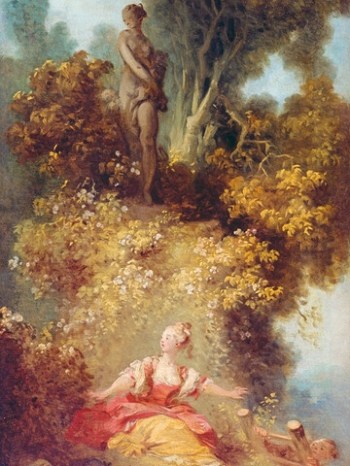
Jean-Honoré Fragonard, La Surprise, ca. 1771
(Musée des Beaux-Arts, Angers)
The work of Jean-Honoré Fragonard (1732–1806) is the embodiment of elegance and expressiveness. The French artist was one of the outstanding masters of the 18th century; and yet his name is relatively unfamiliar to many in Germany today. Born in Grasse, Fragonard spent most of his life in Paris, where he was a pupil of François Boucher. Despite initial successes in the Paris Salon exhibition, he embarked on a path outside the Academy and found his main audience among wealthy private collectors.
First monographic exhibition in Germany of Fragonard’s work
The Karlsruhe exhibition principally features a selection of Fragonard’s drawings, enriched by several oil studies and paintings. With some 80 works in all, the display gives an insight into the dazzling versatility of an oeuvre that includes scenes of cheerful social gatherings, landscapes, narrative scenes, and intimate depictions of great sensuality. The exhibition captures and reflects the artist’s delight in experimentation, his vitality of imagination, and boldness in formal composition. In the same breath, Fragonard demonstrates both how firmly rooted he was in the artistic tradition of the 17th century and his skill in being able to vary and reinterpret the repertoire of forms and subjects of that tradition. Through his handling of chalk and brush, he created compositions of sparkling imagination and great passion.
The exhibition has been made possible thanks to the generous support of international lenders, including the Louvre in Paris, the Albertina in Vienna, the British Museum in London, and the Fundação Calouste Gulbenkian in Lisbon, as well as several private collectors.
◊ ◊ ◊ ◊ ◊
From Artbooks.com:
Juliane Betz, ed., Fragonard: Poesie und Leidenschaft (Munich, Deutscher Kunstverlag, 2013), 272 pages, ISBN: 978-3422072145, $68.50.
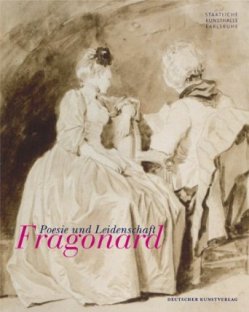 The current exhibition at Staatliche Kunsthalle Karlsruhe focuses on drawings by Jean-Honoré Fragonard, one of the finest French artists of the 18th century. They are juxtaposed against selected paintings that reveal links between his graphic and painterly works. Fragonard developed a unique pictorial idiom, which made use of both painterly and graphic elements and elevated unworked sections of bare paper into a core compositional element.










 Enfilade
leave a comment