Call for Articles | Anthology: On the Politics of Ugliness
As noted at H-ArtHist:
Anthology: On the Politics of Ugliness
Chapter proposals due by 15 January 2015
Ugliness is a pejorative marker for bodies, things, and feelings that fall beyond or outside the limits of acceptability. Ugliness has long been indirectly deployed in order to mark, collect, and exclude that which is determined to be aesthetically intolerable (Garland-Thomson; Grealy; Schweik), disgusting (Meagher), dirty (Douglas), abject (Kristeva), monstrous (Braidotti; Haraway; Rai & Puar; Schildrick; Sharpe), revolting (Lebesco), grotesque (Russo), or even simply plain and unaltered (Bartky; Bordo; Morgan; Wolf). While aesthetically ugliness has been positioned both against beauty and as a distinct category for art and art-making (Adorno; Ranciere), there has been little sustained engagement with the ways that ugliness operates alongside identities, bodies, intimacies, practices, and spaces (exceptions include Danticat; Kincaid; Athanassoglou-Kallmyer). Part of the reason for this absence might be that ugliness is at once too broad and too diffuse, serving, as art historian Nina Athanassoglou-Kallmyer has pointed out, as “an all-purpose repository for everything that [does] not quite fit,” a marker of “mundane reality, the irrational, evil, disorder, dissonance, irregularity, excess, deformity, the marginal” (281).
A repository for many socio-cultural feelings and attitudes, ugliness operates in ways that have dangerous and deadly consequences for bodies and those who inhabit them. When a body is labeled or understood as ‘ugly’, it is subsequently positioned as up for expunging, destruction, and affectively motivated terror (Fanon). For example, the ‘ugly laws’ of late nineteenth- and early twentieth-century America demonstrate the visceral discomfort that ‘ugly’ bodies evoke, justifying their exclusion from public spaces on account of their ‘polluting’ effects (Schweik). This demarcation of ugliness is inextricably bound with taken-for-granted ethical, epistemological, and ontological assumptions about the value of bodies. Further, ugliness is infused with dominant discourses of ability, race, heterosexuality, gender, body size, health, and age. At the level of ideas, relations and institutions, deployments of ugliness can have lethal effects on a body’s horizons and the possibilities for visibility, intimacy, and thick life.
On the Politics of Ugliness seeks to provide the first anthology that centralizes ugliness as a political category. It explores the various ways in which ugliness is deployed against those whose bodies, habits, gestures, feelings, expressions, or ways of being deviate from social norms. It argues that ugliness is politicalin at least two ways: (1) it denotes inequalities and hierarchies, often serving as a repository for all that is ‘other’; and (2) it is contingent and relational, taking shape through the comparison and evaluation of bodies. This collection asserts that it is only in facing ugliness as a political category that we can agitate routinely harmful ways of seeing, understanding and relating.
We are seeking an array of contributions that will center the politics of ugliness as it relates to bodies, feelings, gestures, habits, things, spaces, sounds, intimacies and their operations alongside ability, race, gender, class, sexuality, body size, age, health, or animality. Specifically, we invite submissions of academic papers; however, we will also consider art-based work, memoirs, cultural scholars, writers, and artists. We welcome approaches informed by (but not limited to) critical disability studies, critical race and postcolonial studies, feminist theory, literary theory, art history, cultural studies, queer and sexuality studies, science and technology studies, critical psychology, environmental studies, musicology, and performance studies.
Submissions should engage with the politics of ugliness. Topics of inquiry may include
• interrogations of ugliness as violence against bodies
• the ethics of engaging with ugliness
• feminist explorations of ugliness, ‘ugly’ engagements with feminism
• ugly methodologies, reading practices, and modes of inquiry
• representations of ugliness, ‘ugly’ bodies, body parts, and ‘ugly’ behaviors
• phenomenological encounters with ugliness: feeling ugly, being ‘ugly’, embodying ugliness
• ugly intimacies, feelings, and dispositions (e.g., Ngai; Sharpe)
• genealogies, archives, temporalities, and histories of ugliness
• the fashionizing of ugliness, ugly fashion
• ugly development practices, environmental ugliness
• visual, sensorial, and tactile pollution in relation to spaces and geographies
• theoretical considerations of ugliness as a political category
• reclamations and tactical repositionings of ugliness (e.g., Eileraas)
The deadline for chapter proposals (maximum of 500 words) is 15 January 2015. Please forward proposals or questions to Ela Przybylo (przybylo@yorku.ca) and Sara Rodrigues (sararod@yorku.ca) with the subject heading “On the Politics of Ugliness.”
Exhibition | Alexander, Napoleon, and Joséphine
Opening next spring at the Hermitage Amsterdam:
Alexander, Napoleon, and Joséphine
Hermitage Amsterdam, 28 March — 18 October 2015

Anonymous, after Gioacchino Serangeli, Napoleon and Alexander I Bid Farewell after the Peace of Tilsit (Hermitage Museum, St Petersburg)
It is October 1812. Napoleon and his troops are leaving Moscow. The French armies’ long advance has been checked: Tsar Alexander I has refused to surrender to Napoleon. The inhabitants of Moscow have fled and set the city alight. The army can go no further without supplies. The retreat is disastrous. Napoleon loses half a million men to freezing temperatures and combat. This is a turning point in history, the prelude to Napoleon’s ultimate defeat at Waterloo.
This exhibition brings to life the battle waged by two emperors on the turbulent European stage. From their initial friendship, their meeting on the raft at Tilsit and a fragile peace to the great battles and the fire of Moscow. One woman plays a pivotal role in both their lives: Joséphine de Beauharnais. Her collection from Château de Malmaison eventually ended up in the
Winter Palace in St Petersburg.
Symposium | The Century of Taste: Art in the Age of Enlightenment
As noted at H-ArtHist:
Das Jahrhundert des Geschmacks: Kunst im Zeitalter der Aufklärung
Historischer Saal der Ravensberger Spinnerei, Ravensberger Park, Bielefeld, 28 November 2014
Eine Veranstaltung der Kunstsammlung Rudolf-August Oetker GmbH, des Museum Huelsmann und der Professur für Kunstgeschichte der Universität Bielefeld. Konzeption: Monika Bachtler, Johannes Grave und Hildegard Wiewelhove
Das 18. Jahrhundert hat in vielerlei Hinsicht den modernen Kunstbegriff geprägt, der—ungeachtet aller Zuspitzungen und Infragestellungen—noch bis in unsere Gegenwart nachwirkt. Was wir unter Kunst verstehen, aber auch wie wir mit Kunst umgehen und sie in unser soziales Leben einbinden, ist erheblich durch Entwicklungen beeinflusst worden, die im 18. Jahrhundert ihren Anfang genommen haben. In das Jahrhundert der Aufklärung fallen die Etablierung regelmäßiger Kunstausstellungen, die Entstehung der Kunstkritik und die zunehmende Verbreitung einer bürgerlich geprägten Sammelkultur ebenso wie die Begründung der Ästhetik als einer philosophischen Disziplin, die der Sinnlichkeit eine eigene Erkenntniskraft zumisst. All diese Entwicklungen haben ihrerseits in ohem Maße auf die Künstler und ihre Werke zurückgewirkt. In exemplarischer Weise lässt sich in dieser Zeit daher beobachten, wie sich die Kunstproduktion, der Umgang mit Kunst und das Nachdenken über das Ästhetische wechselseitig beeinflussen.
Anlässlich der Ausstellung Wie es uns gefällt. Kostbarkeiten aus der Sammlung Rudolf-August Oetker, die das 18. Jahrhundert mit ausgewählten Werken der Kunst und des Kunsthandwerks vor Augen führt, soll das Symposium Schlaglichter auf die Kunst und ästhetische Kultur dieser Zeit werfen. In sechs Vorträgen wird sich die Veranstaltung sowohl exemplarischen Werken oder Werkgruppen als auch dem kulturellen Kontext zuwenden, um zu einem besseren Verständnis des Jahrhunderts des Geschmacks beizutragen. Dabei könnte sich erweisen, dass die durchaus spielerischen Formen, in denen im 18. Jahrhundert Kunst und Leben immer wieder neu zueinander ins Verhältnis gesetzt wurden, von überraschender Aktualität sind.
Tagungsgebühr: 20€; ermäßigt für Studierende und Auszubildende: 10€. Anmeldung unter (0521) 51-3767 oder info@museumhuelsmann.de
◊ ◊ ◊ ◊ ◊
P R O G R A M M
10.00 Dr. Monika Bachtler (Kunstsammlung Rudolf-August Oetker GmbH) und Prof. Dr. Hildegard Wiewelhove (Museum Huelsmann), Begrüßung
10.15 Prof. Dr. Johannes Grave (Universität Bielefeld), Einführung
10.30 Dr. Christoph Martin Vogtherr (Wallace Collection London), Niederländische und französische Malerei im Paris des 18. Jahrhunderts
11.30 Dr. Ulrike Grimm (Karlsruhe), Ein Schloss, “in welchem guter Geschmack mehr Gewicht besitzt als äußere Pracht”. Zur Residenz der Caroline Luise von Baden in Karlsruhe
12.30 Mittagspause mit kleinem Imbiss
13.30 Prof. Dr. Anna Zika (Fachhochschule Bielefeld), … und nur das Natürliche ist schön. Modediskurse in deutschsprachigen Journalen des späten 18. Jahrhunderts
14.30 Prof. Dr. Reinhard Wegner (Friedrich-Schiller-Universität Jena), Wie kommt die Farbe ins Bild? Newtons Lichttheorie und die Schönen Künste
15.30 Kaffeepause
16.00 Prof. Dr. Beate Söntgen (Leuphana Universität, Lüneburg), Stiller Austausch. Chardins Formen der Kommunikation
17.00 Prof. Dr. Thomas Kirchner (Deutsches Forum für Kunstgeschichte, Paris), Die Französische Revolution und die Demokratisierung der Kunst
18.00 Abschlussdiskussion
Exhibition | Treasures from the Collection Rudolf-August Oetker
From the Museum Huelsmann
Wie es uns gefällt: Kostbarkeiten aus der Sammlung Rudolf-August Oetker
Museum Huelsmann, Ravensberger Park, Bielefeld, 14 September 2014 — 28 January 2015
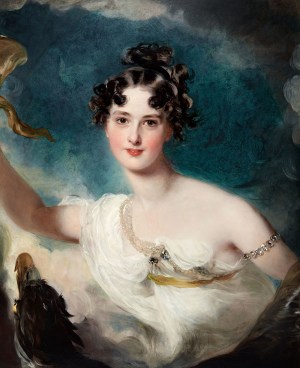
Thomas Lawrence, Princess Clementine de Metternich, ca. 1818–20.
Die umfangreiche Kunstsammlung des Bielefelder Unternehmers, Sammlers und Mäzens Rudolf-August Oetker (1916–2007) gehört in der Sammlungsgeschichte Deutschlands zu den wenigen privaten Beispielen des 20. Jahrhunderts.
Ausgewählte Kostbarkeiten der Malerei des Barock, Rokoko und Klassizismus sowie des europäischen Kunsthandwerks, darunter selten gezeigte Porzellane, auserlesenes Silber und fürstliche Schatzkunst repräsentieren den individuellen, aber auch universellen Charakter des Sammlers und stehen im Kontext des 18. Jahrhunderts, dem Jahrhundert, das das Aufkommen des individuellen Geschmacks betont.
Installation photos from the firm DesignPosition are available here»
The exhibition flyer is available as a PDf file here»
◊ ◊ ◊ ◊ ◊
From Hirmer Verlag:
Monika Bachtler, ed., Wie es uns gefällt: Kostbarkeiten aus der Sammlung Rudolf-August Oetker (Munich: Hirmer Verlag, 2014), 144 pages, ISBN: 978-3777422930, 35€.
 Die umfangreiche Sammlung des Bielefelder Unternehmers Rudolf-August Oetker ist eines der wenigen Beispiele der Geschichte privaten Sammelns in Deutschland während des 20. Jahrhunderts, das gleichermaßen universelle wie individuelle Maßstäbe setzte. Anhand der daraus ausgewählten Kostbarkeiten der Malerei des Barock und Rokoko und des europäischen Kunsthandwerks entsteht ein kulturgeschichtlich plastisches Bild dieser Zeit, aber auch eine Vorstellung vom repräsentierenden Charakter einer persönlich geprägten Ankaufstrategie. Das Katalogbuch spiegelt die Opulenz dieser Sammlerwelt in Bildern und Texten wider.
Call for Papers | ISECS 2015 Panel—Alternative Markets in France
Now accepting proposals for this panel for next year’s ISECS Congress in Rotterdam:
Alternative Markets and Visual Culture in Eighteenth-Century France
ISECS Congress, Rotterdam, 26–31 July 2015
Proposals due by 12 January 2015 (though earlier submissions encouraged)
Organiser: Dr. Esther Bell (Curator in Charge, European Paintings, Fine Arts Museums of San Francisco) and Dr. Jessica Fripp (Post-doctoral Fellow in Visual and Material Culture, Parsons The New School for Design)
Academic artistic practice in the eighteenth century was at odds with the growing commercial culture of the period. From its foundation, the Royal Academy prohibited its members from dealing in art, an offense that was deemed cause for expulsion by 1777. Critics similarly looked down on painting for profit. In 1747, La Font de Saint Yenne had harsh words for artists who chose the more financially lucrative practice of portraiture over the more noble art of history painting. Diderot suggested that Fragonard’s turn away from history painting was caused by “l’appas du gain.”
Of course, even artists who appeared to resist the lure of monetary wealth were embedded in complex systems of exchange based on other forms of capital. This panel seeks to explore alternative markets of exchange that developed around the production of eighteenth-century visual culture and the forms of symbolic capital artists could accumulate. Papers might address topic such as: the role of collecting works by one’s contemporaries, friendship networks between artists and artists and patrons, celebrity as currency, gift exchange and favors, artistic dynasties and family allegiances. We especially encourage papers that demonstrate exchange across France’s borders, including its colonies or other European entities.
Information on how to submit abstracts can be found here»
Exhibition | The Generous Georgian: Dr Richard Mead
The conference Dr Richard Mead: Physician, Philanthropist, Collector takes place next Monday, October 20. While I noted the exhibition previously, I didn’t include the press release. It’s included below, and the image sheet is available here. I’m excited to be part of the conference programme and look forward to a few days in London. –CH
The Generous Georgian: Dr Richard Mead
The Foundling Museum, London, 26 September 2014 — 4 January 2015

Allan Ramsay, Dr Richard Mead, 1747
(London: The Foundling Museum)
For the last major exhibition of the Foundling Museum’s 10th anniversary year, the focus turns to the life and work of Dr Richard Mead (1673–1754), one of the most eminent physicians, patrons, collectors and philanthropists of his day, and a significant figure in the early history of the Foundling Hospital.
A leading expert on poisons, scurvy, smallpox and public health, Mead counted among his patients included Queen Anne, George II, Sir Isaac Newton and the painter Antoine Watteau. Mead was no stranger to daring acts and fierce controversies, with stories of drinking snake venom in his investigations into the effects of various poisons, and fighting a duel to defend his theory on smallpox treatment. He also possessed a deep-seated passion for the arts, demonstrated in a lifetime’s patronage of painters such as Allan Ramsay and a revered collection of masterpieces that included works by Dürer, Holbein, Rembrandt, Poussin, and Canaletto.
Smallpox was endemic in Georgian England, and killed an estimated 400,000 Europeans throughout the eighteenth century. Though vaccination against smallpox was developed by Edward Jenner at the end of the century, inoculation was promoted decades earlier. Dr Mead was an ardent and effective advocate of this procedure, which saved the lives of many, including foundlings. Of the 247 children who were inoculated at the Foundling Hospital, by 1756 only one had died of the disease.
Exploring Mead’s diverse contributions to Georgian society—the collector, the philanthropist and the physician—this exhibition reunites key objects from Mead’s life and collection, such as the ancient bronze Arundel Head (2nd Century BC) and Allan Ramsay’s half-length portrait of Mead, evidence of his significance in London’s cultural landscape.
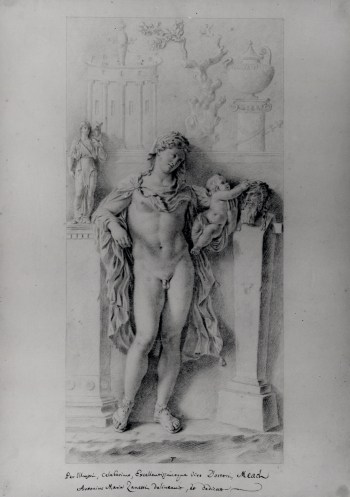
Antonio Maria Zanetti, Study of a relief decorated with a Hermaphrodite; in the Palazzo Colonna, ca.1721. Image courtesy of The Trustees of the British Museum, used with permission.
Items from the Foundling Museum archive, such as the minutes from the very first Governors’ meeting, and the logs of daily life at the Foundling Hospital in its first year, are also on display to illustrate Mead’s relationship with the Hospital and the important role he played in its early history. Mead dedicated considerable time and energy to the Hospital, encouraging his noble clients to support the charity, serving as a Governor and giving his clinical expertise pro bono. His contribution went even further, to attending sick children and advising on nurses’ salaries and what medicines to keep in stock.
His home on Great Ormond Street backed onto the Foundling Hospital grounds, and housed his magnificent collection of paintings, sculptures, antiquities, coins and a library of over 10,000 books. Painters and scholars were given access to Mead’s renowned collection which, in a time before public galleries, offered visitors a rare chance to view artistic masterpieces from around the world.
Mead’s generosity in every aspect of his life meant his family were burdened with huge debts following his death. Perhaps anticipating this, Mead’s will ordered for the sale of thousands of objects from his incredible collection – in an auction lasting 56 days! Through a number of key objects, we highlight a once-legendary collection which, compared to that of his contemporary and founder of the British Museum, Sir Hans Sloane, is not so well known today. This exhibition celebrates the energy, learning and wide interests of a truly generous Georgian who, according to his contemporary the writer Samuel Johnson, “lived more in the broad sunshine of life than almost any man.”
The Generous Georgian: Dr Richard Mead is supported by the Wellcome Trust, the City of London Corporation, the Royal College of Physicians, and Verita.
Exhibition | Canaletto, Bernardo Bellotto Paints Europe
Last fall, I noted this exhibition Canaletto, Bernardo Bellotto Paints Europe / Bernardo Bellotto Malt Europa, which opens this week at Munich’s Alte Pinakothek, Munich (17 October 2014 — 19 January 2015), but that was admittedly ages ago (thanks to Hélène Bremer for the useful reminder). And here’s the information for the catalogue. –CH
The German edition catalogue will soon by published by Hirmer; the English edition, distributed by The University of Chicago Press, will be available in January:
Andreas Schumacher, Canaletto, Bernardo Bellotto Paints Europe (Munich: Hirmer Publishers, 2015), 360 pages, ISBN: 978-3777422473, $75.
 In 1761, Bernardo Bellotto painted his famous panorama of Munich, signing the painting ‘Canaletto’—as he signed many of his paintings—in tribute to his uncle and teacher Giovanni Antonio Canal. In addition to the famous panorama, Bellotto completed over the course of several months two stunning palace views for the Duke of Bavaria, Maximilian III Joseph.
Placing Bellotto’s Munich paintings within the artist’s broader body of work, this well-illustrated book highlights the Italian painter and printmaker’s capacity to create paintings of European cities that are both remarkably realistic and compositionally idealistic. Depicting Dresden, Vienna, Turin, and Warsaw, the paintings demonstrate an elaborate attention to architectural and natural detail and a sophisticated understanding of the specific quality of light in each place. By juxtaposing the paintings with Bellotto’s preparatory sketches, the book also sheds light on his complicated process, which is thought to have included the use of the popular optical aid of that time, the camera obscura. Rounding out the book is a contemporary artistic reevaluation of the paintings through the medium of photography.
Bringing together many well-known works by the Venetian vedute with a trove of paintings rarely seen, including a series of highly idealized architectural depictions, the book illustrates his critical contribution to this important European tradition.
Andreas Schumacher is a director at the Alte Pinakothek, Munich, where he is responsible for the museum’s Collection of Italian Painting to the End of the Eighteenth Century. He is also an associate lecturer at the Institute for Art History at the University of Bonn, Germany.
◊ ◊ ◊ ◊ ◊
Recent Launch of the Association of Print Scholars
APS envisions a future for itself as a CAA affiliate society. As noted at H-ArtHist:
Introducing the Association of Print Scholars, a new group bringing together the print community
 We are excited to announce the launch of the Association of Print Scholars (APS). APS is a nonprofit members’ group for enthusiasts of printmaking that will bring together the diverse community of curators, collectors, academics, grad students, artists, paper conservators, critics, independent scholars, and dealers. APS’s goals are to encourage innovative and interdisciplinary study of printmaking and to facilitate dialogue among members.
Membership benefits will include
• Access to a searchable database of active members and their current activities
• Ability to update online membership profile with all print-related activities
• Announcements about events, exhibitions, calls for papers, and other news from the print world
• Opportunities to promote new projects to members on the APS website and listserv
• Participation in APS’s events, including lectures and scholarly conferences
• Grants for digital projects and research, and support for working/reading groups
For further information, please contact info@printscholars.org, or visit www.printscholars.org. In addition, please consider joining and donating to APS through our Indiegogo campaign. Your support will help us build our website, which will launch in early 2015.
Exhibition | Dining with the Tsars: Fragile Beauty from the Hermitage

Items from the Service of the Order of St George, Porcelain manufactory of Franz (Francis) Gardner in Verbilki, Dmitrovsky, Moscow Province, Russia. 1777–78 (State Hermitage Museum, St Petersburg)
◊ ◊ ◊ ◊ ◊
Press release from the Hermitage Amsterdam:
Dining with the Tsars: Fragile Beauty from the Hermitage / Breekbare schoonheid uit de Hermitage
Hermitage Amsterdam, 6 September 2014 — 1 March 2015
The Hermitage Amsterdam’s fifth anniversary exhibition Dining with the Tsars: Fragile Beauty from the Hermitage opens on 6 September 2014. Eight magnificent porcelain and creamware services from the collection of the Hermitage in St Petersburg will be exhibited in a setting that conveys what the balls and banquets of the Tsar’s court were like. Visitors will imagine they are guests, in possession of a coveted imperial invitation, climbing the steps of the Winter Palace, reviewing the rules of etiquette and preparing for a festive occasion. Finally they enter the main hall where the fine porcelain dinnerware is set out in a festive display.

Items from the Green Frog Service, Wedgwood, Etruria (Stoke-on-Trent). 1773–74 (State Hermitage Museum, St Petersburg)
The exquisite porcelain services, comprising no less than 1,034 pieces, exhibited on authentically laid tables with decorative centrepieces, reveal the enchanting grandeur of the Tsars’ banquets. The exhibition tells the story of the lavish ball and banqueting culture that reached its zenith under the reign (1762–1796) of Catherine the Great, Queen of Feasts, when hundreds of dishes would be served at a single banquet and thousands of guests attended the balls. The last tsar, Nicholas II (ruled 1894–1917) and his wife Alexandra, who organised the largest balls but were only present for as briefly as possible. With their abdication, the ball and banqueting customs that had once captured the imagination of all the courts of Europe came to an end.
The finest pieces are from the dinnerware collections of Catherine the Great, such as the Green Frog Service (Wedgwood, England), the Cameo Service (Sèvres, Paris, exhibited for the first time with silver gilt flatware), which at one time comprised nearly a thousand pieces, and the Berlin Dessert Service (Königliche Porzellan-Manufaktur Berlin). The services of later Tsars were no less impressive and significant for their connection to European history. The services are exhibited in accordance with the rules of etiquette, augmented with ornate centrepieces, gold-rimmed crystal glassware, candelabras, vases, detailed silverwork and wall decorations. The exhibition features a wide range of pieces, from ice buckets for liqueur bottles and ice-cream coupes to salt and pepper sets and table figurines.
The exhibition also offers a culinary view of imperial dining customs, in a culture where banquets of 300 dishes were no exception. Dessert was the highpoint of the meal and the ideal course for showing off the host’s wealth and refined taste. Richly decorated delicacies were served with exceptional inventiveness. There is attention for iconography and the diplomatic function of giving services as gifts and hosting state dinners in the eighteenth and nineteenth centuries. And the balls and performances, gossip and scandal also feature in the exhibition. Evidence of the excesses of the imperial court abounds. Particularly revealing are the quotes drawn from the memoires of Marie Cornélie van Wassenaer Obdam. She visited the Winter Palace in 1824 as a member of the retinue of Anna Paulowna and the later King Willem II.
The surpring final exhibit is the service given to Stalin by the Hungarian people in 1949, which has never been used or exhibited before. It illustrates the diplomatic role that dinnerware also played in the twentieth century.
Never before have so many porcelain dinnerware pieces from the Hermitage been exhibited in the Netherlands. The rich collection of European porcelain from the Hermitage in St Petersburg comprises over 15,000 items, purchased by or given as gifts to the Tsars of Russia between 1745 and the years prior to the First World War. The services, which include many unique pieces, were produced by leading porcelain manufacturers such as Meissen, Sèvres, Gardner and Wedgwood and decorated to the highest artistic standard.
Spatial designer Lies Willers and stylist Jeanine Aalfs joined forces to produce an innovative, festive, engaging, dreamlike and overwhelming scenography.
Dozens of high-resolution images are available here»
New Book | The Drawing Room: English Country House Decoration
From Rizzoli:
Jeremy Musson, foreword by Julian Fellowes with photographs by Paul Barker, The Drawing Room: English Country House Decoration (New York: Rizzoli, 2014), 272 pages, ISBN: 978-0847843336, $60.
 A highly detailed look at the most accomplished English country house interiors, exemplifying English decorating at its best. The English drawing room, a formal place within a house of status where family and honored guests could retire from the more public arena, is one of the most important rooms in an English country house, and thus great attention has been paid to preserving the decoration of this most elegant of spaces: the center of life in the English countryside and the epitome of English country house decoration. This book offers privileged access to fifty of the finest drawing rooms of country houses and historic townhouses—many still in private hands—including Althorp, Attingham, and Knepp Castle. Through these sumptuous rooms, readers experience a history of English decorating from the sixteenth century to the present day, including the work of design legends such as David Hicks, Nancy Lancaster, John Fowler, and David Mlinaric. Specially commissioned photographs capture the entirety of each room, as well as details of furniture, architectural elements, artwork, collections, and textiles, creating a visually seductive book that will inspire interior designers and homeowners interested in the widely popular classic English look.
Jeremy Musson is the former architectural editor of Country Life, the cowriter and presenter of the BBC television series The Curious House Guest, and the author of many books, including English Country House Interiors, The English Manor House, How to Read a Country House, and The Country Houses of Sir John Vanbrugh. Paul Barker is one of England’s premier interior and architectural photographers, whose books include English Country House Interiors, England’s Thousand Best Churches, and English Ruins. Julian Fellowes is the creator of the hit series Downton Abbey.










 Enfilade
leave a comment