New Book | Art and Migration: Netherlandish Artists on the Move
From Brill:
Frits Scholten, Joanna Woodall and Dulcia Meijers, eds., Art and Migration: Netherlandish Artists on the Move, 1400–1750 (Brill, 2014), 384 pages, ISBN: 978-9004270534, €120 / $154. [Netherlands Yearbook for History of Art / Nederlands Kunsthistorisch Jaarboek 63 (2013)]
 Since the Middle Ages artists from the Low Countries were known to be fond of travelling, as Guicciardini in his Descrittione di tutti i Paesi Bassi (Antwerp, 1567) and Karel van Mander in his 1604 Schilderboeck, already noticed. Much more mobile than their colleagues from other European countries, many Netherlandish artists spread all over Europe; a remarkable number among them achieved great fame as court artists, as the careers of Claus Sluter in Burgundy, Anthonis Mor in Spain, Bartholomeus Spranger or Adriaen de Vries in Prague, Giambologna and Jacob Bijlevelt in Florence demonstrate. Moreover, they exerted considerable influence on the artistic production of their time. Nevertheless, most of them sank into oblivion soon after they died. Dutch art history neglected them for a long time as they did not fit into the traditional canon of the Low Countries; nor were they adopted by the art histories of their new homelands. This new NKJ volume is an
attempt to change this.
C O N T E N T S
1. Frits Scholten and Joanna Woodall, Introduction
2. Filip Vermeylen, Greener pastures? Capturing artists’ migrations during the Dutch Revolt
3. Hope Walker, Netherlandish immigrant painters and the Dutch reformed church of London, Austin Friars, 1560–1580
4. Arjan de Koomen, ‘Una cosa non meno maravigliosa che honorata’: The expansion of Netherlandish sculptors in sixteenth-century Europe
5. Franciszek Skibiński, Early-modern Netherlandish sculptors in Danzig and East-Central Europe: A study in dissemination through interrelation and workshop practice
6. Aleksandra Lipińska, Eastern outpost: The sculptors Herman Van Hutte and Hendrik Horst in Lviv, c. 1560–1610
7. Gert Jan van der Sman and Bouk Wierda, Wisselend succes: De loopbanen van Nederlandse en Vlaamse kunstenaars in Florence, 1450–1600
8. Marije Osnabrugge , From itinerant to immigrant artist: Aert Mytens in Naples
9. Abigail D. Newman, Juan de la Corte in Madrid: ‘branding’ Flanders abroad
10. Judith Noorman, A fugitive’s success story: Jacob van Loo in Paris, 1661–1670
11. Isabella di Lenardo, Carlo Helman, merchant, patron and collector, and the role of family ties in the Antwerp–Venice migrant network
12. Saskia Cohen-Willner, Between painter and painter stands a tall mountain: Van Mander’s Italian Lives as a source for instructing artists in the ‘deelen der consten’
Exhibition | Habsburg Splendor
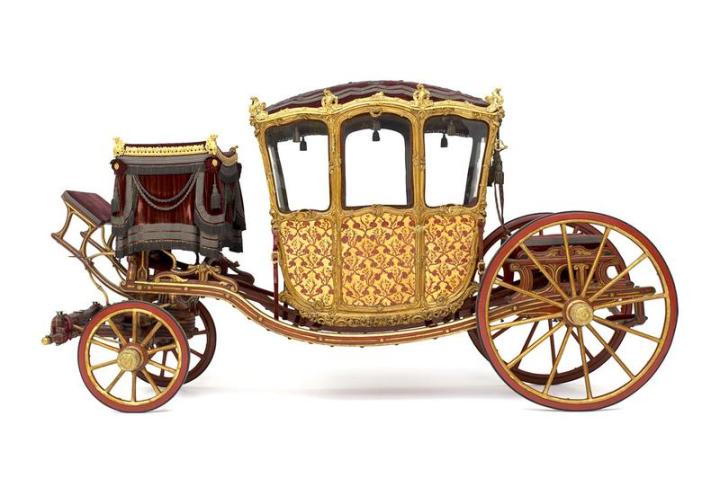
The Prince’s Dress Carriage, ca. 1750–55
(Vienna: Kunsthistorisches Museum)
◊ ◊ ◊ ◊ ◊
It’s still too early to get a good sense of what’s included from the eighteenth century, but we’re sure to hear lots more about the exhibition in the coming months, particularly if you live anywhere near Minneapolis, Houston, or Atlanta. It really should be an extraordinary show. –CH
Press release (18 April 2014) from the MFAH:
Habsburg Splendor: Masterpieces from Vienna’s Imperial Collections
Minneapolis Institute of Arts, 15 February — 10 May 2015
Museum of Fine Arts, Houston, 14 June — 13 September 2015
High Museum of Art, Atlanta, 18 October 2015 — 17 January 2016
Curated by Monica Kurzel-Runtscheiner
In 2015, a major American collaboration will bring masterworks amassed by one of the longest-reigning European dynasties to the United States. Habsburg Splendor: Masterpieces from Vienna’s Imperial Collections showcases masterpieces and rare objects from the collection of the Habsburg Dynasty—the emperors of the Holy Roman Empire and other powerful rulers who commissioned extraordinary artworks now in the collection of the Kunsthistorisches Museum in Vienna. The exhibition, largely composed of works that have never traveled outside of Austria, will be on view at the Minneapolis Institute of Arts (MIA); the Museum of Fine Arts, Houston (MFAH); and the High Museum of Art, Atlanta.
Debuting in Minneapolis in February 2015 before traveling to Houston and Atlanta, Habsburg Splendor: Masterpieces from Vienna’s Imperial Collections explores the dramatic rise and fall of the Habsburgs’ global empire, from their political ascendance in the late Middle Ages to the height of their power in the 16th and 17th centuries, the expansion of the dynasty in the 18th and 19th centuries to its end in 1918 with the conclusion of World War I. The 93 artworks and artifacts that tell the story include arms and armor, sculpture, Greek and Roman antiquities, court costumes, carriages, decorative-art objects, and paintings by such masters as Correggio, Giorgione, Rubens, Tintoretto, Titian, and Velázquez. Key masterpieces that have never before traveled to the United States include:
• The Crowning with Thorns (c. 1602/04) by Caravaggio
• A portrait of Jane Seymour (1536), Queen of England and third wife to Henry VIII, by Hans Holbein the Younger
• Jupiter and Io (c. 1530/32) by Correggio . . . .
Habsburg Splendor: Masterpieces from Vienna’s Imperial Collections chronicles the Habsburgs’ story in three chapters, each featuring a three-dimensional “tableau”—a display of objects from the Habsburgs’ opulent court ceremonies—as context for the other works on view.
D A W N O F T H E D Y N A S T Y
The first section features objects commissioned or collected by the Habsburgs from the 13th through the 16th centuries. In this late medieval/early Renaissance period, Habsburg rulers staged elaborate commemorative celebrations to demonstrate power and to establish their legitimacy to rule, a tradition that flourished during the reigns of Maximilian I and his heirs. Works from this era—including sabres and armor, tapestries, Roman cameos and large-scale paintings—illustrate the significance of war and patronage in expanding Habsburg influence and prestige.
Tableau: Suits of armor displayed on horseback, and jousting weapons from a royal tournament.
Highlights include:
• Armor of Emperor Maximilian I (c. 1492) made by Lorenz Helmschmid
• Bronze bust of Emperor Charles V (c. 1555) by Leone Leoni
• A rock crystal goblet made for Emperor Frederick III (1400–1450)
G O L D E N A G E
The second and largest section of the exhibition highlights the apex of Habsburg rule, the Baroque Age of the 17th and 18th centuries. The dynasty used religion, works of art and court festivities to propagate its self-image and claim to rule during this politically tumultuous time. Paintings by Europe’s leading artists demonstrate the wealth and taste of the Habsburg rulers, while crucifixes wrought in precious metals and gems, as well as sumptuous ecclesiastical vestments, reflect the emperor’s role as defender of the Catholic faith.
Tableau: A procession featuring a Baroque ceremonial carriage and sleigh, with carvings by master craftsman Balthasar Ferdinand Moll.
Highlights include:
• An ivory tankard (1642) by Hans Jacob Bachmann
• Infanta Maria Teresa (1652–53), a portrait of the daughter of Philip IV of Spain and eventual wife of Louis XIV of France, by Velázquez
• An alchemical medal (1677), illustrated with portraits in relief of the Habsburgs, by Johann Permann
T W I L I G H T O F T H E E M P I R E
The exhibition concludes with works from the early 19th century, when the fall of the Holy Roman Empire gave rise to the hereditary Austrian Empire—a transition from the ancien régime to a modern state in which merit determined distinction and advancement. Franz Joseph, who would reign longer than any previous Habsburg, saw the growth of nationalism and ultimately ruled over a dual monarchy of Austria-Hungary. As heir to the Habsburg legacy—and in the spirit of public education and enrichment—he founded the Kunsthistorisches Museum in 1891. Reflecting the modernization of the Habsburg administration, the exhibition ends with a spectacular display of official court uniforms and dresses.
Tableau: Uniforms and women’s gowns from the court of Franz Joseph.
Highlights include:
• Campaign uniform of Franz Joseph (1907)
• A velvet dress made for Empress Elisabeth (c. 1860/65)
• An evening gown made for Princess Kinsky (c. 1905)
• Ceremonial dress of Crown Prince Otto for the Hungarian Coronation (1916)
The exhibition is curated by Dr. Monica Kurzel-Runtscheiner, director of the Imperial Carriage Museum, Vienna. The hosting curator at the Minneapolis Institute of Arts is Kaywin Feldman, director. At the Museum of Fine Arts, Houston, the lead hosting curator is Dr. David Bomford, director of conservation; his curatorial team comprises Dr. Helga Aurisch, curator, European art, and Christine Gervais, associate curator, decorative arts and Rienzi. At the High Museum of Art, the hosting curator is Dr. David A. Brenneman, director of collections and exhibitions and Frances B. Bunzl Family Curator of European art.
A full-color catalogue is being published by the Museum of Fine Arts, Houston, with essays by Dr. Monica Kurzel-Runtscheiner, director of the Imperial Carriage Museum, Vienna; Dr. Franz Pichorner, deputy director, Kunsthistorisches Museum, Vienna; and Dr. Stefan Krause, curator of arms and armor, Kunsthistorisches Museum. Additionally, a virtual exhibition of additional pieces will be viewable online, deepening the visitor experience and providing further opportunities for the public to engage with the art and its history.
A Brief History of the Habsburgs
The noble House of Habsburg rose to prominence in the late Middle Ages through strategic marriages, political alliances and conquest. In 1273, count Rudolph IV gained control of Germany as King of the Romans, and Habsburg domains continued to grow leading up to Pope Nicholas V’s coronation of Frederick III as Holy Roman Emperor in 1452. Under Frederick’s son Maximilian I and his successor, Charles V, the Habsburgs achieved world-power status, assuming the title of emperor without papal consent and enfolding Spain and Burgundy into the Habsburg-controlled territories. The dynasty split into Spanish and Austrian branches shortly thereafter, and in the 17th and 18th centuries the male lines died out, resulting in the loss of Spain.
In 1740, Maria Theresa—the sole female Habsburg ruler, who reigned for a remarkable 40 years—seized control of the Austrian line to become the final ruler of the House of Habsburg. The early 19th century witnessed the final demise of the Holy Roman Empire and the establishment of the main Habsburg line’s successors: the House of Habsburg-Lorraine. A hundred years later, in 1916, Emperor Charles I inherited a dual Austro-Hungarian monarchy upon the death of longtime Emperor Franz Joseph. More than 600 years of Habsburg sovereignty came to an end in 1918 with the close of World War I.
◊ ◊ ◊ ◊ ◊
Scheduled for February publication with distribution by Yale UP:
Monica Kurzel-Runtscheiner, Franz Pichorner, and Stefan Krause, Habsburg Splendor: Masterpieces from Vienna’s Imperial Collections (New Haven: Yale University Press, 2015), 296 pages, ISBN: 978-0300210866, $60.
This beautiful book tells the fascinating story of the Habsburg dynasty, which ruled most of central Europe, Spain, Belgium, and parts of Italy for nearly six hundred years, from the 15th through the 20th century. Charles V (1500–1558) once remarked that the sun never set on the Habsburg Empire, and for most of its history, Vienna served as its capital. The Habsburgs were acclaimed collectors and generous patrons of the arts. Franz Joseph I (1830–1916), the penultimate emperor of the dynasty, created the Kunsthistorisches Museum in Vienna to house the artistic treasures of the empire. Today, this museum possesses one of the most renowned collections in the world of Western art. An extraordinarily wide-ranging survey of the Habsburgs’ collections, this volume features classical Greek and Roman works, medieval arms and armor, tapestries, early modern painting and craftwork, ceremonial gilded carriages, and opulent costumes. Together, they reveal the splendor and the spectacle of the Habsburg court.
Copyright © artdaily.org
Copyright © artdaily.org
Copyright © artdaily.org
“Habsburg Splendor: Masterpieces from Vienna’s Imperial Collections” showcases masterpieces and rare object
Conference | Scholars’ Monuments
From Vienna’s Institut für Kunstgeschichte:
Scholars’ Monuments: Historical Meaning and Cultural Significance
Institut für Kunstgeschichte, Universität Wien, Vienna, 24–26 September 2014
Registration due by 17 September 2014
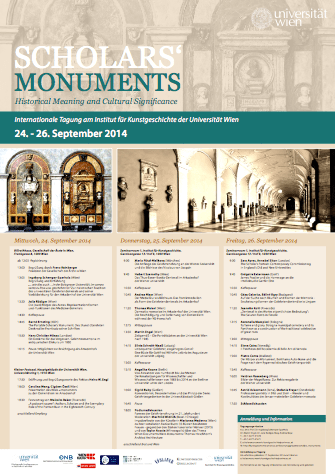 Der Arkadenhof der Universität Wien stellt mit seinen über 150 Gelehrtendenkmälern eine der größten und qualitätsvollsten Ehrenhallen Europas dar. Aus welcher Tradition heraus entstand dieser akademische Gedenkort? Welche Repräsentationsformen nutzten die Künstler, um die Wissenschaftler zu charakterisieren? Und welche zeitgemäße Darstellungsform eignet sich zur überfälligen Ehrung von weiblichen Gelehrten?
Im Rahmen dieser internationalen Tagung am Institut für Kunstgeschichte werden aktuelle, kunst- und kulturhistorische Forschungspositionen zu Gelehrtendenkmälern zusammengetragen und im Spiegel des Arkadenhofs der Wiener Universität reflektiert. Die Tagungsbeiträge nähern sich der Gelehrtenmemoria aus unterschiedlichen methodischen Richtungen und Disziplinen (Kunstgeschichte, Zeitgeschichte, Wissenschaftsgeschichte, cultural memory studies, gender studies). In diesem Rahmen wird nicht nur die Tradition universitärer Ehrenhallen als Funktionsgedächtnis sichtbar, sondern anhand der Auswahl (und Ausgrenzung) von WissenschaftlerInnen lassen sich zeit- und wissenschaftshistorische Konflikte aufdecken. Diese zeigen sich besonders markant bei politisch-ideologisch und gender-spezifisch motivierter Ausgrenzung. So beleuchtet die Tagung nicht nur die lange Wissenschaftstradition der Universität Wien, sondern wirkt mit ihrem Interesse für die Zukunft dieses Gedenkorts auch identitätsstiftend für die scientific community des 21. Jahrhunderts.
Um Anmeldung wird gebeten unter scholarsmonuments.kunstgeschichte@univie.ac.at.
◊ ◊ ◊ ◊ ◊
M I T T W O C H , 2 4 S E P T E M B E R
12:00 Registrierung
13:00 Begrüßung durch Franz Kainberger, Präsident der Gesellschaft der Ärzte in Wien
13:05 Ingeborg Schemper-Sparholz (Wien), Begrüßung und Einführung „… wie dies auch …in der Bologneser Universität, im campo santo zu Pisa usw. geschehen ist.“ Zur italienischen Tradition des universitären Gelehrtendenkmals und seiner Vorbildwirkung für den Arkadenhof der Universität Wien.
13:50 Julia Rüdiger (Wien), Die (zwei) Körper des Arztes. Repräsentationsformen und -funktionen des Medizinerdenkmals
14:30 Kaffeepause
14:45 Bernd Ernsting (Köln), The Portable Scholar’s Monument. Des (Kunst-)Gelehrten Denkmal im Frontispiz seiner Schriften
15:30 Hans Christian Hönes (London), Ein Denkmal für das Vergessen. Gelehrtenmemoria im antiquarischen Diskurs um 1800
16:15 Pause / Möglichkeit zur Besichtigung des Arkadenhofs der Universität Wien
17:30 Eröffnung und Begrüßungsworte des Rektors
18:00 Caroline Mang, Cigdem Özel (Wien), Präsentation des Wikis u:monuments zu den Denkmälern im Arkadenhof
18:30 Festvortrag: Malcolm Baker (Riverside), “A puissant spurre”: Authors, Scholars and the Exemplary Role of the Portrait Bust in the Eighteenth Century
D O N N E R S T A G , 2 5 S E P T E M B E R
9:00 Maria Pötzl-Malikova (München), Die Anfänge der Gelehrtenehrung an der Wiener Universität und die Bildnisse des Nicolaus von Jacquin
9:45 Hubert Szemethy (Wien), Das Thun-Exner-Bonitz-Denkmal im Arkadenhof der Wiener Universität
10:30 Kaffeepause
10:45 Andrea Mayr (Wien), Der Medailleur als Bildhauer. Das Porträtmedaillon als Form des Gelehrtendenkmals im Arkadenhof
11:30 Thomas Maisel (Wien), Damnatio memoriae im Arkadenhof der Universität Wien. Die Beschädigung und Entfernung von Denkmälern während der NS-Herrschaft
12:15 Mittagspause
13:30 Martin Engel (Wien), Zeitgemäß – Die Porträtbüsten an der Universität Wien nach 1945
14:15 Silvia Schmitt-Maaß (Leipzig), Unbequemer Gelehrter, eingehegtes Genie? Eine Büste für Gottfried Wilhelm Leibniz im Augusteum der Universität Leipzig
15:00 Kaffeepause
15:15, Angelika Keune (Berlin), Von Alexander von Humboldt bis Lise Meitner. Denkmalsetzungen für Wissenschaftler und Wissenschaftlerinnen von 1883 bis 2014 an der Berliner Universität Unter den Linden
16:00 Sigrid Ruby (Gießen), Konventionen, Besonderheiten und das Prinzip der Serie: Gelehrtengedenken in der Universitätsstadt Gießen
16:45 Pause
18:00 Podiumsdiskussion: Formen der Gelehrtenehrung im 21. Jahrhundert — Moderation: Mechtild Widrich (Basel/Chicago), Impulsreferate von der Künstlerin Marianne Maderna (Wien) zu ihrer Installation Radical Busts: 33 Büsten berühmter Frauen – gegenüber den Büsten honorierter Männer (2015) und von Taylor Acosta (Minneapolis) über das Thema When Documents Were Monuments: Thomas Hirschhorn’s Archival Architecture
F R E I T A G , 2 6 S E P T E M B E R
9:00 Sara Ayres, Annabel Elton (London), The Scholar’s Portrait: Contemporary Commissioning in England’s Old and New Universities
9:45 Grégoire Extermann (Genf), James Pradier und die Hommage an die intellektuelle Genfer Elite
10:30 Kaffeepause
10:45 Géza Galavics, Bálint Ugry (Budapest), Auf der Suche nach Räumen und Formen der Memoria – Erscheinungsformen der Gelehrtendenkmäler in Ungarn
11:30 Jeanette Kohl (Riverside), „Denkmal in des Wortes eigentlichster Bedeutung“: The Salutati Tomb in
Fiesole
12:15 Antonella Mampieri (Bologna), To Fame and Glory: Bologna Municipal Cemetery and Its Pantheon as a Continuation of the Traditional Celebration of Great Men
13:00 Mittagspause
14:15 Elena Catra (Venedig), Il Pantheon dell’Accademia di Belle Arti di Venezia
15:00 Pietro Conte (Mailand), Der Körper als Monument. Benthams Auto-Ikone und die Frage nach dem hyperrealistischen Gelehrtenporträt
15:45 Kaffeepause
16:00 Heidrun Rosenberg (Wien), Bilder der Magnifizenz. Zur Rektorengalerie der Wiener Universität
16:45 Astrid Ackermann (Jena), Stefanie Freyer (Osnabrück), Professorenporträts in Bild und Stein – Wandel und Kontinuitäten der Jenaer materiellen Gelehrtenmemoria
17:30 Schlussdiskussion
Wedgwood Appeal: Donate to Save the Collection
From Save the Wedgwood Collection:

Josiah Wedgwood, The First Day’s Vase, c.1769 (Wedgwood Museum). Inscribed ‘artes Etruriae renascuntur’ (‘the arts of Etruria are reborn’).
The Wedgwood Collection, one of the most important industrial archives in the world and a unique record of over 250 years of British art, is under threat of being separated and sold off.
The Art Fund now has the opportunity to purchase it for the nation intact, provided the final £2.74m of a total £15.75m fundraising target can be raised by 30 November 2014. This is the only chance to keep the collection in one piece and on public display, preserving this unique record of British history and global commerce.
The collection is the major asset of the Wedgwood Museum Trust, which inherited £134m of pension debt as a result of the UK subsidary of Waterford Wedgwood Plc going into administration in 2009. The debt transferred from company to Trust because the two had been linked through a shared pension fund. Although the Pension Protection Fund (PPF)—the industry body set up by the government to compensate individual pensioners in the event of a company insolvency—will absorb the liability, it has a duty to claw back as much as it can from sale of assets.
In December 2011 the High Court ruled that the Wedgwood Collection was indeed an asset of the Wedgwood Museum Trust that should be sold in order to repay some of the debt owed, and in March 2012 the Attorney General upheld this ruling. Since then, the Art Fund and other partners have looked at all options to prevent the Collection from being broken up and sold on the open market. However, after exploring several avenues, all parties have now agreed that the only option is for the Art Fund to raise the necessary funds to purchase the Collection on behalf of the nation. In order to protect the Collection from ever being at risk again, if the money can be raised, the Art Fund plans to gift it to the Victoria & Albert Museum, the national museum of art and design. Without needing to move it, but with its ownership secure in perpetuity, the V&A intends to assign it on long-term loan to the Wedgwood Museum at Barlaston, which will lie at the heart of a major new visitor experience as part of Waterford Wedgwood Royal Doulton’s (WWRD) £34m redevelopment of the site—set for completion in spring 2015.
The Art Fund has launched an appeal to raise the full £15.75m needed for the purchase, in order to keep this irreplaceable Collection together and on display. Thanks to major support from the Heritage Lottery Fund, the Art Fund and a number of private trusts and foundations, over £13m has already been raised. The campaign has until 30 November to find the remaining £2.74m necessary to purchase—and save—the Collection.
The future of the remarkable Wedgwood Collection has never looked brighter—provided the funds can be raised.
Donate to the appeal online or text WEDGWOOD to 70800 to give £10.
Mark Brown’s coverage for The Guardian (1 September 2014) is available here»
A. N. Wilson’s essay “Wedgwood: The Legacy Must Live On” appears in the Autumn 2014 issue of Art Quarterly and is also available at Save the Wedgwood Collection (4 September 2014).
Exhibition | Pehr Hilleström: The 18th Century Observed

Pehr Hilleström, Three Women Telling Fortune in Coffee, 1780s, 80 x 110cm
(Stockholms universitets konstsamling, J. A. Berg Collection #158)
◊ ◊ ◊ ◊ ◊
From The Sinebrychoff Art Museum:
Pehr Hilleström: The 18th Century Observed / Välähdyksiä 1700-luvun elämästä
The Sinebrychoff Art Museum, Helsinki, 4 September 2014 — 11 January 2015
Curated by Mikael Ahlund
The life of the bourgeoisie in Stockholm in the Age of Enlightenment will be on display in the Sinebrychoff Art Museum. The paintings of the Swedish artist Pehr Hilleström (1732−1816) give us a unique view directly of ordinary life in the 18th century, of how the bourgeoisie lived in Stockholm. Hilleström portrayed the whole strata of life in the Gustavian period: the life and ceremonies of the court, idle young ladies in elegant drawing rooms, servant girls carrying on with their domestic tasks, theatre, peasant culture, foundries and mines. Fifty paintings representing his most important topics will be on display. Pehr Hilleström’s work has never been exhibited this widely in Finland. The exhibition has been created in cooperation with the Nationalmuseum of Stockholm.
Exhibition publication: Mikael Ahlund, Pehr Hilleström – Välähdyksiä 1700-luvun elämästä | 1700-talet i blickpunkten (editors Kirsi Eskelinen, Reetta Kuojärvi-Närhi).
A selection of high-resolution images are available here»
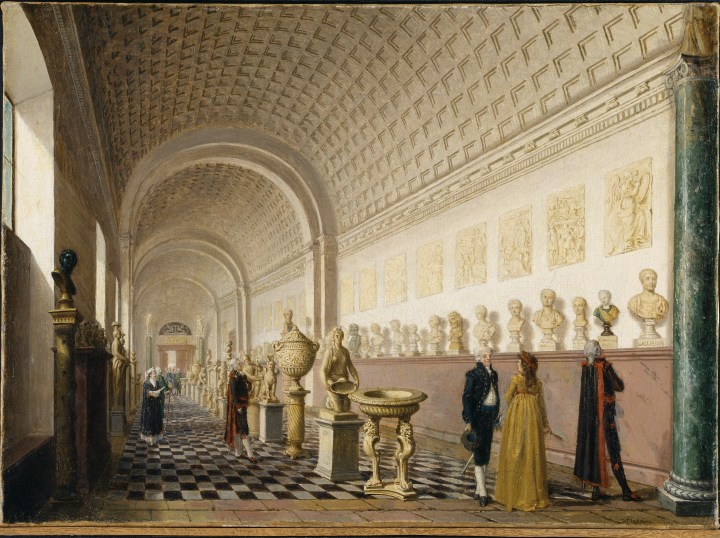
Pehr Hilleström, The Inner Gallery of the Royal Museum at the
Royal Palace, Stockholm, 1796 (Nationalmuseum, Stockholm)
◊ ◊ ◊ ◊ ◊
Press release (1 September 2014) from Stockholm’s Nationalmuseum:
Nationalmuseum has made a major loan of works to the Pehr Hilleström exhibition at the Sinebrychoff Art Museum in Helsinki. The loan comprises some twenty works by this artist best known for his documentary paintings of 18th-century Stockholm.

Pehr Hilleström, Self-Portrait, 1771 (Stockholm: Nationalmuseum; photo by Erik Cornelius)
This is the first time that a Finnish gallery has mounted a comprehensive exhibition of works by the Swedish artist Pehr Hilleström (1732–1816). Nationalmuseum in Stockholm has contributed some twenty paintings by Hillestrom, one of Sweden’s most highly regarded artists of the 18th century. The works on loan include Testing Eggs, Kitchen Scene, Card Game at the Home of Elis Schröderheim, Public Banquet at Stockholm Castle New Year’s Eve 1779, plus two self-portraits and an enigmatic portrait of Carl Michael Bellman. In all, fifty of Hilleström’s best-known paintings are on display. The exhibition was planned by Nationalmuseum’s Mikael Ahlund, who also wrote the commentary for the accompanying book.
Pehr Hilleström portrayed the entire spectrum of life in the Gustavian era, from idle young ladies in elegant drawing rooms to industrious working-class wives going about their domestic chores. He is famous for his almost documentary depictions of city fires and official ceremonies in 18th-century Stockholm. His wide range of motifs includes industry, landscapes and scenes from the theatre. In his later years, he
also turned to historical and religious motifs.
Sweden’s Nationalmuseum Launches Free Online Journal, Volume 20
Press release (3 September 2014) from the Nationalmuseum:
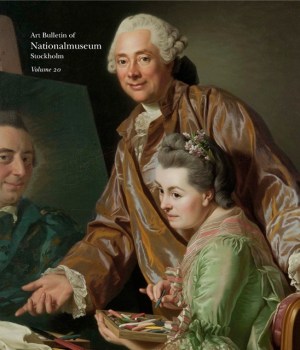 Stockholm’s Nationalmuseum has launched its first digital journal, available online to download and read free of charge. The Art Bulletin of Nationalmuseum Stockholm contains academic articles on art history relating to Nationalmuseum’s collections. The journal is moving to digital-only format and will be available through the DiVA portal (a Swedish publishing system for academic research and student theses) and the museum’s own website. The Art Bulletin of Nationalmuseum Stockholm is an annual publication containing academic articles on art history relating to Nationalmuseum’s collections. The journal has existed in print form since 1996, but is now switching to digital-only format, starting with volume 20. The journal’s established graphic design will be enhanced through the addition of digital media features such as metadata, live links to chapter headings and page references, and high-resolution images.
“For an art institution like Nationalmuseum, it’s important to offer our readers high-quality images that do full justice to the works,” said Janna Herder, editor of the Art Bulletin of Nationalmuseum Stockholm. “Readers therefore have the option of downloading the entire journal in low-resolution format or individual articles in high-resolution format.”
Nationalmuseum expects to attract a larger and wider readership now that the journal and its articles are freely available and searchable via Google and other search engines. As a member of the DiVA portal, the museum is able to distribute the publication more effectively in the academic community. “This is a further step in the digital evolution of Nationalmuseum and a key initiative in fulfilling our mandate to improve access to and awareness of our collections,” said Magdalena Gram, the museum’s head of research, library and archives and the journal’s editor-in-chief. “Another aspect of our mandate involves collaboration with other institutions such as universities and colleges. Offering an established publication like the Art Bulletin of Nationalmuseum Stockholm in digital format through the DiVA portal marks a breakthrough in terms of our ability to make specialized knowledge and information freely available.”
◊ ◊ ◊ ◊ ◊
Articles related to the eighteenth century (visit the Nationalmuseum website for the full contents) . . .
Art Bulletin of Nationalmuseum Stockholm 20 (2013).
A C Q U I S I T I O N S
Carina Fryklund, “Three 17th-Century Paintings from the Collection of Gustaf Adolf Sparre (1746–94),” pp. 11–16.
Magnus Olausson, “Roslin’s Self-Portrait with his Wife Marie Suzanne Giroust Painting a Portrait of Henrik Wilhelm Peill (1767),” pp. 17–18.
Magnus Olausson, “Wertmüller’s Portrait of Henri Bertholet-Campan with the Dog Aline (1786),” pp. 19–20.
Guilhem Scherf, “Une Statuette en Terre Cuite de Jean-Baptiste Stouf au Nationalmuseum,” pp. 27–36.
Magnus Olausson, “Madame Lefranc Painting a Portrait of her Husband Charles Lefranc (1779): A Miniature by Adélaïde Labille-Guiard,” pp. 37–8.
Anders Bengtsson, “A Unique Plate Warmer,” pp. 39–40.
Anders Bengtsson, “A Chair Fit for a Prince,” pp. 41–2.
Acquisitions 2013: Exposé, pp. 61–96.
A R T I C L E S O N T H E H I S T O R Y A N D T H E O R Y O F A R T
Martin Olin, “An Italian Architecture Library under the Polar Star: Nicodemus Tessin the Younger’s Collection of Books and Prints,” pp. 109–18.
Magnus Olausson, “Louis Gauffier’s Portrait of Gustaf Mauritz Armfelt (1793): A Political or a Conspiratorial Painting?,” pp. 119–22.
Ulf Cederlöf, “An Exceptionally Protracted Affair: The Nationalmuseum’s Acquisition of Sergel’s Collections of Drawings and Prints, 1875–76,” pp. 123–34.
S H O R T E R N O T I C E S
Görel Cavalli-Björkman and Margaretha Rossholm-Lagerlöf, “A Source-Critical Comment on Roger de Robelin’s “On the Provenance of Rembrandt’s The Conspiracy of the Batavians under Claudius Civilis,” 135–36.
Roger de Robelin, “Response to “A Source-Critical Comment etc.,” pp. 137–38.
R E P O R T
Helen Evans and Helena Kåberg, “The Nationalmuseum Lighting Lab,” pp. 139–46.
Call for Papers | Streitsache: Architecture as Matter of Contention
From Candide: Journal for Architectural Knowledge:
Streitsache: Architecture as Matter of Contention
Aachen University, 29–31 January 2015
Proposals due by 20 September 2014
From January 29 to 31, 2015 the second Candide Conference will take place at RWTH Aachen University. The peer-reviewed Candide: Journal for Architectural Knowledge was founded in 2009 and publishes contributions on the knowledge of architecture. The best papers presented in the conference will be published in a forthcoming issue.
The interdisciplinary conference Streitsache: Architecture as Matter of Contention intends to probe the complex relation between architecture and conflict. There are numerous instances in which architectural objects become objects of conflict, ‘bones of contention, a Streitsache. Conceiving of architecture as a Streitsache generates new architectural knowledge, including knowledge on the interactions that emerge from and through the objects of contention. Architectural things, whether in the form of architectural details, buildings or entire cities, are actors whose agency becomes manifest in conflictual processes. The field of politics and the negotiation of law is constituted through and by them. As thresholds Streitsachen are politically operative because they render conflicts visible and negotiable. The debates surrounding the Stuttgart 21 project, the Elbphilharmonie in Hamburg, or Les Halles in Paris could serve as recent examples.
The aim of the conference is to expand the scope of thinking about architecture, its function and character, into fields of the theory of law and political philosophy. As agents of the political, ’things of contention render plurality and heterogeneous interests visible and negotiable. Architecture’s dissension opens up a new space for collective thinking and action. The conference is interdisciplinary and addresses scholars and practitioners from the fields of architecture, art, political sciences, legal studies, cultural studies, anthropology, science and technology studies, cultural technology studies, and media philosophy.
The structure of the conference follows the phases of architectural processes in which matters of contention become visible and negotiable: a) design, planning, and implementation b) judgment and critique c) negotiation and settlement.
a) Conflicts arise because of sketches, plans, models, construction site protocols, budgets, legal rules, and press releases. How and through which circumstances does architecture turn into a matter of contention? What precisely is the disputed subject? How can we frame the design process as a sequence and as a negotiation of difference between agencies, both human and non-human? What kind of architectural knowledge becomes manifest in a concrete dispute?
b) Matters of contention generate their own social spaces. They are the sites where a contending community—and therewith the precondition for the political—emerges. How do disputing actors appropriate architecture? What modifications do contested things undergo during the conflictual relation? How do values become comprehensible and negotiable during a conflict? How do processes of selection function and how are verdicts reached? How do architectural objects become instruments that trigger or resolve conflicts?
c) Architectural matters of contention not only promote bellicose polemics but also social knowledge, which is implemented in processes of negotiation and arbitration. How does architecture function as a repository of or evidence of past conflicts? How can knowledge gained from past conflicts be used to create strategies to prevent future conflicts? Does it make sense to think the culture of architecture as a culture of contention?
We welcome submissions of case studies, historical and theoretical reflections dealing with particular projects, built architectures and specific disputes. The working languages at the conference will be German and English. Please send an abstract (max. 500 words) and a short CV before September 20, 2014 to: candide@theorie.arch.rwth-aachen.de.
Exhibition | The Generous Georgian: Dr Richard Mead
From The Foundling Museum:
The Generous Georgian: Dr Richard Mead
The Foundling Museum, London, 26 September 2014 — 4 January 2015
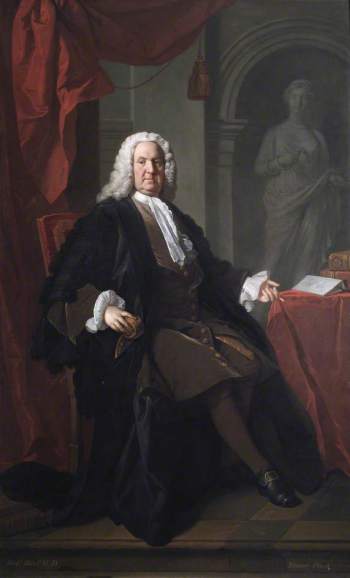
Allan Ramsay, Dr Richard Mead, 1747
(London: The Foundling Museum)
Dr Richard Mead (1673–1754) was one of the most eminent physicians, patrons, collectors, and philanthropists of his day, as well as a significant figure in the early history of the Foundling Hospital. A leading expert on poisons, scurvy, smallpox, and public health, Mead counted among his patients Queen Anne, King George II, Sir Isaac Newton, and the painter Antoine Watteau. A man of action, Mead explored poisons by drinking snake venom and is said to have defended his theory on smallpox treatment to the point of fighting a duel.
His home on Great Ormond Street backed onto the Foundling Hospital grounds and housed a magnificent collection of paintings, sculptures, antiquities, coins, and a library of over 10,000 volumes. Painters and scholars were given access to Mead’s renowned collection, which in a time before public galleries offered visitors a rare chance to view masterpieces from around the world. Examining its significance in London’s cultural landscape, this exhibition reunites key objects from his life and collection, such as the ancient bronze Arundel Head (2nd century BC) and Allan Ramsay’s half-length portrait of Mead.
Exploring Mead ‘in the round’, as a collector, philanthropist and physician, this exhibition will bring to light the Foundling Hospital’s relationship with a truly remarkable individual who, according to his contemporary the writer Samuel Johnson, “lived more in the broad sunshine of life than almost any man.”
The Generous Georgian: Dr Richard Mead is supported by the Wellcome Trust, the City of London Corporation and Verita.
◊ ◊ ◊ ◊ ◊
Conference programme from The Foundling:
Dr Richard Mead: Physician, Philanthropist, Collector
The Foundling Museum, London, 20 October 2014
To accompany the Museum’s autumn exhibition, The Generous Georgian: Dr Richard Mead, this one-day interdisciplinary conference considers the life, work, and collections of Mead. Adults £20, Concessions £15. To book, download a booking form or book online (subject to an 8% booking fee). Please send completed booking forms to: Stephanie Chapman, 40 Brunswick Square, London, WC1N 1AZ. For enquiries please contact exhibitions@foundlingmuseum.org.uk.
P R O G R A M M E
8:30 Optional early morning tour of the Royal College of Physicians (11 St Andrews Place, Regent’s Park) with curator Emma Shepley, addressing Richard Mead and his role in the institution.
9:15 Travel to the Foundling Museum. You will need to make your own way by public transport from RCP to the Foundling Museum, but staff will be able to recommend routes. The journey time is approximately 30 minutes.
9:30 Coffee and registration
10:00 Welcome
10:15 Ludmilla Jordanova, ‘The Problem of Richard Mead’
11:00 Break
11:30 Karen Howell, ‘The Curious Prescriptions of Dr Mead’
12:00 Janette Bright, ‘Dr Mead and the Curious Herbal’
12:30 Kevin Brown, ‘Richard Mead, George Anson’s Circumnavigation of the Globe, and the Health of the Seaman’
13:00 Lunch
14:00 Stephanie Chapman, ‘Richard Mead and the Foundling Hospital’
14:30 Tour of the exhibition, The Generous Georgian: Dr Richard Mead
15:00 Charles Avery, ‘The Large Brass Medallions Cast by Soldani, Selvi, and Pozzi in the Musaeum Meadianum’
15:30 Craig Hanson, ‘Debating Dissent in Leiden’
16:00 Refreshments
Exhibition | In Miniature
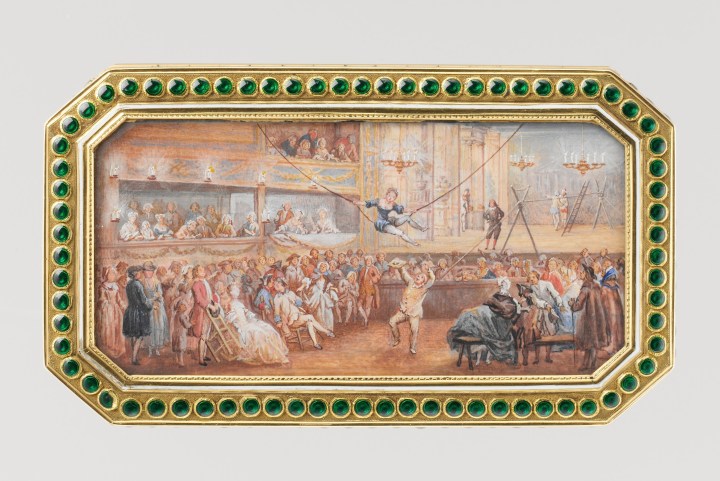
Joseph Étienne Blerzy, Snuffbox with theatrical scenes of a rope dancer and a puppet show by by Louis Nicolas van Blarenberghe and Henri Joseph van Blarenberghe, 1778–79 (New York: The Metropolitan Museum of Art. Gift of J. Pierpont Morgan, 1917; 17.190.1130). A high resolution image is available here»
◊ ◊ ◊ ◊ ◊
Now on at The Met (as noted at Bendor Grosvenor’s Art History News). . .
In Miniature
The Metropolitan Museum of Art, New York, 29 August 29 — 31 December 2014
This exhibition will comprise two groups of portrait miniatures: British, from the sixteenth and early seventeenth centuries, and French, from the revolutionary period to the Empire. Also included are several eighteenth-century French gold boxes decorated with narratives or scenes in grisaille. All are from the Museum’s permanent collection and, because of their sensitivity to light, are infrequently exhibited. Six larger paintings will be exhibited in order to consider what they may share with the miniatures and to show how they differ. Gallery 624.
◊ ◊ ◊ ◊ ◊
In conjunction with the exhibition, The Met has a Pinterest Board dedicated to “Met Miniatures”. There are lots of things there not included in the exhibition (nor particularly relevant to the exhibition), but notes indicate items that are part of the display. Serving basically as an illustrated checklist with links to the full online catalogue entries, it seems like a fairly obvious use of Pinterest by museums. –CH
New Book | The Arts of Living: Europe, 1600–1815
Among the V&A’s New Books for the fall:
Elizabeth Miller and Hilary Young, eds., The Arts of Living: Europe, 1600–1815 (London: V&A Publishing, 2014), 208 pages, ISBN: 978-1851778072, £25 / $40.
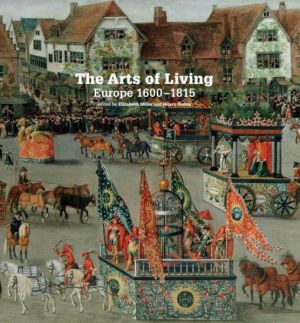 Published to accompany the landmark opening of the V&A’s new Europe 1600–1800 galleries, The Arts of Living explores the breadth, depth and beauty of the V&A’s seventeenth- and eighteenth-century collections. Written by a team of experts, this book provides an overview of more than two centuries of cultural development and artistic endeavour. Masterpieces such as the Serilly Cabinet and Gian Lorenzo Bernini’s terracotta for his funeral monument the Blessed Ludovica Albertoni are contextualized alongside discussions of Louis XIV’s patronage and the seventeenth-century Dutch interior. Many works are shown for the first time, including Count Brühl’s Meissen fountain and actor David Garrick’s tea service.
Elizabeth Miller is senior curator of prints, and Hilary Young is senior curator of ceramics at the V&A.
A preview of the book is available here»










 Enfilade
leave a comment