Year-End Gift Ideas
I’ve had good intentions of pulling this together for weeks, and now it’s surely of almost no use to anyone in terms of gift ideas. Still, it allows me to expand a bit on the usual scope of the blog, and please, by all means chime in with comments for the brilliant suggestions I should have included! -CH
◊ ◊ ◊ ◊ ◊
From Little, Brown, and Company:
Stacy Schiff, The Witches: Salem, 1692 (New York: Little, Brown, and Company, 2015), 512 pages, ISBN: 978-0316200608, $32.
 The Pulitzer Prize-winning author of Cleopatra, the #1 national bestseller, unpacks the mystery of the Salem Witch Trials. It began in 1692, over an exceptionally raw Massachusetts winter, when a minister’s daughter began to scream and convulse. It ended less than a year later, but not before 19 men and women had been hanged and an elderly man crushed to death. The panic spread quickly, involving the most educated men and prominent politicians in the colony. Neighbors accused neighbors, parents and children each other. Aside from suffrage, the Salem Witch Trials represent the only moment when women played the central role in American history. In curious ways, the trials would shape the future republic. As psychologically thrilling as it is historically seminal, The Witches is Stacy Schiff’s account of this fantastical story-the first great American mystery unveiled fully for the first time by one of our most acclaimed historians.
Stacy Schiff is the author of Véra (Mrs. Vladimir Nabokov), winner of the Pulitzer Prize; Saint-Exupéry, Pulitzer Prize finalist; A Great Improvisation: Franklin, France, and the Birth of America, winner of the George Washington Book Prize; and Cleopatra: A Life. Schiff has received fellowships from the Guggenheim Foundation and the National Endowment for the Humanities and an award in literature from the American Academy of Arts and Letters. Named a 2011 Library Lion by the New York Public Library, she lives in New York City.
◊ ◊ ◊ ◊ ◊
From Knopf:
Sven Beckert, Empire of Cotton: A Global History (New York: Knopf, 2014), 640 pages, ISBN: 978-0375414145, $35.
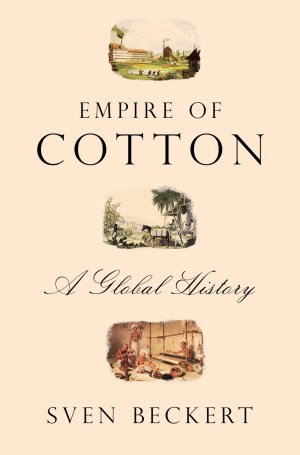 The empire of cotton was, from the beginning, a fulcrum of constant global struggle between slaves and planters, merchants and statesmen, workers and factory owners. Sven Beckert makes clear how these forces ushered in the world of modern capitalism, including the vast wealth and disturbing inequalities that are with us today.
In a remarkably brief period, European entrepreneurs and powerful politicians recast the world’s most significant manufacturing industry, combining imperial expansion and slave labor with new machines and wage workers to make and remake global capitalism. The result is a book as unsettling as it is enlightening: a book that brilliantly weaves together the story of cotton with how the present global world came to exist.
Sven Beckert is the Laird Bell Professor of American History at Harvard University. Holding a PhD from Columbia University, he has written widely on the economic, social, and political history of capitalism. He has been the recipient of numerous awards and fellowships, including from Harvard Business School, the Dorothy and Lewis B. Cullman Center for Scholars and Writers at the New York Public Library, and the Charles Warren Center for Studies in American History. He was also a fellow of the American Council of Learned Societies and the John Simon Guggenheim Memorial Foundation. He lives in Cambridge, Massachusetts.
◊ ◊ ◊ ◊ ◊
From Rizzoli:
Princess Gloria von Thurn und Taxis and John Richardson, with photographs by Todd Eberle, The House of Thurn und Taxis (New York: Skira Rizzoli, 2015), 240 pages, ISBN: 978-0847847143, $85.
 Adventure through the princely Thurn und Taxis estate, an enchanted palace where 1,000 years of history meets a thoroughly modern family. For 200 years the Thurn und Taxis family have called the palace of St. Emmeram home. Regarded as one of Germany’s finest examples of historicist architecture, the Regensburg residence’s myriad rooms trace centuries of distinctive styles: a Romanesque-Gothic cloister built between the twelfth and fourteenth centuries, a neo-Renaissance marble staircase, a number of Rococo and neo-Rococo staterooms, and a Baroque library frescoed in 1737. Celebrated photographer Todd Eberle captures the confluence of high art and grand architecture within the 500-room palace to reveal the curious tale of the Thurn und Taxis family. Complete with stately portraits and scenes of life at St. Emmeram, this monograph offers a glimpse into the world and glamour of one of the most important dynasties of the European aristocracy.
Sir John Richardson is a British art historian and Picasso biographer. Princess Gloria von Thurn und Taxis is the matriarch of the princely house of the Thurn and Taxis. André Leon Talley is an author and contributing editor of Vogue. Alexander Count von Schoenburg is a journalist and author. Elisabeth von Thurn und Taxis is an author and writer for Vogue.
◊ ◊ ◊ ◊ ◊
From Flammarion:
A Day at Château de Vaux-le-Vicomte (Paris: Flammarion, 2015), 192 pages, ISBN: 978-2080201997, $35.
 An insider’s tour of the magnificent seventeenth-century castle and gardens, conceived by Le Vau, Le Brun, and Le Nôtre, that inspired the great châteaux of Europe. Vaux le Vicomte’s rich history began in 1641, when infamous finance minister Nicolas Fouquet bought the estate and enlisted architect Louis Le Vau, decorator Charles Le Brun, and garden designer André Le Nôtre to transform it into a lavish residence. His extravagance piqued Louis XIV’s jealousy, and he was thrown into prison for mishandling funds. The château inspired the design of Versailles and was later home to the great chef Vatel, who famously died for his art. This volume traces the château’s history from the seventeenth century through the Belle Époque, World War I, and its public opening in 1968. Exclusive photography and archival documents offer unprecedented access to the château, furnishings, and gardens, and illuminate the extraordinary secrets of court life and centuries of celebrations that include the enchanting candlelit tours held today.
Alexandre de Vogüé, Jean-Charles de Vogüé and Ascanio de Vogüé are brothers who together manage the Vogüé family estate. In 2012, they began to successfully develop a range of business ventures at the Vaux le Vicomte château. Alexandre, Jean-Charles and Ascanio are fifth generation members of the de Vogüé family. Bruno Ehrs is a lifestyle and architectural photographer based in Stockholm, Sweden. His photographs have been featured in over twenty solo exhibitions and have appeared in numerous magazines and books, including One Savile Row (Flammarion 2014). He has also published several art volumes of his work.
◊ ◊ ◊ ◊ ◊
From Other Press:
Chantal Thomas, The Exchange of Princesses, translated by John Cullen (New York: Other Press, 2015), 336 pages, ISBN: 978-1590517024, $17.
 Set in the French and Spanish courts of the eighteenth century, this novel is based on a true story about the fate of two young princesses caught in the intrigues and secrets of the moment. Philippe d’Orléans, the regent of France, has a gangrenous heart—the result of a life of debauchery, alcohol, power, and flattery. One morning in 1721, he decides to marry eleven-year-old Louis XV to the daughter of Philippe V of Spain, who is only four. Orléans hopes this will tie his kingdom to Spain. But were Louis to die without begetting an heir—the likeliness of which is greatly increased by having a child bride—Orléans himself would finally be king. Orléans tosses his own daughter into the bargain, the twelve-year-old Mlle de Montpensier, who will marry the Prince of Asturias, the heir to the Spanish throne. The Spanish court enthusiastically agrees and arrangements are made. The two nations trade their princesses in a grand ceremony in 1722, making bonds that should end the historical conflict. Nothing turns out as expected.
Chantal Thomas is a noted philosopher and writer. She has taught at a number of American universities and is the author of twenty-five works, including novels, histories, short stories, plays, and essays. Her internationally acclaimed novel Farewell, My Queen, a fictional account of Marie Antoinette’s final days in Versailles, won the Prix Femina in 2002 and was made into an award-winning film by Benoit Jacquot, and starred Diane Kruger. A film adaptation of The Exchange of Princesses, to be directed by Marc Dugain, is currently in the works.
John Cullen is the translator of many books from Spanish, French, German, and Italian, including Philippe Claudel’s Brodeck, Juli Zeh’s Decompression, Antonio Skármeta’s A Distant Father, and Yasmina Reza’s Happy Are the Happy. He lives in upstate New York.
◊ ◊ ◊ ◊ ◊
From The Getty:
Bruno Gibert, A King Seen from the Sky (Los Angeles: J. Paul Getty Museum, 2015), 32 pages, ISBN-13: 978-1606064603, $17.
 This delightful book by award-winning children’s book author and illustrator Bruno Gibert is inspired by the true story of the first flight of living creatures in a handmade aircraft. On September 19, 1783, the Montgolfier brothers demonstrated their new invention, the hot-air balloon or montgolfière, at the Palace of Versailles before a large crowd, including Louis XVI and Marie Antoinette. Considered too dangerous for human passengers, the experimental vessel carried a sheep, a duck, and a hen in its basket. The balloon flew for about eight minutes, covered a distance of roughly two miles, and reached an altitude of more than 1,500 feet before landing safely. The animals’ balloon ride caused a sensation and the first human flight followed a few months later.
By the end of 1783, Louis XVI had ennobled the Montgolfier family in recognition of the brothers’ important achievements, which perhaps prompted a royal celebration for the animals like the one depicted in the book. In Gibert’s fantasy, the animals anger the king at the fete by describing him as “no bigger than the tiniest snail” when viewed from high above the ground, and Louis imprisons them in the Bastille. While the direct role of talking animals in the storming of the Bastille in 1789 can’t quite be supported by historical evidence, this book does vividly evoke the stirring developments in aeronautics that took place right around the time of the French Revolution. Ages five to seven.
Bruno Gibert is a children’s book author and illustrator; he also writes novels for adults. His book Le Petit Gibert Illustré received the Prix Coup de Coeur du Salon de Montreuil in 2010.
◊ ◊ ◊ ◊ ◊
From Frances Lincoln:
Anna Keay and Caroline Stanford, Landmark: A History of Britain in 50 Buildings, 50 Years of the Landmark Trust (London: Frances Lincoln, 2015), 288 pages, ISBN: 978-0711236455, $40.
 This engaging and sumptuously illustrated book celebrates the Landmark Trust’s achievement in the protection of British heritage since the Trust was established 50 years ago. From a medieval hall house to the winner of the 2013 Stirling Prize for Architecture, 50 buildings rescued by Landmark from threatened oblivion are presented here that vividly illustrate the history of Britain from 1250 to the present day.
Presented in the order in which they were built, the selected buildings include the unusual, the fantastic, the spectacular, the utilitarian and the enchanting, each one offering a fascinating glimpse into the past of the British people. In telling the stories of how the buildings came to be, how they were used and how they were adapted by subsequent generations, this book brings history to life through the evidence in the buildings our ancestors have left behind. Examples include a 15th-century inn in Suffolk, an Elizabethan hospital in Yorkshire, a lighthouse on Lundy and an Italianate railway station. The Landmark Trust’s often heroic rescue of each of these buildings is also placed in the context of the Trust’s own evolution to date and the history of British conservation practice.
Anna Keay is a historian with a professional specialism in historic buildings. She has a BA in Modern History from Oxford University, and a PhD in 17th-century British history from the University of London. Formerly a curator at Hampton Court Palace and Curatorial Director of English Heritage, she is now Director of the Landmark Trust. Her books include The Magnificent Monarch (2008), about King Charles II; The Elizabethan Tower of London (2001) and The Crown Jewels (2011). She is also a regular contributor to TV and radio. She divides her time between London and King’s Lynn, Norfolk.
Caroline Stanford has been Historian to the Landmark Trust since 2001. She holds a BA in Modern History from Oxford University, an MA in Early Modern History from London University, and an MSc in Historic Conservation from Oxford Brookes University. She has researched many of the Trust’s buildings, participating in Landmark’s rescue of some of Britain’s finest buildings at risk. This combination of academic research and applied practice allows her to write and contribute widely across all building types and periods to all types of media.
◊ ◊ ◊ ◊ ◊
Available from Pentreath & Hall (I can’t say enough good things about both Pentreath’s blog and his shop in London):
John Rocque’s Plan of the Cities of London and Westminster, and Borough of Southwark, 1746, in 24 sheets, £175.
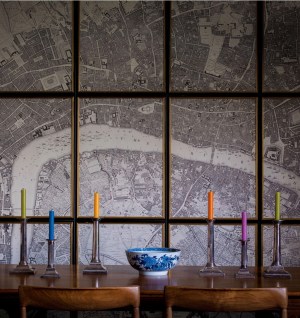 This reproduced publication, measuring 32.5″ (82.5 cm) wide by 22″ (55.9 cm) high, consists of: a cover sheet; an introduction by James Howgego, a past Keeper of Prints and Pictures at the Guildhall Library, London; a key sheet and 24 map sheets, at a scale of 26″ to a mile. The map sheets form a grid eight across and three high, with the image on each sheet being approximately 27″ (68.6 cm) high by 19″ (48.3 cm) wide, thus forming a map area of approximately 12′ 8″ (386 cm) by 6′ 8″ (203 cm) if trimmed and assembled. If the two outer columns were ignored (and their borders transferred to the second and seventh columns), the assembled map area becomes approximately 9′ 6″ (290 cm) wide by 6′ 8″ (203 cm).
The original image was captured, in 1970, by photographic process, which, after being cleaned up and all trace of colouring removed (again by photographic process), resulted in a positive film the same size as the original. This film was then used to create lithographic plates, from which the 1971 print run was taken. The current print run used a digital image, which has been printed lithographically. The Plan is printed on 140 gsm acid free paper, sidestitch bound in 285 gsm card covers.










 Enfilade
An additional stocking stuffer idea from the world of eighteenth-century music:
A new recording by the talented French soprano Sabine Devieilhe devoted to music that Mozart wrote for the Weber sisters, Josepha, Aloysia, and Konstanze (whom he married).
http://www.warnerclassics.com/shop/380314,0825646075843/sabine-devieilhe-mozart-and-the-weber-sisters
The sisters, all singers, inspired Mozart to some of his most brilliant music. The Queen of the Night in ‘The Magic Flute,’ for example, was written for Josepha Weber. The recording includes the wickedly challenging aria ‘Popoli di Tessaglia’, intended as an insertion aria for Gluck’s ‘Alceste,’ and one of my personal favorites, ‘Schon lacht der holde Frühling.’ Devieilhe’s light, clear, agile voice is a pleasure to the ear.
Not art history, but it’ll actually fit into a stocking better than an exhibition catalogue.
Oh, Michael, I was hoping you would chime in with exactly this sort of thing! Thanks, -Craig