Exhibition | Transparent Art: Rock Crystal Carving
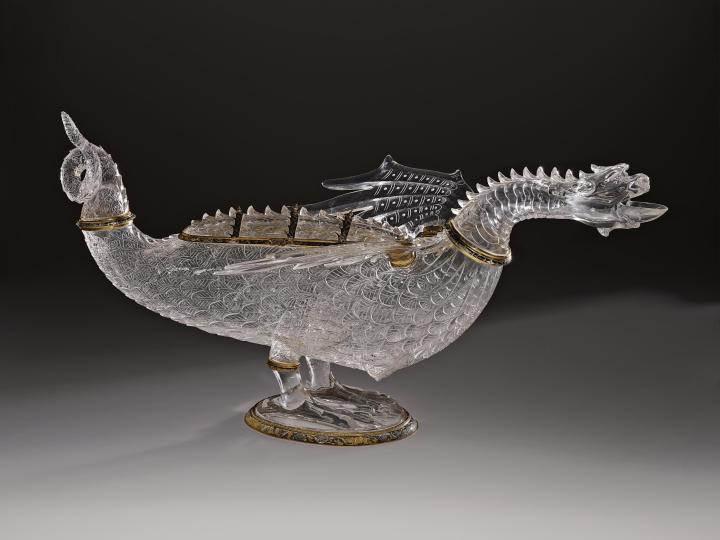
Vase in the shape of a dragon or ‘caquesseitão’; Milan, workshop of the Miseroni, possibly Gasparo Miseroni (act. 1550–70) (?) Rock crystal; second half of the 1500s (Madrid: Museo Nacional del Prado)
◊ ◊ ◊ ◊ ◊
Now on view at the Prado, this exhibition of sixteenth-century carved rock crystal includes items from the collection of the Grand Dauphin (1661–1711). The show also provides a convenient occasion to draw attention to the Prado’s newly designed website, which particularly showcases images. While such a feature might seem obvious for a museum website, it’s hardly been true in most cases to date (the press release detailing the site’s key features is available here).
From the Prado:
Transparent Art: Rock Crystal Carving in Renaissance Milan
Museo Nacional del Prado, Madrid, 14 October 2015 — 10 January 2016
Curated by Letizia Arbeteta Mira
The present exhibition offers visitors a unique opportunity to see a little known chapter in art history, namely that of carving hyaline quartz or rock crystal, a technique for which Milan was particularly celebrated in the second half of the 16th century. Due to their value, both material and artistic, these works were only within the reach of monarchs and the highest ranks of the European aristocracy.
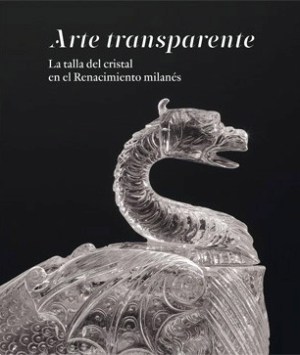 The exhibition includes six magnificent examples loaned from two of the most important historical collections: that of the Medici, now in the Museo degli Argenti in Florence, and the collection of Louis XIV, now in the Musée du Louvre in Paris. Another fourteen splendid pieces, now in the Prado, come from the collection assembled by the Grand Dauphin of France, son of Louis XIV, which was in part inherited by Philip V, the first Spanish Bourbon monarch, in 1711. The latter group, known as ‘The Dauphin’s Treasure’, entered the Prado in 1839. Although somewhat reduced over the course of its eventful history, it still includes important objects, particularly those in rock crystal. In total it has 47 hyaline quartz vessels, 2 in citrine quartz and 1 in smoky quartz. Various academic studies have attributed these pieces to leading workshops and masters, almost all of them Milanese.
Letizia Arbeteta Mira, Arte transparente: La talla del cristal en el Renacimiento milanés (Madrid: Museo del Prado, 2015), 160 pages, ISBN: 978-8484803362, 39€.
Exhibition | Two Extraordinary Women
Opening next month at UVA:
Two Extraordinary Women: The Lives and Art of Maria Cosway and Mary Darby Robinson
The Fralin Museum of Art, The University of Virginia, Charlottesville, 29 January — 1 May 2016
Curated by Diane Boucher
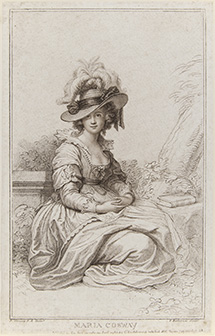
Francesco Bartolozzi, Maria Cosway (after Richard Cosway), 1786; stipple and engraving, 9 1/2 x 6 in (Langhorne Collection, 2014.EL.1.5)
Two Extraordinary Women: The Lives and Art of Maria Cosway and Mary Darby Robinson examines the intersecting careers of two remarkable women who rose to prominence during the late eighteenth century. One of them, the artist, musician, and educator, Maria Cosway, is now best known as the woman with whom Thomas Jefferson fell in love while serving as American ambassador to France in 1786. The other, Mary Darby Robinson, was a celebrated English actress, former royal mistress, fashion icon, and one of the leading literary figures of her day. Both women were politically active Whig supporters and part of a proto-feminist movement that emerged at the end of the eighteenth century. Their ideas were stimulated by the same beliefs in freedom, equality, and democracy that informed the French and American revolutions.
In 1800, Cosway and Robinson collaborated on The Wintry Day, an illustrated poem that contrasted “the evils of poverty with the ostentatious enjoyment of opulence” in Regency England. The publisher, Rudolph Ackermann, described the subject of the poem and its illustrations: “The intention of the designs is to contrast the evils of poverty with the ostentatious enjoyment of opulence.” The exhibition will show how the lives of these two talented women closely resembled the idealized scenes of opulence and luxury in The Wintry Day. However, by juxtaposing these scenes with ones of abject poverty, Cosway and Robinson create a harsh critique of their times, which is in tune with their support of French and American revolutionary ideas on liberty and equality and their proto-feminist ideas on women’s education and the equality of the sexes.
Exhibition | American and European Embroidered Samplers
Now on view at The Met:
American and European Embroidered Samplers, 1600–1900
The Metropolitan Museum of Art, New York, 16 November 2015 — 15 February 2016

Maria Boil, Shaker sampler (detail), 1844. American, Shaker Village of Pleasant Hill, Kentucky. Silk and cotton embroidery on linen/cotton; 13 x 12 inches (New York: The Metropolitan Museum of Art, 2008.453)
The embroidered samplers in this installation were chosen for their practical character: each displays skills and knowledge acquired during the educational process and preserves this expertise for future reference. While these are notably functional samplers, even with more decorative examples, the maker’s skill and creativity were tempered by her adherence to traditional patterns, passed down over the years by means of earlier samplers, patterns books, or instructional manuals.
Samplers were made as part of a young woman’s education, either at a formal school or under informal tutelage at home. Through most of the eighteenth century, in both Europe and America, most girls were expected to learn only practical skills—basic reading, writing, and sums, along with sewing and cooking—to prepare them for their roles as wives, mothers, and homemakers.
The Museum has more than eight hundred samplers from Europe and North America. The survival of so many of these embroideries indicates a continuing appreciation for the skill they demonstrate, for their charming variations on a theme, and, perhaps most of all, for the names of the makers, which were proudly added to many of these pieces when their work was done. For many, these samplers are the only remaining trace of the lives they lived.
New Acquisition | Portrait of Yarrow Mamout (Muhammad Yaro)
With cultural and religious ignorance and intolerance finding new, ever uglier modes of expression here in the United States, on what seems a daily basis, this remarkable portrait (a 2011 acquisition by the Philadelphia Museum of Art) usefully speaks to how diverse and complex American history has always been. –CH
◊ ◊ ◊ ◊ ◊
From the Philadelphia Museum of Art:
Charles Willson Peale, Portrait of Yarrow Mamout (Muhammad Yaro), 1819, oil on canvas, 24 x 20 inches (Philadelphia Museum of Art, 2011-87-1).
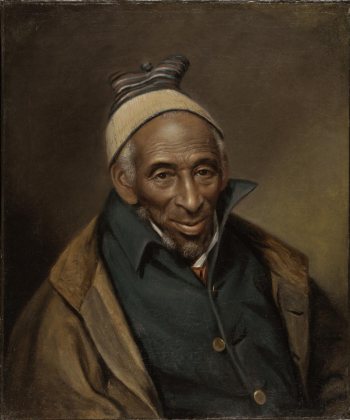 Yarrow Mamout, an African American Muslim who won his freedom from slavery, was reputedly 140 years old in 1819, when Charles Willson Peale painted this portrait for display in his Philadelphia Museum. Although Peale learned this was a miscalculation, the story of eighty-three-year-old Yarrow (c. 1736–1823), a native of the West African country of Guinea who was literate in Arabic, was still remarkable. As Peale noted, Yarrow was “comfortable in his Situation having Bank stock and [he] lives in his own house.”
A rare representation of ethnic and religious diversity in early America, and an outstanding example of Peale’s late naturalistic style, the picture is distinguished by the direct and sympathetic encounter between the artist and his subject and the skilled rendering of the details of physiognomy and age. Yarrow’s knit cap suggests a kufi, a hat traditionally worn by African Muslim men to assert their religion or African identity, but Peale artfully employs its yellow band to highlight his steady gaze with its glint of humor and wisdom.
Seventy-seven years old when he created this portrait, Peale was seeking a record of the personal traits that he believed supported a long life. In his writings and museum displays Peale celebrated making wise choices to maintain good health and a positive attitude, and he perceived Yarrow’s perseverance through his difficult life as a model of resourcefulness, industriousness, sobriety, and an unwillingness to become dispirited.
◊ ◊ ◊ ◊ ◊
More information about Mamout is available from this piece by Colbert King for The Washington Post (13 February 2015). For Mamout’s biography, see James Johnston, From Slave Ship to Harvard: Yarrow Mamout and the History of an African American Family (Fordham University Press, 2012). This past summer, the Historic Preservation Office dug shovel test pits in Georgetown in connection with the Yarrow Mamout Archaeology Project, led by Mia Carey (as reported by WAMU 88.5).
Exhibition | Drawn from Courtly India
Press release (6 November 2015) from the Philadelphia Museum of Art:
Drawn from Courtly India: The Conley Harris and Howard Truelove Collection
Philadelphia Museum of Art, 6 December 2015 — 27 March 2016
Curated by Ainsley Cameron
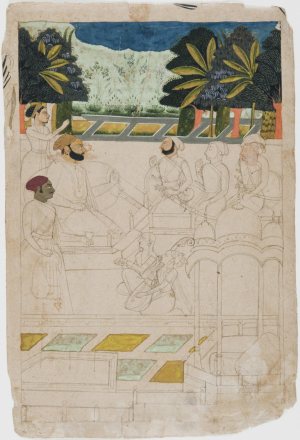
A Prince and Courtiers in a Garden, ca. 1720–30, with later additions, India (Jodhpur or Bikaner, Rajasthan) (Philadelphia Museum of Art, 2013-77-31).
The Philadelphia Museum of Art presents an exhibition of rare and masterful drawings created in the workshops of royal Indian courts over the course of four centuries. Drawn from Courtly India: The Conley Harris and Howard Truelove Collection features a wide range of sketches, preparatory studies, and compositional drawings that vividly depict mythological themes, verdant landscapes and architectural settings, portraits of prominent rulers, and scenes from the lives of Indian nobility. The Museum acquired these important works in 2013, many as a gift, and is presenting the collection in this exhibition for the first time.
While Indian paintings have long been sought after by museums and individual collectors, there has been only a limited interest in drawings. Yet drawings may be wonderful works of art in their own right, yielding a remarkable amount of information about workshop practices and artistic process. Conley Harris, a landscape painter, and the late Howard Truelove, an architectural designer, shared a passion for drawing. They began collecting Indian drawings after being inspired by their travels throughout that country. The collection they assembled over the course of more than a decade provides new insights into the artistic practices of the royal workshops that developed over generations, and offers fresh perspectives on Indian painting. Many of the works to which these collectors were drawn were created during the eighteenth century in the Hindu courts of western India and the Himalayan foothills, an area including the present-day states of Rajasthan, Himachal Pradesh and Jammu-Kashmir.
Timothy Rub, the George D. Widener Director and CEO, stated: “The ongoing development of the Museum’s collection has always represented our partnership with great collectors who have been as passionate as we are about sharing with everyone the finest works of art. In this regard we are especially fortunate to have acquired the marvelous collection assembled by Conley Harris and Howard Truelove, and we are enormously grateful to the collectors. This collection adds a new and important dimension to our holdings of Indian art, which is one of the most important in the country. It also enables us to bring to a broader audience this fascinating and delightful aspect of South Asia’s artistic heritage.”
The first section of the exhibition will feature a group of finished drawings and explore the relationship between court artists and their royal patrons. A second will focus on the innovative workshop process, examining how artists developed and revised drawings through techniques such as white wash corrections, color notations, and pouncing. The drawings in this section will highlight not only the artists’ adept handling of the medium, they will also testify to the collaboration of artists employed within a hierarchical workshop structure, demonstrating how skills were conveyed from master to apprentice. A third section, dedicated to the key moment when brush first meets paper, calls attention to the expressive power of the expert brushstroke. The fourth and final section of the exhibition invites visitors to respond to the works on display by creating their own drawings using workshop techniques.
The exhibition is organized by Ainsley M. Cameron, the Museum’s Ira Brind and Stacey Spector Assistant Curator of South Asian Art. She stated: “These works offer new ways of looking and thinking about Indian courtly drawing. People tend to approach the study of paintings or drawings from the perspective of the patron because so many of the artists’ names are unknown, but we are exploring the perspective of the artist, as maker—the gesture of an artist’s hand, the spontaneity of line, and the process through which ideas are born.”
About Conley Harris and Howard Truelove
Based in Boston, artist Conley Harris (born 1945) is a former faculty member of the department of art and art history at the University of New Hampshire. Harris is known for his lyrical landscapes of New England and the American West. Howard Truelove (1946–2012) was an architectural designer and vice president of design at the firm KlingStubbins in Cambridge, Massachusetts. His interior-design work ranged from public spaces in major office buildings to universities and museums. Harris often uses works in their collection as a source of inspiration, creating paintings that not only absorb motifs from South Asian and Persian miniature paintings, but also play with the idea of multiple layers, the palimpsest found in artists’ working sketches and so creatively reinterpreting the historical drawings for a new generation.
◊ ◊ ◊ ◊ ◊
The catalogue is distributed by Yale UP:
Ainsley Cameron, with an essay by Darielle Mason, Drawn from Courtly India: The Conley Harris and Howard Truelove Collection (Philadelphia: Philadelphia Museum of Art, 2015), 160 pages, ISBN: 978-0300215250, $35.
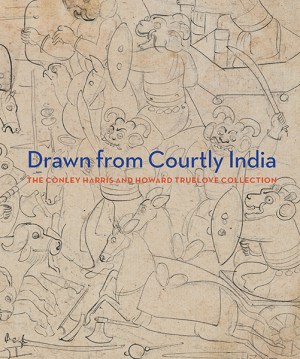 This publication presents the first in-depth survey of the Conley Harris and Howard Truelove Collection of Indian Drawings, which was recently acquired by the Philadelphia Museum of Art. This exceptional collection consists of 65 works on paper created between the 16th and 19th centuries. The Harris-Truelove Collection is uniquely and tightly focused on works from the royal courts of North India, and the majority of these drawings served as preparatory material for the opaque watercolor illustrations that have been widely collected and studied. This catalogue celebrates the assured line of the Indian draftsman and recognizes these drawings as accomplished works of art in their own right. The text details the process and technique involved in their production, and explores what can be revealed by the artist’s hand. The catalogue also contextualizes the role of art production in court culture, and reveals the intricacies of artistic workshop practice.
Ainsley Cameron is the Ira Brind and Stacey Spector Assistant Curator of South Asian Art, and Darielle Mason is the Stella Kramrisch Curator of Indian and Himalayan Art, both at the Philadelphia Museum of Art.
New Book | Passion and Control: Dutch Architectural Culture
Forthcoming in January from Ashgate:
Freek Schmidt, Passion and Control: Dutch Architectural Culture of the Eighteenth Century (Farnham: Ashgate, 2016), 362 pages, ISBN: 978-0754635819, $120.
 Passion and Control explores Dutch architectural culture of the eighteenth century, revealing the central importance of architecture to society in this period and redefining long-established paradigms of early modern architectural history. Architecture was a passion for many of the men and women in this book; wealthy patrons, burgomasters, princes and scientists were all in turn infected with architectural mania. It was a passion shared with artists, architects and builders, and a vast cast of Dutch society who contributed to a complex web of architectural discourse and who influenced building practice. The author presents a rich tapestry of sources to reconstruct the cultural context and meaning of these buildings as they were perceived by contemporaries, including representations in texts, drawings and prints, and builds on recent research by cultural historians on consumerism, material culture and luxury, print culture and the public sphere, and the history of ideas and mentalities.
Freek Schmidt is Associate Professor of Architectural History at Vrije Universiteit Amsterdam, The Netherlands.
◊ ◊ ◊ ◊ ◊
C O N T E N T S
List of Illustrations
Acknowledgments
Introduction
1 Domestic Pleasures
2 Arcadian Territory
3 Royal Ambitions
4 Amateur Passions
5 Reforming Correction
6 Space for Experiment
7 Distinguished Sociability
Epilogue
Bibliography
Index
New Book| Luca Carlevarijs
From Artbooks.com:
Dario Succi, Luca Carlevarijs (Gorizia: Libreria Editrice Goriziana, 2015), 336 pages, ISBN: 978-8861022294, $115.
 La monografia dedicata a Luca Carlevarijs (Udine 1663–1730 Venezia) offre il panorama completo e scientificamente aggiornato sui dipinti del maestro che inaugurò agli inizi del Settecento la gloriosa stagione del vedutismo veneziano. Compilato da Dario Succi, curatore dell’unica mostra finora dedicata all’artista (Padova, Palazzo della Ragione, 1994), il catalogo contiene nella prima parte la ricostruzione dell’itinerario artistico partendo dai famosi porti di mare e dagli spettacolari ingressi solenni degli ambasciatori esteri nel Palazzo Ducale. Fa seguito la schedatura accurata dei 185 dipinti sicuramente autografi presenti nei musei e nelle collezioni private di tutto il mondo, sottoponendo ad una stringente analisi critica le opere pubblicate in precedenza, separandole da quelle dei seguaci. Splendidamente illustrato con 240 immagini a colori anche a doppia pagina, il volume di 340 pagine intende porsi come riferimento ineludibile per gli amanti dell’arte veneziana, oltre che per studiosi, collezionisti, antiquari.
◊ ◊ ◊ ◊ ◊
The monograph devoted to Luca Carlevarijs (Udine Venice 1663–1730) provides a complete overview and scientifically updated on the paintings of the master who ushered in the early eighteenth century the glorious season of Venetian view painting. Compiled by Dario Succi, curator of the only exhibition dedicated to the artist so far (Padua, Palazzo della Ragione, 1994), the catalog contains the first part of the reconstruction of the artistic starting from the famous sea ports and the beautiful solemn entries of the ambassadors Foreign in the Palazzo Ducale. It follows the filing of accurate 185 paintings definitely autographs in museums and private collections around the world, submitting to a stringent critical analysis works published previously, separating them from those of the followers. Beautifully illustrated with 240 color images even double page, the volume of 340 pages intends to become inescapable reference for lovers of Venetian art, not only for scholars, collectors, antique dealers.
At Bonhams | Meissen Acquisitions

Meissen armorial two-handled beaker and saucer from the service for the Elector Clemens August of Cologne, 1735.
More information is available here»
◊ ◊ ◊ ◊ ◊
Press release (4 December 2015) from Bonhams:
Fine European Ceramics, Sale 22783
Bonhams, London, 2 December 2015
A rare Meissen armorial two-handed beaker and saucer, which once belonged to the Elector Clemens of Cologne, was bought this week at Bonhams Fine European Ceramics sale by the Brühl Palaces Augustusburg and Falkenlust. The UNESCO World Heritage Site, which belonged to the Elector Clemens August of Cologne (1700–1761), is the original home of the service to which this beaker and saucer belonged. Estimated at £50,000–60,000, the lot (#42) sold for £74,500. Bonhams Head of European Ceramics, Nette Megens said, “It’s very satisfying to know that this wonderful beaker is going back to its first home and will be re-united with other pieces from the same service in the Brühl Palaces’ collection.”
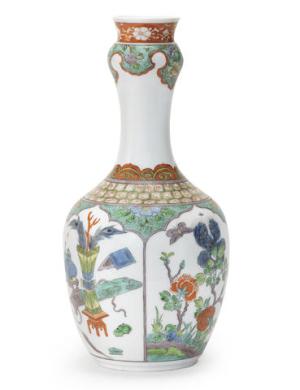
Meissen Famille verte vase, ca. 1735
Sold for £74,500.
The other top lot in the sale was a Meissen Famille verte vase from ca. 1735 (lot #40). One of very few examples of Meissen porcelain in the Chinese style, the vase sold for £74,500. Two other Meissen pieces were bought by major international museums confirming the manufactory’s importance in European cultural history.
The Palace Het Loo bought a Meissen soup plate for £6,875, more than double the lot’s pre-sale estimate of £3,000–5,000 (lot #51). The plate, made in the early 1770s, is from the service of Willem V of Orange, Stadholder of the United Provinces of the Netherlands. The service consists of 435 pieces which over the centuries have been dispersed across a range of museums and private collections. The plate will now join the Het Loo’s collection of around 170 pieces as, little by little, they bring the service together again. “It is one of the earliest Meissen topographical services and what we consider the most important related to the House of Orange,” said Suzanne Lambooy, Curator of Glass and Ceramics at Palace Het Loo. “We are excited to add this plate to our exhibition
as it is has an exceptional decoration depicting a view of
Vlissingen that we did not have before in our collection.”

Large Meissen figure of Paris, ca 1747
Sold for £4,750 (acquired by the V&A)
The Victoria & Albert Museum also purchased a large Meissen figure of Paris from a table centerpiece for £4,750 (lot #67). Reino Liefkes, Senior Curator of Ceramics and Glass at the V&A said: “The V&A is excited about acquiring this Meissen figure, which was originally modeled in 1747 for a grand table-centrepiece in white porcelain which has now been lost. The figure will be acquired with funds from the Capt. H.B. Murray Bequest and will go on display in the Museum’s Ceramics Galleries in due course. A spectacular Meissen centre-piece, also dating from 1747, has recently been restored by the V&A for the Museum’s new Europe 1600–1815 Galleries, which will open next week.”
Armorial Meissen was a further success of the sale. An armorial beaker from 1737 sold for £25,000 and an armorial teabowl and saucer from the service for Christian VI of Denmark sold for £12,500.
Exhibition | Exotic Creatures

Clara, the Rhinoceros, bronze, second half of the eighteenth century
(London: V&A, A.528-1910)
◊ ◊ ◊ ◊ ◊
Press release (19 August 2015) for the Royal Pavilion exhibition:
Exotic Creatures
Royal Pavilion, Brighton, 14 November 2015 — 28 February 2016
Curated by Alexandra Loske
A new exhibition at the Royal Pavilion, Brighton will explore how animals considered exotic by the Georgians and early Victorians were depicted, kept and presented. Exotic Creatures will look at animals owned by the Royal Family and in menageries and early zoos, as well as the ‘political beasts’ of the period (c.1740–1850). A painting of liger cubs (a cross between a tiger and a lion) born at Windsor in 1824, and presented to Royal Pavilion creator George IV shortly after, will be displayed to the public for the first time. Another rarely-seen painting will tell the story of the UK’s first living giraffe, given to George IV as a diplomatic gift by the Pasha of Egypt in 1826. Other works on show will include satirical prints, original menagerie bills, sculptural and ceramic pieces and paintings and archival material. The exhibition will take a hands-on, playful approach suitable for all the family, and a children’s Royal Pavilion Creature Trail will be available to buy at the admission desk.
The exhibition will be organised around four main themes:
Royal Menageries
George IV, himself considered exotic and unpredictable by many, kept a significant collection of exotic animals in his private menagerie at Windsor Great Park—continuing a tradition dating back to the keeping of lions at the Tower of London Menagerie in the early 13th century. The exhibition will tell the stories of individual exotic animals and explain the transition to public menageries, the establishment of the Zoological Society of London in 1826, and the opening of its Gardens—later known as London Zoo—in 1828.
Public and Travelling Menageries and Early Zoos
Many of the exhibits will have a strong connection with Brighton, whose residents enjoyed regular visits from travelling menageries and animal performances in the Royal Pavilion grounds. A permanent zoological gardens was proposed on the site now occupied by Park Crescent, where lions still top the gateposts of the southern garden wall.The late Georgian period saw a change in attitudes to how and why exotic animals where kept, and in the late 1820s the Zoological Society of London, devoted to scientific research, was founded. This led to the establishment of what is now London Zoo.

Jacques-Laurent Agasse, Nubian Giraffe, ca. 1827, (Royal Collection Trust / Her Majesty Queen Elizabeth II)
Royal Beasts
George’s mother Queen Charlotte kept a zebra in the 1760s and ordered a rhino for her children’s amusement, while George IV gave ostriches as presents to mistresses and kept kangaroos at Windsor Great Park. He also received the first living giraffe on British soil as a diplomatic gift. The young female arrived in August 1827 after a long and strenuous journey from Africa, by which time neither she nor George were in a good state of health. Cartoonists mercilessly poked fun at both, but the portrait by Swiss artist Jacques-Laurent Agasse is more sympathetic, depicting the giraffe in great detail with her keepers in Windsor Great Park. Although two Egyptian cows were drafted in as wet nurses, she struggled and died less than two years later.
Political Beasts
Animals were a popular device for mocking politicians and royals in Georgian satire and caricatures, as depicted in Brighton Museum and the Royal Pavilion’s collections.
The exhibition will demonstrate how the arrival of exotic animals influenced fashion and the decorative arts in Britain, with giraffe-patterned wallpaper, teapots and fabrics becoming hugely popular in the late 1820s. It will also address the challenges of creating anatomically correct images of non-native animals in the Georgian era, and the period’s simultaneous passions for scientific research and the use (and abuse) of animals in entertainment. As well as caricatures and striking Staffordshire figures from Brighton Museum & Art Gallery’s own collection, curator Alexandra Loske has sourced significant loans from the Victoria & Albert Museum, the British Museum, Royal Collection Trust and private collections.
Loske said: “We’re thrilled to have secured the loan of one of the most popular and beautiful animal paintings in British art, a portrait of George IV’s giraffe—commissioned by the king himself and still in the Royal Collection. Another highlight will be the V&A’s exquisite bronze statue of a rhino named Clara, which toured Europe in the 1740s and 1750s—of which only four survive. We’re also very proud to be displaying a painting of liger cubs, attributed to Richard Barrett Davis. The cubs were born in Windsor in 1824 and presented to George IV, and were painted by leading animal painters including Agasse. The painting in our exhibition was recently bought by a local collector and supporter of the Royal Pavilion Foundation, and will be displayed to the public for the very first time.”
New Book | Picturing Marie Leszczinska: Representing Queenship
From Ashgate:
Jennifer G. Germann, Picturing Marie Leszczinska (1703–1768): Representing Queenship in Eighteenth-Century France (Farnham: Ashgate, 2015), 258 pages, ISBN: 978-1409455820, $110.
 Portraits of Queen Marie Leszczyńska were highly visible in eighteenth-century France. Appearing in royal châteaux and, after 1737, in the Parisian Salons, the queen’s image was central to the visual construction of the monarchy. Her earliest portraits negotiated aspects of her ethnic difference, French gender norms, and royal rank to craft an image of an appropriate consort to the king. Later portraits by Maurice-Quentin de La Tour, Carle Van Loo, and Jean-Marc Nattier contributed to changing notions of queenship over the course of her 43 year tenure. Whether as royal wife, devout consort, or devoted mother, Marie Leszczinska’s image mattered. While she has often been seen as a weak consort, this study argues that queenly images were powerful and even necessary for Louis XV’s projection of authority. This is the first study dedicated to analyzing the portraits of Leszczynska. It engages feminist theory while setting the queen’s image in the context of portraiture in France, courtly factional conflict, and the history of the French monarchy. While this investigation is historically specific, it raises the larger problem of the power of women’s images versus the empowerment of women, a challenge that continues to plague the representation of political women today.
Jennifer G. Germann is Assistant Professor in the Department of Art History at Ithaca College.
◊ ◊ ◊ ◊ ◊
C O N T E N T S
List of Illustrations
Acknowledgments
Introduction
1 Framing Queenship in France
2 Incorporating Marie Leszczinska
3 Sons and Mothers
4 Gendering the French monarchy
5 The Queen’s New Image
Epilogue: Memorializing Marie Leszczinska
Bibliography
Index










 Enfilade
leave a comment