New Book | The Wonder of the North
From Boydell Press:
Mark Newman, The Wonder of the North: Fountains Abbey and Studley Royal (Woodbridge: Boydell Press, 2015), ISBN: 978-1843838838, 406 pages, $60 / £30.

Dubbed the ‘Wonder of the North’ in 1732, the National Trust’s Fountains Abbey and Studley Royal Estate (now a World Heritage Site) encompasses one of the largest, most magnificent and beautiful designed landscapes ever created. This richly illustrated volume charts the landscape’s history from the first arrival of prehistoric hunters, via medieval monasticism, the Dissolution of the monasteries, eighteenth-century aestheticism and scandal, and the first ages of mass tourism, to the present day. At the heart of the story lies the rise and fall of England’s largest Cistercian monastery and how that shaped the origins of the Aislabie family’s breathtaking gardens. Their Studley Royal was at the forefront of every emergent landscape gardening fashion between 1670 and 1800. The book also describes the dramatic history of the family and the monumental scale of their achievements in this field, extending over many dozens of square miles of North Yorkshire—far beyond the limits of the garden as it is seen today (reduced to serve the more limited needs of Victorian day-trippers). The Wonder of the North brings social and garden history together with archaeology to reveal Fountains Abbey and Studley Royal—too often seen as ‘just’ a ruined medieval monastery—as one of the world’s greatest artistic creations.
Mark Newman has been the National Trust’s archaeological adviser for Fountains Abbey and Studley Royal estate since 1988. He was also resident there, living in Fountains Hall from 1988 to 1995.
◊ ◊ ◊ ◊ ◊
C O N T E N T S
1 Preface: The ‘Wonder of the North’
2 Priming the Canvas: Natural and Man-Made Landscapes before 1132
3 Utility and Sanctity: Fountains Abbey and its Surroundings, 1132–1540
4 From Dissolution to Resurrection: The Manors of Fountains and Studley, 1539–1667
5 Founding a Dynasty: The Emergence of Studley Royal
6 Emerging Wonders: The Unfolding of a Designed Landscape, 1723–42
7 Filling the Landscape: William Aislabie at Studley, 1742–67
8 Beyond Studley’s Domain: Kirkby Fleetham, Hackfall, Laver Banks and Fountains
9 Estates Combined: Fountains and Studley, 1768–81
10 Arcadia Declining: The Estate in the Earlier Nineteenth Century
11 A Place of Popular Resort: The Rising Tide of Visitors
12 Relicts of Our Own Days
13 Conclusion: A Future for Studley Royal
Exhibition | Pierre-Jean Mariette and the Art of Collecting Drawings
Opening next month at The Morgan:
Pierre-Jean Mariette and the Art of Collecting Drawings
The Morgan Library and Museum, New York, 22 January — 1 May 2016

Girolamo Francesco Maria Mazzola, called Il Parmigianino, Man Standing Beside a Plinth on which He Rests a Book, and a Study of Saint Luke, ca. 1530, Pen and brown ink, brown wash, on paper. Purchased by Pierpont Morgan in 1909 (The Morgan Library & Museum)
Pierre-Jean Mariette (1694–1774) was one of the earliest and most important collectors of drawings, and he played a pivotal role in shaping our modern conception of the artists who created them. The exhibition—the first ever devoted to the collector at a U.S. museum—will highlight the peculiar ways in which Mariette organized and presented his holdings.
In order to enhance the appearance of the drawings and to improve their legibility, Mariette often restored (completing, cleaning, and even dismembering) his sheets. He cut them, integrated them with additions, completed and assembled together fragmentary sheets, and sometimes split double-sided drawings using his extraordinary ability as a paper restorer. Moreover, Mariette provided his drawings with elaborate frame-like blue mounts, which are still highly prized by collectors. Drawings featured in this show include works from the Morgan’s collection as well as sheets from the Metropolitan Museum of Art and the Princeton University Art Museum. Among the artists represented are such masters as Parmigianino (1503–1540), Annibale Carracci (1560–1609), and Guercino (1591–1666).
This exhibition is a program of the Drawing Institute at the Morgan Library & Museum. Additional support is provided by Lowell Libson, Ltd.
New Book | Noah’s Ark: Essays on Architecture
From The MIT Press:
Hubert Damisch, Noah’s Ark: Essays on Architecture, edited and introduced by Anthony Vidler, translated by Julie Rose (Cambridge: The MIT Press, 2016), 392 pages, ISBN: 978-0262528580, $31.
 Trained as an art historian but viewing architecture from the perspective of a ‘displaced philosopher’, Hubert Damisch in these essays offers a meticulous parsing of language and structure to ‘think architecture in a different key’, as Anthony Vidler puts it in his introduction. Drawn to architecture because it provides ‘an open series of structural models’, Damisch examines the origin of architecture and then its structural development from the nineteenth through the twenty-first centuries. He leads the reader from Jean-François Blondel to Eugène Viollet-le-Duc to Mies van der Rohe to Diller + Scofidio, with stops along the way at the Temple of Jerusalem, Vitruvius’s De Architectura, and the Louvre. In the title essay, Damisch moves easily from Diderot’s Encylopédie to Noah’s Ark (discussing the provisioning, access, floor plan) to the Pan American Building to Le Corbusier to Ground Zero. Noah’s Ark marks the origin of construction, and thus of architecture itself. Diderot’s Encylopédie entry on architecture followed his entry on Noah’s Ark; architecture could only find its way after the Flood.
In these thirteen essays, written over a span of forty years, Damisch takes on other histories and theories of architecture to trace a unique trajectory of architectural structure and thought. The essays are, as Vidler says, ‘a set of exercises’ in thinking about architecture.
Hubert Damisch is Emeritus Professor of the History and Theory of Art at the École des Hautes Études en Sciences Sociales, Paris. Over the course of a long and distinguished career, he has held posts at Cornell University, Columbia University, and the Center for Advanced Studies in the Visual Arts, Washington. He is the author of The Origin of Perspective, The Judgment of Paris, Skyline: The Narcissistic City, and A Theory of Cloud: Toward a History of Painting.
Anthony Vidler is Dean and Professor of the Irwin S. Chanin School of Architecture at The Cooper Union, New York. He is the author of Warped Space: Art, Architecture, and Anxiety in Modern Culture (2000), and The Architectural Uncanny: Essays in the Modern Unhomely (1992), both published by The MIT Press, and other books.
British Art Studies, Autumn 2015
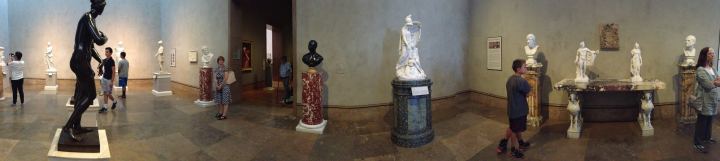
Ken Gonzales-Day, Panorama of Museum West Pavilion, 2015, chromogenic print, 20.32 x 99 cm, taken in the West Pavilion, J. Paul Getty Museum, Los Angeles, ©Ken Gonzales-Day.
◊ ◊ ◊ ◊ ◊
British Art Studies recently launched with an impressive premier issue and an exemplary commitment to free and open access, as detailed in the initial issue’s editorial statement. Congratulations! –CH
British Art Studies is free and open access: there are no subscriptions, no passwords, and no fees to pay. All content will be preserved as a free-to-use resource. The ethos of open access is one that YCBA and PMC have adopted for all their digital efforts, in the recognition that conventional proprietary models represent a major obstacle to scholarship. It is published under a Creative Commons CC BY-NC licence, meaning that you are free to share and re-use its contents for non-commercial purposes, provided that appropriate credit is given to the author/s. No permissions are needed. . . .
◊ ◊ ◊ ◊ ◊
The eighteenth century in BAS 1:
British Art Studies 1 (Autumn 2015)
Conversation Piece coordinated by Richard Johns, “There’s No Such Thing as British Art.”
‘Conversation Piece’ is a British Art Studies series that draws together a group of contributors to respond to an idea, provocation or question. The conversation will develop as more respondents enter the debate. Readers can also join in by adding a response.

Thomas Gainsborough, Charity Relieving Distress, ca. 1784, oil on canvas, 127.6 x 102.2 cm (Indianapolis Museum of Art).
Georgina Cole, “ ‘A Beautiful Assemblage of an Interesting Nature’: Gainsborough’s Charity Relieving Distress and the Reconciliation of High and Low Art.”
In the competitive environment of the eighteenth-century London art scene, Thomas Gainsborough and Sir Joshua Reynolds were often perceived as great rivals. While they shared patrons, sitters, and a stake in the future of British art, their differing artistic approaches caused considerable friction, indeed Gainsborough seceded from the Royal Academy of Art in 1784, boycotting its exhibitions and activities. This essay, however, argues that Gainsborough’s Charity Relieving Distress, painted in the year of his secession, proposes a charitable resolution of their aesthetic attitudes. The complex interrelation of allegorical and anecdotal form is interpreted as a pictorial attempt to reconcile their approaches through the concept of charity, a virtue of powerful artistic lineage in the western tradition, and of contemporary social importance.
Cyra Levenson and Chi-ming Yang, with a photo-essay by Ken Gonzales-Day, “Haptic Blackness: The Double Life of an 18th-Century Bust.”
‘One Object’ is a British Art Studies series that uses an object from a collection as a starting point for collaborative research. Cyra Levenson and Chi-ming Yang have co-authored this essay which is followed by a photo-essay by artist Ken Gonzales-Day and an interview between him and the authors.
Lecture | Mark Hallett on Gainsborough’s Landscapes
At The Morgan:
Mark Hallett, The Nomadic Eye: Traveling through Thomas Gainsborough’s Landscapes
The Morgan Library and Museum, New York, 9 December 2015
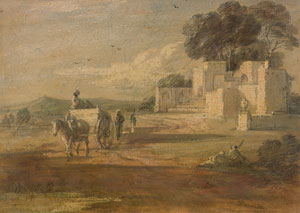
Thomas Gainsborough, Landscape with Horse and Cart, and Ruin, watercolor, oil and black chalk on laid paper; varnished (The Morgan Library and Museum)
Thomas Gainsborough’s landscape drawings and paintings take us into a distinction world. It is one in which we are typically granted the perspective a of a traveller wandering along a winding path, track or road. It is one in which we encounter a succession of familiar but also enigmatic subjects: the edges of woods, muddy banks, shadowed ponds, whitewashed ruins, figures resting on the road’s edges, shepherds with their flocks, men and women returning form the market. It is one in which trees often seem to dance and interact, and in which skies are constantly shifting. And finally, it is one in which we continually sense the echoes of earlier art—of dutch seventeenth-century landscape paintings, for example, or the territories painted by artists such as Rubens, Ruisdael, or Gaspard Dughet. In this illustrated lecture Professor Mark Hallett, Director of Studies at The Paul Mellon Centre for Studies in British Art, takes us on a tour of Gainsborough’s pastoral views and suggests how we might best understand and appreciate the pictorial world that the artist created in and through his landscapes. This program is organized by the Morgan Drawing Institute.
Wednesday, December 9, 6:30pm; admission is free.
Exhibition| Wordplay: Matthias Buchinger’s Drawings
Press release (19 November 2015) from The Met:
Wordplay: Matthias Buchinger’s Drawings from the Collection of Ricky Jay
The Metropolitan Museum of Art, New York, 5 January — 11 April 2016
Curated by Freyda Spira with Femke Speelberg and Jennifer Farrell

Approximately 22 drawings by the 18th-century German artist Matthias Buchinger (1674–1739), who was born without hands or feet, will be presented in Wordplay: Matthias Buchinger’s Drawings from the Collection of Ricky Jay, opening on January 5, 2016. Despite his disabilities, Buchinger was celebrated in his own time as a draftsman and calligrapher as well as a magician and musician, and poems were written in Europe about his many talents and achievements. Known as ‘the Little Man of Nuremberg’, because he was only 29 inches tall, Buchinger was said to have performed for German emperors, European princes, and for King George I of England. He was also a frequent guest at noble houses in England and Ireland, and performed at local fairs and inns from Amsterdam and Stockholm to Leipzig and Paris.
The Metropolitan Museum’s two drawings by Buchinger will be displayed alongside some 20 works from the collection of Ricky Jay, the celebrated illusionist, actor, and author. Framing Buchinger’s stupendous works, which were composed largely through calligraphy and micrography (employing minuscule script to create abstract shapes or figurative designs), will be works from the Metropolitan Museum’s collection that will demonstrate text as image. These additional works will include late medieval manuscripts, Renaissance typographical prints, 17th-century writing books, and contemporary works on paper.
Wordplay: Matthias Buchinger’s Drawings from the Collection of Ricky Jay is organized by Freyda Spira, Associate Curator with Femke Speelberg and Jennifer Farrell, also Associate Curators, of the Metropolitan Museum’s Department of Drawings and Prints.
The New York Times architecture critic Michael Kimmelman and Ricky Jay will discuss Matthias Buchinger in a ‘MetSpeaks’ ticketed talk on January 21, 2016.
◊ ◊ ◊ ◊ ◊
The accompanying publication is due out next March from Siglio:
Ricky Jay, Matthias Buchinger: The Greatest German Living (New York: Siglio Press, 2016), 160 pages, ISBN: 978-1938221125, $40.
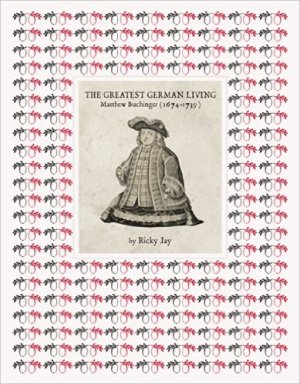 Matthias Buchinger (1674–1739) performed on more than a half-dozen musical instruments, some of his own invention. He exhibited trick shots with pistols, swords and bowling. He danced the hornpipe and deceived audiences with his skill in magic. He was a remarkable calligrapher specializing in micrography—precise handsome letters almost impossible to view with the naked eye—and he drew portraits, coats of arms, landscapes and family trees, many commissioned by royalty. Amazingly, Matthias Buchinger was just twenty-nine inches tall, and born without legs or arms. He lived to the ripe old age of sixty-five, survived three wives, wed a fourth, and fathered fourteen children.
Accompanying the Metropolitan Museum of Art exhibition Wordplay: Matthias Buchinger’s Inventive Drawings from the Collection of Ricky Jay, this book is a cabinet containing a single, multi-faceted wonder, refracted through acclaimed sleight-of-hand master Ricky Jay’s scholarship and storytelling. Alongside an unprecedented and sumptuously reproduced selection of Buchinger’s marvelous drawings and etchings, Jay delves into the history and mythology of the ‘Little Man’, while also chronicling his encounters with the many fascinating characters he meets in his passionate search for Buchinger.
Ricky Jay, one of the world’s great sleight-of-hand artists, has received accolades as a performer, actor, and author. He was recently profiled on the series American Masters and is the subject of the film Deceptive Practice: The Mysteries and Mentors of Ricky Jay. Jay has written frequently on unusual entertainments, and his Learned Pigs & Fireproof Women and Jay’s Journal of Anomalies were both New York Times ‘Notable Books of the Year’. The former curator of the Mulholland Library of Conjuring and the Allied Arts, he has defined the terms of his profession for the Encyclopedia Britannica and the Cambridge Guide to American Theater.










 Enfilade
leave a comment