Call for Papers | Monographic Exhibitions and the History of Art
From the Istituto Lorenzo de’ Medici:
Monographic Exhibitions and the History of Art
Università degli Studi di Firenze and the Istituto Lorenzo de’ Medici, Florence, 31 March — 1 April 2016
Proposals due by 15 October 2015
Conference organized by Maia Gahtan and Donatella Pegazzano
As has often been noted, monographic or retrospective exhibitions that illustrate the career of a single individual are largely a product of the late 19th-century desire to commemorate the deaths or centenaries of artists (e.g. Michelangelo, Firenze 1875; Donatello, Firenze 1886/87 to cite two Italian examples) or to serve patriotic ends using famous artists of the past to raise the status of an emerging nation state (e.g. Holbein, Dresden, 1871, discussed by Francis Haskell). While there are some earlier examples such as the Reynolds retrospective of 1813 at the Royal Academy, it is only in the second half of the century that the practice becomes common. By the early 20th century, some of these exhibitions had become truly art-historical in focus in that their curators approached their subjects with the express purpose of visually chronicling the development of an artist during his career and providing a venue for connoisseurship, and in this way providing opportunities for new approaches to scholarship.
Even those exhibitions of commemorative natures influenced art historical scholarship which, not surprisingly, emerged in the same decades that such exhibitions became popular, as attested to by the Holbein example. The nascent scientific discipline of art history owes much to the developing scientific rigor with which such monographic exhibitions were increasingly equipped—another theme we seek to elaborate through the individual studies. While much work has been done on the development of art historical literature, including the development of the art historical monograph (Gabriele Guercio), and to a lesser extent on the history of exhibitions (Francis Haskell, Enrico Castelnuovo, Roberto Longhi), the important relationship between the two has yet to receive the critical attention it deserves.
In an effort to better understand how the relationship between monographic exhibitions and artistic monographs has changed over time and with respect to the typology of artist subject (old master, contemporary or recently deceased), we invite papers on any aspect of how monographic or retrospective exhibitions have interacted with art history in different time periods and geographical contexts, including but not limited to the changing role of copies vs. originals, the development of connoisseurship, the role of historical documentation, the evolution of the scholarly catalogue, and considerations upon how artists were viewed by their contemporaries. It is one of our objectives to create an opportunity for scholars of various chronological frames from the Middle Ages to contemporary to exchange ideas regarding the fundamental role played by monographic exhibitions in the fields of art history and criticism. Since retrospectives were not confined to painters and sculptors—composers for example regularly received them from the 1930s—papers which address the role of like events in relation to different fields are most welcome, particularly if parallels may be drawn with the visual arts.
The conference will be held at the Istituto Lorenzo de’ Medici and the Università degli Studi di Firenze, 31 March – 1 April 2016. Lodging and meals will be provided for those whose papers have been accepted. The proceedings will be published. Please send your 200–300 word abstract in Italian or English and CV by 15 October 2015 to the conference secretary, Myra Stals: myra.stals@lorenzodemedici.it.
Exhibition | Tavole Barocche: Banchetti, Feste e Nature Morte

◊ ◊ ◊ ◊ ◊
From Gioia Oggi:
Tavole Barocche: Banchetti, feste e nature morte tra
XVII e XVIII secolo dalla Collezione Corsi di Firenze
Castello Svevo di Gioia del Colle (Ba), 11 April — 28 June 2015
Curated by Francesco Di Ciaula
Nell’anno dell’Expo di Milano, dedicato alle tematiche dell’alimentazione, le suggestive sale del Castello Svevo di Gioia del Colle (Ba) ospitano dall’11 aprile al 28 giugno 2015 la mostra Tavole Barocche, promossa dalla Regione Puglia e dal Comune di Gioia del Colle.
La mostra, a cura di Francesco Di Ciaula ed organizzata dalla società Sistema Museo, espone dipinti raffiguranti nature morte, paesaggi e scene conviviali tra XVII e XVIII secolo, provenienti dalla Collezione Corsi di Firenze conservata presso il Museo Bardini, una delle istituzioni museali più importanti del capoluogo toscano. L’esposizione è allestita nel Castello di Gioia del Colle, tra i più affascinanti manieri realizzati dalle maestranze dell’Imperatore Federico II Hohenstaufen, il Sovrano tedesco che fece della Puglia del XIII secolo la sua terra d’elezione. Tra la magnifica Sala del Trono, così nominata per la presenza dell’imponente seggio reale, la Sala del Camino, la Torre de’ Rossi e il Gineceo, si sviluppa armoniosamente la mostra, ricca di opere importanti per la storia dell’arte del Seicento e del Settecento italiano e fiammingo, come quelle del Gobbo dei Carracci, lo Spadino, Giovan Battista Ruoppolo, Jacopo da Empoli, Gian Domenico Ferretti, della bottega dell’Arcimboldo e del seguito di Pieter Brueghel il Giovane. Due le sezioni di mostra, incentrate sulla cultura del cibo e della tavola: la prima espone la rappresentazione degli alimenti nel genere della natura morta, che si impone in maniera decisiva nel Seicento. I dipinti sono dominati dalla variegata presenza di carni, selvaggina, pesci, frutti e ortaggi realizzati da artisti soprattutto di ambito toscano e romano-napoletano. La seconda sezione, arricchita dalle opere di autori fiamminghi, presenta i piaceri conviviali: prevalgono scene di banchetto e di festa, riscontrabili sia nei rituali opulenti e fastosi delle classi aristocratiche sia nelle immagini di contesti umili e popolari, nei quali l’alimentazione più che piacere della tavola diviene ricerca di appagamento della fame.
Le Sezioni
Il tema delle quaranta opere esposte, il cibo e la tavola, si rifà al mondo fisico puramente rappresentato, in un contesto di pittura profana dell’epoca barocca, il cui chiaro richiamo alle esperienze dei sensi conduce l’osservatore verso una visione seducente delle cose naturali. La nascita della natura morta, al centro della prima sezione della mostra, è paradigmatica di un interesse, presente già negli ultimi decenni del XVI secolo tra Fiandre e Italia settentrionale, della possibilità di indagare il reale negli aspetti più dettagliati e “microscopici”, considerati “laterali” nella pittura di storia. L’illusionismo, tutto teatrale, di credere di poter toccare, annusare, assaggiare i cibi sul piano della tela, accentua questa visione di una riproduzione della realtà riconoscibile come vita e vissuto quotidiano dove gli stessi alimenti, fuori da ogni intendimento retorico, suscitano desideri e ricordi sensoriali. Il processo di crescita e decadenza della frutta e dei vegetali, in connessione con l’idea del tempo che scorre, pone la natura morta come specchio della vita della materia, le cui forme assumono più o meno colore e spessore dall’impatto con la luce, l’unico elemento in grado di interagire con lo spazio della scena. Nella seconda sezione della mostra, illustrante i piaceri conviviali, i dipinti di ambito fiammingo e francese, raffiguranti feste aristocratiche tra parchi e boschi, fanno riferimento alla fusione del momento della tavola con l’intrattenimento di danze e musiche. Sempre fiamminghe le scene campestri illustranti i pasti del mondo contadino e le colazioni borghesi, mentre nelle vedute urbane del Settecento fiorentino si osserva la vita brulicante delle città, tra fiere e mercati. Le dispense e le cucine, come luoghi della conservazione e della cottura dei cibi, assumono anch’esse una rilevanza artistica, espressione di una concezione fortemente naturalistica e verosimile della realtà, priva ormai del puro idealismo del Rinascimento.
Le Opere
Come incipit del percorso di visita, accanto al trono di Federico, sono collocate la Primavera, l’Estate e l’Inverno eseguiti dalla bottega dell’Arcimboldo, l’enigmatico pittore lombardo cinquecentesco, il quale inventò la conversione del corpo umano in figura vegetale, facendo delle sue opere una prefigurazione della nascita della natura “in posa”. Nell’insieme delle nature morte qui presenti spiccano i dipinti, la Frutta e la Natura morta con cacciagione e frutta, legati a due tra gli esponenti più rappresentativi del genere in Italia, come Pietro Paolo Bonzi, detto il Gobbo dei Carracci e il Maestro S.B., noto come lo Pseudo Salini, i quali riflettono le innovazioni caravaggesche dei primi capolavori romani del Merisi, connotate da un intenso e “contemplativo” naturalismo. Nel caso del secondo pittore si nota la ripresa di modelli nordici, nell’iconografia degli animali da selvaggina, e una carica cromatica tipica della scuola napoletana del Seicento alla quale egli era legato, che in mostra è splendidamente rappresentata dalla tela attribuita a Giovan Battista Ruoppolo, la Natura morta di cucina. La natura morta fiorentina è presente nelle opere della cerchia di Jacopo da Empoli, il pittore che, formatosi sulla pittura manierista fiorentina, “importa” a Firenze nei primi decenni del XVII secolo il nuovo genere proveniente dalle botteghe romane, tramite la presenza nelle collezioni Medicee di varie tele raffiguranti “pose” di animali e vegetali. I fasti del Barocco romano sono evocati dalla Natura morta di frutta e zucche di Giovanni Paolo Castelli detto lo Spadino, e la grande tela di Michelangelo Pace detto da Campidoglio, Natura morta di fiori e frutta con papere che si abbeverano ad una fontana. La seconda parte della mostra è aperta dai convivi immersi liberamente nel contesto naturale di parchi, boschetti e giardini, con l’allusione all’imprescindibile legame tra cibo ed Eros. La cornice fiabesca delle tele fiamminghe qui esposte, Festa nel parco del Castello e Convivio, con i meravigliosi sfondi di castelli dall’aspetto ancora medievale, dona alla scena un’atmosfera sognante e ovattata, tipica della vita di corte. Ancora di scuola fiamminga, della prima metà del Seicento, sono le due tele che illustrano la piacevolezza del mangiare immersi nella natura, il Banchetto all’aperto e il Paesaggio estivo, nei quali gli atteggiamenti dei personaggi richiamano una disinvoltura borghese nell’atto della consumazione dei pasti e dello stare a tavola. La presenza in mostra di un’opera come Interno di osteria con contadini, attribuibile a un artista del seguito di Pieter Brueghel il Giovane, ci permette di cogliere l’elemento grottesco di una scena di festa contadina, dove l’aspetto di preparazione e consumazione del pasto assume una grandissima forza espressiva, tipica dell’arte bruegheliana. La descrizione della vita umile degli ultimi, in una chiave legata ai costumi alimentari, viene espressa dalla presenza di una tela del pittore del Settecento bolognese, Stefano Gherardini, Interno di osteria con personaggi, formatosi sulla scia del Crespi, e da Il Pulcinella malato, eseguito da un seguace di Pier Leone Ghezzi, il grande caricaturista romano attivo nella Roma della prima metà del XVIII secolo. In posizione dominante, nella bellissima Sala del Camino, svetta il Bacco e Arianna del pittore Rococò fiorentino Gian Domenico Ferretti, il cui dipinto celebra il Dio del vino, dell’ebbrezza, della trasformazione e della rigenerazione della vegetazione. Seguendo un suadente percorso tra dipinti ricolmi di frutta, selvaggina, pesci, tavole imbandite e paesaggi animati da feste aristocratiche, colazioni campestri e fiere cittadine, si assiste alla rivelazione di una cultura artistica dominata dal trionfo della Natura mater, la procreatrice dei prodotti della terra, raffigurata nei paesaggi come luogo di bucolico abbandono, dove Eros e le Dee della fertilità e dell’abbondanza giacciono felici sul verde rigoglioso di un prato primaverile.
Il Castello
Tra le opere fortificate di epoca federiciana presenti in Puglia, il castello di Gioia del Colle è una di quelle che conservano più integro l’impianto architettonico, definito dall’ampio cortile quadrangolare, le poderose torri angolari e le cortine con paramento a conci bugnati. L’originaria struttura di epoca bizantina fu ampliata in epoca normanna. Fin dal 1500 storici, viaggiatori e studiosi hanno attribuito a Federico II la sistemazione definitiva del castello così come appare attualmente. Parte integrante della visita al monumentale Castello di Gioia del Colle sono le sale del Museo Archeologico, dove è presente una sistematica esposizione dei numerosi corredi delle necropoli di Monte Sannace e Santo Mola che coprono un ampio arco cronologico, dall’inizio del VI al III/II secolo a.C. Vasi geometrici e figurati, armi in bronzo, fibule e statuine fittili definiscono la consueta composizione dei corredi funerari del glorioso centro indigeno, ma anche delle più ampie comunità peucete.
◊ ◊ ◊ ◊ ◊
The catalogue is available from Artbooks.com:
Francesco Di Ciaula, Tavole Barocche: Banchetti, feste e nature morte tra XVII e XVIII secolo dalla Collezione Corsi di Firenze (Foggia: Claudio Grenzi, 2015), 96 pages, ISBN: 978-8884315830, $53.
Exhibition | Velvet Paintings: 18th-Century Pastels
Now on view at The Huntington:
Velvet Paintings: 18th-Century Pastels from The Huntington’s Art Collections
The Huntington Library, Art Collections and Gardens, San Marino, CA, 16 May — 7 November 2015
Curated by Melinda McCurdy
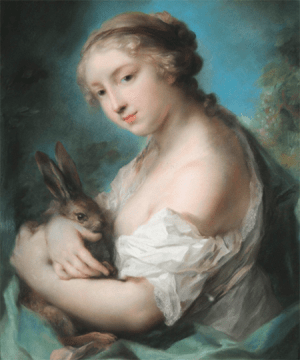
Rosalba Carriera, Girl with a Rabbit, ca. 1720–30, pastel on paper (The Huntington Library, Art Collections, and Gardens: Adele S. Browning Memorial Collection)
The art of pastel painting reached its greatest height in 18th-century Europe. Praised for its bright white luminosity and velvety surface and constrained in size by its delicacy and the technical limitations of its materials, pastel possessed a decorative quality that suited the smaller-scale rooms of rococo interiors. These properties also made it particularly useful in portraiture, where the powdery medium’s ability to diffuse light produced likenesses more convincing than those worked in oils. Despite their fragile nature, the minimal presence of oil binders and lack of surface varnish meant that pastels retained their freshness and vibrancy long after oil paintings darkened with age. This exhibition features nine 18th-century pastels from The Huntington’s holdings, which have not been on public view for nearly a decade. Still-sparkling works by masters of the medium such as Rosalba Carriera, Francis Cotes, and William Hoare, brilliantly demonstrate why the late 17th-century French art theorist Roger de Piles called pastel “the most commodious type of painting.”
◊ ◊ ◊ ◊ ◊
In a posting for Home Subjects (25 June 2015), the curator of the exhibition Melinda McCurdy considers the reasons why pastels were widely perceived in the eighteenth century as especially suitable for domestic interiors—and welcomes your comments.
New Series from Ashgate | Science and the Arts since 1750
A new series from Ashgate:
Science and the Arts since 1750
Series editor: Barbara Larson
This series of monographs and edited volumes explores the arts—painting and sculpture, drama, dance, architecture, design, photography, popular culture materials—as they intersect with emergent scientific theories, agendas, and technologies, from any geographical area from 1750 to now. It welcomes studies on the aesthetic conditioning of scientists as well as those that explore the influence of technologies, medicine, and science on visual culture either in a specific cultural or social context or through webs of influence that cross national, political, or imperial boundaries. Projects additionally might address philosophies of mind, brain, and body that changed the way visuality and aesthetic theory were understood or how new theories can be used to reinterpret the past. For more information on how to submit a book proposal to the series, please contact Margaret Michniewicz, at mmichniewicz@ashgate.com.
Barbara Larson is Professor of Art History at the University of West Florida.
Call for Papers | Difficult Women in the Long Eighteenth Century
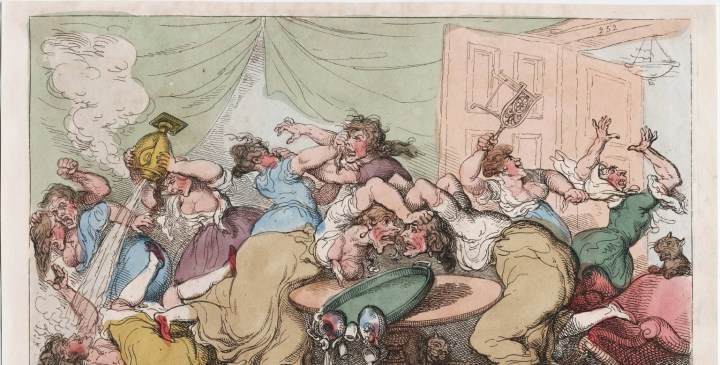
Thomas Rowlandson, Breaking up of the Blue Stocking Club. Published: [London] : By Thos. Tegg, No. 111 Cheapside, [March 1, 1815?]. Lewis Walpole Library, #11823.
◊ ◊ ◊ ◊ ◊
From the conference website:
Difficult Women in the Long Eighteenth Century, 1680–1830
University of York, 28 November 2015
Proposals due by 1 July 2015
The long eighteenth century witnessed an age of social and political revolution which profoundly affected the way in which women occupied and contributed to the public sphere. This interdisciplinary conference looks at representations and conceptions of ‘difficult women’ from 1680 to 1830. The term ‘difficult women’ encapsulates many different female experiences and lifestyles. From religiously non-conformist women to women bearing arms, a plethora of ‘difficult women’ find representation within the British Empire. This conference welcomes abstracts and/or proposals for panels on any topic relating to ‘Difficult Women’ throughout the long eighteenth century.
Topics can include, but are not limited to
• Dissenting Women – Preaching and teaching women, women writing theological texts, Methodist, Quaker, or Moravian women
• The Politically Engaged – Women involved in revolution (Glorious, American, French), female campaigners, authors of political pamphlets, female protestors, women assisting politicians
• Sexually Non-Conformist Women – Lesbianism, cross-dressers, spinsters, prostitutes, promiscuous women
• Women of the Pen – Female philosophers, published authors, bluestockings and similar intellectual circles
• Armed, Dangerous, and Criminal – Murderesses, warriors, thieves, female prisoners, representations of armed women
• Women in Art – Representations of women in satirical prints, portraiture, depictions of the female body, female artists
• Theatrical Women – Travesty roles, gender-bending roles, breeches parts and various forms of theatrical dress, women working in theatre
• Sporting Women – Female cricketers, hunters, horse riders, boxers
• Women of the Larger British Empire – Black women, women of ethnic minorities, women of conquered territories as a form of ‘other’
• Women and Medicine – Hysteria, Melancholia and Femininity, Depictions of Childbirth, Love’s Madness, the female body, female medical practitioners, midwives
Please send abstracts/panel proposals of no more than 500 words to difficultwomenconference@gmail.com by July 1st 2015. Panel proposal submissions should include the full name, affiliation, and email addresses of all participants.
New Book | Anarchist’s Guide to Historic House Museums
Forthcoming from Left Coast Press:
Franklin D. Vagnone and Deborah E. Ryan, Anarchist’s Guide to Historic House Museums (Walnut Creek, California: Left Coast Press, 2015), 210 pages, ISBN: 978-1629581705 (hardback), $99 / ISBN: 978-1629581712 (paperback), $30 / ISBN: 978-162958173 (ebook), $30.
 In these days of an aging traditional audience, shrinking attendance, tightened budgets, increased competition, and exponential growth in new types of communication methods, America’s house museums need to take bold steps and expand their overall purpose beyond those of the traditional museum. They need not only to engage the communities surrounding them, but also to collaborate with visitors on the type and quality of experience they provide. This book
• is a ground-breaking manifesto that calls for the establishment of a more inclusive, visitor-centered paradigm based on the shared experience of human habitation
• draws inspiration from film, theater, public art, and urban design to transform historic house museums
• provides a how-to guide for making historic house museums sustainable, through five primary themes: communicating with the surrounding community, engaging the community, re-imagining the visitor experience, celebrating the detritus of human habitation, and acknowledging the illusion of the shelter’s authenticity
• offers a wry, but informed, rule-breaking perspective from authors with years of experience
• gives numerous vivid examples of both good and not-so-good practices from house museums in the U.S.
Franklin Vagnone has professional experience in preservation, architecture, design, landscape architecture, archive formation and management. He was the Executive Director of the Philadelphia Society for the Preservation of Landmarks (PSPL) for four years and managed four Historic House Museums. In 2008 Vagnone became the Executive Director of the Historic House Trust of New York City, where he manages 23 Historic House Museums. Vagnone has won numerous awards, including two Lucy G. Moses Awards from the New York Landmarks Conservancy, the Award of Excellence from the Greater Hudson Heritage Network, and the Award of Merit from the Museum Association of New York. He serves on numerous nonprofit boards, such as the Greater Hudson Heritage Network and the Advisory Board for the national organization Partners for Sacred Places. His expertise and knowledge are utilized as a grant reviewer for the New York State Culture and Arts Panels. In addition to his passion for architecture and preservation, Vagnone also paints and sculpts, regularly writes on his blog Twisted Preservation, moderates the international LinkedIn Discussion group The Anarchist Guide to Historic House Museums, and tweets about museums on @Franklinvagnone and @museumanarchist.
Deborah Ryan, RLA is an associate professor of architecture and urban design at the University of North Carolina Charlotte, where she founded the Charlotte Community Design Studio as the community outreach arm of the university. As director of the Mayor’s Institute for City Design: South and the Open Space Leadership Institute, she led symposia that taught local leaders how to face growth issues in their communities. Ryan has also served as a faculty member at the Graduate School of Design at Harvard University and as a visiting critic at Columbia University. Ryan designed and developed Wikiplanning™ as an online site for increasing civic engagement in the community planning process. She has published and lectured widely on the subject of community engagement, and in 2013 she was named a Senior Edward I. Koch Fellow by the Historic House Trust of New York City to lead civic engagement efforts for the LatimerNOW project.
◊ ◊ ◊ ◊ ◊
C O N T E N T S
Foreword by Gretchen Sorin
Preface
Research Tools
1 Introduction: Why ‘Anarchist’?
2 Community Markings
3 Communication Markings
4 Experience Markings
5 Environmental Markings
6 Shelter Markings
Appendix: Evaluation Questions
References
Index
Conference | Art and Science in the Early Modern Low Countries
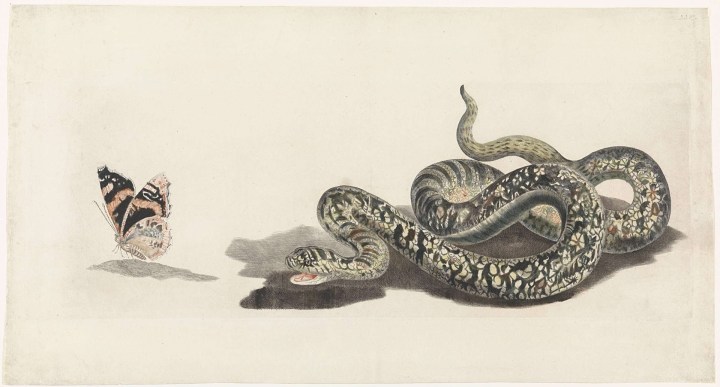
Slang met een vlinder, anoniem, Johan Teyler, 1688–1698, gravure en ets à la poupée in blauw, rood, groen, bruin en zwart, met de hand gekleurd in rood, groen en zwart, h 173mm × b 488mm.
◊ ◊ ◊ ◊ ◊
Art and Science in the Early Modern Low Countries, 1560–1730
Rijksmuseum and Trippenhuis, Amsterdam, 17–18 September 2015
Registration due by 14 September 2015
Organized by the Rijksmuseum and the Huygens Institute for the History of the Netherlands
Prior to the eighteenth century, ‘art’ and ‘science’ were often considered complementary, rather than opposite, expressions of human culture. They enlightened one another: through comparable curiosity, knowledge and observation of the world, but also in their resulting products: paintings, prints, books, maps, anatomical preservations, life casts, and many others. Scholars, craftsmen and artists often engaged in observing and representing nature, in close cooperation. During the sixteenth and seventeenth century, it was the Low Countries that emerged as a center of artistic and scientific innovation and creativity, and as central points in the exchange of goods, knowledge and skill. It is certainly no coincidence that the outburst of artistic productivity in the Netherlands, both the South and the North, coincided with the ‘Scientific Revolution’.
The conference Art and Science in the Early Modern Low Countries wants to contribute to the dialogue between experts in the history of art, historians of science, and all those interested in the visual and material culture of the sixteenth and seventeenth-century Netherlands. The conference focuses on historical objects, images, works or art or texts that represent the combination of art and science, and looks at their origin and intended audience. Sessions are, amongst others, devoted to the culture of collecting; modes of representing living nature; the influence of new optical devices on the arts; and the impact of travels abroad on representations of the world. Although the emphasis of the conference will be on the Low Countries, both the South and the North, several contributions also include developments elsewhere in Europe. This way, it hopes to offer a broad overview of the way in which art and science came together in the early modern Low Countries. Admission and registration: €95 (both days), students: €45.
Keynote Speakers: Pamela H. Smith (Columbia University, New York) and Alexander Marr (University of Cambridge)
Organizing Committee: Eric Jorink and Ilja Nieuwland (Huygens Institute for the History of the Netherlands, The Hague), Jan de Hond, Gregor Weber, Gijs van der Ham, and Pieter Roelofs (Rijksmuseum, Amsterdam)
Scientific Committee: Joanna Woodall (The Courtauld Institute of Art, London), Karin Leonhard (Universität Konstanz), and Tim Huisman (Museum Boerhaave Leiden)
◊ ◊ ◊ ◊ ◊
T H U R S D A Y , 1 7 S E P T E M B E R , 2 0 1 5
Auditorium Rijksmuseum
9.00 Registration and coffee
9.30 Opening by Taco Dibbits (Director of collections, Rijksmuseum Amsterdam)
9.40 Eric Jorink (Huygens Institute for the History of the Netherlands, The Hague), ‘Introduction: Art and Science in the Early Modern Low Countries’
10.00 Keynote Lecture
• Pamela H. Smith (Columbia University)
10.45 Coffee
11.00 Session I: Representing Nature in New Media
• Marisa Anne Bass (Harvard University), `Portentous Nature: Frogs, Fossils, and Divine Disasters in Mid-Sixteenth-Century Antwerp’
• Marrigje Rikken (Leiden University), ‘Exotic Animals in Flemish Art: Representing New Species in a New Medium around 1600’
• Tonny Beentjes, Arie Pappot and Lisa Wiersma (Rijksmuseum / University Amsterdam), “Blommen ende Beestjens af te gieten’: Life-casting in the Netherlands’
12.15 Intermezzo I
Life-casting experiments Rijksmuseum
12.25 Lunch and opportunity to visit highlighted objects in the Rijksmuseum
14.00 Session II: Collecting and Communities of Discourse
• Nadia Baadj (Bern University), ‘The Cabinetization of Art and Science in the Early Modern Low Countries’
• Paul van Duin (Rijksmuseum Amsterdam), ‘A unique Matera Medica Cabinet with a Miniature Apothecary’
• Bert van der Roemer (University of Amsterdam), ‘Dutch Collectors and the Metaphor of Nature as an Embroidery’
15.15 Intermezzo II: Ways of Seeing, Ways of Knowing
(a.o. Presentation microscope and camera obscura by Museum Boerhaave Leiden)
15.35 Tea
16.00 Session III: The Body and the Eye
• Daniel Margócsy (Hunter College, City University of New York), tba
• Huib J. Zuidervaart (Huygens Institute for the History of the Netherlands, The Hague), ‘Mathematical and Optical knowledge in mid-17th-century Delft’
• Katrien Vanagt, (Huygens Institute for the History of the Netherlands, The Hague), ‘Vopiscus Fortunatus Plempius and the Working of the Eye’, followed by the movie ‘In Waking Hours’
17.15 Drinks
F R I D A Y , 1 8 S E P T E M B E R 2 0 1 5
Trippenhuis (Seat Royal Dutch Academy of Arts and Sciences)
9.30 Welcome
9.40 Session IV: Representing Anatomy (of animals and humans)
• Lisa Bourla (University of Pennsylvania), ‘Art, Anatomy, and Pedagogy between Flanders and Florence, ca. 1600’
• Gaëtane Maes (Université de Lille), ‘Between Nature, Anatomy and Art: Crispijn de Passe’s Methods to Draw Animals’
• Steven Nadler (University of Wisconsin-Madison), ‘Picturing Descartes’s Man: The Illustrations of the Traité de l’homme, 1662 and 1664’
10.55 Coffee
11.15 Keynote Lecture
• Alexander Marr (University of Cambridge), ‘Early Modern Epistemic Images’
12.00 Lunch and poster-presentations
13.00 Session V: The Small World
• Floriana Giallombardo (Univerity of Palermo), ‘Paolo Boccone’s Recherches et observations naturelles (Amsterdam, 1674): European Curiosity, Microscopic Anatomy and the Enigma of Figured Stones’
• Ann-Sophie Lehmann, Jeroen Stumpel, (University of Groningen / University of Utrecht), ‘Oil and Observation: Vision and Science in Willem Beurs’ Treatise on Oil Painting De groote waereld in ‘t kleen geschildert’
• Kay Etheridge (Gettysburg College), ‘Maria Sibylla Merian: Envisioning the Natural World’
14.15 Intermezzo III
10-minute presentations
14.35 Tea and poster-presentations
15.00 Session VI: The World at Large: Exploring Oversea
• Claudia Swan (Northwestern University, Chicago), “Al hetwelcke my een groote verwonderinge was’: Birds of Paradise in Dutch art, science, and trade’
• Thijs Weststeijn (University of Amsterdam), ‘The Chinese Challenge: East Asia in Nicolaas Witsen’s Collection’
• Esther Helena Arens (University of Cologne), ‘Between the Exact and the Economic: Material and Illustration in Rumphius’ Rariteitkamer and Kruid-boek, 1670s to 1740s’
16.15 Intermezzo IV
10-minute presentations
16.35 Discussion and concluding remarks
17.00 Drinks
Happy Birthday, Enfilade!
From the Editor
As Enfilade turns six, I continue to be amazed at the growth of the site—all because of you fabulous readers! This spring we passed the half-million hits threshold. A typical month brings in more than 10,000 visits, and over 1300 of you are subscribers. Thank you.
And so I’ll extend my usual annual pleas:
1) Buy an art book this week. In the world of academic art history publishing, several hundred books sold over a few days is stellar. It’s an important way to communicate that the eighteenth century is a thriving field with a vital, engaged audience.
2) Renew your HECAA membership. In the normal world $30 doesn’t really count as philanthropy. For a small academic society it does. And thanks to Michael Yonan’s indefatigable work with the IRS in securing HECAA’s 501c3 status, all donations are now tax deductible in the United States. So send in a contribution of $100 or $5. But donate something. We accept PayPal.
3) Finally, send in news you’d like to see reported! Years into this, and I’m not sure what surprises me more: how easy it is to know what’s going on in the field all over the world, or how difficult it is to know what’s going on in the field all over the world! I’m glad to post announcements about conferences, forthcoming books, journal articles, exhibitions, fellowship opportunities, &c. The postings readers most enjoy are inevitably original content, reports of interesting collections, house museums, resources, and the like. No reason to be shy.
Again, thanks to all of you and all the best!
Craig Hanson
Exhibition | Rich and Tasty: Vermont Furniture to 1850
On view this summer at the Shelburne Museum:
Rich and Tasty: Vermont Furniture to 1850
Shelburne Museum, Shelburne, 25 July — 1 November 2015

Stand, attributed to Lemuel Bishop, Charlotte, Vermont, ca. 1815. Cherry, birch, mahogany, basswood and brass, 28 x 18 x 15 inches. Private Collection
This exhibition and accompanying catalogue will introduce and identify Vermont high style furniture, previously known only to decorative arts scholars, historians, and collectors. The project arrives twenty years after Shelburne Museum published a seminal checklist of early Vermont Furniture and is the result of two decades of scholarship. The exhibition will feature pieces that will illuminate the craft practices and regional economics that help define Vermont furniture’s stylistic features and unexpected aesthetic innovations, referred to as “rich and tasty” by one Vermont cabinetmaker.
◊ ◊ ◊ ◊ ◊
Jean M. Burks and Philip Zea, eds., Rich and Tasty: Vermont Furniture to 1850 (Shelburne, Vermont: Shelburne Museum, 2015), 180 pages, ISBN: 978-0939384112, $30.
Two landmark 1995 publications, The Best the Country Affords: Vermont Furniture 1765–1850 and Vermont Cabinetmakers & Chairmakers Before 1855: A Checklist, reintroduced Vermont high style furniture to decorative arts scholars, historians, and collectors. Equipped with this seminal knowledge, a small cadre of Vermont connoisseurs started scouring country auctions, adding signed and well-documented pieces to their private collections. Twenty years later, it is time to bring these pieces together and share them with the public. This catalog and the accompanying exhibition advances the understanding of Vermont high style furniture—from its features, craftsmanship, and economics, to its unexpected aesthetic innovations. The authors identify key eighteenth-century Vermont pieces before covering a variety of topics, including clockmaking, chairmaking, the half sideboard, furniture from Woodstock, and furniture from Vermont factories. Seventy-five full-color photographs by acclaimed Boston photographer David Bohl and extended catalog entries display furniture from all over the Green Mountain State.
New Book | Global Trade and Visual Arts in Federal New England
From the University Press of New England:
Patricia Johnston and Caroline Frank, eds., Global Trade and Visual Arts in Federal New England (University of New Hampshire Press, 2014), 296 pages, ISBN: 978-1611685848 (hardback), $85 / ISBN: 978-1611685855 (paperback), $45 / ISBN: 978-1611685862, $45 Ebook.
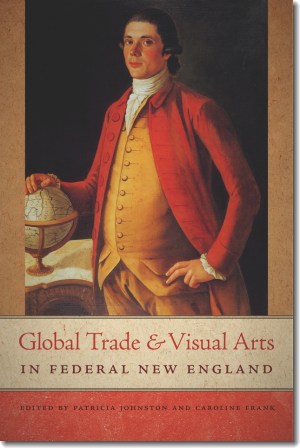 A highly original and much-needed collection that explores the impact of Asian and Indian Ocean trade on the art and aesthetic sensibilities of New England port towns in the late eighteenth and early nineteenth centuries. This diverse, interdisciplinary volume adds to our understanding of visual representations of economic and cultural changes in New England as the region emerged as a global trading center, entering the highly prized East Indies trades. Examining a wide variety of commodities and forms including ceramics, textiles, engravings, paintings, architecture, and gardens, the contributors highlight New Englanders’ imperial ambitions in a wider world.
Patricia Johnston is professor of art history and Rev. J. Gerard Mears, S.J., Chair in Fine Arts at the College of the Holy Cross. Caroline Frank teaches American studies at Brown University.
◊ ◊ ◊ ◊ ◊
C O N T E N T S
Acknowledgments
Introduction: Emerging Imperial Aesthetics in Federal New England—Patricia Johnston and Caroline Frank
Part I: Political Geographies
• The Art of Tea, Revolution, and an American East Indies Trade—Caroline Frank
• West from New England: Geographic Information and the Pacific in the Early Republic—David Jaffee
• The Forgotten Connection: The Connecticut River Valley and the China Trade—Amanda E. Lange
Part II: Commodities
• Salem’s China Trade: ‘Pretty Presents’ and Private Adventures—Jessica Lanier
• ‘Shipped in Good Order’: Rhode Island’s China Trade Silks—Madelyn Shaw
• The Story of A’fong Moy: Selling Chinese Goods in Nineteenth-Century America—Nancy Davis
Part III: Domesticating Asia
• Cultivating Meaning: The Chinese Manner in Early American Gardens—Judy Bullington
• ‘Lavish Expenditure, Defeated Purpose’: Providence’s China Trade Mansions—Thomas Michie
• Fabrics and Fashion of the India Trade at a Salem Sea Captain’s Wedding—Paula Bradstreet Richter
Part IV: Global Imaginaries
• Drawing the Global Landscape: Captain Benjamin Crowninshield’s Voyage Logs—Patricia Johnston
• Capturing the Pacific World: Sailor Collections and New England Museums—Mary Malloy
• Beyond Hemp: The Manila-Salem Trade, 1796–1858—Florina H. Capistrano-Baker
Part V: Global Productions
• Osceola’s Calicoes—Elizabeth Hutchinson
• From Salem to Zanzibar: Cotton and the Cultures of Commerce, 1820–1861—Anna Arabindan-Kesson
• Luxury and the Downfall of Civilization in Thomas Cole’s Course of Empire—Alan Wallach
Contributors
Index










 Enfilade
leave a comment