Royal Collection Trust Announces £37-Million ‘Future Programme’

Windsor Castle, Upper Ward Quadrangle panoramic view, with the State Entrance shown in the center (Wikimedia Commons: Diliff, 4 November 2006).
◊ ◊ ◊ ◊ ◊
For anyone who has ever been bewildered by the plan and circulation route at Windsor, this is excellent news! The State Apartments will make much more sense with the alignment of the visitor’s entrance and the State Entrance (pictured under the clock in the photo above). The project also serves as a useful reminder that the palace today looks like the ‘perfect’ medieval castle largely because of renovations undertaken by George III and even more so by George IV in the late eighteenth and early nineteenth centuries. –CH
Press release from The Royal Collection Trust (5 April 2016). . .
The Royal Collection Trust today announced a £37-million investment at Windsor Castle and the Palace of Holyroodhouse to fund a series of projects that will transform the experience of visitors. Collectively known as Future Programme, the projects will deliver significant improvements to the way visitors are welcomed on arrival, interpret the buildings in new ways, create dedicated Learning Centres and open up new spaces to the public. Work will begin on site in 2017 and is scheduled to be completed at the end of 2018. Both palaces will remain open to visitors throughout the development.
Windsor Castle and Holyroodhouse have been royal palaces since the 12th century and have welcomed visitors for hundreds of years. Today they are official residences of Her Majesty The Queen and in full use as the setting for State Visits, Investitures and Garden Parties. One and a half million people visit the palaces each year, enjoying these historic buildings and the great works of art from the Royal Collection.
At Windsor Castle, Future Programme will
• Increase public access to the ground floor of the State Apartments, incorporating the State Entrance into the visit and for the first time opening up the 14th-century Undercroft to the public as the Castle’s first café
• Reinstate the Castle’s Georgian Entrance Hall, creating a proper sense of arrival and linking the current visitor entrance on the North Terrace with the State Entrance on the south side of the Castle
• Introduce new interpretation and a choice of thematic routes through the State Apartments, replacing the current single, linear route
• Create a dedicated Learning Centre to enable more schoolchildren, families and adults to engage with the Palaces and Royal Collection first hand
At the Palace of Holyroodhouse, Future Programme will
• Introduce new interpretation in the State Apartments, exploring the rich history of the Palace, from its foundation by King David I in the 12th century and occupation by Mary, Queen of Scots and Bonnie Prince Charlie, to the role of the Palace today
• Introduce a new Family Room inside the Palace, and restore the interiors of the Abbey Strand buildings, just outside the Palace gates, creating a Learning Centre within them
• Include plans to make more of the Palace’s outside spaces, in partnership with Historic Environment Scotland, including the Abbey, the grounds and Forecourt, re-connecting the Palace to the city
Funded by The Royal Collection Trust from admissions to the official residences of The Queen and associated retail income, Future Programme is part of the continuing investment by the charity in the presentation and interpretation of the royal palaces and the Royal Collection. Future Programme is the most significant investment by The Trust since the creation of The Queen’s Galleries at Buckingham Palace and the Palace of Holyroodhouse, which opened to the public in 2002.
Today’s announcement coincides with the appointment of the architectural practices Purcell and Burd Haward Architects as the Lead Designers for Future Programme at Windsor Castle and the Palace of Holyroodhouse respectively.
Jonathan Marsden, Director, Royal Collection Trust, said, “Windsor Castle and the Palace of Holyroodhouse, Edinburgh’s royal palace, are two of the most important historic buildings in Britain and home to some of the greatest works of art. Future Programme represents an important investment to enhance everyone’s enjoyment of the Palaces and the Royal Collection and to deliver the best-possible experience of visiting these royal residences.”
Andrew Clark, Chairman, Purcell, said, “It is a great privilege to be appointed as Lead Designer for Future Programme at Windsor Castle. We are excited to be part of the work which will celebrate this royal residence, improve the presentation of the spectacular collections on display there, and transform the experience of visiting this wonderful historic building for the hundreds of thousands of people who do so each year.”
Catherine Burd, Director, Burd Haward Architects, said, “We are delighted to be appointed Lead Designer for Future Programme at the Palace of Holyroodhouse and to be working with Royal Collection Trust across a number of projects that will enable this hugely important building and the works of art on display there to be better understood and enjoyed by all.”
Sir Neil Cossons OBE, former Chairman, English Heritage and a member of the Master Plan Steering Group for Windsor Castle, said, “Windsor Castle is the most important—and perhaps best-known—secular building in England. Twenty years after the completion of the exemplary restoration work following the near-catastrophic fire in 1992, this new investment will introduce an outstanding programme of improvements to increase everyone’s understanding of the Castle and all that it represents as part of the nation’s history, and their enjoyment of the spectacular works of art from the Royal Collection.”
Ian Rankin OBE, author and a member of the Master Plan Steering Group for the Palace of Holyroodhouse, said, “As an Edinburgh resident and a visitor to the Palace of Holyroodhouse (often in the role of amateur guide for visiting friends), I am delighted that there are to be significant developments with the onus on education and information. This will prove invaluable, I hope, to visitors, no matter how much (or how little) they already know or think they know!”
At Auction | The Kangxi Emperor’s Mandate of Heaven Seal

◊ ◊ ◊ ◊ ◊
At Wednesday’s auction in Hong Kong (Sotheby’s HK0642), the Kangxi Emperor’s Mandate of Heaven seal (shown above) sold for $10.4million and his Yuanjianzhai seal for approximately $5.4million (video coverage is available from the BBC News). The Kangxi Baosou, a catalogue of the Emperor’s seals commissioned by his grandson, the Qianlong Emperor in 1781 did not sell.
From the pre-sale press release (11 March 2016) . . .
This spring Sotheby’s Hong Kong is honoured to present the most important Chinese historical object ever to be offered at auction. Bearing the inscription “Revere Heaven and Serve thy People,” the Seal of the Mandate of Heaven is the largest and most powerful ever carved for the Kangxi Emperor, the greatest and longest reigning monarch of China (reigned 1661–1722). Two other important historic objects of the period will be offered to complement this extraordinary seal: the Yuanjianzhai seal and one of only two existing copies of the personal record of the Kangxi Emperor’s seals, in which the exact impressions of both seals are recorded. All three lots will be offered in a dedicated themed sale titled Kangxi: Emperorship and Power on 6 April 2016 at the Hong Kong Convention and Exhibition Centre.
Nicolas Chow, Deputy Chairman, Sotheby’s Asia, International Head and Chairman, Chinese Works of Art, said, “It is an unprecedented privilege for us to handle such an important historical relic of China’s Imperial past. This seal is emblematic of the Mandate of Heaven, which has legitimised the authority of rulers in China since the dawn of recorded history. This almighty principle was also the single guiding light for the Kangxi Emperor, China’s longest reigning emperor, who is credited for completing the conquest of China, anchoring the Qing dynasty and ushering in a long period of great prosperity and peace. The Kangxi Emperor was the single most powerful person on earth at the time, ruling over a vast Kingdom and over 100 million subjects.”
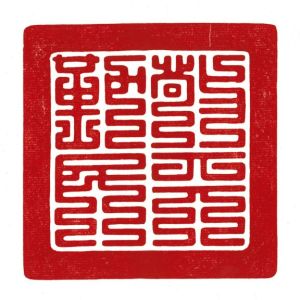 The Seal of the Mandate of Heaven is unusual among Qing imperial seals as it testifies to the close correspondence between Kangxi’s philosophical ideals and his deeds as emperor. The seal was so important that during Kangxi’s reign it was at all times kept in the Palace of Ultimate Purity (Qianqinggong), where Emperors entertained and a major venue for their policymaking. His son and grandson the Yongzheng and Qianlong Emperors, together with Kangxi, were the three greatest Emperors of the Qing dynasty, and they all had identical seals carved as they believed that the Imperial motto would bestow authority and blessing onto their reign.
The Mandate of Heaven (tianming) is the philosophical tenet that Heaven granted emperors the right to rule based on their ability to govern and their righteousness and was used throughout the history of China to validate and legitimise the rule of the emperors of China. According to this belief, Heaven will only bestow its mandate to a just and virtuous ruler, the Son of Heaven. Otherwise, the Mandate and thus his right over his kingdom and subjects will be forfeited in favour of someone better qualified. The overthrow of an emperor was often interpreted as the loss of the Mandate of Heaven. The kings of the Zhou dynasty (1046–256 BCE) first used the concept of the Mandate of Heaven to legitimise their rule and the overthrow of the earlier Shang dynasty (1600–1046 BCE).
As a non-Han Chinese ethnic ruler leading a dynasty barely established two decades before, Kangxi engaged in a relentless, almost obsessive pursuit of the Mandate of Heaven, working tirelessly to demonstrate his righteousness. He developed political reform to centralise power and maintain the unity of his empire and emphasised both economic and cultural development, driving his country to unprecedented heights. Kangxi built the foundation for the golden age of the Qing dynasty. He undoubtedly discharged his heavenly duty like no other emperor before or after him. Kangxi often expressed his devotion to his subjects, whom he considered the reason for the existence of imperial rule:
“Heaven gave birth to the subjects and then established Emperorship, not simply to bestow exceptional status or fortune on the emperor, but also to entrust him with the responsibility of moral cultivation, so that nobody within the four seas and the nine continents would be deficient in it.”
– [Qing] Xuanye [the Kangxi Emperor], Yuzhiwen ji, vol. 19.
Two other important historic objects of the period will be offered to complement this extraordinary seal, namely the Soapstone ‘Yuanjian Zhai’ Seal and the Kangxi Baosou, the only copy of the complete record of the Emperor’s seals in private hands. It is an extraordinarily fortuitous event to assemble these three exceptional legacies of Kangxi’s Emperorship in this auction.
 The soapstone seal is carved with the characters of the Yuanjianzhai (‘Studio of Profound Discernment), the Kangxi Emperor’s favourite personal retreat in the Imperial gardens northwest of Beijing, the studio where he cultivated his passion for calligraphy and research into Western science and art. The carving is of superlative quality, and is exceptional for featuring a dragon and a tiger in addition to mystical trigrams, a specific combination for evoking his status as the unsurpassed ruler of heaven and earth. The unusual positioning of the seal text between double dragons on this seal is a feature that was specifically commented on by Jean-François Gerbillon, the famous Jesuit missionary and close confidant of the emperor, when he was invited to inspect the Emperor’s seals in 1690 in the Yangxindian.
Both the Soapstone ‘Yuanjian Zhai’ Seal and Seal of the Mandate of Heaven are also recorded in the Kangxi Baosou, a complete record of the Emperor’s seals commissioned in 1781 as an act of piety by his grandson, the Qianlong Emperor. Only two copies were produced. The one offered in the upcoming sale is the only example in private hands, while the other copy is preserved in the Palace Museum, Beijing.
New Book | The Russian Canvas: Painting in Imperial Russia
From Yale UP:
Rosalind P. Blakesley, The Russian Canvas: Painting in Imperial Russia, 1757–1881 (New Haven: Yale University Press, 2016), 380 pages, ISBN: 978-0300184372, $75.
 The Russian Canvas charts the remarkable rise of Russian painting in the 18th and 19th centuries, and the nature of its relationship with other European schools. Starting with the foundation of the Imperial Academy of the Arts in 1757 and culminating with the assassination of Tsar Alexander II in 1881, it details the professionalization and wide-ranging activities of painters against a backdrop of dramatic social and political change. The Imperial Academy formalized artistic training but later became a foil for dissent, as successive generations of painters negotiated their own positions between pan-European engagement and local and national identities. Drawing on original archival research, this groundbreaking book recontextualizes the work of major artists, revives the reputations of others, and explores the complex developments that took Russian painters from provincial anonymity to international acclaim.
Rosalind P. Blakesley is reader in Russian and European art at the University of Cambridge.
Blakesley is also the curator of the exhibition now on view at London’s National Portrait Gallery Russia and the Arts: The Age of Tolstoy and Tchaikovsky (17 March — 26 June), which addresses the period from 1867 to 1914.
Exhibition | Brueghel to Canaletto: The Grasset Collection
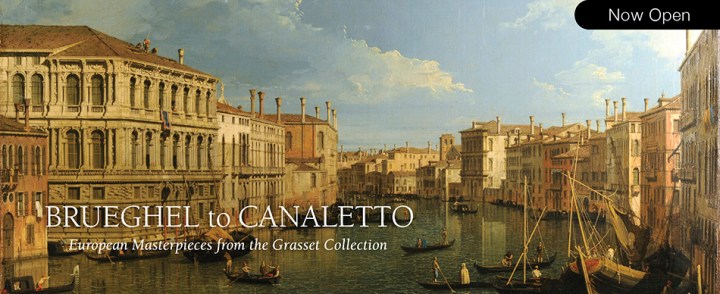
Press release (1 January 2016) from The San Diego Museum of Art:
Brueghel to Canaletto: European Masterpieces from the Grasset Collection
The San Diego Museum of Art, 2 April — 2 August 2016
The San Diego Museum of Art announced the arrival of Brueghel to Canaletto: European Masterpieces from the Grasset Collection, an exhibition featuring some of the finest still life and landscape paintings from leading Dutch, Flemish, Italian, Spanish and German artists of the 17th and 18th centuries. Made possible by a loan from a European family, of French origin with close connection to Spain, the exhibition features 40 works never before displayed publicly. The collection is on view at the Museum, the sole venue for the exhibition, from April 2 through August 2, 2016.
Spanning the years 1600 to 1750, the featured works represent a turning point in history when artwork began to be collected by those other than nobility—and the art market emerged. Grouped thematically, the exhibition begins with still lifes including floral arrangements featuring exquisite flowers imported from around the world and sumptuous banquet scenes featuring exotic fruits, cheeses, fine wine, imported silver and Chinese porcelain highly coveted in the Netherlands, reflecting the high-society influences of the time. The exhibition also includes landscapes depicting the day-to-day lives of common folk, as well as maritime scenes that became increasingly popular throughout northern Europe at the time.
Brueghel to Canaletto: European Masterpieces from the Grasset Collection brings together a rare grouping of artists from the ‘Golden Age’, including Barent Avercamp, famous for his paintings of everyday life in the Netherlands; Juan van der Hamen y León, the most important Spanish still life painter of the 17th century, whose style helped shape the development of still life through the 19th century; and Canaletto, an artist renowned for his views of the canals of Venice.
Notable works featured in the exhibition also include Floris Claesz van Dyck’s Still Life of Fruit and Olives; Osias Beert’s Still Life of Flowers in a Stone Vase; Jan Brueghel’s A Wooded River Landscape, with a Fish Market and Fishing Boats; and Esias van de Velde’s Winter Landscape with Elegant Skaters and a Woman Frying Pancakes on a Frozen Waterway.
“These paintings represent more than flowers and still lifes–they convey the ephemeral nature of life,” said Roxana Velásquez, Maruja Baldwin Executive Director of The San Diego Museum of Art. “The works in Brueghel to Canaletto: European Masterpieces from the Grasset Collection reflect a pivotal time in history as art became a more accessible commodity, and the masters of this period became more technically advanced as a result. We are thrilled to debut this exhibition in its entirety for the very first time and to share it with the San Diego community and its visitors.”
The exhibition will be accompanied by a discussion with Michael Brown, Associate Curator of European Art, who will provide a behind-the-scenes look at the reorganization and renovation of the second-floor galleries featuring Brueghel to Canaletto. Organized thematically, the other galleries will feature works of art from the Museum’s permanent collection associated with The Art of Devotion and The Art of the Portrait. After the conclusion of the exhibition, highlights of Brueghel to Canaletto: European Masterpieces from the Grasset Collection will be on display at The San Diego Museum of Art for three years, providing a rich addition of 17th-century works to the Museum’s collection.
Exhibition | Three Centuries of American Prints
From the press release (3 February 2016) for the exhibition:
Three Centuries of American Prints from the National Gallery of Art
National Gallery of Art, Washington, D.C., 3 April 3 — 24 July 2016
National Gallery, Prague, 4 October 2016 — 5 January 2017
Antiguo Colegio de San Ildefonso, Mexico City, 7 February — 30 April 2017
Curated by Amy Johnston and Judith Brodie

John Simon after John Verelst, Sa Ga Yeath Qua Pieth Tow, King of the Maquas, after 1710 (Washington, D.C.: National Gallery of Art, Paul Mellon Fund)
A new international traveling exhibition will explore major events and movements in American art through some 150 outstanding prints from the Colonial era to the present. Three Centuries of American Prints from the National Gallery of Art is the first major museum survey of American prints in more than 30 years. Timed to coincide with the National Gallery of Art’s 75th anniversary, the exhibition is drawn from the Gallery’s renowned holdings of works on paper, and features more than 100 artists such as Paul Revere, James McNeill Whistler, Mary Cassatt, Winslow Homer, George Bellows, John Marin, Jackson Pollock, Louise Nevelson, Romare Bearden, Andy Warhol, Robert Rauschenberg, Chuck Close, Jenny Holzer, and Kara Walker.
Organized chronologically and thematically through nine galleries, Three Centuries of American Prints reveals the breadth and excellence of the Gallery’s collection while showcasing some of the standouts: exquisite, rare impressions of James McNeill Whistler’s Nocturne (1879/1880), captivating prints by Mary Cassatt, a singularly stunning impression of John Marin’s Woolworth Building, No. 1 (1913), and Robert Rauschenberg’s pioneering Booster (1967).
The exhibition is bracketed by John Simon’s Four Indian Kings (1710)—stately portraits of four Native American leaders who traveled to London to meet Queen Anne—and Kara Walker’s no world (2010), which recalls the disastrous impact of European settlement in the New World. Both prints address the subject of transnational contact, a theme that runs through the history of American art.

Paul Revere, The Boston Massacre, 1770, hand-colored engraving (Washington, D.C.: National Gallery of Art, Rosenwald Collection)
Three Centuries of American Prints features works intended to provoke action, such as Paul Revere’s call for moral outrage in The Bloody Massacre (1770) and Jenny Holzer’s appeal to “Raise Boys and Girls the Same Way” in her Truisms (1977). Others lean more strongly toward visual concerns, such as Stuart Davis’s striking black-and-white lithograph, Barber Shop Chord (1931), and Richard Diebenkorn’s resplendent Green (1986). This duality between prints designed to exhort or teach and ones more weighted to artistic matters is an undercurrent of both the exhibition and the history of American prints.
Since its opening in 1941, the National Gallery of Art has assiduously collected American prints with the help of many generous donors. The Gallery’s American print collection has grown from nearly 1,900 prints in 1950 to some 22,500 prints in 2015. The collection was transformed in recent years by the acquisition of the Reba and Dave Williams Collection, the personal print archive of Jasper Johns, and some 2,300 American prints from the Corcoran Gallery of Art, along with a gift and pledge of 18th- and early 19th-century prints from Harry W. Havemeyer.
“In the past few decades the American collections at the National Gallery of Art have grown vastly in quality and scale. From 2000 until today—thanks to generous donors and acquisitions from the Corcoran Gallery of Art—the collection of American prints has almost doubled and now numbers some 22,500 works,” said Earl A. Powell III, Director, National Gallery of Art. “We are tremendously grateful to hundreds of donors, foremost among them Lessing J. Rosenwald and Reba and Dave Williams, as well as grateful to Altria Group, the Terra Foundation for American Art, and The Exhibition Circle of the National Gallery of Art for their vital support.”
The exhibition is made possible by Altria Group in celebration of the 75th Anniversary of the National Gallery of Art. This is the twelfth exhibition sponsorship by Altria Group at the Gallery. “For more than 50 years, Altria and its companies have supported visual and performing arts. Our partnership with the National Gallery of Art to share Three Centuries of American Prints is an important way that we’re bringing world-class cultural experiences to our communities,” said Bruce Gates, Senior Vice President of External Affairs for Altria Client Services. The international tour of the exhibition is sponsored by the Terra Foundation for American Art. Additional support is provided by The Exhibition Circle of the National Gallery of Art.
The curators of the exhibition are Amy Johnston, assistant curator of prints and drawings, and Judith Brodie, curator and head of the department of modern prints and drawings, both at the National Gallery of Art. The exhibition catalog is conceived and edited by Judith Brodie, with coauthors Amy Johnston and Michael J. Lewis, the Faison-Pierson-Stoddard Professor of Art History at Williams College. The Terra Foundation for American Art provided additional funding for the exhibition catalog.
Judith Brodie, Amy Johnston, and Michael J. Lewis, Three Centuries of American Prints (New York: Thames & Hudson, 2016), 306 pages, ISBN: 978-0500239520, $60.
Journal18, #1 Multilayered (Spring 2016)
The inaugural issue of J18 is now available!
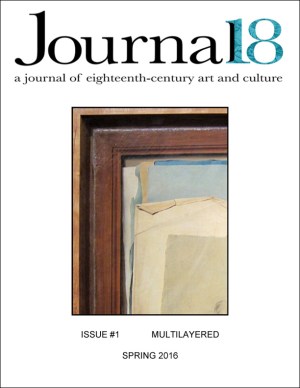 Journal18, #1 Multilayered (Spring 2016)
A R T I C L E S
• David Pullins, “Stubbs, Vernet & Boucher Share a Canvas: Workshops, Authorship & the Status of Painting”
• Charlotte Guichard, “Scratched Surfaces: Artists’ Graffiti in Eighteenth-Century Rome”
• Kristel Smentek, “China and Greco-Roman Antiquity: Overture to a Study of the Vase in Eighteenth-Century France”
• Dipti Khera, “Marginal, Mobile, Multilayered: Painted Invitation Letters as Bazaar Objects in Early Modern India”
Art history’s material turn, informed by anthropology, material culture, and consumption studies, has prompted new interest in both the physicality and the social lives of artworks. Examining the ways that eighteenth-century art objects were produced, transported, and transformed helps us to understand how they were perceived and reimagined in different cultural and temporal contexts. In the workshops and collective spaces of artistic design and manufacture, objects became the creative products of many minds and many hands, simultaneously and successively. Likewise in their afterlives as commodities and possessions, objects were continually altered through use and re-use, each transaction constituting a reframing—sometimes literal—as objects inhabited new settings or were subjected to damage, aging, or rejuvenation.
This inaugural issue of Journal18 explores the multilayered nature of eighteenth-century art. Our focus is on artworks that bear traces of multiple hands as a result of workshop production, cross-cultural exchange, re-use, restoration, vandalism, or other factors. Among the questions considered are: who were the many people involved in art’s production and reproduction (artists, collectors, scholars, dealers, handlers, and restorers)? How were eighteenth-century artworks made, re-purposed, transported, and conserved? How were they translated across media as well as across time, space, and culture? And what is the creative effect of non-creative acts like accidents or defacement? By taking a ‘multilayered’ approach, the articles in this issue not only reexamine traditional art-historical categories—such as style, originality, or authorship—but also encourage new methodological perspectives and find new meaning in the materiality of art objects.
N O T E S & Q U E R I E S
Woven Gold: Tapestries of Louis XIV – by Robert Wellington
Qing Encounters – by Craig Clunas
A Lacquered Past: The Making of Asian Art in the Americas – by Sylvia Houghteling
Castiglione and China: Marking Anniversaries – by Kristina Kleutghen
A Digitally Usable Period Room – by Anne Higonnet
Ornamenting Louis XIV – by Sarah Grant
Pastel will Travel. Liotard at the Royal Academy – by Francesca Whitlum-Cooper
Ceci n’est pas un portrait: A Curator’s Diary – by Melissa Percival
China in Wonderland – by Michelle Wang
Shock Dog! New Sculpture at the Met – by Paris Amanda Spies-Gans
Issue Editors
Noémie Etienne, Getty Research Institute, Los Angeles
Meredith Martin, NYU and Institute of Fine Arts
Hannah Williams, Queen Mary University of London










 Enfilade
leave a comment