Acquisition Appeal | Admiral Russell’s Frame, 1690s
An appeal from The Fitzwilliam in Cambridge:
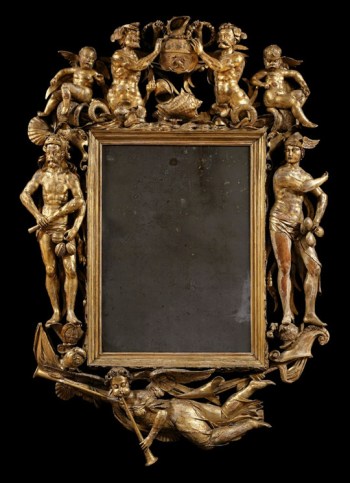
Giltwood frame bearing the arms of Admiral Edward Russell, later 1st Earl of Orford, Admiral of the Fleet; England, ca. 1690s; carved and gilded lime wood with central mirror plate, 182 × 129.5 × 13.5 cm. Provenance: Admiral Russell; private collection, Paris.
To commemorate The Fitzwilliam Museum’s bicentenary, we invite you to support the acquisition of Admiral Russell’s Frame, currently on display at the Museum. The Friends of the Fitzwilliam Museum are able to purchase this magnificent frame at a negotiated price of £345,000. We have until 31st December 2016 to raise the funds. Through the Friends’ acquisition fund, a £50,000 V&A Purchase Grant, and other generous donations, we have raised 80% of the total required. Your support with a personal donation would be truly appreciated as we aim to raise the final £70,000. Please join us in saving this work of local, national and international importance and bring it home to Cambridgeshire for good.
With its local Cambridgeshire connection, highly sophisticated carving and intriguing iconography, this splendid frame will enhance the Museum’s collections for future generations to study and enjoy. The Museum’s Learning Team also sees the great potential of this object’s provenance, mythological figures and Stuart-era history to engage school and community groups alike.
This elaborate mirror frame is a unique survivor from the golden age of English wood carving. It was commissioned by Admiral Edward Russell (1653–1727), the celebrated naval hero best known for his triumphs at the battles of Barfleur and La Hogue in 1692. Russell was a generous patron of architecture and the arts. His Cambridgeshire estate, Chippenham Park, was luxuriously furnished and featured intricately carved woodwork throughout. Almost certainly made between 1693 and 1697 to honour Russell’s achievements and to celebrate his appointment as Admiral of the Fleet and First Lord of the Admiralty, the frame is decorated with symbols representing eternal glory. A personification of Fame with two trumpets flies beneath the mirror, which is flanked by two ancient gods: Mercury representing trade, commerce, and financial gain and Hercules symbolising military strength and triumph.
Sadly, the carvers are unknown. They were probably Dutch or French Huguenots based at Deptford’s naval dockyard, more used to carving elaborate ship prows and interiors than decorative pieces for a country estate.
This magnificent object was probably inherited in 1727 by Admiral Russell’s great-niece, Letitia, who had married the 1st Lord Sandys in 1724. Later the frame was part of M. Michel Dezarnaud’s collection in Neuilly-sur-Seine, Paris, from whom it was bought by a dealer in Belgium in ca. 2015
The frame bears the arms of Admiral Edward Russell, 1st Earl of Orford of the first creation (1653–1727). The marine equivalent of the 1st Duke of Marlborough, Russell is chiefly remembered today for his triumphs at the naval battles of Barfleur and La Hogue on 29 May and 4 June 1692 respectively. These confrontations irreparably damaged the French Atlantic fleet and made the proposed invasion of Britain by Louis XIV and the deposed English King, James II, impossible, thereby securing the position of William III. The scale of this double battle was enormous: 126 ships in total—over twice the size of the Battle of Trafalgar. It was this victory that led to Russell’s promotion to Admiral of the Fleet in November 1693, First Lord of the Admiralty in April 1694, and creation as 1st Earl of Orford in 1697. The imagery of the frame clearly celebrates Russell’s remarkable and unsurpassed naval career.
Edward Russell was a sophisticated and extravagant patron of the arts. This was especially the case at his country estate, Chippenham Park in Cambridgeshire, halfway between Bury St Edmunds and Ely, for which he paid £16,250 in 1689. The house was probably designed by his relative, the architect Thomas Archer (1668–1743) who later designed Russell’s (still surviving) town house in Covent Garden Piazza in 1716–17. Chippenham Park was demolished in 1790 and replaced with a succession of later houses. Drawings of the exterior or interior of the house do not survive, but a map of the estate shows how the trees in the park were planted to evoke the battle formations at La Hogue and Barfleur.
Russell had no direct offspring, and his property was divided between his nieces and nephews. Yet Russell did leave a political legacy; his political protégé Robert Walpole (1676–1745) would become Britain’s first and longest-serving Prime Minister. It was in memory of Russell that Walpole decided to adopt the title of Earl of Orford of the second creation in 1742.
New Book | The American School: Artists and Status
From Yale UP:
Susan Rather, The American School: Artists and Status in the Late-Colonial and Early National Era (New Haven: Yale University Press, 2016), 316 pages, ISBN: 978-0300214611, $75.
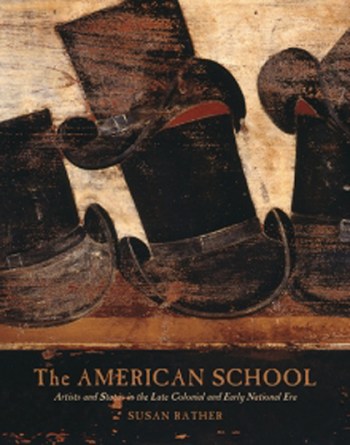 An in-depth look at the changing status of American artists in the 18th and early 19th century This fascinating book is the first comprehensive art-historical study of what it meant to be an American artist in the 18th- and early 19th-century transatlantic world. Susan Rather examines the status of artists from different geographical, professional, and material perspectives, and delves into topics such as portrait painting in Boston and London; the trade of art in Philadelphia and New York; the negotiability and usefulness of colonial American identity in Italy and London; and the shifting representation of artists in and from the former British colonies after the Revolutionary War, when London remained the most important cultural touchstone. The book interweaves nuanced analysis of well-known artists—John Singleton Copley, Benjamin West, and Gilbert Stuart, among others—with accounts of non-elite painters and ephemeral texts and images such as painted signs and advertisements. Throughout, Rather questions the validity of the term ‘American’, which she sees as provisional-the product of an evolving, multifaceted cultural construction.
Susan Rather is a professor in the Department of Art and Art History at the University of Texas, Austin.
Exhibition | On Time
Now on view at The Grolier Club:
On Time: The Quest for Precision
Linda Hall Library of Science, Engineering, and Technology, Kansas City, 2012
The Grolier Club, New York, 14 September — 19 November 2016
Curated by Bruce Bradley
From sundials to atomic clocks, the exhibition On Time: The Quest for Precision explores the history of precise timekeeping through rare books that taught readers techniques of timekeeping, announced new inventions, and provided instructions on the construction and use of timekeeping instruments. On view at The Grolier Club from September 14 through November 19, 2016, the works are drawn from the comprehensive collections of the Linda Hall Library of Science, Engineering, and Technology, Kansas City, Missouri.
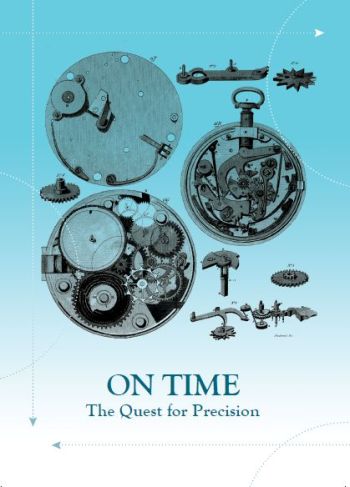 Curator Bruce Bradley tells a timely story with 86 illustrated books dating from the fifteenth century to the present that graphically and artistically depict the sweep of timekeeping. “These books are fascinating and ornate, as well as informative about the innovations that have led to increasingly precise timekeeping devices,” notes Mr. Bradley. As a complement to the printed books, the exhibition includes a small selection of historical clocks and timepieces from the collection of Grolier Club member Fortunat Mueller-Maerki.
The early books describe techniques for timekeeping with fantastic illustrations of sundials and water clocks. The sunflower clock described and illustrated by Athanasius Kircher in his book, Magnes siue De arte magnetica opus tripartitum (Rome, 1641) shows a detailed, full-page engraving of the sunflower clock floating on a piece of cork with its roots in the water. Vegetable magnetism supposedly caused the flower to follow the sun, so that a pointer fixed in the center would indicate the hour on a clock dial. A book that featured more traditional types of sundials is Sebastian Münster’s Horologiographia (Basel, 1533). This comprehensive treatise was first issued as Compositio horologiorum in 1531, but it was popular enough to warrant this second enlarged edition just two years later. Both editions illustrate all manner and variety of sundials with beautiful woodcuts, some of which are attributed to Hans Holbein the Younger.
Early mechanical clocks offered several advantages over sundials, such as portability and the ability to show the time during cloudy weather and at night. They lacked precision, however, and had to be readjusted periodically to synchronize them with local solar time. Even after the appearance of mechanical clocks, books about sundials and how to make them remained popular. Demand for them continued throughout the sixteenth century and into the seventeenth.
A book that described and illustrated some of the best astronomical instruments of the sixteenth century is Tycho Brahe’s Astronomiae instauratae mechanica (Nuremberg, 1602). Of the four clocks in his observatory, two of the smaller clocks are shown in the plate of the famous mural quadrant that Brahe used for making observations of star positions. Brahe explained that he used two clocks to reduce errors in recording the exact moment of observation.
The sixteenth century also saw the first printed depictions of mechanical clocks, published in books by the Italian natural philosopher Girolamo Cardano. The innovation that made mechanical clocks possible, the escapement mechanism, was first illustrated in a seventeenth-century book by Robert Fludd. An English clergyman, William Derham, produced the first practical manual on clock making, The Artificial Clock-Maker (London, 1696), which was popular enough to go through several editions in the early eighteenth century. Much of Derham’s knowledge of clocks came from his friend, the natural philosopher Robert Hooke, who was involved in priority disputes over horological innovations such as the anchor escapement and the balance spring regulator for watches.
Pendulum clocks represented a revolution in timekeeping devices. They had greater accuracy than any other clocks and became standard pieces of scientific equipment, particularly for astronomical observatories. Christiaan Huygens designed the first successful pendulum clock and described it in his classic book on display in the exhibition, Horologium oscillatorium (Paris, 1673). It includes a famous woodcut of the clock’s mechanism.
Another milestone was the marine chronometer built by John Harrison in the eighteenth century. The Principles of Mr. Harrison’s Time-Keeper (London, 1767), includes a preface by Nevil Maskelyne, Astronomer Royal, who insisted on detailed accuracy in the engravings of the chronometer’s mechanism, so others could make duplicates of the watch.
In the twentieth century, Nature, a scientific journal known for publishing important new advances and original research, published the description of the first atomic clock, designed and built by Louis Essen with Jack Parry at the National Physical Laboratory in Teddington, England. Atomic clocks are more precise than the Earth’s rotation and led to a new definition of the second at the 1967 meeting of the International Bureau of Weights and Measures in Paris.
Accompanying the illustrated books and journals are a variety of intricately designed horological objects. Included are a selection of sundials, a clepsydra or water clock, a variety of clock maker’s tools, weight driven clocks, marine chronometers, examples of American railroad-grade pocket watches, and an uncommon Accutron desk clock.
A 60-page illustrated catalogue is available which includes short essays and descriptions by Mr. Bradley for each book in the exhibition. The exhibition and its associated catalogue are supported by a generous grant from the Ascher Family Foundation and by the Linda Hall Library Foundation.
Linda Hall Library is among the world’s foremost independent research libraries devoted to science, engineering, technology, and their histories. Founded in 1946 through an endowment created by Linda and Herbert Hall, the library is a not-for-profit, privately funded institution, and is open to the public free of charge. Scholars, technologists, engineers, researchers, academic institutions and businesses, nationally and internationally, use Linda Hall Library’s collections to investigate, invent, and increase knowledge. The library’s holdings range from rare books to private papers, including extensive collections in diverse areas such as aeronautics, astronomy, engineering standards, a resource center for patents and trademarks and more. In addition to the library’s resources, hundreds of people attend the library’s public programs throughout the year to expand their awareness and understanding of science and technology.
The Grolier Club of New York is America’s oldest and largest society for bibliophiles and enthusiasts in the graphic arts. Founded in 1884, the club is named for Jean Grolier, the Renaissance collector renowned for sharing his library with friends. The club’s objective is to foster the literary study and promotion of arts pertaining to the production of books.
Bruce Bradley, On Time: The Quest for Precision (Kansas City: Linda Hall Library, 2016), 64 pages, ISBN: 978-0976359067.
Display | All Must Have Prizes, 1750–1850

John Milton, God Speed the Field, 1790, Duke of Athol’s Farming Prize.
Now on view at the Ashmolean:
All Must Have Prizes, 1750–1850
Ashmolean Museum, Oxford, 14 June — 13 November 2016
This display of medals and prizes from the mid-eighteenth century tell us about the ideals of personal and professional improvement through competition during the time in which they were made. Their images and inscriptions reveal the hopes and aspirations of those who created and competed for them.
Call for Papers | Eighteenth-Century Research Seminar, Edinburgh
From the ECRS website:
Eighteenth-Century Research Seminars
Institute for Advanced Studies in the Humanities, Edinburgh, January–April 2017
Proposals due by 21 November 2016
 The Eighteenth-Century Research Seminar (ECRS) series invites proposals for twenty-minute papers from postgraduate and early-career researchers addressing any aspect of eighteenth-century history, culture, literature, education, art, music, geography, religion, science, and philosophy. The seminar series seeks to provide a regular inter-disciplinary forum for postgraduate and early-career researchers working on the eighteenth century to meet and discuss their research.
ECRS will take place at the Institute for Advanced Studies in the Humanities (IASH) in Edinburgh on a fortnightly basis from January to April 2017. Each seminar will consist of two papers, one from a University of Edinburgh-based researcher and one from a researcher based in another higher education institution, followed by a drinks reception. Non-University of Edinburgh speakers’ travel expenses will be reimbursed up to £100. Abstracts of up to 300 words along with a brief biography and institutional affiliation should be submitted in the body of an email to: edinburgh18thcentury@gmail.com. The closing date for submissions is Monday 21 November 2016.
ECRS is supported by the Eighteenth-Century and Enlightenment Studies Network (ECENS) of the University of Edinburgh.
Exhibition | Amazons of the Revolution
The exhibition blurb, as translated by Julia Douthwaite, author of the blog A Revolution in Fiction:
Amazons of the Revolution: Women in the Turmoil of 1789
Amazones de la Révolution: des femmes dans la tourmente de 1789
Musée Lambinet, Versailles, 5 November 2016 — 19 February 2017
Curated by Martial Poirson
 Fish-wife, soldier-girl, rioter, fire-starter, criminal, madwoman… these are some of the pejorative labels used to describe the women who joined the revolutionary struggle in 1789. Cloaked in suspicions regarding their lack of femininity, the so-called Amazons of the Revolution have long been used as a scapegoat for things that went wrong. This exhibit brings together a unique group of objects, art-works, and rare writings from the archives to reveal the dark fantasies projected onto revolutionary women, from the 1790s to our day. In a time when categories of gender are finally being understood as a confining cultural construct, this exhibit is particularly useful, for it demonstrates without a doubt that the ‘national novel’ behind the French State has always relied on the contributions of women—either as victims, unwelcome meddlers, or even murderers—to justify the revolutionary past.
In history books as in the popular media, the gendering of revolutionary violence has helped rationalize brutality, and keep it out of sight, so that the pantheon of national heroes and narratives remains untarnished. This exhibit pays homage to the extraordinary women whose political efforts led to the guillotine–Charlotte Corday, Olympe de Gouges, Théroigne de Méricourt, and Manon Roland—but it also highlights the contributions of the unsung heroines behind famous events as well as those women who fought to restore the rule of Crown and Church. The women of this exhibit performed all kinds of duties–from reporting on Tribunal proceedings in coded messages knitted to their confederates (as in the terrifying tricoteuses of Dickens’s Tale of Two Cities)–to meekly submitting to the gallows, as martyrs of their faith—yet all are worthy of our time and attention. With a collection spanning the centuries as well as the gamut of visual media (engravings, sculptures, paintings, video games, cartoons, and mangas), this exhibit has something to offer all ages.
◊ ◊ ◊ ◊ ◊
Readers interested in the topic may find useful the first chapter, “From Fish Seller to Suffragist: The Women’s March on Versailles,” in Julia Douthwaite’s The Frankenstein of 1790 and Other Lost Chapters from Revolutionary France (Chicago: The University of Chicago Press, 2012), recently published in French as Le Frankenstein français et la littérature de l’ère révolutionnaire.
◊ ◊ ◊ ◊ ◊
Le visiteur de la Salle du Jeu de Paume, après avoir lu sur les murs les noms des représentants du Tiers-Etat aux Etats généraux de 1789, ne manque pas de se faire une remarque : aucun nom ou visage de femme ne figure dans ce berceau de la République ! Pourtant, chacun sait combien les femmes ont compté dans le déroulement des événements révolutionnaires.
C’est à ces quelques femmes d’exception que rend hommage l’exposition Amazones de la Révolution, présentée par le Musée Lambinet. Poissarde, femme-soldat, émeutière, incendiaire, criminelle, aliénée… Ces stéréotypes esquissent le portrait à charge de la combattante révolutionnaire, usurpant attributs de la masculinité et codes de la virilité. Ils occultent les sévices exercés sur des femmes désignées comme bouc émissaires et contribuent à les évincer de la sphère publique. Objets, oeuvres et archives qui en attestent font apparaître les fantasmes engendrés par la violence des femmes, tout en soulignant leurs échos contemporains.
Cette exposition explore les zones d’ombre de l’historiographie et les présupposés du « roman national », mettant en lumière le rapport des femmes à la violence des événements révolutionnaires et leur implication—victimes ou bourreaux—dans la brutalité des événements. Tout en faisant place aux femmes d’exception telles que Charlotte Corday, Olympe de Gouges, Théroigne de Méricourt ou Manon Roland, elle met en perspective les figures collectives de la Révolution et de la Contre-Révolution. Des Tricoteuses aux Merveilleuses, des insurgées aux suppliciées, des allégories aux caricatures, toutes ont imprégné la culture à travers les siècles, tant dans la gravure, la peinture, la sculpture ou les arts décoratifs que dans le cinéma, le jeu vidéo, la bande dessinée ou la publicité.
Cette exposition a pour ambition de proposer des éléments de compréhension de l’émancipation contrariée des femmes au cours de la séquence historique qui s’ouvre en 1789 : elle leur donne une visibilité nouvelle tout en les excluant de la sphère politique, au motif, précisément, de leur participation active aux événements.
Exhibition | Marie-Antoinette: A Queen in Versailles
Press release from the Musée National des Châteaux de Versailles et de Trianon:
Marie-Antoinette: A Queen in Versailles / Une Reine à Versailles
Mori Arts Center Gallery, Tokyo, 25 October 2016 — 26 February 2017

Adolf Ulrik Wertmüller, Marie-Antoinette in Amazon Dress, 1788 (RMN-Grand Palais / Château de Versailles).
Japan is most certainly the country, outside France, where the figure of Marie-Antoinette is most popular, notably thanks to the character imagined by Riyoko Ikeda in her manga The Rose of Versailles. The Palace of Versailles and Nippon Television have joined forces to mount an exhibition dedicated to this iconic figure in French history.
Through a large number of works of art from the Versailles collections—paintings furnishings, objets d’art, drawings, and engravings—as well as loans from other public and private collections in France and abroad, the exhibition will provide, for the very first time in Japan, a wide-ranging evocation of the life of Marie-Antoinette, from her youth in Vienna to her tragic end.
Portraits of the queen and members of the royal family by the court’s finest portrait artists—in particular François-Hubert Drouais, Louis Michel Vanloo, and Joseph Siffred Duplessis—will familiarise visitors with the people among whom Marie-Antoinette lived in France [including] King Louis XV (the grand-father of Louis XVI) and her brothers-in-law, the Counts of Provence and Artois, along with the artist Élisabeth-Louise Vigée-Lebrun, who captured the queen’s essence in her works, won her trust, and left us some of the finest (official and more intimate) portraits of Marie-Antoinette.
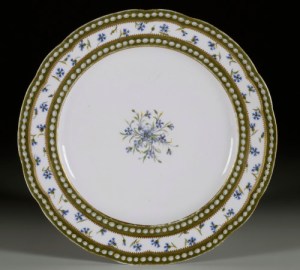
‘Pearls and Cornflower’ (perles et barbeaux) Plate, Manufacture Royale de Sèvres (RMN- Grand Palais / Château de Versailles).
The queen’s own tastes will also feature prominently in the exhibition. Assisted by the royal administration of the Crown Furniture Inventory, Marie-Antoinette gathered some of the finest craftsmen around her, such as cabinet-maker Jean Henri Riesener, joiner Georges Jacob, and bronze-maker Pierre-Philippe Thomire, to design the precious furnishings or objects for the sumptuous, refined decor she liked to surround herself with. The variety of tableware designed by the Sèvres Royal Porcelain Works are featured, and more particularly the ‘Japan’ service inspired by Imari porcelain or the famous ‘Pearls and Cornflower’ dinner service made for Trianon. The most original and spectacular feature of the exhibition will be its presentation of the Queen’s Private Apartment, laid out from 1782 onwards on the ground floor on the Marble Courtyard. The bedroom and bathroom will be fitted out with a large part of their furnishings, while the stucco library which has now disappeared will be reproduced in 3D. This exhibition of almost 150 works provides an insight, for the first time in Japan on such a scale, into the riches and innovation that marked the creations inspired by Marie-Antoinette.
New Book | Prints in Translation, 1450–1750
From Routledge:
Suzanne Karr Schmidt and Edward Wouk, eds., Prints in Translation, 1450–1750: Image, Materiality, Space (New York: Routledge, 2016), 252 pages, ISBN: 978-1472480125, $150.
 Printed artworks were often ephemeral, but in the early modern period, exchanges between print and other media were common, setting off chain reactions of images and objects that endured. Paintings, sculpture, decorative arts, musical or scientific instruments, and armor exerted their own influence on prints, while prints provided artists with paper veneers, templates, and sources of adaptable images. This interdisciplinary collection unites scholars from different fields of art history who elucidate the agency of prints on more traditionally valued media, and vice-versa. Contributors explore how, after translations across traditional geographic, temporal, and material boundaries, original ‘meanings’ may be lost, reconfigured, or subverted in surprising ways, whether a Netherlandish motif graces a cabinet in Italy or the print itself, colored or copied, is integrated into the calligraphic scheme of a Persian royal album. These intertwined relationships yield unexpected yet surprisingly prevalent modes of perception. Andrea Mantegna’s 1470/1500 Battle of the Sea Gods, an engraving that emulates the properties of sculpted relief, was in fact reborn as relief sculpture, and fabrics based on print designs were reapplied to prints, returning color and tactility to the very objects from which the derived. Together, the essays in this volume witness a methodological shift in the study of print, from examining the printed image as an index of an absent invention in another medium—a painting, sculpture, or drawing—to considering its role as a generative, active agent driving modes of invention and perception far beyond the locus of its production.
Suzanne Karr Schmidt is Assistant Curator of Prints and Drawings at the Art Institute of Chicago.
Edward H. Wouk is Lecturer in European Art, 1400–1800, at The University of Manchester.
◊ ◊ ◊ ◊ ◊
C O N T E N T S
List of Figures
Preface
Notes on Contributors
Abbreviations
1 Edward Wouk, Toward an Anthropology of Print
2 Alexandra Onuf, From Print to Paint and Back Again: Painting Practices and Print Culture in Early Modern Antwerp
3 Lelia Packer, Prints as Paintings: Willem van de Velde the Elder (1611–1693) and Dutch Pen Painting, circa 1650–65
4 Freyda Spira, Between Paper and Sword: Daniel Hopfer and the Translation of Etching in Reformation Augsburg
5 Jonathan Tavares, Hunting Erotica: Print Culture and a Seventeenth-Century Rifle in the Collection of the Hessisches Landesmuseum, Darmstadt
6 Patricia Simons, Mantegna’s Battle of the Sea Gods: The Material and Thematic Interaction of Print and Sculpture
7 Suzanne Karr Schmidt, Making Time and Space: Collecting Early Modern Printed Instruments
8 David Pullins, The State of the Fashion Plate, circa 1727: Historicizing Fashion Between ‘Dressed Prints’ and Dezallier’s Recueils
9 Arthur J. DiFuria, The Concettismo of Triumph: Maerten van Heemskerck’s Victories of Charles V and Remembering Spanish Omnipotence in a Late Sixteenth-Century Writing Cabinet
10 Stephanie Porras, St. Michael the Archangel: Spiritual, Visual, and Material Translations from Antwerp to Lima
11 Yael Rice, Lines of Perception: European Prints and the Mughal Kitābkhāna
Bibliography
Index
Call for Papers | MAHS 2017, Cleveland
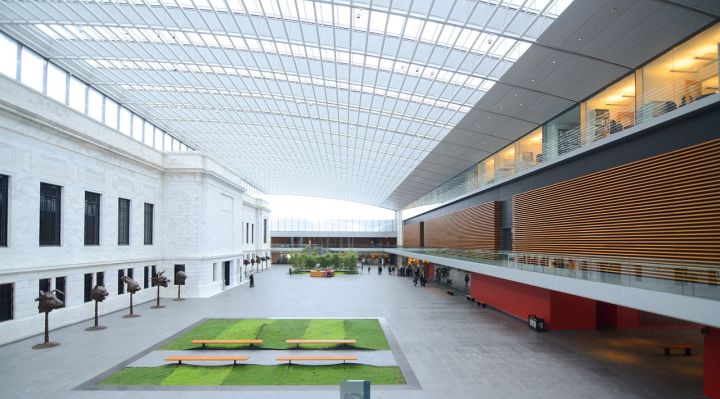
Atrium of the Cleveland Museum of Art
(Wikimedia Commons, photo by Erik Droist, January 2014)
◊ ◊ ◊ ◊ ◊
From the MAHS Fall 2016 Newsletter:
44th Annual Conference of the Midwest Art History Society
Cleveland, 6–8 April 2017
Proposals due by 16 December 2016
The Midwest Art History Society (MAHS) will hold its 44th annual conference in Cleveland, 6–8 April 2017, hosted by the Cleveland Museum of Art (CMA) and Case Western Reserve University (CWRU). Paper sessions and roundtables will be held at the Cleveland Museum of Art on April 6 and 7 and at the Allen Memorial Art Museum of Oberlin College on April 8. On April 6, a distinguished keynote panel will speak on Raphael’s School of Athens Cartoon, which is currently undergoing restoration in Milan. The panel will include Don Alberto Rocca, Director of the Pinacoteca Ambrosiana in Milan; Dr. Maurizio Michelozzi, the Florence-based paper conservator who is undertaking the restoration; and Dr. Carmen C. Bambach, Curator of Italian and Spanish Drawings at The Metropolitan Museum of Art in New York. Funding for the keynote panel has been provided by the Istituto Italiano di Cultura in Chicago, the Italian Art Society, the University of Notre Dame, the Friends of Art of CWRU, the Painting and Drawing Society of the Cleveland Museum of Art, and the Midwest Art History Society.
Cleveland and its surrounding metropolitan area have a rich arts scene, including world-class museums, vibrant galleries, and esteemed art historical resources. The Cleveland Museum of Art is renowned for the quality and breadth of its collection, which includes almost 45,000 objects and spans 6,000 years of achievement in the arts. The museum is a significant international forum for exhibitions, scholarship, performing arts and art education and recently completed an ambitious, multi-phase renovation and expansion project across its campus. One of the top comprehensive art museums in the nation and free of charge to all, the Cleveland Museum of Art is located in the dynamic University Circle neighborhood. Nearby in University Circle, Cleveland’s Museum of Contemporary Art (MOCA) plays an urgent and exciting role in the city’s cultural landscape. As a non-collecting institution and the region’s only contemporary art museum, MOCA is ever-changing, introducing new exhibitions three times a year and creating fresh experiences for visitors each season. The Cleveland History Center of the Western Reserve Historical Society houses exhibits that tell the story of Northeast Ohio through items, documents and artifacts from a variety of collections. Other cultural attractions in and around University Circle include CWRU’s Dittrick Medical History Center and Museum, the Cleveland Museum of Natural History, the Cleveland Botanical Garden, historic Lakeview Cemetery, Little Italy, and the world renowned Cleveland Orchestra housed in Severance Hall, a masterpiece of Art Deco design.
Combining a landmark historical building with a contemporary minimalist addition, the Transformer Station is a new anchor destination in Cleveland’s rapidly evolving Ohio City neighborhood. The project brings a new cultural facility to a mixed residential and industrial neighborhood within walking distance of the restaurants and shops of the Market District and blocks away from the Gordon Square Arts District. In downtown Cleveland, the Rock & Roll Hall of Fame’s mission is to engage, teach and inspire through the power of rock & roll. The Rock Hall is the world’s foremost museum devoted to the celebration and preservation of rock & roll music. Next door to the Rock Hall, visitors can explore science through hands-on exhibits at the Great Lakes Science Center. Cleveland is also home to Playhouse Square, the country’s largest performing arts center outside of New York City; a lively music scene; a vibrant culinary scene including the historic West Side Market and nationally recognized restaurants; the award- winning Cleveland Metroparks system; a fantastic zoo; and three professional sports teams.
Cleveland and its surrounds are home to distinguished academic departments of art history and college art museums. Next door to the CMA is CWRU, home to the joint program in Art History and Museum Studies. This innovative program offers master’s and doctoral degrees, preparing future academics and museum curators through an intensive object-based curriculum taught by CWRU art history professors in association with museum curators and staff. The program takes advantage of the CMA’s Ingalls Library, the third largest art library in the country. The Allen Memorial Art Museum (AMAM) at Oberlin College houses an encyclopedic collection of more than 14,000 works that provide a comprehensive overview of the history of art. Recognized as one of the best academic museums in the country, the AMAM works with faculty and students to promote direct study of original works of art and deepen appreciation for the diversity of the world’s cultures, while also serving a broad regional audience. The museum complex includes a 1917 building designed by Cass Gilbert, and a 1977 addition designed by Robert Venturi, the architect’s first museum commission. The AMAM also shares responsibility with Oberlin College for a Frank Lloyd Wright-designed house, the first Usonian house in Ohio, located in Oberlin. . .
We welcome your participation in the 2017 Midwest Art History Society Annual Conference held in Cleveland . . . In most cases, conference presentations will be expected to be under twenty minutes long. Proposals of no more than 250 words and a two-page CV should be emailed (preferably as Word documents) to the chairs of individual sessions by Friday, December 16, 2017.
The following is a selection of sessions potentially relevant for eighteenth-century studies; please see the newsletter for the full listing.
◊ ◊ ◊ ◊ ◊
The Art Market and Connoisseurship
Chair: Catherine Scallen, Case Western Reserve University, catherine.scallen@case.edu
In this session we will consider the entwined issues of the roles of art markets and of connoisseurship in the history of private and public collecting or in the historiography of art history. Papers are welcomed on any period and geographical region of art.
◊ ◊ ◊ ◊ ◊
Body and Soul: The Visual Arts and Medical Practice
Chair: Andrea Wolk Rager, Case Western Reserve University, andrea.rager@case.edu
This session invites papers that consider the complex relationship between the visual arts and the history of medical practice. The city of Cleveland has been hailed as a hub of bio-medical innovation, rendering this an ideal setting for exploring the revolutionary possibilities of interdisciplinary exchange between cutting-edge art history and medicine. This session will consider not only what lessons we can learn from the intertwined histories of medical practice and the arts, but also how art historical methodologies and critical strategies can inform the practice of healthcare professionals today. How can universities, museums, and medical institutions enrich and inform each other through the arts? Topics may include: the representation of mental and physical illness; the body as a site of knowledge and surveillance through the medical gaze; the socio-political uses of medical imagery; sexuality, pregnancy, and the representation of the female body; physical perception and the operation of cultural bias; the doctor as a figure of authority; trauma and representation; death and grieving through the arts; and the depiction of beauty, disease, and deformity. Papers are welcomed from art historians, museum professionals, and medical clinicians.
◊ ◊ ◊ ◊ ◊
Digital Art History
Chair: Anne Helmreich, Texas Christian University, a.helmreich@tcu.edu
The concept of digital art history has emerged over the past decade to describe an array of new approaches and practices in art history (in both academia and art museums) made possible by the rise of the internet and greater accessibility to computational resources. These include born-digital publications, new tools and techniques for the analysis of art objects and texts as well as building and investigating art and archival collections, and new scholarly interpretations that have resulted from such tools and techniques. It has been manifested by exemplary publications and projects as well as a robust and growing bibliography and has fostered new forms of collaboration across disciplines and institutions. Digital art history has also been an important impetus for open access within the discipline. This session seeks papers that illuminate exemplary projects as well as lessons learned; that is, speakers are expected to share with the audience the perspectives they have acquired through developing and implementing their projects in digital art history so that the session may result in a meaningful discussion of best practices that can be disseminated to the field.
◊ ◊ ◊ ◊ ◊
Is There an African Atlantic?
Chair: Matthew Francis Rarey, Oberlin College, mrarey@oberlin.edu
The Atlantic Ocean provides Africanist art historians a rich model of investigation and analysis. Connecting Africa to Europe and the Americas, the Atlantic maps the flows, circularities, and dislocations of African arts in and out of diaspora. But it also separates. In the hulls of slave ships, new worlds were both forged and lost, underscoring a separation that lives on as today even distinctly black Atlantic scholarship often includes little space for African ideas and worldviews. Responding to the inclusion of open panels dedicated separately to both African and African-American art, this thematic panel seeks contributions that take up African arts’ indeterminate space in the Atlantic world as both possibility and pitfall. Such case studies may include, but are not limited to, the role of African artworks in negotiating new identities and profound social changes wrought by the Atlantic world; the impact of diasporic arts on the African continent; African artistic responses to slavery and the slave trade; and efforts to re-center African epistemologies in diasporic contexts.
◊ ◊ ◊ ◊ ◊
Shifting Meaning: Recontextualizing Objects through Action
Chairs: Amy Sowder Koch, Towson University, akoch@towson.edu, and Susan Ludi Blevins, Washington University in St. Louis, blevins.susan@wustl.edu
This session will address the long afterlives of objects, which are by the very nature of their materiality often intended to survive their creators. With topics of reuse, recycling, appropriation, and conversion in mind, we invite papers that explore the multilayered aspects of meaning created through the physical interactions of people and objects in a variety of cultural contexts: public or private, civic or religious, ritual/ceremonial or mundane, elite or non-elite. Questions addressed might include: When objects and buildings are separated in time from their creators’ original intentions, how do their later uses fill out or complete—or perhaps simplify— these ‘degraded’ original meanings? What might the practice of materially altering an object from the past tell us about later understandings of its symbolic value? How might the physical accumulation of reused and recycled objects through repeated action transform understandings of not only the objects but also the spaces in which they are deposited or displayed? Submissions are welcome from all time periods and geographies that critically reflect on the nuanced ways in which intentional and unintentional interactions with objects from the past have the capacity to create and transform meaning in the present.
◊ ◊ ◊ ◊ ◊
Studio Practice, Research Practice
Chair: Cyra Levenson, The Cleveland Museum of Art, clevenson@clevelandart.org
This panel will explore the intersecting worlds of art making and research practice. Presentations might explore the work of contemporary artists who reference the art historical past; the pedagogical link between material study, observational experience, and research; and multi-sensory approaches to research and learning.
◊ ◊ ◊ ◊ ◊
The Teaching Museum: Best Practices and Future Development
Chairs: Liliana Milkova, Allen Memorial Art Museum, lmilkova@oberlin.edu, and Erik Inglis, Oberlin College, einglis@oberlin.edu
College and university art museums have grown significantly in the last twenty years. Many institutions have created new museums and/or museum studies programs, while established museums have re- visited their mission to deepen their educational contributions. For example, Oberlin College’s Allen Memorial Art Museum has pushed to integrate the Museum’s collection and resources into the College’s curriculum as a whole, and developed a rigorous docent training program that serves as a professional portal. For this roundtable, timed to the Allen’s centennial, we seek case- studies from faculty and museum professionals highlighting how museums contribute to a wide range of student learning. Such cases might include but are not limited to: empowering students as educators in docent programs; involving students in the curatorial process; collaborating with faculty on teaching exhibitions and curatorial projects (real or virtual); bringing STEM faculty and classes into the museum; and training and mentoring students for careers in museums, the arts, and education.
◊ ◊ ◊ ◊ ◊
Technical Art History: Evaluating the Progress of the Interdisciplinary Study of Works of Art
Chair: Maryan Ainsworth, The Metropolitan Museum of Art, Maryan.Ainsworth@metmuseum.org
The development over the last century of the technical examination of works of art has completely altered the ways in which we evaluate objects. Employing an increasingly wide range of analytical tools, researchers from the fields of academic art history, museum curatorship, conservation, and conservation science are demonstrating the value of working together in an interdisciplinary manner in a burgeoning field of study called technical art history. This session invites papers on recent research that addresses any aspect of the creation of or later adjustment to the work of art and that challenges accepted views or leads to a new understanding of an object’s place in history. Papers that demonstrate cooperation between individuals in di erent fields in a jointly-communicated paper will be most welcome.
◊ ◊ ◊ ◊ ◊
O P E N S E S S I O N S
Undergraduate Research
Chairs: Heidi Hornik, Baylor University, Heidi_Hornik@baylor. edu, and Paula Wisotzki, Loyola University Chicago, pwisots@luc.edu
African Art
Chair: Costa Petridis, Art Institute of Chicago, cpetridis@artic.edu
African-American Art
Chair: David Hart, Cleveland Institute of Art, dhart@cia.edu
American Art
Chair: Mark Pohlad, DePaul University, mpohlad@depaul.edu
Ancient Art
Chair: Michael Bennett, The Cleveland Museum of Art, mbennett@clevelandart.org
Art of the Americas
Chair: Caitlin Earley, Metropolitan Museum of Art, caitlin.earley@metmuseum.org
East Asian Art
Chair: Noelle Giuffrida, Case Western Reserve University, noelle.giuffrida@case.edu
Islamic Art
Chair: Emily Neumeier, The Ohio State University, neumeier.25@osu.edu
Latin American Art
Chair: Daniel Quiles, School of the Art Institute of Chicago, dquiles@saic.edu
Medieval Art
Chair: Marian Bleeke, Cleveland State University, m.bleeke@csuohio.edu
Modern and Contemporary Art
Chair: Matthew Levy, Penn State Erie, The Behrend College, mll33@psu.edu
Nineteenth-Century Art
Chair: Catherine Goebel, Augustana College, CatherineGoebel@augustana.edu
Photography
Chair: Andrea Wolk Rager, Case Western Reserve University, andrea.rager@case.edu
Recent Acquisitions in Midwestern Collections
Chair: Beau Rutland, The Cleveland Museum of Art, brutland@clevelandart.org
Renaissance and Baroque Art
Chair: Erin Benay, Case Western Reserve University, erin.benay@case.edu
South, Southeast Asian, and Himalayan Art
Chair: Kimberly Masteller, The Nelson-Atkins Museum of Art, kmasteller@nelson-atkins.org
Works on Paper
Chairs: Robert Randolf Coleman, University of Notre Dame, rcoleman@nd.edu, and Cheryl K. Snay, Snite Museum of Art, csnay@nd.edu
Symposium | Objects of Study: Paper, Ink, and the Material Turn
From the symposium website:
Objects of Study: Paper, Ink, and the Material Turn
University of Pennsylvania and the Philadelphia Museum of Art, 30 March — 1 April 2017
This symposium is co-organized by Aaron M. Hyman (University of California, Berkeley) and Juliet Sperling (University of Pennsylvania). It is funded by the Andrew W. Mellon Foundation, through a partnership of the Andrew W. Mellon Fellowship of Scholars in Critical Bibliography at Rare Book School and the Andrew W. Mellon Object-Based Learning Initiative between the History of Art Department at the University of Pennsylvania and the Philadelphia Museum of Art.
The goal of this symposium is to dissect the interpretive aims of ‘materiality studies’ through a focused lens of works on paper. In recent years, ‘materiality’ has become a buzzword across the humanities, and an impressive range of methods, investigative starting points, and analytic goals have come to rest under the term’s mantle. But in grouping this diverse array of approaches under a single heading, does each method’s unique potential risk becoming flattened and obscured? An illustrated book might just as easily inspire a reconsideration of workshop practices as it could a chemical investigation of ink formulae; are social history and chemistry, to name just these two examples, justifiably held together within the rubric of materiality?
The institutional landscape of object-based study has had a role to play in miscommunications about the goals of focusing on materiality. As art historians, we have noticed that materiality, as a concept, has often complicated communication between scholars of art objects in academic and museum settings. Conversations about process and the substance of things in the academy often veer quite far from the ways of engaging objects with which curators and conservators have long been deeply invested. In light of this muddled translation across institutions, we have chosen to focus this symposium on a single genre of objects that rely upon the materials of paper and ink. Books, prints, drawings, and documents, to name but a few examples, attract intense interest across not only museums and the academy but also libraries, archives, and antiquarian collections. By looking at the spectrum of approaches generated by these materials, this symposium works towards answering a pressing question: do the academy, museum, archive, and library define ‘materiality’ differently? And, if so, what are future avenues towards intersection and collaboration?
The questions and objectives of this symposium have been shaped by the emerging field of ‘critical bibliography’, which unites scholars from a range of disciplinary and methodological backgrounds around the central axis of the book. We aim to map these connections onto art history by gathering academics, archivists, artists, conservators, and curators to think together about shared and divergent premises and, most importantly, goals for object-based study. The symposium will interweave hands-on workshops led by curators, conservators and artists with public talks by materially-focused scholars. In turn, discussions will not solely center on formal presentations, but will extend to alternative venues: the conservation lab, the studio, and the study room.
To begin addressing the symposium’s driving questions, we will ask participants to present ‘materialist’ case studies of 20 minutes in length, and then to devote at least 5 additional minutes to explicitly addressing how ‘materiality’ operates in their work. What are the analytic goals of a materially focused account? Where and how does such an inquiry begin? And, finally, how do those aims and methods relate to the field’s broader material turn? Talks may engage these questions in relationship to works on paper across time, and from any geographic origin.










 Enfilade
leave a comment