Call for Participants | Color Printing and the Global Eighteenth Century
This working group will meet at the RBS-Mellon Conference Bibliography among the Disciplines in October 2017.
Color Printing and the Global Eighteenth Century
Philadelphia, 12–15 October 2017
Proposals due by 25 October 2016
Organizers: Marie-Stephanie Delamaire (Winterthur Museum) and Jeannie Kenmotsu (Royal Ontario Museum)
The long eighteenth century was a period of major breakthroughs in the domain of color printing in several parts of the world. In Asia and Europe, various relief and intaglio techniques were adapted to full color printing and achieved widespread uses in the visual arts. Multiple-block color printing techniques were explored in seventeenth-century Chinese painting manuals; these relief techniques were later seen in Japanese sheet prints and illustrated books on a far greater scale in the eighteenth century, from the poetry anthologies illustrated by Katsuma Ryūsui to Suzuki Harunobu’s vividly colored ‘brocade pictures’. Printing à la poupée was practiced in the Low Countries, Italy, Britain, and France among others for decorative printing as well as lavishly illustrated botanical and ornithological volumes such as those of Pierre-Joseph Redouté. Jacob Christoph Le Blon and his successors experimented with multiple-plate intaglio printing, and produced color prints in collaboration with leading artists.
Although scholars have increasingly studied eighteenth-century knowledge of the properties, meanings, and uses of colors, the materials and practices involved in the production and reception of color-printed images have received comparatively less attention. This project will bring together scholars from a range of disciplines and fields (printing history, book history, critical bibliography, history of art, history of technology, etc.) to explore the proliferation of color-printed images in the long eighteenth century. How do we understand the emergence of widespread color-printing practices across the globe approximately at the same time? What were the economic, social, or political factors that facilitated color printing as a major medium for visual creation? What were the taxonomic, semantic, and aesthetic consequences of printing in color as opposed to hand painting in color? We encourage submissions that engage with the specific material practices of color-printed images that emerged in Europe and Asia between the second half of the seventeenth century up to the early nineteenth century, while reflecting on the broader questions they raise with regards to our knowledge of the period and the validity of current approaches.
Possible topics might include but are not limited to: the production and consumption of color-printed images; color printing as a mode of cultural exchange; the materiality of color printmaking and the production of knowledge (including, but not limited to, spheres of natural history, the fine arts, mapmaking, color theory, and connoisseurship etc.); book illustration versus sheet prints; the relationship between printing in color and painting; conservation issues particular to color-printed works as they relate to methods and approaches to historical inquiry; changes in disciplinary perspectives concerning color printing and the eighteen century.
Participants should be able to commit to attending all sessions of the working group:
Thursday, 12 October 2017, 2:00–5:00pm
Friday, 13 October 2017, 10:45am–12:15pm
Saturday, 14 October 2017, 8:30–10:00am
Participants should further be able to commit to meeting again one year after the conference to work toward a publication of the results of the working group. In their statements of interest, participants should indicate their availability to meet during the year following the conference (e.g., will you be abroad—if so, when, and do you anticipate that you will have sufficient internet connectivity to meet virtually?).
In order to be considered please submit proposals for participation by 25 October 2016 here. Proposals should include a brief 2-page CV and a statement of interest of no more than 500 words, outlining your relevant research, what you hope to contribute toward the group, and what you hope to take away from it (including potential project ideas you hope the group may pursue).
Bibliography Among the Disciplines, a four-day international conference, will bring together scholarly professionals poised to address current problems pertaining to the study of textual artifacts that cross scholarly, pedagogical, professional, and curatorial domains. The conference will explore theories and methods common to the object-oriented disciplines, such as anthropology and archaeology, but new to bibliography. The program aims to promote focused cross-disciplinary exchange and future scholarly collaborations. Bibliography Among the Disciplines is supported by the Andrew W. Mellon Foundation, and organized by the Andrew W. Mellon Fellowship of Scholars in Critical Bibliography at Rare Book School.
Exhibition | Ecclesiastical Textiles from the Age of Maria Theresa
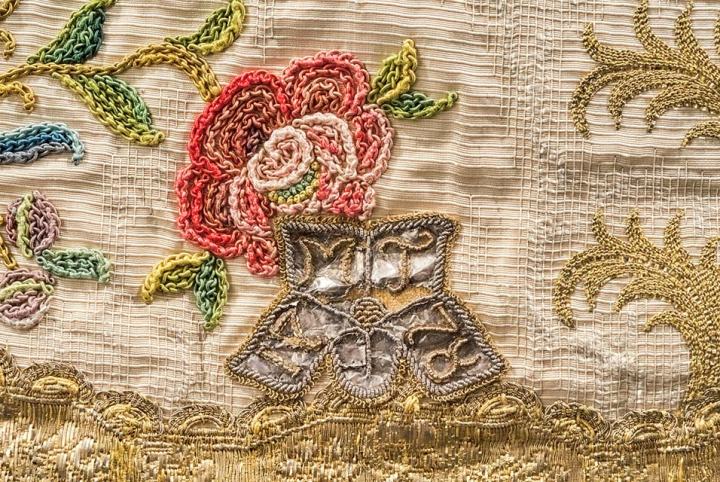
Blue Vestments: chasuble (detail), donated by Maria Theresia (1717–1780), produced in Vienna, 1778; h. 106 cm, w. 73 cm
(KHM-Museumsverband)
◊ ◊ ◊ ◊ ◊
Press release for the exhibition now on view at the Kaiserliche Schatzkammer Wien:
Praise of God: Ecclesiastical Textiles from the Age of Maria Theresia
Gottes Lob: Kirchliche Textilien aus der Zeit Maria Theresias
Imperial Treasury, Vienna, 4 May 2016 — 12 February 2017
The Ecclesiastical Treasury house’s important holdings of 18th-century liturgical vestments cannot be on permanent display for conservation reasons. The majority of these precious textiles were donated by Emperor Charles VI (1685–1740), his wife Elisabeth Christine (1691–1750) and their daughter Maria Theresia (1717–1780). At the time it was customary to use costly French or Italian fabrics, lavishly embellished with embroidery, for such vestments. Imperial robes were also occasionally reworked into such robes.
 The exhibition offers insights into the wealth and exceptional quality of the Imperial Treasury’s holdings of precious vestments, which reflect the Pietas Austriaca, the deep piety of the House of Habsburg. The museum has also included a selection of contemporary ecclesiastical garments produced after designs by the artists Christof Cremer and Stephan Hann. They document the high standard liturgical vestments are still expected to meet today as they continue to form a seminal part of the celebration of Mass. In connection with the exhibition, the museum has also decided to confront three modern copes produced after designs by Christof Cremer with historical vestments in a display installed in the so-called Paramentengang (vestment corridor) in the Ecclesiastical Treasury. This is the first time that contemporary art is displayed in the Treasury since it was newly installed and reopened in the 1980s.
The extensive holdings of the Ecclesiastical Treasury in Vienna are largely unknown to the general public; they comprise mainly vestments and liturgical textiles that were used to celebrate Mass or during religious festivities. Totalling around 1,700 artefacts, the collection includes both sets of vestments and individual textiles. Many of these precious garments were donated by members of the House of Habsburg who for centuries ruled the Holy Roman Empire. The pomp and circumstance associated with this high office is reflected in the costliness of these sumptuous textiles, the finest of which date from the Baroque, the apogee of Habsburg piety. Unlike medieval ecclesiastical textiles, baroque vestments generally feature not figurative but purely ornamental decorations. Precious secular silks adorned with a variety of designs frequently function as the base material, which is then elaborately embellished with appliqués, lace or gold-, silver- and silk embroidery to produce opulent textile works of art.
The leading benefactress in the 18th century was Maria Theresa (1717–1780). She donated precious textiles for use in the imperial palace chapel and the chapels of the different imperial summer residences at Schönbrunn, Laxenburg and Hetzendorf, as well as in St. Augustine’s church in Vienna. The latter evolved into a major stage for Habsburg piety. Here newly-appointed bishops were invested. All these places were lavishly appointed with sumptuous ecclesiastical textiles.
Contemporary sources clearly document the seminal role played by high-quality vestments during the Baroque. Many of these artefacts have been preserved in the Ecclesiastical Treasury because of their preciousness and the prominent benefactors who donated them. A selection is on show in this exhibition.
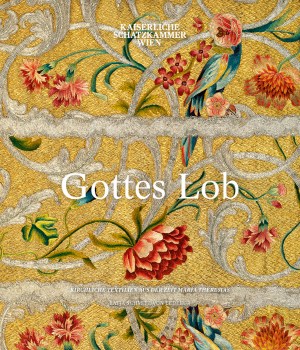
Katja Schmitz-von Ledebur, Gottes Lob: Kirchliche Textilien aus der Zeit Maria Theresias (Vienna, 2016), 96 pages, ISBN: 978-3990201145, €15.
Conference | Human Kind: British and Australian Portraits
From The University of Melbourne:
Human Kind: Transforming Identity in British and Australian Portraits, 1700–1914
The University of Melbourne & National Gallery of Victoria, Melbourne, 8–11 September 2016
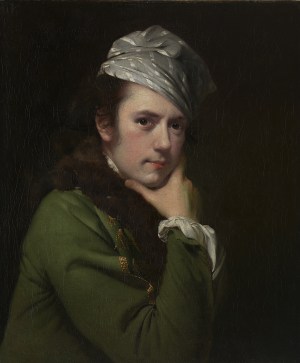
Joseph Wright of Derby, Self-portrait, 1765–68, oil on canvas (Melbourne: National Gallery of Victoria)
Inspired by the outstanding collection of the National Gallery of Victoria, this interdisciplinary conference will be the largest gathering of international and Australian scholars to focus on portraits. It will provide a unique opportunity to explore both British and Australian portraits through a dynamic interchange between academics and curators. Over sixty speaker will explore various aspects of British and Australian portraiture between 1700 and 1914, both as separate fields and as overlapping or comparative studies. Full details of the program can be found here. Keynotes and a selection of papers on eighteenth-century themes are listed below.
Keynotes
• David H. Solkin FBA Walter H Annenberg Professor of the History of Art, The Courtauld Institute of Art: ‘English or European? Portraiture and the Politics of National Identity in Early Georgian Britain’
• Kate Retford Senior Lecturer, Department of History of Art, Birkbeck, University of London: ‘Conversing in and with the Landscape: Edward Haytley’s Portraits of The Brockman Family at Beachborough’
• David Hansen Associate Professor, Centre for Art History & Art Theory, Australian National University: ‘Skin and Bone: Surface and Substance in Anglo-Colonial Portraiture’
• Martin Myrone, Lead Curator, Pre-1800 British Art, Tate Britain, London ‘Portrait and Autograph: Art and Identity in the Age of Reform, c.1820–40’
• Anne Gray Emeritus Curator, National Gallery of Australia, Canberra ‘The Two Titans of Australian Portraiture: Roberts and Lambert’
Sessions and papers on eighteenth-century themes
F R I D A Y , 9 S E P T E M B E R 2 0 1 6
The British Portrait and Europe
• Mark Shepheard, University of Melbourne: ‘The Servile Drudgery of Copying Faces’: Batoni’s Italian Portraits through British Eyes’
• Callum Reid, University of Melbourne: ‘Driven by Glory’: British Self-Portraits in the Galleria degli Uffizi’
• Matthew Ducza, University of Melbourne: ‘Dutch and Flemish Art in Eighteenth-Century Britain: Its Influence on Sir Joshua Reynolds’
• Sophie Matthiesson, National Gallery of Victoria: ‘Joseph Highmore’s Portrait of David Le Marchand’
Portraits, Prints, and the Business of Art
• Kathleen Kiernan, University of Melbourne: ‘Going…Going… Gone!: Portraits of Auctioneers and Printsellers in London, 1741–1800’
• Louise Box, University of Melbourne: ‘Into the Light: An ‘Unknown’ Mezzotint after Romney at the National Gallery of Victoria’
• Sue Russell, Independent scholar: ‘The Dealer as Artist: Robert Bragge’s Portrait of His Father, the Reverend Robert Bragge’
The Theatre of the Self
• Jennifer Jones-O’Neill, Federation University: ‘Male Sensibility in Late Eighteenth-Century Portraits’
• Matthew Watts, University of Melbourne: ‘Reynolds’s Lady Frances Finch: The Female Form as a Site for Social Meaning’
• Matthew Martin, National Gallery of Victoria: ‘Fragile Identities: Eighteenth-Century British Portraits in Porcelain’
Portraits and Empire
• Deirdre Coleman, University of MelbourneL ‘Susanna Gale: A Rose by Any Other Name’
• Kate Fullagar, Macquarie University: ‘Joshua Reynolds’s Portraits of Empire’
• Kim Clayton-Greene, University of Melbourne: ‘The Portrait of Queen Victoria in Colonial Victorian Print Culture’
S A T U R D A Y , 1 0 S E P T E M B E R 2 0 1 6
Empathy
• Angela Hesson, University of Melbourne: ‘Eighteenth-Century Portrait Miniatures as Love Tokens’
• Gillian Russell, University of Melbourne: ‘Emma Hamilton’s Performance Art: ‘Screening’ the Attitudes’
• Jennifer Milam, University of Sydney: ‘Sympathetic Understanding and Viewing Portraiture during the Enlightenment’
Artists and Sitters
• Mark Ledbury, University of Sydney: ‘James Northcote’s Godwin: Friendship, Politics and Likeness in Radical London’
• Georgina Cole, National Art School, Sydney: ‘Blind Justice: Identity and Allegory in Nathaniel Hone’s Portraits of Sir John Fielding’
• Vivien Gaston, University of Melbourne and National Gallery of Victoria: ‘Artist, Actress, Lover: Zoffany’s Portrait of Elizabeth Farren, c.1780’
Exhibition | Drawing or Design? Fine Art Versus Applied Art
Upcoming exhibition at the Wallraf-Richartz Museum:
Drawing or Design? Fine Art Versus Applied Art
Zwischen Disegno und Design? Von der Zeichnung zum Entwurf
Wallraf-Richartz Museum, Cologne, 2 September — 20 November 2016
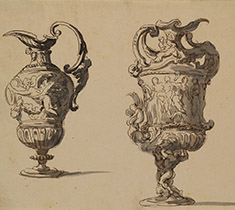 The Wallraf-Richartz Museum has recently been able to identify a set of more than twenty vase drawings in its collection as the work of Louis-Claude Vassé (1716–1772). As a Sculpteur du Roi (sculptor to the king), the artist enjoyed a considerable reputation in his lifetime, but today his name is familiar only to experts. The new attributions have prompted the Museum to devote an exhibition to the specific aesthetic properties of designs for works of decorative art. Such works are still categorised as distinct from fine art drawings, yet designs for applied art produced by French, German and Italian artists in the seventeenth and eighteenth centuries show that the distinction is spurious both in aesthetic terms and as regards artistic quality. The exhibition in the Print Room outlines the rationale behind the separation of the two kinds of drawing and seeks to encourage debate on the subject.
New Book | Paul Revere: Sons of Liberty Bowl
One of the latest installments in the MFA Spotlight series, from Distributed Art Publishers:
Gerald W. R. Ward, Paul Revere: Sons of Liberty Bowl (Boston: MFA Publications, 2016), 56 pages, ISBN: 978-0878468324, $10.
 American patriot Paul Revere is wrapped in the swirling mixture of myth and poetry through which history often descends, but as a craftsman and artist, he left behind more tangible traces as well. In this volume, esteemed art historian Gerald W.R. Ward tells the true story of Revere’s most iconic creation, the Sons of Liberty bowl, bravely made and marked by the rebel and silversmith on the threshold of the Revolutionary War. John Singleton Copley’s portrait of Revere, created the same year, 1768, helps introduce the man he was and the legend he became. The painting and the silver bowl are both popularly reproduced and have joined retellings of his Midnight Ride to define Revere in the American imagination, in turn signifying the Revolution and the young country’s values.
Exhibition | Fiji: Art and Life in the Pacific

Double-hulled Fijian Canoe (drua), Suva Harbour, August 2015.
Photo: Steven Hooper.
◊ ◊ ◊ ◊ ◊
Press release for the exhibition:
Fiji: Art and Life in the Pacific
Sainsbury Centre, University of East Anglia, Norwich, 15 October 2016 – 12 February 2017
Curated by Steven Hooper with Katrina Igglesden and Karen Jacobs
Revealing stunning sculptures, textiles, ceramics, and ivory and shell regalia, Fiji: Art and Life in the Pacific opens in October 2016 at the Sainsbury Centre, Norwich. The largest and most comprehensive exhibition about Fiji ever assembled, it will take the visitor on a journey through the art and cultural history of Fiji since the late 18th century. A highlight of the exhibition will be a beautiful, newly commissioned, eight metre-long double-hulled sailing canoe that has been built in Fiji and shipped to Norwich for display. Made entirely of wood and coir cord, with no metal components, the canoe results from a project to encourage canoe-building skills and is a small version of the great 30-metre- long vessels of the 19th century, the biggest canoes ever built.
Over 270 works of art, including European paintings and historic photographs, are being loaned by exhibition partner the Museum of Archaeology & Anthropology at Cambridge, and by the Fiji Museum, the British Museum, the Pitt Rivers Museum (Oxford) and museums in Aberdeen, Birmingham, Exeter, London, Maidstone, as well as Dresden and Leipzig in Germany.
This exhibition results from a three-year Arts & Humanities Research Council-funded project which examined the extensive but little-known Fijian collections in the UK and overseas and uncovered some significant treasures. Research project leader and exhibition curator Professor Steven Hooper says, “An important aspect of this exhibition is that the many examples of exceptional Fijian creativity on display are not presented as ethnographic specimens or illustrations of Fijian culture, but as works of art in their own right, as worthy of attention as any art tradition in the world, including Modernism. Remarkable creative imagination is applied to the making of ancestral god images, ritual dishes and regalia, and to the decoration of enormous barkcloths.”
Paintings, drawings and photographs of the 19th and 20th century provide context for the artworks. These include exquisite watercolours by the intrepid Victorian travel writer and artist Constance Gordon Cumming and by naval artist James Glen Wilson, who was in Fiji in the 1850s.
Fiji has always been a dynamic place of cultural interactions and exchanges. Since 1000 BC voyaging canoes have transported people and objects around the region, including to Tonga, Samoa and other neighbouring Pacific islands. In the 19th century new voyagers arrived—Europeans—with their new technologies, metal, guns, and Christian religion. Sophisticated strategists, Fijian chiefs twice asked to join the British Empire, and a colonial government was established in 1874. Fiji became independent in 1970. Fiji managed the British colonial administration quite effectively, establishing a particularly close relationship with the British royal family, notably with Her Majesty the Queen.
Fiji has also succeeded in maintaining and adapting many of its proud cultural traditions, and today woodcarvers and textile artists continue to produce sailing canoes, kava bowls (for the preparation of the important ritual drink), and impressive decorated barkcloths—some over 60m long, for weddings and mortuary rituals. In the vibrant Pacific fashion scene designers are using barkcloth and other local materials to make gowns and wedding dresses, showing their creations in London and Los Angeles.
The Sainsbury Centre’s large 900m suite of galleries will be used to present Fiji’s rich cultural past and its important relationship with Britain. Despite a population below one million, Fiji is known globally as a major rugby nation (they are currently World Champions at Rugby 7s) and as an alluring destination for travellers, for whom Fijian hospitality is legendary. The Sainsbury Collection, housed at the Sainsbury Centre, Norwich is world renowned for its works of art from the Pacific, the Americas, Africa, and Asia, as well as for its antiquities and modern works by Picasso, Moore, Giacometti, and Bacon. A selection of contemporary Fijian works such as painted barkcloths and small wood carvings will be stocked for sale in the Museum shop during the exhibition. A fully illustrated book by Steven Hooper will serve as a catalogue of the exhibition and an art history of Fiji.
The exhibition is curated by Professor Steven Hooper, with Katrina Igglesden and Karen Jacobs, all at the Sainsbury Research Unit at the University of East Anglia. Steven Hooper became passionate about Pacific art when growing up in his grandfather’s private museum, the Totems Museum in Arundel, Sussex. It was full of objects brought back from the Pacific as a result of Britain’s naval, missionary, and colonial past. He initially spent over two years (1977–79) doing anthropological research on Kabara, a remote island in eastern Fiji, where canoes, bowls, and barkcloths were still made and which had retained a rich traditional culture. In August 2015 he was in Fiji sailing on, and filming, the canoe that has been specially made for the exhibition. Katrina Talei Igglesden is a PhD student studying Fijian barkcloth and design/fashion. Her mother is Fijian. Karen Jacobs is Lecturer in the Arts of the Pacific specialising in clothing, missionary collections, and the arts of the Kamoro region of West Papua. In 2014 Jacobs and Igglesden co-curated the exhibition Art and the Body at the Fiji Museum.
This exhibition is one of the main outcomes of a research project Fijian Art: political power, sacred value, social transformation and collecting since the 18th century, funded by the UK s Arts and (umanities Research Council A(RC from 2011 to 2014. It was a collaborative endeavour of the Sainsbury Research Unit (SRU) at the University of East Anglia, Norwich, and the Museum of Archaeology and Anthropology (MAA) at the University of Cambridge. Led by Professor Steven Hooper (SRU) and Dr Anita Herle (MAA), project members undertook extensive research on Fijian collections in the UK and overseas, with the aim of bringing these substantial but hitherto little-known collections into the academic and public domains. Artefacts, archives, and pictorial material, including photographs, are being brought together to allow fresh perspectives on the art and history of Fiji.
The islands now called Fiji were first settled about 1000 BC by voyagers from the west, probably from Vanuatu. During the subsequent 3000 years further migrations occurred and the population had expanded to over 120,000 by the late 18th century, when Fiji was briefly visited by Captain Cook and Captain Bligh. After the mutiny on the Bounty in 1789, Bligh was chased by Fijian canoes and was fortunate to escape. The 19th century saw the arrival of European traders, missionaries and planters, and after the first request in 1859 to join the British Empire was turned down, Fiji eventually became a British colony in 1874, with Sir Arthur Gordon as first Governor. He and others based at Government House, including Baron Anatole von Hügel and the redoubtable lady traveller Constance Gordon Cumming, were avid collectors and turned it into a kind of museum. Much of this material was eventually sent back to Britain, hence the substantial collections at Cambridge, the British Museum, and elsewhere. There is also a major high-quality collection in Fiji Museum in the capital, Suva. Although pre-Christian images, ritual objects, and weapons ceased to be made after conversion to Christianity and the cessation of warfare during the 19th century, other traditions, such as canoe building and barkcloth making, have continued as part of a rich traditional cultural life.
Exhibition | Revisiting Rome: Prints of the Eighteenth Century

Giuseppe Vasi, Prospetto dell’ Alma Città di Roma visto dal Monte Gianicolo, ca. 1765, etching
(Staatliche Kunstsammlungen Dresden)
◊ ◊ ◊ ◊ ◊
Upcoming exhibition from the Staatliche Kunstsammlungen Dresden:
Revisiting Rome: Prints of the Eighteenth Century
Begegnungen mit Rom: Druckgraphik des 18. Jahrhunderts
Dresden Royal Palace, 19 October 2016 — 15 January 2017
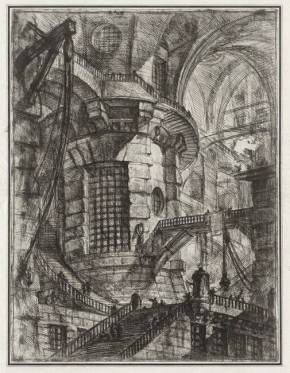
Giovanni Battista Piranesi, Carceri episode: The round tower, ca. 1749–50, etching.
In the eighteenth century Rome was a popular travel destination. Its remains of antiquity, the Renaissance, and Baroque monuments transformed the city into a laboratory of urban and aesthetic innovation. As a location with a rich publishing tradition, Rome also had the necessary infrastructure at its disposal to effectively spread the fame of local landmarks through printed images: illustrators, engravers, and etchers met here with publishers, printers, and distributors of different nationalities.
Thanks to the international circulation of the images, most visitors to Rome had already taken a visual journey through the city. Veduta, maps or panoramas, such as those from Giuseppe Vasi, provided the viewer with an overview of the monuments. Like today’s tourist guides they offered directions on how one might explore the city.
For artists, Rome was also an inexhaustible source of inspiration for architectural fantasies, which, alongside the realistic panoramas, enjoyed a growing popularity. With these inventions, Veneto-born architect Giovanni Battista Piranesi caused something of a stir. At the time, his masterly etchings were significant in establishing Rome alongside Venice as a center of Italian printmaking.

Pier Leone Ghezzi, Signor Domenico Annibali, che parla all’Eminentissimo di San Cesareo, ca. 1749
During his lifetime, almost the entire etched œuvre of the artist made its way to the Dresden Kupferstich-Kabinett. The purchase of Piranesi’s works is only one example of the extensive and selective acquisitions of Roman printmaking that were made at the time. Piranesi’s lifespan covers roughly the same time frame as the exhibited works, which concentrate on panoramas of the ancient and modern Rome as well as unreal spaces. To this day, most of these sheets are bound in so-called collector’s albums—large format volumes that were preferred in the eighteenth and nineteenth centuries for the storage and presentation of print collections.
Additionally, with caricatures by Pier Leone Ghezzi the exhibition offers insights into who populated the streets of the Eternal City in the eighteenth century. Numerous Ghezzi drawings were etched by order of the Saxon Royal Court. Today these sheets are presented as a particularly charming witness of the intensive relationship between Rome and Dresden at that time.
A catalog of the same name published by Sandstein-Verlag Dresden will accompany the exhibition.
New Book | Historical Style: Fashion and the New Mode of History
From Penn Press:
Timothy Campbell, Historical Style: Fashion and the New Mode of History, 1740–1830 (Philadelphia: University of Pennsylvania Press, 2016), 440 pages, (cloth) ISBN: 978-0812248326 / (ebook) ISBN: 978-0812293043, $65 / £42.
 Historical Style connects the birth of eighteenth-century British consumer society to the rise of historical self-consciousness. Prior to the eighteenth century, British style was slow to change and followed the cultural and economic imperatives of monarchical regimes. By the 1750s, however, a growing fashion press extolled, in writing and illustration, the new phenomenon of periodized fashion trends. As fashion fads came in and out of style, and as fashion texts circulated and obsolesced, Britons were forced to confront the material persistence of out-of-date fashions. Timothy Campbell argues that these fashion texts and objects shaped British perception of time and history by producing new curiosity about the very recent past, as well as a new self-consciousness about the means by which the past could be understood.
In a panoptic sweep, Historical Style brings together art history, philosophy, and literary history to portray an era increasingly aware of itself. Burgeoning consumer society, Campbell contends, highlighted the distinction between the past and the present, created an expectation of continual change, and forged a sense of history as something that could be tracked through material objects. Campbell assembles a wide range of writings, images, and objects to render this eighteenth-century landscape: commercial dress displays and David Hume’s ideas of novelty as historical form; popular illustrations of recent fashion trends and Sir Joshua Reynolds’s aesthetic precepts; fashion periodicals and Sir Walter Scott’s costume-saturated historical fiction. In foregrounding fashion to trace eighteenth-century historicism, Historical Style draws upon the interdisciplinary, multimedia archival impressions that fashionable dress has left behind, as well as the historical and conceptual resources within the field of fashion studies that literary and cultural historians of eighteenth-century and Romantic Britain have often neglected.
Timothy Campbell teaches English at the University of Chicago.
◊ ◊ ◊ ◊ ◊
C O N T E N T S
List of Abbreviations
Introduction: Fashions Past
I | The Dress of the Year
1 Modern Fashion and Comparative Contemporaneity
2 Portrait Historicism and the Dress of the Times
II | The Fictions of Serial History
3 Hume, Historical Succession, and the Dress of Rousseau
4 Historical Novelty and Serial Form
5 Walter Scott’s Fashion Systems
6 William Godwin and the Objects of Historical Fiction
Coda
Notes
Bibliography
Index
Acknowledgments
Exhibition | Canova and the Dance
Opening in October at the Bode-Museum:
Canova and the Dance / Canova und der Tanz
Bode-Museum, Berlin, 21 October 2016 — 22 January 2017

Antonio Canova, Dancer with Cymbals (Tänzerin), marble, 1809/1812 (Berlin: Bode-Museum; photo by Andreas Praefcke, Wikimedia Commons, 2007)
Dancer with Cymbals by Antonio Canova (1757–1822) numbers among the most significant and popular of the Bode-Museum’s works of art. The most important sculptor of Italian Neoclassicism was to explore the theme of dance three times in life-size sculptures. On the occasion of the special exhibition, Canova and the Dance, the Berlin dancer is to be joined by her counterparts: Dancer with Hands on Hips, created for Napoleon’s first wife Josephine and held at the Hermitage Museum in Saint Petersburg, and Dancer with Finger on Chin, the model of which is kept at the Museo Canova in Passagno (the sculptor’s place of birth). Additionally, Hebe—a work from the Alte Nationalgalerie acquired for the Berlin collections in 1825—will for the first time be displayed alongside the Dancers. Artistically, Hebe is considered a precursor to Canova’s Dancers, and is the second major work by the Italian sculptor held by the Staatliche Museen zu Berlin. The exhibition gives centre stage to these fascinating marble sculptures, along with a work known as the Berlin Dancer from the Antikensammlung (Collection of Classical Antiquities). Sculptures like this were to serve as a source of inspiration for Canova during the composition of the Dancer in the Bode-Museum’s collection. A key aspect of the exhibition is the way in which Canova, a master of materiality, applied himself to exploring one of his favourite themes—dance—through design sketches, then paintings and models, and finally in the completed marble artwork.
Canova and the Dance is a project undertaken in partnership with two museums in Veneto: the Museo Canova in Passagno and the Museo Civico in Bassano del Grappa—which in 2011 began work on reconstructing the plaster model of the Berlin Dancer (made in Passagno and damaged during World War I), featuring it as part of an exhibition entitled Canova e la danza. The model will now appear in a more advanced state of completion at the Bode-Museum. Paintings both in oil and tempera, created by Canova for his private home, drawings, illustrations, and sculptures—many of which have never previously been exhibited in Germany—will form a display around Canova’s unique suite of Dancers, tracing a visual account of the sensuousness and movement at play in the great Italian sculptor’s work.
New Book | Ancients and Moderns in Europe
From the Voltaire Foundation:
Paddy Bullard and Alexis Tadié, eds., Ancients and Moderns in Europe: Comparative Perspectives (Oxford: Oxford University Studies in the Enlightenment, 2016), 328 pages, ISBN: 978-0729411776, £60 / €74 / $85.
The Querelle des Anciens et des Modernes, or Battle of the Books as it was known in England, famously pitted the Ancients on the one side and the Moderns on the other. This book presents a new intellectual history of the dispute, in which authors explore its manifestations across Europe in the arts and sciences, from the sixteenth to the eighteenth centuries. By paying close attention to local institutional contexts for the Querelle, contributors yield a complex picture of the larger debate. In intellectual life, authors uncover how the debate affected the publication of antiquarian scholarship, and how it became part of discussions in London coffee houses and the periodical press. Authors also position the Low Countries as the true pivot for a modernistic realignment of intellectual method, with concomitant rather than centralised developments in England and France. The volume is particularly concerned with the realisation of the Querelle in the realm of artistic and technical practice. Marrying modern approaches with ancient sympathies was fraught with difficulties, as contributors attest in analyses on musical writing, painting and the querelle du coloris, architectural practice and medical rhetorics. Tracing the deeper cultural resonances of the dispute, authors conclude by revealing how it fostered a new tendency to cultural self-reflection throughout Europe. Together, these contributions demonstrate how the Querelle acted as a leading principle for the configuration of knowledge across the arts and sciences throughout the early modern period, and also emphasise the links between historical debates and our contemporary understanding of what it means to be ‘modern’.
Paddy Bullard is Associate Professor of English literature and book history at the University of Reading. He has published books on Burke and Swift, and his research encompasses material culture studies, intellectual history and political thought.
Alexis Tadié is Professor of English literature, University of Paris-Sorbonne and Senior Research Fellow at the Institut Universitaire de France. He works on eighteenth-century literature and intellectual history, and has published books on Bacon, Locke, and Sterne.
◊ ◊ ◊ ◊ ◊
C O N T E N T S
Paddy Bullard and Alexis Tadié, Introduction
I | Ancient Knowledge and Modern Mediations
1 Vittoria Feola, The Ancients with the Moderns: Oxford’s Approaches to Publishing Ancient Science
2 Alexis Tadié, Ancients, Moderns, and the Language of Criticism
3 Stéphane Van Damme, Digging Authority: Archaeological Controversies and the Recognition of the Metropolitan Past in Early Eighteenth-Century Paris
II | Logic and Criticism across Borders
4 Martine Pécharman, From Lockean Logic to Cartesian(ised) Logic: The Case of Locke’s Essay and Its Contemporary Controversial Reception
5 Marcus Walsh, Scholarly Documentation in the Enlightenment: Validation and Interpretation
6 Karen Collis, Reading the Ancients at the Turn of the Century: The Third Earl of Shaftesbury (1671–1713) and Jean Le Clerc (1657–1736)
III | Conversing with the Ancients: Arts and Practices
7 Théodora Psychoyou, Ancients and Moderns, Italians and French: The Seventeenth-Century Quarrel over Music, Its Status, and Transformations
8 Elisabeth Lavezzi, Painting and the Tripartite Model in Charles Perrault’s Parallèle des Anciens et des Modernes
9 Paddy Bullard, John Evelyn as Modern Architect and Ancient Gardener: ‘Lessons of Perpetual Practice’
10 Sylvie Kleiman-Lafon, Ancient Medicine, Modern Quackery: Bernard Mandeville and the Rhetoric of Healing
IV | The Persistence of the Quarrel
11 Amedeo Quondam, Petrarch and the Invention of Synchrony
12 Karin Kukkonen, Samuel Richardson among the Ancients and Moderns
13 Ourida Mostefai, Finding Ancient Men in Modern Times: Anachronism and the Critique of Modernity in Rousseau
14 Ritchie Robertson, Ancients, Moderns, and the Future: The Querelle in Germany from Winckelmann to Schiller
Summaries
Biographies of contributors
Bibliography
Index










 Enfilade
leave a comment