Exhibition | Stubbs and the Wild

George Stubbs, Horse Frightened by a Lion, 1770
(National Museums Liverpool, Walker Art Gallery)
◊ ◊ ◊ ◊ ◊
Press release (via Art Daily) for the exhibition on view at The Holburne Museum:
Stubbs and the Wild
The Holburne Museum, Bath, 25 June — 2 October 2016
Curated by Amina Wright
The Holburne Museum presents Stubbs and the Wild, an exhibition of animal portraits, grand fantasies, and exquisite prints and drawings by renowned British wildlife painter George Stubbs (1724–1806), on show from 25 June to 2 October 2016. Stubbs and the Wild delves into the many-sided eighteenth-century world of George Stubbs through his realistic animal studies and sublime fantasy pieces, focusing on the artist’s famous depictions of wild animals in paint and print that encapsulated the uneasy relationship between the domestic and the exotic in polite Georgian society.
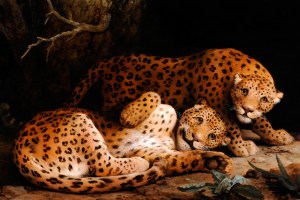
George Stubbs, Two Leopards, ca. 1776, oil on oak panel, 90.5 × 137.4 cm (Private Collection)
Throughout his life George Stubbs was fascinated by how animals are built and studied their anatomy tirelessly. It was this interest that led him beyond horses and dogs to other animals at a time when exotic new wildlife was arriving in London from Britain’s expanding colonies. Moose, leopards, lemurs, antelope and even the remains of a kangaroo were brought home as valuable curiosities and their owners encouraged Stubbs to study the animals and record them for posterity. Although many of them were intended primarily as zoological studies, Stubbs’s paintings of wild creatures are also portraits that capture the behaviour and character of living beings. His most successful essays in the sublime explore the wild, not as a source of curiosity but as a distant, untamed land where nature is merciless and well-fed predators rule. His images of a horse attacked and then devoured by a lion—with variations in different media and reproductions in print—became Stubbs’s signature work.
Alongside paintings, the exhibition will present some of the astonishing works that Stubbs made in other media, using wild animals as his subject. As a printmaker, he was one of the most outstanding etchers of his day, despite being apparently self-taught. He also developed the art of painting in enamels on ceramic, producing jewel-like works of extraordinary clarity and durability.

George Stubbs, The Rev. Robert Carter Thelwall and his Family (Bath: The Holburne Museum)
“The starting point for this exhibition,” explained Amina Wright, Senior Curator at the Holburne Museum and curator of the exhibition, “is the Holburne’s own Stubbs portrait, The Rev. Robert Carter Thelwall and his Family, a polite Georgian conversation piece of a family on a country estate with their horses. This elegant type of portraiture is typical of Stubbs, but this exhibition will explore another side of the artist. By bringing together Stubbs’s anatomical studies and extraordinary images of wild animals, Stubbs and the Wild will present the artist as an indefatigable explorer of the natural world and a bold technical innovator. It will also introduce some of the animal celebrities of eighteenth-century England, from the sweet and fluffy to the majestically terrifying.”
The exhibition will be accompanied by a free audio guide featuring responses to Stubbs’s work by animal experts and artists. Visitors will be able to hear a horse whisperer explaining what’s going on in the minds of Stubbs’s horses and an equine vet explaining the artist’s importance to anatomy. Artist Daphne Wright will explain why monkeys are so fascinating, while wildlife photographer and presenter Simon King will share his many years’ experience of observing big cats. Biographer Wendy Moore introduces the lonely moose who made friends with London’s leading scientists, and a deer manager discusses the life cycle of these beautiful native mammals. Stubbs and the Wild is part of a series of special events and exhibitions to celebrate 100 years since the re-establishment of the Holburne Museum in Sydney Gardens.
◊ ◊ ◊ ◊ ◊
Stubbs and the Wild Study Afternoon
The Holburne Museum, Bath, 29 July 2016, 1:00–4:30
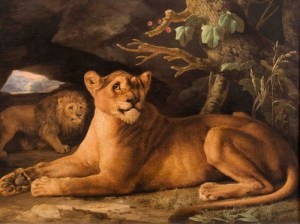
George Stubbs, A Lion and Lioness, 1778, enamel on Wedgwood ceramic 43.1 × 61.6 cm (London: The Daniel Katz Gallery)
Amina Wright, ‘Introduction’
An introduction to the artist and his animals.
Gaye Blake-Roberts, ‘Wedgwood and Stubbs’
In 1775, George Stubbs contacted Josiah Wedgwood to see if he could produce large ceramic tablets on which to paint animals. Over the next few years a fruitful working relationship grew up between these two extraordinary innovators and indefatigable experimenters. Gaye Blake-Roberts, curator at the Wedgwood Museum, explores his unique alliance between potter and painter.
Tim Clayton, ‘George Stubbs and the Print’
George Stubbs was acutely conscious of the importance of prints in communicating his ideas, as the permanent record of his painted images and as the vehicle for his international reputation. Tim Clayton describes why Stubbs taught himself printmaking and traces his subsequent fascination with the medium. He is the author of George Stubbs: The Complete Engraved Works and The English Print, 1688–1802.
The cost of the study afternoon (£30/£12 students) includes admission to the exhibition Stubbs and the Wild.
Exhibition | Painters’ Paintings: From Freud to Van Dyck
Press release (20 May 2016) from The National Gallery:
Painters’ Paintings: From Freud to Van Dyck
The National Gallery, London, 23 June — 4 September 2016
Curated by Anne Robbins
Works of art are models you are to imitate, and at the same time rivals you are to combat. –Sir Joshua Reynolds
 Spanning over five hundred years of art history, Painters’ Paintings presents more than eighty works, which were once in the possession of great painters: pictures that artists were given or chose to acquire, works they lived with and were inspired by. This is an exceptional opportunity to glimpse inside the private world of these painters and to understand the motivations of artists as collectors of paintings.
The inspiration for this exhibition is a painter’s painting: Corot’s Italian Woman, left to the nation by Lucian Freud following his death in 2011. Freud had bought the Italian Woman ten years earlier, no doubt drawn to its solid brushwork and intense physical presence. A major work in its own right, the painting demands to be considered in the light of Freud’s achievements, as a painter who tackled the representation of the human figure with vigour comparable to Corot’s. In his will, Freud stated that he wanted to leave the painting to the nation as a thank you for welcoming his family so warmly when they arrived in the UK as refugees fleeing the Nazis. He also stipulated that the painting’s new home should be the National Gallery, where it could be enjoyed by future generations.
Anne Robbins, curator of Painters’ Paintings says: “Since its acquisition the painting’s notable provenance has attracted considerable attention; in fact, the picture is often appraised in the light of Freud’s own achievements, almost eclipsing the intrinsic merits of Corot’s canvas. It made us start considering questions such as which paintings do artists choose to hang on their own walls? How do the works of art they have in their homes and studios influence their personal creative journeys? What can we learn about painters from their collection of paintings? Painters’ Paintings: From Freud to Van Dyck is the result.”

Thomas Gainsborough, Girl with Pigs, 1781–82 (The Castle Howard Collection). Owned by Sir Joshua Reynolds.
The National Gallery holds a number of important paintings which, like the Corot, once belonged to celebrated painters: Van Dyck’s Titian; Reynolds’s Rembrandt, and Matisse’s Degas among many others. Painters’ Paintings is organised as a series of case studies each devoted to a particular painter-collector: Freud, Matisse, Degas, Leighton, Watts, Lawrence, Reynolds, and Van Dyck. Painters’ Paintings explores the motivations of these artists—as patrons, rivals, speculators—to collect paintings. The exhibition looks at the significance of these works of art for the painters who owned them—as tokens of friendship, status symbols, models to emulate, cherished possessions, financial investments or sources of inspiration.
Works from these artists’ collections are juxtaposed with a number of their own paintings, highlighting the connections between their own creative production and the art they lived with. These pairings and confrontations shed new light on both the paintings and the creative process of the painters who owned them, creating a dynamic and original dialogue between possession and painterly creation.
Half the works in the exhibition are loans from public and private collections, from New York and Philadelphia, to Copenhagen and Paris. A number of them have not been seen in public for several decades.
Dr. Gabriele Finaldi, Director of the National Gallery says: “Artists by definition live with their own pictures, but what motivates them to possess works by other painters, be they contemporaries—friends or rivals—or older masters? The exhibition looks for the answers in the collecting of Freud, Matisse, Degas, Leighton, Watts, Lawrence, Reynolds, and Van Dyck.”
Sir Joshua Reynolds (1723–1792)
As the inaugural President of the Royal Academy, Reynolds was one of the most significant figures of the British art world in the 18th century; for him, collecting was a life-long passion, which he likened to “a great game.” Reynolds had a vast collection of drawings, paintings, and prints that informed both his teachings and supported his ideas about what constituted great art: style of Van Dyck (The Horses of Achilles, 1635–45, The National Gallery, London), Giovanni Bellini (The Agony in the Garden, about 1465, The National Gallery, London), after Michelangelo (Leda and the Swan, after 1530, The National Gallery, London), Poussin (The Adoration of the Shepherds, about 1633–34, The National Gallery, London), and Rembrandt (The Lamentation over the Dead Christ, about 1634–35, The British Museum, London).
Gainsborough’s Girl with Pigs (1781–82, Castle Howard Collection), bought by Reynolds in 1782, also illustrates Reynolds’s interest for the work of his contemporaries, demonstrating the breadth of his taste, but also its changeability—soon after, Reynolds tried to exchange his Gainsborough for a Titian.
Sir Thomas Lawrence (1769–1830)
Lawrence was the leading British portraitist of the early 19th century. He was largely self-taught and hugely influenced by Sir Joshua Reynolds, following in his footsteps to become President of the Royal Academy. Like Degas, Lawrence was a voracious, obsessional collector, using the proceeds of the sale of his society portraits to amass an incomparable collection of Old Master drawings. An inventory upon his death listed some 4,300 drawings, including Carracci’s immense A Woman borne off by a Sea God (?) (about 1599, The National Gallery, London) and a number of paintings including Raphael’s Allegory (about 1504, The National Gallery, London) and Reni’s Coronation of the Virgin, (about 1607, The National Gallery, London).
This section of the exhibition places Lawrence’s collecting within his social world. The paintings he acquired established his reputation as a great connoisseur, and his advice was much sought by influential friends such as John Julius Angerstein and Sir George Beaumont, whose collections came to form the nucleus of the National Gallery holdings. Beyond his acquisitive zeal, the prodigiously gifted Lawrence also sought to gain information about his favoured artists’ methods. An exceptional loan from a private collection, his portrait of the Baring Brothers (Lawrence, Sir Francis Baring, 1st Baronet, John Baring and Charles Wall, 1806–07) demonstrates his absorption of the tradition of Renaissance male portrait, here injected with Lawrence’s trademark dash and virtuosity.
The full press release is available here»
◊ ◊ ◊ ◊ ◊
From Yale UP:
Anne Robbins, Painters’ Paintings: From Freud to Van Dyck (New Haven: Yale University Press, 2016), 96 pages, ISBN: 978-1857096118, £15.
 In this intriguing book, Anne Robbins explores the little-known history of artists collecting paintings. Focusing on the collections of Freud, Matisse, Degas, Leighton, Watts, Lawrence, Reynolds, and Van Dyck, she assesses the ways painters benefited from owning someone else’s work, their motivations for collecting, and how the history of a painting’s ownership influences our own view of both the artist and the work. Robbins investigates paintings as the sources of creative inspiration and their use in teaching theories of art. She also examines how painters acquired the paintings they desired, whether through auction, dealerships, gift or exchange, and how they cared for the works: storing them, displaying them, and, in some cases, flaunting them for self-promotion. Robbins ultimately argues that the acts of acquiring art and of art making evolve in tandem—with rich connections between works owned and works painted.
Anne Robbins is associate curator of Post-1800 paintings at the National Gallery, London.
Exhibition | In the Library: Growth and Development of the Salon Livret

Explication des peintures, sculptures, et autres ouvrages, de messieurs de l’Académie royale (Paris, 1767). Washington, D.C.: National Gallery of Art Library, David K. E. Bruce Fund.
◊ ◊ ◊ ◊ ◊
Press release (31 May 2016) from the NGA:
In the Library: Growth and Development of the Salon Livret
National Gallery of Art, Washington D.C., 20 June — 16 September 2016
Curated by Yuri Long
Documenting the history of the Paris Salon from its emergence in the late 17th century through its decline during the early 20th century, In the Library: Growth and Development of the Salon Livret presents over 60 examples of literature related to the Paris Salon drawn from nearly 250 years of exhibitions. On view in the East Building Study Center, the exhibition includes a variety of publications that document the rise and fall of the Académie Royale de Peinture et de Sculpture and its exhibition, which came to be known as the Salon.
Beginning as a checklist for the works on view, the livret (‘little book’ or catalog) was first published for the Salon of 1673. Appearing then as little more than a pamphlet in decorative wrappers, the livret developed over time into a full catalog. During the latter half of the 19th century livrets included not only additional entries but also supplemental information about the juries, the artists, and the rules of the organization. And throughout the 19th century, new printing technologies—from lithography to photography—allowed for the inclusion of increasingly more faithful reproductions of exhibited works in the livrets.
Developments beyond the academy can also be seen in the growing amount of literature surrounding Salon exhibitions. Art criticism, a new type of writing in the 18th century, evolved alongside the official exhibition livrets as authors began writing commentaries about the Salon. Later, the political upheavals of and following the French Revolution affected the administration of the Salon, whose own controversies, such as the dissatisfaction of member artists, persisted through the 19th century. By the early 20th century, independent exhibitions, each with its own published catalog, had become more frequent and contributed to the declining influence and importance of the official Salon.
Coinciding with the exhibition, the National Gallery of Art Library will publish Documenting the Salon: Paris Salon Catalogs, 1673–1945, compiled and edited by librarian John Hagood. As a bibliography, it lists the publications in the library by and about the organizations that hosted Salons in Paris. Two essays analyze the form and function of Paris Salons and Salon publishing in the ancien régime and in the 19th century. Written by Yuriko Jackall, assistant curator, department of French paintings, and Kimberly A. Jones, associate curator, department of French paintings, they reveal the history and taste of collecting as well as how the Paris Salon grew from a forum for elite, privileged artists and viewers into a more inclusive event. Documenting the Salon is made possible by a grant from The Florence Gould Foundation and will be distributed to museums, libraries, and art research organizations in the US around the world.
Organized by the National Gallery of Art and curated by Yuri Long, rare book librarian, the exhibition is open from 10:00 a.m. to 5:00 p.m., Monday through Friday.
The National Gallery of Art Library contains more than 400,000 books and periodicals, including more than 15,000 volumes in the rare book collection, with an emphasis on Western art from the Middle Ages to the present. The National Gallery of Art Library was founded in 1941, the year the Gallery opened to the public. In 1979, with the move to a seven-story facility in the Gallery’s new East Building and the establishment of the Center for Advanced Study in the Visual Arts (CASVA), the library broadened its purpose and the scope of its collection. Its goal has been to establish a major national art research center, serving the Gallery’s curatorial, educational, and conservation staff, CASVA members, interns, visiting scholars, and researchers in the Washington art community.
New Book | The Grid and the River: Philadelphia’s Green Places
From Penn State UP:
Elizabeth Milroy, The Grid and the River: Philadelphia’s Green Places, 1682–1876 (University Park: The Pennsylvania State University Press, 2016), 464 pages, ISBN: 978-0271066769, $65.
 Philadelphians are fond of quoting a letter in which William Penn described his vision of a “greene country towne, which will never be burnt & always wholesome.” Today, Philadelphia’s public parks cover more than ten thousand acres—roughly 11 percent of the city’s area. They encompass extensive woodlands and waterways as well as the largest collection of historic properties in the state of Pennsylvania, including the Fairmount Water Works, the Philadelphia Zoo (the oldest zoo in the United States), and the Philadelphia Museum of Art.
The Grid and the River is the product of Elizabeth Milroy’s quest to understand the history of public green spaces in William Penn’s city. In this monumental work of urban history, Milroy traces efforts to keep Philadelphia ‘green’ from the time of its founding to the late nineteenth century. She chronicles how patterns of use and representations of green spaces informed notions of community and identity in the city. In particular, Milroy examines the history of how and why the district along the Schuylkill River came to be developed both in opposition to and in concert with William Penn’s original designations of parks in his city plan. Focusing on both the history and representation of Philadelphia’s green spaces, and making use of a wealth of primary source materials, Milroy offers new insights into the city’s political and cultural development and documents how changing attitudes toward the natural environment affected the physical appearance of Philadelphia’s landscape and the lives of its inhabitants.
Elizabeth Milroy is Professor and Department Head of Art and Art History in the Antoinette Westphal College of Media Arts & Design at Drexel University.
◊ ◊ ◊ ◊ ◊
C O N T E N T S
List of Illustrations
Acknowledgments
Introduction
City
1 The Origins of Penn’s Squares
2 Patterns of Growth and Governance in the Centre City
Suburb
3 The Liberty Lands
4 Suburban Villas in the Schuylkill Valley
5 Nurseries of National Virtue: Private Estates and Public Culture
6 Agriculture, Horticulture, and the Origins of the American Picturesque
Consolidation
7 Reviving Penn’s Plan
8 The Fairmount Water Works: Picturing Civic Virtue
9 Rural Cemeteries, River Parks, and the Search for Rational Recreation
10 Greening the Consolidated City
11 The Fairmount Park Commission: Park Building for Preservation and Conservation
12 Spatial Politics and the Centennial Exhibition
13 A Work Unfinished
Notes
Bibliography
Index
New Book | Endeavouring Banks
News emerged in May that the wreckage of the Endeavour has been located off the coast of Rhode Island—as reported, for instance, in The Guardian (2 May 2016). After Cook’s voyage, the ship was renamed the Lord Sandwich and used in the revolutionary war blockade, sinking in 1778. This volume appears with an eye toward the 250th anniversary of the first voyage (the Endeavour sailed from Plymouth in August 1768). From Paul Holberton:
Neil Chambers, ed., with with a foreword by Sir David Attenborough and contributions by Anna Agnarsdóttir, Jeremy Coote, Philip J. Hatfield and John Gascoigne, Endeavouring Banks: Exploring the Collections from the Endeavour Voyage, 1768–1771 (London: Paul Holberton Publishing, 2016), 304 pages, ISBN: 978-1907372902, £40 / $50.
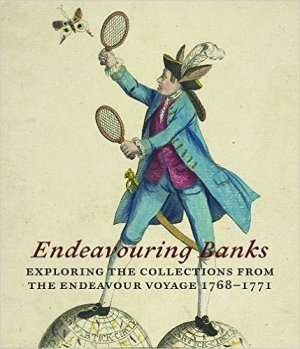 When English naturalist Joseph Banks (1743–1820) accompanied Captain James Cook (1728–1779) on his historic mission into the Pacific, the Endeavour voyage of 1768–1771, he took with him a team of collectors and illustrators. They returned with unprecedented collections of artefacts and specimens of stunning birds, fish, and other animals as well as thousands of plants, most seen for the first time in Europe. They produced, too, remarkable landscape and figure drawings of the peoples encountered on the voyage along with detailed journals and descriptions of the places visited, which, with the first detailed maps of these lands (Tahiti, New Zealand, and the East Coast of Australia), were afterwards used to create lavishly illustrated accounts of the mission. These caused a storm of interest in Europe, where plays, poems, and satirical caricatures were also produced to celebrate and examine the voyage, its personnel, and many ‘new’ discoveries.
Along with specimens and artefacts, contemporary portraits of key personalities aboard the ship, scale models and plans of Endeavour itself, scientific instruments taken on the voyage, commemorative medals and sketches, the objects (over 140) featured in this new book tell the story of the Endeavour voyage and its impact ahead of the 250th anniversary in 2018 of the launch of this seminal mission. Items separated in some cases for more than two centuries are brought together to reveal their fascinating history not only during but since that mission. Original voyage specimens will feature together with illustrations and descriptions of them, showing a rich diversity of newly discovered species and how Banks organized this material, planning but ultimately failing to publish it. Drawings of people and places visited during the mission are reproduced. And by comparing these voyage originals with the often stylized engravings later produced in London for the official account, this book investigates how knowledge gained on the mission was gathered, later revised and then printed in Europe.
The book focuses on the contribution of Banks’s often neglected artists—Sydney Parkinson, Herman Diedrich Spöring, Alexander Buchan as well as the priest Tupaia, who joined Endeavour in the Society Islands—none of whom survived the mission. These men illustrated island scenes of bays, dwellings, canoes as well as the dress, faces, possessions, and ceremonies of Pacific peoples. Of particular interest, and only recently recognised as by him, are the original artworks of Tupaia, who produced as part of this mission the first charts and illustrations on paper by any Polynesian. The surviving Endeavour voyage illustrations and maps were the most important body of images produced since Europeans entered this region, matching the truly historic value of the plant specimens and artefacts seen alongside them in this handsome book.
Exhibition | The Shogun’s World: Japanese Maps
On view at AIC:
The Shogun’s World: Japanese Maps from the 18th and 19th Centuries
Art Institute of Chicago, 25 June — 6 November 2016

Revised Complete Map of Japanese Roads and Lands, 1840. Japan (MacLean Collection)
Maps are practical tools for understanding the world we inhabit, but they are not only visual representations of a particular place and time; their presentations can be strikingly beautiful as well. Japanese mapmaking is particularly distinct, even within the broader context of East Asia’s unique traditions. A multi-directional view, the use of map designs on ceramic plates, and the integration of Western practices like the compass rose, bird’s eye view, and latitude are all part of Japan’s approach to cartography in the 18th and 19th centuries.
A first for the Art Institute’s Japanese print gallery, this exhibition of maps showcases the beauty of Japanese printmaking. The maps on view feature the world, the Japanese archipelago, and major cities, including Osaka, Yokohama, Edo, Nagasaki, and Kyoto. Highlights include works from trustee Barry MacLean’s comprehensive collection, such as a Buddhist map of the world that translates spiritual forces into physical locations. A blue and white “map plate,” also from the MacLean Collection, features a relief map of Japan divided into provinces, with additional land masses and mythical locations such as “the land of women” circling the edge of the plate. An 1861 aerial view of Yokohama from the Art Institute’s collection is made up of six standard-sized prints presented as one image, with important buildings and sections of the foreign settlement labeled for ease of use. In every map presented, Japan is the focus. Sometimes the geography is of lands that are concrete and known, and sometimes it is a gateway to the realm of the imagination.
Call for Papers | Collecting and Display Seminar Group
From H-ArtHist:
Collecting and Display Seminar Group
Institute of Historical Research, London, 3 October 2016 — 22 June 2017
Proposals due by 6 July 2016
Our monthly seminars cover a wide range of topics from the study of individual collectors and the art market to the many different types of collections acquired over the centuries. Although the main emphasis is on art and artefacts, collections of memorabilia, scientific or ethnographic collections have also been covered. Papers have considered every type of collection, from royal and aristocratic collections to those of private citizens.
Papers are invited for the next academic year October 2016–July 2017. We encourage research that opens the field of collecting to new debates on motives of collectors, methods and networks of collecting, the market for works of art and the roles of dealers and auction houses, different types of collections and display. We are able to offer some limited support for travel from abroad where necessary.
Please submit your proposal of 300 words with a short biography to schbracken@btopenworld.com by 6 July. Our proposed dates are 3 October, 14 November, 12 December, 9 January, 6 February, 6 March, 15 May and 20 June. Please indicate if you have a preference for one of these dates.
Exhibition | Divine Pleasures: Painting from India’s Rajput Courts
Press release (14 June 2016) from The Met:
Divine Pleasures: Painting from India’s Rajput Courts—The Kronos Collections
The Metropolitan Museum of Art, Fifth Avenue, New York, 14 June — 12 September 2016
Curated by Navina Haidar and Courtney Stewart

Detail of The Village Beauty. Probably painted by the artist Fattu (active ca. 1770–1820). Illustrated folio from the dispersed ‘Kangra Bihari’ Sat Sai (Seven Hundred Verses). Punjab Hills, kingdom of Kangra, ca. 1785. Opaque watercolor, ink, and gold on paper; narrow yellow and white borders with black inner rules; dark blue spandrels decorated with gold arabesque; painting 18.7 x 13.2 cm, page 20.6 x 14.9 cm. Promised Gift of the Kronos Collections, 2015 (SK.082).
Compelling episodes from the epic and poetic literature of the Indian subcontinent dominate the nearly 100 masterful paintings—most a 2015 promised gift by Steven M. Kossak from his family’s Kronos Collections—on display at The Metropolitan Museum of Art. Created mainly between the 16th and the early 19th century for the royal courts of Rajasthan and the Punjab Hills in northern India, the works on view in the exhibition Divine Pleasures: Painting from India’s Rajput Courts—The Kronos Collections are meant to move the soul and delight the eye. Suffused with the powerful imagery of the myths of the past, Indian painting expressed a new way of seeking the divine through bhakti, or personal devotion. The collection was assembled over nearly four decades by Mr. Kossak, formerly a curator in The Met’s Department of Asian Art.
“We are delighted to present this exhibition of Steve Kossak’s generous promised gift,” said Thomas P. Campbell, Director and CEO of The Met. “These distinguished paintings constitute one of the premier collections of this material in private hands, and their eventual addition to The Met collection will transform the Museum’s holdings of Rajput painting. It is a significant addition to Steve’s legacy at The Met after serving for two decades as a curator.”
The exhibition is organized into three major sections: Early Rajput and Rajasthan, early Pahari (Punjab Hills), and later Pahari. Within each room, the paintings will be shown in relation to the literary traditions of Indian Hinduism. Rajput court painting was mainly intended for royal delectation, to amplify through the artistic fantasy manifest in the pictures, well-known religious, quasi-religious, and secular texts and subjects. The power and magic of the images transcends the subjects they portray.
Under the patronage of their Rajput rulers, many of the principalities of north India developed and nurtured a distinctive painting style. This galaxy of stylistic expression is amply demonstrated in the exhibition through compelling examples of the Early Rajput Style; the later schools of Bikaner, Bundi, Kishangarh, Kota, and Mewar; as well as many of the small courts of the Punjab Hills: Bahu, Bahsoli, Bislalpur, Chamba, Guler, Kangra, Mandi, Mankot, and Nurpur.
Painted on paper in opaque watercolor and ink, they are often heightened with gold and silver. Whites are often raised to simulate pearls and reflective beetle-wing casings stand in for emeralds. Many of the paintings have never before been exhibited publicly.
Concurrent with the exhibition is a small, thematically related display, Poetry and Devotion in Indian Painting: Two Decades of Collecting (June 15–December 4, 2016) in the Florence and Herbert Irving Galleries for the Arts of South and Southeast Asia, Indian Painting Gallery, Gallery #251. Recognizing the contributions of Mr. Kossak to the Department of Asian Art, where he was a curator from 1986 to 2006, it features 22 of the dozens of Rajput and Pahari paintings that were acquired during his tenure, including a large intricately painted and printed cloth pichwai (temple hanging).
The exhibition was organized by Navina Haidar, Curator, and Courtney Stewart, Senior Research Assistant, of The Met’s Department of Islamic Art. Exhibition design is by Daniel Kershaw, Exhibition Design Manager; graphics are by Constance Norkin, Graphic Design Manager; and lighting is by Clint Ross Coller and Richard Lichte, Lighting Design Managers, all of the Museum’s Design Department.
◊ ◊ ◊ ◊ ◊
The catalogue is distributed by Yale UP:
Terence McInerney, with essays by Steven Kossak and Navina Najat Haidar, Divine Pleasures: Painting from India’s Rajput Courts—The Kronos Collections (New York: The Metropolitan Museum of Art, 2016), 272 pages, ISBN: 978-1588395900, $50.
 This splendidly illustrated publication features over 90 important paintings from the predominantly Hindu Rajput tradition of Indian painting, and are highlights from the Kronos Collection, one of the finest holdings of Indian art. These remarkable works—most of them published and illustrated here for the first time—were painted between the 16th and 18th centuries for the Indian royal courts in Rajastan and the Punjab Hills. Many of the paintings are characterized by their brilliant colors and vivid depictions of scenes from Hindu epics, mystical legends, and courtly life. Along with an informative entry for every work and a personal essay by expert and collector Steven M. Kossak, the book contains an extensive essay by Terence McInerney that outlines the history of Indian painting, with a special emphasis on the Rajput courts, and provides an overview of the subject with fresh insights and interpretations.
Terence McInerney is an independent scholar, dealer, and author of numerous articles on Indian painting. Steven M. Kossak is a former curator in the Department of Asian Art at The Metropolitan Museum of Art and a distinguished collector.
Call for Papers | Objects and Possessions
From the conference website:
Objects and Possessions: Material Goods in a Changing World, 1200–1800
Southampton, 3–6 April 2017
Proposals due by 12 September 2016
This interdisciplinary conference looks at material culture across a long timeframe in order to explore the worlds of goods and objects across Europe and its overseas colonies, the connections and relationships facilitated by the exchange of goods, the importance and interpretation of the inheritance of goods and objects, and the ways in which goods brokered relationships between Europe and the wider world in the period.
The aim is to deepen our understanding of how goods ‘worked’ in a variety of social, economic and cultural contexts. We know a great deal about real property and the possession of land, but comparatively little about goods and chattels and their connections, and how these developed across a long timeframe. Over the period 1200‒1800 there were great changes in the type, range and availability of goods, from the finest items of the elite, the work of craftsmen on an individual basis, to the manufacture and widespread availability of cheap and utilitarian goods and equipment.
Customs of ‘possession’ need to be exposed, to show what ownership might mean, what property might be held by women or children, and what might be considered inalienable within families. The conference will look to identify the cultural connections—and how goods and attitudes to them change culture. It will also consider how goods were transferred, exchanged and collected, as well as the ways in which objects could be used to mediate connections and broker relationships between different people and places.
Proposals are invited for single papers and for whole sessions (three papers). Papers should not exceed 30 minutes. Themes might include:
• The ownership of goods; the law and objects
• Patterns of inheritance for different categories
• The connections of different groups in society to goods, for example, domestic equipment, jewellery, textiles
• The introduction of new goods, fashions and colours
• The increasing quantities and diversity of goods
• Furnishings for household interiors
• Consumer revolutions (e.g. sugar, colour, fur)
• Vocabularies for describing goods
• Trades and markets for goods
• Processes of collecting and accumulation
• The politics of possession and display
Please send short abstracts (no more than 200 words per paper) by 12 September 2016 to Chris Woolgar (C.M.Woolgar@southampton.ac.uk).
Call for Essays | Adapting the Eighteenth Century
Adapting the Eighteenth Century: Pedagogies and Practices
Edited by Sharon Harrow (Professor of English, Shippensburg University) and Kirsten Saxton (Professor of English, Mills College)
Proposals due by 15 August 2016; final essays due by 15 January 2017
The eighteenth century has quite a bit of popular currency these days; we see adaptations of eighteenth-century literature and culture on tumblr, fan fiction, web series, scent lines, cult mashups, Facebook accounts, you-tube videos, fashion, graphic novels, literary fiction, theater stagings, greeting cards, and in mainstream films. Adaptation is currently a lively intellectual topic, generating both theoretical and applied research. Theories of adaptation—including Linda Hutcheon’s A Theory of Adaptation, Julie Sanders’s Adaptation and Appropriation, and Dan Hassler-Forest’s and Pascal Nicklas’s The Politics of Adaptation: Media Convergence and Ideology—undergird recent inquiries into adaptation, including interpretations of contemporary adaptations of eighteenth-century texts, such as Pride and Prejudice and Zombies, Longbourn, The Scandal of the Season, Foe, The Cattle Killing, Inkle and Yariko, Mother Clap’s Molly House, and Zong! In addition, new work argues for the adaptive nature of the century itself; Citizens of the World: Adapting in the Eighteenth Century, edited by Samara Anne Cahill and Kevin Cope, explores adaptations—transnational and transactional—within the century.
Our collection will build on this rich scholarly foundation to focus on adaptation and pedagogy. Adaptations of material or ideas from the long eighteenth century are often seen as middlebrow simplifications, capitalist exploitations, or, in teaching, simply as gateway texts. Rather than viewing adaptations as the spoonful of sugar, we invite essays to combine current adaptations of eighteenth-century texts or concepts with texts from the eighteenth-century in ways that provocatively and thoughtfully open up and out our own reading and teaching.
Essays might focus on the literary (novels, plays, poems), or on philosophical or scientific treatises, paintings, historical records, or musical notations. We are interested in both direct adaptations as well as in appropriations, re-mixes, or traces. We are particularly interested in essays that move beyond description of a film adaptation of a book to address new forms of media convergence and participatory culture in which reading, watching, and listening are key elements in the process of adaptation.
Adapting the Eighteenth Century: Pedagogies and Practices hopes to be broadly representative in the philosophies, methodologies, and critical orientations presented; and in the types of schools, students, and courses considered. We want the book to be relevant for non-specialists as well as specialists, for graduate student teachers as well as senior professors. We welcome essays across a range of disciplines, geographies, and levels of focus. Since this volume is dedicated to teaching, abstracts and essays should center on pedagogical issues. Whatever its topic—practical teaching or more theoretical or topical—essays should explicitly address how they will apply to the needs of teachers in preparing and teaching classes and the needs of students in learning.
Please send a 500 word proposal/abstract and a CV to ktsaxton@mills.edu and srharr@ship.edu by August 15, 2016. We will respond with decisions by September 15, 2016. Completed essays of no more than 25 pages will be due by January 15, 2017.










 Enfilade
leave a comment