The Coach Gallery at Versailles Open Once Again

Baptism Sedan of the Duc of Bordeaux
(Château de Versailles)
◊ ◊ ◊ ◊ ◊
The coaches at Versailles are once again on view:
The Coach Gallery of the Palace of Versailles, situated in the King’s Great Stables and closed to the public since 2007, will once again be opening its doors in the spring of 2016, thanks to sponsorship by the Michelin Corporate Foundation. This recently restored collection of coaches is one of the largest in Europe but is still very little known by the general public, and will be on display in a new and fully redesigned space.
Designed to be noticed, the carriages of Versailles are artistic masterpieces. Ostentatiously luxurious and extravagantly decorated with gold and sculpted detail, they were produced by the best artists of the French Court, including architects, carpenters, sculptors, cabinet-makers, bronze workers, chasers, gilders, upholsterers, embroiderers, and trimmings suppliers.
Besides its artistic quality, the collection is also a sort of ‘Vehicle Exhibition from the 18th and 19th centuries’, containing the finest prototypes and cutting-edge advances in French coach-making in terms of comfort, level of performance, and technique including traction, steering and suspension, and the first coupés and convertibles.
In addition, each coach tells a bit of French history through dynastic or political events such as christenings, marriages, coronations or funeral ceremonies. Above all else, the collection is a living testimony to life in the French Court and sumptuousness during the Ancien Régime, the French Empire, and the Restoration.
Visitors will discover these magnificent vehicles up close, such as the Berlins from the marriage of Napoleon I, the coach from the coronation of Charles X and the funeral carriage for Louis XVIII. They will also see finely decorated harnesses with gilded bronze, litters, the small coaches belonging to Marie-Antoinette’s children and an incredible collection of fantastical sledges made during the reign of Louis XV.
During the Ancien Régime the royal stables were located in the King’s Small Stables and Great Stables, a pair of buildings built opposite the Palace of Versailles by Jules Hardouin-Mansart. Pearls of classic French architecture, these two constructions were designed to house the horses and coaches of the King and the Court as well as the thousand or so people who formed the Institution, including horsemen, drivers, blacksmiths, wheelwrights, saddlers, doctors and even musicians.
At the time of the revolution, hundreds of vehicles that once served the King and Court were sold and dispersed, and then re-used during the War in the Vendée and to serve the needs of the revolutionary government. In 1837, when Louis-Philippe turned the Palace of Versailles into a museum dedicated to ‘All the glory of France’, he re-assembled the collection of historical Coaches.
The success of the exhibition Roulez Carrosses! in 2011–13 at the Arras Musée des Beaux-Arts revealed both the richness of the exhibition and the public’s interest in these works of art. It also brought to light the need to exhibit them in the Palace of Versailles and make them permanently available to the public.
The exhibition space is composed of two galleries and currently covers nearly 1000 m², allowing the collection to be comfortably spread out. The scenography will respect the spirit and architecture of the setting: the Royal Stables built by Jules Hardouin-Mansart between 1679 and 1682.
New Book | Fashionable Encounters
This collection of essays appeared in 2014, but I learned of it just a a few days ago—thanks to Michael Yonan’s Instagram: he’s in Denmark this week, participating in Attingham’s Study Programme. I’m hoping to start a list of Instagram feeds relevant to eighteenth-century art and architecture in the coming weeks, so please feel free to send me any of your favorites! -Craig Hanson
◊ ◊ ◊ ◊ ◊
From Oxbow Books:
Tove Engelhardt Mathiassen, Marie-Louise Nosch, Maj Ringgaard, Kirsten Toftegaard, and Mikkel Venborg Pederson, eds., Fashionable Encounters: Perspectives and Trends in Textile and Dress in the Early Modern Nordic World (Oxford: Oxbow Books, 2014), 256 pages, ISBN: 978-1782973829, £40.
 At the heart of this anthology lies the world of fashion—a concept that pervades the realm of clothes and dress, appearances and fashionable manners, interior design, ideas and attitudes. Here sixteen papers focus on the Nordic world (Denmark, Norway, Sweden Finland, Iceland, the Faroe Isles and Greenland) from 1500 to 1850. This was a period of rapid and far-reaching social, political and economic change, from feudal Europe through political revolution, industrialisation, development of international trade, religious upheaval, and technological innovation—changes impacting on every aspect of life and reflected in equally rapid and widespread changes in fashion at all levels of society. These papers present a broad image of the theme of fashion as a concept and as an empirical manifestation in the Nordic countries in early modernity, exploring a variety of ways in which that world encountered fashionable impressions in clothing and related aspects of material culture from Europe, the Russian Empire, and far beyond. The chapters range from object-based studies to theory-driven analysis. Elite and sophisticated fashions, the importation of luxuries and fashion garments, christening and bridal wear, silk knitted waistcoats, woollen sweaters and the influence of the whaling trade on women’s clothing are some of the diverse topics considered, as well as religious influences on perceptions of luxury and aspects of the garment trade and merchant inventories.
◊ ◊ ◊ ◊ ◊
C O N T E N T S
Prologue (Mikkel Venborg Pedersen)
1 The World of Foreign Goods and Imported Luxuries: Merchant and Shop Inventories in Late 17th-Century Denmark-Norway (Camilla Luise Dahl and Piia Lempiäinen)
2 Foreign Seductions: Sumptuary Laws, Consumption and National Identity in Early Modern Sweden (Eva I. Andersson)
3 Fashion from the Ship: Life, Fashion and Fashion Dissemination in and around Kokkola, Finland in the 18th Century (Seija Johnson)
4 Creating fashion: Tailors’ and Seamstresses’ Work with Cutting and Construction Techniques in Women’s Dress, ca. 1750–1830 (Pernilla Rasmussen)
5 Silk Knitted Waistcoats: A 17th-Century Fashion Item (Maj Ringgaard)
6 Fashioning the Early Modern Swedish Nobility, Mirrored in Preserved 17th-Century Liturgical Textiles (Lena Dahrén)
7 Reflections on Dress Practices and How to Get to Know the Past (Bjørn Sverre Hol Haugen)
8 The Queen of Denmark: An English Fashion Doll and Its Connections to the Nordic Countries (Cecilie Stöger Nachman)
9 At the Nordic Fringe of Global Consumption: A Copenhagen Bourgeois’ Home and the Use of New Goods in the Mid-18th Century (Mikkel Venborg Pedersen)
10 The Theft of Fashion: Circulation of Fashionable Textiles and Garments in 18th-Century Copenhagen (Vibe Maria Martens)
11 Bolette-Marie Harboe’s Bridal Dress: Fashionable Encounters Told in an 18th-Century Dress (Kirsten Toftegaard)
12 Luxurious Textiles in Danish Christening Garments: Fashionable Encounters across Social and Geographical Borders (Tove Engelhardt Mathiassen)
13 Fish-bones and Fashion: The Influence of Whaling on Women’s Clothes in Early Modern Europe (Christina Folke Ax)
14 From Doll Cups to Woollen Sweaters: Trends, Consumption, and Influentials in early 19th-Century Southern Disko Bay, Greenland (Peter Andreas Toft and Maria Mackinney-Valentin)
15 Abundance to Asceticism: Religious Influences on Perceptions of Luxury in Denmark and Great Britain in the 18th Century (Juliane Engelhardt)
16 Circulating Images of Unmanliness and Foreignness: Collector Niclas Holterman and European Caricatures in Sweden around 1800 (Patrik Steorn)
Acknowledgements
Illustrations
Contributors
New Book | The Royal Garden: Identity, Power and Pleasure
From the Ax:son Johnson Foundation:
Kurt Almqvist and Susanna Hakelius Popova, eds., The Royal Garden: Identity, Power and Pleasure (Stockholm: Axel and Margaret Ax:son Johnson Foundation, 2016), 193 pages, 250SEK.
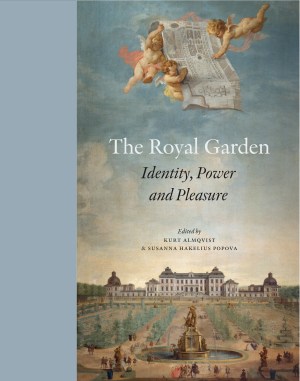 Throughout history, royals have strongly influenced the form and content of gardens and parks. Our strong connection to these cultivated places is not only due to our fascination with nature itself, but reveals our relationship to royal houses, monarchy and the nation. Through the conservation of these places we do not only see and view nature, but our own cultural heritage.
In this book, eight garden experts from five countries provide important examples of how kings and regents—through their extraordinary creations—have shaped history, communicated with the world, and mirrored themselves in their respective eras. The essays stem from a seminar, The Royal Garden, arranged by The Axel and Margaret Ax:son Johnson Foundation for Public Benefit and held at Drottningholm Palace near Stockholm in 2015.
The conference included these presentations:
• John Dixon Hunt — The Royal Garden as an Historic Concept
• Göran Alm — The Paradise: A Swedish Royal Garden Recreation
• Magnus Olausson — Travels, Tournaments, and Freemasonry: National and International
• Åsa Ahrland — The Royal Park: From Regal Pursuit to Public Recreation
• Renske Ek — The Royal Baroque Garden at Het Loo as a Work of Art
• Patricia Bouchenot-Déchin — Louis XVI, André Le Nôtre, and the Royal Garden of Versailles
• Todd Longstaffe-Gowan — Sweet Prospects and Stately Avenues: The Role and Importance of the Lime Tree Avenues at Hampton Court
• Peter Wirtz — Case Study Domaine de Wideville: Revamping a Louis XIII Garden
• George Plumptre — Overview of, and Differences in, Ten Interesting Royal European Gardens
Exhibition | In the Course of Time: 400 Years of Royal Clocks
Now on view at the Royal Palace in Stockholm:
In the Course of Time: 400 Years of Royal Clocks / I tiden: Kungliga klockor under 400 år
Royal Palace of Stockholm, 22 January — 25 September 2016

Marble and gold-plated bronze table clock with portrait medallions of King Gustav I, King Gustav II Adolf and King Gustav III. Made for King Gustav III by the Swedish-born clockmaker André Hessén in Paris. Photo: Alexis Daflos/Royalcourt.se
The exhibition In Course of Time: 400 Years of Royal Clocks features more than 50 royal clocks—some of which are on show for the first time—dating from the 16th century to the present day. The exhibition marks the 70th birthday of King Carl XVI Gustaf of Sweden (30 April 2016).
Clockmaking is a precise trade, and clocks have long been seen as extremely exclusive objects. They have therefore often been designed with a great degree of artistic skill. The clock as an objet d’art is one aspect of the exhibition. With the dawn of the modern era, clocks also became useful tools for coordinating work at the palace. For example, the exhibition includes the clock that governed the palace guards’ routines during the 19th century. Today, clocks remain part of day-to-day palace life. Most of the clocks in the collections still work, continuing to perform their function centuries later as timekeepers at a number of the royal palaces.
Conference | Auricular Style: Frames
From the conference website:
Auricular Style: Frames
The Wallace Collection, London, 5–6 October 2016
Organized by Gerry Alabone and Lynn Roberts
This two-day international conference is the first dedicated to the Auricular style, centring on one of its most significant manifestations, the picture frame. The conference aims to stimulate awareness and study of this important but neglected style by bringing together research in fine and decorative art histories. Speakers from Europe, UK, and USA will consider the origins and development of the Auricular style in different materials, including silver, wood, stucco, and leather. Papers will explore how other areas of the decorative and applied arts fed into the creation of picture frames. They will examine the influence of prints, drawings, ad the style’s dissemination between European centres in Bohemia, Germany, Italy, France, the Netherlands, and Britain. Poster presentations will be exhibited during the conference. These will be edited with the papers and published, fully illustrated, for free download on Auricular Style: Frames—which, it is hoped, will become a hub for future related research.
Early bird registration is now open. Early bird ticket prices (including Eventbrite’s commission): £100 regular, £90 Icon members, £50 students (ID to be shown at conference). Early bird option ends and prices rise after 30 June. The theatre’s capacity is 150; therefore, early registration is recommended. No refunds will be made after 23 September. If you do not wish your email address to be included in the Delegates list, please contact the event coordinator at gdsg.events@gmail.com.
Convenors: Gerry Alabone (Tate / City and Guilds of London Art School) and Lynn Roberts (The Frame Blog) in association with the Institute of Conservation (Gilding and Decorative Surfaces Group).
◊ ◊ ◊ ◊ ◊
5 O C T O B E R 2 0 1 6
9.00 Registration and coffee
• On the Inception of Auricular Ornament: Paulus van Vianen’s Metamorphic Bodies and the Fleshy Frame (Allison Stielau, McGill University)
• Object Bodies, Metal Mounts and the Skins of Things (Anna Grasskamp, Heidelberg University)
Coffee
• A French Auricular? A Brief History of a Style (Marika Knowles, Harvard University)
• German Knorpelwerk: Auricular Dissemination in Prints, Woodcarving, Stucco and Painted Wall Decorations, 1620–1670 (Daniela Roberts, Würzburg University)
• The Auricular Style in Dutch Furniture (Reinier Baarsen, Leiden University / Rijksmuseum)
Lunch break
• Gilt Leather: A Creative Industry avant la lettre (Eloy Koldeweij, Cultural Heritage Agency, the Netherlands)
• Material Research on Auricular Frames in the Netherlands (Hubert Baija, Rijksmuseum)
• The Auricular Frame Depicted in Paintings (Lynn Roberts, The Frame Blog)
Tea
• Between Amsterdam, Paderborn and Rome: A Remarkable Frame in the Collections of the Louvre (Charlotte Chastel-Rousseau, Louvre)
• Dutch Auricular Woodcarving (Ada de Wit, Radboud University / Wallace Collection)
6 O C T O B E R 2 0 1 6
9.55 Welcome and introduction
• The Development of an Auricular Style in Florence (Adriana Turpin, Institut d’Études Supèrieures des Arts)
• Anthropomorphism and Zoomorphism in the Medici Picture Frames (Marilena Mosco, former Director of Palazzo Pitti)
Coffee
• Florentine Auricular Frames: Techniques and Aesthetics (Aviv Fürst, Palazzo Pitti)
• Documenting Developments in the Taste for Auricular Framing in England, 1620–1700 (Jacob Simon, National Portrait Gallery)
• Looking at Material and Visual Evidence of English Auricular Frames (Gerry Alabone, Tate / City and Guilds of London Art School)
Lunch break
• An Auricular Frame amongst the Founder’s Collection of the Ashmolean Museum (Tim Newbery and Jevon Thistlewood, Ashmolean Museum)
• Picture Galleries in Seventeenth-Century Britain (Honorary Professor Karen Hearn, University College London)
• Notes on the Revival of the Auricular Style for Picture Frames (Christopher Rowell, National Trust)
Tea
• The Auricular Today: Putting an Ear to the Ground (Steve Shriver, art+works)
• Panel discussion with all speakers (to finish at 5.00pm)
Exhibition | The Emperor’s Gold
◊ ◊ ◊ ◊ ◊
From the Kunsthistorisches Museum:
The Emperor’s Gold / Das Gold des Kaisers
Kunsthistorisches Museum, Wien, 24 May 2016 — 5 March 2017
The great fame that the imperial coin collection already enjoyed throughout Europe around 1800 derived from its size and quality as well as from the rarity of the objects it contained. It was the collecting passion of the Emperors Charles VI (reigned 1711–1740) and Francis I (reigned 1745–1765), which already fascinated contemporaries, and to which the Vienna Coin Cabinet owes its world-class status today. On the occasion of the 125th anniversary of the Kunsthistorisches Museum, the Vienna Coin Cabinet presents a special exhibition of the highest-carat gold pieces from its once-imperial coin collection.
From Antiquity to the Modern Period
The gamut ranges from gold coins in everyday circulation through multiples, true gold giants, and singular commemorative issues. Many of the imprints on display were honorific gifts to the emperor or were targeted acquisitions for the imperial collection. Antique treasure hordes also played an important role in the expansion and enrichment of the imperial coin collection. The spectacular find at Szilágysomlyó in Transylvania, for instance, contained the heaviest gold medals from antiquity ever discovered.
All That Glitters Is Not Gold
The so-called ‘splendid’ medals (Prunkmedaillen) represent a highlight of the exhibition. These were produced in only a few exemplars and presented as precious gifts to important personages. Due to their enormous sizes, they offer images with a richness of detail that is otherwise unknown. Today their exclusive value lies not only in their precious metal content and artistic quality, but also in their singular provenance.
The Birthplace of Numismatics
In addition to its purely representative function, the Vienna Coin Cabinet was also the birthplace of numismatics as a modern scholarly discipline during the eighteenth century. The custodians of the imperial coin collection penned the first printed coin catalogues. They were concerned with the organization of antique and modern coins, and developed systems that still remain relevant.
Replica of the ‘Gotheborg’ for Sale

The Gothenburg III on its journey to China, October 2005
(Photo: Wikimedia Commons)
◊ ◊ ◊ ◊ ◊
As reported by AFP, via Art Daily (27 May 2016) . . .
The world’s largest seaworthy wooden ship of its class, a replica of a merchant vessel that sank in 1745 off the coast of Sweden for reasons still unknown, is up for sale after years on the seas. The Swedish foundation that owns the vessel Gotheborg, a replica of the 18th-century galleon from the Swedish East India Company, announced Thursday it could no longer afford the upkeep.
“This is a tough decision that we’ve been forced to make,” said Lars Malmer, chairman of the Ostindiefararen Gotheborg foundation. “We would have preferred it to continue sailing, but can confirm that the financial conditions do not exist,” he said in a statement.
The original, the East Indiaman Gotheborg, sank in 1745 within sight of its home port of Gothenburg on Sweden’s west coast after nearly completing a two-year voyage home from China. . .
The full article is available here»
Exhibition | Porcelain, No Simple Matter

Left: Royal Meissen manufactory, a pair of four-sided bottles with stoppers, ca. 1724, Collection of Henry H. Arnhold; photo by Michael Bodycomb. Right: Arlene Shechet, Three Hundred Years, 2012, © Arlene Shechet, courtesy of Sikkema Jenkins & Co., New York; photo by Alan Wiener.
◊ ◊ ◊ ◊ ◊
Now on view at The Frick:
Porcelain, No Simple Matter: Arlene Shechet and the Arnhold Collection
The Frick Collection, New York, 24 May 2016 — 2 April 2017
Curated by Charlotte Vignon
The Frick will present a year-long exhibition exploring the complex history of making, collecting, and displaying porcelain. Included are 130 pieces produced by the renowned Royal Meissen manufactory, which led the ceramic industry in Europe, both scientifically and artistically, during the early to mid-eighteenth century. Most of the works date from 1720 to 1745 and were selected by New York−based sculptor Arlene Shechet from the promised gift of Henry H. Arnhold. Twelve works in the exhibition are Shechet’s own sculptures—exuberant porcelain she made during a series of residencies at the Meissen manufactory in 2012 and 2013. Designed by Shechet, the exhibition avoids the typical chronological or thematic order of most porcelain installations in favor of a personal and imaginative approach that creates an intriguing dialogue between the historical and the contemporary, from then to now. With nature as the dominant theme, the exhibition will be presented in the Frick’s Portico Gallery, which overlooks the museum’s historic Fifth Avenue Garden.
Porcelain, No Simple Matter: Arlene Shechet and the Arnhold Collection is organized by Charlotte Vignon, Curator of Decorative Arts, The Frick Collection. Major support for the exhibition is generously provided by Chuck and Deborah Royce, Melinda and Paul Sullivan, Margot and Jerry Bogert, and Monika McLennan. A fully illustrated booklet featuring installation views and a conversation with Arnhold, Shechet, and Vignon will be available in July.
Additional information and images are available from Meghan Dailey’s piece: “Contemporary Ceramics, Up Against 18th-Century Pieces — Literally,” T: The New York Times Style Magazine (24 May 2016).
Exhibition | Celebration!
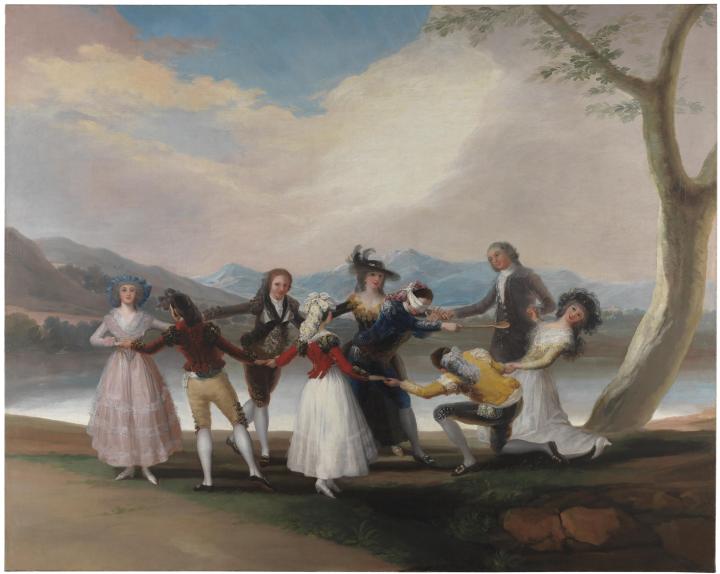
Francisco de Goya, Blind Man’s Bluff (La Gallina Ciega), 1788, canvas, 269 x 350 cm
(Madrid: Museo Nacional del Prado)
◊ ◊ ◊ ◊ ◊
Press release for the exhibition now on view in Vienna:
Celebration! 125 Years, Anniversary Exhibition / Feste Feiern: 125 Jahre – Jubiläumsausstellung
Kunsthistorisches Museum, Wien, 8 March — 11 September 2016
Curated by Gudrun Swoboda
In 2016 the Kunsthistorisches Museum is celebrating a jubilee: 125 years ago, on October 17, 1891, Emperor Franz Joseph formally opened the new main museum on Vienna’s Ringstrasse. To celebrate this anniversary in style we are showing an important exhibition on ‘the art of celebration’ showcasing precious artworks from all the collections of the Kunsthistorisches Museum. International loans like Francisco de Goya’s La gallina ciega from the Prado in Madrid or the magnificent Yashmak designed by Shaun Leane for one of Alexander McQueen’s fashion shows from the V&A in London will enrich this magnificent show, which presents 125 groups of objects in three galleries.
The show focuses on celebrations and their history, and looks at different aspects of European festivities from the Renaissance to the French Revolution—at court (especially that of the Habsburgs) in towns and cities, and in the country. Court banquets and their opulent dishes, dancing and music form the centre of the show (Gallery VIII). The adjacent galleries look at sumptuous outdoor parties organized to celebrate coronations, weddings or birthdays but also during Carnival, popular festivals or on market days (Gallery IX), and at courtly tournaments (Gallery I).
Festivities always represent a state of exception during which every-day laws are temporarily suspended—through role-playing games and disguises that flout historical, cultural and gender differences. But what can we display of these ephemeral, long gone festivities? By turning the question on its head we arrive at a preliminary answer: we can display what remains of the day: show-pieces, props and pictorial records of these events.
For millennia something was presented or displayed during many of these celebrations, be they ecclesiastical or secular. Court festivities offered the host the opportunity to display precious show-pieces removed for this purpose from his treasury or Kunstkammer. The large two-handled rock crystal vase is such a show-piece; in 1764 it was removed from the Imperial Treasury in Vienna and transported to Frankfurt for the coronation of Joseph II. After the event these prestigious artefacts were returned to their respective depositories, only to reappear again at the next important festivity. Not a show-piece sensu stricto but nonetheless an important prop is the seventeen-metres-long tablecloth presented here to the public for the first time; Emperor Charles V commissioned it in 1527 for the banquets of the Order of the Golden Fleece. Another extraordinary prop for princely drinking parties is the 16th-century ‘trick chair’ that shackled guests until they had downed the content of a ‘welcome-glass’.
Fantastic parade armour worn at Renaissance tournaments documents exceptional creativity and imagination, and these artefacts are among the most fascinating props used as elegant disguises by the elite. Courtly festivities demanded both opulence and splendour but also extravagance—including technical extravagance. A particularly sophisticated construction that documents the innovative potential and the creative energies employed to plan and produce surprising show-effects is the mechanical breast-piece comprising springs and levers that Emperor Maximilian I commissioned for courtly tournaments. A direct hit on the shield of one’s opponent activated the mechanism, catapulting the pieces of the disintegrating shield high into the air. Hosts worked hard to surprise and enchant their guests, and the creative achievements of the court artists especially employed to plan and organize these festivities reflected back on their patrons.
Fragile sculptures made of molten sugar functioned as ephemeral table décor at banquets, and they, too, illustrate the sophistication of such costly festive creations. Contemporary Tuscan artisans have produced a number of sugar statuettes especially for this exhibition, an attempt to recreate the splendour of these centrepieces known as trionfi di tavola. But festive infrastructure also required invisible props like the 17th-century rocket-pole that bears witness to the magnificence of ephemeral baroque fireworks displays. In addition to opulent treasures and curious extravagances the exhibition includes depictions of real and imaginary festivities: from coronations to Bruegel’s boisterous peasant celebrations to the fanciful fêtes galantes of Watteau and his followers—dreamy scenes set in Arcadian parklands in which fashionable ladies and gentlemen give themselves up to dance, games and gallant conversation.
Public festivals offered a counter-draft to the strictly regulated hierarchical court festivities—especially during Carnival, a looking-glass world when the existing social order was temporarily turned upside down through exuberant partying, the donning of disguises and role reversal—one way of defusing the tensions that accumulate in every hierarchic society. A number of musical examples document that various elements of public festivals have enriched and inspired court celebrations. A perfect example of this rich interdependency is the painting of Blind Man’s Bluff by the Spanish court painter Francisco de Goya, who recorded public festivals and their entertainments in many of his compositions. Occasionally elements of a public festival are even turned into a court ceremony, and are thus constrained and controlled. One example is the Cuccagna Napoletana, which evolved out of carnival processions in Naples. The rising number of increasingly serious accidents during celebrations originally organized by the craftsmen’s guild led the ruler to assume control. Royal troops guarded a land-of- Cockayne-like structure set up in front of the royal palace until the king standing on a balcony gave the sign that gave it up for plunder, and it was stormed by the populace.
The artefacts assembled for this exhibition bear witness to the exceptional splendour and opulence of some of these festivities but they also hint at their rigid as well as fragile order. They also show that the history of celebrations includes some that never actually happened. The exhibition offers insights into the history of celebrations—mainly, but not exclusively, during the early Modern Era. Our aim is to show that throughout history festivities were always also displays, and although the installation is ‘festive’ it aims also to remind visitors of what separates us from earlier festivities: it is, of course, obvious that modern museum visitors differ greatly from the protagonists and spectators of historical feasts—but how does a modern audience see itself? The exhibition poses this question in the form of a magnificent baroque mirror: it is, in a way, a precursor of our modern selfies, and functioned in much the same way. But perhaps it can also turn into an instrument of (humorous) self reflection, for which there is more than enough cause 125 years after the formal opening of the magnificent museum building on the Ringstrasse.
The exhibition was curated by Gudrun Swoboda, curator for Baroque Painting in the Picture Gallery of the Kunsthistorisches Museum. Most of the artefacts on show come from the rich holdings of the Kunsthistorisches Museum, and some of them have never, or only very rarely, been on display. In addition, the show includes loans from a number of national and international museums such as the Victoria & Albert Museum in London, the Museo del Prado in Madrid, the Museum Boijmans Van Beuningen in Rotterdam, the Germanisches Nationalmuseum in Nuremberg, the Historisches Museum Frankfurt, the MAK—Austrian Museum for Applied Arts / Contemporary Art, the Albertina, the Österreichische Nationalbibliothek, the Hofmobiliendepot and the Musikverein in Vienna, and the Tiroler Landesmuseum. The exhibition is organized in collaboration with the Academy of Fine Arts in Vienna, who have also lent a number of important works.
◊ ◊ ◊ ◊ ◊
The full-length German catalogue is available from the Kunsthistorisches Museum, along with an abridged English version. A 27-page booklet with a checklist of the 126 items included in the exhibition and a brief description for each object is available to download as a PDF file here.
Sabine Haag and Gudrun Swoboda, eds., Feste Feiern (Vienna: Kunsthistorisches Museum, 2016), 320 pages, 35€.
Exhibition | Goya: Mad Reason
From The Blanton Museum:
Goya: Mad Reason
Blanton Museum of Art, University of Texas, Austin, 19 June — 18 September 2016
Almost 200 years after the artist’s death, the work of Spanish court painter Francisco Goya (1746–1828) remains powerful, arresting, and pertinent. Addressing abuses of power and the ravages of war, Goya’s work shows his hope for Enlightenment principles (progress, liberty, tolerance) as well as his dismay at the movement’s failures, especially its inability to prevent war and oppression. Goya: Mad Reason explores these dynamics across much of the artist’s printmaking career, highlighting his mastery of both idea and artistic expression. The exhibition features superb editions from Goya’s print series, including Los desastres de la Guerra (The Disasters of War), La tauromaquia, (The Art of Bullfighting), and Los disparates (The Follies or Absurdities) from the collection of Yale University Art Gallery.
Press release (added 19 June 2016) . . .
The Blanton Museum of Art at The University of Texas at Austin presents Goya: Mad Reason, an exhibition of nearly 150 prints and paintings by renowned Spanish court painter Francisco de Goya. The series of prints comprising the exhibition—borrowed from Yale University Art Gallery’s distinguished Arthur Ross Collection—illustrate the artist’s mastery of forms and concepts as he grappled with the changing political and intellectual landscape of his native Spain in the early nineteenth century. Yale chose the Blanton as a partner for its Ross Collection sharing initiative, and the Blanton in turn selected Yale’s superb and affecting Goya prints as a foundation for this exhibition. Select paintings on loan from the Kimbell Art Museum, the Meadows Museum, and the Museum of Fine Arts Houston further punctuate Goya: Mad Reason thematically and visually, offering new and insightful ways of understanding the artist’s prints.
“We are honored to partner with Yale University Art Gallery to bring selections from the renowned Arthur Ross Collection to Austin,” remarked Blanton Director Simone Wicha. “This project has also afforded us the opportunity to borrow paintings from other key institutions across Texas, offering further insight into the remarkable works of Francisco de Goya, an artist whose oeuvre touches on the very fabric of human nature, and whose profound creativity remains an inspiration centuries after his death.”
Among Spain’s most celebrated artists, Francisco de Goya (1746–1828) is sometimes considered to be among the first truly modern artists. Edouard Manet, Pablo Picasso, Salvador Dalí and many other artists from the nineteenth and twentieth centuries looked to Goya’s art for inspiration, and he continues to serve as a touchstone for contemporary artists like Yinka Shonibare and Enrique Chagoya. Goya is known for his penetrating characterization of the human condition, his insightful criticisms of ignorance and oppression, and his unflinching look at the inhumanity of war.
Goya: Mad Reason highlights the artist’s treatment of war, bullfighting as a national pastime, and the instability of reason itself. His work makes visible the great transformations and unrest of Europe during his lifetime. Goya’s images manifest his hope for social progress as well as his disappointments. Against the traditions and vested interests of the populace, Church, and nobility, and influenced by French and English ideas, Spain’s liberal elites sought and achieved limited economic and educational reforms throughout the 1700s. Fears of the French Revolution spreading instability, and Napoleon Bonaparte’s subsequent 1808 invasion of Spain, halted much of that progress. After the war, the reign of Ferdinand VII led to regression and repression. In 1824, Goya left Spain for a self-imposed exile in Bordeaux, France.
Goya’s art belongs to this history, yet it remains relevant for today’s viewers due, in part, to the themes explored in his works as well as his unique visual expression. The works exhibited in Goya: Mad Reason also reveal a shifting tension between objectivity, or reason, and irrational emotion. The partitioning of knowledge that flourished in Goya’s lifetime, as modern scientific thought emerged, underlies this development and persists as a basis of our own worldviews today. Goya: Mad Reason explores these issues across the artist’s prints and paintings, examining their historical and social power as well as the artist’s mastery across the media of painting and printmaking.
Highlights of the exhibition include:
· Portrait of the Matador Pedro Romero (ca. 1795–98): Goya painted Pedro Romero, one of the greatest toreadors of all time, shortly before he retired from the bullring. Goya’s study of the works of Diego Velázquez is evident in the skilled brushwork of Romero’s costume and muted tones of the painting’s background.
· La tauromaquia [The Art of Bullfighting] (1815–16): A series of etchings chronicling Goya’s idea of the evolution of bullfighting in Spain, including the practice’s history as well as the rituals and styles of famous bullfighters of the eighteenth and nineteenth centuries.
· Los desastres de la guerra [The Disasters of War] (1810–ca. 1815): One of Goya’s most well-known series, Los desastres de la guerra (first published posthumously in 1863) is often viewed as a visual protest against the violence of the 1808 Dos de Mayo Uprising, the subsequent Peninsular War of 1808–14, and the Bourbon Restoration of 1814.
· Los disparates [Follies] (1815–24): Los disparates, also known as Los proverbios [The Proverbs], was Goya’s last major intaglio print series, and was not published until after the artist’s death. The works depict dark and dream-like scenes, and they have been variously related to political issues, the Spanish carnival, and traditional proverbs—though they are far more complex puzzles than any one solution may answer.










 Enfilade
leave a comment