Call for Articles | Spring 2017 Issue of J18: Lifelike
◊ ◊ ◊ ◊ ◊
From J18:
Journal18, Issue #3 (Spring 2017) — Lifelike
Proposals due by 15 May 2016; finished articles will be due by 1 November 2016
During the eighteenth century, a range of artistic productions aimed to simulate motion and life, at the same time that individuals became ever more preoccupied with performing or embodying static works of art. This issue of Journal18 aims to explore such hybrid creations and the boundaries they challenged between animate and inanimate form, art and technology, nature and artifice, the living and the dead. Echoing contemporary discussions about vraisemblance and verisimilitude, as well as mimesis and imitation, in eighteenth-century artistic literature, these preoccupations also related to larger philosophical and scientific debates about matter, mankind and machines at a global level. What was considered ‘lifelike’ in the eighteenth century? How did artistic practices engage this notion and participate in redefining it?
Articles may focus on specific objects, such as automata created by Pierre Jacquet-Droz and others that imitated human acts of writing or harpsichord playing; hyperrealistic wax figures, sometimes displayed in groups, that were used for entertainment as well as pedagogical and medical purposes; ‘tableaux mécaniques’, or mixed-media paintings with motors on the back that enabled figures to move across their surfaces; and natural history materials, such as taxidermic animals, specimens or skeletons that were displayed in particular spaces. Other possible topics include the staging of collaborative tableaux vivants in eighteenth-century theaters, gardens, and salons; and related attempts to resurrect or animate ancient artifacts, as in Emma Hamilton’s ‘living statue’ performances. Articles that consider the eighteenth-century specificity of such artistic productions, introduce new methodological perspectives, or discuss relevant examples from outside of Europe are especially encouraged.
Proposals for #3 LIFELIKE are now being accepted. Deadline for proposals: 15 May 2016. To submit a proposal, send an abstract (200 words) and a brief CV to editor@journal18.org. Articles should not exceed 6000 words and will be due on 1 November 2016.
Issue Editors
Noémie Etienne, Getty Research Institute, Los Angeles
Meredith Martin, NYU and Institute of Fine Arts
Conference| Animating the Georgian London Town House
From The National Gallery:
Animating the Georgian London Town House
The National Gallery, London, 17 March 2016
Rediscovering and animating London town houses of the 18th and early 19th centuries
 Organised by the Paul Mellon Centre, London, the National Gallery, and Birkbeck College, University of London, this conference explores the position town houses once occupied in the lives of families and the nation as a whole. Some—such as Spencer House—have survived; many have left fragmentary traces; others have been completely destroyed and can only be recreated on the basis of inventories and descriptive accounts. There is much still to be uncovered about the collections of paintings, sculpture, and decorative arts which these buildings once housed, as well as about their furnishing, architecture, gardens, and refashionings over time.
This event follows on from the successful Animating the 18th-Century Country House conference held at the National Gallery in March 2015. Expert speakers will discuss both famed and little-remembered London town houses, considering how these residences were designed, furnished, and ornamented. Papers also explore the significance and function of these properties for owners and their families, together with the varied experiences of guests and visitors. To book tickets, please visit The National Gallery.
◊ ◊ ◊ ◊ ◊
P R O G R A M M E
10.00 Registration
10.20 Welcome by Susanna Avery-Quash and Kate Retford
10.30 Keynote Lecture
• Desmond Shawe Taylor, ‘Picture displays at Carlton House’
11.30 Coffee break
12.00 Construction and Reconstruction
• Matthew Jenkins and Charlotte Newman, ‘London in pieces: Building biographies in Georgian Mayfair’
• Neil Bingham, ‘The Regency transformation of Burlington House, Piccadilly, documented through the architectural drawings of Samuel Ware’
• Pat Hardy, ‘Canaletto’s town houses’
1.30 Lunch break
2.30 Fashioning and Inhabiting
• Jeremy Howard, ‘New light on Norfolk House: The decoration and furnishing of Norfolk House for the 9th Duke and Duchess of Norfolk’
• Anne Nellis Richter, ‘Glitter and fashion in the “Louvre of London”: Animating Cleveland House’
• Peter Nelson Lindfield, ‘London’s gothic pineapple: 18 Arlington Street’
4.00 Refreshment break
4.30 Keynote Lecture
• Adriano Aymonino and Manolo Guerci, ‘London’s greatest mansion in the Strand: Northumberland House, the urban palace of the 1st Duke and Duchess of Northumberland’
5.30 Closing remarks
◊ ◊ ◊ ◊ ◊
Note (added 2 March 2016) — The original version of this posting inadvertently omitted Anne Nellis Richter’s presentation.
At Sotheby’s | Pelham: The Public and the Private Collections
Press release (22 February 2016) from Sotheby’s:
Pelham: The Public and the Private Collections of Alan Rubin (L16322)
Sotheby’s London, 8 March 2016
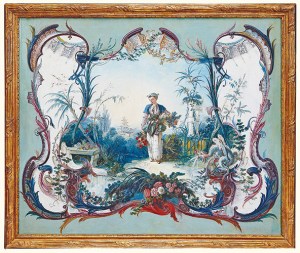
Lot 114: François Boucher, La Marchande de Fleurs in a Rocaille Surround, ca. 1742.
On 8th March 2016, Sotheby’s London will host an exceptional sale of furniture and works of art from the ‘public’ and ‘private’ collections of Alan Rubin of Pelham Galleries. The name Pelham is inextricably linked with the history of the 20th-century antiques trade. For almost 90 years, Pelham Galleries has been a mecca for international collectors, dealers and museums curators. The galleries in London and Paris have been instrumental in helping form some of today’s greatest collections, and treasures discovered by Alan Rubin, his father and uncle can be found in many of the world’s greatest museums including the Victoria and Albert Museum, The Metropolitan Museum, and the Louvre. The printed catalogue, which can be viewed online here, includes a substantial introduction by Alan Rubin with a fascinating history of the company and a masterly survey of the history of the London art trade, which will be a work of reference for future generations of dealers.
The sale will feature fascinating acquisitions made by two generations of antiques dealers with unrivalled expertise, alongside great rarities that have adorned Alan Rubin’s wonderful Queen Anne house in London for the past 30 years. Together, the 180 lots include outstanding examples of English and European furniture, an exceptionally rich group of Italian decorative arts, chinoiserie masterpieces and a number of items reflecting Alan Rubin’s passion for early music.
Commenting on the forthcoming auction, Alan Rubin said: “This sale marks a new chapter for Pelham Galleries which will now be run from our Paris gallery. The sale includes a number of pieces never previously offered to the public, some acquired by my family over sixty years ago. I hope they will give as much pleasure to their new owners as they have given to me.”
Henry House, Head of Sotheby’s Furniture and Decorative Arts Department added: “This sale celebrates the great eye, sublime taste and academic rigour that have contributed to Alan Rubin’s worldwide reputation. In addition to their extraordinary quality and rarity, many items in the sale come with fascinating provenances and carry the imprimatur of one of Britain’s most renowned antique dealing families.”
English Furniture
Pelham Galleries has been synonymous with the finest English Furniture since it was founded in 1928. The sale features outstanding pieces which were acquired either by Alan Rubin in his early years as a dealer or by his father, Ernest Rubin in the 1950s. Stunning examples of neo-classical furniture include a George III satinwood, harewood and tulipwood breakfront bookcase, circa 1780 by Mayhew and Ince, acquired from Lord and Lady Mountbatten in the 1950s (est. £40,000–60,000) and an important pair of George III painted and parcel-gilt satinwood pier tables, circa 1795 which adorned the Blue Room of the White House between 1972 and 2002. Formerly in the collection of the Dukes of Sutherland, these tables are among the finest examples of their period (est. £100,000–150,000).
Italian Decorative Arts
Alan Rubin’s profound interest in Italian decorative arts is reflected in an impressive ensemble of 18th-century furniture and works of art. Highlights comprise one of the finest pairs of Genoese giltwood torchères by Fillipo Parodi (1630–1702) ever to come on the market. These exceptional pieces are extremely rare in private hands. The majority of surviving examples are now in public collections or remain in situ in Genoese palaces (est. £50,000–100,000). Exceptional examples of English Palladian furniture include a George II mahogany breakfront secrétaire-cabinet, circa 1750, by William Hallett which was acquired privately from Wentworth Woodhouse over sixty years ago (est. £70,000–100,000) and a beautiful hall settee by William and John Linnell (est. £70,000–100,000). An astonishing painted trompe l’oeil and grisaille Cassapanca from first quarter 18th century (est. £25,000–50,000) and its matching torchères (est. £20,000–40,000) are a rare testament to the tradition of illusionist painting in Italian interiors. Such furniture often adorned the entrance halls of palazzi but most original pieces have now been lost or dispersed, which makes the survival of such a set remarkable. Equally fascinating, examples of Italian hardstone and mosaic works of art include an exquisite pair of micromosaics by the outstanding Roman mosaicist Giacomo Raffaelli (1753–1836) from the Hamilton Palace collection (est. £50,000–100,000) and a magnificent pietre dure plaque produced by the Grand Ducal Workshops in Florence in the 17th century (est. £20,000–30,000).
French Furniture and Works of Arts
Testament to Alan Rubin’s taste for Chinoiserie, the sale includes masterpieces by the great proponents of the style, including an unpublished work by François Boucher (1703–1770), La Marchande d’Oiseaux which was previously in the collection of Baron Edmond de Rothschild, circa 1915 (est. £100,000–150,000). The sale also features rare and evocative objects from 18th-century France, including the only recorded surviving life-size 18th-century French mannequin de mode, circa 1765 which recently featured in exhibitions at the Fitzwilliam Museum, Cambridge and the Musée Bourdelle, Paris (est. £30,000–50,000), a 1783 miniature recording the first flight in a hot-air balloon (est. £12,000–18,000) and an impressive Consulat armchair, circa 1796–1803 similar to the one in the Chateau de Malmaison, where Napoléon lived with his first wife, Joséphine de Beauharnais (est. £30,000–50,000).
Works of Art on the Theme of Music
A keen music lover and collector of early musical instruments, Alan Rubin also made fascinating acquisitions on the theme of music, such as a rare Indian duet stand, circa 1810 which once belonged to world famous violinist, Yehudi Menuhin (est. £5,000–7,000), a late-16th-century Italian harpsichord, (est. £30,000–50,000), and a pair of 17th-century musical still-lives attributed to Bettera of Bergamo (est. £20,000–30,000).
Summer Workshop | Visualizing Venice: The Ghetto of Venice

◊ ◊ ◊ ◊ ◊
From H-ArtHist, with more information available from Venice International University:
Visualizing Venice Workshop: Mapping and Modeling the Ghetto of Venice
Venice International University, 8–20 June 2016
Applications due by 31 March 2016
With the support of The Getty Foundation as part of its Digital Art History initiative, The Wired! Lab at Duke University, Università Iuav di Venezia, the University of Padua, and Venice International University are collaborating on a summer workshop that will train art, architectural, and urban historians with the digital media that can enhance or transform their research questions and their capacity to communicate narratives about objects, places, and spaces to the public.
This fifth annual 12-day workshop teaches a range of digital skills in mapping, 3D modeling, mobile application and web development, and time based media authorship to enable participants to engage historical questions with emerging digital tools. The course will engage with the Ghetto of Venice on the 500th anniversary of its creation as case study for training with a variety of technologies and applications. Instruction will be given in English by faculty and staff from Duke University’s Wired! Lab and Università Iuav di Venezia.
The workshop is designed for PhD or post doctoral participants in the interpretive humanities (including cultural patrimony, history of art, architecture and urbanism, history, geography, architecture, archaeology, and other relevant disciplines). Preference will be given to PhD students and recent PhD graduates in the history of art, architecture, and urbanism. The workshop is taught at Venice International University on the island of San Servolo in the Venetian Lagoon. Participants can live in the housing facilities of the island of San Servolo or arrange for accommodation in the city of Venice. Tuition fees are 1,000€ (+22%VAT). Scholarships are available in order to support tuition, travel, board, and accommodation expenses thanks to the generosity of The Getty Foundation.
Exhibition | Jefferson and Palladio: Constructing a New World
◊ ◊ ◊ ◊ ◊
From the Palladio Museum:
Jefferson and Palladio: Constructing a New World / Come costruire un mondo nuovo
Palladio Museum, Vicenza, 23 September 2015 — 28 March 2016
Curated by Guido Beltramini and Fulvio Lenzo
Visitors are introduced to the exhibition by a mirror reflecting the busts of Palladio and Thomas Jefferson. This raises the initial question in the show: how are forms and ideas ‘reflected’? Why, in this case, was an architect from a province in Northern Italy adopted as a model for the construction of the architecture of the New World?

Thomas Jefferson, Plan of the Rotunda of the University of Virginia (Charlottesville: Special Collections, University of Virginia Library)
The answer is linked to another fundamental question: what is Thomas Jefferson (1743–1826), the man who drafted the Declaration of Independence and was the third president of the United States, doing in a museum of architecture? The reason is that he more than any other American shaped the face of the new nation through art, architecture and regional planning. Visionary but also pragmatic, he was both a man of action and an intellectual who knew Latin and Greek. And he was convinced that the New World could only be built through reason and beauty.
Jefferson and Palladio: Constructing a New World is the first-ever exhibition dedicated to the great American Palladian in Europe. It will enable visitors to explore Jefferson’s world, his art collections, architectural designs, dreams, and also his contradictions, through drawings, sculptures, precious books, architectural models, films and multimedia. The exhibition also features 36 photographs by Filippo Romano, the result of a photographic survey specifically conducted in Virginia in Spring 2014. There are also three precious original bozzetti (models) by Antonio Canova for a statue of George Washington, commissioned by Thomas Jefferson. Visitors can enhance their experience of the exhibition by downloading a free smartphone app with descriptions by the curators and so move through the rooms accompanied by their words.
The exhibition is dedicated to the memory of Mario Valmarana, the still greatly cherished professor at the University of Virginia who devoted his life to creating bridges between Palladio’s Veneto and Jefferson’s Virginia. Sponsored by Roberto Coin, the exhibition has been made possible thanks to the support of the Regione del Veneto, the Fondazione Cariverona and Dainese, and is the result of collaboration with the Fondazione Canova di Possagno and the Stiftung Bibliothek Werner Oechslin, Einsiedeln, Switzerland. The exhibition is also part of a joint project developed with the Canadian Centre for Architecture, Montreal, which in October 2014 staged the photographic exhibition Found in Translation: Palladio-Jefferson, A narrative by Filippo Romano.
The exhibition has been curated by Guido Beltramini and Fulvio Lenzo, with the support of an Advisory Committee, chaired by Howard Burns (Scuola Normale Superiore, Pisa), and composed of James Ackerman (Harvard University), Bruce Boucher (University of Virginia), Travis C. McDonald (Corporation for Jefferson’s Poplar Forest), Damiana Paternò (IUAV, Venice), Mario Piana (IUAV, Venice), and Craig Reynolds (University of Virginia). The catalogue (available in English or Italian) is published by Officina Libraria. The exhibition layout has been designed by Alessandro Scandurra.
◊ ◊ ◊ ◊ ◊
◊ ◊ ◊ ◊ ◊
The catalogue is available from Artbooks.com:
Guido Beltramini and Fulvio Lenzo, eds., Jefferson and Palladio: Constructing a New World (Milan: Officina Libraria, 2016), 176 pages, ISBN: 9788897737780, $30.
 The catalogue offers an opportunity to acquire a deeper understanding of Jefferson’s architecture and, at the same time, leads to a clearer understanding of Palladio himself. Jefferson looked to Palladio because he was the architect of one of Europe’s few republics in which administrative power was in the hands of landed gentlemen who avoided the ostentation of princely manners and spent long periods of time in the countryside.
Thomas Jefferson (1743–1826), a cosmopolitan figure with rural roots, was a master of the knowledge of his time. He drafted The Declaration of Independence (1776), and thus founded a new view of the proper relation between governed and government. Jefferson was the architect of the new America, not just in a political sense, but in a literal sense as well. Architecture had an important place in his personal and public agenda. A self-taught architect, Jefferson buildings are among America’s most famous: Monticello, the Virginia State Capitol, and the University of Virginia are the starting points of American classical architecture. Jefferson was guided by his admiration for Palladio’s Four Books on Architecture, which provided him with key architectural forms and ideas. Palladio showed him how the admired building types of the ancient Romans could be adapted to modern purposes and provide a rational, harmonious framework for living and for building a new society.
Guido Beltramini is Director of the Centro Internazionale di Studi di Architettura Andrea Palladio, Vicenza. Fulvio Lenzo is Associate Professor in the history of architecture at the Universita IUAV di Venezia, Venice.
◊ ◊ ◊ ◊ ◊
C O N T E N T S
Palladio in America, James Ackerman
Jefferson and Palladio, Guido Beltramini
Jefferson: Architecture and Democracy, Fulvio Lenzo
Photographing Jefferson, Filippo Romano
Palladianism in America Before Jefferson, Bruce Boucher
The National Survey Grid and the American Democracy, Catherine Maumi
Jefferson’s Creation of American Classical Architecture, Richard Guy Wilson
Jefferson and the First Public Statues in the United States, Giovanna Capitelli
Canova and the Monument to George Washington, Mario Guderzo
Palladio: Materials and Building Techniques Damiana, Lucia Paterno
Jefferson Builder, Travis McDonald
Enrtries for Monticello, Virginia State Capitol, President’s House, Poplar Forest, Bremo, Barboursville, University of Virginia
Bibliography
Exhibition Checklist
New Appointment for Isabella Vitti
In January 2016, Isabella Vitti began her new position as Editor of Art History & Visual Studies at Routledge Taylor & Francis Group. She comes to the position after four years at Cambridge University Press, where she worked mainly on archaeology and Renaissance studies books—highly-illustrated projects that provided a lot of experience with image permissions, color plate sections, and high-resolution image files. Before Cambridge, Vitti worked at the Museum of Modern Art in the membership department—in her words, “an art historian’s dream!” She studied art history as an undergraduate at Wesleyan University.
Vitti stresses that most of Ashgate’s series covering the eighteenth century will continue. These include:
• The Histories of Material Culture and Collecting, 1700–1950
• Science and the Arts since 1750
• Visual Culture in Early Modernity
Routledge’s proposal guidelines are available here: Vitti’s email address is isabella.vitti@taylorandfrancis.com. She welcomes proposals for research monographs or edited collections.
Display | Benjamin West at Spencer House

Benjamin West, Milkmaids in St. James’s Park, Westminster Abbey Beyond, ca. 1801, oil on panel, 100.6 × 143.5 cm
(New Haven: Yale Center for British Art, Paul Mellon Fund)
◊ ◊ ◊ ◊ ◊
From Art Daily:
Benjamin West at Spencer House
Spencer House, London, 31 January 2016 — 29 January 2017
In celebration of the 25th anniversary of the restoration of the State Rooms at Spencer House, James ‘Athenian’ Stuart’s early neo-classical interiors will showcase work of Benjamin West, a central figure in the development of neo-classical painting.
Central to the exhibition is West’s Milkmaids in St. James’s Park, Westminster Abbey Beyond (ca. 1801, oil on panel, Paul Mellon Fund), which is on special loan to the Rothschild Foundation from the Yale Center for British Art. This rare and important panel painting deals with an uncommon subject in West’s artistic practice; it shows the east area of St James’s Park near Whitehall, overlooked by Spencer House, where milk-maids kept cows from the end of the seventeenth-century. During the eighteenth century it became fashionable to visit the area in the morning to drink milk or syllabub, a mixture of milk and wine. The painting highlights West’s ability to blend landscape and genre painting and his originality in turning a popular event of everyday urban life into a pastoral scene of peace and pleasure. At the same time, West captures the skyline of central London with topographical accuracy, with the outline of Westminster Abbey clearly visible in the background.
The display unites Yale’s recent acquisition with three large history paintings by West, commissioned by George III, on loan to Spencer House from Her Majesty the Queen. Displayed in the Dining Room is West’s famous Death of Wolfe (1771) and its Renaissance and classical parallels The Death of Chevalier Bayard (1772) and The Death of Epaminondas (1773). In addition visitors will be able to see two further West paintings from The Royal Collection, shown in Lady Spencer’s Room, The Family of the King of Armenia before Cyrus (1773) and The Wife of Arminius Brought Captive to Germanicus (1773). Milkmaids in St. James’s Park, Westminster Abbey Beyond creates an interesting and illuminating comparison with these works, showing West’s versatility as an artist in demonstrating both his ability to depict historic scenes of heroic bravery and contemporary scenes of daily life in central London.
In his recent book Benjamin West and the Struggle to be Modern, Loyd Grossman describes West as “one of the most neglected and misunderstood of Britain’s eighteenth-century artists.” West arrived in England from America in 1763 and quickly established himself as the most prominent history painter in England, earning the adulatory nickname the ‘American Raphael’ from the press. By 1768, at the age of 32, he became one of the founding members of the Royal Academy of Arts—to which he was elected President in 1792—and in 1772 he was appointed Historical Painter to the King.
To complement the exhibition, a series of three lectures about Benjamin West will take place at Spencer House, followed by drinks:
• Loyd Grossman, How to Paint History: Benjamin West and the Death of General Wolfe, 14 March at 6.30pm
• Desmond Shawe-Taylor (The Surveyor of The Queen’s Pictures), Benjamin West and George III, 18 July at 6.30pm
• Lars Kokkonen (Assistant Curator of Paintings and Sculpture, Yale Center for British Art), Evaporations: Milkmaids in St. James’s Park No More, 14 November at 6.30pm
Booking information is available here»
A brief video clip from the YCBA describes the recent restoration of the painting. The accompanying text points to a recipe for syllabub here.
New Book | Benjamin West and the Struggle to be Modern
From Merrell:
Loyd Grossman, Benjamin West and the Struggle to be Modern (London, Merrell, 2015), 256 pages, ISBN: 978-1858946412, £35 / $60.
 At the time of his death in 1820, Benjamin West was the most famous artist in the English-speaking world and celebrated throughout Europe. From humble beginnings in Pennsylvania, he had become the first American artist to study in Italy, and within a few short years of his arrival in London had been instrumental in the foundation of the Royal Academy of Arts and been appointed history painter to King George III. However, West’s posthumous reputation took a critical mauling, and today he remains one of the most neglected and misunderstood of Britain’s great 18th-century artists. As Loyd Grossman asserts in his new book, West was in the vanguard that created neoclassicism and romanticism, and among the first painters to represent the exciting and inspirational qualities of contemporary events, as opposed to events from the biblical, classical or mythological past. Most significantly, his best-known painting, The Death of General Wolfe, was a thrilling, revolutionary work that played a role in changing the course of art. In a lively, immersing text that situates West in the midst of Enlightenment thinking about history and progress, Grossman explores both why Wolfe has exercised such a magnetic grip on our imaginations for almost 250 years, and how, with this artwork, West helped to lay the foundations of a modern attitude that has affected the way we live and think ever since.
Loyd Grossman is a broadcaster, historian and journalist. He has presented a wide range of TV programmes, from Through the Keyhole and MasterChef to Loyd on Location and History of British Sculpture. Born in Massachusetts, Grossman has been based in the UK since 1975. He is involved with many charities supporting the arts, heritage and education in the UK. He is Chairman of the Heritage Alliance, Chairman of the Churches Conservation Trust and President of the National Association of Decorative and Fine Arts Societies (NADFAS). He was appointed OBE in 2003 and was awarded a Doctor of Letters degree in 2007 by the University of Chester in recognition of his heritage work. In January 2011 the University of Lincoln awarded him an honorary Doctor of Arts degree in recognition of his contribution to the cultural heritage sector. Grossman has a particular interest in eighteenth-century British art and architecture.
Exhibition | Faces of Terror: Violence and Fantasy
The exhibition closes in Paris this weekend:
Faces of Terror: Violence and Fantasy from David to Delacroix
Visages de l’effroi: Violence et Fantastique de David à Delacroix
Musée de la Vie Romantique, Paris, 3 November 2015 — 28 February 2016
Musée Municipal, La Roche-sur-Yon, 19 March — 19 June 2016
 With a collection of more than 100 paintings, drawings and sculptures by David, Girodet, Gericault, Ingres and Delacroix, Faces of Terror presents French forms of fantastical Romanticism. This darker part of 19th-century art reveals a certain strength of spirit and provides a fascinating perspective on imagination during the romantic period.
Romanticism, although often reduced to a feeling of discontentment among the people of the 18th century that was generated by the upheavals of the time, without a doubt expresses the feeling of disenchantment of a whole generation, built on the ruins of the Ancien Régime and the tumult of the French Revolution. In the overflow of extreme emotions these artists skilfully found subjects for a new kind of aesthetic, exploring the dark side of the human soul, at a time when dreams and the irrational were emerging from the latency of Reason and the spirit of the Enlightenment period.
From the end of the 18th century, the form of Neoclassicism adopted by the greatest artists depicted the death of heroes and portrayed the violence of tragedies from ancient history, simultaneously justified by both moral values and academic proprieties. Terror, political upheaval and Napoleonic war generated a much more blatant perspective of horror that was no longer the prerogative of historical paintings. During the period of the Restoration of the monarchy, the development of the mainstream press led to broadcasts of reports of bloody violence across the country, which became topical issues for artists.
The Romantic period focuses on the supernatural and sometimes morbid, and depicts—thanks to an abundant but often unknown production of works of art—a crude reality as well as the strange, dusky figures of spectres and devils from the literature and poetry of the time. This dialogue with the supernatural is notably depicted in representations of the myth of Ossian, or in the success of Dante’s work with the torment of the condemned.
Jérôme Farigoule and Hélène Jagot, eds., Visages de l’effroi: Violence et fantastique de David à Delacroix (Liénart, 2015), 288 pages, ISBN: 978-2359061475, 26€.
At Auction | Rare Books at Ketterer Kunst in Hamburg
From Art Daily:

From John Hill, Vegetable System
It is a masterpiece of utmost rarity: the complete series of John Hill’s The Vegetable System (1759–75). The remarkably well-preserved copy will be called up with an estimate of €60,000 in the auction of Rare Books at Ketterer Kunst on 23/24 May (#430). One of the 18th century’s most elaborate botanic publications is thus offered on the auction market. The comprehensive work with 1544 colored copper plates delivers an extensive account of 26,000 different plants. Even the great Carl von Linné, founding father of modern taxonomy, noted in awe: “I almost fainted in the face of the magnificence of Hill’s work…” (Henrey). John Hill dedicated his lifetime achievement, which lead him into bankruptcy despite financially strong sponsors, to the Prince of Wales and later King George III.
A likewise noble provenance is also true for a Book of Hours made in Paris in 1533, as it is inscribed with the autographed ownership entry of the Elector and archbishop of Mainz, Georg Friedrich von Greiffenclau zu Vollrad. He, as well as the other owners, must have cherished the entirely illuminated work very much, since it still is in excellent condition. The price estimate is €20,000.
The work Atlas de la navigation et de du commerce by Louis Renard, published in 1739, carries the same estimate. The splendid work is based on the sea maps by Frederik de Wit; however, each map was thoroughly revised. Additionally, it features an extra world map in two hemispheres. All maps are in excellent print with a fine coloring.
The series of 80 sheets Los Caprichos by Francisco de Goya will be called up with an estimate of €16,000 and promises some excitement in the salesroom. The famous cycle of etchings, in which Goya scorns the church’s errors with bitter mockery and decries the political and social miseries of his days, had already been sold successfully by Ketterer Kunst in 2013 – both in the very rare first edition that was released in Goya’s lifetime (calling price: €96,000, result: €195,000*) as well as in sixth edition (calling price: €9,600, result: €25,000*).
One of the most beautiful and most comprehensive herbal- and medical books from the 15th and early 16th century could perhaps be available for the estimate of €12,000. The Hortus sanitatis, endowed with numerous expressive illustrated woodcuts, covers the drugs extracted from plants, animals, stones and metals and explains their medicinal benefits under the caption ‘operationes’.
The range of offerings is rounded off by George Edward’s work in several volumes Histoire naturelle (estimate: €28,000), as well as the autographed manuscript “The Seals of Obezvelvolpal” by Alexei Michailowitsch Remisov (estimate: €8,500), the first edition of the magnificent publication Paléographie universelle by Joseph Balthazar Silvestre (estimate: €5,000), Georges Bataille’s Histoire de l’oeil (estimate: €3,000), and The American Woods by Romeyn Beck Hough (estimate: €5,000), with more than 940 samples of wood.
Alongside rare books, manuscripts, autographs and decorative prints, the auction also comprises works of maritime and Northern German art. While the latter features works by, among others, Fritz Overbeck (Bergkuppe im Engadin, estimate: €3,000) and Fritz Fleer (St. Christophoros (Entwurfsmodell für St. Christophoros Hamburg), estimate: €2,500), the section of maritime art offers works such as Johannes Holst’s Vollschiff ‘Grossherzogin Elisabeth’ auf bewegter See (estimate: €4,000) and Anton Melbye’s Segelschiff and Besegelter Dampfer auf See vor einer Küste (estimate: €2,500).










 Enfilade
leave a comment