Exhibition | Pugin, Prisons, and the Plight of the Poor
Now on view at The Huntington:
A. W. N. Pugin, Prisons, and the Plight of the Poor: British Prints,
Drawings, and Illustrated Books from The Huntington’s Collections
The Huntington Art Gallery, San Marino, CA, 11 March — 26 June 2017
Curated by Courtney Long
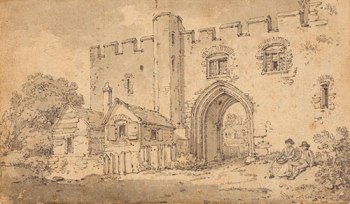
William Alexander, Prison at St. Albans, undated, late 18th–early 19th century, graphite and ink wash on board (San Marino: The Huntington).
This exhibition examines the history of British prisons and how artists and architects documented the social, political, and legal tensions surrounding prison reform and Poor Law debates in Parliament during the 19th century. Drawn from the rich holdings of British material in The Huntington’s library and art collections, the works in A.W. N. Pugin, Prisons, and the Plight of the Poor depict a range of prison styles and highlight the role that these spaces served in containing and punishing criminals, debtors, drunks, gamblers, and paupers. Through a variety of visual materials, the exhibition examines the belief that the style and treatment of architecture has a direct correlation to the manner and behavior of society, an idea which had been promoted by prominent 19th-century architect and designer Augustus Welby Northmore Pugin. Fifteen thought-provoking drawings, watercolors, prints, and rare books by artists such as Thomas Rowlandson, George Romney, Henry Rushbury, and Edward Dalziel present images of the fortress-like prisons, criminal acts, and zealous reformers that sparked imaginations from the mid-18th to the early 20th centuries.
Courtney Skipton Long is guest curator for A.W.N. Pugin, Prisons, and the Plight of the Poor. She received her Ph.D. in the history of art and architecture from the University of Pittsburgh in 2016 and is currently the Zvi Grunberg Postdoctoral Fellow at the Bruce Museum in Greenwich, Connecticut.
Also, see the posting at Verso, the blog for The Huntington Library, Art Collections, and Botanical Gardens.
Call for Papers | Enlightened Princesses: Britain and Europe, 1700–1820
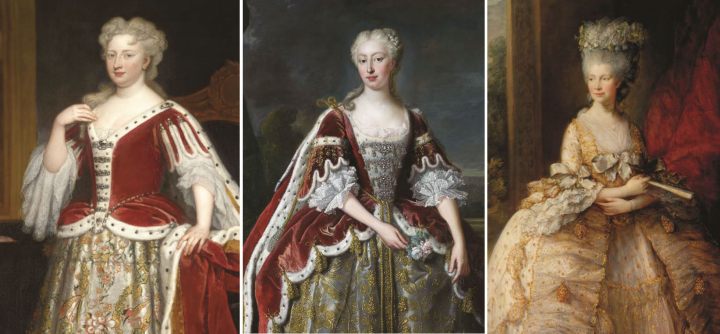
Left to right: Sir Godfrey Kneller, Queen Caroline of Ansbach, when Princess of Wales, 1716, oil on canvas, Royal Collection Trust; Jean-Baptiste van Loo, Augusta, Princess of Wales, 1742, oil on canvas, Royal Collection Trust; Thomas Gainsborough, Queen Charlotte, 1781, oil on canvas, Royal Collection Trust.
◊ ◊ ◊ ◊ ◊
From the Yale Center for British Art:
Enlightened Princesses: Britain and Europe, 1700–1820
Kensington Palace, Hampton Court Palace, and the Tower of London, 29–31 October 2017
Proposals due by 15 May 2017
Co-organized by Historic Royal Palaces, the Yale Center for British Art, and the Paul Mellon Centre for Studies in British Art, London, in association with the exhibition Enlightened Princesses: Caroline, Augusta, Charlotte, and the Shaping of the Modern World, on view at Kensington Palace, June 22–November 12, 2017
Caroline of Ansbach (1683–1737), Augusta of Saxe Gotha (1719–1772), and Charlotte of Mecklenburg-Strelitz (1744–1818), three Protestant German princesses, became variously Princess of Wales, Queen Consort, and Princess Dowager of Great Britain. Recent research has explored how in fulfilling these roles they made major contributions to the arts; the development of new models of philanthropy and social welfare; the promotion and support of advances in science and medicine, as well as trade and industry; and the furthering of imperial ambition. While local contexts may have conditioned the forms such initiatives took, their objectives were rooted in a European tradition of elite female empowerment.
This symposium, Enlightened Princesses: Britain and Europe, 1700–1820, seeks to investigate the role played by royal women—electresses, princesses, queens consort, reigning queens, and empresses—in the shaping of court culture and politics in Europe of the long eighteenth century. Papers that explore some of the following themes are invited:
• Royal women as political agents
• Royal women: networks and conversations
• Royal women: education, charity, and health
• Royal women as patrons of art and architecture
• Royal women and science
• Royal women: mercantile culture and the wider world
• Royal women as political gardeners
The conference will take place October 29–31, 2017, at Kensington Palace, Hampton Court Palace, and the Tower of London. Please send proposals of 400 words maximum, for papers of 25 minutes, together with a short biography of 100 words maximum to samantha.howard@hrp.org.uk.
Journal18, #3 Lifelike (Spring 2017)
The third issue of J18 is now available.
Journal18, Issue #3: Lifelike (Spring 2017)
Issue Editors: Noémie Etienne and Meredith Martin
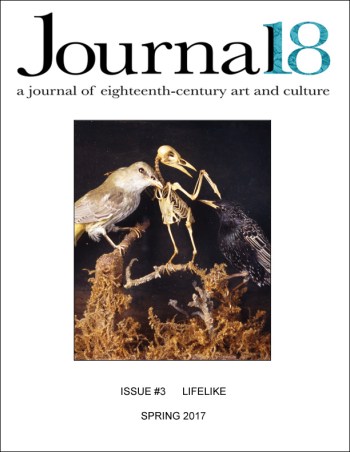 During the eighteenth century, a range of artistic productions sought to simulate motion and life in new ways. At the same time, individuals became ever more preoccupied with performing or embodying static works of art. Echoing contemporary discussions in artistic and literary discourses around vraisemblance and verisimilitude, as well as mimesis and imitation, these preoccupations also tapped in to larger social and intellectual debates about matter, mankind, and machines at a global level.
This issue of Journal18 explores these fundamental tensions between art and life, movement and permanence that obsessed the worlds of art, science, and entertainment during the eighteenth century. What was considered ‘lifelike’ in this period? How did artworks—among them taxidermy tableaux, moving statues, nautilus cups, and automaton clocks—engage with this notion and participate in redefining it? What was at stake in staging a convincing simulation of life, and what purpose—political, pedagogical, or otherwise—did it serve? What role did ephemeral performances or spectacles play in generating such illusions and in shaping their significance? And how might we interpret these acts historically today?
In addition to full-length articles, we have assembled a series of shorter essays on the theme of ‘Waxworks’. More than any other material in the eighteenth century, wax seems to have provoked debates about the permeable boundaries between illusion and imitation, art and science, absence and presence. At the same time, objects made of wax—from La Specola’s famous anatomical Venus to busts portraying victims of the French Revolution modeled from life by Marie Tussaud—have the potential to disrupt traditional categories and hierarchies of art history, which is perhaps one reason why wax has emerged in recent years as such an exciting and provocative field of study.
A R T I C L E S
• Valérie Kobi, Staging Life: Natural History Tableaux in Eighteenth-Century Europe
• Amelia Rauser, Vitalist Statues and the Belly Pad of 1793
• Eugenia Zuroski, Nautilus Cups and Unstill Life
• Lihong Liu, Pyrotechnic Profusion: Fireworks, Spectacles, and Automata in Time
W A X W O R K S
• David Mark Mitchell, Vividness without Vitality: The Specola Venus’s Intersecting Afterlives
• Robert Wellington, Antoine Benoist’s Wax Portraits of Louis XIV
• Charles Kang, Anatomy of the Bel Effet: Wax between Science and Art
• Paris Amanda Spies-Gans, ‘The Fullest Imitation of Life’: Reconsidering Marie Tussaud, Artist-Historian of the French Revolution
Cover image: Detail of stuffed Starling, Oriole and Bird’s Skeleton from Goethe’s Collection, before 1790 (Goethe-Nationalmuseum, Weimar ©Klassik Stiftung Weimar/Thomas Korn)
Call for Papers | Plaster as an Art Material
From H-ArtHist:
Uniqueness and Multiplication: Plaster as an Art Material
Royal Institute for Cultural Heritage, Brussels, 10–11 October 2017
Proposals due by 5 May 2017
The study of plaster objects is experiencing a true revival, amongst others attested by the scientific conferences of the past years. Plaster, a material of low value often used for reproductions, has been part of sculpture practice for centuries. The conferences and publications of the past years have discussed a wide range of subjects related to plasters, from the restoration and valorisation of plaster collections to the study and possible implementation of conservation and restoration campaigns.
The Royal Institute for Cultural Heritage (KIK-IRPA, Brussels), is the Belgian federal institution committed to the inventory, scientific study, conservation and promotion of the country’s cultural heritage. The Institute, whose chief mission is research and public service, represents a unique instrument for the Belgian heritage, both movable and immovable. Amongst others active in the historical study, conservation and restoration of these objects, KIK-IRPA has partnered up with Epitaaf. Since 1989, this non-profit volunteer organization manages the former sculptor’s and mason’s studio of the Ernest Salu dynasty, active in Laeken (near Brussels) between 1872 and 1983. As a funerary art museum they have a substantial collection of plaster moulds and models that were manufactured in the studio. The wide range of approaches presented on this international conference will allow us to study different aspects of plaster objects.
The conference will take place at the KIK-IRPA in Brussels 10–11 October 2017 and consists of three sessions:
Session 1 Plaster (and plaster moulds), their role and signification within the studio
This session will focus on the role of plaster (as a material for sculpture or architecture), plaster moulds (casts) and plaster models in art history. The following topics could be addressed: plaster for which use, the use and or role of plaster in the artist’s training, in an institutional context (academy, art education) or in that of the studio? The authenticity and position (status) of plaster in the artistic process (design, intermediary state, model, art work)? The added value of plasters, prints and photos in the artist’s studio? The representation or the role of plasters in the practice of the artist’s studio, and more particularly their position within an artist’s oeuvre and its diffusion? The significance or status of plasters as autonomous objects?
Session 2 Plaster collections, their origins, aim, and future
The aim of this session is to put together a survey of existing plaster collections as museum collections, not in the form of an exhaustive inventory, but in order to get a broad and general view of the wide range of differences (and significations) of the collections to get insight in the collection building and composition of the different plaster collections. The lines of approach are the collections’ history and objective. How should one go about their presentation (museology) and what is the status of plaster collections within a public (museum), semi-public (university, academy) or private context (artist’s collection).
Session 3 Conservation and restoration of plasters (and plaster moulds)
This session is the logical continuation of session 2. Due to a renewed interest in plaster objects, regardless of their context, repairing them has once again become a priority. Which conservation and restoration techniques are best suited for plaster and plaster objects? Should a different approach be adopted with regards to their presentation and status (within art history or as an educational tool)? Can the material or technique used tell us more about the period, place of origin or author of the plaster? These topics are preferably evoked through case studies and examples of best practices, by choice concerning so-called masterpieces. The official language of the conference is English (submissions in French or Dutch are also accepted).
Candidates are invited to submit their proposals to Géraldine Patigny (geraldine.patigny@kikirpa.be) by May 5th 2017. This should include an abstract (up to 300 words) and a brief CV (max. 1 page). The conference organizers are unable to cover travel and accommodation costs for speakers. Interested parties are encouraged to apply for aid from their respective institutions. The Scientific Committee will inform all the applicants of the final selection on June 16th 2017.
Scientific direction
Géraldine Patigny (KIK-IRPA)
Tom Verhofstadt (vzw Epitaaf)
Exhibition | Printed Fashions: Textiles for Clothing and the Home
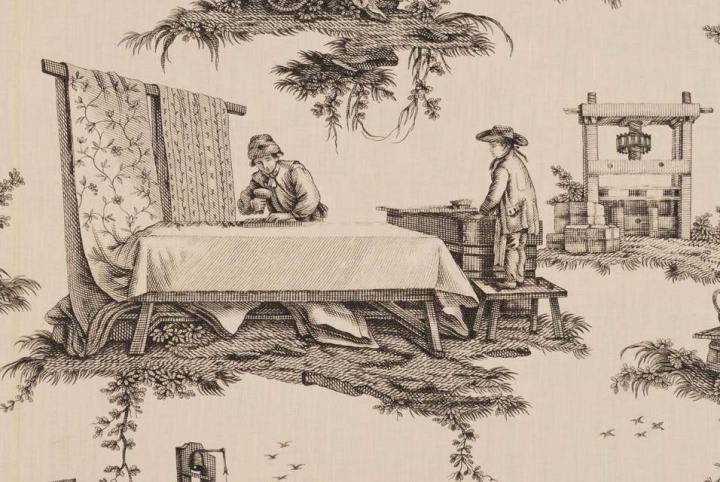
Scene of textile printing, adapted from a French copperplate-printed textile of the 1780s
(The Art Museums of Colonial Williamsburg)
◊ ◊ ◊ ◊ ◊
Press release (6 February 2017) from Colonial Williamsburg:
Printed Fashions: Textiles for Clothing and the Home, 1700–1820
DeWitt Wallace Decorative Arts Museum, Colonial Williamsburg, 25 March 2017 — March 2019
Curated by Linda Baumgarten
In the eighteenth and early nineteenth centuries, early printed textiles with their luminous colors and attractive designs were widely sought for fashionable clothing and home furnishings. Eighty examples of these stunning printed cottons and linens, many of which have never been exhibited before, will go on view in Printed Fashions: Textiles for Clothing and Home at the DeWitt Wallace Decorative Arts Museum, one of the Art Museums of Colonial Williamsburg, opening March 25, 2017. The exhibition will illustrate the design, history, and techniques of printed textiles during this formative era; these objects played their own important role in history, not just for their obvious aesthetic qualities, but also for their economic importance as trade goods and as examples of technological advances. Printed Fashions will remain on view through March 2019.
“Textiles are among the most fragile objects that survive from the past. They also afford us particularly detailed views into the lives of our forbearers,” said Ronald L. Hurst, Colonial Williamsburg’s Carlisle H. Humelsine chief curator and vice president for collections, conservation, and museums. “Thanks to decades of effort and scholarship on the part of our textile curator Linda Baumgarten and her predecessors, the Foundation is home to a remarkably large and complete collection of printed textiles. This exhibition provides an opportunity to employ many of those beautiful objects to tell these very human stories.”
“The history of printed textiles may sound modern to today’s consumers,” says Linda Baumgarten, Colonial Williamsburg’s senior curator of textiles and costumes who organized the exhibition. “Traders shipping goods from the other side of the world in ships, domestic workers trying their best to respond to foreign competition, people making the effort to dress in up-to-date styles despite their limited means and the importance of chemistry and mechanical expertise in the production of consumer goods: All of these concepts could easily represent textile production today as well as it did centuries ago.”
Although fashionable Indian chintzes had inspired European printers to begin developing competing technologies as early as the seventeenth century, it was during the eighteenth century that most of the technical advances were realized. Rather than using the Indian method of painstakingly hand-painting chemical fixatives known as mordants and then dyeing the textiles, Europeans developed laborsaving techniques to expedite the process. Blocks, copperplates, and rollers allowed printers to apply pattern at a faster rate, often with delicate and intricate linear effects rivaling prints on paper. Experiments with chemicals yielded pencil blue and china blue techniques to solve the difficult challenges of pattering textiles with indigo blue.
Printed Fashions will include a variety of objects dating between 1700 and 1820 from India, England, France, and colonial America. Among them will be men’s and women’s garments, women’s accessories, a doll dressed in original clothing from the 1770s, quilts and an Indian ‘palampore’ bedcover in brilliant colors, a trunk linked with rare, early printed cotton, case covers for chairs, curtains and valances for tall-post beds, plus study documents that show printing techniques, advances in printing chemistry, and trends in design. Among the exhibition’s highlights is a stunning bed quilt, never previously exhibited, incorporated into which is a printed panel from India as the center focus. This panel, or ‘palampore’, was too small for the finished quilt, so the unknown quilt maker enlarged the bedcover with fine silk borders and then quilted the whole with closely spaced running stitches. The flowering tree at the center of the palampore is patterned with a large tree bursting with floral blooms, growing from the hilly ground. Later known as a ‘tree of life’, this design influenced English and American appliquéd quilts for a century after the first palampores entered the West.
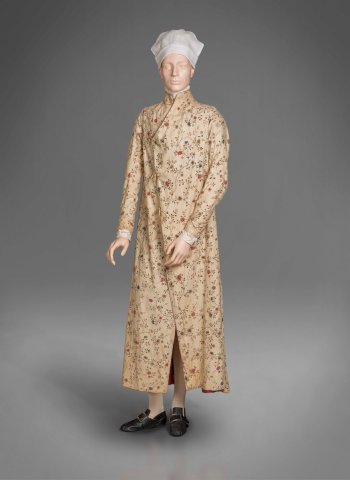 Another featured object in Printed Fashions is a gentleman’s banyan made of stylish and expensive cotton from India. The delicate floral design was mordant-painted-and-resist-dyed, creating a colorful yet comfortable garment suitable for relaxing at home. By donning his imported chintz banyan, the man at leisure signaled his wealth and fashion sense. A textile swatch or sample book from 1783 is yet another must-see object in the exhibition; it unrolls to reveal more than seven feet of swatches with 430 samples in all. The colorful printed cottons were available for sale in a single year by a Manchester, England printing establishment. In less than a century, British manufacturers went from rudimentary early attempts at copying Indian imports to becoming a major printing industry.
This exhibition was made possible through the generosity of Mary and Clinton Gilliland and the Turner-Gilliland Family Fund of the Silicon Valley Community Foundation; the DeWitt Wallace Fund for Colonial Williamsburg; and Mr. and Mrs. Jay E. Frick. Ellan and Charles Spring funded the purchase of mannequins.
To celebrate the opening of Printed Fashions, the Colonial Williamsburg Foundation will host a symposium of internationally known scholars, March 26–28, 2017. Guest speakers will include Rosemary Crill, honorary research associate, Victoria and Albert Museum; Linda Eaton, John L. & Marjorie P. McGraw director of collections & senior curator of textiles, Winterthur Museum; Susan Greene, author and independent researcher whose lecture is generously sponsored by Windham Fabrics, Inc.; Philip Sykas, research associate, Manchester School of Art, United Kingdom; and Barbara Brackman, independent scholar and researcher. In addition, twenty scholars from the United States and England will present juried papers on all aspects of textile printing and usage. The program will take place in the Hennage Auditorium at the Art Museums of Colonial Williamsburg. More information is available here.
An exhibition in formation for more than a decade, Printed Fashions: Textiles for Clothing and Home is certain to fascinate and delight decorative arts aficionados, fashion historians, and design enthusiasts who will appreciate the many patterns that could easily have modern interpretations.
Conference | Printed Fashions: Textiles for Clothing and the Home
From the conference schedule:
Printed Fashions: Textiles for Clothing and the Home
Colonial Williamsburg, 26–28 March 2017
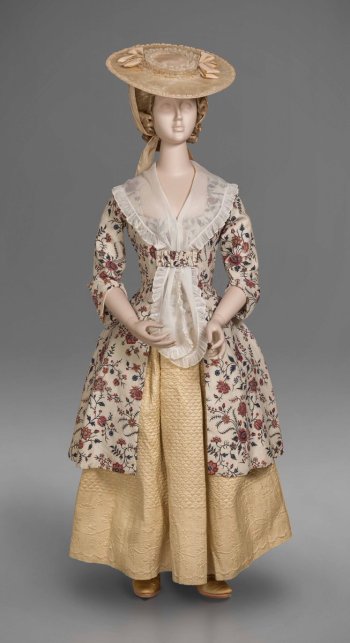 With their brilliant colors and engaging designs, early painted and printed textiles were eagerly sought for fashionable clothing, quilts, and other home furnishings. But textiles also tell human stories that sound modern: traders transporting goods from the other side of the world in ships powered by wind and sails; domestic workers trying their best to respond to foreign competition; people making the effort to dress in up-to-date styles despite their limited means; and the importance of chemistry and mechanical expertise in the production of consumer goods. The Colonial Williamsburg Foundation in Williamsburg, Virginia, hosts this symposium about painted and printed textiles with invited speakers and juried papers. The symposium coincides with the exhibition Printed Fashions: Textiles for Clothing and the Home, 1700–1820 mounted in the Gilliland Textile Gallery.
◊ ◊ ◊ ◊ ◊
S U N D A Y , 2 6 M A R C H 2 0 1 7
1:00 Conference registration
3:30 Welcome, Linda Baumgarten (senior curator of textiles and costumes, Colonial Williamsburg)
3:40 Juried Papers
• Philippe Halbert (Ph.D. candidate, Yale University, Department of the History of Art), ‘You know that my dear Mother loves Indienne’: Printed and Painted Textiles in the French Atlantic World, 1675–1800
• Ned Lazaro (associate curator of textiles and collections manager, Historic Deerfield, Massachusetts), On Risk and Account: The Fashion for Eighteenth-Century Indian Cottons in New England
• John Styles (research professor in History, University of Herfordshire and honorary senior research fellow, Victoria and Albert Museum), How Colonial America’s Taste for Printed Calicoes Drove the British Industrial Revolution
4:50 Break
5:00 Rosemary Crill (honorary research associate, Victoria and Albert Museum), When Print Meets Pen: Block-Printing and Hand-Drawing in Indian Cotton Textiles
6:00 Reception
M O N D A Y , 2 7 M A R C H 2 0 1 7
8:30 Art Museums of Colonial Williamsburg open for conference registrants
9:00 Announcements and introduction to the Printed Fashions exhibition
9:30 Linda Eaton (John L. and Marjorie P. McGraw Director of Collections and Senior Curator of Textiles, Winterthur Museum), Printed Furnitures: The Women’s Side of the Upholstery Trade
10:30 Break
11:00 Susan Greene (author and independent researcher, Alfred Station, New York), From Kalam to Cylinder
12:00 Lunch break with museum exhibitions open
2:00 Juried Papers
• Rebecca Fifield (Head of Collection Management, Special Collections, New York Public Library), Of the Lowest Prices: Printed Textile Use in the Dress of Unfree American Women, 1750–90
• Jennifer Swope (assistant curator, David and Robert Logie, Department of Textiles and Fashion Arts, Museum of Fine Arts, Boston), The Diversity of Printed Textile in Early America: The Robbins Family Collection at the Museum of Fine Arts, Boston
• Mary D. Doering (independent scholar, collector and guest curator), Case Study of a Printed Cotton Gown, Possibly Worn in Massachusetts, ca. 1780–85
• Alexandra Barlow (assistant conservator, Textile Conservation, The Metropolitan Museum of Art, New York) and Sara Reiter (The Penny and Bob Fox Senior Conservator of Costumes and Textiles, Philadelphia Museums of Art), Printed Gown Patterns: The Conservation of an Early Nineteenth-Century Block-Printed Dress: Techniques and Historical Importance
3:30 Break
4:00 Juried Papers
• Edward Heimiller (curator, The Stephen J. Ponzillo, Jr. Memorial Library & Museum of the Grand Lodge of A.F. & A.M. of Maryland), Revealing Fraternal Secrets: Establishing a Masonic Treatise for Fraternal Design
• Matthew Skic (assistant curator, Museum of the American Revolution, Clifton Heights, Pennsylvania), Stand Fast in the Liberty: A Rare Waistcoat Belt
• Angela Burnley (independent scholar, Williamsburg), 1 Gown Flowered All Over with Cards: Fashion’s Fancy through the Eyes of the Eighteenth-Century Textile Consumer
• Christina Westenberger (assistant manager for museum education, Colonial Williamsburg), Hunting, Murder and Bacon: Backstories of Three Printed Handkerchiefs in the Colonial Williamsburg Collection
T U E S D A Y , 2 8 M A R C H 2 0 1 7
8:30 Art Museums of Colonial Williamsburg open for conference registrants
9:00 Kimberly Ivey (senior curator of textiles and historic interiors, Colonial Williamsburg), Annie L. Hayslip’s Printed Textile Album
9:20 Philip Sykas (research associate, Manchester School of Art, Manchester), Pattern Books within ‘a Seasonal and Fancy Trade’: English Calico Printers, 1780–1830
10:10 Break
10:40 Barbara Brackman (independent scholar and researcher, Lawrence, Kansas), Printed Textiles in Quilts, 1775–1830
11:35 Bridget Long (visiting research fellow in history, University of Hertfordshire), ‘Have You Remembered To Collect Pieces for the Patchwork?’ The Impact of Printed Cloth on Eighteenth-Century Patchwork Practice (juried paper)
12:00 Lunch break with museum exhibitions open
2:00 Juried Papers
• Julia Brennan, Kaitlyn Munro, and Lauren Klamm (conservators, Caring for Textiles, Washington, D.C.), Burn Out: Case Studies in Conserving Printed Textiles
• Anita Loscalzo (independent textile historian, Dover, Massachusetts), Prussian Blue Textiles Found in American Quilts and Dress
• Linda Welters (professor, Textiles, Fashion Merchandising and Design, University of Rhode Island), In Small Things Forgotten: Three Eighteenth-Century Rhode Island Prints
3:10 Break
3:30 Juried Papers
• Margaret T. Ordoñez (Professor Emertia and Adjunct, Textiles, Fashion Merchandising and Design, University of Rhode Island), Printed Delaines with a French Label from East Greenwich, Rhode Island, ca. 1843
• Deborah E. Kraak (independent museum professional, Wilmington, Delaware) and Terry Tickhill Terrell (independent quilt history researcher, Masonville, Colorado), What’s in a Name? A New Database of Early Floral Chintz Motifs
• Sheryl DeJong (independent researcher, Reston, Virginia), Printed Fabrics in the Copp Quilt at the Smithsonian
• Lori Lee and Kay Triplett (authors and independent researchers, Overland Park, Kansas), Unexplored Printing Techniques in Textiles
5:00 Closing reception
New Book | London: Prints and Drawings before 1800
Published by the Bodleian and distributed by The University of Chicago Press:
Bernard Nurse, London: Prints and Drawings before 1800 (Oxford: Bodleian Library, in association with The London Topographical Society, 2017), 232 pages, ISBN: 978 18512 44126, £30 / $50.
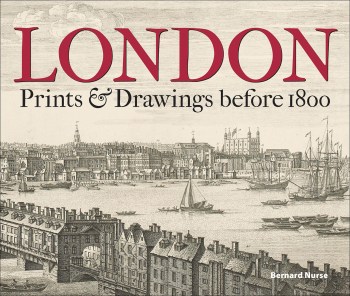 By the end of the eighteenth century London was the second largest city in the world, its relentless growth fuelled by Britain’s expanding empire. Before the age of photography, the most widely used means of creating a visual record of the changing capital was through engravings and drawings, and those that survive today are invaluable in showing us what the capital was like in the century leading up to the Industrial Revolution.
This book contains over one hundred images of the Greater London area before 1800 from maps, drawings, manuscripts, printed books, and engravings, all from the Gough Collection at the Bodleian Library. Examples are drawn from the present Greater London to contrast town and countryside at the time. Panoramas of the river Thames were popular illustrations of the day, and the extraordinarily detailed engravings made by the Buck brothers are reproduced here. The construction, and destruction, of landmark bridges across the river are also shown in contemporary engravings.
Prints made of London before and after the Great Fire show how artists and engravers responded to contemporary events such as executions, riots, fires, and even the effects of a tornado. They also recorded public spectacles, creating beautiful images of firework displays and frost fairs on the river Thames. This book presents rare material from the most extensive collection on British topography assembled in this period by a private collector, providing a fascinating insight into life in Georgian London.
Bernard Nurse is the former Librarian of the Society of Antiquaries of London.
New Book | The Print Before Photography
From Museum Bookstore:
Anthony Griffiths, The Print Before Photography: An Introduction to European Printmaking, 1550–1820 (London: The British Museum, 2016), 560 pages, ISBN: 978 07141 26951, $75.
 A landmark publication—beautifully illustrated with over 300 prints from the British Museum’s renowned collection—The Print Before Photography traces the history of printmaking from its earliest days until the arrival of photography.
Copperplate printmaking, developed alongside Gutenberg’s invention of moveable type, was a huge business employing thousands of people, and dominating image production for nearly four centuries across the whole of Europe. Its techniques and influence remained very stable until the nineteenth century, when this world was displaced by new technologies, of which photography was by far the most important. The Print Before Photography examines the unrivaled importance of printmaking in its golden age, illustrated through the British Museum’s outstanding collection of prints. This unique and significant book is destined to be a leading reference in print scholarship, and will be of interest to anyone with an interest in this era of art history.
Between 1991 and 2010, Antony Griffiths was deputy keeper, then keeper, of Prints and Drawings at The British Museum. In 1984 he co-founded the journal Print Quarterly. He was appointed a fellow of the British Academy in 2000.
New Book | The Sovereign Artist: Charles Le Brun
From Paul Holberton:
Wolf Burchard, The Sovereign Artist: Charles Le Brun and the Image of Louis XIV (London: Paul Holberton Publishing, 2017), 288 pages, ISBN: 978 19113 00052, £40.
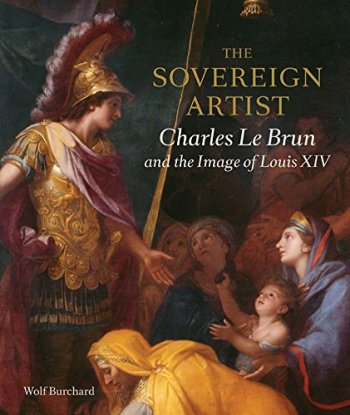 The first monograph to examine the wide artistic production of Louis XIV’s most prolific and powerful artist, Charles Le Brun (1619–1690), illustrating not only his paintings but the magnificence of the interiors and decorative works of art produced according to his designs. Revealing Le Brun’s extraordinary versatility and exploring his work at the Academy, the Gobelins and Savonnerie manufactories, and the royal building sites of the Louvre and Versailles, it is also the first book to explore in depth his artistic relationship to the Sun King.
In his joint capacities of Premier peintre du roi, director of the Gobelins manufactory and rector of the Académie royale de peinture et de sculpture, Le Brun exercised a previously unprecedented influence on the production of the visual arts—so much so that some scholars have repeatedly described him as ‘dictator’ of the arts in France. The Sovereign Artist explores how Le Brun operated in his diverse fields of activities, linking and juxtaposing his portraiture, history painting and pictorial theory with his designs for architecture, tapestries, carpets and furniture. It argues that Le Brun sought to create a repeatable and easily recognizable visual language associated with Louis XIV, in order to translate the king’s political claims for absolute power into a visual form. How he did this is discussed through a series of individual case studies ranging from Le Brun’s lost equestrian portrait of Louis XIV, and his involvement in the Querelle du coloris at the Académie, to his scheme for 93 Savonnerie carpets for the Grande Galerie at the Louvre, his Histoire du roy tapestry series, his decoration of the now destroyed Escalier des Ambassadeurs at Versailles.
One key theme is the relation between the unity of the visual arts, to which Le Brun aspired, and the strong hierarchical distinctions he made between the liberal arts and the mechanical crafts: while his lectures at the Académie advocated a visual and conceptual unity in painting and architecture, they were also a means by which he attempted to secure the newly gained status of painting as a liberal art, and therefore to distinguish it from the mechanical crafts which he oversaw the production of at the Gobelins manufactories. His artistic and architectural aspirations were comparable to those of his Roman contemporary Gianlorenzo Bernini, summoned to Paris in 1665 to design the Louvre’s East façade and to create a portrait bust of Louis XIV. Bernini’s failure to convince the king and Colbert of his architectural scheme offered new opportunities for Le Brun and his French contemporaries to prove themselves capable of solving the architectural problems of the Louvre and to transform it into a palace appropriate “to the grandeur and the magnificence of the prince who [was] to inhabit it” (Jean-Baptiste Colbert to Nicolas Poussin in 1664). The comparison between Le Brun and Bernini, made in the book, not only illustrates how France sought artistic supremacy over Italy during the second half of the 17th century, but further helps to demonstrate how Le Brun himself wanted to be perceived: beyond acting as a translator of the king’s artistic ambition, the artist appears to have sought his own sovereign authority over the visual arts.
Wolf Burchard is an art and architectural historian. He is the National Trust’s Furniture Research Curator and was formerly Curatorial Assistant at the Royal Collection Trust.
Exhibition | The Tweeddales: Power, Politics and Portraits

Attributed to Sir John Baptiste de Medina, The Family of John Hay, 1st Marquess Tweeddale, Lord High Chancellor of Scotland, ca. 1695, oil on canvas, 141 × 184 cm (Scottish National Portrait Gallery, purchased with the aid of the Art Fund and the Heritage Lottery Fund 1999).
◊ ◊ ◊ ◊ ◊
Now on view at the Scottish National Portrait Gallery:
The Tweeddales: Power, Politics and Portraits
Scottish National Portrait Gallery, Edinburgh, 23 April 2016 — 28 May 2017
Wealthy, influential, and politically savvy the Tweeddale family was at the heart of Scottish society in the second half of the seventeenth century. At the head of the family was John Hay (1626–1697), 2nd Earl and later 1st Marquess of Tweeddale. His marriage to Lady Jean Scott (1629–1688), second daughter of the Borders landowner Walter Scott, 1st Earl of Buccleuch, brought him wealth, opportunity, and a large family—the couple had several children. Members of the Tweeddale dynasty married into some of the noblest families in Scotland and England.
While several members of the Tweeddale family are acknowledged for their contribution to politics, the military, and for their strategic marriage matches, their role as patrons of the arts and architecture is often overlooked. The family were enthusiastic art collectors who commissioned portraits and landscapes by established and little-known artists, particularly those of Dutch, Flemish, and German origin including Sir Anthony van Dyck, Sir Peter Lely, Gerard Soest, and Sir John Baptiste de Medina. Paintings by each these artists feature in the exhibition. The highlight of the exhibition is the fascinating group portrait of the Marquess and his family, attributed to the Flemish artist Sir John Baptiste de Medina, which was painted around 1695.










 Enfilade
leave a comment