New Book | The Botany of Empire in the Long Eighteenth Century
From Harvard UP:
Yota Batsaki, Sarah Burke Cahalan, and Anatole Tchikine, eds., The Botany of Empire in the Long Eighteenth Century, Dumbarton Oaks Symposia and Colloquia (Cambridge: Harvard University Press, 2017), 406 pages, ISBN: 978 08840 24163, $90 / £67 / €81.
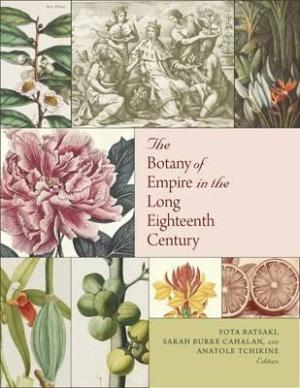 This book brings together an international body of scholars working on eighteenth-century botany within the context of imperial expansion. The eighteenth century saw widespread exploration, a tremendous increase in the traffic in botanical specimens, taxonomic breakthroughs, and horticultural experimentation. The contributors to this volume compare the impact of new developments and discoveries across several regions, broadening the geographical scope of their inquiries to encompass imperial powers that did not have overseas colonial possessions—such as the Russian, Ottoman, and Qing empires and the Tokugawa shogunate—as well as politically borderline regions such as South Africa, Yemen, and New Zealand. Essays examine the botanical ambitions of eighteenth-century empires; the figure of the botanical explorer; the links between imperial ambition and the impulse to survey, map, and collect botanical specimens in ‘new’ territories; and the relationships among botanical knowledge, self-representation, and material culture.
Yota Batsaki is Executive Director of Dumbarton Oaks.
Sarah Burke Cahalan is Director of the Marian Library, University of Dayton.
Anatole Tchikine is Assistant Director of Garden and Landscape Studies, Dumbarton Oaks.
New Book | Gardens of Court and Country: English Design, 1630–1730
From Yale UP:
David Jacques, Gardens of Court and Country: English Design, 1630–1730 (London: Paul Mellon Centre for Studies in British Art, 2017), 416 pages, ISBN: 978 0300 222012, £45 / $75.
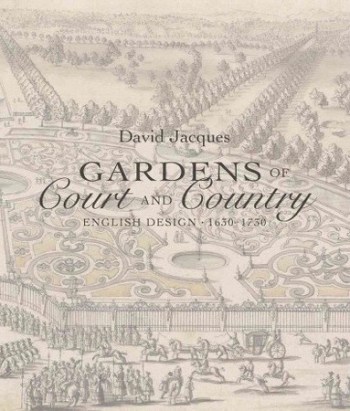 Gardens of Court and Country provides the first comprehensive overview of the development of the English formal garden from 1630 to 1730. Often overshadowed by the English landscape garden that became fashionable later in the 18th century, English formal gardens of the 17th century displayed important design innovations that reflected a broad rethinking of how gardens functioned within society. With insights into how the Protestant nobility planned and used their formal gardens, the domestication of the lawn, and the transformation of gardens into large rustic parks, David Jacques explores the ways forecourts, flower gardens, bowling greens, cascades, and more were created and reimagined over time. This handsome volume includes 300 illustrations—including plans, engravings, and paintings—that bring lost and forgotten gardens back to life.
David Jacques is an independent scholar and a consultant in historic landscapes, parks, and gardens.
Call for Papers | CAA in Los Angeles, 2018

From CAA News (27 February 2017) . . .
106th Annual Conference of the College Art Association
Los Angeles, 21–24 February 2018
Proposals due by 17 or 24 April 2017 (depending upon type of proposal)
CAA’s Annual Conference Committee invites proposals of interest to its members and varied audiences. Submissions that cover the breadth of current thought and research in art and art practice, art and architectural history, theory and criticism, studio art, pedagogical issues, museum and curatorial practice, conservation, design, new media, and developments in technology are encouraged.
To submit a proposal, individuals must be current CAA members. All session participants, including presenters, chairs, moderators, and discussants, must also be current individual CAA members. Please have your CAA Member ID handy as well as the member IDs of any and all participants as this is a required field on the submission form. Please note that institutional member IDs cannot be used to submit proposals. If you are not a current individual member, please renew your membership or join CAA.
All session participants must also register for the conference. Online registration for CAA 2018 will begin October 2, 2017. Early conference registration will end December 15, 2017 and advance conference registration will end on February 7, 2018. Early and advance conference registration fees will not change from CAA 2017, New York.
The Annual Conference Committee will accept the following proposals for review: Complete Sessions, Sessions Soliciting Contributors, and Individual Paper/Project proposals. All sessions will be 90 minutes in length at CAA 2018. Please plan accordingly. For full details on the submission process for the conference, please review the information below and on the individual submission pages.
P R O P O S A L S U B M I S S I O N T Y P E S
Session Soliciting Contributors
Proposals due by 17 April 2017
The Session Soliciting Contributors option allows a submission for a full session (90 minutes in length) with yet-to-be identified speakers and papers/projects. If selected, such sessions will be included in the call for participation (CFP) which opens June 30.
Individual Paper/Project
Proposals due by 17 April 2017
Individual Paper/Project proposals (15 minutes in presentation length) may be submitted for review. No specific theme is required. The Annual Conference Committee will review and select paper/project proposals based on merit and group approved submissions into Composed Sessions of up to four participants. A liaison from the Annual Conference Committee will be identified for each Composed Session to assist with the format and to help identify a session chair or moderator.
Complete Session
Proposals due by 24 April 2017
The Complete Session option allows a submission for a complete panel (90 minutes in length) pre-formed with participants and papers/projects chosen in advance by session chairs. This session requires advance planning and information gathering by the chair(s).
Affiliated Societies
Proposals due by 24 April 2017
Each Affiliated Society may submit either one Complete Session proposal (90 minutes in length) pre-formed with participants and papers/projects chosen in advance or one Session Soliciting Contributors proposal (90 minutes in length) to be included in the CFP which opens June 30. A note of approval from the Affiliated Society chair must accompany the submission. This session will be guaranteed and will be identified as an Affiliated Society session in all CAA publications. Subsequent proposals by Affiliated Society members may be submitted separately by individuals, but are subject to peer review by the Annual Conference Committee and must be submitted via the Complete Session, Session Soliciting Contributors, or Individual Paper/Project submissions forms described above. These submissions are not guaranteed and, if selected, will not be labeled or identified as Affiliated Society sessions in CAA publications.
CAA PIPS Committees
Proposals due by 24 April 2017
CAA PIPS [Professional Interests, Practices, and Standards] committees may submit either one Complete Session proposal (90 minutes in length) pre-formed with participants and papers/projects chosen in advance or one Session Soliciting Contributors proposal (90 minutes in length) to be included in the CFP which opens June 30. A note of approval from the committee chair must accompany the submission. This session will be identified as a committee session in all CAA publications. Subsequent proposals by committee members may be submitted separately by individuals, but are subject to peer review by the Annual Conference Committee and must be submitted via the Complete Session, Session Soliciting Contributors, or Individual Paper/Project submissions forms described above. These submissions are not guaranteed and, if selected, will not be labeled or identified as committee sessions in CAA publications.
Rare Book School Offerings
Rare Book School offers five-day, intensive courses in several locations focused on the history of manuscript, print, and digital materials. Our courses this spring and summer will be held at the University of Virginia, Yale University, the University of Pennsylvania, and Indiana University, Bloomington.
Among our more than thirty courses on the history of books and printing, we are pleased to offer courses of interest to those in the fields of art history and eighteenth-century studies. The following is a sample of the breadth of classes offered:
• I-10 The History of Printed Book Illustration in the West, taught by Erin C. Blake (Folger Shakespeare Library)
• H-100 The Eighteenth-Century Book, taught by Mark Dimunation (Library of Congress) and Michael F. Suarez, S.J. (University of Virginia & Rare Book School)
• H-30 The Printed Book in the West to 1800, taught by Martin Antonetti (Northwestern University)
Applications are now open on a rolling admissions basis. Visit our website for course details.
A 2016 RBS student remarked, “I will never look at a book—any book—the same way again,” and so we hope you will join us at an RBS course this year and learn to see books in a new way as well!
With kindest regards,
The RBS Programs Team
Research Lunch | Isabelle Baudino on Samuel Wale’s Book Illustrations
From the Paul Mellon Centre:
Isabelle Baudino, Samuel Wale’s Book Illustrations:
Designing Historical Panoramas in Georgian London
Paul Mellon Centre, London, 31 March 2017
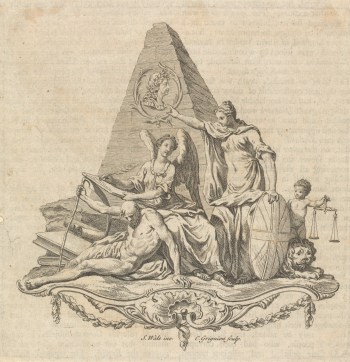
Charles Grignion, after Samuel Wale, Britannia Allegory, between 1743 and 1747, Line engraving and etching; letterpress on verso on medium, slightly textured, cream laid paper (page in book) (Yale Center for British Art, Yale Art Gallery Collection).
Despite being a founding member of the Royal Academy of Arts, Samuel Wale (1721?–1786) has remained quite an elusive figure. Most of his easel paintings have disappeared and the greater part of his decorative works has been damaged or destroyed. Although he was apprenticed as an engraver, he started his career as a painter, attending classes at St Martin’s Lane Academy, decorating the Foundling Hospital and assisting Francis Hayman. While being consistently involved in the academic movement that led to the foundation of the Royal Academy, Wale also became one of the most prolific book illustrators of the day, designing hundreds of plates that contributed to the growing popularity of pictorial histories. Over the course of his forty-year career, he established a formulaic, full-page framed historical scene offering an unprecedented visualisation of British history. Indeed, building on his first selection of historical events, and drawing inspiration from the theatre, other books or paintings, Wale established a sequence of landmarks that gave an overview of Britain’s history from its ancient origins until modern times. He thus contributed to the visual perception of historical chronology and created images of national history that were emulated, adapted and appropriated. Friday, 31 March 2017, from 12:30 to 2:00pm. Registration information is available here.
I will argue that despite their low aesthetic and commercial value, the images that composed Wale’s historical panorama proved remarkably persistent because they brought together history, nationhood and iconography, thus transforming the understanding of history and fostering a new engagement with the past and its traces in the eighteenth-century present.
Isabelle Baudino is Senior Lecturer at the ENS in Lyons and has been a Visiting Fellow at Magdalene College, Cambridge, over the past academic year. Her work focuses on eighteenth-century British art with particular interest in history painting and the Royal Academy, taken individually, but also studied together in the context of the institutionalization of the arts in eighteenth-century Britain. Her study on Samuel Wale is part of a project which is generously supported by a mid-career fellowship from the Paul Mellon Centre for Studies in British Art.
Exhibition | Volcanoes

Sir William Hamilton’s volcano archive includes paintings he commissioned (Oxford: Bodleian).
◊ ◊ ◊ ◊ ◊
From the press release (16 January 2017) for the exhibition:
Volcanoes
Weston Library, Bodleian, Oxford, 10 February 2017 — 21 May 2017
Curated by David Pyle
A new exhibition at the Bodleian Libraries uses a spectacular selection of eye witness accounts, scientific observations, and artwork to chart how our understanding of volcanoes has evolved over the past two millennia. The exhibition examines some of the world’s most spectacular volcanoes including the 79 AD eruption of Vesuvius—one of the most catastrophic eruptions in European history—and the 19th-century eruptions of Krakatoa and Santorini, two of the first volcanic eruptions to be intensely studied by modern scientists.
Today, satellites monitor volcanic activity and anyone with internet access can watch volcanic eruptions live in real time. In the past, volcanic eruptions were described in letters, manuscript accounts, and early printed books and illustrated through sketches, woodcuts, and engravings. Many of these fascinating accounts are preserved in the Bodleian’s historic collections and will be on display in Volcanoes at the Weston Library.
The human encounters with volcanoes that are traced in the exhibition range from Pliny the Younger’s account of the dramatic eruption of Vesuvius in 79 CE to early Renaissance explorers who reported strange sightings of mountains that spewed fire and stones. Also explored is how scientific understanding of volcanoes and the Earth’s interior have developed over time, from classical mythology and early concepts of subterranean fires to the emergence of modern volcano science, or volcanology, in the 19th century. The exhibition brings together science and society, art, and history and will delight visitors of all ages.
 The exhibition is curated by David M. Pyle, Professor of Earth Sciences at the University of Oxford, whose research uses historical sources to improve our knowledge of past volcanic activity and to shed light on what might happen in the future at young or active volcanoes. It will feature treasures from the Bodleian Libraries, some of which have never been on public display before. In addition, the exhibition will feature items on loan from the Natural History Museum in London and from the University of Oxford’s Museum of Natural History, the Museum of the History of Science, and Magdalen College. Highlights of Volcanoes include:
• Fragments of ‘burnt’ papyrus scrolls from the ancient Roman town of Herculaneum, which were buried during the 79 AD eruption of Vesuvius
• The earliest known manuscript illustration of a volcano, found in the margin of a 14th-century account of the voyage of St Brendan, an Irish monk who travelled across the north Atlantic in the 6th century
• A stunning illustration of the Earth’s subterranean fires from Athanasius Kircher’s Mundus Subterraneus, an influential 17th-century work which proposed that volcanoes were created where the Earth’s internal fires escaped at the surface
• Spectacular 18th-century studies of Vesuvius by Scottish diplomat and early volcanologist William Hamilton who wrote one of the first descriptive monographs of an active volcano
• 18th- and 19th-century weather diaries and paintings that capture the distant effects and freak weather conditions caused by major volcanic eruptions in Iceland and Indonesia
• ‘Infographics’ from 19th-century natural historians Alexander von Humboldt and Charles Daubeny whose work has contributed greatly to our current understanding of volcanoes
• Lava and rock samples, maps, lecture notes, and scientific equipment from 19th-century volcanologists and explorers
The exhibition curator David Pyle said: “Humans have lived with volcanoes for millions of years yet scientists are still grappling with questions about how they work. This exhibition features historical representations and ideas about volcanoes that are captivating and dramatic but most importantly these works provide scientists today with valuable insights into how these enigmatic phenomena behave. Looking back at history can help us learn valuable lessons about how best to reduce the effects of future volcanic disasters.”
Richard Ovenden, Bodley’s Librarian said: “Volcanoes are one of the most extraordinary marvels of the natural world and have fascinated us for millennia. This exhibition draws on both the rich collections held at the Bodleian and cutting edge scientific research to demonstrate the power and fascination of volcanoes through time.”
David Pyle, Volcanoes (Oxford Bodleian Libraries, 2017), 224 pages, ISBN: ISBN: 978 18512 44591, £20.
Exhibition | A Life of Seduction: Venice in the 1700s
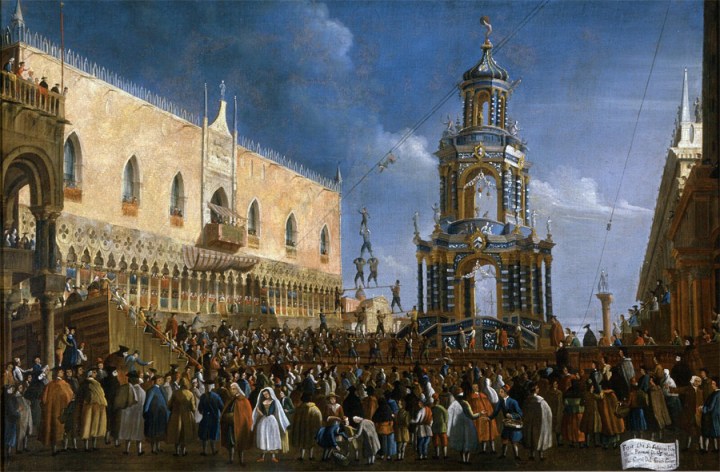
Gabriel Bella, Fat Thursday Festivity in Piazzetta, 18th century
(Venice: Querini Stampalia Foundation)
◊ ◊ ◊ ◊ ◊
Press release (11 January 2017) from NOMA:
A Life of Seduction: Venice in the 1700s
New Orleans Museum of Art, 16 February — 21 May 2017
Curated by Giandomenico Romanelli
The grandeur of Venice comes to America’s most historic city in A Life of Seduction: Venice in the 1700s, an exhibition at the New Orleans Museum of Art. NOMA is the sole venue in the United States presenting this exhibition of objects providing a glimpse into the pageantry, ceremony, and extravagance of Venetian life in the eighteenth century.

Glass sugar bowl, Venice, 18th century, glass and chalcedony (Murano: Museo del Vetro).
“It is with great pleasure that NOMA brings this remarkable exhibition to our public. Venice is presented through an elegant, multi-disciplinary installation featuring an exceptional selection of objects, costumes, and paintings that illuminate an extraordinary time in the history of Venice,” says Susan Taylor, Montine McDaniel Freeman Director at the NOMA.
A Life of Seduction illuminates Venetian life and pageantry during the century of Casanova, Canaletto, and Tiepolo. Visitors will see objects depicting the opulence of the time, when the city was a cultural mecca. Eighteenth-century carnival masks, costumes and robes, shoes, handbags, and regal glass objects are displayed among exquisite paintings by Canaletto and Guardi. “A significant strength of this exhibition is its historical and cultural point of view and the distinctive range of objects that tell the story,” says NOMA Curator Vanessa Schmid.
Fittingly, A Life of Seduction arrives in New Orleans at a time when parallels between the two cities are apparent, just before Carnival and the spring festival season. Guest-curated by the former director of the Civic Museums of Venice, Giandomenico Romanelli, the exhibition presents four themes: A City that Lives on Water, the Celebration of Power, Aristocratic Life in Town and Country, and the City as Theater. The festivals and celebration unique to Venetian culture are depicted in detailed paintings of a city transformed at carnival. Gondola models illustrate the exquisite craftsmanship and elegance of canal life and travel. Palace and country living are brought to life by resplendent costumes, silk waistcoats, gloves, and handbags, as well as furnishings and delicate, rare Venetian glass objects, for which the city is still so well known. Theater and opera—vital elements in Venetian life and imagination—are represented through paintings, decorative arts, and a full-scale puppet theater lent by the Casa Goldoni of Venice especially for this exhibition.
The exhibition is originated by NOMA, organized by the Contemporanea Progetti, and guest-curated by Giandomenico Romanelli.
Lecture | David Pullins on the Shape of Painting
Of note for anyone in the Boston area next Tuesday; from Harvard:
David Pullins | The Shape of Painting: Eighteenth-Century Departures from the Rectangle
Harvard University, Cambridge, 7 March 2017
 Informed by questions asked explicitly by twentieth-century painters (Johns, Stella, Murray) about the relationship between image and support, this talk engages with the wildly irregular formats produced in response to decorative programs in eighteenth-century France. While developing an historical understanding of the conditions that produced this pervasive (yet entirely unstudied) category of painting, the talk’s primary aim is to address what can be learned about the crises and limits of painting through this early modern departure from the rectangle. Tuesday, 7 March 2017, 5:00pm, Barker Center 133.
David Pullins is a Lecturer at MIT.
Image: Jacques de Lajoüe, Optics, ca. 1734 (private collection).
Exhibition | Glorious Years: French Calendars

François Gérard Jollain, Almanac (detail), ‘The August Portraits of the First Born Sons of Our Kings That Have Had the Title of Dauphin’ (Louis XV, the Queen, and the Dauphin surrounded by courtiers and other nations with a family tree of French kings), 1734; etching and engraving, 84 × 51 cm (Waddesdon Manor, National Trust, 2669.3.17; photo: Mike Fear).
◊ ◊ ◊ ◊ ◊
Opening next month at Waddesdon:
Glorious Years: French Calendars from Louis XIV to the Revolution
Waddesdon Manor, Buckinghamshire, 22 March — 29 October 2017
Curated by Rachel Jacobs
Glorious Years is a celebration of the power of the printed image before photography—an exhibition of rare calendars, published in Paris in the 17th and 18th centuries, from their golden period under Louis XIV, through to the Revolution, when time itself was re-invented, with new ways of illustrating and naming the days and years.
Despite their popularity, these calendars (originally named ‘almanacs’) have not survived in great numbers. They were replaced annually and were easily damaged due to their large sizes. The depicted major events, from royal weddings, and births to victorious battles and peace treaties and were designed to inform and delight the public, while glorifying the king and his image. These rare prints can be enjoyed as works of art and as important historic documents, revealing much about the social, political, and artistic world of the Old Regime.

Philibert Louis Debucourt, Almanac: Republican Calendar, 1794; etching and engraving; 51 × 41 cm (Waddesdon Manor, National Trust, 2669.3.42; photo: Mike Fear).
A number of bound pocketbook almanacs are also included in the exhibition. These small volumes were extremely popular towards the end of the 18th century. They vary hugely in content, but all contain a calendar within. Some are official directories, listing members of the royal households, schedules for the post and carriage travel; others are for amusement, containing songs, poems, illustrations and even erasable paper for recording gambling gains and losses. These small pocketbooks are not dissimilar to our modern-day smart phones, perfectly suited to distract, amuse, and inform.
In a time before photography, the printed image was the most effective communicator. Images were everywhere and consumed by all. The exhibition will explore the context in which these almanacs were made and consider how these everyday prints and books were used to educate, delight, impress, and express the official print programme of the court and the later revolutionary government.
Baron Ferdinand de Rothschild (1839–1898) was as fascinated by social history and printed ephemera—such as trade cards and lottery tickets—as he was by the finest English and French art of the 18th century. His collection of over 70 almanacs is unique in the UK, and it is the first time some 30 of these prints will be on public display. All the prints in the exhibition have been conservation cleaned, remounted, and digitised and will be available to browse and research on the website alongside our other collections of printed ephemera, including trade cards, board games, and prints from the French Revolution.
UK Government Art Collection To Set Up Its Own Gallery

Selections from the UK’s Government Art Collection as displayed in its current storage facility off Tottenham Court Road; photo from a blog posting (5 March 2014) at Please Don’t Touch The Dinosaurs, which noted the introduction of lunchtime tours of the GAC.
◊ ◊ ◊ ◊ ◊
As reported by The Art Newspaper (February 2017), p. 10.
The UK’s Government Art Collection (GAC) plans to set up its own gallery. This will open up a huge collection of 14,000 works, mainly by British artists, which is not easily accessible.
A spokeswoman for the Department for Culture, Media and Sport, which oversees the GAC, says that the collection’s offices and stores will be moved to new premises in London which should include a “display space that everyone will be able to enjoy.” Entry will presumably be free. The location and timing have not yet been announced.
At present, the collection is stored in Queen’s Yard, just off Tottenham Court Road, in central London. The stores are not environmentally controlled to museum standards, which is another reason for the move. . .
Of the 14,000 works, around one-third are in store, with most of the remainder hanging in 100 government offices in the UK and 270 offices abroad, where there is very limited public access. . .
The works are nearly all by British artists, although there are a few paintings made by foreigners of British subjects. They date from the 16th century to the present. . .










 Enfilade
leave a comment