Exhibition | Comforts, Cures, and Distractions

The farmhouse in which Bronson Alcott and family lived, now Fruitlands Museum, Harvard, Massachusetts (Photo: Wikimedia Commons, May 2009).
◊ ◊ ◊ ◊ ◊
Press release from Fruitlands Museum (via Art Daily). . .
Comforts, Cures, and Distractions: Winter at Fruitlands Museum
Fruitlands Museum, Harvard, Massachusetts, 29 November 2016 — 26 March 2017
Curated by Shana Dumont Garr and Rebecca Migdal
The Trustees of Reservations [a non-profit land conservation and historic preservation organization dedicated to preserving natural and historical places in Massachusetts] announced that Fruitlands Museum, its newest property, is presenting Comforts, Cures, and Distractions: Winter at Fruitlands Museum, running through March 26, 2017. The exhibition brings wintry New England into vivid focus with an assortment of art and artifacts from the museum’s diverse Transcendentalist, Shaker, Native American, and landscape painting collection.
“As daylight hours shorten and temperatures plummet, snow transforms the landscape, blanketing it with hushed beauty,” says Fruitlands Curator Shana Dumont Garr, who joined The Trustees in September. “During this season of winter wonder it becomes difficult to imagine how people made it through the cold weather in past centuries, before central heating and other modern conveniences. The objects assembled in Comforts, Cures, and Distractions will connect visitors to moments spent during winters past, and historical attempts to foster good health and good cheer, offering glimpses into wintertime daily life in 18th- and 19th-century New England when life was often so much more challenging day to day.”
The array of items also tells a unique story about Fruitlands’ collection, with Shaker scarves and mittens, a Woodlands Native American water warmer, or mokuk, and a 19th-century painting of ice skaters that captures the dramatic transformation of the landscape. There are skates, sleds, and snowshoes dating from the era when 11-year-old Louisa May Alcott described playing in the snow when she and her family lived in the Fruitlands Farmhouse in 1834, as well as a pair of pink and white mittens that are believed to have been used by the Alcott girls.
“Seeing items drawn from Fruitlands Museum’s varied collections provides an opportunity to see how different communities solve the same enduring problems of how to stay warm, fed, and entertained during the tough winter months,” adds Rebecca Migdal, who co-curated the exhibition with Dumont. Contemporary objects, such as dried herbs that follow Shaker healing traditions, a shovel, hat, and sled will help round out stories that follow themes of either survival or celebration and connect winters past with winters present.
Comforts, Cures, and Distractions is co-curated by Fruitlands Curator Shana Dumont Garr and Rebecca Migdal.
◊ ◊ ◊ ◊ ◊
Fruitlands Museum, founded in 1914 by Clara Endicott Sears, takes its name from an experimental utopian community led by Bronson Alcott and Charles Lane, which took place on the site in 1843. The campus includes
• The Fruitlands Farmhouse, the site of the experiment in communal living led by Alcott and Lane in 1843
• The Shaker Museum, the first Shaker museum in the country and home to the largest archive of Harvard Shaker documents in the world, housed in an historic building moved here from the Harvard Shaker community
• The Native American Museum, which houses a significant collection of artifacts that honor the spiritual presence and cultural history of the first Americans including New England Native culture and a survey of culture in the Plains, Southwest, and Northwest
• The Art Museum, including a collection of over 100 Hudson River School landscape paintings and over 230 nineteenth-century vernacular portraits, the second largest collection in the country along with a variety of rotating exhibits throughout the year
• The Wayside Visitor Center, exhibiting information on Fruitlands’ landscape and environment and providing classroom space for education programs and classes
Conference | CAA 2017, New York
105th Annual Conference of the College Art Association
New York Hilton Midtown, 15–18 February 2017
 The 2017 College Art Association conference takes place in New York, February 15–18, at the New York Hilton Midtown (1335 Avenue of the Americas). In introducing the eighteenth-century offerings for CAA 2016, I complained there were only four panels that seemed obviously relevant for the period. This year, again there are only a handful of sessions. Still, these look fabulous, and for anyone put off by the exorbitant registration fee (which can run as high as $495), bear in mind that there are other options ($20 per single time-slot session), which might be especially attractive for anyone in the New York area. We would love to have you join us!
Also, I’m glad to extend a warm invitation to HECAA members to join a group of HBA members on Saturday for a day trip to visit the recently re-opened Yale Center for British Art and to tour the exhibition Enlightened Princesses: Caroline, Augusta, Charlotte, and the Shaping of the Modern World with Lisa Ford, Assistant Director of Research. Space is limited. For more information or to reserve a spot, please email: CraigAshleyHanson@gmail.com. –CH
◊ ◊ ◊ ◊ ◊
Charting a New Course: Reorienting the Discourse of Early African American Art History
Wednesday, 15 February 2017, 3:30–5:00, Clinton Suite, 2nd Floor
Chairs: Mia L. Bagneris (Tulane University) and Anna Arabindan-Kesson (Princeton University)
• Jennifer Van Horn (George Mason University), Stealing a Glance: Enslaved Viewers in the Plantation South
• Key Jo Lee (Yale University), Face(ing) the Impossibility of Recovery: Tracing the Affective Terrain of the Anonymous in African American Photography
• Phillip Troutman (The George Washington University), Techniques of the Engraver: Patrick Henry Reason’s African American Portraits, 1830s–1860s
◊ ◊ ◊ ◊ ◊
Editing Journals in a Digital Age, Association of Research Institutes in Art History (ARIAH)
Thursday, 16 February 2017, 8:30–10:00am, East Ballroom, 3rd Floor
Chairs: Sarah Victoria Turner (The Paul Mellon Centre for Studies in British Art) and Martina Droth (Yale Center for British Art)
• Samuel Bibby, Reflections on Editing Art History
• Petra ten-Doesschate Chu, Reflections on Editing Nineteenth-Century Art Worldwide
• Kirk Ambrose, Reflection on Editing The Art Bulletin
• Alison M. Kettering, Reflections on Editing the Journal of Historians of Netherlandish Art
• Discussant: Gail Feigenbaum (Getty Research Institute)
◊ ◊ ◊ ◊ ◊
Transglobal Collecting: Co-Producing and Re-visioning British Art Abroad (HBA)
Thursday, 16 February 2017, 3:30–5:00, Gramercy B/East, 2nd Floor
Chair: Julie Codell (Arizona State University)
• Kathleen Stuart (Denver Art Museum), The Berger Collection at the Denver Art Museum: British Art in the Rocky Mountain West
• Elizabeth A. Pergam (Sotheby’s Institute of Art, New York), The British Model of Collecting: Importing British Art to America
• Andrew Stephenson (University of East London), ‘A Thing That Racially Belongs to Us More Than Any of the Latin Styles’: Collecting and Displaying English Art in Private Collections in the United States, c.1890–1926
• Nancy Scott (Brandeis University), Paintings across the Pond: Anchoring J. M. W. Turner in American Collections
◊ ◊ ◊ ◊ ◊
Studies in Eighteenth-Century Style
Friday, 17 February 2017, 8:30–10:00am, Gramercy B/East, 2nd Floor
• Josefine Baark (Lingnan University), ‘The King Stared at the Figure in Astonishment’: Chinese Nodding-Head Figures in Early Modern Denmark
• Andrea Bell (Parsons School of Design, The New School), The Geometrical Landscape: Architecture and the Severity of Style in Rome
• Tracy Ehrlich (The New School), Fashioning the Architectural Body in Eighteenth-Century Rome
• Kristin O’Rourke (Dartmouth College), The Toilette: Dressing in Public and Private
◊ ◊ ◊ ◊ ◊
Superpowers in the Global Eighteenth Century: Empire, Colonialism, and Cultural Contact
Friday, 17 February 2017, 10:30–12:00, Beekman Parlor, 2nd Floor
Chair: Tara Zanardi (The Metropolitan Museum of Art)
• Joanna Gohmann (Walters Art Museum), A Sign of Empire: The Pineapple in the Colonial British World
• Jocelyn Anderson (Independent Scholar), ‘The Most Remarkable Places’: Military Views of North America and the Caribbean in the Mid-Eighteenth Century”
• Amelia Rauser (Franklin and Marshall College), Satanic Mills, Indian Muslin, and the Materiality of Neoclassical Dress in the 1790s
• Discussant: Michael Yonan (University of Missouri)
The session is dedicated to the memory of Mary Sheriff (1950–2016).
◊ ◊ ◊ ◊ ◊
Yale Center for British Art and Paul Mellon Center Reception
Friday, 17 February 2017, 12:00–1:30, East Ballroom Foyer, 3rd Floor
◊ ◊ ◊ ◊ ◊
Art and Caricature
Friday, 17 February 2017, 5:30–7:00, Gramercy A/West, 2nd Floor
Chair: Phoebe Wolfskill (Indiana University)
• Anne L. Williams (Virginia Commonwealth University), Early Modern Multivalence: Caricature, Subversion, and Veneration in Sacred Art
• Richard Taws (University College London), The Smiling Face of Terror: Etienne Béricourt’s French Revolution
• Matthew Von Vogt (Indiana University), Pasolini’s Authorial Caricature: Reconsidering Authorship in the Intellettuale
• Corina L. Apostol (Rutgers University), Aggravating the Powerful: Political Caricature Now and Then
◊ ◊ ◊ ◊ ◊
The Netherlands and the Global Baroque, Historians of Netherlandish Art (HNA)
Saturday, 18 February 2017, 8:30–10:00am, Trianon Ballroom, 3rd Floor
Chair: Caroline Fowler (Yale University)
• Adam Eaker (The Metropolitan Museum of Art), Suriname on Display
• Christina An (Boston University), Art beyond Price or Place: Vermeer, Asia, and the Poetics of Painting
• Marsely Kehoe (Michigan State University), A Global Dutch Architecture?: Hybridity in Curaçao’s Eighteenth-Century Merchant Homes
◊ ◊ ◊ ◊ ◊
Key Conversation: Mary Sheriff (1950–2016): A Memorial Session
Saturday, 18 February 2017, 12:15–1:15, Madison Suite, 2nd Floor
Chair: Francesca Fiorani (University of Virginia)
Join this session to remember Mary Sheriff. Come together, share memories, and celebrate her achievements.
◊ ◊ ◊ ◊ ◊
Graphic Growth: Discovering, Drawing, and Understanding Nature in the Early Modern World
Saturday, 18 February 2017, 1:30–3:00, Madison Suite, 2nd Floor
Chairs: Catherine Girard (Williams College) and Jaya Remond (Max Planck Institute for the History of Science)
• Madeleine C. Viljoen (The New York Public Library), Ornament’s Science
• Katherine M. Reinhart (University of Cambridge), Graphic Practice and Natural Philosophy in the Early Paris Académie Royale des Sciences
• Elizabeth Athens (Worcester Art Museum), The Animating Mark: William Bartram’s Drawings from Life
◊ ◊ ◊ ◊ ◊
Day Trip to New Haven for the Yale Center for British Art
Saturday, 18 February 2017, 10:00am–5:00pm
Opportunity to visit the recently re-opened Yale Center for British Art and to tour the exhibition Enlightened Princesses: Caroline, Augusta, Charlotte, and the Shaping of the Modern World with Lisa Ford, Assistant Director of Research. Space is limited. For more information or to reserve a spot, please email: CraigAshleyHanson@gmail.com.
◊ ◊ ◊ ◊ ◊
Note (added 25 January 2017) — The original posting did not include the memorial session for Mary Sheriff.
Note (added 6 February 2017) — The original posting did not include the session on editing journals in a digital age.
New Website | Early Modern Typography

I imagine some Enfilade readers will find Early Modern Typography useful (it includes the eighteenth century); it’s also interesting to see a blog used as an index for a Flickr collection of images. As posted several days ago on the SHARP listserv (with permission from Paul Dijstelberge for resposting). –CH
◊ ◊ ◊ ◊ ◊
Dear Friends,
On the first day of the year I want to present a new website: earlymoderntypography.com. I have been adding images to a Flickr collection for 7 years, but the access became more and more difficult, due to the sheer amount of images. Early Modern Typography functions as an index to the Flickr website of 70,000 images of type, historiated initials, images, pages, bindings, and so on. The Flickr collection functions as a repository containing the ‘rough’ material for a book I am writing on the 16th-century European decorated initials (to be finished in 2017, with a separate website with advanced search possibilities).
The Flickr site contains material of 800+ printers and is growing on a daily basis. In time I hope to use ICONCLASS and advanced image search to create an instrument for the history of the book in the broadest sense. In 2017 I hope to digitize the archives of the late Paul Valkema Blouw that contains all 16th-century Dutch printers from 1540 to 1600 and to start on the Dutch late 17th and 18th centuries. Dutch books can be rather boring so I will add initials and images from other European printers too, mainly from the 16th and 18th centuries.
There is another page that might be of interest: illustrations from early modern books. I am working on Ovid’s Metamorphoses and on our great collections of topography and medicine at the Allard Pierson / Special Collections at the University of Amsterdam. Ovid is part of a project to write a thesis on the Dutch editions of the Metamorphoses.
I hope 2017 will be a good year. Like Candide I will spend it with cultivating my garden, but not without looking out for our civilization in general.
Best,
Paul Dijstelberge
University of Amsterdam / Allard Pierson – Special Collections
Exhibition | Images and Revolts in Book and Prints
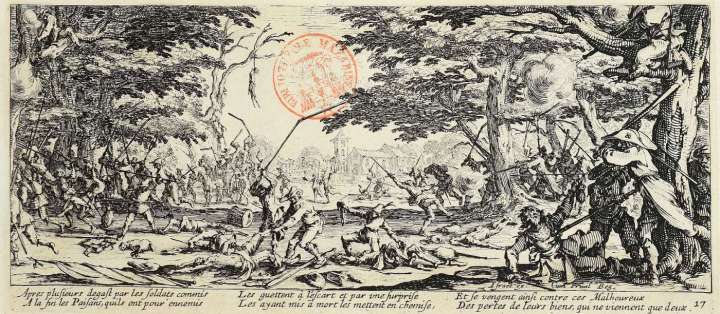
Now on view at the Bibliothèque Mazarine:
Images and Revolts in Book and Prints, 14th–Mid-18th Century
Images & Révoltes dans le livre et l’estampe, 14e–milieu du 18e siècle
Bibliothèque Mazarine, Paris, 14 December 2016 — 17 March 2017
Curated by Tiphaine Gaumy
Since the late Middle Ages, revolts and uprisings have marked European history. For a long time, historians believed that due to the extent of illiteracy, opponents had very few means of self-expression. However, the increase and widespread appearance of contesting images during periods of insurgency provides evidence of a visual and popular culture existing long before the French Revolution. Significant examples can be observed during the Bohemian Hussite movement in the 15th century or during the Peasants War in the Holy Roman Empire (1525).
An iconography of revolts emerged and spread, especially on ephemeral and scarcely preserved materials, but also in manuscripts, and very soon on new media. Opponents expressed their discontent through pamphlets and prints. In response, authorities tried to contain the dissemination of seditious images and to display, through other images, their own legitimacy and authority. This visual production raises many questions. How did rebels influence their creation? How did technical innovations (printing) or spiritual ones (reformation, iconoclasm…) determine their spread, form and content? Can historians trust them?
The exhibition features a broad variety of images, from rebellions of Flemish cities in the 14th century, to peasants revolts and religious troubles of the 15th and 16th centuries, uprisings and revolutions in the mid-17th century (in France, Portugal, Naples, the British Isles), and Jansenist protests in the 18th century. They form an unknown and astonishing visual legacy and a key testimony to understanding the political culture of Europe.
An exhibition organised by the Bibliothèque Mazarine, in collaboration with the ANR project Culture des révoltes et révolutions.
Stéphane Haffemayer, Alain Hugon, Yann Sordet, and Christophe Vellet, eds., Images & Révoltes dans le livre et l’estampe, XIVe–milieu du XVIIIe siècle (Paris: Bibliothèque Mazarine & Editions des Cendres, 2016), 315 pages, ISBN: 979 1090853 096, 38€.
Call for Papers | Jacques-François Blondel
From the appel à communications:
Jacques-François Blondel et l’enseignement de l’architecture
La dernière leçon de l’architecture « à la française »
Cité de l’architecture et du patrimoine, Paris, 14 December 2017
Proposals due by 31 March 2017

Gabriel de Saint-Aubin, Blondel démontrant des machines dans l’académie d’architecture, 1770, Recueil de poésies de Sedaine, 1770 (Chantilly, musée Condé).
La Cité de l’architecture et du patrimoine et la Ville de Metz se sont associées pour organiser une journée d’étude sur l’architecte Jacques-François Blondel (1708/9–1774). L’objectif de cette journée est d’interroger le rôle de cette gure majeure du siècle des Lumières dans l’enseignement de l’architecture. Cette rencontre annonce l’exposition monographique Blondel, architecte des Lumières, qui sera présentée à Metz en 2018, et l’exposition-dossier qui lui sera consacrée à la Cité de l’architecture et du patrimoine la même année.
Parmi les architectes ayant publié des traités ou des « cours » sur l’exercice de leur art, Jacques-Francois Blondel se distingue par la qualité de ses ouvrages. Auteur majeur de la théorie architecturale, ce collaborateur de l’Encyclopédie de Diderot et d’Alembert a su, au cœur des Lumières, redonner une actualité à l’architecture classique, en s’opposant à l’art rocaille qui domine alors. Pour J.-F. Blondel, l’architecture possède une dimension encyclopédique — elle mobilise à la fois les savoirs techniques et les di érents arts — mais aussi sociale. Les écrits de J.-F. Blondel sont par ailleurs indissociables de son action pédagogique : avec la fondation de son École des Arts (1740), qui se propose de centraliser la diversité des compétences, il opère une véritable révolution pédagogique. Cette révolution, le professeur la mène jusque dans les salles de l’Académie royale d’architecture, où il est agréé académicien en 1755, puis nommé professeur o ciel en 1762. Au cours de sa longue carrière, il a l’occasion de former plusieurs générations d’architectes français et étranger, ainsi que d’in uencer des artisans, des amateurs, des commanditaires, des hommes de lettres… En ce qui concerne la pratique, J.-F. Blondel est surtout connu pour avoir aménagé le secteur de la cathédrale de Metz. On ne saurait cependant ignorer ses projets, rééls ou pédagogiques, tels l’aménagement du centre de Strasbourg, ou ses propositions d’architecture religieuse inspirées par les structures du gothique, mais respectant le répertoire classique des formes.
Les propositions devront s’intégrer dans les thèmatiques suivantes :
1. Blondel et les institutions : de son école privée à l’école de l’Académie
Par la volonté du marquis de Marigny, directeur général des bâtiments du roi, J.-F. Blondel, après avoir fondé l’école privée d’architecture (1740), est appelé à poursuivre son enseignement dans les salles du Louvre (1762), secondé par son ancien élève, Julien-David Le Roy. Ce premier axe entend explorer la manière dont le système royal des beaux-arts fut mis en place et le rôle que J.-F. Blondel et d’autres personnages-clés, furent amenés à y jouer. Cette thématique voudrait également interroger les résultats de cette politique.
2. Enseigner l’architecture aux XVIIIe et XIXe siècles : de l’atelier à l’école de l’Académie, quelle fortune pour Jacques-François Blondel ?
Avant que J.-F. Blondel ne fonde l’École des Arts en 1740, chaque élève se formait à son futur métier en atelier, en agence, auprès de di érents professionnels (architecte, dessinateur, charpentier…). J.-F. Blondel révolutionne l’enseignement de l’architecture : il rassemble les cours dispensés par plusieurs professeurs dans de mêmes locaux. En 1747, lors de la réorganisation de son école, c’est encore J.-F. Blondel qui est sollicité pour enseigner l’architecture aux élèves de l’École des ponts et chaussées. Au-delà de cette méthode d’enseignement, comment les professeurs qui succèdent à J.-F. Blondel cherchent-ils à l’imiter ou à se démarquer de lui ? Quels liens ou ruptures peut-on établir avec l’enseignement dispensé au XIXe siècle, que ce soit à Paris ou ailleurs ?
La langue du colloque est de préférence le français. L’anglais est cependant accepté. Les propositions et les communications sont acceptées dans ces deux langues. Les propositions de communication sont à envoyer sous forme d’un résumé (entre 1500 et 2000 signes) accompa- gnées d’un titre et d’une notice biographique à l’adresse suivante : blondel@citechaillot.fr. Date limite d’envoi des propositions : 31 mars 2017 Les réponses seront communiquées début mai. La durée de chaque communication est de 20 mn. Les communications feront l’objet d’une captation video ; elles seront mises en ligne sur le site internet de la Ville de Metz et celui de la Cité de l’architecture et du patrimoine.
Comité scientifique
Présidence:
• Corinne Bélier, directrice du musée des Monuments français, Cité de l’architecture et du patrimoine
• Aurélien Davrius, maître-assistant à l’École nationale supérieure d’architecture de Paris-Malaquais
• Joseph Abram, professeur honoraire à l’École nationale supérieure d’architecture de Nancy
• Pierre Caye, directeur de recherche au CNRS
• Lorenzo Diez, directeur de l’École nationale supérieure d’architecture de Nancy
• Guillaume Fonkenell, conservateur du patrimoine, musée national de la Renaissance, Écouen
• Jean-Marc Hofman, attaché de conservation, Cité de l’architecture et du patrimoine
• Olga Medvedkova, directrice de recherche au CNRS
• Stéphanie Quantin, conservateur du patrimoine, Cité de l’architecture et du patrimoine
• Hélène Rousteau-Chambon, professeur d’histoire de l’art moderne, Université de Nantes
Exhibition | House Style: Five Centuries of Fashion at Chatsworth

Mario Testino, Stella Tennant (in Junya Watanabe) with Her Grandmother the Duchess of Devonshire (in Oscar de la Renta), from British Vogue (December 2006). © Mario Testino.
◊ ◊ ◊ ◊ ◊
Press release (via Art Daily):
House Style: Five Centuries of Fashion at Chatsworth
Chatsworth House, Derbyshire, 25 March — 22 October 2017
Curated by Hamish Bowles
In 2017 Chatsworth will present its most ambitious exhibition to date, exploring the history of fashion and adornment: House Style: Five Centuries of Fashion at Chatsworth. Hamish Bowles, International Editor-at-Large at American Vogue, will curate this landmark show with creative direction and design by Patrick Kinmonth and Antonio Monfreda, the duo behind some of the most memorable fashion exhibitions of recent years. House Style will give unprecedented insight into the depth of the Devonshire Collection and the lives of renowned style icons from Georgiana, Duchess of Devonshire to Stella Tennant.
 The exhibition will bring to life the captivating individuals from the Cavendish family, including Bess of Hardwick, one of the most powerful women of the 16th century; the 18th-century ‘Empress of Fashion’ Georgiana, Duchess of Devonshire; and Adele Astaire, the sister and dance partner of Fred Astaire. Deborah Devonshire and Nancy Mitford (two of the Mitford sisters), model Stella Tennant, and John F. Kennedy’s sister ‘Kick’ Kennedy will also be central to the show. Telling the rich history of both international style and the Devonshire Collection, the exhibition will demonstrate the power of fashion to illuminate these extraordinary characters.
House Style will be woven throughout one of Britain’s finest stately homes, including the largest and grandest room of the Baroque house, the Painted Hall, the Chapel, and the lavishly decorated State Music Room. Layering art history, fashion, jewellery, archival material, design, and textiles, the exhibition will be organised by theme, including Coronation Dress, The Devonshire House Ball, Bess of Hardwick and the Tudor influence, The Georgiana Effect, Ducal Style, Country Living, The Circle of Life, and Entertaining at Chatsworth.
Highlights of the exhibition will include exceptional couture designed by Jean Phillipe Worth and Christian Dior, together with influential contemporary garments from designers such as Gucci, Helmut Lang, Margiela, Vivienne Westwood, Erdem, Alexander McQueen, Christopher Kane, and Vetements. The show will also feature personal family collections, including items belonging to the current Duke and Duchess of Devonshire, such as a Givenchy bolero worn on the Duchess’s wedding day. These pieces will be displayed alongside livery, uniforms, coronation robes, and fancy-dress costumes, demonstrating the varying breadth of fashion and adornment from the collection throughout the generations.
Important artworks will also be on display, including rare costume designs from the 1660s by Inigo Jones, Surveyor to the King’s Works and one of the most notable architects of 17th-century England. Contemporary artist T. J. Wilcox will be showing his intimate filmed portrait of Adele Astaire, which contains the only extant film of the star, found at Chatsworth in 2015.
Hamish Bowles commented: “To be let loose in the wardrobe rooms, the gold vaults, the muniment room, and the closets, cupboards, and attics of Chatsworth, in search of sartorial treasures has been a dream come true for me. Chatsworth is a real treasure house and the characters of generations of Cavendish family members who have peopled its rooms and gardens and landscapes is revealed as vividly through their choice of clothing and adornments, as through the canvases and lenses of the great artists and photographers who have memorialised them through the centuries. In House Style, we hope to bring these compelling and fascinating people and the very different worlds they inhabited to life, through the clothes and the jewels that they wore.”
Alessandro Michele, Creative Director at Gucci, commented: “Chatsworth is unlike anywhere else in the world—a place full of charm, history, and rituals. It is a piece of England, of Europe, and the contemporary world, all at the same time. You can see history everywhere, yet everything is alive.
This exhibition proves how much historical objects are an incredible source of inspiration for creating the present. Thus far the house has been speaking, now House Style gives a voice to the wardrobes of its inhabitants and guests.”
Patrick Kinmonth commented: “The patina of Chatsworth House itself is one of the greatest treasures of the collections, and looking at the surfaces and materials of clothes worn over hundreds of years in these very rooms proves to be a novel way to rediscover both the house and the wonderful things in it. Clothes and personal objects (especially jewels), in turn bring ghosts and visions of remarkable characters to the surface of the place, and we hope to conjure the presence of these remarkable men and women who have animated, loved and created this unique ensemble of great art, furniture, and personal style in its many layers.”
Hamish Bowles, ed., House Style: Five Centuries of Fashion at Chatsworth (New York: Rizzoli, 2017), 192 pages, ISBN: 978 0847 858965, $45. With a foreword by the Duke of Devonshire, an introduction by the Countess of Burlington, and essays and texts by Hamish Bowles, Kimberly Chrisman-Campbell, Charlotte Mosley, Sarah Mower, Diana Scarisbrick, and Lady Sophia Topley.
Barograph Clock Acquired by London’s Science Museum
One of 2016’s notable acquisitions; press release (July 2016) from the Science Museum:
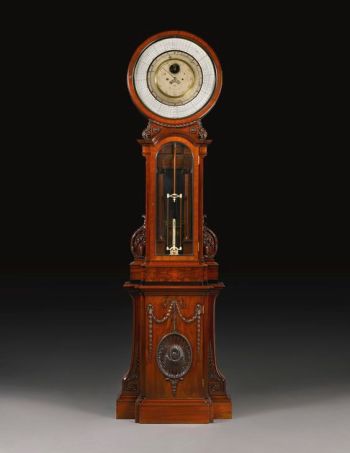
Alexander Cumming, George III Mahogany Longcase Barograph Regulator, London, 1766, with a case likely by Thomas Chippendale (London: Science Museum).
A rare Georgian clock, capable of recording changes in air pressure and used at the dawn of climate science, has been acquired for the nation by the Science Museum. The acquisition of this exceptional clock was made possible by a grant from Art Fund and was purchased through Sotheby’s. Dated 1766, the barograph clock is one of only four of its type that highly-regarded London clockmaker Alexander Cumming is known to have constructed. It was used by renowned meteorologist Luke Howard to conduct some of the world’s first urban climate studies.
Following Cumming’s death in 1814, Luke Howard purchased the clock and used it for observations of atmospheric pressure at his homes in London and Ackworth, a crucial project in the emergence of climate science. The data from the barograph traces, accompanied by notes on global weather events and descriptions of the clock, were published in the book Barometrographia in 1847. Howard’s life’s work has earned him the nickname ‘the father of scientific meteorology’.
Inside the imposing 7ft 2in-high decorated case, thought to be made by famed London cabinet maker Thomas Chippendale, is a barograph mechanism used for measuring air pressure. The barograph comprises two tubes of mercury in which a float rises and falls as atmospheric pressure changes. This data is recorded on the clock dial, which rotates once a year. A fine example of the technical innovations of the Georgian period, the clock was designed by Cumming using ideas first outlined by Royal Society founding member Robert Hooke. It has featured in previous exhibitions at the Science Museum as a loan and curators are now planning a permanent display.
Ian Blatchford, Director of the Science Museum Group, said of the acquisition “Nothing beats the marriage of an exquisite object and an enquiring mind. We are delighted to have been able to save the barograph clock so that we can share the story of Luke Howard’s contribution to climate science with future generations.”
During the Georgian period, scientific practice was often presented in public as a high-status activity expressed through ornately decorated and very finely constructed instruments such as this, and in fact the first barograph clock that Cumming constructed was commissioned by King George III as a prime example of his pursuit of Enlightenment.










 Enfilade
leave a comment