Exhibition | Humphry Repton at Woburn Abbey
Now on view at Woburn Abbey:
Humphry Repton: Art & Nature for the Duke of Bedford
Woburn Abbey, 23 March — 28 October 2018
Curated by Matthew Hirst and Victoria Poulton
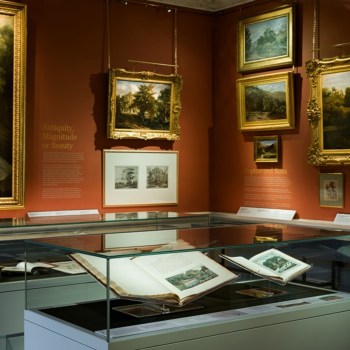 When the 6th Duke of Bedford inherited Woburn in 1802, he commissioned the famous landscape gardener, Humphry Repton (1752–1818), to create designs to enhance the gardens and parkland. 2018 celebrates the bicentenary of Humphry Repton.
Recognised as the first person to invent and use the title ‘landscape gardener’, Humphry Repton regarded himself as the rightful successor to Lancelot ‘Capability’ Brown. Repton produced over 400 designs and schemes for gardens great and small, but of these, he stated, “none were more fully realised than at Woburn Abbey.” He published his theories in two influential books, Observations on the Theory and Practice of Landscape Gardening (1803), and Fragments on the Theory and Practice of Landscape Gardening (1816). In these, he promotes his style and references his important work for the Duke of Bedford.
With the Duke being Repton’s most important client, at a time of declining commissions, the Woburn Red Book is one of his largest works. It contains Repton’s most ambitious and detailed designs covering the approaches to the Abbey, the lakes and plantings in the surrounding parkland, and the formal Pleasure Grounds.

The Rockery and Chinese Pavilion at Woburn Abbey; the pavilion was constructed in 2011.
Open to the public between 23rd March and 28th October 2018, the new exhibition explores the fascinating relationship between Repton and one of his greatest clients. On public display for visitors to see for the first time will be his most elaborate and comprehensive Red Book. In addition, the exhibition will give visitors the opportunity to discover Repton’s other works for the family including at the picturesque Devon estate of Endsleigh, Oakley House, and Russell Square in London. Never before seen unexecuted designs will feature alongside works of art and archival treasures, which bring to life the creative legacy of Repton. There will also be Repton-related family trails, activities, and events throughout the year.
Having explored the Repton’s legacy in the exhibition, visitors need only step outside to discover Repton’s beautiful landscape designs. Since 2004 the present Duke and Duchess of Bedford have been restoring many of Repton’s features in the Woburn Abbey Gardens. These include the folly grotto, the Cone House, the menagerie, and the striking Chinese-style pavilion, which was completed in 2011 and went on to win a Hudson’s Heritage Award. In 2013, Woburn’s project to restore the 19th-century Humphry Repton landscape won the ‘Best Restoration of a Georgian Garden’ at the Georgian Group Architectural Awards. Other Repton features in the Woburn landscape include the Aviary, set to be further restored in 2018, and the Doric Temple.
New Book | Stowe House
From Scala Publishers:
Nick Morris, Stowe House: Saving an Architectural Masterpiece (London: Scala Arts & Heritage Publishers, 2018), 160 pages, ISBN: 978-1785511110, £20 / $28.
 The restoration of Stowe House and development of the surrounding estate by Stowe School, allied to work in the landscape gardens by the National Trust, is one of the greatest rescues of a country house ever achieved. The ancestral home of the Temple-Grenvilles came close to demolition in 1920, when the entire site was put up for sale. The formation of Stowe School in 1923 secured a future use that maintained the traditions of the Enlightenment with its unrelenting quest for knowledge and understanding. The past 94 years have seen innovation in land management with the gifting of the gardens to the National Trust and a renovation programme of truly monumental proportions. This book details the architectural history of the site, tells the story of the restoration through the words of those most closely involved, and demonstrates how the School has continued to build in a sympathetic and harmonious manner that preserves the estate’s identity and character.
Nick Morris, Stowe House’s Chief Executive Officer who has managed restoration work there for the past eight years, has drawn together contributions from leading experts to produce an authoritative work that looks behind the creation of the house, charting the continuing evolution of the site and demonstrating the care taken to ensure authenticity throughout the £40m restoration programme. As Stowe School’s Operations Director from 2009 to 2017, he was closely involved in the School’s building projects and management of the site.
Exhibition | Lost Treasures of Strawberry Hill
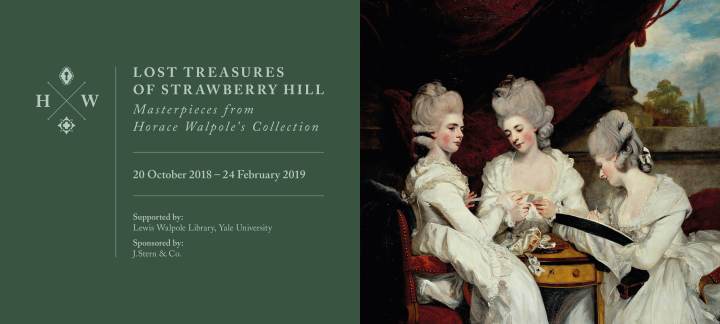
Joshua Reynolds, Portrait of the Ladies Waldegrave, 1780-81, oil on canvas, 143 × 168 cm (Edinburgh: National Galleries of Scotland, purchased with the aid of The Cowan Smith Bequest and the Art Fund 1952).
◊ ◊ ◊ ◊ ◊
This fall at Strawberry Hill:
Lost Treasures of Strawberry Hill
Strawberry Hill House & Garden, Twickenham, 20 October 2018 — 24 February 2019
Curated by Silvia Davoli and Michael Snodin
This exhibition brings back to Strawberry Hill some of the most important masterpieces in Horace Walpole’s famous and unique collection for a once-in-a-lifetime exhibition. Horace Walpole’s collection was one of the most important of the 18th century. It was dispersed in a great sale in 1842. For the first time in over 170 years, Strawberry Hill can be seen as Walpole conceived it, with the collection in the interiors as he designed it, shown in their original positions.
Strawberry Hill was filled with a celebrated collection of paintings, furniture, sculptures, and curiosities: great portraits by Sir Joshua Reynolds, Sir Peter Lely, Allan Ramsay, Rubens, Van Dyck, Hans Holbein, and Clouet; miniature portraits by Isaac and Peter Oliver, Hilliard and Petitot, a carved Roman eagle from the 1st century AD; fine furniture including a Boulle cabinet, fabulous Sèvres pieces as well as some oddities such as a lime-wood cravat, carved by Grinling Gibbons, a lock of Mary Tudor’s hair and a ‘magic mirror’ (an obsidian disc) which Dr Dee, Queen Elizabeth I’s necromancer, had used for conjuring up the spirits.
 In 1842, the collection was dispersed worldwide in a 28-day ‘sale of the century’. From the 1920s to the ‘70s, Walpole scholar and consummate collector Wilmarth S. Lewis, who edited and published with Yale University Press the 48-volume Yale Edition of Horace Walpole’s Correspondence (New Haven, 1937–83), assembled the largest private collection of Walpoliana, including many pieces from Strawberry Hill, which he and his wife bequeathed to Yale University in 1980 as the Lewis Walpole Library, with whose help the Strawberry Hill Trust is delighted to be mounting this exhibition.
Walpole left detailed descriptions of the displays in each of the main rooms of his villa, so that nearly all the works can be shown in their original positions. In The Great Parlour, a display of portraits of Walpole’s family includes the famous Reynolds’s painting of Walpole’s nieces, The Ladies Waldegrave, (now in the National Gallery of Scotland). The Tribune will house the famous rosewood cabinet designed by Walpole, owned by the V&A, together with a display of exquisite portrait miniatures. Walpole’s gilded, crimson Gallery will be once again house the impressive Roman sculpture of an eagle and be hung with life-size portraits, including The Family of Catherine de Medici by Clouet.
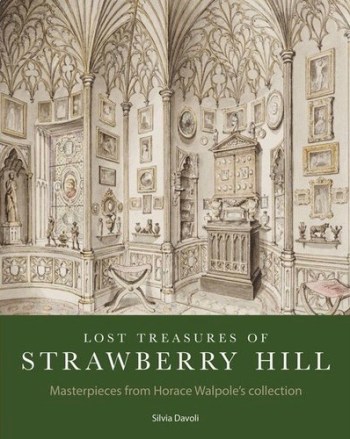
Silvia Davoli, Lost Treasures of Strawberry Hill: Masterpieces from Horace Walpole’s Collection (London: Scala Arts & Heritage Publishers, 2018), ISBN: 9781785511806, £15.
Print Quarterly, June 2018
The eighteenth century in the current issue of Print Quarterly:
Print Quarterly 35.2 (June 2018):

Juan Camarón, Robinson in his Llama Skin Habit and Parasol, 1788–89, brush and grey wash, 110 × 65 mm (London, British Library).
A R T I C L E S
• Benito Navarrete Prieto and Alejandro Martínez Pérez, “Drawings for the Spanish Robinson Crusoe by José Juan Camarón and Rafael Ximeno,” pp. 160–72.
The article addresses newly identified drawings by José Camarón and Rafael Ximeno for the seminal Spanish edition of Robinson Crusoe by Tomás de Iriarte, published in Madrid in 1789. The presence of the drawing for the map and the narrative illustrations among Iriarte’s papers underscore the poet’s close involvement with the book’s production and illustration.
• Kate Heard, “The Royal Collection of Satirical Prints in the Nineteenth and Twentieth Centuries,” pp. 173–82.
In describing the the history of the collection of satirical prints in Britain’s royal collection before their sale in 1921 to the Library of Congress, the article explains the origins of the collection under George III, its development most famously under George IV, its continued growth under Queen Victoria and Prince Albert—when Georgian works entered the collection that would not have been acquired earlier, including prints that were critical of the royal family—and finally the disfavor the collection solicited during the reign of George V from the royal librarian John Fortescue, who brokered the 1921 sale.
N O T E S A N D R E V I E W S
• Celina Fox, Review of Bernard Nurse, London: Prints and Drawings before 1800 (Bodleian Library, 2017), pp. 198–200.
• Susan Sloman, Review of Ann Gunn, The Prints of Paul Sandby (1731–1809): A Catalogue Raisonné (Brepols and Harvey Miller Publishers, 2016), pp. 200–03.
• Flavia Pesci, Review of the exhibition catalogue Nicholas Stanley Price, At the Foot of the Pyramid: 300 Years of the Cemetery for Foreigners in Rome (Casa di Goethe Museum, 2016), pp. 203–04.
• Mark McDonald, Review of the catalogue Peter Raissis, Prints and Drawings: Europe 1500–1900 from the Art Gallery of New South Wales (Art Gallery of New South Wales, 2014), pp. 204–06.
• Charles Newton, Review of Elisabeth Fraser, Mediterranean Encounters: Artists between Europe and the Ottoman Empire, 1774–1839 (Pennsylvania State University Press, 2017), pp. 206–09.
◊ ◊ ◊ ◊ ◊
Note (added 6 June 2018) — The original posting did not include descriptions for the two articles.










 Enfilade
leave a comment