Call for Papers | After the Grand Tour
From H-ArtHist:
After the Grand Tour: References, Revisions, Returns
Accademia Nazionale di San Luca, Rome, 12 April 2019
Proposals due by 15 November 2018
Ninth edition of the international symposium Grand Tour del Terzo Millennio: Researches on Art and Architectural History by Foreign Scholars and Artists in Rome. Previous editions were held at the University of Rome – Tor Vergata; this year’s symposium will be curated by the Rome Art History Network (RAHN) with the generous support of the Accademia Nazionale di San Luca and the Bibliotheca Hertziana – Max Planck Institute for Art History (Rome). It is organized by Iacopo Benincampi and Arianna Carannante, in collaboration with Anne Scheinhardt.
Between the eighteenth and the first half of the nineteenth century, Rome represented the main international cultural center of Europe. Consequently, many young and passionate ‘amateurs’ continued to go there, just to get closer to art as well as to specialize in their profession as artists. However, due to the political weakness of the Papal government, travelers did not set a permanent base in the city. They went back home with the certainty that their acquired knowledge would confer them a favorable advantage in the exercise of their profession. After all, the repertory of Roman sources remained an essential point of cultural reference for the construction, completion, and legitimation of modern identities in Europe. These were translated in an open-air catalogue of themes, formal models, and technical solutions with the power to inspire innovative elaborations, and to catalyze new compositional and constructional experiments.
Rome’s distinctiveness in this regard fostered its international significance and acted as an incentive for the foundation of foreign academies. To this day these institutions are a cultural compass for the scientific and artistic exploration of the city of Rome. The objective of this conference is to reflect on the inheritance of the experience of the Grand Tour, especially within the realm of the figurative arts and architecture. Our aim is to create a platform for comparing and reflecting on models of research by foreigners and Italian scholars in Rome.
Which instances of Rome’s artistic output—from contemporary and/or previous times—captured the interest of visitors and artists between the eighteenth and nineteenth centuries? What were the privileged mediums of their documentation (sketches, drawings, and so forth)? Once they returned home, which Roman works did Grand Tourists take as models for local experimentation, and how did these references come to be developed? What role did religious and lay patrons play in this regard? What social networks did they form during their Roman sojourn? What contacts did they maintain? Did anyone stay or return at a later point?
These themes will be addressed during the conference which will be held on 12th of April. Especially fellows, doctoral students, postdoctoral scholars, and professors in history of art and architecture from foreign institutions are invited to send proposals related to these themes.
Please send an abstract in Italian or English of 2,500 characters max (spaces included) and a bio of 1,500 characters max (spaces included) to convegno.grandtour@gmail.com by the 15th of November 2018. We will consider the possibility of publishing the conference proceedings.
New Book (and Film) | Peterloo
From Head of Zeus Books:
Jacqueline Riding, Peterloo: The Story of the Manchester Massacre (London: Head of Zeus, 2018), 400 pages, 400 pages, ISBN: 978-1786695833, £30.
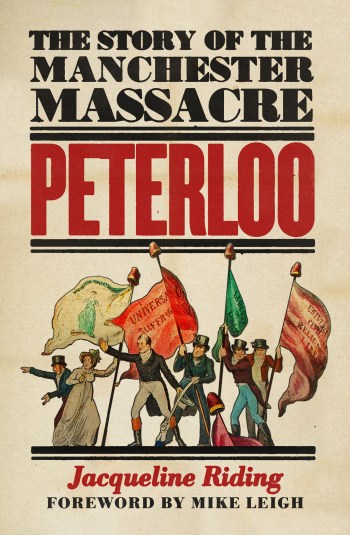 Manchester, August 1819: 60,000 people had gathered in the cause of parliamentary reform. To those defending the status quo, the vote was not a universal right, but a privilege of wealth and land ownership. To radical reformers the fundamental overhaul of a corrupt system was long overdue. The people had come to hear one such reformer, Henry Hunt, from all over Lancashire, walking to the sound of hymns and folk songs. By the end of the day fifteen of them, including two women and a child, were dead or mortally wounded, and 650 injured, hacked down by drunken yeomanry after local magistrates panicked at the scale of the meeting. The British state, four years after defeating the ‘tyrant’ Bonaparte at Waterloo, had turned its forces against its own people, as they peaceably exercised their liberties.
Dr Jacqueline Riding’s compelling book ties in to Mike Leigh’s forthcoming film Peterloo, for which the author was historical advisor, in advance of the bicentenary of Peterloo in 2019.
Jacqueline Riding is author of the award-winning Jacobites: A New History of the ‘45 Rebellion. She is a consultant for museums, galleries and historic buildings, and an historical adviser on feature films.
◊ ◊ ◊ ◊ ◊
According to Wikipedia, the film is “scheduled to be released in the United Kingdom on 2 November 2018, by Entertainment One, and in the United States on 9 November 2018, by Amazon Studios.”
Exhibition | Rosetsu: Ferocious Brush

Nagasawa Rosetsu, Tiger, 1786 door panels from the Zen Temple Muryōji, Kushimoto.
◊ ◊ ◊ ◊ ◊
From the press release for the exhibition:
Rosetsu: Ferocious Brush / Rosetsu: Fantastische Bilderwelten aus Japan
Museum Rietberg, Zurich, 6 September — 4 November 2018
Curated by Khanh Trinh and Matthew McKelway
For eight weeks, Japan’s most famous tiger will reside exclusively at Museum Rietberg in Zurich. The story goes that the Japanese artist Nagasawa Rosetsu (1754–1799) painted this monumental tiger together with its counterpart, a dragon, on the sliding door panels of the Zen temple Muryōji in a single night in the year 1786. Now the entire temple’s painted walls and a number of other, awe-inspiring masterpieces by Rosetsu are being shown for the first time outside of Japan. Rosetsu’s highly dynamic paintings created with vigorous brushstrokes and sometimes with his fingers, but also his delicate compositions painted with fine brushes and rich colour are replete with energy, wit, and modern appeal.
Renowned as one of the most eccentric and imaginative artists in early modern Japan, Nagasawa Rosetsu (1754–1799) produced visually exciting, classification-defying works during his brief career. The exhibition Rosetsu: Ferocious Brush unravels the many mysteries of this enigmatic career. An exclusive and expert selection of works by Rosetsu chosen in consultation with the Agency for Cultural Affairs of the Government of Japan (Bunkachō) reveals his painting subjects, his relationship to Zen Buddhism, his contacts with patrons outside Kyoto, and his choice of extraordinarily bold images.

The exhibition at the Rietberg Museum will survey Rosetsu’s art through a selection of sixty of his most important paintings, beginning with the earliest works in the realist style of his teacher Maruyama Ōkyo (1733–1795) and ending with the haunting and occasionally bizarre final masterpieces of his career. Screen paintings, scrolls, and albums depicting Zen eccentrics, children at play, ethereal beauties, breathtaking landscapes, and vivacious animals and birds will take viewers on a journey through Rosetsu’s own travels and into his fantastic imagination. These works, some of them compellingly realistic and others surprisingly abstract, take us into an early modern Japan we did not know and which feels very contemporary.
The highlight of the exhibition will be a magnificent ensemble of 48 screens and hanging scrolls, displayed in a recreated original floorplan of the Zen temple Muryōji. This Zen temple in the southern part of Japan’s main island holds the largest and most important collection of Rosetsu’s paintings, created in 1786. Various stories recount the creation of this breathtaking ensemble. The installation of these works would present an unprecedented opportunity to view and examine the paintings in a single venue outside their home in Kushimoto, and indeed the first such installation of architecturally specific paintings in an exhibition outside Japan.
Approximately one-third of the works to be exhibited are registered as Important Cultural Properties or Important Art Objects. Complementing these masterpieces from Japan, paintings from museums, temples, and private collections in Japan, Europe, and the United States trace the phases of Rosetsu’s life as he pursued his livelihood in Kyoto and the surrounding provinces. The exhibition closes with a dramatic display of abstract landscapes, ghosts, and perhaps his most astonishing work of all, a depiction of 500 Disciples of the Buddha on a surface of only one square inch.
Rosetsu, who hailed from a low-ranking samurai family, gained his reputation among art circles in the imperial capital Kyoto and its neighbouring regions with his untamed personality and his unusual talent. The exhibits run the gamut of formats and subjects, from exquisitely executed scrolls depicting birds and flowers in brilliant polychrome pigments to large-scale sliding doors and folding screens with fantastic landscapes, bizarre figures, and adorable animals. With his unconventional compositions and powerful brushwork Rosetsu always offers a fresh take on traditional subject matter. His paintings never fail to surprise, entertain, and charm.
The show at the Museum Rietberg is the first comprehensive presentation ever to take place outside of Japan. The exhibition is jointly curated by Dr Khanh Trinh, Curator of Japanese art, Museum Rietberg, Zurich, and Professor Matthew McKelway, Takeo and Itsuko Atsumi Professor of Japanese art history; director of the Mary Griggs Burke Center for Japanese Art, Columbia University in the City of New York.
Khanh Trinh and Matthew McKelway, Rosetsu: Ferocious Brush (London: Prestel, 2018), 296 pages, ISBN: 978-3791357263, $60 / £45. Also available in German.
Symposium | Rosetsu in Context
From H-ArtHist:
Rosetsu in Context
Museum Rietberg, Zurich, 7 October 2018

Nagasawa Rosetsu, Scholars Crossing a Bridge, 1788–89, ink and color on paper, hanging scroll, 47 × 21 inches (San Diego Museum of Art).
Eighteenth-century Japan witnessed an unprecedented diversity in artistic expression, nourished by the flourishing of a sophisticated urban culture and the increased affluence of the population in provincial areas. This symposium presents an array of fresh perspectives on issues of art production and consumption as well as leading figures of the art scene that constitute the environment in which Nagasawa Rosetsu (1754–1799) lived and worked.
Organised with the support of the Mary Griggs Burke Center for Japanese Art, Columbia University, in conjunction with the special exhibition Rosetsu: Ferocious Brush, on view at the Museum Rietberg Zurich, 6 September — 4 November 2018. While participation in the symposium is free of charge, a registration is required.
P R O G R A M M E
9.30 Doors open
10.00 Welcome by Albert Lutz (Director, Museum Rietberg)
10.10 Introduction by Khanh Trinh (Curator of Japanese and Korean Art, Museum Rietberg)
10.30 Noguchi Takeshi (Chief Curator, Nezu Museum), The Tiger and Departure from Realistic Representation: Nagasawa Rosetsu in Comparison to his Master Maruyama Ōkyo
11.10 Break
11.30 Alexander Hofmann (Curator for Japanese Art, Asian Art Museum, State Museums Berlin), The Genius and the Bores – Or: Whatever Happened to Rosetsu’s Contemporary Academic Painters?
12.10 Lunch and exhibition viewing
14.00 Yukio Lippit (Professor, Harvard University), From Kisō to Kijin: Reconsidering Eccentricity through Ike no Taiga’s Two Chinese Poets
14.40 Kadowaki Mutsumi (Visiting Professor, Osaka University), Itō Jakuchū and Zen
15.20 Break
15.40 Matthew McKelway (Professor, Columbia University), Nagasawa Rosetsu and Zen
16.30 Questions and panel discussion
Symposium | Rethinking the Life and Work of Rosetsu
From H-ArtHist:
Rethinking the Life and Work of Nagasawa Rosetsu
University of Zurich, 20–21 October 2018
The Japanese painter Nagasawa Rosetsu (1754–1799) has increasingly been a source of interest during the last years from popular and academic audiences with numerous exhibitions in Japan and in the West. Rosetsu has long been a name in Western studies of Japanese art, starting with a groundbreaking exhibition at the Denver Art Museum in 1973 and the publication by Robert Moes from the same year. Presently he is represented at an outstanding exhibition at the Museum Rietberg, Zurich, that feature key works of the artists, seldom seen outside of Japan.
Rosetsu has been the center of controversy over a long time, from the different versions of his contested biography to the questions of how to interpret the artist and his work. For decades he has been relegated to a list of eccentric artists, which serves little but to obscure a serious discussion of the artist and his remarkable works. At this time of great popularity and exposure to the public in the East and the West, a rethinking of the artist and his works seems highly overdue.
For this purpose, the University of Zurich has invited the top Japanese scholars who have been working on Rosetsu over the last years. We have planned a two-day conference with presentations and discussions and are inviting both younger and more established scholars, including Professors Yasuhiro Satō and Motoaki Kōno, who has been working on Rosetsu since the 1970s. Among the younger stars in the field, we are inviting Momo Miyazaki and Hideyuki Okada who have recently changed Rosetsu scholarship in significant ways.
The aim is to gather these scholars and to have them engage with each other and pool their knowledge into meaningful discussions. The expected result of the conference is to spread wider knowledge of this outstanding artist among the scholarly community and among the public. We also hope that discoveries in the life and works of the artist will be a lasting result of this conference.
The symposium is free and open to the public. No prior registration is required. Presentations will be in Japanese and in English. Texts in English will be supplied for presentations held in Japanese. For questions, please contact the Section for East Asian Art: kgoa@khist.uzh.ch.
The symposium is organized by the Section for East Asian Art, University of Zurich, and is funded by the Swiss National Science Foundation, the Swiss-Japanese Society, and the University of Zurich Foundation (Hochschulstiftung).
S A T U R D A Y , 2 0 O C T O B E R 2 0 1 8
10:15
佐藤康宏 Satō Yasuhiro, University of Tokyo
「長澤蘆雪における〈反動〉― 應舉の氷を破る」/ Rosetsu’s Backlash: Breaking the Ice of Ōkyo
11:15
野口剛 Noguchi Takeshi, 根津美術館 Nezu Art Museum
「月光」と詩情の回復:師・円山応挙との比較による長沢芦雪に関する考察 / Moonlight and the Return of Sentiment: Nagasawa Rosetsu in Comparison to His Master Maruyama Ōkyo
14:15
岡田秀之 Okada Hideyuki, 嵯峨嵐山日本美術研究所 Saga-Arashiyama Institute for Japanese Art
「芦雪の初期作品について」/ On the Early Works by Rosetsu
15:45
河野元昭 Kōno Motoaki, 静嘉堂文庫 Seikadō Bunko Art Museum
「私が見てきた長澤蘆雪受容の変化」/ Changes in Rosetsu Reception That I Have Observed Over the Years
16:45
中谷伸生 Nakatani Nobuo, Kansai University
「芦雪と大坂画壇」/ Osaka Painters and Rosetsu
S U N D A Y , 2 1 O C T O B E R 2 0 1 8
14:00
宮崎ももMiyazaki Momo, 大和文華館 Yamato Bunkakan
「芦雪の指頭画をめぐって」/ On the Finger Paintings of Rosetsu
15:00
Hans Bjarne Thomsen, University of Zurich
The Kansai Eccentric
16:30
筒井忠仁 Tsutsui Tadahito, 文化庁Agency for Cultural Affairs
「南紀から広島へ―長澤蘆雪の画風の変遷と精神の変容―」/ From Nanki to Hiroshima: The Transition of the Nagasawa Rosetsu’s Style and the Transformation of his Spirit
Call for Papers | Performance, Royalty, and the Court, 1500–1800
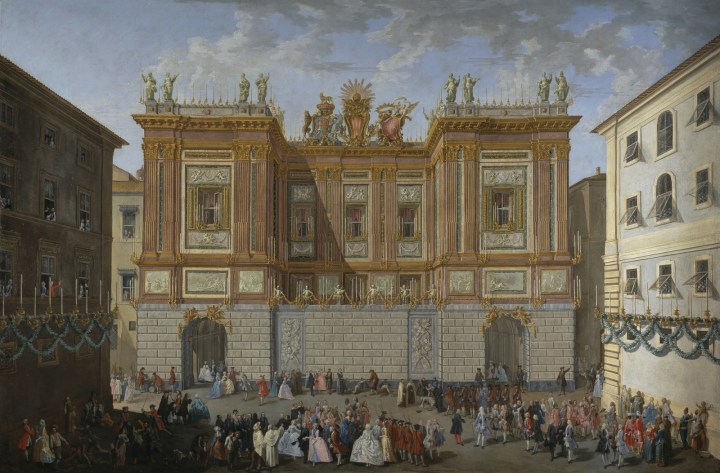
Paolo Monaldi, Prince James Receiving his Son Prince Henry in front of the Palazzo del Re, ca. 1747–48, oil on canvas, 196 × 297 cm (National Galleries of Scotland). The Palazzo del Re was home to the exiled Jacobite court in Rome. Owned by the Muti family, it was rented by the Papacy for the Old Pretender, James.
◊ ◊ ◊ ◊ ◊
From the Call for Papers:
Performance, Royalty, and the Court, 1500–1800
Society for Court Studies Conference
Paul Mellon Centre for Studies in British Art, London, 11–12 April 2019
Proposals due by 7 December 2018
Next year is the 400th anniversary of the death of Anne of Denmark (1574–1619), a queen consort of the king of Scotland, England, and Ireland, who is well known for her patronage of art, architecture, and court entertainments, in particular masques devised by Ben Jonson and Inigo Jones. To mark this important anniversary, The Society for Court Studies, with the support of the Paul Mellon Centre for Studies in British Art and Birkbeck College School of Arts, is organizing a two-day conference focusing on performance and the courts of the British Isles and continental Europe during the early modern period, with the opportunity to explore the networks and encounters between courts, both within and beyond Europe. The interdisciplinary nature of the topic necessarily embraces cultural, political and economic history, literature, and the visual and performing arts.
Performance was at the heart of the early modern period, with the court itself forming a stage for the construction, communication, and display of power and privilege—a world in which the social relationships that circulated around rulers, their families, and supporters took shape and found expression. Men and women played out a variety of important social, political, military, and governmental roles as well as participating in dramatic events, with court rituals and ceremonies providing occasions for demonstrations of authority, prowess, and magnificence. The architecture and decoration that surrounded the court, whether permanent or temporary, not only provided a physical setting but reinforced objectives and allegiances, as did dress, accoutrements, and entourage. The court also formed a rich source of inspiration for composers, playwrights, and actors—whether representing courts in their dramas, playing before the court, or devising masques and ballets with courtiers as performers. Equally, art and artistic patronage were of central importance, not only through the direct participation of painters, designers and craftsmen in ceremonies, dramas and other occasions, but also through portraiture and other forms of representation. Indeed, a work of art was often perceived and described as a performance.
In all its senses, performance represented opportunities for individuals and groups to find ways of expressing their ideals, their ambitions and aspirations, their frustrations and hostilities. This conference aims to bring this sense of opportunity to the study of the early-modern court, thinking in the broadest possible terms about how we can define our approaches and how, by taking the theme of performance as our guide, we can open up the study of the courtly world and its peoples to new scholarship and new audiences.
Suggested themes include, but are not restricted to:
• Political ritual and gift-giving
• Diplomacy, power play, and hospitality
• Gender and modes of performance
• Loyalties and affiliations
• Control and freedom
• Identity and values
• Court rituals and traditions
• Ceremonies, receptions, progresses and processions
• Reception, audience, and commentary
• Drama, dance, music, and speeches/addresses
• Cultural and social patronage
• Chivalric, sportive and martial performance (tournaments, barriers, manège)
• Trade, commerce, and entrepreneurship
• Visual arts as performance
• Architecture, interiors, settings and locations
Please send proposals of no more than 300 words along with a short biography to courtstudiesconference@gmail.com by Friday, 7 December 2018.
Convenors: Dr Janet Dickinson (Conference Secretary SCS and Oxford University) and Dr Jacqueline Riding (Committee Member SCS and Birkbeck College)
At Sotheby’s | Jewels Owned by Marie Antoinette
Press release, via Art Daily, for the auction at Sotheby’s:
Royal Jewels from the Bourbon Parma Family
Sotheby’s, Geneva, 14 November 2018, Sale GE1809

Natural pearl and diamond pendant, 18th century; set with an oval diamond supporting a diamond bow motif and a slightly baroque drop-shaped natural pearl measuring approximately 16 × 18 × 26mm, hook and hinged back fitting. Estimated at $1–2 million.
Sotheby’s unveiled additional highlights from one of the most important royal jewellery collections ever to be presented at auction. On 14 November 2018, in Geneva, royal jewels from the Bourbon Parma Family will be offered at auction for the first time, including treasures which belonged to France’s ill-fated queen, Marie Antoinette (1755–1793). During an international tour of public exhibitions in the coming weeks, jewellery lovers will be able to view these historic jewels, which carry with them more than 200 years of European history.
An initial announcement in June captured the world’s imagination, when it was revealed that Sotheby’s would offer this extraordinary collection of treasures in Geneva. The sale includes pieces which can be traced back to Marie Antoinette led by an extraordinary diamond and natural pearl pendant estimated at $1–2 million, as well treasures from her brother-in-law, King Charles X of France (1757–1836), the Archdukes of Austria and the Dukes of Parma.
Jewels of Marie Antoinette
Never in the course of history has the destiny of a queen been so closely associated with jewels than that of Marie Antoinette. Her great love of pearls and diamonds is well-known and a number of historians have cited Napoleon’s view, that the so-called ‘affair of the diamond necklace’—a scandal which tarnished the queen’s reputation in 1785—was one of the causes of the French Revolution.
The impressive ensemble of jewels to be offered this autumn has an extraordinary story. In March 1791, King Louis XVI, Marie Antoinette and their children began to prepare their escape from France. According to accounts written by Marie Antoinette’s lady in waiting, Madame Campan, the queen spent an entire evening in the Tuileries Palace wrapping all of her diamonds, rubies, and pearls in cotton and placing them in a wooden chest. In the following days, the jewels were sent to Brussels, which was under the rule of the queen’s sister, Archduchess Marie-Christine and which was home to Count Mercy Argentau. The count, the former Austrian Ambassador to Paris, was one of the only men who had retained the queen’s trust. It was he who took delivery of the jewels and sent them on to Vienna, into the safe keeping of the Austrian Emperor, Marie Antoinette’s nephew.
Altogether, the collection includes 10 jewels which belonged to Marie Antoinette.
In 1792, the royal family was imprisoned in the Temple tower. Louis XVI and Marie Antoinette were executed by guillotine in 1793 and their 10-year old son, Louis XVII, died in captivity. The king and queen’s only surviving child, Marie-Thérèse de France (1778–1851), ‘Madame Royale’, was released in December 1795, after three years of solitary confinement. After learning of the deaths of her mother and brother, she was sent to Austria. Upon her arrival in Vienna in 1796, she was given her mother’s jewels by her cousin, the emperor. Having borne no children of her own, Madame Royale bequeathed part of her jewellery collection to her niece and adopted daughter, Louise of France (1819–1864), Duchess of Parma and grand-daughter of Charles X, King of France (1757–1836), who in turn left them to her son, Robert I (1848–1907), the last ruling Duke of Parma.
In addition to the exquisite pearl jewels announced in June, several more pearl jewels to be offered in November belonged to Marie Antoinette, including a beautiful pair of natural pearl and diamond earrings (estimate $200,000–300,000). Also from Marie Antoinette is a superb single-strand natural pearl necklace (estimate $40,000–70,000).
A beautiful six-strand pearl necklace also provides a direct link to the iconic queen of France. Its clasp—which remains unaltered today—was part of her collection and features five large and 18 smaller natural pearls. In Marie Antoinette’s day, it formed the clasp of a six-row natural pearl bracelet, one of a pair. The necklace was commissioned by later generations of the Bourbon Parma family and strung with cultured pearls (estimate $5,000–8,000).
Five fascinating diamond jewels to be auctioned in November can be traced back to Marie Antoinette. Among them is a stunning diamond brooch from the late 18th century, featuring a beautiful yellow diamond. The double ribbon bow was formerly part of Marie Antoinette’s collection, and it is thought that the yellow diamond pendant was added at a later date (estimate CHF $50,000–80,000).
Created as a memento, a diamond ring bearing initials ‘MA’ for Marie Antoinette and containing a lock of her hair provides a fascinatingly intimate link to the queen. It is offered together with a ring with the monogram and hair of her father-in-law, Louis, Dauphin of France (1729–1765) who died before he could ascend the throne, and a diamond plaque bearing the monogram ‘MT’ set in diamonds, which refers to Marie-Thérèse of Savoie (1803–1879), Duchess of Parma and wife of Charles II, Duke of Parma (estimate for the two rings and plaque: $20,000–50,000).
By family tradition, the diamonds adorning this beautiful brooch belonged to Marie Antoinette. In her detailed inventory of the family’s jewels, Maria Anna of Austria (1882–1940), explains she was informed of the history of the brooch by her father-in-law, Robert I of Parma (1848–1907), who presented it to her on the occasion of her engagement to his son, Elie de Bourbon Parme (1880–1959) (estimate $95,000–140,000).
Also passed down through generations of Marie Antoinette’s descendants is a diamond ring decorated with her portrait, made in the late 18th century. In her will, Marie Antoinette’s daughter, Marie Thérèse de France (also known as Madame Royale), mentions that the portrait, which is set within a frame of pearls, is a likeness of her mother (estimate $8,000–12,000).
Marie Antoinette’s passion for Jewellery also extended to fine watches, as is evidenced by a pocket watch. Although the movement of the watch has been changed, its case—in blue enamel and encrusted with pearls—belonged to the queen. It bears the initials ‘M.A.’ on the inside of the case, along with three fleur de lys motifs (estimate $1,000–2,000).
Additional Jewels from the French Royal Family
The collection is also highlighted by jewels that belonged to King Charles X (1757–1836), the last King of France and last of the Bourbon rulers, his son, the Duke of Angoulême and their descendants. Resolutely conservative, accused by his own brother Louis XVI of being “plus royaliste que le roi” (more royalist than the king), Charles X revived a number of orders of chivalry that had been abolished during the French revolution and under Napoleon’s rule.
A breathtaking diamond tiara (estimate $350,000–550,000) offers a fascinating insight into how precious objects were disassembled in order to retrieve diamonds and gemstones, so they could be re-used as fashions evolved. The diamonds that adorn the tiara came from a badge of the Royal Order of the Holy Spirit, a French order of chivalry founded by King Henri III in 1578. The insignia was originally owned by Charles X, Marie Antoinette’s brother-in-law. The diamonds later passed to Robert I, Duke of Parma (1848–1907). The tiara was created using the precious stones around 1912 for Archduchess Maria Anna of Austria (1882–1940) by the celebrated Vienna jeweller Hübner, who designed it to allow the wearer to explore different styles: the fleur de lys motifs of this stunning piece can be detached and worn separately as brooches. The frame of Charles X’s order, which originally held the diamonds, has remained in the family and will also be offered in November (estimate $150-300).
Extraordinary in its workmanship and powerful symbolism, this jeweled badge of the Order of the Golden Fleece belonged to Louis Antoine of Bourbon, Duke of Angoulême (1775–1844), who married Marie-Antoinette’s daughter, his cousin. The Order of the Golden Fleece is widely considered to be the most prestigious and exclusive order of chivalry in the world. It is likely that Louis Antoine received the badge following his participation in the Spanish Expedition of 1823, thanks to which his cousin, Ferdinand of Bourbon was restored as absolute king of Spain. A sumptuous example of the order’s symbol, beneath a large white diamond this badge features the traditional French royal symbol, the oriflamme, represented by a central sapphire, surrounded by flames composed of rubies. The fleece of the ram forms the lower part of the jewel, realized in gold and diamonds (estimate $300,000–400,000).
Boasting the same extraordinary provenance, this plaque of the Royal Order of the Holy Spirit (right) was awarded to Louis Antoine, Duke of Angoulême before being passed down through the generations to Robert I, son of Charles III of Parma and Louise de France (and Marie Antoinette’s great-nephew). The most prestigious French order of chivalry during its 252 years of existence (1578–1830), it was abolished during the French Revolution, and then revived by Charles X who restored the ceremonies of the Order. The loop at the top of the badge (adorned with baguette- and round-cut diamonds) was designed so that the order could be worn on a tie without having to alter the jewel (estimate $100,000–150,000).
Royal Treasures of Austria
Sumptuous jewels passed down through the Bourbon Parma family from the imperial family of Austria will also be offered in November. A beautiful Burmese ruby and diamond set, composed of a brooch and a pair of earrings, dates from the turn of the last century. It conjures up images of the glamour and elegance of the Austrian court. Originally part of the collection of Queen Isabella II of Spain (1830–1904), the set was later purchased by Archduke and Archduchess Frédéric of Austria and inherited by their daughter, Maria Anna, Archduchess of Austria (1882–1940), who mentions it in her inventory of the family jewels (estimate $150,000–250,000).
A diamond bow brooch from the 18th century also stands out among the jewels from the Austrian side of the Bourbon-Parma family. It originally belonged to Empress Marie Thérèse of Austria (1717–1780), Marie Antoinette’s mother, and later to Archduke Rainier of Austria (1827–1913) before passing down through the family to Maria Anna. Its intricate design and workmanship illustrate the quality of jewels created for the royal family (estimate $75,000–110,000).
In her inventory, Maria Anna recorded that this delightful diamond brooch, with a yellow sapphire in its centre, originally belonged to her mother, Princess Isabella of Croÿ (1856–1931) (estimate $40,000–65,000). Maria Anna received these simple yet elegant diamond earrings from her father, Archduke Frédéric, on the occasion of her wedding in 1903 (estimate $50,000–80,000).
Tour Dates
Munich | 18 September
Hong Kong | 28 September – 2 October
Dubai | 7–9 October
New York | 12–16 October
London | 20–22 October
Singapore | 26–27 October
Taipei | 30–31 October
◊ ◊ ◊ ◊ ◊
Note (added 15 November 2018) — The pearl pendant, estimated to sell for up to $2million, fetched an extraordinary $36millon. The ten pieces auctioned reached a total of $42.7 million against a pre-sale estimate of $1.6–2.9 million. The post sale press release is available here.
Conference | Hadrian’s Villa and Its Reception
From Munich’s Zentralinstitut für Kunstgeschichte:
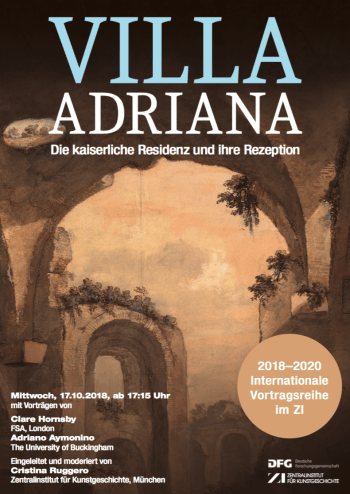
Villa Adriana: Die kaiserliche Residenz und ihre Rezeption
Zentralinstitut für Kunstgeschichte, Munich, 17 October 2018
 17:15 Cristina Ruggero (ZI, München), Bares für Rares: Antike aus der Hadriansvilla und der römische Kunstmarkt
17:45 Clare Hornsby (London), Man of Spirit, Man of Taste, Man of Fashion: Deciphering Identities of the British Collectors of Ancient Marbles
This talk will examine some examples of motivations for collecting: art as investment, response to peer pressure or fashion, ambition to form taste or to improve national standards; rarely were the motivations clear cut. The collectors included here will range from the politically ambitious commoner Bubb Dodington and his highly-placed dealer Cardinal Albani in the late 1740s, to the archetype of the nobleman collector the Earl of Shelburne, who acquired several pieces from Hadrian’s Villa in the 1760s and 70s. Others considered are the obsessively acquisitive gentleman-scholar Charles Townley and the banker-collector Lyde Browne, their activities furnishing us with a look at the role of the secondary market and the expansion of the mania for collecting. For all of these collectors, Hadrian’s Villa was the provenance par excellence for any ancient statue; reference will be made in this talk to some of the sculptures discovered there and how the British excavators and dealers used that provenance to add even further value to the perennial glamour of the ancient work of art.
18:30 Adriano Aymonino (The University of Buckingham), The Reception of Ancient Painting in the Eighteenth Century: Theoretical Debate, Antiquarian Publications, and the Visual Arts
This talk focuses on the nature of the relationship between the reception of ancient painting and the humanistic theory of art. It argues that this relationship was twofold: on the one hand, surviving textual evidence on Greek and Roman painting provided examples, tropes and principles that were instrumental in shaping art theory, from Leon Battista Alberti to Giovanni Pietro Bellori and the theoreticians of eighteenth-century classicism. On the other hand, the almost complete lack of physical remains of these artworks contributed to an idealised vision of ancient painting that was equally influential in defining some of the essential tendencies that shaped this theoretical tradition. Specifically, my paper will investigate how the relationship between theory and object evolved in the face of those new discoveries, publications and antiquarian ideas that proliferated over the course of the eighteenth century—with a particular focus on Hadrian’s Villa.
Additional information is available here»
Research Lunch | Nicole Cochrane on Classical Art in Britain
From the PMC:
Nicole Cochrane, Ancient Sculpture and the Narratives of Collecting: (Re)Contextualising the Collection and Display of Classical Art in Britain
Paul Mellon Centre for Studies in British Art, London, 5 October 2018

Joseph Wright of Derby, Academy by Lamplight, 1769, oil on canvas (New Haven: Yale Center for British Art, Paul Mellon Collection).
Collections of ancient art are an ever-present sight in British museums and art galleries, largely due to the efforts of the collecting practices of Britain’s wealthy, male elite. Through an exploration of private collections of ancient art and their transition to public display, this paper explores the implicit and explicit role of the individual collector on the reception of antiquity in the late eighteenth and nineteenth century museum. It will analyse how collection formation and display reinforced the connection between owner and object, irrevocably tying the collector with his possessions. Turning then to their museum contexts, arguing that the individual created a reception of the classical world which is always necessarily mediated by the narrative of the collector. It hopes to shed new light on the way we analyse the space and context of the public and private gallery, arguing that the identity and narrative of the collector continues to have an important, yet overlooked, effect on the way we understand the ancient world.
Research Lunches are a series of free lunchtime research talks. All are welcome, but please book a ticket in advance. 1:00–2:00pm, Seminar Room, Paul Mellon Centre.
Nicole Cochrane is a final year PhD candidate at the University of Hull as part of the AHRC Heritage Consortium. Her PhD explores the way we understand and interpret the ancient world within the museum environment, asserting the importance of the private collector and their private display as imbedding legacies and narratives of collecting on British museums and galleries of ancient art. As part of her PhD project, in 2016 she completed an internship at the Henry Moore Institute in Leeds proposing a project on the global history of sculpture collecting.










 Enfilade
leave a comment