Exhibition | Humphry Repton at Woburn Abbey
Now on view at Woburn Abbey:
Humphry Repton: Art & Nature for the Duke of Bedford
Woburn Abbey, 23 March — 28 October 2018
Curated by Matthew Hirst and Victoria Poulton
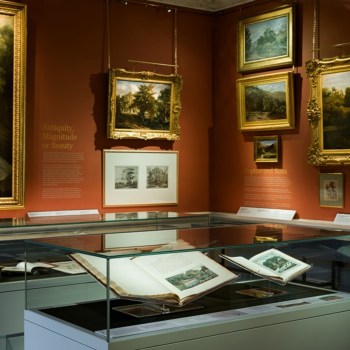 When the 6th Duke of Bedford inherited Woburn in 1802, he commissioned the famous landscape gardener, Humphry Repton (1752–1818), to create designs to enhance the gardens and parkland. 2018 celebrates the bicentenary of Humphry Repton.
Recognised as the first person to invent and use the title ‘landscape gardener’, Humphry Repton regarded himself as the rightful successor to Lancelot ‘Capability’ Brown. Repton produced over 400 designs and schemes for gardens great and small, but of these, he stated, “none were more fully realised than at Woburn Abbey.” He published his theories in two influential books, Observations on the Theory and Practice of Landscape Gardening (1803), and Fragments on the Theory and Practice of Landscape Gardening (1816). In these, he promotes his style and references his important work for the Duke of Bedford.
With the Duke being Repton’s most important client, at a time of declining commissions, the Woburn Red Book is one of his largest works. It contains Repton’s most ambitious and detailed designs covering the approaches to the Abbey, the lakes and plantings in the surrounding parkland, and the formal Pleasure Grounds.

The Rockery and Chinese Pavilion at Woburn Abbey; the pavilion was constructed in 2011.
Open to the public between 23rd March and 28th October 2018, the new exhibition explores the fascinating relationship between Repton and one of his greatest clients. On public display for visitors to see for the first time will be his most elaborate and comprehensive Red Book. In addition, the exhibition will give visitors the opportunity to discover Repton’s other works for the family including at the picturesque Devon estate of Endsleigh, Oakley House, and Russell Square in London. Never before seen unexecuted designs will feature alongside works of art and archival treasures, which bring to life the creative legacy of Repton. There will also be Repton-related family trails, activities, and events throughout the year.
Having explored the Repton’s legacy in the exhibition, visitors need only step outside to discover Repton’s beautiful landscape designs. Since 2004 the present Duke and Duchess of Bedford have been restoring many of Repton’s features in the Woburn Abbey Gardens. These include the folly grotto, the Cone House, the menagerie, and the striking Chinese-style pavilion, which was completed in 2011 and went on to win a Hudson’s Heritage Award. In 2013, Woburn’s project to restore the 19th-century Humphry Repton landscape won the ‘Best Restoration of a Georgian Garden’ at the Georgian Group Architectural Awards. Other Repton features in the Woburn landscape include the Aviary, set to be further restored in 2018, and the Doric Temple.
New Book | Stowe House
From Scala Publishers:
Nick Morris, Stowe House: Saving an Architectural Masterpiece (London: Scala Arts & Heritage Publishers, 2018), 160 pages, ISBN: 978-1785511110, £20 / $28.
 The restoration of Stowe House and development of the surrounding estate by Stowe School, allied to work in the landscape gardens by the National Trust, is one of the greatest rescues of a country house ever achieved. The ancestral home of the Temple-Grenvilles came close to demolition in 1920, when the entire site was put up for sale. The formation of Stowe School in 1923 secured a future use that maintained the traditions of the Enlightenment with its unrelenting quest for knowledge and understanding. The past 94 years have seen innovation in land management with the gifting of the gardens to the National Trust and a renovation programme of truly monumental proportions. This book details the architectural history of the site, tells the story of the restoration through the words of those most closely involved, and demonstrates how the School has continued to build in a sympathetic and harmonious manner that preserves the estate’s identity and character.
Nick Morris, Stowe House’s Chief Executive Officer who has managed restoration work there for the past eight years, has drawn together contributions from leading experts to produce an authoritative work that looks behind the creation of the house, charting the continuing evolution of the site and demonstrating the care taken to ensure authenticity throughout the £40m restoration programme. As Stowe School’s Operations Director from 2009 to 2017, he was closely involved in the School’s building projects and management of the site.
Exhibition | Lost Treasures of Strawberry Hill
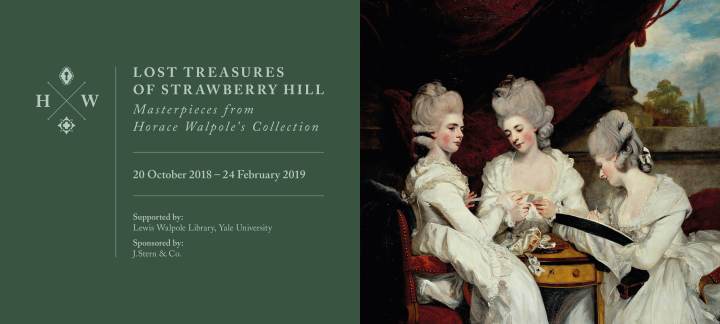
Joshua Reynolds, Portrait of the Ladies Waldegrave, 1780-81, oil on canvas, 143 × 168 cm (Edinburgh: National Galleries of Scotland, purchased with the aid of The Cowan Smith Bequest and the Art Fund 1952).
◊ ◊ ◊ ◊ ◊
This fall at Strawberry Hill:
Lost Treasures of Strawberry Hill
Strawberry Hill House & Garden, Twickenham, 20 October 2018 — 24 February 2019
Curated by Silvia Davoli and Michael Snodin
This exhibition brings back to Strawberry Hill some of the most important masterpieces in Horace Walpole’s famous and unique collection for a once-in-a-lifetime exhibition. Horace Walpole’s collection was one of the most important of the 18th century. It was dispersed in a great sale in 1842. For the first time in over 170 years, Strawberry Hill can be seen as Walpole conceived it, with the collection in the interiors as he designed it, shown in their original positions.
Strawberry Hill was filled with a celebrated collection of paintings, furniture, sculptures, and curiosities: great portraits by Sir Joshua Reynolds, Sir Peter Lely, Allan Ramsay, Rubens, Van Dyck, Hans Holbein, and Clouet; miniature portraits by Isaac and Peter Oliver, Hilliard and Petitot, a carved Roman eagle from the 1st century AD; fine furniture including a Boulle cabinet, fabulous Sèvres pieces as well as some oddities such as a lime-wood cravat, carved by Grinling Gibbons, a lock of Mary Tudor’s hair and a ‘magic mirror’ (an obsidian disc) which Dr Dee, Queen Elizabeth I’s necromancer, had used for conjuring up the spirits.
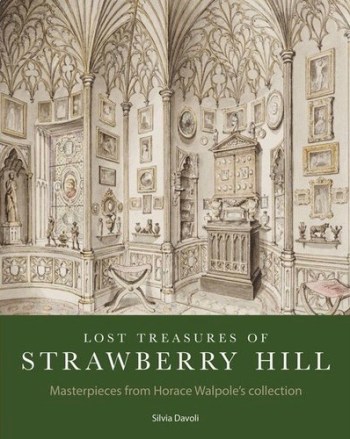 In 1842, the collection was dispersed worldwide in a 28-day ‘sale of the century’. From the 1920s to the ‘70s, Walpole scholar and consummate collector Wilmarth S. Lewis, who edited and published with Yale University Press the 48-volume Yale Edition of Horace Walpole’s Correspondence (New Haven, 1937–83), assembled the largest private collection of Walpoliana, including many pieces from Strawberry Hill, which he and his wife bequeathed to Yale University in 1980 as the Lewis Walpole Library, with whose help the Strawberry Hill Trust is delighted to be mounting this exhibition.
Walpole left detailed descriptions of the displays in each of the main rooms of his villa, so that nearly all the works can be shown in their original positions. In The Great Parlour, a display of portraits of Walpole’s family includes the famous Reynolds’s painting of Walpole’s nieces, The Ladies Waldegrave, (now in the National Gallery of Scotland). The Tribune will house the famous rosewood cabinet designed by Walpole, owned by the V&A, together with a display of exquisite portrait miniatures. Walpole’s gilded, crimson Gallery will be once again house the impressive Roman sculpture of an eagle and be hung with life-size portraits, including The Family of Catherine de Medici by Clouet.
Silvia Davoli, Lost Treasures of Strawberry Hill: Masterpieces from Horace Walpole’s Collection (London: Scala Arts & Heritage Publishers, 2018), ISBN: 9781785511806, £15.
Print Quarterly, June 2018
The eighteenth century in the current issue of Print Quarterly:
Print Quarterly 35.2 (June 2018):

Juan Camarón, Robinson in his Llama Skin Habit and Parasol, 1788–89, brush and grey wash, 110 × 65 mm (London, British Library).
A R T I C L E S
• Benito Navarrete Prieto and Alejandro Martínez Pérez, “Drawings for the Spanish Robinson Crusoe by José Juan Camarón and Rafael Ximeno,” pp. 160–72.
The article addresses newly identified drawings by José Camarón and Rafael Ximeno for the seminal Spanish edition of Robinson Crusoe by Tomás de Iriarte, published in Madrid in 1789. The presence of the drawing for the map and the narrative illustrations among Iriarte’s papers underscore the poet’s close involvement with the book’s production and illustration.
• Kate Heard, “The Royal Collection of Satirical Prints in the Nineteenth and Twentieth Centuries,” pp. 173–82.
In describing the the history of the collection of satirical prints in Britain’s royal collection before their sale in 1921 to the Library of Congress, the article explains the origins of the collection under George III, its development most famously under George IV, its continued growth under Queen Victoria and Prince Albert—when Georgian works entered the collection that would not have been acquired earlier, including prints that were critical of the royal family—and finally the disfavor the collection solicited during the reign of George V from the royal librarian John Fortescue, who brokered the 1921 sale.
N O T E S A N D R E V I E W S
• Celina Fox, Review of Bernard Nurse, London: Prints and Drawings before 1800 (Bodleian Library, 2017), pp. 198–200.
• Susan Sloman, Review of Ann Gunn, The Prints of Paul Sandby (1731–1809): A Catalogue Raisonné (Brepols and Harvey Miller Publishers, 2016), pp. 200–03.
• Flavia Pesci, Review of the exhibition catalogue Nicholas Stanley Price, At the Foot of the Pyramid: 300 Years of the Cemetery for Foreigners in Rome (Casa di Goethe Museum, 2016), pp. 203–04.
• Mark McDonald, Review of the catalogue Peter Raissis, Prints and Drawings: Europe 1500–1900 from the Art Gallery of New South Wales (Art Gallery of New South Wales, 2014), pp. 204–06.
• Charles Newton, Review of Elisabeth Fraser, Mediterranean Encounters: Artists between Europe and the Ottoman Empire, 1774–1839 (Pennsylvania State University Press, 2017), pp. 206–09.
◊ ◊ ◊ ◊ ◊
Note (added 6 June 2018) — The original posting did not include descriptions for the two articles.
Bilbao Acquires Paret’s ‘Triumph of Love over War’

Luis Paret y Alcázar, The Triumph of Love over War (Mars), 1784, oil on canvas, 82 × 160 cm (Bilbao Fine Arts Museum). One of a pair of lunettes, this latest acquisition is reunited with its pendant, which entered the museum’s collection in 1999.
◊ ◊ ◊ ◊ ◊
Press release (29 May 2018) from the Bilbao Fine Arts Museum:
The collector Alicia Koplowitz has donated a painting by Luis Paret y Alcázar (Madrid, 1746–1799) to the Bilbao Fine Arts Museum. It will be presented to the public within the context of the exhibition 110 Works 110 Years as a tribute to the generosity and philanthropic spirit of the individuals whose donations have contributed over the years to the creation and growth of the collection.
With this donation the museum has increased its already outstanding representation of the artist’s work, comprising eight paintings: The Divine Shepherd (1782), View of Bermeo (1783), The Triumph of Love over War (two lunettes forming a pair) (1784), View of El Arenal in Bilbao (1783–84), Scene with Villagers (fragment) (1786), View of Fuenterrabía (fragment) (1786), and The Virgin Mary with the Infant Christ and Saint James the Greater (1786).
These works by Paret entered the collection by different means: through the founding donations made by the City Council of Bilbao (The Divine Shepherd and The Virgin Mary with the Infant Christ and Saint James the Greater in 1913); acquisitions made by the museum (View of Fuenterrabía in 1986 and The Triumph of Love over War in 1999); donations (Scene with Villagers donated by Plácido Arango in 1996—which has been reunited with the other fragment of the same composition, View of Fuenterrabía—and the present donation by Alicia Koplowitz); the donation in lieu of tax by BBVA presented to the museum by the Provincial Council of Bizkaia (View of El Arenal in Bilbao in 1996); and the acquisition made with funding from BBK and from contributions by the Friends of the Museum (View of Bermeo in 2017).
Luis Paret y Alcázar lived in Bilbao between 1779 and 1789 during part of his exile ordered by Charles III as a consequence of his participation in the licentious lifestyle of the King’s younger brother, the Infante don Luis de Borbón. During that time Paret produced a body of mature work that included religious commissions, allegorical compositions, and the series of views of Cantabrian ports, which began with View of Bermeo (1783)—acquired by the museum in December 2017—and continued from 1786 with a commission from Charles III.

Luis Paret y Alcázar, The Triumph of Love over War (Venus), 1784, oil on canvas, 82 × 160 cm (Bilbao Fine Arts Museum).
This period saw the execution of The Triumph of Love over War, which now enters the museum as a donation and will once again form a pair with another work of the same title and characteristics. Both were previously in a private English collection. The one that entered the museum first was sold on the art market in the late 1990s, shortly after which it was acquired by the museum. In 2017 its pendant, now donated by Alicia Koplowitz, went on the market. The two lunettes are now reunited after two decades, “in one of those happy coincidences that are rare in the museum world” in the words of Manuela Mena in the book published by the museum to mark this donation.
The two paintings are unusual within Paret’s output due to their format and dimensions (two lunette-shaped canvases each measuring approximately 81 × 160 cm), which are notably different to his easel paintings, all of small size. The recent cleaning undertaken in the museum’s Conservation and Restoration Department has revealed a grey strip added around all sides of the canvas in a previous restoration. It would seem that it was probably added when the lunettes were separated from their first location as it seems likely that they were originally set into the wall in a room within white stucco frames with decorative gilt motifs in the 18th-century taste.
The pictorial technique also differs from that of the artist’s small, Rococo-style paintings which are characterised by a delicate, transparent brushstroke and an emphasis on detail. Here Paret’s handling is much freer and more energetic, undoubtedly because the lunettes were conceived to be hung high up, facing each other and with a di sotto in sù (from below to above) perspective. The use of similar tonalities and pictorial devices in the two works (such as the modelling of the volumes through small brushstrokes) confirms that they were executed at the same time, were intended for the same space, and thus had a complementary iconographic programme. With regard to their subject matter, both compositions depict infant nudes framed by garlands of flowers and on the point of undertaking actions that will connect them: the one on the right is about to let loose a dove which will ‘fly’ towards the sleeping boy in the lunette on the left. On waking, he in turn will ‘shoot’ his arrow with three roses strung on it. The skin colour and more decorous pose of the first figure suggests that she is a depiction of the infant Venus wearing a laurel wreath as a symbol of the triumph of Love over Mars, represented by the boy in the other lunette.
More information is available in this article:
Manuela B. Mena Marqués, “The Triumph of Love,” online available at http://www.museobilbao.com/pro/uploads/salas_lecturas/archivo_in-81.pdf. Original text in Spanish in Luis Paret y Alcázar [1746–1799]: El triunfo del Amor sobre la Guerra: Donación Alicia Koplowitz (Bilbao: Bilboko Arte Ederren Museoa = Museo de Bellas Artes de Bilbao, 2018), pp. 6–33.
The Burlington Magazine, May 2018
The eighteenth century in The Burlington:
The Burlington Magazine 160 (May 2018)
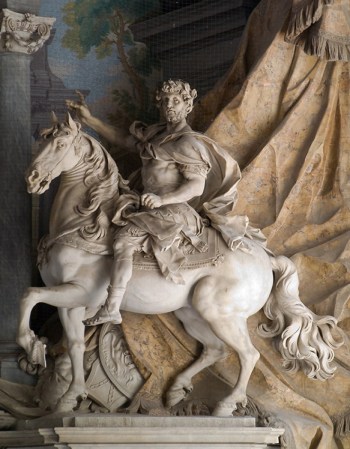
Agostino Cornacchini, Charlemagne, 1725, marble (St Peter’s Basilica).
A R T I C L E S
• Gloria Martínez Leiva, “Art as Diplomacy: John Closterman’s Portraits of Carlos II of Spain and His Wife Queen Maria Anna of Neuburg,” pp. 381–86.
• Teresa Leonor M. Vale, “Art and Festivities in Eighteenth-Century Rome: Letters from a Portuguese Priest, 1721–22,” pp. 387–93.
R E V I E W S
• Christopher Rowell, Review of the exhibition Thomas Chippendale: A Celebration of Craftsmanship and Design, 1718–2018 (Leeds City Museum, 2018), pp. 414–16.
• Charles Darwent, Review of the exhibition The Dutch in Paris, 1789–1914 (Paris: Petit Palais, 2018), pp. 420–21.
• Stéphane Loire, Review of Giancarlo Sestieri, Il capriccio architettonico in Italia nel XVII e XVIII secolo (Etgraphiae editoriale, 2015), p. 432.
• Andrew McClellan, Review of Geneviève Bresc-Bautier and Béatrice de Chancel-Bardelot, eds., Un musée révolutionaire: Le Musée des Monuments français d’Alexandre Lenoir (Musée du Louvre, 2016), pp. 432–33.
Exhibition | Canaletto, 1697–1768
Now on view at the Museo di Roma:
Canaletto, 1697–1768
Museo di Roma, Palazzo Braschi, Rome, 11 April — 19 August 2018
Curated by Bożena Anna Kowalczyk
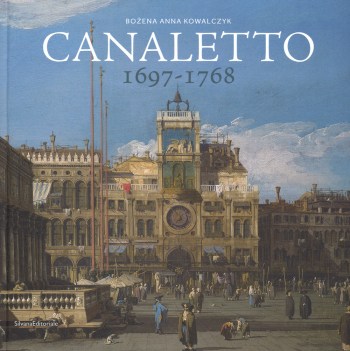 Italy’s capital celebrates Canaletto (1697–1768) by bringing together works from some of the most important museums and galleries in the world. On display, to celebrate the 250th anniversary of the artist’s death, is the largest collection of his works ever exhibited in Italy: 67 paintings, drawings, and documents. Outstanding among the masterpieces are two works from the Pinacoteca del Lingotto Giovanni e Marella Agnelli in Turin, The Grand Canal from the North, towards the Rialto Bridge and The Grand Canal with Santa Maria della Carità, on display for the first time together with the manuscript from the Biblioteca statale di Lucca. Also for the first time, the two parts of a single large canvas cut before 1802, depicting Chelsea from Battersea Reach, are brought together. The left part comes from the National Trust property Blickling Hall in the UK; the right part, from the Museo Nacional De Bellas Artes de la Hanana, has been loaned for the first time by the government of Cuba.
Bozena Anna Kowalczyk, Canaletto, 1697–1768 (Milan: Silvana, 2018), 256 pages, ISBN: 978-8836639328 (English edition), €34 / $55.
New Book | Making Majesty: The Throne Room at Dublin Castle
From Irish Academic Press:
Myles Campbell and William Derham, eds., Making Majesty: The Throne Room at Dublin Castle, A Cultural History (Newbridge: Irish Academic Press, 2017), 372 pages, ISBN: 978-1911024736 (hardback), €60 / ISBN: 978-1911024729 (paperback), €60.
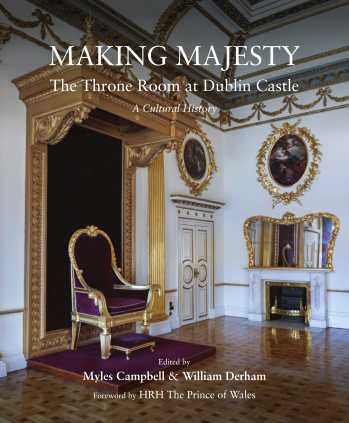 The Throne Room at Dublin Castle was the ultimate focus of viceregal ceremony, royal visits and many great state occasions both before and after Irish independence in 1922—a touchstone of British authority and Irish autonomy that can be analysed through the details of its form and furnishing. Making Majesty is an elegant collection of essays by leading Irish art and architectural historians that covers a broad range of perspectives, which help to enhance our understanding of this lavish and highly significant historical space, shedding new light on the major and minor figures who created, ornamented, decorated, and made use of it.
The first output of an ongoing programme of research into the cultural history of the State Apartments at Dublin Castle, Making Majesty presents original findings that offer a new reading of the nature and presence of the British monarchy and the viceregal court in Ireland. With insightful analysis that draws upon uniquely accessed archives, the contributors bring to light every aspect of how Dublin Castle’s authorities wished to be perceived and how that changed according to the whims of imperious viceroys, renowned craftsmen, and an Irish state wishing to secure an image of its newfound self-determination.
Myles Campbell works for the Office of Public Works at Dublin Castle in the recently established Collections, Research and Interpretation Office. He is co-editor of The Chapel Royal, Dublin Castle: An Architectural History (2015) and has contributed peer-reviewed articles and chapters to books by various academic publishers. His work on Making Majesty has earned him the inaugural George B. Clarke Prize.
William Derham works for the Office of Public Works at Dublin Castle in the recently established Collections, Research and Interpretation Office. He is co-editor of The Chapel Royal, Dublin Castle: An Architectural History (2015) and is author of Lost Ireland: 1860–1960 (2016).
C O N T E N T S
Foreword by HRH The Prince of Wales
Preface by Mary Heffernan, OPW
Contributors and Editors
Editors’ Acknowledgements
Editors’ Note
Editors’ Introduction
• Jane Fenlon, The Presence Chamber at Dublin Castle in the Seventeenth Century
• Patricia McCarthy, ‘Trophys and Festoons’: The Lost Presence Chamber, 1684–1788
• Myles Campbell, ‘Sketches of their Boundless Mind’: The Marquess of Buckingham and the Presence Chamber at Dublin Castle, 1788–1838
• Graham Hickey, ‘Quite Like a Palace’: The Presence Chamber at Dublin Castle, 1838–1911
• Ludovica Neglie, ‘Admirably Calculated for the Object’: Gaetano Gandolfi’s Paintings in the Throne Room at Dublin Castle
• Sylvie Kleinman, Where Crown Met Town: The Presence of Lay Catholics and the Uncrowned Monarch of Ireland in the Chamber, c. 1795–1845
• Kathryn Milligan, Royal Visits to Dublin, 1821–1911: Pier, Procession, Presence Chamber
• Éimear O’Connor, (Ad)dressing Home Rule: Irish Home Industries, the Throne Room and Lady Aberdeen’s Modern Modes of Display
• William Derham, (Re)making Majesty: The Throne Room at Dublin Castle, 1911–2011
• Christopher Warleigh-Lack, The Creation and Evolution of Hillsborough Castle’s Throne Room: What’s in a Name?
Index
Note (added 30 May 2018) — The original posting included an incorrect table of contents.
New Book | A Princely Pursuit
Part of a promised gift to the Fine Arts Museums of San Francisco, approximately 100 works from the Malcolm D. Gutter porcelain collection were exhibited at the Legion of Honor in 2015 and 2016. Published by Hirmer and distributed by The University of Chicago Press, the catalogue of the collection is now available.
Maria Santangelo, ed., A Princely Pursuit: The Malcolm D. Gutter Collection of Early Meissen Porcelain (Munich: Hirmer Publishers, 2018), 256 pages, ISBN: 978-3777429847, $65.
 Through tremendous grit and research, Malcolm D. Gutter has been forming a remarkable porcelain collection over several decades, primarily on a professor’s salary. A Princely Pursuit presents more than one hundred significant pieces from the collection, which focuses primarily on early Meissen, particularly the royal collection that Augustus II (1670–1733) commissioned for the Japanisches Palais, his pleasure palace in Dresden, and the porcelain works he had imported from China and Japan. In addition to reproducing many documented pieces from the royal collection, this volume includes numerous ‘collector’s stories’ which capture, in Gutter’s own voice, his determined and painstaking hunt for Meissen porcelain around the world, as well as the legendary figures he has met and worked with along the way. Pairing Meissen history with exemplary objects from the German manufactory, A Princely Pursuit makes an essential contribution to the field of decorative arts.
Maria Santangelo is curator of fine arts for Ann and Gordon Getty.
Conference | Sir Richard Wallace and His Age

Alexandre Desgoffe, Works of Art from the Collection of Sir Richard Wallace, 1880
(Staatliche Kunsthalle, Karlsruhe)
◊ ◊ ◊ ◊ ◊
From the registration page:
Sir Richard Wallace and His Age: Connoisseurs, Collectors, and Philanthropists
The Wallace Collection, London, 15–16 November 2018
This year the Wallace Collection is celebrating the two-hundredth anniversary of the birth of Sir Richard Wallace. Taking Sir Richard Wallace and his collection as its starting point, our two-day international conference will look at aspects of collecting and collections in London and Paris in the wake of the upheavals of the Franco-Prussian War and the Commune in 1870–71, considering essentially the period between 1870 and 1900. The first day of the conference will consider the impact on the Anglo-French art market of the political and social upheavals in France in 1870–71, including the dispersal of collections and the movement of collectors, as well as the curatorship of private art collections. The second day will focus on two themes: the subject of the morning session will be loans to exhibitions from distinguished collections and the motivations that drove them; the afternoon will showcase works of art in the Wallace Collection acquired by Sir Richard Wallace.
T H U R S D A Y , 1 5 N O V E M B E R 2 0 1 8
9.30 Registration and coffee
10.00 Xavier Bray (Director, The Wallace Collection), Welcome and introduction
10.15 Suzanne Higgott (Curator, The Wallace Collection), Setting the scene, or Why Sir Richard Wallace subscribed towards the proposed submarine tunnel between England and France in 1872
10.30 Olivier Hurstel (Curatorial Fellow, European Decorative Arts and Sculpture, Philadelphia Museum of Art), Hertford-Wallace properties in Paris based on the information available in the French archives
10.40 Morning Session
Chair: Adriana Turpin (IESA International)
• Robert Tombs (Fellow of St John’s College, Cambridge), The Rise and Fall of the New Babylon
• Thomas Stammers (Assistant Professor, Department of History, University of Durham), Salvage and speculation: The London art market after the Franco-Prussian War (provisional title)
• Anthony Geraghty (Department of History of Art, University of York), An Imperial Collection in Exile: The Empress Eugénie in Farnborough, 1880–1920
• Mathieu Deldicque (Conservateur du Patrimoine, Musée Condé, Chantilly), ‘Wishing to preserve the complete estate of Chantilly for France’: The duc d’Aumale and the settlement of Chantilly on the Institut de France
12.30 Lunch break
13.45 Afternoon Session
Chair: Alastair Laing (Curator Emeritus of Pictures and Sculpture, The National Trust)
• Suzanne Higgott (Curator, The Wallace Collection), Sir Richard Wallace as the custodian of his collection
• Joseph Friedman (Honorary Visiting Fellow of the Department of History of Art, University of York, and Senior Research Fellow in the History of Art and Architecture, University of Buckingham), ‘Inhabited Museums’: London’s treasure houses in the age of Sir Richard Wallace
• Helen Jones (Research Librarian, Wallace Collection Library), More than mere ornaments: Female visitors to Richard Wallace’s art collection
• Mathieu Deldicque (Conservateur du Patrimoine, Musée Condé, Chantilly), The picture hang devised by Henri d’Orleans, duc d’Aumale, at Chantilly
• Natalie Zimmer (Curatorial Assistant, The Wallace Collection), Captured for eternity: Visual recording of collections in the nineteenth century
• Olivier Hurstel ( Curatorial Fellow, European Decorative Arts and Sculpture, Philadelphia Museum of Art), Edouard Lièvre (1828–1886), From art books editor to designer: On the importance of art books in shaping taste in the nineteenth century (provisional title)
• Silvia Davoli (Research Curator Strawberry Hill, The Horace Walpole Collection), Richard Wallace and the acquisition of the Nieuwerkerke and Both de Tauzia collections: The Parisian network (provisional title)
16.40 Discussion
F R I D A Y , 1 6 N O V E M B E R 2 0 1 8
9.45 Registration and coffee
10.15 Morning Session
• Lindsay Macnaughton (PhD researcher, Durham University/The Bowes Museum), Displaying philanthropy and patriotism: The Wallaces in focus
• Suzanne Higgott (Curator, The Wallace Collection), Good intentions, mixed motives: Sir Richard Wallace’s loan exhibition at the Bethnal Green Museum, 1872–75
• Kathryn Jones (Senior Curator of Decorative Arts, Royal Collection Trust), ‘Successful designs ought not to be restricted to the palaces’: Victoria, Albert and the exhibitions
• Eloise Donelly (AHRC Collaborative Doctoral Candidate, University of Cambridge and the British Museum), ‘The Expansion of Art’: The English Rothschilds and loan exhibitions, 1850–97
• Suzanne Higgott (Curator, The Wallace Collection), From loans to legacy: The transformation of the Wallace Collection from a private collection into a national museum
12.30 Lunch break
13.45 Afternoon Session
• Helen Jacobsen (Senior Curator, The Wallace Collection), Sir Richard Wallace: Shaping a national collection
• Suzanne Higgott and Tobias Capwell (Curators, The Wallace Collection), Two paintings by Blaise-Alexandre Desgoffe of works of art and arms and armour in Sir Richard Wallace’s collection
• Tobias Capwell (Curator, The Wallace Collection), Armour and the man: Three triumphs of Sir Richard Wallace, collector of arms
• Speaker to be announced, Fragonard’s A Boy as Pierrot
• Ada de Wit (Assistant Curator, The Wallace Collection), Collecting the World: An Asante trophy head and Chinese Imperial wine cups
• Stephen Duffy (formerly Senior Curator, The Wallace Collection), Sir Richard Wallace and contemporary painting
• Jeremy Warren (Honorary Curator of Sculpture, Ashmolean Museum, Oxford and Sculpture Research Curator, The National Trust), Sir Richard Wallace and small bronze sculptures
16.35 Discussion
17.30 Round-table discussion with Xavier Bray (Director, The Wallace Collection), Christian Levett (Private Collector), Olivier Gabet (Director, Musée des Arts décoratifs, Paris), Ian Wardropper (Director, The Frick Collection, New York), and Emilie E.S. Gordenker (Director, Mauritshaus, The Hague)
18.30 Drinks reception in the Porphyry Court at the Wallace Collection










 Enfilade
leave a comment