Reopened: August the Strong’s State Apartments and Porcelain Cabinet
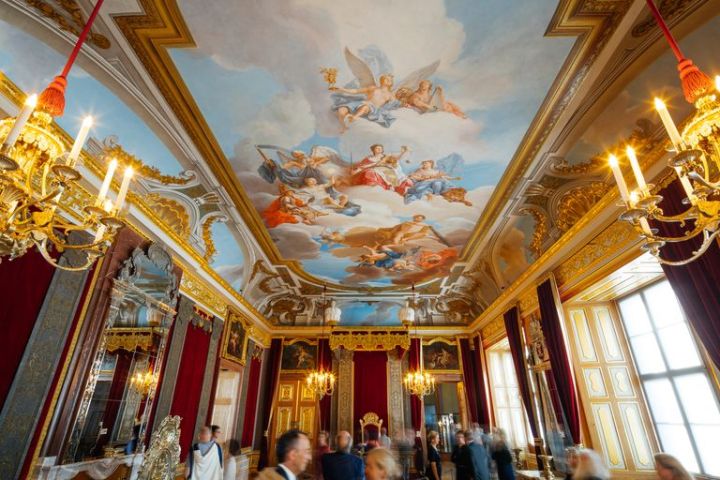
Audience Room of the State Apartments of Dresden’s Residenzschloss (28 September 2019)
Photo by Oliver Killig
◊ ◊ ◊ ◊ ◊
Press release (26 September 2019) from the SKD:
August the Strong’s Royal State Apartments (Paraderäume) and the Porcelain Cabinet in the Turmzimmer (Tower Room) were opened on Saturday, 28 Saturday 2019, marking the culmination of the restoration of Dresden’s Residenzschloss, which started in 1986. The prestigious suite of rooms in the west wing—conceived by the Elector-King personally as a ceremonial centrepiece of his residence—takes visitors to the pinnacle of ostentatious princely splendour on their tour of the museum palace.
Together with original artworks from several of Staatliche Kunstsammlungen Dresden’s museums, the painstakingly restored rooms form a unique ensemble of museum-grade rooms. The harmonious interplay of wall textiles, paintings, precious ornamental furniture and porcelains, magnificent robes of state, and August the Strong’s royal insignia let visitors experience both the standard of European artistry in the early 18th century and the ceremonial court culture.
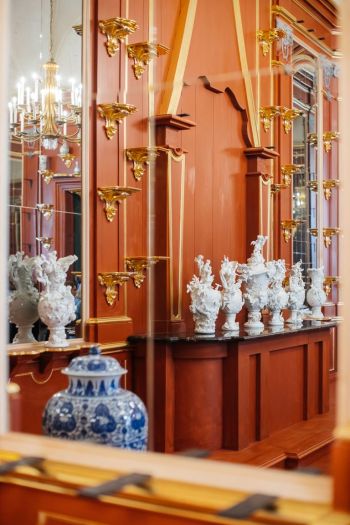
Porcelain Cabinet in the Tower Room of Dresden’s Residenzschloss (28 September 2019); photo by Oliver Killig.
August the Strong opened the State Apartments exactly 300 years ago, in September 1719, to celebrate the wedding of Crown Prince Friedrich August and daughter of the Emperor and Archduchess Maria Josepha of Austria. The construction and craft works continued from March 1717 to 2 September 1719—the day on which the Habsburgian daughter-in-law of August the Strong and his wife Christiane Eberhardine was welcomed in the new staterooms. Not only were the nine rooms of the State Apartments built in the west wing to mark this occasion, the entire second floor of the palace was renovated. The resulting ceremonial, prestigious suite began at the Englische Treppe (English Staircase) and led on through the Riesensaal (Hall of the Giants) and the Turmzimmer (Tower Room) to the west wing.
It housed the most important ceremonial and splendid rooms in the residence, enabling the Prince-Elector of Saxony to prove that his palace was truly the palace of a king, rivalling the residences of other European kings and the Emperor. The interiors grow increasingly luxurious from room to room: Whether in the corner state room to the two antechambers, to the audience chamber and the state bedroom, the rooms seemed to outdo one another in the number and splendour of the candelabras, wall textiles and furniture. This prestigious suite combined touches of the ceremonial style of the French royal court at Versailles with that at the imperial court of Vienna, whereby the state bedroom in the Viennese tradition was used as the most private ceremonial venue, and not for the opulent lever, the morning reception, as was the case under Louis XIV.
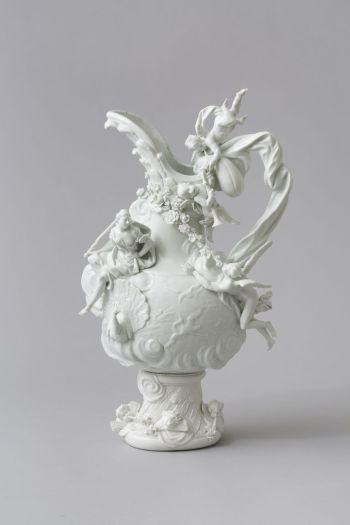
Johann Joachim Kaendler, Johann Friedrich Eberlein, Elementvase Luft aus dem fünfteiligen Satz der Elementvasen, Meissen, 1742
(Porzellansammlung der SKD; photo by Adrian Sauer).
In 1997, the Saxon State Government decided that the ceremonial rooms, which had been completely destroyed in the Second World War, should be rebuilt as far as possible. The present meticulous restoration of the rooms to their historic, 18th-century condition is an immense achievement by Staatsbetriebe Sächsische Immobilien- und Baumanagement (Saxon Real Estate and Construction Management, SIB) and many regional and international artists and craftspeople. Comprehensive records allowed the rooms to be restored as closely as possible to the original. For instance, Louis de Silvestre’s monumental ceiling paintings were recreated based on colour photographs taken in 1942/1944. The preserved baroque ornamental textiles of the audience chamber with pilasters adorned in intricate gold embroidery and trim were restored and the crimson silk velvet was reproduced to cover the entire wall surface with ‘thread-true’ recreations based on a fragment. Lost tapestries were replicated based on comparable examples. Overall, 300 craft firms from around Europe that have preserved the traditional skills worked together on this project.
Thanks to timely removal for safekeeping, many of the precious items of furniture from the early 18th century and the following decades, which were in the ceremonial rooms’ inventory, were preserved. They had been stored by the Kunstgewerbemuseum (Museum of Decorative Arts) since the end of the Second World War: the throne, rare silver furniture from Augsburg, French ornamental furniture using the Boulle marquetry technique. Paintings and overdoors by Louis de Silvestre from Gemäldegalerie Alte Meister now complete the current restoration project. As surviving historical pieces, the preserved originals tell the tale of the original interior and the rooms’ eventful past.
In four other rooms that, like the restored State Apartments, are in the west wing, exhibits from the Rüstkammer (Armoury) showcase the overwhelming splendour with which August the Strong staged his own persona and power. The two retirades (private refuges)—a suite of rooms leading from the corner state room to the state bedroom—house an exhibition on the ‘Royal Wardrobe’ of the Elector-King. The robes of state reflect his biography and significant events in his reign. Precious royal baroque fashions from the baroque period share space with August the Strong’s favourite weapons and diplomatic gifts received from the kings of Europe and the Czar. The picture cabinets located behind the audience chamber are dedicated to his royal majesty August the Strong and his son Augustus III. Besides the royal insignia of the Saxon-Polish union, the figurine dressed in the coronation regalia of 1697 with the face of August the Strong from the life mask of 1704 is particularly impressive. Other royal artefacts, like the Saxon electoral hat and the ceremonial royal flags and swords of Poland and Lithuania, reveal the European dimension of the linked Saxon and Polish monarchy.
The route to the State Apartments also takes visitors through the 100 m² Turmzimmer (Tower Room) in Hausmannsturm of the Residenzschloss. At the time of the wedding, August the Strong displayed his state treasury in the form of the exceptionally precious monumental silver vessels on pedestals and wall shelves there. In the 1730s under August III, the silver buffet was turned into a porcelain cabinet that went on to serve as a prominent showroom for the electoral and royal porcelain collection for 200 years. Now hosting a selection of porcelain, the recreated room has regained its historical function. It houses unique masterpieces from the manufactory in Meissen, like the Johann Joachim Kaendler’s outstanding, highly sculptural vases depicting the elements, returning to their original home after more than 75 years in the depot.
Eva-Maria Stange, State Minister for Higher Education, Research and the Arts: “Restoring the State Apartments to their resplendent former glory, gives the Residenzschloss its soul back. Visitors to the rooms get a great impression of life in the royal court. We must also remember that the principality and its prosperity were built on the work and hardships of the miners who extracted the silver that made Saxony rich, among other things. Even at that time, the economy, science and the arts stimulated one another, creating the admirable halo effect that is still maintained today.”
Marion Ackermann, Director General of Staatliche Kunstsammlungen Dresden: “When opened in 1719, August the Strong’s State Apartments and the Tower Room were the expression of an axiomatically European understanding of culture. Influences from many European countries inspired the efforts to attain perfection and outstanding artistic achievements. 300 years later, we can experience this phenomenon again: It was only the cooperation of many extraordinary Saxon and European craftspeople, artists and restorers, who still master the ancient techniques at a high level that made restoration of the State Apartments, and the Tower Room as a Porcelain Cabinet possible. With respect and admiration, I would like to thank everyone who worked on the project under the guidance of Staatsbetrieb Sächsisches Immobilien- und Baumanagement and collaborated to complete this unique architectural masterpiece.”
Dirk Syndram, Director of Grünes Gewölbe and Rüstkammer: “Nowhere else can you feel as close to August the Strong as in the State Apartments. And no other rule of baroque Europe left behind so many, so magnificent and so personal material testimonies to his time. These many originals make the splendour with which August the Strong surrounded himself directly tangible.”
New Book | Worn on This Day
From Running Press:
Kimberly Chrisman-Campbell, Worn on This Day: The Clothes That Made History (Philadelphia: Running Press, 2019), 336 pages, ISBN: 978-0762493579, $28.
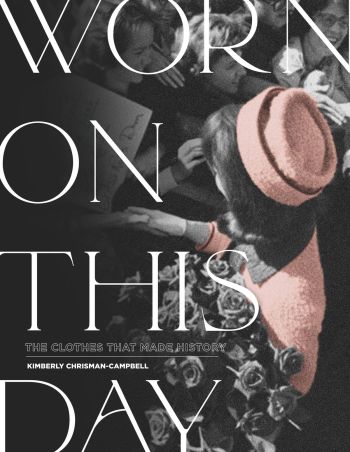 This stunning visual guide is a journey of discovery through fashion’s fascinating history, one day at a time. Beginning on January 1st and ending on December 31st, Worn On This Day looks at garments worn on monumental occasions across centuries, offering capsule fashion histories of everything from space suits to wedding gowns, Olympics uniforms, and armor. It creates thought-provoking juxtapositions, like Wallis Simpson’s June wedding and Queen Elizabeth’s June coronation, or the battered shoes Marie-Antoinette and a World Trade Center survivor wore to escape certain death, just a few calendar days apart. In every case there is a newsworthy narrative behind the garment, whether famous and glamorous or anonymous and humble. Prominent figures like Abraham Lincoln, Marilyn Monroe, and the Duchess of Cambridge are represented alongside ordinary people caught up in extraordinary events. Beautifully illustrated throughout, Worn On This Day presents a revelatory mash-up of styles, stories, and personalities.
Kimberly Chrisman-Campbell is a fashion historian, curator, and journalist. She is the author of the award-winning book Fashion Victims: Dress at the Court of Louis XVI and Marie-Antoinette. Kimberly lives in Los Angeles.
Symposium | Ornamenta Sacra, 1400–1800

From ArtHist.net:
Ornamenta Sacra: Late Medieval and Early Modern Liturgical Objects in a European Context, 1400–1800
Brussels and Leuven, 24–26 October 2019
We are pleased to invite you to Ornamenta Sacra: Late Medieval and Early Modern Liturgical Objects in a European Context, 1400–1800 October 24–26 in Brussels and Leuven. The symposium is organised in the framework of a Brain-Belspo funded project, led by Ralph Dekoninck (GEMCA, UCLouvain), Barbara Baert (IRG/Illuminare, KU Leuven), and Marie-Christine Claes (KIK-IRPA). You can confirm your participation by registering here.
The symposium is dedicated to the iconological and anthropological study of late medieval and early modern liturgical objects (1400–1800), once known as ornamenta sacra. This notion encompasses a wide range of objects made of various materials and techniques (such as chalices, censers, and chasubles), which are not only essential for the rites, but also hold a central position in the religious artistic production of the past. Yet, a large portion of recent studies related to the connections between art and liturgy mainly focuses on paintings and sculptures, leaving aside other cult objects. The few studies that take these ritual instruments into account are primarily devoted to the Middle Ages. The late Middle Ages and the early modern period have attracted far less attention, whereas liturgy underwent profound transformations. Although studies limited to certain collections or types of objects are available, we are still in need of a broader analysis instigated by recent methodological trends in historical anthropology and iconology, which have renewed our understanding of images and art objects. We have therefore invited an international group of scholars, experts in their fields and specialized in exactly these methodologies. As a result, the symposium will contribute to this broader analysis and will offer new insights on the material dimension of objects, the place of works of art within a network of relationships, the history of senses and the sensible, and the way in which ornamentation affects meaning.
T H U R S D A Y , 2 4 O C T O B E R 2 0 1 9
Royal Institute for Cultural Heritage (KIK-IRPA), Brussels
9:30 Coffee and tea
9:50 Welcome by Hilde De Clercq (dir. KIK-IRPA) and Georges Jamart (Belspo)
10:00 Introduction by Ralph Dekoninck (UCLouvain), Barbara Baert (KU Leuven), and Marie-Christine Claes (KIK-IRPA)
10:30 Morning Papers
• Eric Palazzo (Université de Poitiers), Le Christ énergétique, la spirale et la monstrance
• Frédéric Tixier (Université de Lorraine), Voir et entendre ou entendre et voir? Les objets liturgiques en procession (XIIIe–XVIIe s.)
12:30 Lunch
14:00 Afternoon Papers
• Cynthia Hahn (Hunter College and Graduate Center CUNY, New York), Reliquaries as Mediation in Liturgy and Ecclesiastical Space
• Frédéric Cousinié (Université de Rouen-Normandie) and Alysée Le Druillenec (Université Paris 1 Sorbonne-Panthéon), Objets de dévotions: Figures de la liaison au divin
• Michele Bacci (Université de Fribourg), Western Liturgical Vessels and the Byzantine Rite in the Late Middle Ages
• Sébastien Bontemps (Ecole du Louvre, Université de Bourgogne), Le trophée d’église: Système décoratif et illustration de la liturgie en France au XVIIIe siècle
• Caroline Heering (UCLouvain), Ornamenta Sacra: De l’ornement des objets aux objets comme ornements
F R I D A Y , 2 5 O C O T O B E R 2 0 1 9
Royal Institute for Cultural Heritage (KIK-IRPA), Brussels
9:00 Coffee and tea
9:30 Morning Papers
• Herman Roodenburg (Vrije Universiteit Amsterdam and Meertens Instituut), The Eucharist and not so sensuous worship: Shedding tears among the Modern Devout
• Anne-Laure Van Bruaene (Universiteit Gent), Viglius’s Mitre: Clerical Self-fashioning in Sixteenth-century Ghent
• Anne-Clothilde Dumargne (Université de Versailles, Saint-Quentin-en-Yvelines), Ornamenta ou ministeria? Statut et fonction des chandeliers en alliages de cuivre dans l’espace ecclésial de la fin du Moyen Âge à l’époque moderne
• Wendy Wauters (KU Leuven), Smellscapes and Censers: Strategies behind their Ritual Use and Iconographic Meaning
12:30 Lunch
14:00 Afternoon Papers
• Marie Lezowski (Université d’Angers), Le corps du délit: Les objets liturgiques volés dans les sources inquisitoriales (Italie, XVIIe–XVIIIe siècles)
• Emmanuel Joly (KIK-IRPA), Financer et entretenir les ornements liturgiques: Le cas des paroisses rurales du diocèse de Liège, 1400–1700
• Soetkin Vanhauwaert (KU Leuven), Worthy of Imitation: The Holy Sacrament and the Relic Cult of the Forerunner in Mechelen
• Anne Lepoittevin (Université Paris-Sorbonne), Les Agnus Dei en cire: Des objets de culte?
• Nicole Pellegrin (CNRS-ENS, Paris), Chapes en Révolution: Quelques traces d’abandons, destructions, réemplois et mutations, 1790–1820
S A T U R D A Y , 2 6 O C T O B E R 2 0 1 9
Katholieke Universiteit (KU), Leuven
9:00 Coffee and tea
9:30 Morning Papers
• Ethan Matt Kavaler (University of Toronto), The Netherlandish Carved Altarpiece as Miniature
• Kamil Kopania (The Aleksander Zelwerowicz National Academy of Dramatic Art, Warsaw), Animated Sculptures of the Crucified Christ in Context of Liturgical Space, Objects, and Gestures
• Ruben Suykerbuyk (Universiteit Gent), The Ritual Use of Memoria Monuments in the Low Countries, ca. 1520–85
• Charles Caspers (Titus Brandsma Instituut, Nijmegen), Wax and the Ghent Altarpiece: A New Interpretation
12:10 Discussion and concluding remarks
12:30 Lunch
14:30 Visit to the exhibition Borman and Sons at Museum M, Leuven










 Enfilade
leave a comment