Terra Foundation for American Art Research Travel Grants
With more information available through CAA:
Terra Foundation for American Art Research Travel Grants
Applications due by 15 January 2020
The College Art Association is pleased to announce its administration of the Terra Foundation for American Art Research Travel Grants, which provide support to doctoral, postdoctoral, and senior scholars from both the US and outside the US for research topics dedicated to the art and visual culture of the United States prior to 1980. The grants foster firsthand engagement with American artworks and art-historical resources; build networks for non-US-based scholars studying American art; and expand access to artworks, scholarly materials, and communities for US-based scholars studying American art in an international context.
Now administered and juried by CAA, this grant program was initiated by the Terra Foundation in 2003 to fund European candidates. It was expanded to reach candidates worldwide in 2012 and opened to US-based researchers in 2017 to travel abroad, developing American art scholar networks around the world with a total of 173 grantees since its inception.
“We are excited to expand our partnership with the Terra Foundation to provide continued support for scholars of American art,” said David Raizman, interim executive director of CAA. “Research funding for domestic and international scholars is essential to the vitality of the field, and these generous grants from the Terra Foundation will facilitate the advancement of their work. The inclusion of international scholars for these grants is especially gratifying, as it promotes new perspectives and engages the wider scholarly community.”
Awards of up to $9,000 will be granted on a per project basis by a jury formed by CAA. The first awards will be announced in March of 2020.
CAA’s administration of the Terra Foundation for American Art Research Travel Grants continues a long history at CAA of supporting travel and scholarship for professionals and students in the visual arts and design. Other grants offered by CAA include the Professional Development Fellowships for Graduate Students, the Terra Foundation for American Art International Publication Grant, the Wyeth Foundation for American Art Publication Grant, the Millard Meiss Publication Fund, the CAA Getty International Program, Travel Grants to the CAA Annual Conference, and introduced last year, the Art History Fund for Travel to Special Exhibitions.
New Book | Witnessing Slavery
From Yale UP:
Sarah Thomas, Witnessing Slavery: Art and Travel in the Age of Abolition (London: Paul Mellon Centre for Studies in British Art, 2019), 304 pages, ISBN: 978-1913107055, $55.
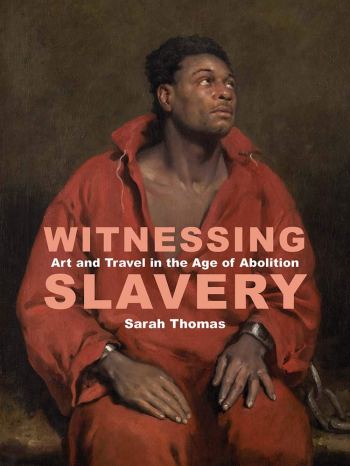 Gathering together over 160 paintings, watercolors, drawings, and prints, this book offers an unprecedented examination of the shifting iconography of slavery in British and European art between 1760 and 1840. In addition to considering how the work of artists such as Agostino Brunias, James Hakewill, and Augustus Earle responded to abolitionist politics, Sarah Thomas examines the importance of the eyewitness account in endowing visual representations of transatlantic slavery with veracity. ‘Being there’, indeed, became significant not only because of the empirical opportunities to document slave life it afforded but also because the imagery of the eyewitness was more credible than sketches and paintings created by the ‘armchair traveler’ at home. Full of original insights that cast a new light on these highly charged images, this volume reconsiders how slavery was depicted within a historical context in which truth was a deeply contested subject.
Sarah Thomas is lecturer in the Department of History of Art at Birkbeck, University of London.
Exhibition | Savour: Food Culture in the Age of Enlightenment
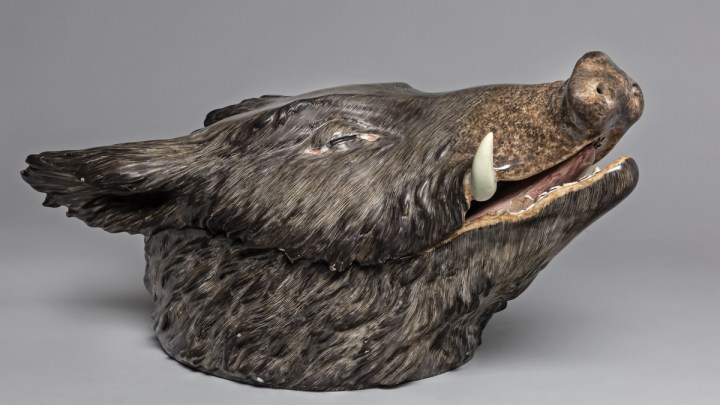
Boar’s Head Tureen, France, probably Strasbourg, ca. 1745; tin-glazed earthenware (faïence)
(Toronto: Gardiner Museum, anonymous loan; photo by Toni Hafkenscheid)
◊ ◊ ◊ ◊ ◊
Opening next month at the Gardiner Museum:
Savour: Food Culture in the Age of Enlightenment
Gardiner Museum, Toronto, 17 October 2019 — 19 January 2020
Wadsworth Atheneum Museum of Art, Hartford, CT, 29 February — 24 May 2020
Curated by Meredith Chilton
Food and dining were transformed in Europe during the age of Enlightenment by profound changes that still resonate today. What many of us eat, the way food is cooked, and how we dine continues to be influenced by radical changes that occurred in France from 1650 until the French Revolution in 1789.

Philippe Mercier, The Sense of Taste, 1744–47, oil on canvas, 132 × 154 cm (New Haven: Yale Center for British Art, Paul Mellon Collection, B1974.3.18).
Savour: Food Culture in the Age of Enlightenment explores the story of this transformation with rare objects, fascinating histories, and amusing stories. We start in the kitchen gardens at Versailles where advances in horticulture expanded the growing seasons of vegetables and fruits, making a greater selection of foods available year-round. Then we visit the steamy kitchens of cooks who advocated light, flavourful cuisine centuries before our time. Next, we discover surprisingly modern philosophies for healthy eating and vegetarianism, and join ardent foodies as they savour meals served on newly invented ceramic and silver wares, from sauceboats to tureens. Along the way, we explore how social changes were impacting eating then, just as now, as the grand formality of the past was abandoned in favour of informality and intimacy.
Savour: Food Culture in the Age of Enlightenment is organized by the Gardiner Museum and curated by Meredith Chilton, C.M., Curator Emerita. Works of art and objects from major North American museums and private collections, as well as key pieces of contemporary ceramics and knitted art, will come together in a delectable feast for the senses designed by Opera Atelier’s Resident Set Designer, Gerard Gauci.
After the Gardiner Museum, the exhibition will tour to the Wadsworth Atheneum Museum of Art, Hartford, Connecticut. The exhibition is accompanied by a cookbook titled The King’s Peas: Delectable Recipes and their Stories from the Age of Enlightenment by Meredith Chilton, with contributions by Markus Bestig, Executive Chef, The York Club, Toronto.

Children Shelling Peas, England, Chelsea, ca. 1759–70; soft-paste porcelain, enamels, and gilding
(Museum of Fine Arts, Boston)
◊ ◊ ◊ ◊ ◊
Meredith Chilton, The King’s Peas: Delectable Recipes and Their Stories from the Age of Enlightenment (Stuttgart: Arnoldsche Verlagsanstalt, 2019), 144 pages, ISBN: 978-3897905603, $50.
Food and dining were transformed in Europe during the Age of Enlightenment, and these profound changes continue to resonate today. What many of us now eat, the way our food is prepared and how we dine are the result of radical changes that occurred in France from 1650 until the French Revolution in 1789. Over thirty French and English recipes of the period are presented in this cookbook, offering readers a taste of the past. Amusing stories, culinary insights, and snippets of history outline the cultural milieu of the time. The King’s Peas is richly illustrated with pictures of paintings, books, silver, glass and ceramics to stimulate the imagination—and the appetite. You are cordially invited to take part in this delectable historical feast.
Installation | Claire Partington: Taking Tea
Now on view at SAM:
Claire Partington: Taking Tea
Seattle Art Museum, 7 December 2018 — 6 December 2020
 Get a new perspective on SAM’s popular Porcelain Room through the site-specific work of contemporary British ceramic artist Claire Partington. Taking Tea features an installation referencing Baroque painting and European porcelain factories, as well as a panel mounted with fragments from 17th- and 18th-century shipwrecks. The Porcelain Room is a SAM favorite for visitors with more than 1,000 European and Asian porcelain pieces from SAM’s collection grouped to evoke porcelain as a treasured commodity between the East and the West.
Claire Partington reappraises the narrative histories of the porcelain objects. Her figures engaged in the act of ‘taking tea’ give a human face to the European craze for Chinese porcelain on display in the Porcelain Room. Partington’s installation suggests the often unintentional consequences of the porcelain trade during the expansion of international shipping routes. The figures in the installation are steeped in the rarified luxury and high-end fashion these items once conveyed, but they also expose the degrading aspects of trade—the reality of precarious ocean voyages and human exploitation.
At SAM, Kim Rorschach Retires as Amada Cruz Steps In
This month Amada Cruz succeeds Kimerly Rorschah as Director and CEO of of the Seattle Art Museum. Rorschach did her PhD at Yale in the 1980s, writing on Frederick, Prince of Wales. At the University of Chicago, she was director of the Smart Museum of Art before going on to serve as the founding director of the Nasher Museum of Art at Duke University. Kim graciously served on my dissertation committee at Chicago, offering invaluable advice and wisdom. A few words here don’t begin to express my debts of gratitude, but I feel profoundly fortunate to have been one of her students. –Craig Hanson
From the press release (10 June 2019) . . .
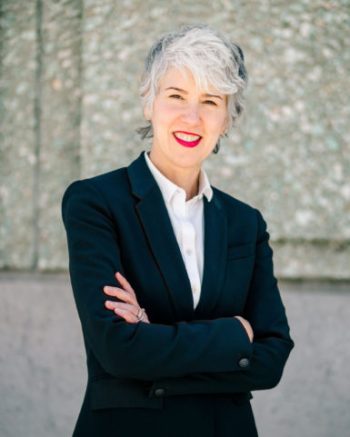
Amada Cruz previously served as Director and CEO of the Phoenix Art Museum. Photo by Airi Katsuta.
The Board of Trustees of the Seattle Art Museum (SAM) announced today that Amada Cruz has been chosen as the museum’s new Illsley Ball Nordstrom Director and CEO following an extensive international search. Since February 2015, Ms. Cruz has served as the Sybil Harrington Director and CEO of the Phoenix Art Museum in Arizona, the largest art museum in the Southwestern United States. She will assume her position at SAM in September, succeeding Kimerly Rorschach who will be retiring.
In her role at SAM—comprising the downtown Seattle Art Museum, the Asian Art Museum in Volunteer Park, and the Olympic Sculpture Park on the downtown waterfront—Cruz will oversee the institution’s wide-ranging artistic and education programs and manage a staff of more than 300.
“I am so excited about moving to one of the most progressive, innovative, and fastest-growing cities in the country. As an immigrant, Seattle’s embrace of diversity and commitment to inclusion certainly strikes a chord,” says Cruz. “Across its three stunning locations, SAM offers incredibly varied cultural experiences. It’s a particularly exciting opportunity to reintroduce the spectacular Asian Art Museum’s building and collection to the city this fall. And I am honored to be following the enlightened leadership of Kimerly Rorschach. She has been a model of a 21st-century museum director, connecting with communities and expanding the range of artists exhibiting at the museum and entering its collection. I’m looking forward to continuing SAM’s commitment to welcoming everyone.”
“After an exhaustive search with an impressive array of candidates, it’s clear that Amada Cruz is the forward-thinking leader we’re seeking,” said Charles Wright, SAM trustee and chair of the search committee. “Amada’s strong vision, extensive experience as both a curator and a fundraiser, and keen understanding of the power of the visual arts will undoubtedly help her take SAM to the next level.”
“Like the city of Seattle, the museum is always evolving and moving forward,” said Stewart Landefeld, SAM Board of Trustees Chair. “Kim’s incredible leadership has brought SAM to a vital and stable present, and Amada is the right person to lead it into an ambitious future along with SAM’s talented staff, dedicated volunteers, and committed Board of Trustees.”
During her tenure at the Phoenix Art Museum (PAM), Cruz set ambitious goals to increase diversity and create a culture of inclusion and accessibility. She oversaw a series of initiatives designed to improve financial stability, strengthen community engagement, and build national visibility. PAM attracted key national funders in support of the museum’s mission; introduced more Latinx and bilingual educational programming; and increased diversity across exhibitions and installations, presenting works by artists of color, LGBTQI+ artists, and women artists, including a retrospective for modern artist Agnes Pelton that will travel to the Whitney Museum of American Art in 2020.
Over her 30-year career, Cruz has held posts as the Executive Director at San Antonio-based Artpace, an artist residency program; Director of the Center for Curatorial Studies Museum at Bard College, where she co-organized the first US museum survey of Takashi Murakami’s work; and Acting Chief Curator and Manilow Curator of Exhibitions at the Museum of Contemporary Art in Chicago.
Cruz has also worked as a grantmaker and was the founding Program Director for United States Artists in Los Angeles, where she formed longstanding relationships with artists around the country and was responsible for all programming activities of a Ford and Rockefeller Foundations initiative. She also has been Executive Director of Artadia: The Fund for Art and Dialogue in New York City, which awarded grants to visual artists in San Francisco, Houston, and Chicago.
Born in Havana, Cuba, Cruz received a Bachelor’s degree in Art History and Political Science at New York University. She received the 2018 Virginia Cardenas Arts Advocacy Award by Xico, an Arizona cultural institution serving Latinx and Indigenous artists. In 2015, W Magazine named her one of the 11 most powerful female museum directors in America.
“I am absolutely delighted that Amada Cruz has been named to lead SAM into the future. She is an experienced professional of the highest integrity and brings an exciting vision for the future of our great museum,” says Kimerly Rorschach, SAM Illsley Ball Nordstrom Director and CEO. “She has a profound love of art and a deep commitment to increasing access for all. I know that she will keep the museum moving forward in our dynamic city and region.”
From the press release (31 October 2018) announcing Kim Rorschach’s retirement:
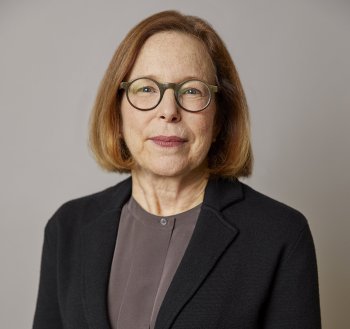
Kimerly Rorschach became director of the Seattle Art Museum in November 2012. Photo by Scott Areman.
Kimerly Rorschach, Illsley Ball Nordstrom Director and CEO of the Seattle Art Museum (SAM), announced today that she will retire in fall 2019 after seven years leading the institution. Rorschach will step down following the opening of the museum’s newly renovated and expanded Seattle Asian Art Museum facility. The museum’s Board of Trustees will initiate an international search to find Rorschach’s replacement.
Winnie Stratton, President of SAM’s Board of Trustees, noted, “Kim’s retirement culminates an esteemed 25-year career leading museums. SAM and Seattle are stronger today thanks to her seven years of leadership. Over the years, it has been an honor to work with Kim and see how each of our three locations have matured to a new level and thrived with her guidance. She facilitated important art scholarship and brought to Seattle groundbreaking exhibitions. She worked to bring in more diverse and younger audiences, and increased attendance and community engagement.”
Added Stewart Landefeld, Chairman of SAM’s Board of Trustees, “SAM has flourished under Kim’s leadership. Her myriad of duties aside, she has been the number one champion for the museum. Her contribution to fundraising has been transformative, including raising nearly $125M towards the museum’s current $150M campaign to boost SAM’s endowment, renovate the Seattle Asian Art Museum, and expand programming across all three sites. Collegial, disciplined, and community-focused, Kim has been a great mentor and colleague. Her passion, drive, and desire to foster new connections between art, culture, and the community, will be greatly missed.”
Rorschach joined SAM in November 2012. She immediately set her sights on creating a schedule of exhibitions and programs for the museum’s three locations that was compelling and timely and that would resonate with a rapidly growing and diversifying Seattle community.
Working with SAM’s curators, Rorschach has been able to secure and produce an exhibition lineup that has bolstered the museum’s mission to “connect art to life” and increased attendance and membership to new levels. Through the years, Rorschach has overseen a roster of special exhibitions such as Disguise: Masks & Global African Art (2015); Intimate Impressionism from the National Gallery of Art (2015); Kehinde Wiley: A New Republic (2016); Yayoi Kusama: Infinity Mirrors (2017); Andrew Wyeth: In Retrospect (2017); and Figuring History: Robert Colescott, Kerry James Marshall, Mickalene Thomas (2018). In cooperation with The Phillips Collection and the Museum of Modern Art, Rorschach helped bring to Seattle in 2017 Jacob Lawrence’s epic The Migration Series—the first time all sixty panels had been shown together on the West Coast for two decades. At the Seattle Asian Art Museum, known for its historic Chinese, Japanese, and Korean collections, Rorschach and the museum’s curators developed a lively and popular program of contemporary Asian exhibitions including Live On: Mr’s Japanese Neo-Pop (2014), Chiho Aoshima: Rebirth of the World (2015), and Tabaimo: Utsutsushi Utsushi (2016). The Olympic Sculpture Park continued to develop and thrive with the introduction of new year-round programs including the popular SAM Lights in December, as well as art installations in the PACCAR Pavilion by Sam Vernon (2015), Victoria Haven (2016), and the current installation by Spencer Finch.
During Rorschach’s tenure, SAM’s global collection has been enhanced by significant acquisitions. Louis-Phillipe Crépin’s Shipwreck Off the Coast of Alaska (1806); Raphaelle Peale’s Still Life with Strawberries and Ostrich Egg Cup (1814); Ai Wei Wei’s Colored Vases (2010); Jaume Plensa’s Echo (2011)—a gift of the late Barney Ebsworth; and Kehinde Wiley’s Anthony of Padua (2013) are among the many new works that have added breadth and depth to the collection and addressed critical gaps.
Guided by a shared vision for strengthening SAM’s collection for all, Rorschach has worked hand-in-hand with numerous generous donors to bring to the museum several substantial and transformative private collections, including the Virginia and Bagley Wright Collection, the most extensive collection of modern and contemporary art in the Northwest, featuring works by Johns, Frankenthaler, Rothko, Ruscha, Irwin, and more; as well as the Sam and Gladys Rubinstein Collection, focused on early European modernism, including works by Jawlensky, Delaunay, and Kupka.
Under Rorschach’s leadership, SAM’s growth has not been limited to its collection. She joined the museum as the nation and Seattle were beginning to rebound from a major economic downturn. She took steps to address the museum’s long-term operating challenges, improving its operating performance year over year. She has been instrumental in the launch of a major $150M fundraising campaign to secure the museum’s financial future; greatly increase its operating endowment by $60M; fund the $54M renovation and expansion of the Seattle Asian Art Museum, located in SAM’s historic first home; and fund numerous new programs, including a new Asian Paintings Conservation Center. She also worked with the museum’s staff and Board of Trustees to create a multi-year Strategic Plan, confirming the museum’s mission and vision, articulating its values, asserting its leadership position, and defining key strategic directions moving forward. This Strategic Plan continues as a template for SAM’s growth and was recently updated to include new priorities, including a focus on equity and inclusion.
Equity and inclusion have been top priorities for Rorschach during her time at SAM. As part of a commitment to building racial equity, addressing institutional racism, and bringing forth real change, she led the museum’s participation in the City of Seattle’s Race and Social Justice Initiative; established racial equity training for the museum staff, volunteers, docent corps, and Board of Trustees; and oversaw the formation of a museum Equity Team. Under her leadership, the museum also created special exhibition advisory committees to ensure that diverse community voices are part of the exhibition, programming, and marketing planning processes.
Engaging young people and building new audiences has also been a top priority for Rorschach. With her encouragement, SAM began hosting free
Community Celebrations, inviting thousands of people to see the special exhibitions on opening day. At the Olympic Sculpture Park, the museum launched the innovative Tiny Trees preschool program partnership and new winter programming for all audiences. And SAM has continued to grow its important partnership with the City of Seattle around the Creative Advantage arts education initiative. Overall, the museum has seen dramatic growth in its young adult audiences, echoing the rapid growth of the Seattle area.
Among Rorschach’s proudest accomplishments is the renovation and expansion of the Seattle Asian Art Museum, currently underway. The project not only preserves and restores the historic Art Deco building that houses the museum, but it also adds much needed gallery and education space. The project creates an opportunity to rethink the way the Asian Art Museum collections are presented and how new tools, such as interactive technology, can help visitors engage with the collection. A 12,000-square-foot expansion will allow for an expanded programming schedule for students and adults, supported by dedicated education space and more rotating exhibitions featuring cultures outside of SAM’s core Chinese, Japanese, and Korean collections. The anticipated reopening of the museum is late 2019.
“It has been a tremendous honor to lead the Seattle Art Museum during this exciting period of challenge and growth,” said Rorschach. “I am so proud of all that we have accomplished, and of our incredible SAM staff, whose dedication has inspired me every step of the way. I am also enormously grateful to SAM’s Board of Trustees and generous supporters, whose leadership has underpinned our many successes. With the downtown expansion and Olympic Sculpture Park, and now the rebirth of the Seattle Asian Art Museum, SAM’s three sites are poised to serve the community for many years to come.”
Before coming to the Seattle Art Museum, Rorschach was the founding director of the Nasher Museum of Art at Duke University, which she established as the most dynamic museum presenting contemporary art in the region, with a significant national profile. She previously served as the director of the University of Chicago’s Smart Museum of Art, and held curatorial positions at the Philadelphia Museum of Art and the Rosenbach Museum and Library in Philadelphia. Rorschach holds a Ph.D. in art history from Yale University, and was a Fulbright Scholar. She is a former President of the Association of Art Museum Directors and serves on the board of the Center for Curatorial Leadership, New York, founded by Agnes Gund.
The Wallace Collection to Lend

The Wallace Collection, Manchester Square, London
(Photo: Wikimedia Commons, 2005)
◊ ◊ ◊ ◊ ◊
From the press release, via Art Daily (25 September 2019) . . .
Although the Wallace is traditionally considered to be a ‘closed’ collection, the terms of Lady Wallace’s bequest do not expressly forbid lending or borrowing. Sir Richard Wallace himself loaned works extensively to other institutions in Paris and London, notably the Royal Academy and the Bethnal Green museum. The conclusion reached by the Trustees and the Director is that temporary loans would not be going against the bequest and this would be entirely in keeping with Sir Richard’s desire to share great art with the widest possible audience.
As the Wallace Collection resides in Sir Richard Wallace’s original home at Hertford House, Manchester Square, in central London, each loan request will be considered extremely carefully in order to minimise disturbance to its unique environment. Owing to these restrictions, the Wallace Collection will only be able to enter into loan agreements under very special circumstances.
The decision to lend works on a temporary basis will enable the Wallace Collection to develop exciting new collaborations with museums across the UK and internationally, expanding public access to the museum’s exceptional collection and encouraging new audiences to engage with its treasures. It will also provide exciting opportunities for scholarly research and enable the museum to remain a centre of curatorial excellence.
António Horta-Osório, Chairman of the Board of Trustees, says: “This is a hugely significant moment in the history of the Wallace Collection and is the result of careful deliberations by the Board. Our successful programme of ground-breaking exhibitions, in which our own masterpieces are showcased alongside related treasures from elsewhere, can now be complemented by an ability to lend our works to other great collections. This allows us to develop new collaborations at home and internationally, and will mean that the treasures of the Wallace Collection will be shared with an even greater audience. It represents a new chapter in the museum’s history and will ensure that the Wallace Collection continues to flourish and remains relevant for generations to come.”
Dr Xavier Bray, Director of the Wallace Collection, says: “I am thrilled we are announcing that the Wallace Collection will now be able to lend works of art. This is a transformative moment for the museum which will enable us to deepen our understanding of the Collection and play a wider role within the international art historical community. This is not a decision that has been taken lightly by the Board, mindful as we are that the Wallace Collection is loved by the public for being an intimate house museum. However, in order to share our collection with the widest possible audience we believe that it is the right next step for the Wallace Collection and we look forward to expanding our horizons in accordance with the scale of the museum.”
Conference | Late Venetian Fortification
From ArtHist.net:
Late Venetian Fortification
Split City Museum, 4 October 2019
Until now, research on Venetian fortifications has given considerable more attention to Cinquecento works than to the achievements of the following centuries. This is why the aim of the conference is to focus on the later period. New material and insights are expected on the period starting with the War of Candia. Relevant topics include but are not limited to important fortification sites and projects (Morea, Corfu, Corinto, Dalmatia etc.), activities of military engineers, procedures and institutions involved in the construction of fortifications, Schulenburg’s involvement in fortification construction.
More information is available here»
P R O G R A M M E
9:00 Morning Papers
• Andrej Žmegač — Late Venetian Fortification: An Introduction
• Josip Pavić — The State of War: Reflections Regarding War Management in the Stato da Mar
• Ivo Glavaš — Barone and St. John’s Fortresses above the town of Šibenik
• Elisabetta Molteni — Filippo Verneda (c.1617–1692): Un maestro della fortificazione nella Venezia del XVII secolo
• Snježana Perojević — Military Engineers and the Fortification of Split in the 17th Century
• Antonio Manno — ‘La porta dell’Adriatico’: Il ruolo di Corfù nel sistema difensivo della Repubblica di Venezia
• Christian Ottersbach — The Fortresses of Palamidi and Corfu in their European Context: Testimonies of a Revolution in Military Architecture
13.00 Lunch break
14.00 Afternoon Papers
• Nikolaos A. Lianos — Military Engineers in the Morea during the Second Venetian Domination
• Eric G. L. Pinzelli — Modon, the Eye of the Republic
• Darka Bilić — Le circostanze del soggiorno del maresciallo Schulenburg in Dalmazia e Albania veneta
• Federico Bulfone Gransinigh and Alberto Pérez Negrete — Dopo Candia e Corfù: Niccolò Erizzo e le influenze al fortificare nell’ammodernamento dei forti lagunari della Serenissima, 1716–18
• Andrej Žmegač — The Venetian Military Engineer Antonio Giancix: Chronology and Evaluation
New Book | The Architecture of Ruins
From Routledge:
Jonathan Hill, The Architecture of Ruins: Designs on the Past, Present, and Future (New York: Routledge, 2019), 374 pages, ISBN: 978-1138367777 (hardback), $140 / ISBN: 978-1138367784 (paperback), $47.
 The Architecture of Ruins: Designs on the Past, Present and Future identifies an alternative and significant history of architecture from the sixteenth century to the twenty-first century, in which a building is designed, occupied, and imagined as a ruin. This design practice conceives a monument and a ruin as creative, interdependent and simultaneous themes within a single building dialectic, addressing temporal and environmental questions in poetic, psychological, and practical terms, and stimulating questions of personal and national identity, nature and culture, weather and climate, permanence and impermanence, and life and death. Conceiving a building as a dialogue between a monument and a ruin intensifies the already blurred relations between the unfinished and the ruined and envisages the past, the present, and the future in a single architecture.
Structured around a collection of biographies, this book conceives a monument and a ruin as metaphors for a life and means to negotiate between a self and a society. Emphasising the interconnections between designers and the particular ways in which later architects learned from earlier ones, the chapters investigate an evolving, interdisciplinary design practice to show the relevance of historical understanding to design. Like a history, a design is a reinterpretation of the past that is meaningful to the present. Equally, a design is equivalent to a fiction, convincing users to suspend disbelief. We expect a history or a novel to be written in words, but they can also be delineated in drawing, cast in concrete or seeded in soil. The architect is a ‘physical novelist’ as well as a ‘physical historian’.
Like building sites, ruins are full of potential. In revealing not only what is lost, but also what is incomplete, a ruin suggests the future as well as the past. As a stimulus to the imagination, a ruin’s incomplete and broken forms expand architecture’s allegorical and metaphorical capacity, indicating that a building can remain unfinished, literally and in the imagination, focusing attention on the creativity of users as well as architects. Emphasising the symbiotic relations between nature and culture, a building designed, occupied, and imagined as a ruin acknowledges the coproduction of multiple authors, whether human, non-human or atmospheric, and is an appropriate model for architecture in an era of increasing climate change.
Jonathan Hill is Professor of Architecture and Visual Theory at the Bartlett School of Architecture, University College London, where he directs the MPhil/PhD Architectural Design programme. He is the author of The Illegal Architect (1998), Actions of Architecture (2003), Immaterial Architecture (2006), Weather Architecture (2012), and A Landscape of Architecture, History and Fiction (2016); editor of Occupying Architecture (1998) and Architecture—the Subject is Matter (2001); and co-editor of Critical Architecture (2007).
C O N T E N T S
List of Figures
Acknowledgements
Introduction
1 Monuments to Rome
2 The First ‘Ruins’
3 Architecture in Ruins
4 Speaking Ruins
5 Ruin and Rotunda
6 Life in Ruins
7 Wrapping Ruins around Buildings
8 Nations in Ruins
Conclusion: A Monument to a Ruin
Bibliography
Exhibition | City Women in the 18th Century

From the exhibition:
City Women in the 18th Century: An Outdoor Exhibition of Women Traders in Cheapside, London
Cheapside, London, 21 September — 18 October 2019
Curated by Amy Erickson
In the 18th century, many women worked in luxury manufacturing and sales in the Cheapside area between St Paul’s and the Royal Exchange. They were not only employed to make the clothing, jewellery, prints, fans, trunks and furniture on sale; they also ran some of the businesses. These women, all of whom were members of London’s livery companies, employed thousands more in their trades. Some of these elite employers produced highly ornamental trade cards to advertise their business. These represent only a fraction of all the business women trading over the 18th century. Others we know of through their printed products (e.g., Sarah Ashton, fanmaker), or an insurance policy (Eleanor Coade, merchant), or livery company records (Martha Gurney, printer).
Most of the surviving business cards are in two collections in the British Museum. The first collector was Sarah Sophia Banks (1744–1818). The sister of Joseph Banks, who collected items of natural history, she collected material relating to the social history of her own day. The second collector was Ambrose Heal (1872–1959), arts and crafts furniture designer and heir to Heal’s furniture shop which had been established in Tottenham Court Road since the 1850s. This outdoor exhibition, over a 700-metre trail, explores the important role of women in commerce and manufacturing in 18th-century City.
Amy Louise Erickson, the curator of the exhibition, is Reader in Economic History at the University of Cambridge, and the author of Women and Property in Early Modern England and articles on women trading in 18th-century London. Her current project is reconstructing female labour force participation in early modern Britain. She co-directs the ‘Occupational Structure of England and Wales, 1379–1911’ research programme at the Cambridge Group for the History of Population & Social Structure.
◊ ◊ ◊ ◊ ◊
In addition to the virtual exhibition, organized around eight sites, the exhibition includes the following programming:

Mary Owen, jeweller and goldsmith, printed her card as a widow in the mid-18th century. Her husband (dead by 1745) had also been a goldsmith, but was a member of the Fishmongers’ Company; as his widow, Owen traded as a member by courtesy.
Talk | City Women in the 18th Century
London Metropolitan Archives, 17 September, 14.00
Dr Amy Erickson, from the Faculty of History at the University Cambridge, will be discussing her exhibition, City Women in the 18th Century, at the London Metropolitan Archives.
Guided Tours
Paternoster Square, 29 September, 10.30; and 6 October, 15.00
Join Dr Amy Erickson on a tour of the exhibition. Booking required (29 September or 6 October).
Talk | Women in the Luxury Trades
Goldsmiths’ Centre in Clerkenwell, 19 November, 18.00
Learn about the women who traded as goldsmiths, silversmiths, milliners, fan-makers, and printers along the length of Cheapside, from Paternoster Square to the Royal Exchange, through their ornately engraved business cards. Further details.
Lecture | Matthew Reeve, ‘Children of Strawberry’
Next month at BGC:
Matthew Reeve, ‘Children of Strawberry’: Replication and Referentiality in the English Gothic Revival / The Lee B. Anderson Memorial Lecture on the Gothic
Bard Graduate Center, New York, 16 October 2019

John Carter, The Tribune at Strawberry Hill, ca. 1789 (Lewis Walpole Library, Yale University).
Matthew M. Reeve will deliver the inaugural Lee B. Anderson Memorial Lecture on the Gothic on Wednesday, October 16, at 6pm. His talk is entitled “‘Children of Strawberry’: Replication and Referentiality in the English Gothic Revival.”
Horace Walpole’s Strawberry Hill (begun 1747) established a significant template for subsequent Gothic buildings. Eliding the persona of a famous author, antiquary, and connoisseur with an extraordinary Gothic villa, it would be emulated in a long list of commissions from c. 1750 into the twentieth century. In Reeve’s recent work he has explored the place of homoerotic coteries in the formation of the Gothic idiom—and more broadly of medievalism—within Walpole’s milieu. Walpole’s queer coterie would disseminate the Gothic style in Georgian London from c. 1750–1790 in a handful of buildings that followed in Strawberry Hill’s wake. For Walpole, these buildings were “Children of Strawberry,” the offspring of his famous home. This was grounded in the construction of Walpole’s coterie as a ‘queer family’, a sexual rather than biological construction of kinship. Sexuality was, however, only one possible signification of Strawberry Hill and Strawberry Hill Gothic, and the house’s reception history indicates that the meanings of the house morphed to adapt to different needs of patrons. The apparent ‘queerness’ of these buildings and of the Gothic generally, would change significantly around 1800 and be reframed in the light of the religious and social reforms that shaped the Victorian Gothic Revival. Taking the ‘long view’ of Walpole’s famous home, this lecture considers the changing meanings of the Gothic on either side of c. 1800 and in so doing offers a new perspective on the shaping of ‘the Gothic Revival’.
Matthew M. Reeve is Associate Professor and Queen’s National Scholar of Art History at Queen’s University and a Fellow of the Society of Antiquaries of London. Beginning at the University of Toronto, he moved to Cambridge for his graduate work under Paul Binski and taught at the University of Toronto and the University of London. His research has long been divided between medieval art (proper) and episodes of medievalism in Western art. His first books were on Gothic architecture and wall painting and he has recently completed Gothic Architecture and Sexuality in the Circle of Horace Walpole 1717–97, which is soon to appear from Penn State. Arguing that the revival of Gothic art and architecture was the product of a queer coterie surrounding Horace Walpole, this study interrogates the sexual and aesthetic origins of medievalism itself. This project has been supported by fellowships from the Paul Mellon Centre and the Social Sciences and Humanities Research Council of Canada, and earlier papers from it were published in The Art Bulletin, Architectural History, the Burlington Magazine, and elsewhere. He is currently working on books on the Gothic sculpture of Wells Cathedral, Welsh Gothic architecture, and a collaborative study of Medievalism during Toronto’s Gilded Age.










 Enfilade
leave a comment