Brooklyn Museum Acquires Portrait by Vigée Le Brun
From the press release (26 April 2019) . . .

Elisabeth Louise Vigée Le Brun, Portrait of Countess Maria Theresia Czernin, 1793, oil on canvas, 54 x 39 inches (Brooklyn Museum, Gift of Lilla Brown in memory of her husband John W. Brown, Mrs. Watson B. Dickerman, A. Augustus Healy, Helen Babbott MacDonald, Charles H. Schieren, and L.L. Themal, by exchange, 2018.53).
The Brooklyn Museum announced significant new acquisitions that emphasize the institution’s dedication to presenting diverse narratives through its collection. The artists represented by these acquisitions span a wide range of aesthetic styles, mediums, eras, and nationalities. Highlights include over 3,000 vernacular photographs documenting a century of women’s history from the Kaplan-Henes Collection; a work by eighteenth-century French portrait painter Elisabeth Louise Vigée Le Brun; a portrait gifted by Supreme Court Justice Ruth Bader Ginsburg; a significant gift of over fifty photographs by experimental Chinese contemporary artists; and a painting created specifically for the Brooklyn Museum by one of China’s most important living artists, Xu Bing. Works by Al Held, Chris Martin, and Joan Snyder also join the collection.
Anne Pasternak, Shelby White and Leon Levy Director, Brooklyn Museum, says, “We are so excited by these transformational works of art that add significantly to the strengths of our exceptional collections, and we are tremendously grateful to the generous donors behind them who make it possible for our institution to continue telling trailblazing stories of inclusion through art.”
Portrait of Countess Maria Theresia Czernin by Elisabeth Louise Vigée Le Brun
Elisabeth Louise Vigée Le Brun is one of the most celebrated portrait painters of late eighteenth- and early nineteenth-century Europe. She secured the patronage of the French aristocracy and served as portrait painter to Marie Antoinette. Vigée Le Brun became one of only four women members of the French Royal Academy in 1783 and spent her later years enjoying fame and financial success. This large, striking portrait by Vigée Le Brun is notable for the way it presents the sitter, Countess Maria Theresia Czernin. Vigée Le Brun paints the countess holding an open book about ancient Greece, suggesting that she was engaged in scholarship and history, qualities that were more often seen in portraits of men at the time.
The portrait allows the Brooklyn Museum to present a more inclusive narrative of European art with regard to the contributions of women and to further explore how identity in portraiture is visually constructed and constituted along cultural, class, political, and gender lines. It will strengthen the current presentation of historical portraiture in the Museum’s European Art galleries. It also provides an important link between our historical collections and Judy Chicago’s The Dinner Party, where Vigée Le Brun is referenced on the floor of the work and in the historical timeline. . . .
The full press release is available here»
Exhibition | A Return to the Grand Tour: Micromosaic Jewels
Opening this weekend at the VMFA:
A Return to the Grand Tour: Micromosaic Jewels from the Collection of Elizabeth Locke
Virginia Museum of Fine Arts, Richmond, 27 April — 2 September 2019
The Gibbes Museum of Art, Charleston, 2020
Curated by Susan Rawles
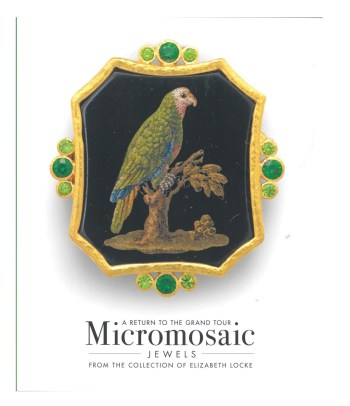 The wide range of subjects depicted in these 92 intricately crafted works of art—precious souvenirs designed for Grand Tour travelers of the mid-18th to late-19th centuries—include Renaissance paintings, architecture, birds, animals, historical sites, landscapes, and portraits. These micromosaic jewels reflect the sophisticated pursuits of elite Europeans for whom travel was a rite of passage.
Diminutive forms of ancient Roman, Grecian, and Byzantine mosaics, ‘micromosaics’—a term coined in the 1970s by collector Sir Arthur Gilbert—are made using a painstaking technique that involves tesserae, small pieces of opaque enamel glass. The tiny mosaics were first developed with regularity in the second half of the 18th century by the Vatican Mosaic Workshop. By the 19th century, numerous independent studios devoted to the production of these small keepsakes were established to meet travelers’ demands and to capitalize on the increasing popularity of micromosaics as symbols of status, sophistication, and social polish. For an English traveler to Rome, Venice, or Milan, for example, a micromosaic of an Italian Renaissance painting or ancient architectural monument captured the journey and today reflects that era’s fascination with the classics and societal requisite travel to the ‘cradle of western civilization’.
The works of art on view in this exhibition, which are predominantly stunning pieces of jewelry, are dazzling in their exquisite detail and craftsmanship. In addition to the tiny enameled glass that forms the mosaic, eye-catching designs include gold, precious stones, and diamonds. VMFA is pleased to present this decorative arts exhibition and to share these fine works of art from the Elizabeth Locke Collection of Micromosaics.
The exhibition is organized by the Virginia Museum of Fine Arts and curated by Dr. Susan J. Rawles, Associate Curator of American Painting and Decorative Arts, VMFA.
Susan Rawles, with a foreword by John Guare, A Return to the Grand Tour: Micromosaic Jewels from the Collection of Elizabeth Locke (Richmond: Virginia Museum of Fine Arts, 2019), 118 pages, ISBN: 978-1934351154, $25.
Conference | New Directions in British Art and Architecture, 1550–1850
Next week at Columbia:
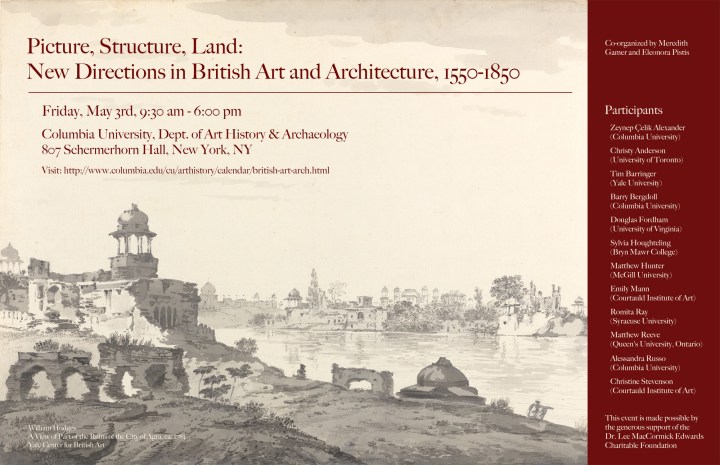
Picture, Structure, Land: New Directions in British Art and Architecture, 1550–1850
Columbia University, New York, 3 May 2019
Organized by Meredith Gamer and Eleonora Pistis
This one-day conference will bring together leading and emerging scholars working in and across the fields of British art and architectural history, broadly defined. Even with the rise of interdisciplinary studies, the study of the visual arts and the built environment in early modern Britain have remained largely separate endeavors. Our aim is to put the two in dialogue and, in doing so, to test, blur, and redraw the boundaries of each. For any questions, please contact britishartarch@gmail.com.
Register here»
P R O G R A M
9:30 Opening Remarks from Meredith Gamer and Eleonora Pistis (Columbia University)
10:00 Fluid Boundaries
Moderator: Alessandra Russo (Columbia University)
• Christy Anderson (University of Toronto), Castles of the Sea: Ships and Architecture in Early Modern England
• Emily Mann (Courtauld Institute of Art), Land, Sea, and the Space in Between: The Visual World of the Overseas Trading Company
11:15 Coffee Break
11:45 Shifting Perspectives
Moderator: Zeynep Celik Alexander (Columbia University)
• Christine Stevenson (Courtauld Institute of Art), Naming Names in Early Modern English Architecture
• Matthew Hunter (McGill University), ‘The Sun is God’: Turner’s Insurance
1:00 Lunch Break
2:30 Performing Identities
Moderator: Barry Bergdoll (Columbia University)
• Matthew Reeve (Queen’s University), Body Politics and Gothic Architecture in the Long Eighteenth Century
• Douglas Fordham (University of Virginia), Discovering Britain in Aquatint: William Daniell’s A Voyage Round Great Britain (1814–25)
3:45 Coffee Break
4:15 Transitional Objects
Moderator: Tim Barringer (Yale University)
• Sylvia Houghteling (Bryn Mawr College), Tapestry between Architecture and Chintz: A Medium in Transition, ca. 1700
• Romita Ray (Syracuse University), China Connections: Tea and Colonial Calcutta
5:30 Refreshments
This event is made possible by the generous support of the Dr. Lee MacCormick Edwards Charitable Foundation, which honors the legacy of Columbia alumna Dr. Lee MacCormick Edwards, GSAS’78, GSAS’81, GSAS’84, an art history scholar, author, and photographer who contributed richly to the cultural and artistic life of both the United States and Australia.
Conference | (Un)Like: Life Writing and Portraiture
From King’s College:
(Un)Like: Life Writing and Portraiture, c.1700–the Present
King’s College London, Strand Campus, 3 May 2019
 Portraiture and life-writing have long been understood as genres that, for all their differences, share key concepts. As both genres are concerned with the individual figure, they rely on particularities and specificities, on telling events and characteristic anecdotes and, most importantly, on a representative depiction of the subject in question which was similar or like. Resemblance, similarity, likeness—these were the terms by which works were judged. A letter to the Daily Gazetteer remarked in 1742: “I think it is agreed on all Hands that in Biography, as it is in Portrait Painting, a Likeness is to be preserved, if we would give satisfaction in either Science.” Importantly (and to complicate the study of likeness), the media concerned with likeness were likewise considered to be alike. The art theorist Jonathan Richardson famously wrote in 1715: “to sit for one’s Portrait is like to have an Abstract of one’s Life written and published, and to have one consigned over to Honour or Infamy.” Richardson referred to the long tradition of inter- or multi-media portraying and life-writing practices, the linking of literary with visual portraits for mutual benefit and the reciprocal bolstering of genres by providing additional information or another perspective. Next to resemblance and medial proximity, Richardson introduces a third aspect: appreciation or emotional response to portraits and biographies. Samuel Johnson would later write in the Idler no. 45 (1759) that “Every man is always present to himself, and has, therefore, little need of his own resemblance; nor can he desire it, but for the sake of those whom he loves, and by whom he hopes to be remembered.” Likeness, it appears, therefore intersects with the representation’s potential to make a person not only like, but also likeable, to have third parties appreciate both the individuals and their representations. This notion of recognition—understood as identification—being closely linked with respect and social approval still shows in such phenomena as Facebook and Instagram, where ‘to like’ equals acceptance, affirmation, or recommendation, signalling approval of the online persona.
This one-day conference explores the different layers of likeness in portraiture and life writing in Europe, from the beginning of the eighteenth century to the present day. Subjects include authors, inventors, painters, self-painters and selfie-takers, robots, realists, surrealists, expressionists, and others, from literature, painting, photography, and film. How does the concept of likeness appear, converge and change across these instances of portraying and portraiture?
Registration information is available here»
P R O G R A M M E
9.00 Welcome and Introduction by Clare Brant
9.15 Panel 1
• Franziska Gygax, Portraying (in) Language: Gertrude Stein’s Literary Portraits
• Max Saunders, Imaginary Portraits: Alfred Cohen and the Rabbi from Dublin
• Alex Belsey, Maintaining Distance: Techniques of Removal and Depersonalisation in the Work of Keith Vaughan
10.30 Panel 2
• Nadja Gernalzick, Queerly (Un)Recognizable: Jerome Hill’s Film Portrait
• Darragh O’Donoghue, Auto/biography in the Work of Disabled Artist Stephen Dwoskin
11.20 Coffee
11.35 Panel 3
• Tim Gorichanaz, Self-Portraiture: A Conceptual Exploration
• Eliza Maureen Altenhof, Describing One’s Self, Depicting One’s Self: The Self-Portrait in Contemporary Literature and Visual Arts in the Context of Illness and Death
• Ksenia Gusarova, Posing as Oneself: Normativity and Individuality in Current Photographic Practice
12.15 Panel 4
• Santiago Gonzales Villajos, Portraying Miguel de Cervantes: An Enlightenment’s Task and Its Factual Deconstruction
• Emrys Jones, The Portrait on the Screen: Film Narrative and Eighteenth-Century Art
• Sofya Dmitrieva, Fancy Picture / Sujet de Caprice: Defining the Genre in the Eighteenth-Century European Painting
1.15 Lunch
2.00 Panel 5
• Claudine van Hensbergen, Behn’s Elusive Likeness, Portraiture’s Place in the Biographical Account
• Olivia Ferguson, ‘The Worst Part of Wordsworth’: Intimacy, Accuracy, and the Author Portrait in the Romantic Period
• Leigh Wetherall Dickson, Painting Celebrity: Capturing the Character of Lady Caroline Lamb
3.15 Panel 6
• Julian North, Portraits for the People: Margaret Gillies’s Portrait of Charles Dickens
• Alba Campo Rosillo, The Medium Makes Publicity: Materiality in The Inventor Portrait by George Peter Alexander Healy
• Ana Belén Martinéz García, Portraying the Activist Likeness as/in Intermedia Practice
4.30 Tea
5.00 Panel 7
• David Veltman, Portraiture as a Mirror: Transcending the Limits of Representativeness in Felix de Boeck’s ‘Double’ Portraits
• Martin Schieder, The Non-Pictorial Portrait: Armani Portrait-robot d’Iris Clert (1960)
• Teresa Bruś, Increase and Excess in Portraiture: S. I. Witkiewicz
6.15 Drinks
6.30 Discussion led by Kerstin Pahl and Kate Retford
Call for Panel Proposals | ASECS 2020, St. Louis
2020 American Society for Eighteenth-Century Studies Conference
Hyatt Regency at the Arch in St. Louis, 19–21 March 2020
Session proposals due by 15 May 2019
 The 51st annual meeting of the American Society for Eighteenth-Century Studies takes place at the Hyatt Regency at the Arch in St. Louis, 19–21 March 2020. Proposals for panels, roundtables, and other sessions are now being accepted. The online submission form is available here. The deadline for proposal submissions is Wednesday, 15 May 2019.
The Program Committee also invites proposals for sessions in other formats, as well as for pre-conference workshops. In addition to explaining what the session would contribute to the annual meeting, special proposals should include a detailed description of the format and logistical requirements (e.g., technology, type of meeting space, particular days/times); an estimate of additional costs to participants or to ASECS (if any); and an explanation of how people would be chosen to participate (if it is not open to all conference attendees). If the event is a workshop that would have a facilitator or main presenter(s), provide a brief description of their expertise. The Program Committee may contact proposers for additional information before deciding on whether special sessions will be included on the Annual Meeting program. Proposals that cannot be accommodated in St. Louis may be considered for later annual meetings. If you have any questions, please contact the ASECS Business Office at asecsoffice@gmail.com.
Lectures | ‘Orientalism’ after 40, with Elisabeth Fraser and Mary Roberts
During the two-year, £50-million renovation of Somerset House, classes and lectures at The Courtauld are held at Vernon Square, near King’s Cross.
Orientalism after 40, with Elisabeth Fraser and Mary Roberts
The Courtauld Institute of Art, Vernon Square, London, 25 April 2019
This term’s Visiting Expert series is a joint collaboration with Professor Mary Roberts (University of Sydney) and Professor Elisabeth Fraser (University of South Florida). This series of events was curated by The Courtauld Institute of Art’s Dr Sussan Babaie. Whilst our Visiting Experts are here, we will reflect upon the 40th anniversary of the publication of Edward Said’s seminal text Orientalism on Thursday, 25 April, 6:00–7:00pm. The event consists of two separate lectures.
Elisabeth Fraser, The Ottoman Costume Album as Collaborative Object and Agent of Contact
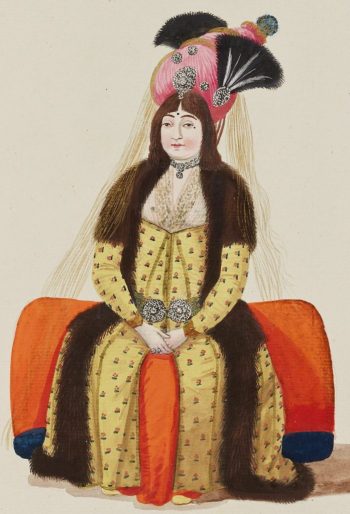 The Ottoman costume album served as a vital agent of contact in the early modern world. Conceived and collected through the movement of people, bound, rebound, sold, gifted, copied and reworked, Ottoman costume albums—produced from the sixteenth through nineteenth centuries—are mobile objects constituted by a flexibility that lends itself to reinvention and reconfiguration. The costume album transcended geographic points of origin, connecting artisans of the book and diverse audiences across time and space in unforeseeable ways. Composed of individual sheets, each bearing a single costumed figure representing variously the Ottoman court, military, professions, and civil society, a costume album was custom made and inflected according to the interests of the owner; the collector and professionals of the book trade determined sequence, thematic emphasis, presentation, and numbers of folios to include. The Ottoman costume album is defined by an essential mutability.
This talk will explore these ideas in relation to one particular eighteenth-century album, Costumes turcs, now in the British Museum, and its connection to a network of other albums and books. Containing 225 costume images painted in Istanbul in the 1780s, this magnificent album was transported to Berlin and then London; at each stop on its journey the album was added to, modified, and redefined. Following the trail of this object reveals the essentially collaborative nature of costume albums.
Elisabeth Fraser is Professor of Art History at the University of South Florida. A specialist of European art and interactions between European and Islamicate cultures, she is the author of Mediterranean Encounters: Artists between Europe and the Ottoman Empire, 1774–1839 and Delacroix, Art and Patrimony in Post-Revolutionary France. She has recently published an essay, “The Color of the Orient: On Ottoman Costume Albums, European Print Culture, and Cross-Cultural Exchange,” in Visual Typologies from the Early Modern to the Contemporary (T. Zanardi and L. Klich, eds., 2018), and edited a volume of essays The Mobility of People and Things in the Early Modern Mediterranean, which will be published by Routledge in 2019. A recipient of an International Scholarship from the Staatliche Museen in Berlin in 2018, she is writing a book on Ottoman costume albums and their relationship to European print culture, Dressing the Ottoman Empire: Early Modern Costume Albums and Transculturation.
Mary Roberts, Edward Said and the Epistolary Interior
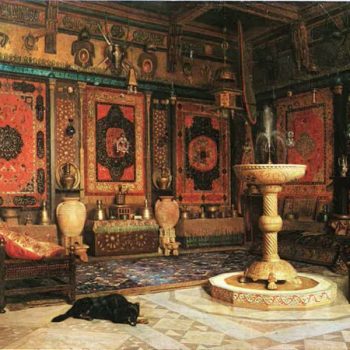 “to [some] theorists of civilization identity is a stable and undisturbed thing, like a room full of furniture at the back of your house. This is extremely far from the truth, not just in the Islamic world but throughout the entire surface of the globe.” –Edward Said, 1996
In histories of modernism the orientalist interior has been consigned like furniture at the back of the house. I resist this formulation by addressing the life of Islamic art as it moved into and out of these spaces. Commencing with Duranton’s painting of Albert Goupil’s Oriental Salon in Paris before the 1888 sale that catalysed movement of his Islamic art into collections across Europe, including the Louvre’s inaugural acquisitions. It is a foundational interior for the history of Islamic art. Goupil’s acquisition channels reveals this interior as the tip of an iceberg that exists in a set of linked relations with Ottoman and Orientalist interiors in Istanbul and Kraków with Polish artist Stanisław Chlebowski as the linchpin. The iceberg, with its north/south axis proves a limited geographic metaphor. It is tempting to construe these Islamic art supply lines through a network model, but that too fails to capture the way these interiors were imagined or lived. In letters to his family in Kraków, written inside the Ottoman Sultan’s Beaux-Arts Palace, Chlebowski articulated one interior within others. I propose that Chlebowski’s epistolary Ottoman and Orientalist interiors exist according to a logic of enfolding. It’s a model for construing the role of historic Islamic art in multiple modernities.
Mary Roberts is John Schaeffer Professor of Art History at the University of Sydney. She specialises in late Ottoman visual culture, British art, and the art of empire and has published extensively on the history of artistic exchanges between the Ottoman Empire and Europe. Her book Istanbul Exchanges: Ottomans, Orientalists and Nineteenth-Century Visual Culture, published by the University of California Press in 2015, was awarded the Art Association of Australia and New Zealand’s Book Prize in 2016 and translated into Turkish the same year. She is also the author of Intimate Outsiders: The Harem in Ottoman and Orientalist Art and Travel Literature (Duke, 2007) and four co-edited books. Mary has been a Getty Scholar, CASVA senior fellow, YCBA fellow, and Clark-Oakley fellow and is currently completing her next book Inside Networks: Orientalist Interiors and Islamic Art in Transit.
Concert and Symposium | Black Music in Eighteenth-Century London
This Thursday at YCBA:
Black Music in Eighteenth-Century London
Yale Center for British Art, New Haven, 25 April 2019

Tunde Jegede (Photo by Yoshitaka Kono).
This concert will feature Tunde Jegede, a renowned cellist and master kora player who specializes in the West African classical music tradition; Robin Jeffrey, a versatile performer on instruments of the lute and guitar families; Corey Shotwell, a celebrated vocalist; and Nathaniel Mander, an exciting young harpsichordist. The performances are free and open to all.
In October 2017, the Yale Center for British Art, Paul Mellon Centre for Studies in British Art (PMC), Historic Royal Palaces (HRP), and Handel & Hendrix in London (HHL) co-hosted a scholarly workshop entitled Black Music: Its Circulation and Impact in Eighteenth-Century London. The program was produced in association with Enlightened Princesses: Caroline, Augusta, Charlotte, and the Shaping of the Modern World, an exhibition that had been co-organized by the Center and HRP, and which then was on display at Kensington Palace. Moderated by Michael Veal (Professor of African Music, African American Studies, and American Studies at Yale) and attended by scholars from around the world, the workshop opened with a series of concerts and performances held throughout HHL, which set the stage for a rich and productive exchange the following day at the PMC. Thanks to the generosity of Laura and James Duncan, Yale BA 1975, Friends of the Center who underwrote the original workshop, this program will be reconstituted for a New Haven audience on Thursday, April 25, at 5:30pm. The performance will be followed on Friday, April 26, by a daylong symposium Black Music: Its Circulation and Impact in Eighteenth-Century London, also at the Center.
This Friday at YCBA:
Black Music: Its Circulation and Impact in Eighteenth-Century London
Yale Center for British Art, New Haven, 26 April 2019
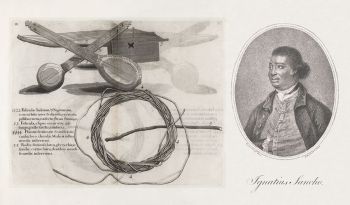 This daylong symposium, which follows the musical performance Black Music in Eighteenth-Century London at the Center on Thursday, April 25, will explore the complex, long-standing relationship between African and Western musical traditions, especially within London metropolitan society, and to recognize the brilliance of black composers and performers who, against great odds, contributed to the musical culture of the age. The program is hosted by the Yale Center for British Art and co-organized with Historic Royal Palaces, Handel & Hendrix in London, and the Paul Mellon Centre for Studies in British Art, with generous support from Laura and James Duncan, Yale BA 1975. Admission is free, though space is limited.
New Book | Joseph Rose: Working Drawings. Facsimile of a Sketchbook
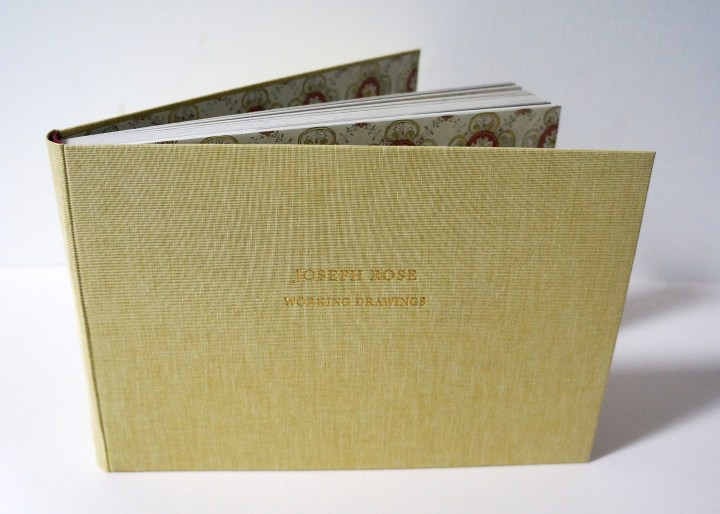
Joseph Rose: Working Drawings. Facsimile of a Sketchbook at Harewood House, with an introduction by Ashleigh Murray (Frome, Somerset: Kate Holland, 2019). Limited edition of 50, of which 48 are ‘ordinary’ (£150) and 2 ‘extraordinary’ (£3000).
The two extraordinary copies are bound in full alum tawed calfskin with hand dyed calfskin inlays and blind and gold tooling. A plasterwork rosette by Hayles and Howe, gilded by Glenny Thomas, is inset into the front board. Hand coloured edges. Hand sewn silk endbands. Printed endpapers from an original watercolour.
This book came about following an invitation to Kate Holland to exhibit as one of the 26 makers selected to feature in the inaugural celebration of contemporary craft at Harewood House, Useful/Beautiful: Why Craft Matters, on view from 23 March until 1 September 2019. A preliminary visit to the house culminated in a behind-the-scenes tour of the archives. In one drawer was a small, nondescript, slightly battered book that revealed a series of working drawings by both Joseph Rose Senior (ca. 1723–1780) and Joseph Rose Junior (1745–1799).
The Roses were the pre-eminent master plasterers of their day and worked closely with Robert Adam (1728–1792) on the ceilings at Harewood in the 1760s as well as on many other big houses, several of which feature in this book. The sketchbook gives a fascinating glimpse into the minds of two incredible craftsmen working on highly significant commissions with some of the foremost architects and interior designers of their time. It is the perfect record of the link between commissioner, designer, and craftsman. Particularly because craftsmen too often fade into the background, Holland wanted to celebrate them especially for this celebration of craft.
As well as the facsimile sketchbook, there is also included an introduction by Ashleigh Murray, currently the academic expert on Joseph Rose in the UK. There are also contemporary images from the workshop floor of Hayles and Howe in Bristol, who still use the same techniques as Joseph Rose today—as well as a full list of plates, transcribed from the manuscript titles, as written by Joseph Rose.
This book is intended to serve not only as an important reference tool for those researching ornamental plasterwork or the work of Robert Adam but also to appeal to a wider audience with an interest in Georgian architecture or the history of interior design and craftsmanship.
For those visiting Harewood House, copies are available at the gift shop. Mail order copies can be arranged by contacting Kate Holland directly, katehollandbookbinder@gmail.com.
More information on the exhibition Useful/Beautiful: Why Craft Matters is available here.

Portrait of James Adam Acquired by NGS and V&A
Press release (18 April 2019) from the National Galleries of Scotland:

Antonio Zucchi, Portrait of James Adam, oil on canvas, 173 × 123 cm (Purchased jointly by the National Galleries of Scotland and the Victoria and Albert Museum, with assistance from the Art Fund, 2019).
The National Galleries of Scotland (NGS) and the Victoria and Albert Museum (V&A) have jointly acquired the most ambitious and splendid surviving portrait of a member of the Adam family, the great eighteenth-century Scottish architectural dynasty.
The portrait of James Adam (1732–1794) by the Italian artist Antonio Zucchi (1726–1795) becomes the third outstanding artwork to be jointly-acquired by the V&A and NGS after together securing two exceptional sculptures, Antonio Canova’s The Three Graces (purchased 1994) and Lorenzo Bartolini’s The Campbell Sisters (purchased 2015). The Zucchi portrait has been purchased thanks to a major grant from national charity Art Fund.
The newly acquired portrait of James Adam will be shown among the great eighteenth-century collection at the Scottish National Portrait Gallery (SNPG), Edinburgh before going on display in the V&A’s British Galleries in London later this year. It will remain on display at the V&A for one year before returning to be shown in Edinburgh. Thereafter, it will be shown at each institution for a period of seven years, on rotation.
Christopher Baker, Director of European and Scottish Art and Portraiture for the National Galleries of Scotland, commented: “James Adam’s portrait is a work of great swagger and refinement that demonstrates the confidence of the Scottish Adam family as seminal taste makers for eighteenth-century Europe. It represents a splendid addition to the collection of the National Galleries of Scotland and we are immensely grateful to both the Victoria and Albert Museum and the Art Fund for making its joint purchase possible.”
Julius Bryant, Keeper of Word and Image at The Victoria and Albert Museum, said: “Zucchi’s portrait of James Adam depicts one of the leading Scottish exponents of the European Neoclassical movement who played a formative role in developing British architecture. It is an ideal portrait for the Neoclassicism section of the V&A’s British Galleries. We are delighted that it joins the V&A’s collection, together with the two sculptures previously purchased with the National Galleries of Scotland. We are enormously grateful to both the NGS and Art Fund for enabling this joint acquisition.”
Stephen Deuchar, Director of the Art Fund, added: “We are very pleased to be helping both National Galleries Scotland and the V&A in acquiring this fine and important portrait of James Adam. It is fitting addition to both collections, marking the sitter’s legacy as a highly influential Scotsman with great significance to the history of British architecture and design, and we know it will enjoyed by a wide public in both locations.”
The painting depicts James Adam during his grand tour of Italy in 1763, before he returned to London to work with his brother, Robert Adam (1728–1792). Dramatically posed and luxuriously dressed, he is surrounded by objects that refer to the study of the ancient world that inspired the neo-classical designs for which the Adam were renowned.
Robert and James Adam, along with their brothers John and William, were the sons of the mason-architect and entrepreneur William Adam (1689–1748). Together the family enjoyed the status of being Scotland’s foremost architects of the eighteenth century. Their role as designers of neo-classical buildings and interiors was to prove profoundly influential not only in Edinburgh and London but all across Europe, North America and Russia.
Robert and James established their architectural practice in 1758. They not only excelled at designing elegant Palladian buildings but also entire interior decorative schemes, including furniture, so ensuring a unity to their immensely popular neo-classical vision. Between 1773 and 1779 the brothers published The Works in Architecture of Robert and James Adam which played a key role in spreading knowledge of their work internationally.
James undertook a Grand Tour of Italy, to seek inspiration for his work, between 1760 and 1763. This impressive portrait was painted in the final year of his tour. It refers to his profession as an architect, and sees him hold dividers in one hand and paper in the other. However, he is also presented as a man of wealth and discrimination, dressed in a silk and fur trimmed gown, at ease with his knowledge of the remains of the classical world that surround him. This type of magnificent portraiture was commonly associated with travelling aristocrats, rather than architects.
The portrait has the distinction of being the only known work of such a subject by the painter Zucchi, who was born in Venice and later worked on a number of decorative paintings for major interior schemes designed by the Adam brothers, before marrying the painter Angelica Kauffmann (1741–1807) in 1781 and settling with her in Rome.
The sculptures depicted in the painting behind James include the Medici Vase and a variant of the Giustiniani Minerva—revered examples of ancient art which could be studied in Rome and, it was felt, could inspire contemporary design. Panels of so-called grotesque ornament frame the niche in which Minerva stands.
The most significant object depicted is the capital (the sculpted top of a column) in the foreground, on which James rests his left arm. It looks at first like a work from antiquity, but is in fact taken from a sculpture design by James Adam. While in Italy he made detailed plans for re-building the Houses of Parliament in London in a neo-classical style, a project that was never realised. As part of this scheme, he produced detailed drawings for a new British architectural order of columns, and combined on them the Scottish unicorn (clearly visible here) with an English lion. The drawings he made were used as the basis for creating a model made of wax that was coloured bronze—and it is this object, which sadly no longer survives, that is depicted by Zucchi. It acted as an extraordinary advertisement for Adam’s ingenuity as a designer and through the prominence of the unicorn, reminded his clientele of his Scottish heritage.
Until now James Adam has only been represented in the collection of the National Galleries of Scotland through a modest and informal drawing by Allan Ramsay (1713–1784), while Robert Adam is the subject of two paste medallions by James Tassie (1735–1799). Zucchi’s unique painted portrait complements his work as an engraver and decorative painter held in the V&A’s collection.
Exhibition | Souvenirs of Italy: An English Family Abroad
Now on view at Audley End:
Souvenirs of Italy: An English Family Abroad
Library at Audley End House, Essex, 1 April — 31 October 2019
Curated by Peter Moore, Abigail Brundin, and Dunstan Roberts
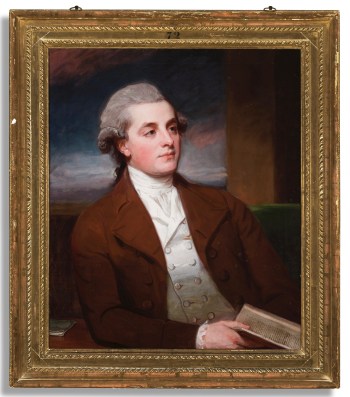
George Romney, Portrait of Richard Aldworth Neville, later 2nd Baron Braybrooke, oil on canvas, ca.1779 (On loan from a private collection; photograph by Mark Asher).
We learn relatively little about Richard Griffin (formerly Richard Aldworth Neville, 1750–1825), second Baron Braybrooke, when we visit or read about Audley End House. He seems to have spent limited time at the house and left it largely unchanged on his death. Recent research in the Library has thrown fascinating new light on this family member, including a European tour that was initiated in the wake of a bereavement and left a lasting personal and cultural legacy at Audley End. Richard’s experiences abroad have much to tell us about the importance of multiculturalism and multilingualism in eighteenth-century England.
The exhibition revolves around the European tour undertaken by Richard Aldworth Neville from 1771 until 1774, when he was in his early twenties. It focuses on the family circumstances that led to the tour, the family’s multilingualism, Richard’s experiences in France, Switzerland, and Italy and what he brought home with him—both materially and culturally—which later found its way into Audley End House and its library. Books, manuscripts, paintings, drawings, and personal items from the house are brought into conversation through the exhibition with archival loans from Essex Record Office that shed light on Richard’s upbringing, his family relationships, and his reactions to his experiences abroad.
The broad aim is twofold. First the exhibition will help to bring into a focus a member of the family and owner of Audley End House who currently does not feature very much in the existing public engagement materials. Second the focus on the Grand Tour allows us to build a narrative about European engagement, through language learning, travel and the consumption of foreign literature and material culture, which enriched the lives of those who lived in and passed through Audley End.
The exhibition is curated by Dr Peter Moore (Curator of Collections & Interiors, Audley End); Dr Abigail Brundin (Reader in Early Modern Literature and Culture, Department of Italian, University of Cambridge); and Dr Dunstan Roberts (Postdoctoral Researcher, Department of English, University of Cambridge). The exhibition is funded by the University of Cambridge and the Friends of Audley End.










 Enfilade
leave a comment