Call for Essays | Thomas Aquinas and His Images
Thomas Aquinas and His Images
Edited by Claire Rousseau and Émilie Roffidal
Proposals due by 15 June 2020

Michel Serre (1658–1733), Thomas Aquinas Trampling Heresy, Basilica of Mary Magdalene, Saint-Maximin-la-Sainte-Baume, Var.
On the occasion of the double centennial of Thomas Aquinas (1225–1274)—with 2023 marking the 7th centennial of his canonization and 2025 the 8th centennial of his birth—and in parallel with events pertaining to the philosophical and theological approach of the ‘angelic doctor’, this publication aims at questioning pictorial representations of the saint. Thomas Aquinas’s innovative work is a link in the transmission of ancient philosophy and early theology’s heritage and has marked European intellectual thought throughout the centuries (with the Summa Theologiae and Summa contra Gentiles, to name just the most famous of his works). The numerous depictions of this extraordinary Dominican answer various purposes: glorification of the Order founded by Saint Dominic through one of its most remarkable figures, hagiographic processes, bringing the devotion of the Blessed Sacrament to the fore via the composer of the Roman office of Corpus Christi, particular devotions, etc.
The proposed publication addresses three themes:
• the doctor: the figure of the intellectual, of the theologian
• the depiction of his virtues
• his canonization
We expect papers offering cross-cutting approaches as well as case studies (paintings, sculptures, or engravings) highlighting the specific features of the iconography proper to Thomas Aquinas, or on the contrary its inscription in traditional schemes of representation (inspired writer, ecstatic saint, etc.). The envisioned chronology covers the long period stretching from the 15th to the 20th century, as well as areas as diverse as Europe or South America (and more).
Schedule
• 15th of June 2020 at the latest: proposals due with title, summary, and bio-bibliographical presentation of the author.
• November 2021: final essays due (35,000 characters at most, 3/4 free of rights photos). The text can be written in French, English, or Italian.
Proposals are to be sent to: Claire Rousseau ParisIV-Sorbonne (maison.seilhan@gmail.com) and Émilie Roffidal CNRS-UT2J (emilie.roffidal@univ-tlse2.fr)
Publisher: Angelicum University Press Roma
Fellowships | Morgan Drawing Institute

From The Morgan:
Morgan Drawing Institute Fellowships
The Morgan Library & Museum, New York, 2020–21
Applications due by 19 November 2019
We would like to remind you of our annual fellowships in the Morgan Drawing Institute. This year we are offering three fellowships: the Samuel H. Kress Predoctoral Fellowship, the Postdoctoral Fellowship, and the Morgan-Menil Fellowship. Fellowship information and applications can be found on the Call for Applications page. All application materials must be submitted online.
Samuel H. Kress Predoctoral Fellowship
The Drawing Institute will award one nine-month Samuel H. Kress Predoctoral Fellowship to an advanced-level graduate student who has completed all course work and exams and is currently engaged in carrying out research leading to the completion of a doctoral dissertation in the history of art, some component of which pertains to the history, theory, collecting, function or interpretation of old master and/or modern drawings.
The Drawing Institute will award one nine-month Postdoctoral Fellowship to a scholar in the first decade of their career following the completion of the Ph.D. or equivalent advanced degree. The Postdoctoral Fellowship supports work on an independent research project relating to some aspect of the history, theory, collecting, function or interpretation of old master and/or modern drawings.
The Drawing Institute and the Menil Drawing Institute, Houston, will award one fellowship of four to six months to support research projects on some aspect of the history, theory, interpretation, or cultural meaning of drawing throughout the history of art. Preference will be given to projects that would benefit from the resources of the Morgan Library & Museum and the Menil Collection.
Belle da Costa Greene Curatorial Fellowships
From The Morgan:
Belle da Costa Greene Curatorial Fellowships
The Morgan Library & Museum, New York
Applications due by 31 December 2019
The Morgan Library & Museum announces the creation of two new two-year curatorial fellowships, the Belle da Costa Greene Curatorial Fellowships, to be awarded to promising scholars from communities historically underrepresented in the curatorial and special collections fields. Named for the Morgan’s first director, one of the most prominent American librarians and cultural leaders of the first half of the twentieth century and a woman of color, this full-time program will equip Fellows with a strong working knowledge of museum and special collections library operations and will provide Fellows with resources and mentorship to support them in their professional careers.
The Morgan seeks candidates who are interested in working on specific projects as outlined below. The program will provide Fellows with experience in a variety of core curatorial activities, such as exhibition and publications planning, research on the collection and on potential acquisitions, the creation of public programs, and donor relations. Fellows will also have the opportunity to propose and curate their own installation in the museum. Fellows will join all departmental meetings as well as the Morgan’s Curatorial Forum, a monthly gathering of all curators and conservators. Regular interaction with colleagues in other departments, including the Thaw Conservation Center, will give each Fellow a good grounding in the key functional areas of a museum and special collections library. Travel funds will support Fellows’ professional development.
Graduate degree in relevant field or equivalent professional experience required. General qualifications include experience conducting archival research using primary sources, deep intellectual curiosity and versatility, and a demonstrated ability to work independently, collaboratively, and efficiently. Candidates should have excellent writing and public speaking skills.
Fellows will be selected on a competitive basis via an application process. All application materials must be in English. Applications consisting of the following elements are due by December 31, 2019. The Morgan will notify successful candidates of their selection in March 2020.
Applicants for the fellowship should describe their specific interests in, and qualifications for one or more possible departments:
Drawings and Prints
The Department of Drawings and Prints seeks a Fellow to work on one of a number of future exhibitions, depending upon the potential Fellow’s expertise: Claude Gillot and eighteenth-century French art; the drawings of Pierre-Auguste Renoir; a project focusing on art in seventeenth-century Rome; or a project looking at the work of Hendrick Goltzius and other northern artists around the year 1600. The Fellow would also take part in the research on the permanent collection and/or potential acquisitions and would have the opportunity to mount a small installation based on the Fellow’s specialty. Candidates should hold or be in pursuit of an advanced degree in the history of art (PhD preferred). Other qualifications include superior research skills and a documented interest in works on paper.
Information on other departments’ needs and details for applying are available here»
New Book | Painting with Fire
From The University of Chicago Press:
Matthew C. Hunter, Painting with Fire: Sir Joshua Reynolds, Photography, and the Temporally Evolving Chemical Object (Chicago: The University of Chicago Press, 2019), 304 pages, ISBN: 978-0226390253, $50.
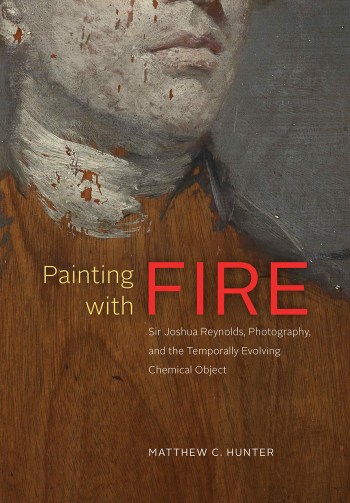 Painting with Fire shows how experiments with chemicals known to change visibly over the course of time transformed British pictorial arts of the long eighteenth century—and how they can alter our conceptions of photography today. As early as the 1670s, experimental philosophers at the Royal Society of London had studied the visual effects of dynamic combustibles. By the 1770s, chemical volatility became central to the ambitious paintings of Sir Joshua Reynolds, premier portraitist and first president of Britain’s Royal Academy of Arts. Valued by some critics for changing in time (and thus, for prompting intellectual reflection on the nature of time), Reynolds’s unstable chemistry also prompted new techniques of chemical replication among Matthew Boulton, James Watt, and other leading industrialists. In turn, those replicas of chemically decaying academic paintings were rediscovered in the mid-nineteenth century and claimed as origin points in the history of photography.
Tracing the long arc of chemically produced and reproduced art from the 1670s through the 1860s, the book reconsiders early photography by situating it in relationship to Reynolds’s replicated paintings and the literal engines of British industry. By following the chemicals, Painting with Fire remaps familiar stories about academic painting and pictorial experiment amid the industrialization of chemical knowledge.
Matthew C. Hunter is associate professor in the Department of Art History and Communication Studies at McGill University. He is the author of Wicked Intelligence: Visual Art and the Science of Experiment in Restoration London, also published by the University of Chicago Press.
C O N T E N T S
Introduction: Slow-Motion Mobiles
1 ‘Pictures . . . in time petrify’d’
2 Joshua Reynolds’s ‘Nice Chymistry’ in the 1770s
3 ‘Rend’rd Imortal”: The Work of Art in an Age of Chemical Reproduction
4 Space, Time, and Chemistry: Making Enlightenment ‘Photography’ in the 1860s
Conclusion: Art History in/as an Age of Combustion
Acknowledgments
Notes
Bibliography
Index
Symposium | Houses of Politicians
From the conference website:
Houses of Politicians
Manchester Metropolitan University, 29–30 November 2019
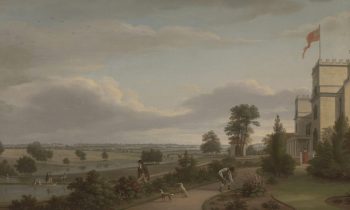 As politics and the idea of politician evolved throughout the long eighteenth century—from landed aristocracy to new money and career politicians—and the empire became increasingly more complex, the building of country houses remained a constant. This symposium brings together established and early career scholars who explore the correlation between politics and the country house within this protean political environment. Case studies and dialogue sessions will discuss design and style, as well as collecting, display, patronage, networking, dissemination, and the relationship between London and the country. The symposium also involves an (optional) tour of Wentworth Woodhouse, built by the marquises of Rockingham and now the focus of a major heritage restoration initiative. Key outcomes will be a publication of scholarly essays and a Politics and Country House Toolkit intended for the professional heritage sector.
F R I D A Y , 2 9 N O V E M B E R 2 0 1 9
Friends Meeting House, 6 Mount St, Manchester
9.00 Morning Session
Moderator: Jon Stobart (Manchester Metropolitan University)
• Joan Coutu (University of Waterloo), Introduction
• Peter Lindfield and Jon Stobart (Manchester Metropolitan University), Powerhouse or Home: Different Readings of the British Country House in Recent Symposia
• Oliver Cox (University of Oxford), Writing Political Histories
• Fiona Candlin (Birkbeck, University of London), When Is a Historic House a Museum? (and Why Might It Matter)
10.45 Break
11.00 Wentworth Woodhouse in Focus
• Dylan Spivey (PhD candidate, University of Virginia), Thomas Wentworth and Wentworth Woodhouse
• Joan Coutu (University of Waterloo), Burke’s Exemplum: The ‘Natural Family Mansion’ and Wentworth Woodhouse
• John Bonehill (University of Glasgow), Painting for Portland: George Barret and Welbeck
12.45 Coach departs for Wentworth Woodhouse; box lunch provided for eating on the coach. Tour followed by a reception at Wentworth Woodhouse.
17.30 Coach departs Wentworth Woodhouse, returning to Manchester at approximately 19.00
S A T U R D A Y , 3 0 N O V E M B E R 2 0 1 9
Manchester Metropolitan University, Business School, All Saints Building, Manchester
8.30 The House, the Style, the Contents, the Message
Moderators: Kate Retford (Birkbeck, University of London) and Anne Bordeleau (University of Waterloo)
• Amy Lim (DPhil candidate, University of Oxford and Tate Britain), Executive or Exile? The Art and Architecture of Country Houses after the Glorious Revolution
• Juliet Learmouth (PhD candidate, Birkbeck, University of London), Holding Court at Marlborough House: The London Residence of Sarah, Duchess of Marlborough
• Jon Stobart, Competing Cultures of Consumption: Politics and Taste at Shugborough
• Dale Townshend (Manchester Metropolitan University), Tory Gothic / Whig Classicism: Chiasmus, Architecture, and the Politics of Style in the Long Eighteenth Century
• Matthew Reeve (Queen’s University, Canada), Gothic Architecture and the Liberty Trope
• Peter Lindfield (Manchester Metropolitan University), A Gothic Houghton: Pelham’s Forgotten Country House
12:45 Lunch
13:30 The Empire at Home
Moderators: Dana Arnold (University of East Anglia) and Anne Bordeleau (University of Waterloo)
• Elisabeth Grass (DPhil candidate, University of Oxford and the National Trust), St. Kitts in Norfolk: The Country House Network of Crisp Molineux
• Jocelyn Anderson (University of Toronto, Mississauga), The ‘Fine House’ of a Caribbean Planter: Public Responses to the Alderman Beckford’s Fonthill
• Kieran Hazzard (University of Oxford), The Clives and India: Collecting, Display, and Colonialism
• Rowena Willard-Wright (freelance curator), William Pitt the Younger and How to Make a Political Home
16:30 Post-Graduate Students Roundtable – Sources and Reflection, Building the Toolkit
Moderator: Oliver Cox
18:00 Concluding Remarks: Reflecting on the Political House
Chaired by Jon Stobart, with Joan Coutu, Oliver Cox, and Peter Lindfield
Call for Papers | Prints in Their Place
From The Courtauld:
Prints in Their Place: New Research on Printed Images in Their Places of Production, Sale, and Use
Research Forum, Courtauld Institute of Art, Vernon Square, Kings Cross, London, 19–20 June 2020
Proposals due by 15 January 2020
Organized by Sheila McTighe, Paris Spies-Gans, and Anita Viola Sganzerla
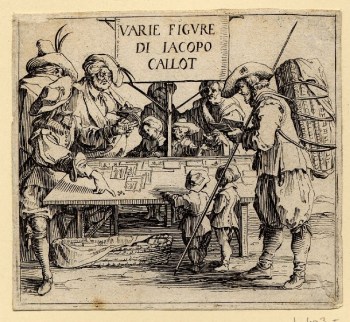
Jacques Callot, Title page to Varie figure, etching, ca. 1621/22 (Washington, DC: National Gallery of Art).
We solicit papers that address printed images in relation to their early modern and modern contexts in the broadest sense. We hope to include papers that cover the full span of the history of prints, and the range of disciplines in which print is now studied, from art history, the history of the book and print culture studies, to the history of science and ideas.
We open up the terms ‘place’ or ‘context’ to include a variety of approaches to the study of prints and of print. To look at prints in their place might concern the relation between prints and their place of production—how did the spaces and formats of artists’ workshops shape their creative process and affect the prints produced? How did the entrepreneurship of print producers in workshops and publishing houses affect the print materials that were bought by their customers? How were the places in which cheap prints were sold—on the street, in the piazza, the book fair, the market table—reflected in their format, imagery, and functions? Equally rich contexts include the places in which printed materials were collected, stored, and used: how did the formats and conventions for looking at prints, pamphlets and books, in libraries, kunstkammer, galleries, chapels, schools, kitchens, laboratories, bedrooms, coffee shops and salons, affect the way prints were made as well as what they portrayed? More broadly, when print shops and book shops were clustered into certain streets or districts in the city, and/or when a locality became associated with the print trade, what effects did the character of this site have on the culture of print in that place? We also encourage topics that consider gender as well as women artists—Were these places gendered? Did women cultivate their own spaces of print production? When and where did women actors navigate the spaces above? What was the place of print, literally or figuratively, for aspiring or established women artists or publishers? The places for prints might also be considered as metaphoric or imagined spaces, such as the international arena for news and political debate. Finally, we invite studies of such real or imagined places for prints that extend beyond western Europe.
If you are interested in presenting a paper at this conference, please send a proposal with your name and institutional affiliation (if you have one), your paper’s title, an abstract of no more than 200 words, and a brief cv, to sheila.mctighe@courtauld.ac.uk. Deadline for submissions is 15 January 2020.
Organizers: Dr. Sheila McTighe (Senior Lecturer, Courtauld Institute), Dr. Paris Spies-Gans (Harvard University Society of Fellows), Dr. Anita Viola Sganzerla (Independent scholar)
Fellowships | Lewis Walpole Library, 2020–21
 The Lewis Walpole Library invites applications to its 2020–21 fellowship program:
Fellowships and Travel Grants in Eighteenth-Century Studies
The Lewis Walpole Library, 2020–21
Applications due by 6 January 2020
The Lewis Walpole Library, a department of Yale University Library, invites applications to its 2020–2021 fellowship program. Located in Farmington, Connecticut, the library offers short-term residential fellowships and travel grants to support research in the library’s rich collections of eighteenth-century materials (mainly British), including important holdings of prints, drawings, manuscripts, rare books, and paintings. Scholars pursuing postdoctoral or advanced research, as well as doctoral candidates at work on a dissertation, are encouraged to apply.
Recipients are expected to be in residence at the library, to be free of other significant professional obligations during their stay, and to focus their research on the Lewis Walpole Library’s collections. Fellows also have access to additional resources at Yale, including those in the Sterling Memorial Library, the Beinecke Rare Book and Manuscript Library, and the Yale Center for British Art. Residential fellowships include the cost of travel to and from Farmington, accommodation for four weeks in an eighteenth-century house on the library’s campus, and a per diem living allowance. Travel grants cover transportation costs to and from Farmington for research trips of shorter duration and include on-site accommodation.
Applications are accepted beginning the first Monday in November. The application deadline is January 6, 2020. Awards will be announced in March.
Fellowships | Tyson Scholars in American Art

From Crystal Bridges:
Tyson Scholars Program: Fellowships in American Art
Crystal Bridges Museum of American Art, Bentonville, Arkansas, 2020–21
Applications due by 15 January 2019
Apply now for a fellowship to support your research. Crystal Bridges invites applications addressing a variety of topics including American art history, architecture, visual and material culture, Indigenous art, Latin American Art, American studies, craft, and contemporary art that expand traditional categories of investigation into American art. Projects with an interdisciplinary focus are encouraged.
The program is open to scholars affiliated with a university, museum, or independent holding a PhD (or equivalent) and PhD candidates. Scholars are selected based on potential to advance understanding of American art and intersect with Crystal Bridges’ collections, architecture, or landscape.
Terms range from six weeks to nine months. Tyson Scholars have access to the art and library collections of Crystal Bridges and the University of Arkansas library. Housing is provided near Crystal Bridges. Workspace at the museum is also provided. Stipends vary depending on duration of residency and experience, and range from $15,000 to $30,000 per semester. Additional funds for relocation and research travel funds are also available. The deadline for the 2020–2021 academic year is January 15, 2020.
New Book | Ancient Marbles in Naples in the Eighteenth Century
From Brill:
Eloisa Dodero, Ancient Marbles in Naples in the Eighteenth Century: Findings, Collections, Dispersals (Leiden: Brill, 2019), 630 pages, ISBN: 978-9004362857, €139 / $167.
 In Ancient Marbles in Naples in the Eighteenth Century Eloisa Dodero aims at documenting the history of numerous private collections formed in Naples during the 18th century, with particular concern for the ‘Neapolitan marbles’ and the circumstances of their dispersal. Research has thus made it possible to formulate a synthesis of the collecting dynamics of Naples in the 18th century, to define the interest of the great European collectors, especially British, in the antiquities of the city and its territory and to draw up a catalogue which for the first time brings together the nucleus of sculptures reported in the Neapolitan collections or coming from irregular excavations, most of which shared the destiny of dispersal, in some cases here traced in definitive fashion.
Eloisa Dodero is curator archaeologist at the Capitoline Museums, Rome. She is involved in the publication of the Paper Museum of Cassiano dal Pozzo (Brepols) and in a new, revised edition of Taste and the Antique: The Lure of Classical Sculpture (Brepols).
C O N T E N T S
List of Figures
List of Abbreviations
Introduction
1 The Collections of Antiquities in Naples in the 18th Century: A Changing Scenario
2 Sources for a Knowledge of the Neapolitan Collections of Antiquities in the 18th Century
• The Descrizioni of Naples and the Travel Literature in the 17th and 18th Century
• Erudite Works, Epigraphic Sylloges and Corpora
• The Correspondence of Antiquarians
• Catalogues of Collections
• Private Archives, Inventories and Auction Catalogues
• The Evidence Offered by the Paintings
• The Townley Archive, the Townley Drawings and the Topham Collection of Drawings
3 Collections of Antiquities in Naples between the End of the 17th and the Closing Years of the 18th Century
• Sculptures as Furniture: Ancient Marbles in Old Palaces and Stately Homes
• The Leading Collectors
• Small Collections of Vases, Inscriptions, Coins, Gems
• Wunderkammern in Naples
• The Collections of the Religious Orders
• The Collections of the Foreigners
4 The Channels of Dispersal of the Neapolitan Marbles from the Viceregal Period to the End of the 18th Century
• The Spanish Viceroyalty and the Austrian Viceroyalty
• The Age of the Bourbons
• Marbles of Neapolitan Origin in 18th-Century British Collections
Conclusions
Catalogue – Part 1: Ancient Marbles in 18th-Century Neapolitan Collection
Sculptures as Furniture: Ancient Marbles in Old Palaces and Stately Homes
• Palazzo Carafa di Colubrano (cat. no. 1–43)
• Villa Mazza (cat. no. 44–50)
• Palazzo Firrao (cat. no. 51–52)
• Palazzo Cellamare (cat. no. 53–64)
• The Gaetani d’Aragona, Dukes of Laurenzano (cat. no. 65–71)
The Leading Collectors
• Giuseppe Valletta (cat. no. 72–122)
• Felice Maria Mastrilli (cat. no. 123–133)
• Giovanni Battista Carafa Duke di Noja (cat. no. 134–138)
Small Collections of Vases, Inscriptions, Coins, Gems
• Ferdinando Galiani (cat. no. 139–140)
Wunderkammern in Naples
• Francesco Antonio Picchiatti (cat. no. 141–145)
The Collections of the Foreigners
• Sir William Hamilton (cat. no. 146–200)
• Vinzenz von Rainer zu Harbach (cat. no. 201–202)
Catalogue – Part 2: Sculptures Found in Naples and Its Surroundings Between the 17th and the 18th Century
Pimentel’s Excavations at Cuma (cat. no. 203–217)
The Dispersal
• Berlin (cat. no. 218–222)
• Paris (cat. no. 223–224)
• Saint Petersburg (cat. no. 225)
• Rome (cat. no. 226–233)
Hadrawa’s Excavations in Capri (cat. no. 234–240)
Neapolitan Marbles in British Collections
• Wilton House
• Other Collections Assembled in the First Half of the 18th Century (cat. no. 241)
• Charles Townley Collection (cat. no. 242–252)
• Lyde Browne Collection (cat. no. 251–253)
• Henry Blundell Collection (cat. no. 254–255)
• Thomas Hope Collection (cat. no. 256)
Archival Sources
Bibliography
Index of Sculptures by Location
General Index
New Book | The Lost Library of the King of Portugal
On 1 November 1755, Lisbon was devastated by a massive earthquake. From PHP:
Angela Delaforce, The Lost Library of the King of Portugal (London: Paul Holberton Publishing, 2019), 208 pages, ISBN: 978-1912168156, £45.
 The destruction on the morning of All Saints Day 1755 of the heart of the city of Lisbon by an earthquake, tidal wave and the urban fires that followed was a tragedy that divides the 18th century in Portugal. One casualty on that fatal morning was the Royal Library, one of the most magnificent libraries in Europe at the time. The Lost Library of the King of Portugal tells the story of the lost library—its creation, collection, and significance.
This 18th-century library was founded by the Bragança monarch Dom João V shortly after he came to the throne in 1706 and was housed at the heart of the royal palace, the Paço da Ribeira, in Lisbon. The king’s abiding ambition was to create one of Europe’s great court libraries, and, at the time of his death in 1750, it was reputed to be one of the most magnificent libraries in Europe. The Royal Library was also composed of a Cabinet of Prints and Drawings, medals and scientific instruments as well as a Cabinet of Natural History with specimens from across Portugal’s global empire.
This documented study describes the creation of the library, its cultural significance in 18th-century Portugal, the acquisition of single volumes as well as entire libraries from across Europe, and the role in this of Portugal’s most talented diplomats. It includes the collection of manuscripts from the celebrated library of Charles Spencer, 3rd Earl of Sunderland and the unpublished correspondence exchanged during the negotiations between London and Lisbon. Throughout his reign, the devout Dom João V set out to conjure up his own vision of Rome and the papal court he never saw. Two chapters are devoted to Italy—one to the talented archaeologist Francesco Bianchini at the papal court, including the unpublished correspondence between him and his royal patron Dom João V, as well as the guides to Rome and art and architecture at the ducal courts of northern Italy, both commissioned by the king.
When the library was destroyed in 1 November 1755 by the earthquake, tidal wave, and the fires that followed, only a few books, manuscripts, and albums of prints were saved, and the author traces their final journey with the royal family and court to Brazil on the eve of the invasion by Napoleon’s army in November 1806.










 Enfilade
leave a comment