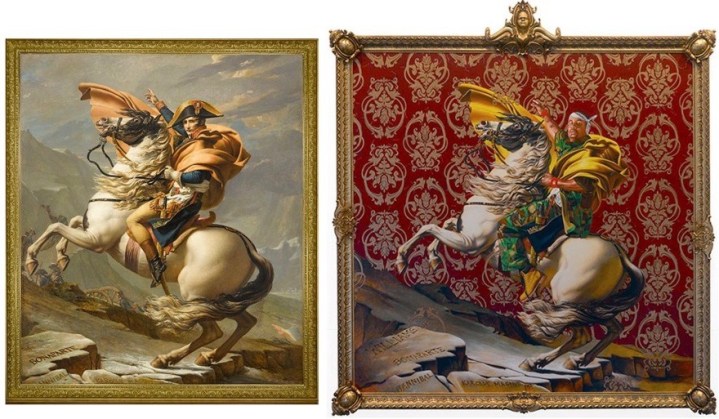
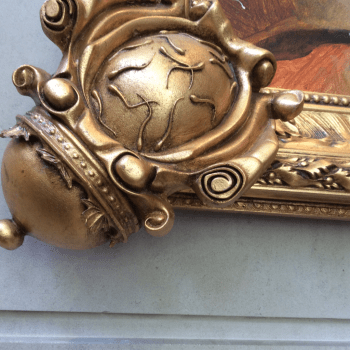
 In Wiley’s interpretation, the artist replaced the Italian mountainside and ready infantry with a detailed background flooded with sperm cells. To this ensemble, he added an ornate gilded frame with testicular-shaped cartouches in each corner and crowned by a carved self-portrait emerging from yonic volutes. The result transforms and challenges the grand tradition of historical portraiture established by artists like David, calling attention to the long-standing blind spots of canonical Western painting and the need to redress historical biases. The work belongs to an ongoing series of Wiley’s titled Rumors of War, begun in 2005, which includes the artist’s latest work of the same name: a monumental equestrian bronze statue in New York’s Times Square, which was unveiled in September 2019 and is now in the collection of the Virginia Museum of Fine Arts.
 The first survey of the history, design, and use of trimmings in the historic interior in Britain and Ireland which will become the standard work on the subject.
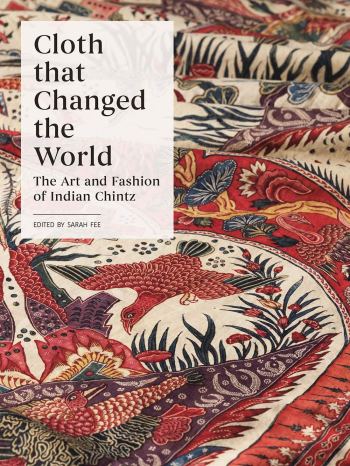 Made with novel cotton, vivid colours and exuberant design, the painted and printed cottons of India changed human history; they revolutionized art, fashion, and science wherever they went around the globe. Featuring pieces from the Museum’s world-renowned collection and several important international loans, this ROM original exhibition explores how over thousands of years India’s artisans have created, perfected, and innovated these printed and painted multicoloured cotton fabrics to fashion the body, honour divinities, and beautify palaces and homes.
Exploring the fascinating stories behind the making and trade of these glorious pieces past and present, The Cloth that Changed the World considers India’s textile innovations and their influences on fashion, trade, and industry around the world in places as far as Cairo, Japan, Sumatra, London, and Ottawa. They were the luxury fabric of their day, coveted by all, and one of the great inventions that drew foreigners to India’s shores hungry for more. Discover how through trade-routes, encounters, and exchange, these cloths connected cultures, inspired imitation and, quite literally, changed the world. Experience how India’s designers and makers today are innovating for new times and audiences.
Sarah Fee, ed., with a preface by Sven Beckert, Cloth that Changed the World: The Art and Fashion of Indian Chintz (New Haven: Yale University Press, 2020), 312 pages, ISBN: 978-0300246797, $50.
◊ ◊ ◊ ◊ ◊
This ROM blog posting from 6 July 2018 looks back to the museum’s 1970 exhibition:
The Origins of Chintz
Royal Ontario Museum, Toronto, 8 April — 28 May 1970
“Chintz… the exotic fabric from India that caught Europe’s fancy… So popular it was banned in England and France… Revolutionized Europe’s textile printing industry.”
Thus exclaimed the brochure that accompanied the ROM’s landmark exhibition, The Origins of Chintz, which opened in April, 1970, now nearly fifty years ago. Occupying the whole of the central ground gallery, known today as Currelly’s Court, the exhibition displayed nearly 100 towering examples of Indian ‘chintz’. . . .
Half of the one hundred objects displayed in the ROM exhibition Origins of Chintz came from the ROM’s own great holdings, particularly the 1934 donation from the estate of Harry Wearne (1852–1929), a British-born textile and wall paper designer. London’s Victoria & Albert (V&A) museum loaned almost forty treasures, including its unique ‘Garrick bed’: these Indian chintz bed coverings are famous both for their grandeur and for the impassioned letters that Mr. Garrick sent to customs officials in London begging for their return; the fabrics had been impounded during the aforementioned import ban on Indian chintz, meant to protect local British silk and linen weavers. A few additional masterpieces—including a seventeenth-century hanging from a Deccan Indian court palace—came on loan from the Metropolitan Museum of Art, the Cooper Hewitt Design Museum, and Austrian Decorative Art Museum of Vienna. . . .
The full posting is available here»











 Enfilade
leave a comment