New Book | My Dearest Heart: The Artist Mary Beale
Distributed in the USA and Canada by The University of Chicago Press:
Penelope Hunting, My Dearest Heart: The Artist Mary Beale (1633–1699) (London: Unicorn Publishing, 2020), 208 pages, ISBN: 9781912690084, £25 / $35.
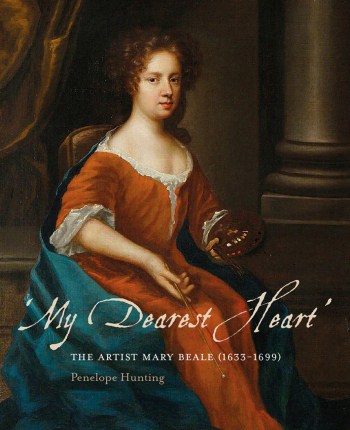 Mary Beale (1633–1699) was one of the earliest professional women artists in Britain. Her successful career as a Baroque-era portrait artist was documented by her husband, Charles, whose almanacs provide a unique record of Beale’s patrons, painting technique, and family affairs. Her portraits of politicians, clergy, aristocracy, and intellectuals reflect the vibrant literary, scientific, and political scene of the seventeenth century.
Beale is recognized as a feminist icon for her success in the male-driven world of portrait painting, and in addition to being a professional artist, she was also as a poet and author. Her book Discourse on Friendship, published in 1667, argued for the equality of husband and wife in marriage—a radical concept at that time. My Dearest Heart, the first biography of Mary Beale, features more than 120 color illustrations of her ground-breaking artistry.
Penelope Hunting is a fellow of the Society of Antiquaries, chairman of the London Topographical Society, and a trustee of the Heatherley School of Fine Art in Chelsea. She is the author of many books, including History of the Royal Society of Medicine and, most recently, Riot and Revolution: Sir Robert Geffery 1613–1704.
New Book | Looking at Jewelry
From The Getty:
Susanne Gänsicke and Yvonne J. Markowitz, Looking at Jewelry: A Guide to Terms, Styles, and Techniques (Los Angeles: J. Paul Getty Museum, 2019), 132 pages, ISBN: 978-1606065990, $20.
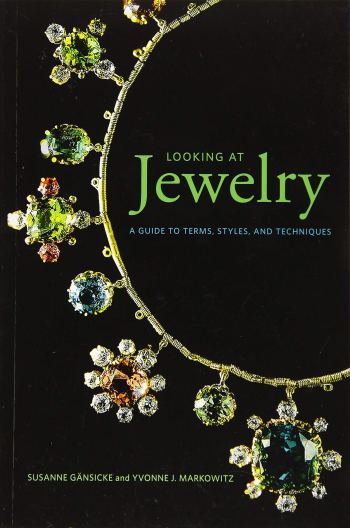 The fascination with personal adornment is universal. It is a preoccupation that is primal, instinctive, and uniquely human. Jewelry encompasses a seemingly endless number of ornaments produced across time and in all cultures. The range of materials and techniques used in its construction is extraordinary, even revolutionary, with new substances and methods of fabrication added with every generation. In any given society, master artisans have devoted their time, energy, and talent to the fine art of jewelry making, creating some of the most spectacular objects known to humankind.
This volume, geared toward jewelry makers, scholars, scientists, students, and fashionistas alike, begins with a lively introduction that offers a cultural history of jewelry and its production. The main text provides information on the most common, iconic, and culturally significant forms of jewelry and also covers materials, techniques, and manufacturing processes. Containing more than eighty color illustrations, this guide will be invaluable to all those wishing to increase their understanding and enjoyment of the art of jewelry.
Susanne Gänsicke is senior conservator and head of antiquities conservation at the J. Paul Getty Museum. Yvonne J . Markowitz is the Rita J. Kaplan and Susan B. Kaplan Curator Emerita of Jewelry at the Museum of Fine Arts, Boston.
Call for Papers | Props: Staging Objects on the ‘Stage of Art’
From the posting at ArtHist.net, which includes the German version:
Props: Staging Objects on the ‘Stage of Art’
Requisiten: Die Inszenierung von Objekten auf der ‚Bühne der Kunst‘
Goethe-Universität, Frankfurt am Main, 9–10 October 2020
Organized by Joanna Olchawa and Julia Saviello
Proposals due by 29 February 2020
Not every object used on a stage is a prop. In his acclaimed study The Stage Life of Props of 2003 Andrew Sofer includes under this term only independent, physical and inanimate objects that are visibly manipulated by an actress or actor over the course of a performance. In this stricter definition of the concept of props the moment of movement plays a central role: objects themselves are not equipped with the potential to move, but they become props as soon as they are integrated into intentional and meaningful representative actions. This definition not only highlights the specific nature of props, but also and above all the way in which props are handled by human actors, which is in turn determined by the connotations and specific construction (functional or otherwise) of each object.
The conference is dedicated to the props that have been used on the various ‘stages’ of the visual arts from the Middle Ages to the present. Not only used in the theatre, objects have been staged in the most diverse ways and semantically enriched in Christian liturgy, military triumphal processions and court ceremonies, to name but a few examples. By describing the picture as a window opening on a ‘historia’, i.e. a scene composed of several figures in different postures and movements, Leon Battista Alberti has assimilated the image space to a stage area, thereby stressing for the first time the parallels between pictorial representations and performances in theatre. Following this, a widening of the view from real to fictional space seems appropriate, in which significant objects can also become props.
The focus of theatre studies so far has been on existing objects, such as rings, skulls and fans, or artefacts made especially for a theatre production, such as masks, sugar jars or knives with retractable blades. In addition to such objects, which partly have already been the subject of art historical studies, ‘props’ from the above-mentioned contexts, from private collections or artists’ studios and comparable contexts can also be discussed during the conference. In addition to the staging of such objects in real and fictional spaces, the places where they are stored and presented will also be considered (armories, cabinets of wonder and prop rooms). The methodological approaches to the exploration of props in their relevance to art history or art-historical object studies can also be addressed, such as the theory of affordances and the actor-network theory, both of focus on the specific nature of the objects, or gender-theoretical and transcultural approaches from which new impulses for the analysis of the multi-layered interaction of humans and objects have emerged.
We look forward to receiving your proposals in German or English. Please submit an abstract of approximately 300 words and a short biography by 29th February 2020 to olchawa@kunst.uni-frankfurt.de and saviello@kunst.uni-frankfurt.de. You will receive a notification by 15th March 2020. The conference will take place on 9th and 10th October 2020. Travel and accommodation costs will be covered thanks to the generous support of the ‘FONTE Stiftung zur Förderung geisteswissenschaftlichen Nachwuchses’. A publication of the conference proceedings is planned.
New Book | Artifacts: How We Think and Write about Found Objects
From Johns Hopkins UP:
Crystal B. Lake, Artifacts: How We Think and Write about Found Objects (Baltimore: Johns Hopkins University Press, 2020), 272 pages, ISBN: 978-1421436500, $35.
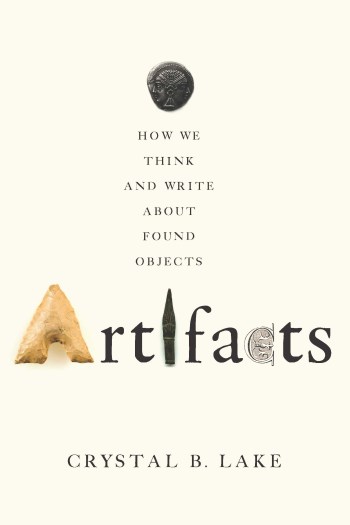 A literary history of the old, broken, rusty, dusty, and moldy stuff that people dug up in England during the long eighteenth century.
In the eighteenth century, antiquaries—wary of the biases of philosophers, scientists, politicians, and historians—used old objects to establish what they claimed was a true account of history. But just what could these small, fragmentary, frequently unidentifiable things, whose origins were unknown and whose worth or meaning was not self-evident, tell people about the past?
In Artifacts, Crystal B. Lake unearths the four kinds of old objects that were most frequently found and cataloged in Enlightenment-era England: coins, manuscripts, weapons, and grave goods. Following these prized objects as they made their way into popular culture, Lake develops new interpretations of works by Joseph Addison, John Dryden, Horace Walpole, Jonathan Swift, Tobias Smollett, Lord Byron, and Percy Bysshe Shelley, among others. Rereading these authors with the artifact in mind uncovers previously unrecognized allusions that unravel works we thought we knew well.
In this new history of antiquarianism and, by extension, historiography, Lake reveals that artifacts rarely acted as agents of fact, as those who studied them would have claimed. Instead, she explains, artifacts are objects unlike any other. Fragmented and from another time or place, artifacts invite us to fill in their shapes and complete their histories with our imaginations. Composed of body as well as spirit and located in the present as well as the past, artifacts inspire speculative reconstructions that frequently contradict one another. Lake’s history and theory of the artifact will be of particular importance to scholars of material culture and forms. This fascinating book provides curious readers with new ways of evaluating the relationships that exist between texts and objects.
Crystal B. Lake is a professor of English language and literatures at Wright State University. She is the cofounder and coeditor of The Rambling.
C O N T E N T S
List of Illustrations
Acknowledgments
Prologue: Things Speaking for Themselves
Part I Terms and Contexts
1 Leaving Room to Guess
2 Ten Thousand Gimcracks
Part II Case Studies
3 Coins: The Most Vocal Monuments
4 Manuscripts: Burnt to a Crust
5 Weapons: A Wilderness of Arms
6 Grave Goods: The Kings’ Four Bodies
Afterword: The Artifactual Form
Notes
Works Cited
Index
Exhibition | Piranesi Drawings: Visions of Antiquity
Opening next month at The British Museum, with a catalogue from Thames & Hudson:
Piranesi Drawings: Visions of Antiquity
The British Museum, London, 20 February — 9 August 2020
Curated by Sarah Vowles
 Celebrating the 300th anniversary of the birth of Giovanni Battista Piranesi (1720–1778), Piranesi Drawings: Visions of Antiquity explores the artist’s celebrated skill as a draftsman. The Venetian-born artist is best known for his dramatic etchings of the architecture and antiquities of his adopted home city of Rome and for his extraordinary flights of spatial fancy, such as Le Carceri (‘Prisons’). This exhibition, however, presents the Museum’s complete collection of Piranesi’s drawings, exploring the formidable quality of his pen and chalk studies and tracking his artistic evolution.
Sarah Vowles is the Hamish Swanston Curator of Italian and French Prints and Drawings at the British Museum. Hugo Chapman is the Simon Sainsbury Keeper of Prints and Drawings at the British Museum.
Sarah Vowles, with an introduction by Hugo Chapman, Piranesi Drawings: Visions of Antiquity
(London: Thames & Hudson, 2020), 144 pages, ISBN: 978-0500480618, £20 / $30.
◊ ◊ ◊ ◊ ◊
Press release (via Art Daily) . . .
Virtuosic and turbulent, Giovanni Battista Piranesi (1720–1778) was a visionary printmaker, architect, antiquarian, and dealer. These varied aspects of his career were based on his practice of drawing, which has received comparatively little attention. The British Museum will mark the 300th anniversary of Piranesi’s birth through a new exhibition focusing on his work as a draughtsman. Piranesi Drawings: Visions of Antiquity will examine his draughtsmanship through the quality and impact of his pen and chalk studies, as well as examining how the Venetian artist’s style developed throughout his career. This exhibition is the British Museum’s first to focus on Piranesi as a draughtsman and celebrates the extraordinary richness of its collections of his drawings, which is one of the largest groups in the world.
Through over 50 works, Piranesi drawings looks at his practice broadly chronologically with sections focusing on four different themes that preoccupied him throughout his career: Venice and Rome, The Carceri, The Glory of Rome, and Architect & Antiquarian. The exhibition also allows visitors to see the way in which his style and interests as a draughtsman evolved over time. The works on display will range from the scene designs and Venetian fantasies of his youth to the prison scenes and dramatic views of Rome that he produced in his artistic maturity. Additionally, the British Museum’s first Piranesi figure drawing will be on display for the first time, a new acquisition from 2019 collected especially for this exhibition.
The exhibition begins with one of the most impressive drawings by Piranesi in the British Museum’s collection, Fantastical Façade of an Antique Building with Columns, Heads, and Sphinxes, c. 1765–69. The drawing dates from later in Piranesi’s career and is not only visually appealing but captures many of the themes explored throughout this exhibition, from his antiquarian flair to his interest in archaeology and his fantastical, extravagant spirit. Piranesi’s melange of architectural elements from Roman, Egyptian, and Etruscan cultures, exemplifies his belief in combining motifs into new and visionary creations.
A notable work featured in the section on The Glory of Rome, The Meeting of the Via Appia and the Via Ardeatina, Seen at the Second Milestone outside the Porta Capena, c. 1750–56, is a magnificent preparatory drawing for one of the secondary frontispieces of the Antichità Romane, published in 1756. Piranesi depicts the junction of two great antique roads, the Via Appia and the Via Ardeatina, outside Rome, but forgoes archaeological exactitude in favour of an elaborate fantasy of Roman sculptures and monuments. A striking and unusual drawing is a Frontispiece Design with Two Skeletons, in Front of a Tomb, c. 1746–47. Made during a visit to his native Venice, it highlights Piranesi’s skill in using pen and wash to create airy and playful visions of light and tone.
Piranesi’s drawings are given context by a selection of related prints along with a pair of fragmentary Roman sculptures from the museum’s collection, purchased by Charles Townley from Piranesi in the 18th century. Visitors are encouraged to explore his influence beyond the gallery by visiting the British Museum’s permanent collection, where the Piranesi Vase and the Trentham Laver can be found in the centre of The Enlightenment Gallery (Room 1).
Piranesi Drawings: Visions of Antiquity offers a rare opportunity to celebrate Piranesi’s influence as a draughtsman. His drawings demonstrate how he brought together his various passions to create magnificent imaginary buildings throughout his life as the architect of a fantastical, imaginary world.
Sarah Vowles, the Smirnov Family Curator of Italian and French Prints and Drawings at The British Museum said: “Many people will be familiar with Piranesi’s evocative prints, but his brilliant and powerful drawings are less well known. He drew compulsively throughout his life, using his sketches and studies as a way to explore, innovate, and invent. The British Museum’s collection of Piranesi drawings is one of the richest in the world, including drawings from throughout his career and giving us insights into all aspects of his varied activity. By presenting the group in its entirety in this focused exhibition, we hope visitors will gain a holistic sense of Piranesi, not only for his influential views of ancient Rome, or his thrillingly gloomy ‘Carceri’ prints, but also appreciating his work as antiquarian, architect, and relentlessly creative visionary.”
Hugo Chapman, The Simon Sainsbury Keeper of Prints & Drawings at The British Museum said: “Piranesi’s etchings of Rome and of fantastical architecture are well known, but far less familiar is the scintillating brilliance of his drawings in which he rehearsed and honed his graphic talents. This exhibition is the first to concentrate on the British Museum’s remarkable collection of over fifty drawings by Piranesi that map the course of his career in Rome as he established his name internationally as one of the great graphic artists of his age. The drawings are remarkable for their dashing speed of execution as Piranesi’s pen strained to keep pace with the tumbling rush of his ideas. They register the dynamic force of his imagination as he transformed the ruins and shattered artefacts of ancient Rome into buildings and works of epic scale and magnificence. Through drawing, Piranesi shaped and perfected his vision, giving us a sense of his transformative imagination. Such is the power of his singular vision that it continues to excite and inspire architects, filmmakers, video game designers, and other creative minds to this day.”
◊ ◊ ◊ ◊ ◊
Note (added 20 February 2020) — The original posting did not include the press release.
New Book | The Ruins Lesson
From The University of Chicago Press:
Susan Stewart, The Ruins Lesson: Meaning and Material in Western Culture (Chicago: The University of Chicago Press, 2020), 368 pages, ISBN: 978-0226632612, $35.
 How have ruins become so valued in Western culture and so central to our art and literature? Covering a vast chronological and geographical range, from ancient Egyptian inscriptions to twentieth-century memorials, Susan Stewart seeks to answer this question as she traces the appeal of ruins and ruins images, and the lessons that writers and artists have drawn from their haunting forms.
Stewart takes us on a sweeping journey through founding legends of broken covenants and original sin, the Christian appropriation of the classical past, myths and rituals of fertility, images of decay in early modern allegory and melancholy, the ruins craze of the eighteenth century, and the creation of “new ruins” for gardens and other structures. Stewart focuses particularly on Renaissance humanism and Romanticism, periods of intense interest in ruins that also offer new frames for their perception. The Ruins Lesson looks in depth at the works of Goethe, Piranesi, Blake, and Wordsworth, each of whom found in ruins a means of reinventing art.
Ruins, Stewart concludes, arise at the boundaries of cultures and civilizations. Their very appearance depends upon an act of translation between the past and the present, between those who have vanished and those who emerge. Lively and engaging, The Ruins Lesson ultimately asks what can resist ruination—and finds in the self-transforming, ever-fleeting practices of language and thought a clue to what might truly endure.
Susan Stewart is the Avalon Foundation University Professor in the Humanities and director of the Society of Fellows in the Liberal Arts at Princeton University. A former MacArthur fellow, she is the author of five earlier critical studies, including Poetry and the Fate of the Senses (2002), winner of the Christian Gauss award of the Phi Beta Kappa Society and the Truman Capote Award. She is also the author of five books of poems, most recently Red Rover (2008) and Columbarium (2003), winner of the National Book Critics Circle Award. These titles, along with The Open Studio (2005) and The Forest (1995), are all published by the University of Chicago Press.
C O N T E N T S
List of Illustrations
Preface
Introduction: Valuing Ruin
1 Matter: This Ruined Earth
2 Marks: Inscriptions and Spolia
3 Mater: Nymphs, Virgins, and Whores—On the Ruin of Women
4 Matrix: Humanism and the Rise of the Ruins Print
5 Model: The Architectural Imaginary
6 Mirrors: The Voyages and Fantasies of the Ruins Craze
7 The Unfinished: On the Nonfinality of Certain Works of Art
8 Resisting Ruin: The Decay of Monuments and the Promises of Language
Acknowledgments
Notes
Works Cited
Photography Credits
Name Index
Subject Index
New Books | Historical Fiction
Recent historical fiction set in the eighteenth century . . . with a strand of Nordic noir woven in:
Niklas Natt och Dag, The Wolf and the Watchman (New York: Atria, 2019), 384 pages, ISBN: 978-1501196775, $28. [Originally published in Swedish as 1793.]
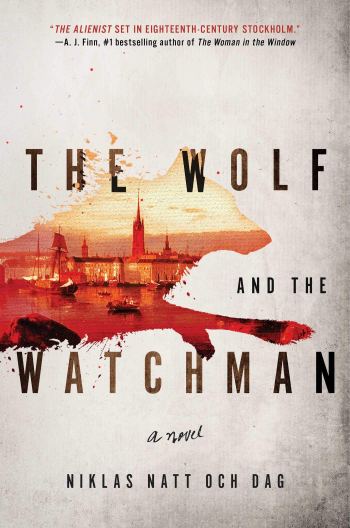 One morning in the autumn of 1793, watchman Mikel Cardell is awakened from his drunken slumber with reports of a body seen floating in the Larder, once a pristine lake on Stockholm’s Southern Isle, now a rancid bog. Efforts to identify the bizarrely mutilated corpse are entrusted to incorruptible lawyer Cecil Winge, who enlists Cardell’s help to solve the case. But time is short: Winge’s health is failing, the monarchy is in shambles, and whispered conspiracies and paranoia abound. Winge and Cardell become immersed in a brutal world of guttersnipes and thieves, mercenaries and madams. From a farmer’s son who is led down a treacherous path when he seeks his fortune in the capital to an orphan girl consigned to the workhouse by a pitiless parish priest, their gruesome investigation peels back layer upon layer of the city’s labyrinthine society. The rich and the poor, the pious and the fallen, the living and the dead—all collide and interconnect with the body pulled from the lake. Breathtakingly bold and intricately constructed, The Wolf and the Watchman brings to life the crowded streets, gilded palaces, and dark corners of late-eighteenth-century Stockholm, offering a startling vision of the crimes we commit in the name of justice, and the sacrifices we make in order to survive.
Niklas Natt och Dag (‘Night and Day’) is a member of the oldest surviving noble family in Sweden. He enjoys playing the guitar, mandolin, violin, and the Japanese bamboo flute. The Wolf and the Watchman, his first novel, was named the Best Debut of 2017 by the Swedish Academy of Crime Writers and is being published in thirty countries. He lives in Stockholm with his wife and their two sons.
◊ ◊ ◊ ◊ ◊
Dexter Palmer, Mary Toft; or, The Rabbit Queen: A Novel (New York: Pantheon, 2019), 336 pages, ISBN: 978-1101871935, $28.
 In 1726, in the town of Godalming, England, a woman confounded the nation’s medical community by giving birth to seventeen rabbits. This astonishing true story is the basis for Dexter Palmer’s stunning, powerfully evocative new novel.
Surgeon’s apprentice Zachary Walsh knows that his master, John Howard, prides himself on his rationality. But John cannot explain how or why Mary Toft, the wife of a local journeyman, has managed to give birth to a dead rabbit. When this singular event becomes a regular occurrence, John and Zachary realize that nothing in their experience as rural physicians has prepared them to deal with a situation like this—strange, troubling, and possibly miraculous. John contacts several of London’s finest surgeons, three of whom soon arrive in Godalming to observe, argue, and perhaps use the case to cultivate their own fame.
When King George I learns of Mary’s plight, she and her doctors are summoned to London, where Zachary experiences a world far removed from his small-town existence and is exposed to some of the darkest corners of the human soul. All the while Mary lies in bed, as doubts begin to blossom among her caretakers and a growing group of onlookers waits with impatience for another birth, another miracle.
Dexter Palmer is the author of two previous novels: Version Control, which was selected as one of the best novels of 2016 by GQ, the San Francisco Chronicle, and other publications, and The Dream of Perpetual Motion, which was selected as one of the best fiction debuts of 2010 by Kirkus Reviews. He lives in Princeton.
◊ ◊ ◊ ◊ ◊
Laura Shepherd-Robinson, Blood & Sugar (Mantle Books, 2019), 448 pages, ISBN: 978-1509880775, £15.
 Blood & Sugar is the thrilling debut historical crime novel from Laura Shepherd-Robinson. June, 1781. An unidentified body hangs upon a hook at Deptford Dock—horribly tortured and branded with a slaver’s mark. Some days later, Captain Harry Corsham—a war hero embarking upon a promising parliamentary career—is visited by the sister of an old friend. Her brother, passionate abolitionist Tad Archer, had been about to expose a secret that he believed could cause irreparable damage to the British slaving industry. He’d said people were trying to kill him, and now he is missing . . .
To discover what happened to Tad, Harry is forced to pick up the threads of his friend’s investigation, delving into the heart of the conspiracy Tad had unearthed. His investigation will threaten his political prospects, his family’s happiness, and force a reckoning with his past, risking the revelation of secrets that have the power to destroy him. And that is only if he can survive the mortal dangers awaiting him in Deptford . . .
“A page-turner of a crime thriller . . . This is a world conveyed with convincing, terrible clarity.”
–C. J. Sansom
◊ ◊ ◊ ◊ ◊
Laura Shepherd-Robinson, Daughters of Night (Mantle Books, 2020), 448 pages, ISBN: 9781509880829, £15.
 From the brothels and gin-shops of Covent Garden to the elegant townhouses of Mayfair, Laura Shepherd-Robinson’s Daughters of Night follows Caroline Corsham, as she seeks justice for a murdered woman whom London society would rather forget . . .
Lucia’s fingers found her own. She gazed at Caro as if from a distance. Her lips parted, her words a whisper: ‘He knows.’
London, 1782. Desperate for her politician husband to return home from France, Caroline ‘Caro’ Corsham is already in a state of anxiety when she finds a well-dressed woman mortally wounded in the bowers of the Vauxhall Pleasure Gardens. The Bow Street constables are swift to act, until they discover that the deceased woman was a highly-paid prostitute, at which point they cease to care entirely. But Caro has motives of her own for wanting to see justice done, and so sets out to solve the crime herself. Enlisting the help of thieftaker, Peregrine Child, their inquiry delves into the hidden corners of Georgian society, a world of artifice, deception and secret lives. But with many gentlemen refusing to speak about their dealings with the dead woman, and Caro’s own reputation under threat, finding the killer will be harder, and more treacherous than she can know . . .
New Book | The Art of the Bird
From The University of Chicago Press:
Roger Lederer, The Art of the Bird: The History of Ornithological Art through Forty Artists (Chicago: The University of Chicago Press, 2019), 224 pages, ISBN: 978-0226675053, $35.
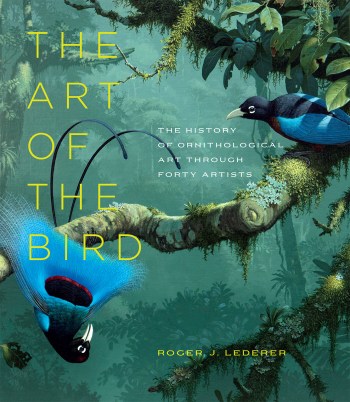 The human history of depicting birds dates to as many as 40,000 years ago, when Paleolithic artists took to cave walls to capture winged and other beasts. But the art form has reached its peak in the last four hundred years. In The Art of the Bird, devout birder and ornithologist Roger J. Lederer celebrates this heyday of avian illustration in forty artists’ profiles, beginning with the work of Flemish painter Frans Snyders in the early 1600s and continuing through to contemporary artists like Elizabeth Butterworth, famed for her portraits of macaws. Stretching its wings across time, taxa, geography, and artistic style—from the celebrated realism of American conservation icon John James Audubon, to Elizabeth Gould’s nineteenth-century renderings of museum specimens from the Himalayas, to Swedish artist and ornithologist Lars Jonsson’s ethereal watercolors—this book is feathered with art and artists as diverse and beautiful as their subjects. A soaring exploration of our fascination with the avian form, The Art of the Bird is a testament to the ways in which the intense observation inherent in both art and science reveals the mysteries of the natural world.
Roger J. Lederer is professor emeritus of biological sciences at California State University, Chico, where he taught courses on ornithology and ecology. He is the author of Beaks, Bones, and Bird Songs: How the Struggle for Survival Has Shaped Birds and Their Behavior; coauthor of Latin for Bird Lovers; and creator of Ornithology.com.
C O N T E N T S
Introduction
1 Flemish Baroque Artists, 1580–1700
From the early seventeenth to early eighteenth centuries, Flemish painters favoured exotic birds as subjects, especially parrots and peacocks.
Frans Snyders (1579–1657)
Carel Pietersz Fabritius (1622–1654)
Melchior d’Hondecoeter (1636–95)
2 Early English Artists, 1626–1716
Animal representations were superseded by religious paintings and portraiture, but painters of these genres often worked with animaliers to add creatures to scenes.
Francis Barlow (1626–1704)
Jakob Bogdani (1658–1724)
Marmaduke Cradock (1660–1716)
3 Natural History, 1680–1806
Explorers brought back specimens from exotic destinations, popularizing natural history. As new birds were discovered, collected, and named, the science of ornithology came into being with the help of artists who illustrated these new discoveries.
Mark Catesby (1682/3–1749)
George Edwards (1694–1773)
Aert Schouman (1710–1792)
4 Before Ecology
Natural history focused on the identification of organisms. Naming became more standardized, thoughtful, and detailed, as did the art that accompanied it.
Thomas Bewick (1753–1828)
Lady Elizabeth Symonds Gwillim (1763–1807)
Alexander Wilson (1766–1813)
5 Early Scientific Illustration
Art began to accurately reflect the habitat and behaviour of birds, as observation revealed the subtle details of their physical appearance and their behavioural patterns.
John James Audubon (1785–1851)
Prideaux John Selby (1788–1867)
Elizabeth Gould (1804–1841)
6 In the Age of Darwin
The age of Darwin was also the golden age of ornithology. Ideas about how birds’ shape, colours and behaviour came to be and what relationships they had were debated.
Edward Lear (1812–1888)
Joseph Wolf (1820–1899)
William Matthew Hart (1830–1908)
7 Art and Science Overlap
As exploration of the natural world expanded, artists became important observers. Comparing species and varieties required artists to put more than one species on a page, and scientific monographs on specific bird groups became more common.
John Gerrard Keulemans (1842–1912)
Robert Ridgway (1850–1929)
Archibald Thorburn (1860–1935)
Bruno Liljefors (1860–1939)
Allan Cyril Brooks (1869–1946)
Louis Agassiz Fuertes (1874–1927)
8 Broader Appeal
The skills of artists, the variety of their styles, their publications, and their reach to communities outside of the art world stoked the public’s interest both in birds and art.
Claude Gibney Finch-Davies (1875–1920)
Lilian Marguerite Medland (1880–1955)
Neville William Cayley (1886–1950)
Jessie Arms Botke (1883–1971)
Eric Ennion (1900–1981)
Roger Tory Peterson (1908–1996)
9 Bird Art Support Birds
When the environmental movement began in earnest in the latter half of the twentieth century, people noticed that bird habitats were disappearing and bird numbers declining. Artists helped to increase public awareness of these environmental issues.
Janet Turner (1914–1988)
Arthur B. Singer (1917–1990)
Keith Shackleton (1923–2015)
William Thomas Cooper (1934–2015)
James Fenwick Lansdowne (1937–2008)
10 Ornithological Art Expands
Bird field guides and illustrated books maintain their popularity but artists are also producing novel, creative and bizarre bird art that continues to enthral and inspire.
Raymond Harris-Ching (b. 1939)
Hilary Burn (b. 1946)
Elizabeth Butterworth (b. 1949)
Lars Jonsson (b. 1952)
David Allen Sibley (b. 1961)
Bibliography
Index
Call for Papers | The Animal and the Human in Netherlandish Art
From ArtHist.net:
The Animal and the Human in Netherlandish Art
Nederlands Kunsthistorisch Jaarboek 71 (2021)
Proposals due by 10 February 2020; articles due by 3 August 2020
Art begins with the animal. –Deleuze and Guattari (1991)
If the topic of the animal and the human in Netherlandish art evokes images of aristocratic hunt scenes, lap-dogs or Boschian hybrids, current ecological and ethical concerns reveal persistent questions of why and how artists have engaged with the nonhuman animal as subject and object of depiction. From Bosch to Snyders to Broodthaers to Fabre, Netherlandish artists have probed, and continue to probe, changing understandings of the relations and shifting boundaries between the human and the animal. Yet despite the importance of the visual arts to ‘the question of the animal’, the abundance of Netherlandish imagery of animals and human-animal relations has not received sustained attention. Volume 71 (2021) of the Nederlands Kunsthistorisch Jaarboek invites investigations into the animal and the human in the art and visual culture of the Low Countries and its diasporas in all periods.
In recent decades the field of animal studies has attracted increasing interest as scholars from various disciplines take other animals seriously as subjects. Animal studies pays close attention to the ways in which humans anthropomorphize animals, whilst adopting a post-humanist perspective in recognizing animals as beings-in-themselves, separate from our interests in them. The field has roots in questions about human beings’ co-existence with and use of other animals, extending the possibility of feeling emotion and pain to other sentient creatures. It also arises from cultural and philosophical interest in attempts to define the self and humanity through interactions with and representations of other animals. Giorgio Agamben for example, has examined the ways in which Western thought has produced ‘the human’ as a distinct and superior animal, or as different in kind from ‘the animal’.
The distinction made by René Descartes—who lived in the Netherlands from 1628 until 1639—between a self-aware, thinking human subject and a reflex-driven beast-machine was an important symbolic moment in the separation of ‘the animal’ from ‘the human’. The early modern period witnessed a tendency to depict animals as objects. Here, knowledge of the nature of a specific species of animal was not a matter of symbolic references and emblematic meanings, but of accurate, ‘scientific’ depiction. Depicted ‘ad vivum’ became an advertising slogan—whether the artist had seen the creature with his or her own eyes or not. In the early 18th century, for example, the magnificent printed publications after Maria Sybilla Merian’s drawings were authorized by the claim to be ‘naer het leven’. This claim to lifelikeness went hand in hand with experiments in observation and representation. One could think of the technologies of the microscope, photography and other forms of imaging including the digital. One might also cite interest in insects, animal anatomy, vivisection, comparative anatomy, taxonomy, or in the natural habitat of animals and their reproduction, animal curiosities, wonders, and genetics.
A sense of wonder could be evoked by the techniques of representation and the materiality of works of art. For example: Joris Hoefnagel and Otto Marseus van Schrieck famously inserted real insect-wings in their images, like, later, Fabre. This opens up the question to the use of animals in works of art in a broader sense: as a source for pigments and dyes, for glue and for brushes; or as source for parchment and vellum; or as elements of site-specific installations. How were these animal products obtained and processed? How did/does awareness of this affect interpretation of the works they constitute?
This volume invites new work that engages with the humanities beyond the human. Contributions might explore northern European art works that visualise animal mutations, metamorphoses, fables, struggles, fetishizing, speciation, preservation, and the monstrous. They might also engage with artistic critiques of taxonomies, habitats, hybridities, consumption, and the post-human.
The NKJ is dedicated to a particular theme each year and promotes innovative scholarship and articles that employ a diversity of approaches to the study of Netherlandish art in its wider context. More information is available here. Contributions to the NKJ (in Dutch, English, German, or French) are limited to a maximum of 7,500 words, excluding notes and bibliography. Following a peer review process and receipt of the complete text, the editorial board will make final decisions on the acceptance of papers.
Please send a 500-word proposal and short CV by 10 February 2020 to:
Eric.Jorink@huygens.knaw.nl
Joanna.Woodall@courtauld.ac.uk
Edward.Wouk@manchester.ac.uk
Schedule of production
Deadline for submission of proposals: 28 February 2020
Notifications about proposals: by 15 March 2020
Submission of articles for peer review: 3 August 2020
New Book | The Warrior, the Voyager, and the Artist
From Yale UP:
Kate Fullagar, The Warrior, the Voyager, and the Artist: Three Lives in an Age of Empire (New Haven: Yale University Press, 2020), 320 pages, ISBN: 978-0300243062, $40.
 A portrait of empire through the biographies of a Native American, a Pacific Islander, and the British artist who painted them both.
Three interconnected eighteenth-century lives offer a fresh account of the British Empire and its intrusion into Indigenous societies. This engaging history brings together the stories of Joshua Reynolds and two Indigenous men, the Cherokee Ostenaco and the Raiatean Mai. Fullagar uncovers the life of Ostenaco, tracing his emergence as a warrior, his engagement with colonists through war and peace, and his eventual rejection of imperial politics during the American Revolution. She delves into the story of Mai, his confrontation with conquest and displacement, his voyage to London on Cook’s imperial expedition, and his return home with a burning ambition to right past wrongs. Woven throughout is a new history of Reynolds, growing up in Devon near a key port in England, becoming a portraitist of empire, rising to the top of Britain’s art world and yet remaining ambivalent about his nation’s expansionist trajectory.
Kate Fullagar is an associate professor of Modern History at Macquarie University in Sydney, Australia. She is the author of The Savage Visit, the editor of The Atlantic World in the Antipodes, and co-editor of Facing Empire.










 Enfilade
leave a comment