Call for Papers | Space and the Hospital
From the Call for Papers:
Space and the Hospital
13th Conference of the International Network for the History of Hospitals
Lisbon, 26–28 May 2021
Proposals due by 30 September 2020
Hosted by “Hospitalis: Hospital Architecture in Portugal at the Dawn of Modernity” and “Royal Hospital of All Saints: city and public health” research projects.
Space, in both its physical and conceptual manifestations, has been a part of how hospitals were designed, built, used, and understood within the wider community. By focusing on space, this conference aims to explore this subject through the lens of its architectural, socio-cultural, medical, economic, charitable, ideological, and public conceptualisations. This thirteenth INHH conference will explore the relationship between space and hospitals throughout history by examining it through the lens of five themes: (1) ritual, space, and architecture; (2) hospitals as ‘model’ spaces; (3) the impact of medical practice and theory on space; (4) hospitality and social space; (5) sponsorship. Below are more details about how the conference themes will address along with related questions. The themes and questions presented are by no means an exhaustive list; however, we encourage the submission of an abstract that examines any aspects of space and the history of hospitals in innovative ways.
Key themes and questions to be explored:
1 Ritual, Space, and Architecture
• How has the architectural designs of hospitals shaped their use? How has ritual impacted the built environment? How have these spaces been preserved and how are they presented to modern audiences? How were aesthetic changes integrated over time?
• Examples: architectural design, death care and burials, patient rooms, religious spaces in medical environments, archeological and/or architectural reconstructions, material culture, heritage studies.
2 Hospitals as ‘Model’ Spaces
• How have hospitals, leprosaria, and other health care establishments been conceptualised as ‘model’ institutions, both architecturally and spatially? How were architectural models communicated and circulated? How did colonial ‘models’ inform both hospitals and the surrounding environment? How were these ‘models’ juxtaposed against preexisting institutions and/or practices? Did bad ‘models’ exist, if so, what was the criteria for this categorisation?
• Examples: Using plans from preexisting hospitals; the imposition of a non-indigenous ‘model;’ hospitals in transition (i.e. colonial to postcolonial).
3 The Impact of Medical Theory and Practice on Space
• How did prevailing medical theories influence the built environment? As these theories and practices changed, how were these changes made manifest?
• Examples: colonial medicine and its impact on architecture and space of existing and ‘new’ hospitals; changes in space creating inclusive or exclusive environments; bioarchaeological studies of hospitals and their patients; care versus cure.
4 Hospitality as Social Space
Organization
• How has the inclusion or exclusion of groups shaped care and space? How is this reflected in its architecture? How have hospitals been designed to be more welcoming? How were health and social activities balanced in a hospital’s built environment? How does the presence of hospitals and/or leprosaria impact urban planning?
• Examples: segregation within hospitals; concierge services and creating a ‘public face;’ the role of gender and hospitality; hospitality and socio-economic status; psychological responses to space in hospitals.
5 Sponsorship
• How have founders and donors affected the creation and/or development of a hospital? Did their donation change the social or cultural environment? How does this impact the hospital’s reputation?
• Examples: Prioritising wings for specific illness or methods of care; perception of donors as individuals; impact of class and gender.
The Advisory Board of the INHH and the local organizer committee wish to invite proposals for 20-minute papers or posters which address the conference theme. Potential contributors are asked to bear in mind that engagement with the theme of space and the hospital will be a key criterion in determining which papers are accepted onto the programme.
Abstracts should be a maximum of 300 words in length, in English and accompanied by a brief biography of no more than 200 words. Proposals should be sent to space.inhh@gmail.com by 30 September 2020. As with previous INHH conferences, it is intended that an edited volume of the conference papers will be published. Submissions are particularly encouraged from researchers who have not previously given a paper at an INHH conference.
Upon provision of full receipts, we hope to be able to support attendance at this conference, particularly for postgraduates and early career researchers. Speakers will be asked to make use of alternative sources of funding where these are available. Any queries may be directed to space.inhh@gmail.com.
2020 APS Publication Grant
From APS:
2020 APS Publication Grant (up to $2000)
Applications due by 31 August 2020
The Association of Print Scholars invites submissions for the 2020 APS Publication Grant, supported by C.G. Boerner and Harris Schrank. The APS Publication Grant supports the publication of innovative scholarly research about printmaking across all time periods and geographic regions. The grant carries a maximum award of $2,000 and is funded through the Association of Print Scholars and the generosity of C.G. Boerner and Harris Schrank.
Proposed projects should be feature-length articles, online publications or essays, exhibition catalogues, or books, which are nearing completion and publication. Examples of possible uses for an APS Publication Grant include, but are not limited to, the following:
• Travel expenses for research essential to the completion of a manuscript
• Studio time or courses in printmaking that will contribute significantly to a scholar’s understanding of their subject matter, or collaboration between printmakers and scholars
• Funding assistance for photography and image permissions
• Honoraria for contributors to edited volumes or other collaborative publications.
Applications are due August 31. Successful applicants will be notified by November 1 and the grant must be applied to publication costs within one year of notification.
Successful proposals must address all of the following criteria, which must be consolidated into a single PDF document (12 pt. font, black text):
1. Proposal narrative describing scholarly project. Projects will be evaluated based on the clarity of the proposal and the originality and innovation of the applicant’s research (500-1000 words).
2. Budget and budget narrative (250 words or less) detailing how grant funding would be spent. Please list any other grants for which the applicant has applied, amounts, and the results (if known).
3. A detailed publishing plan, which should ideally include documentation of progress towards publication or the project’s likelihood of publication. This documentation could take the form of a letter from an editor, press, or publisher, or an outline of possible publishers and contact made thus far. Please note that applications with a publisher’s support will receive highest consideration for the grant.
4. CV for all participant(s), no longer than 3 pages for each participant.
Applicants should send the above materials in a single PDF by 31 August 2020 to the APS Grants Committee at grants@printscholars.org. Additional information is available here.
The Decorative Arts Trust Meets Capital Campaign Goal
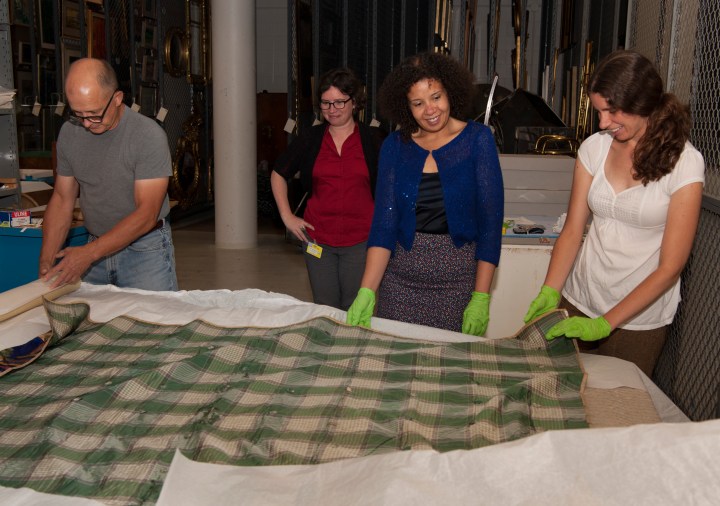
Maureen Marton (center right) was the Decorative Arts Trust Curatorial Intern at the Munson-Williams-Proctor Arts Institute Museum of Art (MWPAI). Here she evaluated the back of a crazy quilt with MWPAI staff. Photo by Richard Walker Photography.
◊ ◊ ◊ ◊ ◊
Press release (15 July 2020) from the Decorative Arts Trust:
The Board of Governors of the Decorative Arts Trust is honored to announce the successful conclusion of a $2M campaign to raise endowed funds in support of the Emerging Scholars Program (ESP). Titled Providing a Future for Students of the Past, the campaign commenced in 2017 and was achieved through contributions from more than 200 donors. The largest fundraising effort mounted by the organization to date, the generosity of Trust members and a small group of private foundations and charitable funds ensures the ESP’s future in the years ahead. Upwards of 50 emerging scholars benefit from the Trust’s support in a typical year.
The Trust’s Executive Director, Matthew A. Thurlow, cites “the tremendous munificence of our community” in reaching the goal. “We are grateful for the opportunity to celebrate this milestone, especially in a challenging climate.”
Charles T. Akre, Jr., President of the Trust’s Board of Governors, adds “the benefit of the ESP to young scholars and institutions alike is a great source of pride for the organization and our membership. This service is central to the Trust’s mission and will remain part of our core focus thanks to the success of this campaign.” Akre chaired the Campaign Committee and guided the fundraising process to a successful end.
Robert A. Leath, Chairman of the Trust’s Education Committee, which oversees the ESP, and President of the Classical American Homes Preservation Trust, states “this campaign helps to secure the future of our field through valuable opportunities for highly qualified young professionals who will serve as the next generation of caretakers for our nation’s artistic legacy.”
Brock W. Jobe, Vice President of the Board of Governors and Professor of American Decorative Arts Emeritus at Winterthur Museum, Garden & Library, sees this as “a foundational moment for the Trust that guarantees the continuation of grants and internships that change the lives of young professionals and enhance the Trust’s commitment to scholarship and the museum world.” Jobe was instrumental in the expansion of the ESP.
New YouTube Channel | ArtStoryLab
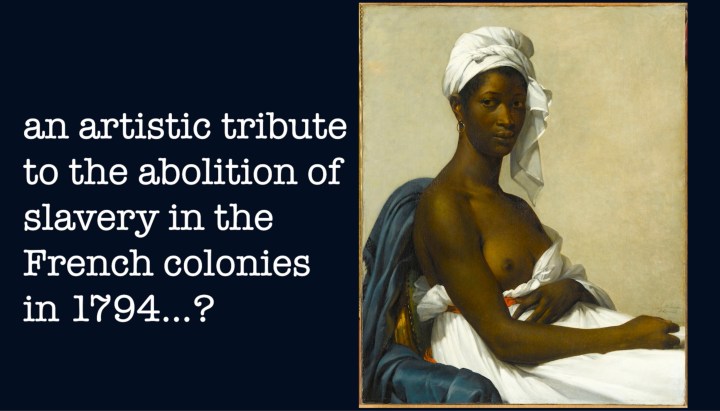
A note from Hyejin Lee:
In April, I created a YouTube channel called ArtStoryLab, featuring short videos on various art-historical topics. I have ten episodes so far, and most of them center on 18th-century European art. As the channel grows, I hope to branch out into other fields of art history. I upload a new video every few weeks. All ten episodes can be found here.
My aim for the channel is to create fun and accessible art-historical contents that everyone can enjoy. While my videos feature recent works by other art historians, I prioritize my personal interpretations on artworks in each episode to empower my viewers to form their own opinions about the visual, material world they inhabit. I have created the channel also as a teaching resource for art history courses in the age of remote learning. In the future, I would like to feature my colleagues in interviews and other formats to show art historians in action in academia, museums, and elsewhere. The big vision for the channel is to demonstrate to the global audience at YouTube the importance of visual literacy and the relevance of art history for today’s world in approachable, entertaining ways. I would greatly appreciate it if you could share this channel with your colleagues and students. I also welcome any questions, comments, and suggestions for future episodes.
Hyejin Lee
hyejinlee.18e@gmail.com
Call for Papers | Redefining the British Decorative Arts
From the Mellon Centre:
Redefining the British Decorative Arts
British Art Studies, September 2021
Abstracts due by 15 September 2020
The open access journal British Art Studies invites proposals for articles on the British decorative arts for its forthcoming September 2021 issue.
What roles have objects, which have long been deemed as ‘superfluous’, played in shaping and negotiating our political, social, and economic needs, wants, and desires, both past and present? With the aim of expanding the parameters of the British decorative arts, we invite papers that explore topics on an array of materials, including textiles, dress, popular and luxury objects and furniture, from the fifteenth century to the present. Beyond the decorative arts’ traditional framework of taste, style and patronage, the issue is meant to encourage reflection on the politics, economics and social aspects of the decorative arts. How can we put terms such as the necessary and the superfluous, refinement and exploitation, or labor and sensibility, into new and productive relationships through a historical and theoretical reassessment of the decorative arts? How might our current political, social and economic crises provide new angles for exploring—or exploding—the myths of the past? We invite proposals from museum curators, public historians, art historians, cultural critics and students to explore topics related to the British decorative arts, including but not limited to: production, consumption, exploitation, exclusion, scarcity, extinction, depletion, resource extraction, recession, depression, inflation, labor, automation, protest, dissent, consent, needs, wants, and finally, desires.
As a prelude to the special issue, a provocation and series of short responses on this subject, in response to the specific theme of ‘luxury and crisis’, appeared in Issue 16 (June 2020) of British Art Studies.
Please submit abstracts of 200 words or less to the editors at journal@paul-mellon-centre.ac.uk by Tuesday, 15 September. We will notify accepted papers by Tuesday, 6 October. The standard length for scholarly articles ranges between 6,000 and 9,000 words, and other formats are considered when appropriate to the nature of the content. Stills, moving images, 3D models and audio tracks can all be included as illustrations, and proposals that engage with the digital possibilities of the journal platform are encouraged.
British Art Studies is an open access and peer-reviewed journal co-published by the Paul Mellon Centre for Studies in British Art, London, and the Yale Center for British Art, New Haven. Since it was established in 2015, it has published scholarship on all aspects of British art, architecture and visual culture, from the medieval period to the present day.
Online Lecture | The Porcelain Collection of the Dukes of Parma
This Saturday via Zoom from the French Porcelain Society:
Andreina d’Agliano, The Porcelain Collection of the Dukes of Parma
FPS Living Room Lecture, 25 July 2020, 18.00 (BST), please note the new time
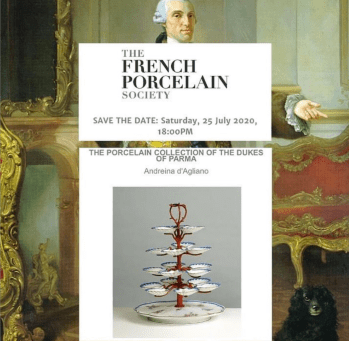
Oyster pyramid stand, 1759, Sèvres manufacture (Florence: Palazzo Pitti, Museo delle Porcellane).
The French Porcelain Society continues its series of weekly online lectures with Andreina d’Agliano, who will explore the outstanding collection of eighteenth-century porcelain of the Dukes of Parma. FPS members will receive an email invitation with instructions on how to join the online lecture. If you want to join, please contact us for more details on FPSenquiries@gmail.com. We hope that you can join us!
The porcelain collection of Louis-Philippe and Louise Elisabeth of Bourbon-Parma, daughter of Louis XV, is one of the most interesting princely collections of the eighteenth century. In addition to Meissen and outstanding Sèvres pieces, it also included pieces from other factories such as Chantilly, Berlin, and the Italian Ginori. Today, the original collection is scattered among the ex-Italian royal residences, some still in the Galleria Nazionle of Parma, but mostly divided between the Palazzo Pitti in Florence and the Palazzo del Quirinale in Rome, where they were sent from the Parmesan Court residences after the Italian Unification in 1861. This lecture will focus on some of the Meissen and Vincennes-Sèvres porcelain pieces of the Bourbon-Parma collection, and will link them with some documents kept at the Parma Archives as well as with other relevant research.
Call for Papers | Becoming the Work
From the Call for Papers:
Becoming the Work: Body Reification Practices in Exhibitions and Museums
Université du Québec en Outaouais (UQO), Gatineau, 21–22 May 2021
Organized by Mélanie Boucher with Anne Bénichou and Éric Langlois
Proposals due by 25 September 2020
In this pandemic period of our history, which links unprecedented physical restrictions with an unlimited access to the Internet, people appear to have maintained a singular interest in personifying the canons of art history and publishing the results of their experimentations on social media (GUNTHERT 2015, LANGLOIS 2015). Museums, which had to shut their doors, also use social media to maintain acquisition modes of works that function by way of a self-recognition in a production from the past. But before this hopefully short pandemic period, museums had recently already fueled this popular fascination of imagining oneself as a work, as is borne out by their greater acceptance of allowing visitors to take pictures in their rooms (CHAUMIER, KREBS & ROUSTAN 2013) and the education and marketing activities that primarily invite them to appropriate their collections (CIÉCO). In addition to this presentism-oriented interest (HARTOG 2003) of museums and the public for the work of art and more broadly for tangible heritage, there is also the interest of artists, who since the start of the new millennium have more insistently initiated performances in museums or in making them a subject of their performances, quite often by revisiting works of ancient art (BÉNICHOU 2015, BISHOP 2012, BOUCHER 2017). While these popular and artistic identification and remake practices seem to have been amplified since five or ten years, the public visibility they enjoy plays a role in this (HEINICH 2012). The recognition of cultural and gender diversity has also had an impact on the uses tied to works of the past, which moreover contributes to considering exclusion in a critical perspective. These uses can help to reveal specificities as well as the differences that mark groups and individuals. The biggest inclusivity that museums who are sensitive to social demands seek to achieve (BARRÈRE & MAIRESSE 2015) is thus also expressed through their way of inviting audiences and artists to ‘take possession’ of their works to make them their own.
However, these initiatives are not solely a product of our times and the bodily techniques they require have been put into practice without recourse to technology, in contexts and periods that are sometimes far removed from our own (BOUCHER 2017, BOUCHER & CONTOGOURIS 2019, BREDEKAMP 2010, RAMOS 2014, VOUILLOUX 2002). Already in a distant past, human beings have recognized themselves in works of art and examples of an identification with a tangible object go far back, at least to their appearance in mythological stories. Moreover, the first museum-based demonstrations of the genre can be traced back to the revolutionary context of opening the Palais du Louvre’s Museum and its other indoor and outdoor sites to the public. The colonial exhibition, popularized through world fairs, as well as displays derived from popular entertainment, which these initial planetary gatherings developed (BOUCHER & PARÉ 2015, MONTPETIT 1996), also contributed to the inversion of the living and the inanimate, thus leading to a self-reification and a reification of the other. If these manifestations can still be observed today, particularly in artistic, cultural and social expressions, the technological developments that facilitate them have multiplied the possibilities of these practices and their results in addition to increasing their visibility coefficient. Stagings that are digitally captured and shared, consequently revive the historical practices, which in turn makes it possible to step back from the current context.
What can one comprehend from these bodies from past and present who exhibit themselves with or in the place of the works? And from these images and the stories that testify to them? Can their poses be linked to a desire for identification and appropriation, for conservation, or on the contrary one for vivification and critique, or mere playfulness? In what regard do they oblige us to rethink the dialectic that unites the subject with the object and which unites social groups between each other as well as singularities? This colloquium aspires to find answers to these questions by focusing on exhibitionary apparatuses developed by the artists and museums as well as those that audiences have appropriated in various eras. Taking specific and exemplary cases as a starting point, the event will seek, for example, to envisage the contribution of the tableau vivant, mirror, diorama and the zoo, reenactment, performance and choreography, analog and digital recording, selfie, mobile apps or dissemination platforms about the practices, their development and agency. In short, this colloquium sets out to revisit certain foundations of the museum and of exhibitionary practice in order to include within it an ontological reflection on the conservation and representation of the person.
We invite researchers, museum professionals and artists to submit a proposal for a presentation, performance-presentation or performance which can be conveyed live or in a pre-recorded form, as part of the colloquium that has been designed for an online dissemination.
The proposals should include:
• A title (a maximum of 150 characters, including spaces)
• An abstract (between 100 to 150 words max.)
• A short bio (between 100 to 150 words max.)
Proposals are to be sent to Jessica Minier <minj11@uqo.ca> before September 25, 2020. Participants’ in person contributions as well as the reception in an auditorium room will be determined over the fall-winter 2020–2021, in respect of social distancing measures.
References
BARRÈRE & MAIRESSE 2015 – BARRÈRE, Anne, François Mairesse, Eds., L’inclusion sociale : les enjeux de la culture et de l’éducation, Paris, L’Harmattan, coll. “Les cahiers de la médiation culturelle”, 2015, 164 p.
BÉNICHOU 2015 – BÉNICHOU, Anne Eds., Recréer/Scripter: mémoires et transmissions des œuvres performatives et chorégraphiques contemporaines, Dijon, Les Presses du Réel, coll.: “Nouvelles scènes”, 2015, 525 p.
BENNETT 1995 – BENNETT, Tony, The Birth of the Museum: History, Theory, Politics, London and New York, Routledge, 1995, 278 p.
BISHOP 2012 – BISHOP, Claire, Artificial Hells: Participatory Art and the Politics of Spectatorship, London and New York, Verso, 2012, 382 p.
BOUCHER & PARÉ 2015 – BOUCHER, Mélanie, André-Louis Paré, Eds., thematic issue “Diorama”, Espace art actuel. Pratiques et perspectives, winter 2015, 128 p.
BOUCHER 2017 – BOUCHER, Mélanie, “Pour une histoire du corps muséifié”, Cultures et musées, dossier “Conserver et transmettre la performance artistique” (edited by Jean-Marc Leveratto), no. 29, 2007, p. 81–96.
BOUCHER & CONTOGOURIS 2019 – BOUCHER, Mélanie, Ersy Contogouris Eds., dossier “Stay Still : histoire, actualité et pratique du tableau vivant”, La revue de l’Association d’art des universités du Canada (RACAR), vol. 44, no. 2, 2019, 214 p.
BREDEKAMP 2010 – BREDEKAMP, Horst, Théorie de l’acte d’image, Paris, Éditions de la découverte, coll.: “Politique et société”, 2010 (2015), 376 p.
CHAUMIER, KREBS & ROUSTAN 2015 – CHAUMIER, Serge, Anne Krebs, et Mélanie Roustan Eds., Visiteurs photographes au musée, Paris, La Documentation française, coll.: “Musées-Mondes”, 2013, 317 p. CIÉCO – Research and inquiry group CIÉCO: Collections et impératif évènementiel/The Convulsive Collections, Museum Collections in the Context of the Event Imperative, accessed on June 15 2020, at http://cieco.umontreal.ca/
GUNTHERT 2015 – GUNTHERT, André, “La consécration du selfie”, Études photographiques, dossier “Interroger le genre / Retour sur l’amateur / Personnage de l’histoire”, no. 32, 2015, accessed at https://journals.openedition.org/etudesphotographiques/3529?lang=en
HARTOG 2003 – HARTOG, François, Régimes d’historicité. Présentisme et expériences du temps, Paris, Seuil, coll. “La Librairie du XXIe siècle”, 2003, 262 p.
HEINICH 2012 – HEINICH, Nathalie, De la visibilité : Excellence et singularité en régime médiatique, Paris, Gallimard, 2012, 593 p.
LANGLOIS 2015 – LANGLOIS, Éric, “La cybermuséologie et ses nouveaux objets culturels : mise en contexte et études de cas”, Muséologies, Les cahiers d’études supérieures, vol. 7, no. 2, 2015, p. 73-93.
MONTPETIT 1996 – MONTPETIT, Raymond, “Une logique d’exposition populaire : les images de la muséographie analogique”, Publics et Musées, no. 9, 1996, p. 63–82.
RAMOS 2014 – RAMOS, Julie, avec la collaboration de Léonard Pouy Eds., Le tableau vivant ou l’image performée, Paris, Institut national d’histoire de l’art et Mare & Marin, 2014, 366 p.
VOUILLOUX 2002 – VOUILLOUX, Bernard, Le tableau vivant. Phryné, l’orateur et le peintre, Paris, Flammarion, coll.: “idées et recherches”, 2002, 477 p.
Call for Papers | UAAC/AAUC 2020, Online
From UAAC/AAUC:
Universities Art Association of Canada / l’association d’art des universités du Canada
Online, 15–17 October 2020
Proposals due by 31 July 2020
Co-organized by Simon Fraser University, The University of British Columbia, and the UAAC Board of Directors
This year’s conference will be held online. While the organizers regret that they will not have the opportunity to welcome you in Vancouver, we hope you will join us for what promises to be a stimulating weekend of panels, roundtables, workshops and plenaries, including two live keynote addresses featuring artist Stan Douglas and art historian Charmaine Nelson.
HECAA Open Session (Historians of Eighteenth-Century Art and Architecture)
Chair: Christina Smylitopoulos (University of Guelph), csmylito@uoguelph.ca
HECAA works to stimulate, foster, and disseminate knowledge of all aspects of visual culture in the long eighteenth century. This open session welcomes papers that examine any aspect of art and visual culture from the 1680s to the 1830s. Special consideration will be given to proposals that demonstrate innovation in theoretical and/or methodological approaches.
A full list of panels is available here»
Call for Articles | Latin American Art, Visual and Material Culture
From the Call for Papers:
Latin American Art, Visual and Material Culture in the Long Eighteenth Century
Special Issue of Arts edited by Lauren Beck and Alena Robin
Abstracts due by 15 August 2020; completed manuscripts due by 1 February 2021
We invite articles dealing with Latin American art, visual and material culture of the late seventeenth to early nineteenth centuries. Any aspect of artistic expression, any theoretical or methodological approach, and any geographic region of Latin America will be welcome. Topics include, but are not limited to, workshop practices, art and propaganda, patronage, identity and gender, spirituality and art, mainstream and peripheral relationships, reception and transformation, collecting and exhibition practices, processes of looking and of attracting the gaze, historiographic considerations, and conservation and restoration. We are particularly interested in contributions that spotlight women, Indigenous people, and people of colour, although we will also consider articles that do not focus on these demographics.
We invite contributors to submit their research in English for consideration. Please note that there is a two-stage submission procedure. We will first collect a title and short abstract (maximum 250 words), 5 keywords, and a short bio (150 words), by August 15, 2020, via email to Dr. Lauren Beck (lbeck@mta.ca) and Dr. Alena Robin (arobin82@uwo.ca). Before August 30, we will invite selected abstracts to be submitted as 7,000–9,000 word papers for peer review by February 1, 2021. Journal publication is expected in mid- to late-2021, depending on the revision time needed after peer review. Each article will be published open access on a rolling basis after successfully passing peer review. More information is available here.
Special Issue Editors
Dr. Lauren Beck — Canada Research Chair in Intercultural Encounter, Professor of Hispanic Studies and Visual and Material Culture Studies, Mount Allison University, Sackville, New Brunswick E4L 1C7, Canada. Interests: Early modern visual culture; settler-colonial studies; history of cartography; Empire
Dr. Alena Robin — Associate Professor, Department of Languages and Cultures, Western University, London, ON N6A 3K7, Canada. Interests: Spanish American colonial art; New Spain; religious art; heritage protection; Latin American art in Canada
Call for Papers | Materializing Race: #VastEarlyAmerica
From the Materializing Race website:
Materializing Race: An Unconference on Objects and Identity in #VastEarlyAmerica
24–25 August 2020 (Zoom)
Organized by Cynthia Chin and Philippe Halbert
Proposals due by 1 August 2020
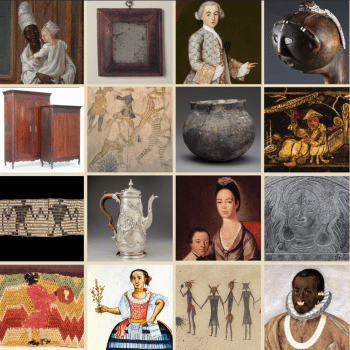 In a commitment to fostering nuanced interpretations of early American objects and meaningful dialogue on historical constructions of race and their legacies, we propose a virtual ‘unconference’ to share and discuss scholarship on the intersections of identity and material culture in #VastEarlyAmerica. This participant-driven, lightning round-style event will be held via Zoom, with two approximately two-hour afternoon sessions conducted in English. Energized by Dr. Karin Wulf’s call for broader, more inclusive histories of early America, we seek to promote a diverse cross-section of scholarship focused on North, Central, and South America and the Caribbean before 1830.
Macro Themes
• What were some of the threads or outcomes of the 1619 Project dialogue (and other relevant publications/discussions) that relate/interact/tessellate with material culture studies?
• Should the 1619 Project and its surrounding narratives affect material culture studies?
• Can the outcomes or discussions surrounding this dialogue engender new approaches/methodologies and discussions in material culture studies? How might it affect the way we as historians and curators interact with and publicly present objects? Does it present the ability to see “legacy” objects and historical figures/narratives differently as a result?
• How do we as historians approach or come to terms with our own family or ancestral narratives within the scope of the 1619 Project?
• What’s the next chapter in the discussion of race and early American material culture?
Micro Themes
• Historians and material culture specialists as genealogists: how do our own personal family/ancestral narratives intersect with our study of early American history and material culture; the historian as biographer; the biographical object and the object biography
• Public history: new thoughts on old things, from the exhibition and display of objects in museum settings to historical and character interpretation
• New methodological approaches and revisions/additions to existing material culture frameworks. How can #VastEarlyAmerica work to expand the traditional American material culture canon?
• Object Case Studies: New interpretations of early American objects related to identity and race
• Jamestown and Plymouth/the Mayflower: new potential interpretations, Plymouth’s 400th anniversary
• Others?
This event is co-convened by Dr. Cynthia Chin (Fred W. Smith National Library for the Study of George Washington) and Philippe Halbert (Yale History of Art).
For more information and submission details, please visit the Materializing Race website.










 Enfilade
leave a comment