Amanda Lahikainen Named Director of OMAA
Press release (2 April 2020) from the Ogunquit Museum of American Art in Maine (Lahikainen’s scholarship to date has focused on late eighteenth- and early nineteenth-century print culture, including the reception and representation of paper money in Britain, ‘imitation banknotes’ during the Romantic period, and British representations of the French Revolution in graphic satire). . .
 David Mallen, President of the Board of the Ogunquit Museum of American Art (OMAA) announced today that Amanda Lahikainen, PhD, has been appointed as the museum’s new Executive Director, effective May 1, 2020. The board unanimously approved the appointment on March 23, 2020.
Dr. Lahikainen is currently Chair of the Art Department and a tenured Associate Professor of Art History at Aquinas College in Grand Rapids, Michigan, where she oversees the art gallery. Mallen said, “After a nationwide search, we are delighted to have selected Amanda as our next Executive Director. She is a gifted administrator and scholar.”
Dr. Lahikainen holds a PhD in art history from Brown University and a BA from Wellesley College. She oversaw and co-curated exhibitions at her college gallery and the Bell Gallery at Brown University, and has worked with local museums in Grand Rapids including the Grand Rapids Art Museum and the Meijer Gardens and Sculpture Park. She held the Kluge Fellowship at the Library of Congress in 2012 and has attracted grants and fellowships from the Paul Mellon Centre and the Lewis Walpole Library at Yale University. She previously taught at Brown University, Rhode Island College, and Roger Williams University, and she has worked or studied in London and Athens. She is widely published and has lectured and participated on panels across the US and in Canada and Australia.
Mallen added, “Amanda’s credentials are exceptional and will further strengthen the OMAA as we aim to expand our audiences and make our museum even better known. Amanda will relocate to Maine with her family from Grand Rapids. She grew up in Salem and has a summer home in Maine, so she is eager to live year-round in a region she knows and loves.”
Dr. Lahikainen said, “I am honored to lead OMAA with its wonderful collection, its sculpture garden, and strong sense of place. The museum is an important and beloved asset of the region and has a wonderful record of recent growth and accomplishment under my predecessor Michael Mansfield. The commitment of the Board is inspiring. While I have been happy and successful at Aquinas College, this is an opportunity I could not resist when recruited. I look forward to working with the board, staff, volunteers, and the community of artists and donors in Ogunquit and beyond to lead the next exciting chapter in the museum’s life.”
Dr. Lahikainen will replace Interim Executive Director Richard D’Abate, who Mallen said, “has led the museum strongly through the transition, and we are very grateful for his service.” D’Abate was appointed following former Executive Director Michael Mansfield’s appointment as President of Maine Media Workshops and College in Rockport, Maine on December 15, 2019.
Mallen stated, “The OMAA maintains its momentum as a strong and innovative institution, and we are excited for its future. The museum recently rehung the permanent collection and continues with exhibitions, performances, and publications. Its lecture series set attendance records in 2019. The 2020 exhibition season, now tentatively scheduled to begin May 31st, is planned with exciting shows, performances and lectures, subject, of course, to the coronavirus situation.
The search committee was chaired by former board member Diana Joyner and included Board President David Mallen and board members Chris Caraviello, Ann Ramsey-Jenkins, Carol Leary, Robyn LeBuff, and Alan Shepard. The museum retained Principal Marilyn Hoffman and Senior Search Consultant Scott Stevens of Museum Search & Reference, an executive search firm in Manchester, New Hampshire and Boston to conduct the national search.
The Ogunquit Museum of American Art was founded by Lost Generation artist Henry Strater and opened in 1953. Closely tied to one of the earliest art colonies of the American modernist art movement, OMAA today houses a permanent collection of important paintings, sculpture, drawings, prints, and photographs from the late 1800s to the present. The museum honors Strater’s vision to preserve and showcase American art by mounting innovative modern and contemporary exhibition programs each year from May through October. OMAA and its three-acre seaside sculpture gardens overlook Narrow Cove and the Atlantic Ocean
YCBA’s Scott Wilcox Begins Phased Retirement
Press release (31 March 2020) from YCBA:
 The Yale Center for British Art announced that Scott Wilcox, Deputy Director for Collections, will begin a two-year phased retirement starting April 1, 2020. Wilcox, who has worked for the Center for his entire career, will immediately take on a new position as Senior Research Scholar. His full retirement will begin on March 1, 2022, concluding a career that spans more than three decades. A search for his successor is forthcoming.
“Scott has shaped the curatorial ambitions of the Center over the past 30 years by enriching our knowledge of and appreciation for works on paper and by bringing significant examples of photography into the collection,” Director Courtney J. Martin said. “As a student at Yale in the early 2000s, I knew of Scott’s great achievements as a curator and scholar. When I returned to the Center as director, I learned that he was also a stellar colleague. Over the next two years, we will have the opportunity to learn more from him as he turns to a research role that will certainly benefit staff, visiting scholars, and visitors to our exhibitions.”
Wilcox received his PhD in the history of art from Yale University in 1985, completing his doctoral dissertation on the nineteenth-century watercolor painter David Cox. He joined the Center as Assistant Curator of Prints and Drawings in 1982 and later held the positions of Associate Curator (1991), Curator (1998), Chief Curator of Art Collections, and Senior Curator of Prints and Drawings (2009).
“As I look back on nearly 38 years at the Center, I feel tremendously grateful that I’ve had such a long run in an institution with such great collections, great programs, and great colleagues,” Wilcox said. “I hope I’ve been able to make a positive contribution to what makes the Center special. At different moments I considered moving on, but I always concluded that there was no other place I’d rather be.”
From 1987 to 2014, Wilcox served as the Center’s in-house curator for photographic exhibitions and was instrumental in establishing a collection of photography within the Department of Prints and Drawings through the purchase or gift of works from Charles Isaacs and Carol Nigro and the gift of works from the Joy of Giving Something, Inc.
In 2014, Wilcox was promoted to Deputy Director for Collections, expanding his curatorial role to include all the Center’s collections. In this role, one of five senior leadership positions at the Center, he has overseen the intellectual framework in which the Center’s art is interpreted, as well as the care of the art and growth of the collections. Between 2009 and 2010, Wilcox directed the creation and development of the new Department for Collections Information and Access, which catalogues the Center’s collections electronically and serves as their online platform. Wilcox co-led a team of curators to develop Britain in the World, the reinstallation of the Center’s collections that coincided with its reopening in 2016, following a major building conservation project. This ongoing exhibition offers a new interpretation of the collections that focuses on British art, history, and culture in a global context.
Wilcox’s deep knowledge of works on paper has resulted in many significant exhibitions at the Center: Victorian Landscape Watercolors (also at the Cleveland Museum of Art and the Birmingham Museum and Art Gallery) in 1992–93; Lucian Freud Etchings from the Paine Webber Art Collection (Museum of Contemporary Art, San Diego; Seattle Art Museum; Blaffer Gallery, University of Houston; Iris & B. Gerald Cantor Center for Visual Arts at Stanford University; and Carnegie Museum of Art) in 1999–2000; Sun, Wind, and Rain: The Art of David Cox (Birmingham Museum and Art Gallery) in 2008–9; and The English Prize: The Capture of the ‘Westmorland’, an Episode of the Grand Tour (Ashmolean Museum of Art and Archaeology, University of Oxford) in 2012–13. These exhibitions were accompanied by major publications with scholarly essays and illustrated catalogues.
“I have known Scott Wilcox throughout his illustrious career at Yale,” said Jules D. Prown, Founding Director of the Yale Center for British Art and Professor Emeritus in the History of Art at Yale University. “Our initial acquaintance began when, as Scott’s professor, I directed his dissertation on the English artist David Cox. Since he knew a great deal about the artist and I did not, it did not require much effort on my part. When Scott applied for a position in the Department of Prints and Drawings at the Center, he distinguished himself quickly from the other candidates by the accuracy of his eye in making attributions and aesthetic judgments. Scott is deeply respected by his colleagues, not only for his curatorial and administrative ability but also for his intelligent analysis, conclusions, and leadership.”
In his new role as Senior Research Scholar, Wilcox will assist in the transition to his successor and will cocurate (with Antonella Pelizzari) Photographs of Italy and the British Imagination, 1840–1914, scheduled to open at the Center in fall 2021. The exhibition will showcase the work of British photographers in Italy and consider the ways in which photography shaped the British appreciation and understanding of Italian art, culture, and politics.
New Book | British Art and the East India Company
From Boydell & Brewer:
Geoff Quilley, British Art and the East India Company (Martlesham, Suffolk: Boydell Press, 2020), 370 pages, ISBN: 9781783275106, $120.
 This book examines the role of the East India Company in the production and development of British art during the eighteenth and early nineteenth centuries, when a new ‘school’ of British art was in its formative stages with the foundation of exhibiting societies and the Royal Academy in 1768. It focuses on the Company’s patronage, promotion and uses of art, both in Britain and in India and the Far East, and how the Company and its trade with the East were represented visually, through maritime imagery, landscape, genre painting, and printmaking. It also considers how, for artists such as William Hodges and Arthur William Devis, the East India Company, and its provision of a wealthy market in British India, provided opportunities for career advancement, through alignment with Company commercial principles. In this light, the book’s main concern is to address the conflicted and ambiguous nature of art produced in the service of a corporation that was the ‘scandal of empire’ for most of its existence and how this has shaped and distorted our understanding of the history of British art in relation to the concomitant rise of Britain as a self-consciously commercial and maritime nation, whose prosperity relied upon global expansion, increasing colonialism and the development of mercantile organisations.
Geoff Quilley is Professor of Art History at the University of Sussex, specializing in the relation of British and western visual culture to empire and global expansion in the eighteenth and nineteenth centuries. He was previously Curator of Fine Art at the National Maritime Museum, London, and has written and edited numerous books, including Empire to Nation: Art, History and the Visualization of Maritime Britain, 1768–1829 (Yale University Press 2011).
C O N T E N T S
Introduction: Corporate Patronage and Company Artists
‘That Extensive Commerce’: The Maritime Image of the East India Company
Travels in India: Landscape and Colonial Patronage
Networks of Knowledge, Power, and Cultural Exchange
The Cries of India: Colonial Power, Classification, and the Diffusion of Knowledge
By Way of China
Collecting India
Conclusion
Notes
Bibliography
Index
New Book | The Napoleonic Wars: A Global History
From Oxford UP:
Alexander Mikaberidze, The Napoleonic Wars: A Global History (Oxford: Oxford University Press, 2020), 960 Pages, ISBN: 978-0199951062, $40.
 Austerlitz, Wagram, Borodino, Trafalgar, Leipzig, Waterloo: these are the places most closely associated with the era of the Napoleonic Wars. But how did this period of nearly continuous conflict affect the world beyond Europe? The immensity of the fighting waged by France against England, Prussia, Austria, and Russia, and the immediate consequences of the tremors that spread throughout the world.
In this ambitious and far-ranging work, Alexander Mikaberidze argues that the Napoleonic Wars can only be fully understood in an international perspective. France struggled for dominance not only on the plains of Europe but also in the Americas, West and South Africa, Ottoman Empire, Iran, India, Indonesia, the Philippines, Mediterranean Sea, and the Atlantic and Indian Oceans. Taking specific regions in turn, Mikaberidze discusses major political-military events around the world and situates geopolitical decision-making within its long- and short-term contexts. From the British expeditions to Argentina and South Africa to the Franco-Russian maneuvering in the Ottoman Empire, the effects of the French Revolution and Napoleonic Wars would shape international affairs well into the next century. In Egypt, the wars led to the rise of Mehmed Ali and the emergence of a powerful state; in North America, the period transformed and enlarged the newly established United States; and in South America, the Spanish colonial empire witnessed the start of national-liberation movements that ultimately ended imperial control.
Skillfully narrated and deeply researched, here at last is the global history of the period, one that expands our view of the Napoleonic Wars and their role in laying the foundations of the modern world.
Alexander Mikaberidze is Professor of European History at Louisiana State University at Shreveport, where he is also Ruth Herring Noel Endowed Chair for the Curatorship of the James Smith Noel Collection. He is the author of several books, including The Burning of Moscow: Napoleon’s Trial by Fire 1812 and The Battle of Borodino: Napoleon versus Kutuzov.
C O N T E N T S
1 The Revolutionary Prelude
2 The Eighteenth-Century International Order
3 The War of the First Coalition, 1792–97
4 The Making of ‘La Grande Nation’, 1797–1802
5 The Second Coalition War and the Origins of the ‘Great Game’
6 The Rites of Peace, 1801–02
7 The Road to War, 1802–03
8 The Rupture, 1803
9 The Elephant Against the Whale: France and Britain at War, 1803–1804
10 The Emperor’s Conquest, 1805–07
11 ‘War through Other Means’: Europe and the Continental System
12 The Struggle for Portugal and Spain, 1807–12
13 The Grand Empire, 1807–12
14 The Emperor’s Last Triumph
15 The Northern Question, 1807–11
16 ‘An Empire Besieged’: The Ottomans and the Napoleonic Wars
17 The Qajar Connection: Iran and the European Powers, 1804–14
18 Britain’s Expeditionary Warfare, 1805–10
19 Britain’s Eastern Empire, 1800–15
20 The Western Question? Struggle for the Americas, 1808–15
21 The Turning Point, 1812
22 The Fall of the French Empire
23 The War and Peace, 1814–1815
24 The Aftermath of the Great War
Notes
Select Bibliography
Index
New Book | King of the World: The Life of Louis XIV
Forthcoming from the U of C Press (though its distribution center is temporarily shut down, e-books are now 30% off, and some titles will ship from other locations). I’ll also put in a plug for Hyde Park’s Seminary Co-op Bookstore, one of the world’s great academic bookstores; its Front Table makes for fine online browsing. Like all independent bookstores, the Seminary Co-op faces daunting challenges in the weeks ahead. So keep reading, and all the better if some of those books are coming from independent booksellers you care about. –CH
Philip Mansel, King of the World: The Life of Louis XIV (Chicago: The University of Chicago Press, 2020), 608 pages, ISBN: 978-0226690896, $35.
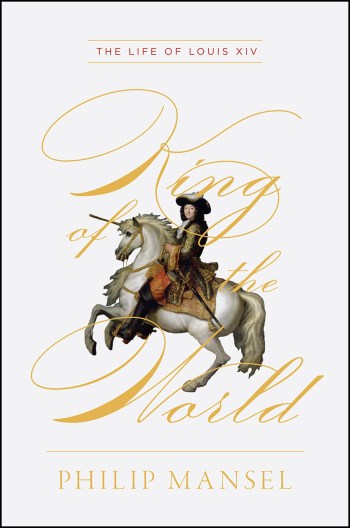 Louis XIV was a man in pursuit of glory. Not content to be the ruler of a world power, he wanted the power to rule the world. And, for a time, he came tantalizingly close. Philip Mansel’s King of the World is the most comprehensive and up-to-date biography in English of this hypnotic, flawed figure who continues to captivate our attention. This lively work takes Louis outside Versailles and shows the true extent of his global ambitions, with stops in London, Madrid, Constantinople, Bangkok, and beyond. We witness the importance of his alliance with the Spanish crown and his success in securing Spain for his descendants, his enmity with England, and his relations with the rest of Europe, as well as Asia, Africa, and the Americas. We also see the king’s effect on the two great global diasporas of Huguenots and Jacobites, and their influence on him as he failed in his brutal attempts to stop Protestants from leaving France. Along the way, we are enveloped in the splendor of Louis’s court and the fascinating cast of characters who prostrated and plotted within it.
King of the World is exceptionally researched, drawing on international archives and incorporating sources who knew the king intimately, including the newly released correspondence of Louis’s second wife, Madame de Maintenon. Mansel’s narrative flair is a perfect match for this grand figure, and he brings the Sun King’s world to vivid life. This is a global biography of a global king, whose power was extensive but also limited by laws and circumstances, and whose interests and ambitions stretched far beyond his homeland. Through it all, we watch Louis XIV progressively turn from a dazzling, attractive young king to a belligerent reactionary who sets France on the path to 1789. It is a convincing and compelling portrait of a man who, three hundred years after his death, still epitomizes the idea of le grand monarque.
Philip Mansel is one of Britain’s leading historians of France and the Middle East. He is the author of many books, including, most recently, Aleppo: The Rise and Fall of Syria’s Great Merchant City; The Eagle in Splendour: Inside the Court of Napoleon; and Levant: Splendour and Catastrophe on the Mediterranean.
C O N T E N T S
List of Illustrations
Maps
Family Trees
Introduction: A Thousand Years of France
1 The Gift of God
2 Our Good City of Paris
3 The Struggle for France
4 M. le Cardinal
5 The Power of Queens
6 Fouquet’s Fall
7 Making France Work
8 The Pursuit of Immortality: The Louvre and Versailles
9 Conquering Flanders
10 Fighting the Netherlands
11 To the Rhine
12 The King Outdoors
13 Inside Versailles
14 Inside Louis XIV
15 The Global King: From the Mississippi to the Mekong
16 The Huguenot Cataclysm
17 England Changes Sides: The Flights of King James
18 France against Europe
19 Spain Changes Sides: The Accession of King Philip
20 The Triumph of Europe
21 Towards the Precipice
22 Nemesis Averted
23 Funeral Games
24 The Shadow of Versailles
Acknowledgements
Notes
Bibliography
Index
Call for Papers | Rediscovering Our Sculpture
From Art UK:
Rediscovering Our Sculpture: An Art UK Symposium
Cloth Hall Court, Leeds, 18–19 September 2020
Proposals due by 10 May 2020

Anne Seymour Damer, Portrait of Mary Berry (1763–1852), based on a work from ca.1793, bronze (London: National Portrait Gallery, 6395).
Art UK is inviting submissions for papers for the conference Rediscovering Our Sculpture, which will be held on Friday 18th and Saturday 19th September 2020 at Cloth Hall Court, Leeds. This symposium will celebrate the completion of Art UK’s ambitious sculpture project. It will be an opportunity to thank the project partners and funders. We will be able to share what we have learned and provide practical guidance on using sculpture for learning and engagement and methods of digitisation.
From 2017 to 2020 Art UK has been digitising sculptures in galleries, museums and public buildings, as well as outdoors—in parks, streets, and squares across the UK. The largest sculpture cataloguing project ever undertaken in the UK will be completed as a result of the hard work of a team of dedicated and enthusiastic project staff, photographers, and volunteers. Thousands of sculptures are now free to browse and search on the site, and many more will be added by the end of 2020.
Our extensive learning and engagement programme has taken sculptures into schools, engaged people and communities with their local sculptural heritage, made a series of films with young people, and provided opportunities for blind and partially sighted people to engage with sculpture collections. Professional development training has been made available for staff and volunteers from collections to develop skills around sculpture care and digitisation.
The conference will feature a selection of papers on a wide range of sculpture-related subjects. We welcome papers on topics that may include, but are not limited to:
• Sculpture in the UK – research and mapping using Art UK data; new discoveries or research on sculptors, sculptures or collections; materials of sculpture; public sculpture
• Sculpture curation – contemporary curation and collections development; collecting and dealing; acquiring new works; display and exhibition; collections research
• Public engagement with sculpture – how we grow public interest in sculpture; interpretation and telling stories; access; digital engagement
We welcome proposals for 20-minute presentations. We will also consider proposals for shorter 10-minute case study talks. Please send an abstract of no more than 300 words, as well as a biography of around 200 words, to katey.goodwin@artuk.org. The deadline for proposals is 9am on Monday, 11th May 2020.
The Burlington Magazine, March 2020
The eighteenth century in The Burlington:
The Burlington Magazine 162 (March 2020) — Drawings

Luigi Valadier, Pyx, 1769–71, gilt silver, 22 × 11 cm, one of eighteen pieces of a pontifical mass service belonging to the cathedral of Portalegre, Portugal (Church of S. Miguel, Castelo Branco).
A R T I C L E S
• Teresa Leonor M. Vale “A Portuguese Bishop’s Pontifical Mass Service by Luigi Valadier,” pp. 196–203. A gilt silver pontifical mass service belonging to the cathedral of Portalegre, Portugal, is here identified as the work of the celebrated Roman silversmith Luigi Valadier and dated 1769–71. It is closely similar to a contemporary service owned by Cardinal Domenico Orsini and both services can be linked to a group of drawings from Valadier’s workshop.
S H O R T E R N O T I C E S
Kee Il Choi, Jr., “Ornament from China: Sources for a Garden Folly Design by Jean-Jacques Lequeu,” pp. 216–19.
R E V I E W S
• Kirstin Kennedy, Review of Carolina Naya Franco, Joyas y alhajas del Alto Aragón: esmaltes y piedras preciosas de ajuares y tesoros históricos (2018).
• Stéphane Loire, Review of Nicola Spinosa, ed., Francesco Solimena (1657–1747) e le Arti a Napoli (2018).
• Aileen Dawson, Review of Claudia Bodinek (with contributions by Peter Braun, Tobias Pfeifer-Helke und Claudia Schnitzer), Raffinesse im Akkord: Meissener Porzellanmalerei und ihre Grafischen Vorlagen (2018).
• David Bindman, Review of the exhibition Canova Thorvaldsen: The Birth of Modern Sculpture (Milan: Gallerie d’Italia, 2019–20).
• Daniel Stewart, Review of the exhibition Troy: Myth and Reality (London: British Museum, 2019–20).
• Christiane Elster, Review of the exhibition History in Fashion: 1500 Years of Embroidery in Fashion (Leipzig: GRASSI Museum of Applied Arts, 2019–20).
• Philippa Glanville, Review of the exhibition Feast and Fast: The Art of Food in Europe, 1500–1800 (Cambridge: Fitzwilliam Museum, 2019–20)
• Kamila Kocialkowska, Review of the exhibition Peter the Great: Collector, Scholar, Artist (Moscow Kremlin Museums, 2019–20).
• Eckart Marchand, Review of the exhibition Near Life: The Gipsformerei: 200 Years of Casting Plaster (Berlin: James-Simon-Galerie, 2019–20).
New Resource | Colonial Virginia Portraits

◊ ◊ ◊ ◊ ◊
The Omohundro Institute of Early American History & Culture announces the debut of Colonial Virginia Portraits.
Featuring an interactive database of oil portraits with a documented history in Virginia or of colonial Virginia subjects painted before ca. 1776, the site includes portraits painted in both the colonies and abroad. While most subjects are colonists, there are also records of portraits of family, friends, and officials from England or elsewhere that hung in Virginia homes. It also includes portraits of colonial Virginians that were sent or left abroad. Portraits can be searched or browsed by subject, family name, artist, date, location(s), or attributes. Twenty-eight institutions and several private collections have shared images for the project.
The site represents the scholarship of Janine Yorimoto Boldt. For the initial release of the site, she compiled 500 entries recording over 500 portraits and about 350 individual images. Additional entries will likely be added in the coming months. You can read about some of the work that went into collecting the initial images in this blog post Dr. Boldt wrote for the OI’s Uncommon Sense, “When the Past Still Hangs in the Parlor.”
“Colonial portraits were sites where subjects, patrons, artists, and viewers mediated both individual and community identities,” Dr. Boldt writes. “Based on this assumption, I began systematically gathering evidence of portraits from colonial Virginia. I was particularly interested in portraiture’s function in a colonial plantation society and discovering any regional trends. The resulting database became Colonial Virginia Portraits. Together and individually, the portraits can tell scholars about kinship, gender, race, social status, political ideologies, and cultural exchange because all of these affected representational choices. Spanning 150 years, the portraits are evidence of the development of an American art, culture, and society.”
Janine Boldt is the 2018–2020 Andrew W. Mellon Foundation Postdoctoral Curatorial Fellow at the American Philosophical Society Library and Museum. She is the lead curator for the 2020 exhibition Dr. Franklin, Citizen Scientist and was co-curator of Mapping a Nation: Shaping the Early American Republic. She received her Ph.D. in American Studies from William & Mary in 2018. Her current book project investigates the political function and development of portraiture in colonial Virginia.
Colonial Virginia Portraits is the latest in a series of digital projects undertaken by the Omohundro Institute thanks to the Lapidus Initiative for Excellence and Innovation in Early American Scholarship, generously funded with a gift from Sid and Ruth Lapidus. Other projects funded by the Lapidus Initiative include the Ben Franklin’s World and Doing History podcasts, both available in Apple Podcasts; the publication of the refreshed Commonplace (in partnership with the American Antiquarian Society); the OI Reader app; and the Georgian Papers Programme (in partnership with William & Mary, King’s College London, and the Royal Collection Trust). Additional projects, including a second version of the OI Reader app, are due later in 2020.
New Book | The Campbells of Cawdor and their Welsh Estates
From Boydell & Brewer:
John Davies, The Changing Fortunes of a British Aristocratic Family, 1689–1976: The Campbells of Cawdor and their Welsh Estates (Martlesham, Suffolk: Boydell & Brewer, 2019), 353 pages, £85.
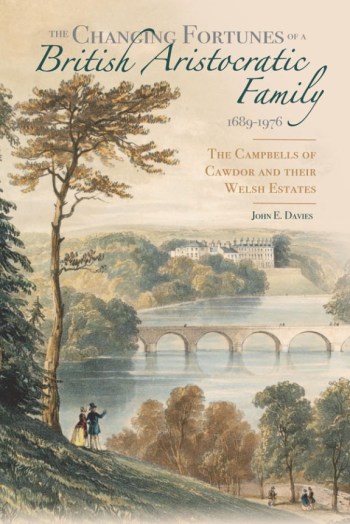 Traces the development of a typical British aristocratic family, its estates and its activities over the period when the landed aristocracy was at its height and over the period when the aristocracy had to cope with increasing democratisation.
For over two hundred years, the Campbells of Cawdor were major landowners, industrialists and politicians. Originating in Nairnshire, Scotland, they moved in the late seventeenth century to south Wales, where they became the second largest landowner in Wales and owners of significant coal and lead mines. They participated politically in the British state as MPs, peers, lords of the admiralty including one first lord, treasury lords, admirals, and army officers. They supported local good causes, were involved in London ‘society’, and were major art collectors. As such their story is fairly typical of many other aristocratic families in the period. This book traces the development of the family, its estates, and activities from the late seventeenth to the late twentieth century. It shows how they established their wealth and power during the eighteenth century—the period when the landed aristocracy was at its height—how they responded in the nineteenth century to the moves towards more democratic forms of local and national government, and how—despite the difficulties aristocratic families and estates faced in the twentieth century—they survived, selling off their Welsh lands and returning to their Scottish base, which remains a flourishing agricultural estate and tourist destination.
John E. Davies was the County Archivist for Carmarthenshire and is now an independent historical researcher. He completed his doctorate at Swansea University.
C O N T E N T S
Introduction
Cawdor and Campbell
Estate Administration
The Agricultural Estate: The Cawdors as Farmers and Landlords
The Cawdors as Industrial Landowners
The Cawdors in the Community: Church and Education
The Melee of Local Governance
The Cawdors in Politics: Interest Building, Consolidation, and Decline
Private and Exclusive Lives
The End of the Welsh Estates
Conclusion
Bibliography
New Book | Anglo-Saxonism and the Idea of Englishness
From Boydell & Brewer:
Dustin M. Frazier Wood, Anglo-Saxonism and the Idea of Englishness in Eighteenth-Century Britain (Martlesham, Suffolk: Boydell Press, 2020), 239 pages, ISBN: 978-1783275014, $99.
 Long before they appeared in the pages of Ivanhoe and nineteenth-century Old English scholarship, the Anglo-Saxons had become commonplace in Georgian Britain. The eighteenth century—closely associated with Neoclassicism and the Gothic and Celtic revivals—also witnessed the emergence of intertwined scholarly and popular Anglo-Saxonisms that helped to define what it meant to be English. This book explores scholarly Anglo-Saxon studies and imaginative Anglo-Saxonism during a century not normally associated with either. Early in the century, scholars and politicians devised a rhetoric of Anglo-Saxon inheritance in response to the Hanoverian succession, and participants in Britain’s burgeoning antiquarian culture adopted simultaneously affective and scientific approaches to Anglo-Saxon remains. Patriotism, imagination, and scholarship informed the writing of Enlightenment histories that presented England, its counties, and its towns as Anglo-Saxon landscapes. Those same histories encouraged English readers to imagine themselves as the descendants of Anglo-Saxon ancestors—as did history paintings, book illustrations, poetry, and drama that brought the Anglo-Saxon past to life. Drawing together these strands of scholarly and popular medievalism, this book identifies Anglo-Saxonism as a multifaceted, celebratory and inclusive idea of Englishness at work in eighteenth-century Britain.
Dustin M. Frazier Wood is a Lecturer in English at the University of Roehampton.
C O N T E N T S
Introduction: Anglo-Saxonism, Medievalism, and the Eighteenth Century
1 Anglo-Saxonisms of the Early Eighteenth Century
2 Antiquaries and Anglo-Saxons
3 Anglo-Saxon History and the English Landscape
4 Imaging and Imagining Anglo-Saxonness
5 Anglo-Saxonist Politics and Posterity
Conclusion: Sharon Turner’s History of the Anglo-Saxons
Bibliography










 Enfilade
leave a comment