Call for Essays | Funerary Inscriptions
From ArtHist.net:
Funerary Inscriptions in Early Modern Europe
Intersections, Yearbook for Early Modern Studies
Abstracts due by 15 May 2020
In this volume of Intersections, we want to bring together studies that consider funerary inscriptions in early modern Europe within the context of a culture of commemoration and remembrance. Depending on funding, a two-day conference to prepare the volume is planned to take place in Frankfurt am Main in late August or early September 2021. Applicants will be notified before June 30, 2020.
Although funerary inscriptions from the period 1400–1800 have been collected and studied widely, they have usually been considered with a focus on their axiomatic character or the person they commemorate, or in relation to inscriptions from the same area or time period they were made in. Studies of a more analytical and comparative nature are limited, just as studies that consider funerary inscriptions for their literary components, or analyze them in a wider cultural context, questioning for instance what they reveal about belief in an afterlife and how this relates to contemporary theological notions about life after death and/or a resurrection of the dead. Also open to study are questions how funerary inscriptions for people from similar social classes or professional groups relate to each other, and how the qualities the deceased are praised for correspond to contemporary social values.
The central issue in this volume of Intersections will be the question of how funerary inscriptions were used to shape the memory of a deceased person in a specific way. How were they used to create a specific image that would determine how a deceased person would be remembered and what (s)he would be commemorated for? How would this image fit in the contemporary collective culture of remembrance or in narrower spheres, as for instance specific religious groups or denominations? Or was this image meant to function within a sphere of private commemoration? With these questions as the central issue, funerary inscriptions in Europe from the period between ca. 1400 and 1800 may be approached from various angles: their material dimension, their literary character, the content of what they are stating, their relation to portraits and (sculpted and other) decorations, and the wider cultural context in which they were created and functioned. Topics to be addressed may include:
Material aspects
• How did the persons cutting the text into the stone work together with the writers of the inscriptions, in determining such things as the length of the texts and the individual sentences, dividing lines and breaking off words, using abbreviations etc?
• How do incised funerary inscriptions relate to versions printed in (more or less) contemporary books (differences, mistakes, reductions, etc.)?
• Is there a common pattern of the arrangement of inscriptions on a monument/sarcophagus or does the arrangement of inscriptions have a symbolic character?
Literary aspects
• Epitaphs that were actually carved in the tomb stone vs. epitaphs that were written as literary exercises, never meant to be put on a grave
• Collecting, exchanging and publishing (collections of) funerary inscriptions from Antiquity and/or Christian times
• Funerary inscriptions written by the future deceased themselves as a way to secure their memory
• Funerary inscriptions written in the first person singular (‘the deceased speaking from the grave’ or the tombstone addressing the passer-by): by whom were they written, how common were they on actual tombs or were they mainly created as literary exercises?
• Mock epitaphs and funerary inscriptions for animals
• Style and language: the impact of antique formulations and traditions
• The repetition of axiomatic sayings, motto’s, texts from the Bible
• The use of example books (Ars moriendi) and/or contemporary anthologies of rhetoric and poetry
• The use of Latin, Greek or Hebrew vs. vernacular language.
Content
• What are the qualities and characteristics for which the deceased were praised and deserved to be remembered? How do they correspond to contemporary social values?
• ‘Naming and faming’: which names of well-known people or places are included in funerary inscriptions so as to make the deceased seem (more) important?
• Pride and (false?) humility
• Self-presentation of the dedicators
• Notions about an afterlife and resurrection of the dead; predictions of (the moment or way of) having died come true (vaticinium ex eventu)
• Use of symbols or allegorical structures in the textual parts of the epitaph.
Context
• In what respects are funerary inscriptions for women different from those for men?
• Do funerary inscriptions for specific social classes or professional groups have common characteristics?
• How do funerary inscriptions relate to portraits and to (sculpted and other) decorations of a tomb?
• Symbolism, pictorial program, emblematic structures.
Please submit a one-page abstract (ca. 300 words) and a short curriculum vitae (max. two pages) to one of the editors, before May 15, 2020.
Dr. Veronika Brandis
Goethe-Universität
Institut für Klassische Philologie
Norbert-Wollheim-Platz 1
D – 60629 Frankfurt am Main
brandis@em.uni-frankfurt.de
Dr. Jan L. de Jong
University of Groningen
Dept. of History of Art, Architecture and Landscape
PO Box 716
9700 AS Groningen
j.l.de.jong@rug.nl
Prof. Dr. Robert Seidel
Goethe-Universität
Institut für deutsche Literatur
Norbert-Wollheim-Platz 1
D – 60629 Frankfurt am Main
robertcseidel@lingua.uni-frankfurt.de
Art Market | The Bachofen von Echt Ukiyo-e Collection
Scheduled to correspond with New York Asia Week, exhibitions like this one at Scholten Japanese Art may still be on view this week, though the auctions have been postponed until June, as noted by The Art Newspaper (also see this press release, published at Art Daily on 17 March). . .
The Baron J. Bachofen von Echt Collection of Golden Age Ukiyo-e
Scholten Japanese Art, New York, 12–21 March 2020
Scholten Japanese Art is pleased to participate in Asia Week 2020 with an extraordinary offering of Japanese woodblock prints: The Baron J. Bachofen von Echt Collection of Golden Age Ukiyo-e. The collection is comprised of a highly selective group of twenty-two figural woodblock prints produced during a period considered the highpoint of the genre, known as the ‘golden age’ of ukiyo-e, reaching its peak in the last decade of the 18th century. The prints depict bijin-ga (literally ‘beautiful person’), the influencers of their time—famous courtesans, waitresses, and beloved actors—with works by the most acclaimed ukiyo-e artists of the late 18th and early 19th century. There are works in this collection that are possibly unique, or one of only a handful of recorded examples, with connections to some of the most prominent early collectors and dealers of ukiyo-e. In many cases, these are the only examples still remaining outside of museum collections.

Kitao Shigemasa, Geisha and Maid Carrying a Shamisen Box, unsigned, with seal Hayashi Tadamasa, ca. 1777.
The term ukiyo (literally ‘floating world’) references an older Buddhist concept regarding the impermanence of life, but during the prosperity of the Edo Period in Japan the term began to be used to encompass and embolden everyday indulgences because of that impermanence. One of the tangible records of those indulgences was the production of nishiki-e (literally ‘brocade pictures’), the full-color prints that we recognize today as ukiyo-e—images of the floating world celebrating youth and beauty, which began in ca. 1765. After the advent of full-color woodblock printing, the market for nishiki-e, accessible to everyday people, steadily grew, and the materials and methods used to create this art rapidly evolved. A significant change that came about in the 1770s was that the craftsmen involved with production developed techniques for full-color printing on larger sheets of paper, and, as a result, this led to the general adoption of the standard ‘oban’ (approximately 15 by 10 inches) size by publishers. Larger paper was followed by an increase of the scale of the figures within compositions. An excellent example of this is the earliest print in the group, a ca. 1777 design by Kitao Shigemasa (ca. 1739–1820), Geisha and Maid Carrying a Shamisen Box (15 by 10 1/8 inches). Shigemasa was primarily a designer of illustrated books, producing over 250 in his lifetime, many of which were erotic in nature. With a comparatively small output of single sheet designs, the scarcity of extant Shigemasa prints belies his talent and influence on the genre. He worked with over twenty publishers, often with the innovative Tsutaya Juzaburo (1750–1797), whose impact looms large in the ‘golden age’ and likewise, in the Bachofen Collection. In 1774, the first book published by Tsutaya, Thousands at a Glance (Hitome senbon), featured illustrations by Shigemasa. Approximately three years later Tsutaya published an untitled series depicting full-length images of geisha of which this is a part.

Eishosai Choki, Woman and Servant in Snow (Sechu sho shiki jo), this impression unsigned and without censor or publisher seals, published by Tsutaya Juzaburo, ca. 1790.
One of the finest prints included in this show, Woman and Servant in Snow, ca. 1790 (14 1/2 by 10 inches), is by an artist whose work is particularly rare to the market: Eishosai Choki (fl. ca. 1780–1809). Also published by Tsutaya Juzaburo, the print demonstrates one of the hallmarks of golden age prints—the introduction of lavish printing techniques such as mica ground printing. The print is from an untitled group of four portraits of beauties presented in a dramatic outdoor setting that are among the most reproduced and coveted works in all of the ukiyo-e genre. The designs are distinctive in the way that Choki positions the figure off to the side, roughly occupying only two-thirds of the composition. In this print we see a beauty pausing beneath an open umbrella which shields her from the fat flakes of falling snow, shimmering (or shivering) against a cold mica background. She leans on the back of her burly servant who is bending over, reaching beyond the frame of the composition to clean the clumps of heavy wet snow off of her geta. Although they are a study in contrasts, she is lovely and delicate, he is solid with rough whiskers on his face, Choki conveys a sense of quiet intimacy shared between the two.
An example of a lavish printing is by Hosoda Eishi (1756–1829), Selection of Beauties from the Pleasure Quarters: Hanamurasaki of the Tamaya in Procession (15 by 10 inches), which utilizes both an incredibly dramatic dark mica background as well as metallic printing on the hem of the sauntering courtesan, Hanamurasaki. This design was formerly in the esteemed collection of the French connoisseur Henri Vever (1854–1942) and was the subject of extensive research by the American collector Louis V. Ledoux (1880–1948), who had a variant impression which he identified as a later state of the print. His research led him to conclude that there may have been four states of this scarce print, of which this (the Vever impression) is the earliest and (he thought) one of only three extant examples. Current research clarifies that this one is one of only two recorded impressions of the earliest version of the print.
Another development in print production was the issuance of multi-panel prints- most typically in the format of triptychs. One of the most stunning works in the show which shares the Vever Collection provenance is a triptych by a student of Eishi, Chokosai Eisho (fl. ca. 1795–1801) titled A Glimpse of the Ogiya: Hashidate, Nanakoshi and Hanabito (triptych 15 by 28 inches). This breath-taking composition presents three beautiful women who are seated in a brothel reception room decorated with an elaborate painting of a peacock covering the background wall. The three women are identified from right to left as the well-known and high-ranking courtesans: Hashidate, Nanakoshi, and Hanabito. The title places them at the Ogiya brothel located in the Yoshiwara. All three courtesans worked at the Ogiya and seem to be engrossed in a private conversation away from their customers. Perhaps they are sharing an amusing story related to the folded love letter which Hashidate is handing to Nanakoshi. There are few copies of this triptych extant and almost all are now in museum collections.
The bijin-ga of ukiyo-e were represented by beautiful women and beautiful men, and kabuki actors enjoyed celebrity-worship that would surely resonate with that of today. The Bachofen Collection includes three prints depicting kabuki actors, including a powerful bust-portrait by Utagawa Kunimasa (1773–1810), Actor Ichikawa Yaozo III as a Bandit (15 by 10 inches). This intense okubi-e portrait of Ichikawa Yaozo III (Suketakaya Takasuke II, 1747–1818) shows the actor in the role of a yamagatsu (lumberjack), who is actually a legendary warrior in disguise. The print was made at the time of Yaozo’s performance in a play that was staged at the Miyako-za theater in the 11th lunar month of 1796. The artist Kunimasa died at the young age of only 37 with approximately 125 recorded designs with few impressions extant. Of the four known examples of this print, this is the only one currently in private hands.
The Bachofen Collection has several highly important works by Kitagawa Utamaro (1753–1806), arguably the leading painting and print artist of his time who practically owned the market for images of beauties in the 1790s and early 1800s, until his untimely death in 1806 which marks the close of the ‘golden age’ period. In most ukiyo-e collections just one of these works would be the treasured highlight, in this collection there are nine Utamaro prints, including three okubi-e (‘big head’ or bust portraits) and one half-length portrait, each one a masterpiece in and of itself.
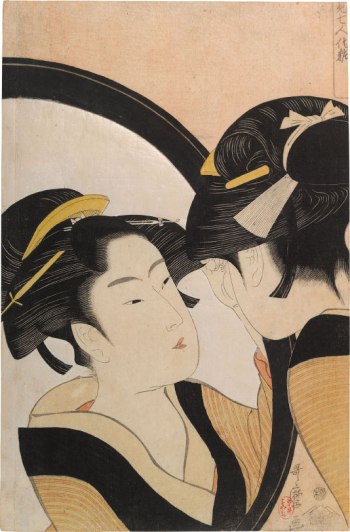
Kitagawa Utamaro, Seven Women Applying Make-up before a Full-length Mirror (Sugatami shichinin kesho), signed Utamaro ga with censor’s seal kiwame (approved) publisher’s mark of Tsutaya Juzaburo (Koshodo), sealed Wakai Hayashi, and oval WS (Schindler) collector’s seal on verso, ca. 1792–93. The title indicates this print is one from an intended series of seven, although only this one design is recorded.
The earliest Utamaro print in the exhibition is a compositional tour-de-force. Dated to around 1792–93, the print, Seven Women Applying Make-up Before a Full-length Mirror (14 1/4 by 9 1/2 inches), was issued at the beginning of a productive period for Utamaro during which he designed a number of ambitious half-length and bust portrait images of beauties primarily in collaboration with the publisher Tsutaya. The title in the bookmark-shaped cartouche indicates this print is one from an intended series of seven, although only this one design is recorded. While the term ‘sugatami’ in the title refers to a full-length mirror, the composition is that of a reflection of a bust portrait of a beauty as seen from over her shoulder. The effect is to both share her gaze into the mirror, while simultaneously appreciating her coiffure from behind as well as a titillating view of her erikubi (the nape of her neck). Her facial features and the crest on her kimono suggest that this is a portrait of one of Utamaro’s favorite subjects, the teahouse waitress Naniwa Okita. Tsutaya spared no expense with this production, generously embellishing the print with mica both on the background and on the mirror. The red seal to the left of the signature sheds light on the print’s provenance of having been in the hands of Wakai Kenzaburo (1834–1908), a highly influential Japanese art dealer and collector who was vital to the formation of ukiyo-e collections in Paris in the 1870s and 1880s. Wakai’s seal confirms that this exact impression was illustrated in Dr. Julius Kurth’s 1907 monograph on Utamaro (the first in a European language) when it was in the hands of Rex & Co in Berlin, an early importer of Asian art; it then passed into the hands of Werner Schindler (1905–1986) of Bienne, Switzerland. Highlights from the Schindler Collection were exhibited in several cities in Japan in 1985, and this print was illustrated on the cover of the exhibition catalogue.
In about 1792–93, the publisher Tsutaya began producing print series by Utamaro depicting half-length portraits of beauties with glittering full-mica backgrounds. These lavish images elevated print production to new aesthetic heights, establishing both Utamaro and Tsutaya as pre-eminent ukiyo-e artist and publisher, respectively. The portrait of Wakaume of the Tamaya in Edo-machi itchome, kamuro Mumeno and Iroka (14 1/2 by 9 5/8 inches) is dated to around 1793–94 and is associated with a group of three portraits that were likely intended as an informal triptych, each featuring a courtesan identified in the title cartouche with her house and naming her two kamuro (child attendants) with an accompanying kyoka poem. Of the three designs, this composition functions best at the central panel because the figure’s body faces one way while she turns to look in the opposite direction, and one of her kamuro peeks out from behind in a rare instance of frontal portraiture. The courtesan is Wakaume of the zashiki-mochi (‘having her own suite’) rank of the Tamaya house, and two kamuro, Mumeno and Iroka, are mentioned in the cartouche along with a poem playing on the literal meaning of her name, Wakaume, or White Plum.
The ca. 1795–96 bust portrait, Painting the Eyebrows (15 by 10 inches), is another masterpiece by Utamaro included in this group. It depicts a beauty leaning forward in concentration while applying make-up to her eyebrows. We catch a glimpse of her reflection from another angle in her hand-mirror, which is highlighted with mica to suggest the polished surface. This print was produced by a rather small publishing house, Isemago, about whom very little is known, which may explain why this design is extremely scarce. Of the three recorded impressions of this design, this is the only one currently in private hands.
The final Utamaro okubi-e in the exhibition is a delightful portrait of the famous courtesan Komurasaki of the Tamaya House after a Bath (15 by 10 inches) from around 1797–99. The portrait is of the famous courtesan Komurasaki, who held the highest rank of yobidashi (‘on call’), which meant she only could be seen by making an appointment through a teahouse, the same rank as her ‘house sister’ Hanamurasaki featured in the full-length mica-ground print by Eishi. This print bears the collector’s seal of the artist Paul Blondeau (ca. 1860–1920) and was later in the collection of Charles Haviland (1839–1921), which was sold in Paris in 1922. This print is one of only two recorded impressions of this design.
The exhibition will feature twenty-two woodblock prints including works by major ukiyo-e artists such as: Kitao Shigemasa (1739–1820), Torii Kiyonaga (1752–1815), Katsukawa Shuncho (fl. ca. 1780–1795), Eishosai Choki (fl. ca. 1780–1809), Hosoda Eishi (1756–1829), Chokosai Eisho (fl. ca. 1795–1801), Chokyosai Eiri (fl. ca. 1795–1800), Ichirakutei Eisui (fl. ca. 1795–1803), Utagawa Toyokuni I (1769–1825), Katsukawa Shunei (1762–1819), and Kitagawa Utamaro (1753–1806).
Katherine Martin, Highlights of Japanese Printmaking: Part Six, The Baron J. Bachofen von Echt Collection of Golden Age Ukiyo-e (2020), $40.
◊ ◊ ◊ ◊ ◊
Note (added 17 March 2020)— The original posting did not include the link to the press release posted at Art Daily.
Exhibition | Turner: Paintings and Watercolours from Tate
From the Jacquemart-André, which is—like most other public museums—currently closed until further notice in response to the Coronavirus pandemic:
Turner: Paintings and Watercolours from Tate
Musée Jacquemart-André, Paris, 13 March — 20 July 2020
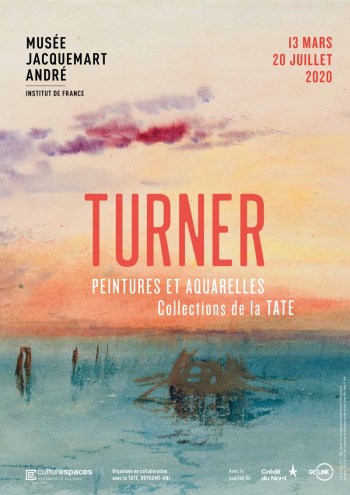 In 2020 the Musée Jacquemart-André will present Turner, peintures et aquarelles, a major retrospective of the oeuvre of Joseph Mallord William Turner (1775–1851). Undoubtedly the greatest representative of the golden age of English watercolours, he experimented with the effects of light and transparency on English landscapes and Venetian lagoons. Celebrated by his contemporaries, Turner still has many admirers. Thanks to exceptional loans from Tate Britain in London, which houses the largest collection of Turner’s works in the world, the Musée Jacquemart-André will hold an exhibition of sixty watercolours and ten oil paintings, some of which have never been exhibited in France.
Apart from his finished works intended for sale, Turner kept a considerable collection of works for himself, which were kept in his house and studio. With their unique qualities, these sketches, which were more expressive and experimental, were certainly closer to nature than those he painted for the public. In 1856, after the artist’s death, an enormous collection of works was bequeathed to the British nation, comprising many oil paintings, unfinished studies, and sketches, as well as thousands of works executed on paper: watercolours, drawings, and sketchbooks.
John Ruskin, who was one of the first to study the entire bequest, observed that Turner had executed most of these works for his “own pleasure and delight.” Now held at Tate Britain, the collection highlights the incredible modernity of the great Romantic painter. The exhibition will display part of this private collection, which provides illuminating perspectives about Turner’s mindset, imagination, and private works. The young Turner, who came from relatively humble beginnings, taught himself to draw; an insatiable traveller, he gradually freed himself from the conventions of the pictorial genre and developed his own technique. A chronological itinerary enables visitors to discover every phase of his artistic development: from his youthful works—which attest to a certain topographical realism and which he sent to the Royal Academy—to his mature works, which were more radical and accomplished, as fascinating experiments with light and colour. Displayed in this exhibition alongside various finished watercolours and oil paintings to illustrate their influence on Turner’s public pictures, these highly personal works are as fresh and spontaneous as they were when first set them down on paper.
David Blayney Brown, Jobert Barthelemy, Pierre Curie, Turner: Peintures et aquarelles de la Tate (Brussels: Mercatorfonds, 2020), 192 pages, ISBN: 978-9462302204, 40€.
Exhibition | Turner and the Thames: Five Paintings
I noted here at Enfilade back in 2014 that plans were established to preserve Turner’s house, but I realize that I never followed up. Turner’s House opened to the public in 2017 after a £2.4 million restoration, and it’s now hosting its first exhibition of original oil paintings by the artist. –CH
Turner and the Thames: Five Paintings
Sandycombe Lodge, Twickenham, 10 January — 30 April 2020 (extended from the original March closing date)
 Turner’s House Trust are thrilled to announce their first exhibition of J.M.W. Turner’s original oil paintings in the house he designed for himself. Thanks to a generous loan from Tate, the exhibition opened on January 10th and will run until 30th April 2020. Turner and the Thames: Five Paintings features rare oil sketches, seldom seen by the public. The works have been chosen for their depictions of scenes close to his house near the river and feature riparian landscapes from Isleworth to Windsor. The Thames enticed Turner to buy a plot of land in Twickenham on which to build a retreat for him and his father in the 1800s, and he designed the villa so that he could glimpse the river from his bedroom window. Turner spent a lot of time on the Thames both working and fishing, keeping his catch in two ponds in what was then a large, country garden.
The exhibition is included in the price of general admission to the house. Special tours may also be purchased for up to ten people for £120 and the group will have the house to themselves. These tours would make excellent presents for special occasions for friends and family. If you are interested in booking on of these tours please contact Ricky Pound at housedirector@turnershouse.org.
Turner on the Twenty, Replacing Adam Smith
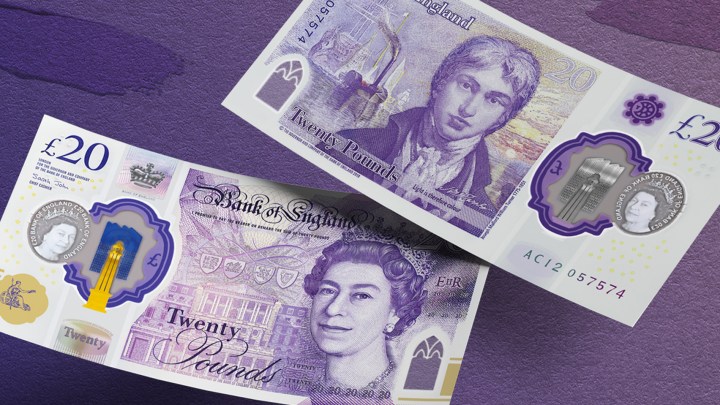
As reported several weeks ago by Simon Read for BBC News (20 February 2020) . . .
You’ll soon no longer find Adam Smith in your wallet or purse. The economist has been replaced as the face of the £20 note by artist JMW Turner. . . . It includes two see-through windows and a two colour foil to help beat forgers. . . . The new £20 is the third plastic banknote to be issued by the Bank of England after the fiver featuring Winston Churchill—launched in 2016—and the tenner featuring Jane Austen, which was first issued in 2017. It replaces the paper one featuring Adam Smith which has been in circulation since 2007.
The portrait is based on Turner’s ca. 1799 Self-Portrait now part of the Tate Collection.
Church Monuments Essay Prize
From ArtHist.net:
Church Monuments Essay Prize
Submissions due by 31 December 2020
The Council of the Church Monuments Society offers a biennial prize of £500 called the Church Monuments Essay Prize, to be awarded with a certificate for the best essay submitted in the relevant year along with publication of the winning essay in the peer-reviewed international annual CMS journal Church Monuments. The competition is open only to those who have not previously published an article in Church Monuments. The subject of the essay must be an aspect of church monuments—of any period in Britain or abroad. The length, including notes, shall not exceed 10,000 words and a maximum of 10 illustrations, preferably in colour. The prize will be awarded only if the essay is considered by the judges to be of sufficiently high standard to merit publication in Church Monuments. The closing date for new entries is 31 December 2020. For a copy of the rules and the contributor guidelines, please see the Society’s website, or contact the Hon. Journal Editors for more details or advice on the suitability of a particular topic. For details and for submission of articles, please email the editors: Jonathan Trigg (jrtrigg@liverpool.ac.uk) and Ann Adams (cmsed.aja@gmail.com).
Church Monuments Society
Patron HRH Duke of Gloucester KG GCVO
Registered Charity 279597
Conservation of The Blue Boy Completed
Press release from The Huntington (27 February 2020) . . .
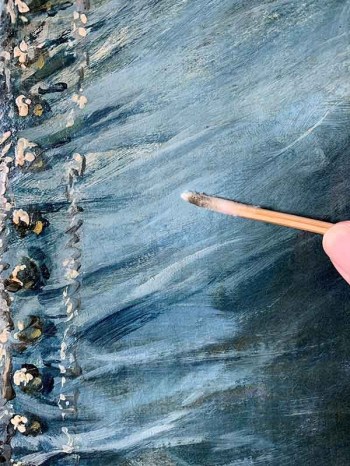
The conservator removed dirt trapped underneath the varnish (as seen on the cotton swab), which clouded the clarity of Gainsborough’s masterful brushwork (The Huntington Library, Art Museum, and Botanical Gardens).
The Huntington Library, Art Museum, and Botanical Gardens announced today that the extensive 18-month initiative to analyze, conserve, and restore The Blue Boy (ca. 1770) by Thomas Gainsborough (1727–1788) is complete, and the iconic painting will go back on view Thursday, March 26, in the Thornton Portrait Gallery. With much of the process carried out in public view during the Project Blue Boy exhibition (22 September 2018 — 30 September 2019), the major undertaking involved high-tech data gathering and analysis as well as more than 500 hours of expert conservation work to remove old overpaint and varnish, repair and reattach the lining and other structural materials, and inpaint areas of loss as a result of flaking and abrasion. Now, minute shades of color, fine brushstroke textures, and nuanced details of the famous figure of a young man in a blue satin costume, as well as the landscape in which he stands, are once again legible and closer to what Gainsborough intended.
“The Blue Boy has been a star of The Huntington’s collections since we opened as the first old masters museum in Los Angeles in 1928, when visitors flocked to see this magnificent work of 18th-century British portraiture,” said Huntington President Karen R. Lawrence. “Now the painting is again the center of a joyous occasion, as we celebrate the completion of a robust and thoughtful conservation project. A well-attended exhibition showcasing the conservator at work, more than 100 public talks, and the convening of experts in the field all helped to define Project Blue Boy as an ambitious and successful project with an educational focus.”
More than 217,000 people visited the Project Blue Boy exhibition. Christina O’Connell, The Huntington’s Mary Ann and John Sturgeon Senior Paintings Conservator and leader of the project, gave about 170 gallery talks, emphasizing the guidelines and code of ethics in the field of conservation as she responded to visitor questions on topics ranging from the history of the painting, to details of the technical study, to the structural elements of the work.
The conservation project involved slowly removing several uneven layers of dirt and discolored varnish with small cotton swabs to reveal Gainsborough’s original brilliant blues and other pigments. Then, with tiny brushes, the artist’s brushstrokes were reconnected across the voids of past damage as part of the inpainting process.
As O’Connell worked on the painting, she became intimately aware of Gainsborough’s every brushstroke. “It’s been an incredibly deep professional experience,” she said. “Conservation work is very much a process of discovery. I’ve not only had a view of the painting at the microscopic level, but I was also able to observe each stroke as the true colors of Gainsborough’s palette were revealed from underneath many layers of dirt and discolored varnish.” During the process, O’Connell discovered that although Gainsborough painted The Blue Boy on a recycled canvas (as revealed in earlier X-rays), he made considerable use of a complex network of paint layers and pigments to create a painting that truly showed off his skills.
“We have to remember that this painting wasn’t commissioned, but rather was produced by Gainsborough for the express purpose of showing off his prowess at the Royal Academy exhibition of 1770—where it would be seen next to the work of his rivals,” said Melinda McCurdy, The Huntington’s associate curator for British art and co-curator of Project Blue Boy. “Gainsborough intended it to grab attention, and conservation work has revealed the incredible technical skill he brought to this showpiece.”
Other discoveries made over the course of the project, which was supported by a grant from Bank of America as a part of its global Arts Conservation Project, include one relating to the painting’s lining. After observation and analysis, conservators determined that the lining adhesive for The Blue Boy correlated to a historic recipe for a paste made of rye flour and ale. O’Connell enlisted the help of a food historian to recreate the paste with modern ingredients to construct a mock-up in order to observe how the materials for the lining behaved. More discoveries should be forthcoming once the copious data that was collected during the project is analyzed. Information was gathered via X-radiography, infrared reflectography, cross-section microscopy, and macro X-ray fluorescence scanning. The results of the analysis will take several more months.
Conservation was funded by a grant from the Bank of America Art Conservation Project. Additional generous support for this project was provided by the Getty Foundation, Friends of Heritage Preservation, and Haag-Streit USA
Call for Papers | Antiquities and the Art Market in Britain and Italy
Postponed: It is with regret that we have decided to postpone the Antiquities, the Art Market and Collecting in Britain and Italy in the 18th Century conference at Birkbeck this year (17–18 September 2020), due to the ongoing Covid-19 health crisis. Given the current limitations on travel and the closure of university campuses, research institutions, libraries, archives and collections, as well as the obvious challenges to personal safety, the conference will not take place this year. It will instead be held on 16–17 September 2021. The Call for Papers is therefore temporarily closed. To all who have submitted abstracts so far, thank you very much for your interest; we hope that you will consider submitting an abstract again when the Call for Papers is reissued closer to the new deadline. Note added 24 March 2020.
From ArtHist.net:
Antiquities, the Art Market, and Collecting in Britain and Italy in the 18th Century
Birkbeck, University of London, 17–18 September 2020
Organized by Caroline Barron, Catharine Edwards, and Kate Retford
Proposals due by 15 April 2020
Recent years have seen a resurgence of interest in the formation and display of country house collections of art and antiquities in Britain, and particularly those created as a result of a Grand Tour to Italy in the eighteenth century. From The English Prize at the Ashmolean Museum in 2012 and the collaboration between Houghton Hall and The Hermitage State Museum, Houghton Revisited, in 2013, to The Lost Treasures of Strawberry Hill: Masterpieces from Horace Walpole’s Collection in 2018, curators and academics have sought to investigate the antiquities, paintings and collectibles that were brought to Britain in such large quantities.
However, the organisation of the art market at that time has received less attention, and far less than it deserves given its fundamental role in the processes by which objects arrived in collections at that time. New contexts for collecting have also emerged, such as the history of consumption and the economic background to the acquisition of so-called ‘luxury’ goods and prestige objects. The art market of the eighteenth century continues to play a vital role in collecting today; with so many of the objects acquired during a Grand Tour since dispersed in house sales and auctions, or bequeathed or sold to museums. The antiquities and paintings that once adorned the galleries of the cultured in Britain are also still to be found for sale, indicating the longevity of their appeal and value for collectors.
This conference seeks to explore the processes by which these collections were formed, interrogating the relationship between the Italian and British art markets of the eighteenth century, the role of the dealers in Italy, and the auction houses in Britain, through which many of the objects were later to pass, encompassing in depth discussion of the objects themselves. We invite abstracts of no more than 500 words for 30 minute papers to be submitted to the organising committee by 15th April 2020 (antiquitiesartmarketconference@gmail.com) as well as a short CV. We welcome proposals from scholars working in museums, collections, and archives, as well as from academics from across disciplines such as History, Art History, Museum Studies, and Classics. PhD students and ECRs are particularly encouraged to submit abstracts.
Topics may include, but are not limited to:
• Dealers in antiquities between Rome and Britain
• Auctions and auction houses in Britain
• Object biographies of antiquities, old master paintings, modern paintings, rare books, prints, and neo-classical sculpture circulating in the 18th-century art market
• Customers and collectors in the 18th century
• Networks and communities of dealers and collectors
• The economic history of the art market
• The afterlife of collections from the 18th century to today
Print Quarterly, March 2020
The eighteenth century in the current issue of Print Quarterly:
Print Quarterly 37.1 (March 2020)

Antoine Trouvain and Pierre Lepautre after Bon Boullogne, Thesis Print of François Bourgarel for Mathematics, 1695, engraving, top 336 x 540 mm, bottom 462 x 540 mm (Paris, Bibliothèque Nationale de France).
N O T E S A N D R E V I E W S
• John Roger Paas, Review of Simon Turner, ed., The New Hollstein German Engravings, Etchings, and Woodcuts, 1400–1700: Johann Stridbeck the Elder and the Younger, compiled by Dieter Beaujean and based on the research material of Josef H. Biller, parts 1–4 (Ouderkerk aan den IJssel: Sound & Vision Publishers, 2018), pp. 72–73.
The fact that artists are prolific and find a market in their lifetime is no guarantee that their work will enjoy critical acclaim in the long run or be avidly sought after by collectors. Such is the case of the Stridbecks, Johann the Elder (1641–1716) and Johann the Younger (1666–1714), Augsburg printmakers active from the late seventeenth century to the second decade of the eighteenth. . . . [But] their prints help to give us a deeper understanding of the print market and of public taste at the time, and we are fortunate that the more than a thousand prints of the Stridbecks have now been carefully collected and catalogued.
• Louis Marchesano, Review of Véronique Meyer, Pour la plus grand gloire du roi: Louis XIV en theses (Rennes: Presses Universitaires de Rennes, 2017), pp. 73–75.
This book provides an insightful account of the thesis print phenomenon by focusing on prints dedicated to the French king. It explores the function of these prints in the candidate’s life at university and outside, the production, reception and diffusion of the sheets and analyses the king’s image and its evolution in the period from his birth in 1638 to his death in 1715.
• Niklas Leverenz, “Isidore-Stanislas Helman and J. Pélicier,” pp. 75–76.
This short note focuses on a recently discovered signature of J. Pélicier on the proof state of a 1787 print previously attributed to Isidore-Stanislas Helman (1742–1809). This evidence suggests that Helman must have relied on a team of etchers for his large body of work, unusually allowing some of them to put their name on the plates.
P U B L I C A T I O N S R E C E I V E D
• Who is Who Chez les Colbert? La collection d’estampes de Joseph de Colbert, exhibition catalogue (Sceaux: Musée du Domaine départemental de Sceaux / Ghent: Éditions Snoeck, 2019), p. 96.
• Sandra Pisot, ed., Goya, Fragonard, Tiepolo: Die Freiheit der Malerei, exhibition catalogue (Hamburg: Hamburger Kunsthalle / Munich: Hirmer Verlag, 2019), p. 96.
• Laurent Baridon, Jean-Philippe Garric, and Martial Guédron, eds., Jean-Jacques Lequeu: Bâtisseur des Fantasmes, exhibition catalogue (Paris: Petit Palais, Bibliothèque Nationale de France / Éditions Norma, 2018), p. 97.

J. Pélicier, Emperor Qianlong Welcoming the Elderly Citizens of his Empire for a Celebration in their Honour, 1787, etching, 303 x 428 mm (Private Collection).
Book Launch | The Art of the Jewish Family
This month at BGC:
Book Launch—Laura Leibman, The Art of the Jewish Family
Bard Graduate Center, New York, 23 March 2020, 6:00–7:30pm
Author Laura Leibman in conversation with Jonathan Sarna and Barbara Kirshenblatt-Gimblett, moderated by Dean Peter N. Miller, to celebrate the publication of The Art of the Jewish Family: A History of Women in Early New York in Five Objects.
Laura Arnold Leibman, The Art of the Jewish Family: A History of Women in Early New York in Five Objects (Chicago: The University of Chicago Press, 2020), 350 pages, ISBN: 978-1941792209, $35.
 In order to rethink early Jewish American women’s lives, The Art of the Jewish Family examines five objects owned by Jewish women who lived at least a portion of their lives in early New York between 1750 and 1850. Each chapter creates a biography of a single woman through her object, but also uses her story to shed light on larger changes in Jewish American women’s lives. The women Leibman discusses are diverse: some rich, some poor; some Sephardi, some Ashkenazi; some born enslaved, and some who were slave owners themselves. In creating these biographies, Leibman proposes a new methodology for early American Jewish women’s history, one which could be applied to other areas in Jewish history for which records on women are sparse. This method looks at both material objects and fragmentation as important evidence for understanding the past. What social and religious structures, Leibman asks, caused early Jewish women to disappear from the archives?
The objects she considers span the 1750s through the 1850s. They are (1) a letter written in 1761 by an impoverished Hannah Louzada requesting assistance from Congregation Shearith Israel; (2) a famous set of silver cups owned by Reyna Levy Moses (1753–1824); (3) a beautiful ivory miniature of Sarah Brandon Moses (1798–1829), who was born enslaved in Barbados but became one of the wealthiest Jewish women in New York; (4) a commonplace book created by Sarah Ann Hays Mordecai (1805–1894); and (5) a family silhouette of Rebbetzin Jane Symons Isaacs (1823–1884) and her young brood.
Looking past texts to material culture, Leibman expands our ability to understand early Jewish American women’s lives and restores some of their agency as creators of Jewish identity. While the vast majority of early American texts about Jewish women were written by men with men as the primary intended audience, objects made for and by Jewish women help us consider women as consumers and creators of identity. Everyday objects provide windows into those women’s daily lives, highlighting what they themselves valued, how they wanted their contemporaries to see and understand them, and how they passed identity on to their children and grandchildren.
Laura Arnold Leibman is professor of English and humanities at Reed College.
Art of the Jewish Family is published in Cultural Histories of the Material World, a series dedicated to publishing monographs, works in translation, and collective project volumes that mark out the frontiers of BGC’s knowledge map. All books derived from the Leon Levy Foundation lectures in Jewish Material Culture will be published in this series.










 Enfilade
leave a comment