Workshop | Nobility without Limits? Prussian Identities, 1525 –1795

Johann Hennenberger: Stemmata genealogica praecipuarum in Prussia Familiarum Nobilium, Ende 16. Jh., Seite der Familie Dohna (Detail), public domain: http://kpbc.umk.pl/dlibra/doccontent?id=3096
◊ ◊ ◊ ◊ ◊
From the posting at ArtHist.net, which includes the Polish:
Adel ohne Grenzen? Identitäten und Repräsentation zwischen Königlichem Preußen und Herzogtum Preußen //
Szlachta bez granic? Tożsamości i reprezentacje w Prusach Królewskich i Książęcych
Deutsches Historisches Institut, Warsaw, 26–27 March 2020
Organized by Sabine Jagodzinski and Rahul Kulka
In dem Workshop werden vor allem kunsthistorische Fragen zum Adel in den beiden Teilen Preußens und dessen künstlerischen Repräsentationen, den Visualisierungen und dem materiellen Ausdruck von regionalen oder überregionalen Identifikationen und Loyalitäten zu den Höfen diskutiert. Außerdem interessiert die künstlerisch-architektonische Prägung seiner Handlungsräume. Im Zentrum der Betrachtung stehen die Entwicklungen nach dem Zweiten Frieden von Thorn 1466, insbesondere im Zeitraum von der Schaffung des Herzogtums Preußen (1525) über die Lubliner Union (1569) bis zu den Teilungen Polen-Litauens 1772/1793/1795.
Die Beiträge und Diskussionen werden simultan ins Polnische bzw. Deutsche übersetzt. Anmeldungen zum Workshop werden bis zum 16. März 2020 erbeten an: dhi@dhi.waw.pl.
Konzeption und Organisation
Dr. Sabine Jagodzinski (DHI Warschau)
Rahul Kulka, Ph.D. Candidate (Harvard University / ZI München)
Kontakt
Deutsches Historisches Institut / Niemiecki Instytut Historyczny
Pałac Karnickich
Aleje Ujazdowskie 39
00-540 Warszawa
D O N N E R S T A G , 2 6 M Ä R Z 2 0 2 0
17.00 Ankunft der Teilnehmerinnen und Teilnehmer
17.15 Begrüßung und Einführung, Sabine Jagodzinski (Warszawa), Rahul Kulka (Cambridge, MA / München)
18.00 Keynote
Moderation: Miloš Řezník (Warszawa)
• Karin Friedrich (Aberdeen) – Zwischen Republik und Dynastie. Adelswelten und adelige Identitäten zwischen Preußen Königlichen Anteils und Herzogtum Preußen, 1569–1772
F R E I T A G , 2 7 M Ä R Z 2 0 2 0
10.00 Kirchenraum und Konfession
Moderation: Dorota Piramidowicz (Warszawa)
• Franciszek Skibiński (Toruń) – Adelige Stiftungen des 17. und 18. Jh. in Kirchen Thorns und anderen preußischen Städten im Kontext von Religion, Gesellschaft und Politik. Ein Problemaufriss
• Piotr Birecki (Toruń) – Der Innenraum evangelischer Kirchen als Ausdruck gesellschaftlichen Konservatismus im Herzogtum Preußen
11.00 Kaffeepause
11.15 Kult und Liturgie
Moderation / Prowadzenie: Agnieszka Gąsior (Leipzig)
• Michał F. Woźniak (Toruń) – Stiftungen der katholischen Geistlichkeit im Königlichen Preußen im Bereich der liturgischen Ausstattung
• Sabine Jagodzinski (Warszawa) – Heiligenverehrung des katholischen Adels im Königlichen Preußen. Zu Schnittmengen regionaler und überregionaler Identitäten
12.15 Mittagspause
13.30 Bildnis und Symbol
Moderation: Magdalena Górska (Warszawa)
• Rahul Kulka (Cambridge, MA / München) – Die Stemmata genealogica des Königsberger Hofmalers Johann Hennenberger. Heraldik und Genealogie als Medien adeliger Repräsentation um 1600
• Agnieszka Gąsior (Leipzig): Geprägte Identität. Medaillenkunst und die Elitennetzwerke des frühen 17. Jahrhunderts
14.30 Kaffeepause
14.45 Residenzen und Landgüter
Moderation: Konrad Morawski (Warszawa)
• Anna Oleńska (Warszawa) – Versailles im Herzen der Rzeczpospolita. Repräsentationsstrategien und Struktur der künstlerischen Vorhaben Jan Klemens Branickis (1689–1771)
• Wulf D. Wagner (Palermo) – Ein Handbuch ostpreußischer Güter als Quellengrundlage weiterer Forschungen
New Book | The Pocket: A Hidden History of Women’s Lives
The book appeared last summer in hardback and is already sold out; a paperback is scheduled for release in the coming months from Yale UP.
Barbara Burman and Ariane Fennetaux, The Pocket: A Hidden History of Women’s Lives, 1660–1900 (New Haven: Yale University Press, 2020), 264 pages, ISBN: 978-0300253740 (paperback), $25.
 Pencils, a sketchbook, cake, yards of stolen ribbon, thimbles, snuff boxes, a picture of a lover, two live ducks: these are just some of the fascinating things carried by women and girls in their tie-on pockets, an essential accessory throughout the 18th and 19th centuries.
This first book-length study of the tie-on pocket combines materiality and gender to provide new insight into the social history of women’s everyday lives—from duchesses and country gentry to prostitutes and washerwomen—and explore their consumption practices, work, sociability, mobility, privacy, and identity. The authors draw on an unprecedented study of surviving pockets in museums and private collections to identify their materials, techniques, and decoration; their use is investigated through sources as diverse as criminal trials, letters, diaries, inventories, novels, and advertisements. Richly illustrated with paintings, satirical prints, and photographs of artifacts in detail, this innovative book reveals the unexpected story of these deeply evocative and personal objects.
Barbara Burman is an independent scholar, and Ariane Fennetaux is associate professor of 18th-century British history at the Université Paris Diderot.
Lecture | Wendy Wassyng Roworth on Angelica Kauffman
At SLAM (and conveniently enough, coinciding with ASECS) . . .
Wendy Wassyng Roworth, Angelica Kauffman: An Enterprising Artist in 18th-Century Britain
Saint Louis Art Museum, 20 March 2020
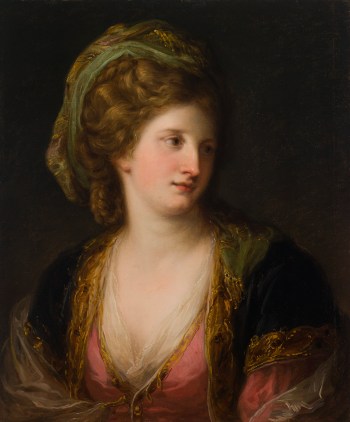
Angelica Kauffman, Woman in Turkish Dress, 1767, oil on canvas, 25 × 20 inches (Saint Louis Art Museum, Funds given by Dr. E. Robert and Carol Sue Schultz 704.2018).
Angelica Kauffman (1741–1807), an Austrian-Swiss artist, began her career in Italy, where her clients included British tourists who encouraged the young painter to pursue her profession in England. Over the fifteen years she worked in London, Kauffman achieved fame and fortune and returned to Italy as an international celebrity. Celebrating a portrait recently acquired by the Museum, this lecture will discuss Kauffman’s life and work in England as a fashionable painter and member of the Royal Academy of Arts, a rare distinction for a woman, and how she used her talents to advantage.
Friday, 20 March 2020, 7pm, Farrell Auditorium at the Saint Louis Art Museum. The lecture is offered free of charge, thanks to the Mary Strauss Women in the Arts Endowment. Tickets are, however, required. Advance tickets are recommended and may be reserved in person at the Museum’s Information Centers or through MetroTix, 314.534.1111 (all tickets reserved through MetroTix incur a service charge).
Wendy Wassyng Roworth is Professor Emerita of Art History, University of Rhode Island.
Journal for Eighteenth-Century Studies, March 2020
In the latest issue of the Journal for Eighteenth-Century Studies:
Journal for Eighteenth-Century Studies 43.1 (March 2020).
 A R T I C L E S
• Amanda Vickery, “Branding Angelica: Reputation Management in Late Eighteenth‐Century England,” 3–24.
• Alberto del Campo Tejedor, “The Barber of Enlightened Spain: On the Politics and Practice of Grooming a Modern Nation,” pp. 25–42.
• Ana Sáez‐Hidalgo, “Anglo‐Spanish Enlightenment: Joseph Shepherd, an English ‘ilustrado’ in Valladolid,” pp. 46–60.
• Robert W. Jones, “Elizabeth Sheridan’s Post‐Celebrity,” pp. 61–78.
• Jonathan Taylor, “‘Who Bravely Fights, and Like Achilles Bleeds’: The Ideal of the Front‐Line Soldier during the Long Eighteenth Century,” pp. 79–100.
E D I T E D M A N U S C R I P T S
• Jessica Wen Hui Lim, “Barbauld’s Lessons: The Conversational Primer in Late Eighteenth‐Century British Children’s Literature,” 101–20.
R E V I E W S
• Madeleine Pelling, Review of Susanna Avery‐Quash and Kate Retford, eds., The Georgian London Town House: Building, Collecting and Display, pp. 121–22.
• Megan Kitching, Review of Keith Michael Baker and Jenna Gibbs, eds., Life Forms in the Thinking of the Long Eighteenth Century, pp. 122–24.
• Charlotte Fletcher, Review of Barbara Burman and Ariane Fennetaux, The Pocket: A Hidden History of Women’s Lives, 1660–1900, pp. 124–25.
• Hannah Hutchings‐Georgiou, Review of Andrew Carpenter, ed., The Poems of Olivia Elder, pp. 125–26.
• Thomas Lalevée, Review of Gabriel Galice and Christophe Miqueu, eds., Rousseau, la république, la paix: actes du colloque du GIPRI (Grand‐Saconnex, 2012), pp. 126–28.
• Helen Metcalfe, Review of Sally Holloway, The Game of Love in Georgian England: Courtship, Emotions, and Material Culture, pp. 128–29.
• Olive Baldwin Thelma Wilson, Review of Berta Joncus, Kitty Clive, or The Fair Songster, pp. 129–31.
• Joachim Whaley, Review of Claudia Keller, Lebendiger Abglanz: Goethes Italien‐Projekt als Kulturanalyse, pp. 131–32.
• Ben Wilkinson‐Turnbull, Review of A. C. Elias, John Irwin Fischer, and Panthea Reid, eds., Jonathan Swift’s Word‐Book: A Vocabulary Compiled for Esther Johnson and Copied in Her Own Hand, pp. 132–33.
• Max Skjönsberg, Review of Margaret Watkins, The Philosophical Progress of Hume’s Essays, pp. 133–35.
Exhibition | Angelica Kauffman
Now on view at the Kunstpalast and coming to London’s RA in June:
Angelica Kauffman: Artist, Superwoman, Influencer
Kunstpalast, Düsseldorf, 30 January — 24 May 2020
Royal Academy of Arts, London, 28 June — 20 September 2020
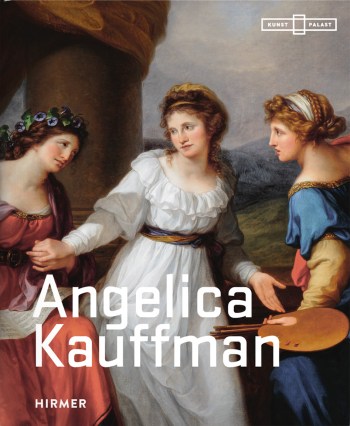 Angelica Kauffman was a founding member of the Royal Academy and an artist who defied convention. In this major exhibition we trace her trajectory from child prodigy to one of the most sought-after painters of her time. Born in Switzerland in 1741, Angelica Kauffman (1741–1807) was quickly recognised as a child prodigy, before receiving further artistic training in Italy. Arriving in London in 1766, she enjoyed an unprecedented career as a history painter and portraitist before moving to Rome in 1782, where her studio became a hub of the city’s cultural life. Kauffman’s career was unusual for a female artist in the late 18th and early 19th century. A highly acclaimed portraitist, she identified herself primarily as a history painter, working for patrons across Britain and the continent, including Catherine the Great amongst others. This exhibition will focus on Kauffman’s work at the height of her career, tracing the life and work of this celebrated artist.
The catalogue is published by Hirmer and distributed in North America by The University of Chicago Press:
Bettina Baumgärtel, ed., with contributions by B. Baumgärtel, I. M. Holubec, J. Myssok, and H. Valentine, Angelica Kauffman (Munich: Hirmer Publishers, 2020), 208 pages, ISBN: 978-3777434629, £35 / $45.
Call for Papers | Angelica Kauffman Study Day
From ArtHist.net:
Angelica Kauffman Study Day
Royal Academy of Arts, London, 16 September 2020
Proposals due by 15 April 2020
On the occasion of the retrospective dedicated to Angelica Kauffman taking place in Düsseldorf and London in 2020, the Royal Academy of Arts is organising a study day on the artist on Wednesday, 16 September 2020.
A child prodigy and a respected painter famous all over Europe in her own lifetime, Angelica Kauffman (1741–1807) transcended many boundaries and conventions linked to eighteenth-century social norms. She embraced many facets of the Enlightenment beliefs, pursued a career to become a history painter following the neoclassical ideals, and worked for some of the most prominent patrons of the time. She was also one of the two female founding members of the Royal Academy of Arts in London in 1768. At her death, her sculpted bust was placed next to Raphael’s in the Pantheon in Rome thereby underlining her place in the artistic canon.
We welcome papers exploring the rich and versatile career of Angelica Kauffman with a fresh contextualisation in the broader artistic, cultural, social, and economic fabric of the eighteenth century. Topics should draw on Kauffman’s production and career and may include, but are not necessarily limited to:
• Fashion and costume
• The business of art (showroom, records, book-keeping, and clientele)
• Cosmopolitan networks
• International career
• Women patrons
• Royal patrons
• Women artists and their careers
• Artistic/Intellectual friendships and their impact on creativity
• Multiples (prints, designs for decorative arts)
• Female self-portrait and self-representation
• Display in 18th-century European art
Please send an abstract of 300 words and a short biography of 200 words to: Marie.Tavinor@royalacademy.org.uk and Will.Iron@royalacademy.org.uk. We are sorry that we cannot offer any travel bursaries on this occasion.
Call for Papers | Revivals in the Decorative Arts
From ArtHist.net:
Revivals in the Decorative Arts — Annual ICOM / ICDAD Conference
National Palace of Ajuda, Lisbon, 14–16 October 2020
Proposals due by 15 April 2020
The 2020 Annual Conference and General Assembly of ICOM International Committee for Museums and Collections of Decorative Arts and Design will take place at the National Palace of Ajuda in Lisbon, Portugal, from October 14 to 16—plus two days (17–18 October) for the post conference tour to Coimbra and Porto.
Revivals—as a socio-cultural phenomenon recurrent throughout history—seek to rescue principles and traditions of times gone by. In this conference we approach revivals with regard to decorative arts and design. Decorative arts and design are to be interpreted as any domestic or public furnishings including but not limited to textiles, silverware, furniture, wallpaper, tableware, interior decoration as a whole, graphic design, as well as personal accessories (excluding fashion). We also welcome presentations on revivals within decorative and applied art traditions (ceramics, lacquer, metalwork, textiles, woodwork, etc.) made for utilitarian or connoisseurial purposes. Hence we encourage papers proposals on a wide variety of topics including a broad array of Asian, European, or North and South American revival styles. We also include the retro design styles of the 20th and 21st centuries, referring to the resurgence of old yet relatively recent styles.
It is fascinating how heritage is being used and valued, reconsidered both from the positions of a curator, artist, or a designer. We are interested in the examples, phenomena, and notions that reflect upon the relation to the past, treating it with both unsentimental and sentimental nostalgia, introducing ways of dealing with the recent past from different periods in history.
15-minute presentations (in English) will comprise the conference sessions. Please send an abstract of 250–300 words, including your name, title, institution, and ICOM membership number to Maria José Gaivão Tavares, Curator of the Furniture Collection at National Palace of Ajuda and ICDAD Secretary, icdad.secretariat@gmail.com. Additional information is available here.
AGO Acquires Portrait of a Lady Holding an Orange Blossom
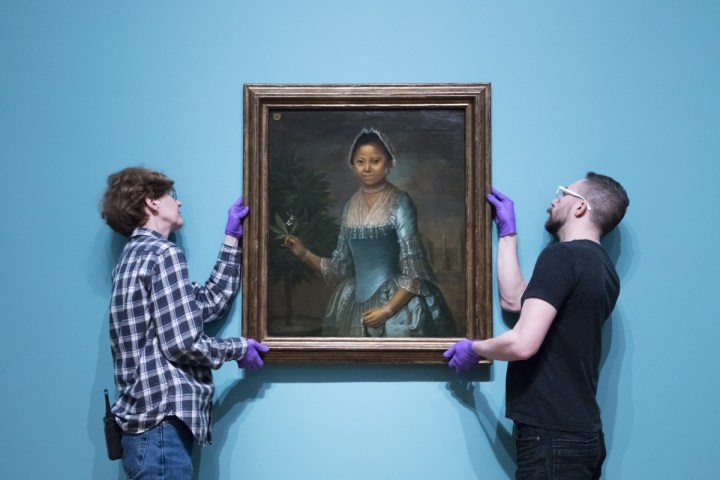
Unknown artist, Portrait of a Lady, Three Quarter Length, Holding an Orange Tree Flower, mid-18th century, oil on canvas, 80 × 56 cm
(Toronto: Art Gallery of Ontario, purchase, 2020, 2019/2437)
◊ ◊ ◊ ◊ ◊
Press release (25 February), from Toronto’s Art Gallery of Ontario:
If you’ve read about the AGO’s recent acquisitions, then you know it’s a top priority of ours to acquire dynamic and captivating works that will both strengthen and diversify our collection. With this in mind, we jumped at the opportunity to purchase the beauty you see pictured above. And what’s even more exciting is that it comes to us with a fascinating mystery to uncover.
Portrait of a Lady Holding an Orange Blossom is a striking and mysterious portrait that commands your attention. Its central figure is a young woman wearing a luxurious blue silk gown, woven with intricate lace trim. Around her neck and wrists are elegant pearls, which complement her bejewelled drop earrings. She is aware of her own radiance, smizing with piercing brown eyes and regal posture, clasping the front of her gown while presenting an orange tree blossom.
Though the subject’s presence is arresting and undeniable, her identity, as well as that of the artist who painted her, are currently unknown. Scholars agree that Portrait of a Lady is from the mid-1700s, painted by a male artist who was born and trained in Europe. With so many unanswered questions, we are left wondering: Who was this painter? What is the location of this painting and what brought him there? Who was his stunning subject?
Very few portraits of Black people by European artists survive from this time period. The painting raises important questions about the subject’s status within the transatlantic slave trade. While her opulent clothing and the mere existence of the portrait suggest that she was a free woman, her ancestors and even one of her parents may have been enslaved.
We continue to do research to find out more about her story. In the meantime, the presence of this figure in the European galleries reminds us that history is complex and diverse, composed of countless stories told from many perspectives. For the AGO, this acquisition is an important step toward acknowledging the rich and vital presence of people of colour in the history of Europe and its art. Portrait of a Lady Holding an Orange Blossom is currently on view on Level 1 in Frank P. Wood Gallery (Gallery 123).
New Book | Collecting and Empires
From Brepols:
Maia Wellington Gahtan and Eva-Maria Troelenberg, eds., Collecting and Empires: An Historical and Global Perspective (Turnhout: Harvey Miller Publishers, 2019), 404 pages, ISBN: 978-1909400634, 125€ / $156.
 The comparative historical investigation of imperialism through the lens of collecting practices, museum archetypes, and museums proper helps shape our understanding of contemporary aesthetics and diversity management as well as helps identify what is imperial about our own approaches to material culture.
The creation and dissolution of empires has been a constant feature of human history from ancient times through the present day. Establishing new identities and new power relationships, empires also irrevocably altered social structures and the material culture on which those social structures were partly based. The political activities of empires are materially reflected in the movement of objects from periphery to center (and vice versa) and in the formation and display of collections which represent the potential for the production and the dissemination of knowledge. Imperial collecting practices tell stories that are complementary to and go beyond the classical sources of official history, the statistics of social history and even the narratives of collective or individual oral history. Building on previous work on European and Colonial object histories, this collection of essays—for the first time—approaches the subject of collecting and empires from a global and inclusive comparative perspective by addressing selection of the greatest empires the world has known from Han China to Hellenistic Greece to Aztec Mexico to the Third Reich.
C O N T E N T S
• Collection and Power in the Near Eastern World — Alain Schnapp
• The Biopolitics of Collecting: Empires of Mesopotamia — Zainab Bahrani
• Princely Treasures and Imperial Expansion in Western Han China (second/first century BC) — Michèle Pirazzoli-t’Serstevens
• Collecting like Caesar: The Pornography and Paideia of Amassing Artefacts in and after the Roman Empire — Caroline Vout
• From a Culture of the Intimate to a Culture of the Remote. A Latin Epigram Collection between Two Universal Powers: Papal Rome and the Holy Roman Empire — Nadia Cannata and Maia Wellington Gahtan
• The Mexica Empire: Memory, Identity, and Collectionism — Enrique Florescano
• Jahangir’s Hazelnut and Shah Jahan’s Chini Khana: The Collections of the Mughal Emperors — Ebba Koch
• Global Aspects of Habsburg Imperial Collecting — Thomas Da Costa Kaufmann
• Collecting in the Dutch Colonial Empire, Seventeenth and Eighteenth Centuries — Michael North
• The Musée Napoléon as an Imperial Louvre — Dominique Poulot
• The Object Flows of Empire: Cross-Cultural Collecting in Early Colonial India — Tapati Guha-Thakurta
• The Other Victoria and Albert Museum: Royal Souvenirs, Victorian Science and the Itineraries of Empire at the Swiss Cottage Museum, Osborne House — Ruth B. Phillips
• The (Still)Birth of the Ottoman ‘Museum’: A Critical Reassessment — Edhem Eldem
• The Ruin and Restoration of the Russian Art Empire — Katia Dianina
• Collecting and the ‘Visual Evidence of Events’: Exemplary Reflections on Berlin between the Imperial and Post-Imperial Age — Eva Maria Troelenberg
• Looted Art, Booty Art, ‘Degenerate Art’: Aspects of Art Collecting in the Third Reich — Christoph Zuschlag
• The (De)Colonized Object: Museums and the Other in France since 1960 — Daniel J. Sherman
• Signs of Empire: Islamic Art Museums from European Imperialism to the Global Empire of Capital — Wendy Shaw
• Afterword: The Imperial Style of Collecting — Krzysztof Pomian
Colloquium | Les réseaux des académies d’art provinciales
This month at INHA, from the conference programme:
Les réseaux des académies d’art provinciales au Siècle des Lumières: Enjeux et dynamiques d’échanges
Institut national d’histoire de l’art, Paris, 26–28 March 2020
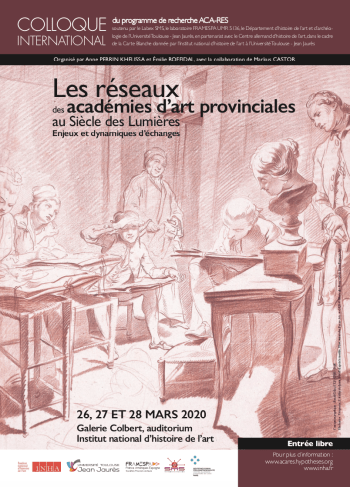 Colloque international du programme ACA-RES
Université Toulouse-Jean Jaurès, FRAMESPA UMR 5136, Labex SMS, en partenariat avec le Centre allemand d’histoire de l’art et l’Institut national d’histoire de l’art dans le cadre de la Carte Blanche 2019
J E U D I , 2 6 M A R S 2 0 2 0
9.30 Mots d’ouverture du colloque
France Nerlich (INHA) et Thomas Kirchner (Centre allemand d’histoire de l’art – Paris)
Conférences introductives
• Pierre-Yves Beaurepaire, (Université Côte d’Azur), Sociabilités, réseaux et échanges des savoirs au siècle des Lumières
• Anne Perrin Khelissa et Émilie Roffidal (Université Toulouse-Jean Jaurès, FRAMESPA UMR 5136), Le programme ACA-RES, résultats et perspectives de recherche
Session 1 : Un levier pour les carrières artistiques ?
Sous la présidence de Charlotte Guichard (ENS, IHMC)
• Catherine Voiriot (Musée du Louvre), Les femmes et les académies des arts, sciences et belles lettres, 1740–1791 : début de recherche
• Gabriel Batalla-Lagleyre (Université de Bourgogne, Centre Georges Chevrier), Exposer en amateur dans les académies : réseaux et identités
12.30 Pause déjeuner
14.00 Reprise de la session 1
• Maël Tauziède Espariat (Université de Bourgogne, Centre Georges Chevrier), Les peintres parisiens et les écoles de dessin provinciales : des connexions inégales
• Hélène Rousteau-Chambon (Université de Nantes), L’école de dessin de Nantes, un creuset pour les architectes
• Stéphanie Trouvé (musée des beaux-arts de Bordeaux), Les cercles académiques bordelais dans la trajectoire du peintre Pierre Lacour (1745–1814)
• Joëlle Raineau (Petit Palais, Paris), Les cercles et établissements académiques : un levier de diffusion et de postérité d’une carrière. L’exemple des affiliations multiples du graveur Nicolas Ponce (1746–1831)
• Marlen Schneider (Université Grenoble Alpes, LARHRA), Les académies d’art allemandes au XVIIIe siècle – un tremplin pour les artistes français ?
V E N D R E D I , 2 7 M A R S 2 0 2 0
9.00 Session 2 : Quelle utilité pour les territoires ?
Sous la présidence de Pascal Julien (Université Toulouse-Jean Jaurès, FRAMESPA UMR 5136)
• Lesley Miller (Victoria & Albert Museum – University of Glasgow), L’école de dessin de Lyon et la production de tissus
• Fabienne Sartre (Université Paul-Valery Montpellier 3), Le statut de la sculpture académique à l’épreuve du terrain : les cas de Toulouse, Montpellier et Marseille
• Catherine Isaac (Université Toulouse-Jean Jaurès, FRAMESPA UMR 5136 – EPHE), Le rôle des académies des sciences et des arts dans la création et l’essor du corps des ingénieurs du Languedoc au XVIIIe siècle
• Aude Gobet (Musée du Louvre), École de dessin et patrimoine : l’enjeu des inventaires révolutionnaires
• Adrián Almoguera (Sorbonne Université, École française de Rome), L’Espagne académique du Siècle des Lumières: Construire un système pour définir un style architectural entre Madrid et Valence (1768-1808)
12.30 Pause déjeuner
14.00 Session 3 : Collections et supports d’apprentissage
Sous la présidence d’Olivier Bonfait (Université de Bourgogne, Centre Georges Chevrier)
• Morwena Joly (Centre des Monuments nationaux), Les modèles morphologiques et anatomiques des académies d’art : des migrations européennes complexes
• Nelly Vi-Tong (Université de Bourgogne, Centre Georges Chevrier), Enseignement artistique et supports d’apprentissage : les exemples de Dijon, Reims et Valenciennes
• Tara Cruzol (Université Toulouse-Jean Jaurès, FRAMESPA UMR 5136), Enseigner la sculpture à l’Académie de Lyon : le traité inédit d’Antoine-Michel Perrache
• Gérard Fabre (musée des beaux-arts de Marseille), Les collections dispersées de l’Académie de peinture et de sculpture de Marseille
• Flore César (Université Paul-Valery Montpellier 3), Le rôle des collections lors de l’instauration des écoles de dessin en province au XVIIIe siècle
• Miguel Faria (Université autonome de Lisbonne), Les modèles pédagogiques des écoles d’art (aulas) portugaises
Conférence conclusive de la journée
• Christian Michel (Université de Lausanne), Complémentarité ou subordination : L’Académie royale de Peinture et de Sculpture et les académies de province
S A M E D I , 2 8 M A R S 2 0 2 0
9.00 Session 4 : Échos internationaux en Europe et outre-Atlantique
Sous la présidence de Gaëtane Maës (Université de Lille, IRHIS)
• Markus Castor (Centre allemand d’histoire de l’art), L’académie des beaux-arts comme histoire institutionnelle : prolégomènes d’une analyse structurelle
• Maria Pia Donato (CNRS, IHMC-Paris), Émulation et propagande : remarques sur les académies italiennes au XVIIIe siècle
• Hugo Tardy (Université Toulouse-Jean Jaurès, FRAMESPA UMR 5136), Le système académique russe construit par ses échanges les ambitions d’un empire face à l’Europe
• Marion Amblard (Université Grenoble Alpes), Des arts manufacturés aux beaux-arts : l’influence des modèles romains et français dans le développement des académies écossaises au XVIIIe siècle
• Reed Benhamou (Indiana University, Bloomington), The Last Provincial Academy: ‘L’Académie des sciences et beaux arts des États-Unis de l’Amérique’
• Ana Maria Tavares Cavalcanti et Sonia Gomes Pereira (Universidade Federal do Rio de Janeiro), L’Académie des Beaux-Arts à Rio de Janeiro, Brésil










 Enfilade
leave a comment