Exhibition | Painting Edo
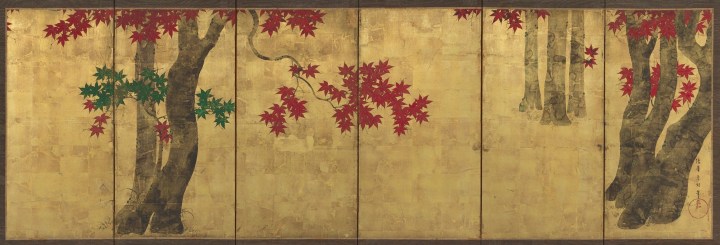
Tawaraya Sōri, Autumn Maple Trees, painted screen, second half of the eighteenth century
(Feinberg Collection, TL42147.39)
◊ ◊ ◊ ◊ ◊
Press release (3 February 2020) for the exhibition:
Painting Edo: Japanese Art from the Feinberg Collection
Harvard Art Museums, 14 February — 18 July 2021
Curated by Rachel Saunders and Yukio Lippit
Beginning February 14, 2020, the Harvard Art Museums present Painting Edo: Japanese Art from the Feinberg Collection, a special exhibition of more than 120 of the finest works from the preeminent collection of Robert S. (Harvard class of 1961) and Betsy G. Feinberg; the exhibition runs through July 26, 2020. Painting Edo offers a window onto the supremely rich visual culture of Japan’s early modern era and explores how the Edo period (1615–1868), and the city of Edo (present-day Tokyo), expressed itself during a time of artistic renaissance. A striking array of paintings in all the major formats will be on display—hanging scrolls, folding screens, sliding doors, fan paintings, and woodblock-printed books, among others—from virtually every stylistic lineage of the era, telling a comprehensive story of Edo painting on its own terms.
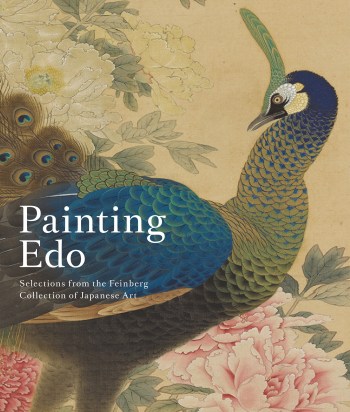 Painting Edo, organized by the Harvard Art Museums, is co-curated by Rachel Saunders, the Abby Aldrich Rockefeller Curator of Asian Art at the Harvard Art Museums, and Yukio Lippit, the Jeffrey T. Chambers and Andrea Okamura Professor of History of Art and Architecture at Harvard University. The exhibition will be on view exclusively at the Harvard Art Museums; an illustrated publication by Saunders and Lippit accompanies the show.
“Painting Edo is one of the largest exhibitions ever presented at the Harvard Art Museums—and fittingly so, since the Feinberg Collection is one of the largest gifts of art ever promised to this institution,” said Martha Tedeschi, the Elizabeth and John Moors Cabot Director of the Harvard Art Museums. “We are immensely grateful to the Feinbergs, whose great care and vision will ensure that the beauty and material ingenuity of these works reach viewers today and for generations to come.”
Robert S. and Betsy G. Feinberg generously promised their collection of more than 300 works of Japanese art to the Harvard Art Museums in 2013. Judiciously assembled over nearly fifty years, the collection—the finest private collection of Edo period Japanese painting in the United States—offers an exceptional opportunity to explore continuities and disruptions in artistic practice in early modern Japan. The museums’ stewardship of the collection ensures access by students, faculty, scholars, and the public, and allows for teaching, research, and further documentation of these important works.
The Feinberg Collection is notable not only for its size and remarkable quality, but also for its comprehensiveness. It comprises representative paintings from virtually every stylistic lineage of the era: from the gorgeous decorative works of the Rinpa School to the luminous clarity of the Maruyama-Shijō School, from the monochromatic indexes of interiority of so-called Nanga, or Southern School, painting to the actors and courtesans of the pleasure quarters depicted in ukiyo-e, to the inky innovations of the so-called eccentrics. A complete catalogue of the Feinberg Collection will be published by the museums in late summer 2020.
 Over the last five years, since the museums reopened in 2014, select objects from the Feinberg Collection have been on display in extended thematic installations in the East Asian gallery on Level 2. The rotating presentation of these works was designed not only to introduce strengths of the collection to visitors, but also to broaden access for teaching and research. These initial installations provided a preview of the amazing range of works now united in the powerhouse Painting Edo exhibition.
“I had the pleasure of meeting the Feinbergs and viewing their collection for the first time in the late 1990s while I was a student,” said Professor Lippit. “That experience gave me an appreciation for the study of new objects and cultural histories, and since becoming a faculty member at Harvard I have been actively teaching with the Feinberg Collection, inviting students to view and discuss the paintings.”
Painting Edo begins in the Special Exhibitions Gallery on Level 3 and expands into three adjacent galleries typically reserved for installations that support university coursework. This is the first time the museums mount a single exhibition across all four spaces. Visitors are greeted by Tani Bunchō’s Grasses and Moon (1817), a large painting that encapsulates the Japanese tradition of moon-viewing, before being immediately enveloped by Sakai Hōitsu’s Birds and Flowers of the Twelve Months (c. 1820–28), a stunning group of 12 hanging scrolls that together create a paradisal garden in which all the seasons flower simultaneously. From this introductory gallery, visitors are encouraged to wander at will to discover the major schools and styles of painting. Galleries are organized to reflect Edo period conceptions of lineage, offering a view of how “Edo” was articulated by and for its own creators and consumers.
“The Feinbergs have collected so carefully and with such dedication over the years that they have formed a truly comprehensive collection,” said Saunders. “That is particularly significant for us as a teaching museum because it allows us to look at the whole gamut of Edo painting within the exhibition, including virtually every major lineage and painting format.”
Additional Highlights
• Maruyama Ōkyo’s Peacock and Peonies (1768), a hanging scroll with a resplendent peacock rendered with Western-style anatomical precision against a luxuriant background of peonies [Intro section]
• A Portuguese Trading Ship Arrives in Japan (17th century), a pair of six-panel folding screens that depicts the arrival of a ship into port and the procession of its captain into town, an annual voyage made by the Portuguese to trade silver, silks, and spices [Floating Worlds section]
• Tawaraya Sōri’s Autumn Maple Trees (second half 18th century), one of only a handful of works that survive by the artist and widely regarded as his masterpiece [School of Kōrin section]
• Ikeno Taiga’s The Poet Su Shi and Meng Jia Loses His Hat (18th century), a pair of six-panel folding screens depicting two renowned figures in acts of elegant disregard for societal norms [Eccentricity section]
• Lotus in Autumn (1872), a wildly brushed hanging scroll by the female artist Okuhara Seiko, whose Chinese-style ink paintings became hugely popular in the years immediately following the Meiji Restoration of 1868, a time that ushered in Japan’s modern era [Remembering Edo section]
• Twenty fans by Suzuki Kiitsu, displayed against a deep blue backdrop, evoking the moment at the end of summer when Japanese men and women would cast their used fans into the river in celebration of the arrival of autumn [Remembering Edo section]
A rotation of select exhibition objects will take place between May 4 and 7 to preserve light-sensitive works as well as to add other fine examples of painting. Galleries will remain open to the public on these dates.
Publications
Two catalogues will be released in conjunction with the exhibition, both published by the Harvard Art Museums and distributed by Yale University Press. The first, Painting Edo: Selections from the Feinberg Collection of Japanese Art, is a companion to the exhibition; it offers a sweeping and lavishly illustrated overview of a transformative era in Japanese art-making as told through superb examples from the finest private collection of Edo period painting in the United States. It includes essays by Rachel Saunders and Yukio Lippitt. The second book, a comprehensive Catalogue of the Feinberg Collection of Japanese Art, will be published in late Summer 2020. Edited by Rachel Saunders, the volume includes new photography and commentary from a range of authors on each of the more than 300 works in the Feinberg Collection.
Rachel Saunders and Yukio Lippit, Painting Edo: Selections from the Feinberg Collection of Japanese Art (Cambridge: Harvard Art Museums, 2020), 180 pages, ISBN: 978-030025089, $35.
Rachel Saunders, ed., Catalogue of the Feinberg Collection of Japanese Art (Cambridge: Harvard Art Museums, 2020), 264 pages, ISBN: 978-0300250909, $65.
Call for Essays | Giants and Dwarfs
From ArtHist.net (18 February 2020). . .
Giants and Dwarfs in Early Modern Europe: Real, Imagined, Metaphorical
Volume edited by Robin O’Bryan and Felicia Else
Abstracts due by 30 May 2020
Nourished by biblical accounts, classical precedents, and medieval traditions, the cultural interest in giants and dwarfs came of age in the early modern period. In the popular realm, the two were often to be found in carnivals, fairs, and religious festivals, the role of giants enacted by effigies or people wearing stilts. Dwarfs especially became important additions to the royal and princely courts, enlisted for amusement and prestige and featured in the ruler’s pageantry and protocol. In art, dwarfs were ubiquitous motifs in painting and sculpture, with giants portrayed literally or expressed metaphorically in colossi or other ‘gigantified’ works. Inspired by the Arthurian and Carolingian romances, chivalric spectacles were staged with dwarfs and giants, while burlesque poets and playwrights paid homage to the two in their mock-heroic poems and dramatic endeavors.
We seek essays for an edited volume dealing with any aspect of giants and/or dwarfs in early modern Europe. Topics might focus on their appearance in ephemeral entertainments; their exhibition in popular fairs and carnivals; as characters in legends, folkloric traditions, and dynastic histories; as leitmotifs in artistic and literary works; as embodiments of the period taste for the marvelous; and as manifestations of the Other. Please send abstracts of 200–250 words, along with any questions, to Robin O’Bryan at rlobryan@comcast.net by 30 May 2020.
Conference | Engaging Objects: Looking at Art with Malcolm Baker
From ArtHist.net:
Engaging Objects: Looking at Art with Malcolm Baker
Center for Ideas and Society, University of California Riverside, 21 February 2020
Organized by Jeanette Kohl, Kristoffer Neville, and Jason Weems
Looking at art with Malcolm Baker is always an adventure. This conference celebrates Distinguished Professor Emeritus Baker’s scholarship and his time at UCR, from 2007 to 2019. Baker is an eminent authority in the history of sculpture, especially in 18th-century Britain, France, and Germany. Within that field, he developed a keen interest in portraiture and the history of collecting and display. Professor Baker had an important career as a curator in the UK, first as Assistant Keeper of the Department of Art & Archaeology at the Royal Scottish Museum in Edinburgh, then as Keeper, Deputy Head of Research, and Head of the Medieval and Renaissance Galleries Project in the Victoria & and Albert Museum in London. He taught at the Universities of York, Sussex, and at USC before joining UCR’s Department of the History of Art as a Distinguished Professor. As chair of the Art History department at UCR he was a key figure in developing and consolidating its ties with the Huntington Library and Gardens and the Getty Museum and Research Institute. Professor Baker’s joy in front of works of art colors and informs his research as much as his teaching, and students love his classes. During the conference, we will look with friends and colleagues at some engaging objects to honor his career and his unique approach to art and its display. The conference is free and open to the public.
P R O G R A M
10:00 Welcome by Jeanette Kohl (Acting Director, Center for Ideas and Society) and Jason Weems (Chair, Department of the History of Art)
10:15 Faya Causey (National Gallery of Art, Washington D.C.), Ancient Amber Miniature Masterpieces
10:45 Thomas E. Cogswell (UCR, History), Van Dyck’s Venus and Adonis: Sex, Power and the Duke of Buckingham
11:15 Steve Hindle (Huntington Library), The Tools in the Shop: The Material Culture of the Village Blacksmith in Seventeenth-Century England
11:45 Lunch break
1:00 Daniela Bleichmar (University of Southern California, Art History), The Museum, the World
1:30 Anne-Lise Desmas (J. Paul Getty Museum), Variations on the Theme of the Portrait Bust, Drawn from the French Sculpture Collection of the J. Paul Getty Museum
2:00 Coffee break
2:30 Jeanette Kohl and Kristoffer Neville (UCR, Art History), Fire Within: Four Eyes on Two Objects
3:00 John Brewer (Professor Emeritus Caltech), Sir William Hamilton’s Sublime Creation: Vesuvius as Dynamic Sculpture
3:30 Coffee break
4:00 Keynote by Malcolm Baker, Crossing Faultlines: Doing Art History in the Museum and the Academy
5:00 Reception at the Center for Ideas and Society, College Building South, UCR
Call for Papers | The Art of Plaster
From ArtHist.net:
The Art of Plaster: Between Creation and Reproduction, Study and Preservation
Faculty of Fine Arts, University of Lisboa / Calouste Gulbenkian Museum, Lisbon, 6–8 July 2020
Proposals due by 10 March 2020
The «Art» of plaster has been valued by our historiography over the last few years. Indeed, it was at the end of the 20th century that the first in-depth studies on the application of plaster in architectural decoration began to emerge, and a new set of plastering artists became known and valued. However, issues concerning sculptural practice itself have been secondary until very recently, although the use of plaster as a material for artistic production has been a constant over the centuries. Because it is very easy to prepare and very malleable, it has been chosen as a material for both architectural decoration and sculpture, due to its ability to imitate other noble materials and, especially, because it is replicable if using casts.
In the artistic production field, even though they often do not represent the final work, the plaster pieces can show us the artists’ original intentions or the various studies and stages of artwork creation. Their preservation often represents the memory of the creation process itself. On the other hand, its use for making moulds easily, and later plaster casts or reproductions, has allowed the spread of three-dimensional shapes around the world, making the great works of art available to those who could never see them in their original place. In the 19th-century Academies, it became practical to exchange patterns of the great museums and collections’ main sculptures, aiming at the creation of sets of models for students’ learning. At the same time, on the architectural decoration field, one witnesses a similar phenomenon, by finding elements copied from important national and foreign monuments.
The growing importance of teaching Industrial Art has also given great importance to learning through the observation and reproduction of the great national and international artistic models, seeking the creation of a new plastic expression, based on artistic tradition. This teaching method is still common today, pursuing an ancient practice of learning for the future artists and our current students, through drawing, painting, sculpture or even copying, continue learning the basis for their future artistic development.
Although its presence in museums in the 19th century was not maintained in the following century, which gradually moved away from the idea of the Universal Museum, today, the reproductions of the great masterpieces are themselves valued objects, giving birth to large collections, which must be preserved and which have been occupying prominent places in numerous museums and art galleries in the international context. The concern for the preservation of these elements is now a vital issue. The maintenance of plaster pieces is essential, as didactic material or as a register of the artistic creation, but also because they become unique testimonies of the state of the pieces in a certain moment, or even of the existence of some works of art that disappeared over the years.
The Conservation and Restoration field has also been developing studies dedicated to these issues, not only about the knowledge of production techniques and their evolution, but also about the type of restoration performed over time. To these aspects was added the importance of the information collected through the examination and analysis methods. With the wealth of information resulting from these studies, increasingly complete and elucidative information is gathered about the state of conservation of the plaster pieces and procedures to be followed for their preservation.
Thematic Lines
• Historical Memory / Art History
• Artistic Production
• Teaching
• Preservation, Conservation and Restoration
• Another subject
Official languages: Portuguese and English
Those who are interested in participating are invited to send an abstract of up to 400 words, including title, name, affiliation and text, along with a brief curriculum summary of 50 words maximum, to aartedogesso@belasartes.ulisboa.pt by 10 March 2020. The subject of the email, as well as the file, should have the following designation: ABSTRACT – Name of the first author. Results will be released by 20 March 2020.
Exhibition | Colonists, Citizens, Constitutions
From the New-York Historical Society:
Colonists, Citizens, Constitutions: Creating the American Republic
New-York Historical Society, 28 February — 31 May 2020
Curated by James Hrdlicka with Michael Ryan and Sue Ann Weinberg
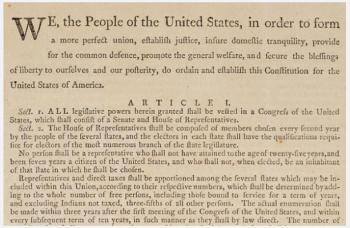
First printing of the U. S. Constitution (Philadelphia: Dunlap & Claypoole, 1787)
America has been singular among nations in fostering a vibrant culture of engagement with constitutional matters and the fundamental principles of government. Featuring 40 books and documents from collector and philanthropist Dorothy Tapper Goldman’s collection—including constitutions from the federal and state levels—Colonists, Citizens, Constitutions: Creating the American Republic depicts the story of America’s unique constitutionalism from the founding era through the turn of the 20th century. The exhibition, which sketches the often troubled history of the country as it expanded across the continent, serves as a timely reminder of our country’s democratic foundations and its relentless quest for improvement. Curated by James F. Hrdlicka of Arizona State University with Michael Ryan, vice president and Sue Ann Weinberg director of the Patricia D. Klingenstein Library.
2020 Mount Vernon Symposium
In May at Mount Vernon (it’s already sold out, but there is a wait list) . . .
‘Under my Vine & Fig Tree’: Gardens and Landscapes in the Age of Washington and Now
Mount Vernon, 29–31 May 2020
Join leading gardeners, historians, horticulturists, archaeologists, and preservationists as they reconsider the importance of gardening, landscapes, and design in early America. Learn how Washington and his contemporaries shaped the natural world to achieve beauty through gardening, profited through agriculture, and conveyed civic values through landscape design—and how these historic methods remain relevant in today’s world. Revisit long-lost gardens, explore contemporary creations inspired by the past, and come face-to-face with the most authentic 18th-century plantation landscape in the United States.
The Mount Vernon Symposium is endowed by the generous support of The Robert H. Smith Family Foundation, Lucy S. Rhame, and David Maxfield.
Exhibition | In Sparkling Company: Glass and Social Life

Pair of covered green vases, ca. 1765 and a pair of vases, 1750–75, probably from the workshop of James Giles, London, gilded copper-green lead glass (Corning, New York: Corning Museum of Glass, 2003.2.4 A-B, 54.2.4 A-B).
◊ ◊ ◊ ◊ ◊
Press release (30 October 2019) for the exhibition:
In Sparkling Company: Glass and the Costs of Social Life in Britain during the 1700s
Corning Museum of Glass, Corning, New York, 9 May 2020 — 3 January 2021; new dates: 22 May 2021 — 2 January 2022
Curated by Christopher Maxwell
The Museum’s spring exhibition, In Sparkling Company: Glass and Social Life in Britain during the 1700s, will open May 9, 2020. With exhibition design by Selldorf Architects, In Sparkling Company will present the glittering costume and jewelry, elaborate tableware, polished mirrors, and dazzling lighting devices that delighted the British elite, and helped define social rituals and cultural values of the period. Through a lens of glass, this exhibition will show visitors what it meant to be ‘modern’ in the 1700s, and what it cost.
The exhibition will also include a specially created virtual reality reconstruction of the remarkable and innovative spangled-glass drawing room completed in 1775 for Hugh Percy, 1st Duke of Northumberland (1714–1786), and designed by Robert Adam (1728–1792), one of the leading architects and designers in Britain at the time. An original section of the room (which was dismantled in the 1870s), on loan from the Victoria and Albert Museum in London, will be on view in North America for the first time as part of the exhibition. It will be accompanied by Adam’s original colored design drawings for the interior, on loan from the Sir John Soane’s Museum, London.
“One medium that is often overlooked in scholarly discussions of 18th-century art, design, and material culture is glass,” said Christopher L. Maxwell, Curator of European Glass at CMoG, who has organized the exhibition. “In Britain, developments in glass formulas and manufacturing techniques resulted in new and better types of glass, from windowpanes and mirrors to heavy, clear ‘crystal’ tableware, perfectly suited to the tastes and needs of Britain’s growing urban elite whose wealth derived from new enterprises in finance, manufacture, international trade and colonial expansion. In Sparkling Company will demonstrate the many functions and meanings of glass in the exuberant social life of the 1700s.”
The smooth, ‘polished’ and reflective properties of glass perfectly embodied 18th-century ideals of sociability, in what is considered by many as the ‘age of politeness.’ As urban centers grew in size and prosperity, sociability became ever more sophisticated. The terms ‘polite’ and ‘polished’ were often used interchangeably in the numerous etiquette manuals eagerly read by those wishing to take their place in the polite world. Examples of such literature will be displayed alongside fashionable glass of the period, including embroidered costume, mirrors, a chandelier, cut glass lighting and tableware, and paste jewelry that accessorized and defined the lives of the ‘polished’ elite.
In the 1700s Britain was a prosperous and commercial nation. Its growing cities were hubs of industry, scientific advancement, trade and finance, and its colonies were expanding. British merchants navigated the globe carrying a multitude of cargoes: consumable, material, and human. Underpinning Britain’s prosperity was a far-reaching economy of enslavement, the profits of which funded the pleasures and innovations of the fashionable world, among them luxury glass. Alongside the beauty and innovation of glass during this period, the exhibition will consider the role of the material as a witness to colonization and slavery. Using artifacts and documents relating to the slave trade, it will reveal a connection that permeated all levels of British society.
From glittering costume and elaborately presented confectionery, to polished mirrors and dazzling chandeliers, glass helped define the social rituals and cultural values of the period. While it delighted the eyes of the wealthy, glass also bore witness to the horrors of slavery. Glass beads were traded for human lives while elegant glass dishes, baskets and bowls held sweet delicacies made with sugar produced by enslaved labor.
In Sparkling Company: Glass and Social Life in Britain during the 1700s will include important examples of 18th-century British glass, including:
• Glass embroidered costume: a spectacular men’s coat intricately decorated with glass ‘jewels’ made around 1780; a pair of women’s shoes covered in glass beads; shoe buckles set with glass paste jewels; jewelry and other accessories.
• Cut glass lighting and tableware, all made possible through the perfection of British lead ‘crystal’ in the late 1600s and exported throughout Europe and the British colonies in America and beyond.
• A number of large mirrors, which became the tell-tale sign of a fashionable interior, and reverse-painted glass meticulously decorated in China for the British luxury market.
• Opulent glass dressing room accessories, including a magnificent gilded silver dressing table set, with a looking glass as its centerpiece, made in about 1700 for the 1st Countess of Portland; perfume bottles, patch boxes, a dazzling cut glass washing basin and pitcher and an exquisite blue glass casket richly mounted in gilded metal, used in the ‘toilette’ a semi-public ritual of dressing which was adopted from France for men and women alike and became a feature of British aristocratic life in the 18th century.

Robert Adam, Design for the end wall of the drawing room at Northumberland House, 1770–73, pen, pencil, and colored washes, including pink, verdigris, and Indian yellow on laid paper, 52 × 102 cm (London: Sir John Soane’s Museum, SM Adam, volume 39/7; photo by Ardon Bar Hama).
◊ ◊ ◊ ◊ ◊
Glass Drawing Room for the Duke of Northumberland
Over the course of the 18th century, domestic interiors were transformed by the increasing presence of clear and smooth plate glass. A remarkable example is the lavish drawing room designed by the celebrated British architect Robert Adam for Hugh Percy, 1st Duke of Northumberland (1714–1786) and his wife, the Duchess Elizabeth Percy (1716–1776), and completed in 1775. This unique room, measuring 36 by 22 feet, was paneled between dado rail and architrave with red glass panels sprinkled on the reverse with flakes of metal foil, like large-scale glitter. Similarly spangled green glass pilasters, large French looking glasses, and intricate neo-classical ornament in gilded lead completed the dazzling scheme. The room was altered in the 1820s and finally dismantled in the 1870s, when Northumberland House was demolished. Many of the panels were acquired by the V&A Museum in the 1950s, but their poor condition meant that they could only be partially displayed. The panels on display at The Corning Museum of Glass incorporate newly-conserved elements from the V&A’s stores.
In Sparkling Company will feature a virtual reality reconstruction of the drawing room, created by Irish production house Noho. Visitors to the exhibition will be transported into the interior, experiencing the original design scheme—last seen almost 200 years ago. This will be the first virtual-reality experience ever offered at CMoG. Visitors will also be able to see Robert Adam’s design drawings, on loan from the Sir John Soane’s Museum, London, and a section of the original Northumberland House Glass Drawing Room on loan from the V&A Museum, which has never been on view in North America.
In Sparkling Company: Glass and Social Life in Britain during the 1700s will include loans from the Victoria and Albert Museum; Sir John Soane’s Museum; the Museum of London; the Fashion Museum, Bath; Royal Museums Greenwich; Los Angeles County Museum of Art (LACMA); Penn State University Library; Cleveland Museum of Art; and The Museum of Fine Arts in Boston.
The exhibition is accompanied by a catalogue, In Sparkling Company: Reflections on Glass in the 18th-Century British World (The Corning Museum of Glass, 2020). Publication contributors include Marvin Bolt, Kimberly Chrisman Campbell, Jennifer Chuong, Melanie Doderer Winkler, Christopher Maxwell, Anna Moran, Marcia Pointon, and Kerry Sinanan.
◊ ◊ ◊ ◊ ◊
Note (added 2 May 2021) — The posting was updated with revised dates for the exhibition.
Note (added 16 September 2021) — The posting has been updated to include the revised title; the original title was In Sparkling Company: Glass and Social Life in Britain during the 1700s.
Conference | Reconsidering Chinese Reverse Glass Painting
This weekend in Switzerland at the Vitromusée Romont (via ArtHist.net), in conjunction with the exhibition Reflets de Chine: Three Centuries of Chinese Glass Painting:
China and the West: Reconsidering Chinese Reverse Glass Painting
Vitromusée Romont, 14–16 February 2020
Organized by Francine Giese, Hans Bjarne Thomsen, and Elisa Ambrosio
 F R I D A Y , 1 4 F E B R U A R Y 2 0 2 0
9.30 Welcome
9.45 Danielle Elisseeff (EHESS, Paris), Quelques remarques sur le concept d’hybridité
10.00 Transfer and Transmateriality
Chair: Francine Giese (Vitrocentre Romont)
• Jessica Lee Patterson (University of San Diego), Varieties of Replication in Chinese Reverse Glass Paintings
• Patrick Conner (London), Figures of Westerners in Early Chinese Reverse Glass Paintings
• Alina Martimyanova (University of Zurich), From Wooden Blocks to Glass: Regarding the Transfer of Vernacular Motives and Other Common Features of the Chinese New Year Prints and Chinese Reverse Glass Paintings
• Kee II Choi Jr. (University of Leiden), Originality among les arts du feu: Illusionistic Painting on Glass, Porcelain, and Copper in Early Modern Canton
12.30 Lunch break
14.00 Chinese Reverse Glass Paintings in European Collections
Chair: Hans Bjarne Thomsen (University of Zurich)
• Rosalien van der Poel (University of Leiden), 18th-Century Chinese Reverse Glass Paintings in a Dutch Collection: Art and Commodity
• Patricia Ferguson (London), Reflecting Asia: The Reception of Chinese Reverse Glass Paintings in Britain in the 18th Century
• Michaela Pejčochová (National Gallery Prague), ‘In all of Beijing, there are no more than four paintings on glass that would fall within our consideration’: European Collecting of Chinese Reverse Glass Paintings in the Inter-war Period and Its Contexts
15.30 Coffee break
16.00 Guided tour of the exhibition Reflets de Chine: Three Centuries of Chinese Glass Painting
17.30 Keynote Lecture
Chair: Danielle Elisseeff (EHESS, Paris)
• Thierry Audric (Vitrocentre Romont), Brève histoire de la peinture sous verre chinoise
18.30 Reception
S A T U R D A Y , 1 5 F E B R U A R Y 2 0 2 0
9.00 Beyond China
Chair: Elisa Ambrosio (Vitrocentre Romont)
• Hans Bjarne Thomsen (University of Zurich), Japanese Reverse Glass Painting: The Other East Asian Tradition
• William Hsingyo Ma (College of Art, Louisiana State University), Guangzhou-made Reverse Glass Paintings in Nguyen Dynasty Vietnam
• Karina Corrigan (Peabody Essex Museum, Salem, Massachusetts), From Oudh to Guangzhou: Tilly Kettle’s Portrait of Shuja-ud-Daula in Cantonese Reverse Glass Painting
• Catherine Raymond (Northern Illinois University), Reverse Glass Paintings in Mainland Southeast Asia and the Key Role of the Chinese Diaspora
• Jérôme Samuel (Inalco-Case, Paris), China and Its South: Chinese Ladies on Glass in 19th- and 20th-Century Java
12.00 Lunch break
13.30 Workshops and Techniques
Chair: Sophie Wolf (Vitrocentre Romont)
• Charlotte Pageot (ERIMIT- Université Rennes 2), Jean-Denis Attiret’s Reverse Glass Paintings at Qianlong Court Workshop
• Jan van Campen (Rijksmuseum, Amsterdam), Glass Paintings in the Collection of Andreas Everardus van Braam Houckgeest (1739–1801)
• Rupprecht Mayer (Germany), Painting Styles in 19th- and 20th-Century Chinese Glass Pictures: A First Approach
• Simon Steger (Bundesanstalt für Materialforschung und -prüfung (BAM), Berlin), Spectroscopic Analysis of Colourants and Binders of Chinese Reverse Glass Paintings: Tracing a Cultural Dialogue
15.30 Coffee break
16.00 Translucidity
Chair: Alina Martimyanova (University of Zurich)
• Lihong Liu (University of Rochester), From Virtuosity to Vernacularism: Reversals of Glass Paintings
• Christopher Maxwell (Corning Museum of Glass), People in Glass Houses: Plate Glass and Politeness in 18th-Century Britain
17.00 Hans Bjarne Thomsen (University of Zurich), Closing Remarks
S U N D A Y , 1 6 F E B R U A R Y 2 0 2 0
Optional morning with tours of the Vitromusée Romont and local historical sites of the town of Romont: Collégiale and Fille-Dieu.
CAA 2020, Chicago
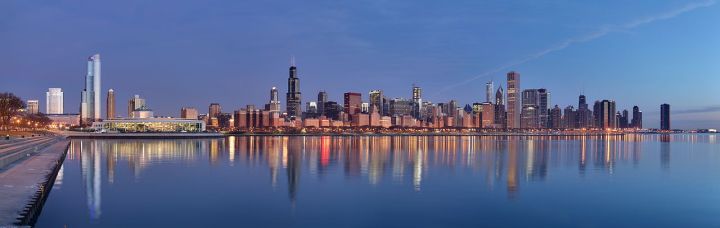
Photo by Daniel Schwen, 18 April 2009
(Wikimedia Commons)
◊ ◊ ◊ ◊ ◊
108th Annual Conference of the College Art Association
Hilton Chicago, 12–15 February 2020
The 2020 College Art Association conference takes place at the Hilton, Chicago (720 S. Michigan Ave), February 12–15. Of particular note is the ASECS session chaired by Kristin O’Rourke and the HECAA session chaired by Danielle Rebecca Ezor and Michael Feinberg. Both take place on Saturday. Other sessions that may be of interest for dixhuitièmistes are also listed. A full schedule of panels is available here»
A S E C S / H E C A A S E S S I O N S
American Society for Eighteenth-Century Studies
Rulers, Consorts, and Mothers: Queens in the Long Eighteenth Century
Saturday, 15 February, 8:30–10:00am, 3rd Floor – Joliet Room
Chair: Kristin M. O’Rourke, Dartmouth College
• The Colonial Adventures of a Queen Anne Miniature, Janine Yorimoto Boldt, American Philosophical Society
• Eighteenth-Century Saxon Consorts and Their Personal Relationships with Porcelain Manufactories in Europe, Heidi C. Nickisher, Rochester Institute of Technology
• ‘Femmes illustres’: The Defense of Queenship and the Public Woman in Revolutionary France, Sarah Elisabeth Lund, Harvard University
• Pose: Royal Bodies and Gendered Accoutrements in Eighteenth-Century Portraiture, Jodi Lynn McCoy, Missouri State University
◊ ◊ ◊ ◊ ◊
Historians of Eighteenth-Century Art and Architecture
Race Beyond the Human Body in the Long Eighteenth Century
Saturday, 15 February, 2:00–3:30, 3rd Floor – Joliet Room
Chairs: Danielle Rebecca Ezor, Southern Methodist University and Michael Feinberg, University of Wisconsin Madison
• ‘Color is only Skin Deep’: Black Pigs and the Rendering of Race in the Early American Republic, Stephen Mandravelis, University of Tennessee at Chattanooga
• The Whiteness Aesthetic and Caste Implications of Ivory Art of South India, Deepthi Murali, University of Illinois at Chicago
• White, Pink, and Pompadour, Oliver Wunsch, Boston College
◊ ◊ ◊ ◊ ◊
O T H E R S E S S I O N S R E L A T E D T O T H E 1 8 T H C E N T U R Y
Society for Paragone Studies
Session in Honor of Sarah Jordan Lippert (1975–2019), Founder of the Society for Paragone Studies
Wednesday, 12 February, 10:30–12:00, 3rd Floor – Waldorf Room
Chair: Liana De Girolami Cheney, Association for Textual Scholarship in Art History
• The Remarkable Tomb of Abbot Meli, Ellen Longsworth, Merrimack College
• Rival Ideologies in Eighteenth Century Exotic Costume, Linda Johnson
• Voice of Authority: Native American Art and Cultural Hegemony in the Art Museum, Mary Kelly
• Image/Text/Sound: The Role of Intermediality and Poeticity in Claes Oldenburg, Nadja Rottner
• Dematerializing Formalism: Lucy Lippard and John Chandler’s Conceptual Challenge to Clement Greenber, Owen Duffy
◊ ◊ ◊ ◊ ◊
Community College Professors of Art and Art History
Taking a New Look: Creating Change in the Studio and Art History Classrooms
Wednesday, 12 February, 2:00–3:30, Lobby Level – Continental B
Chairs: Susan Altman, Middlesex County College, and Monica Anke Hahn, Community College of Philadelphia
• Engaging Students through Narrative Painting, Richard J. Moninski, University of Wisconsin-Platteville
• Recruitment, Retention, and Relocation: The College Arts Fair, Tyrus Clutter, College for Central Florida
• Creative Collaboration for Art History and Studio Art Courses, Rachael Bower, Northwest Vista College
• Changing the Conversation: The Relevancy of Arts Thinking for 21st-Century Students, Ross McClain
◊ ◊ ◊ ◊ ◊
Barriers, Borders, and Boundaries in the Early Modern World
Thursday, 13 February, 8:30–10:00am, 3rd Floor – Wilford C
Chairs: Luis J. Gordo-Pelaez, California State University Fresno and Charles C. Barteet, University of Western Ontario
Discussant: Michael J. Schreffler, University of Notre Dame
• Bordering on Chaos: Order in the Inka Empire and the Virtues of Volatility, Gaby Greenlee, UCSC
• Columbus Unbound: Walls, or their Absence, in the Age/Imaginary of Exploration, Roger J. Crum, University of Dayton
• Picturing Havana: The Early Modern City in Plans and Maps, Guadalupe Garcia, Tulane University
• Ornament and Order in the Spanish Colonial Philippines, Lalaine Bangilan Little, Misericordia University
◊ ◊ ◊ ◊ ◊
Japan Art History Forum
Taking up the Mantle: Lineages and Genealogies in Japanese Art History
Thursday, 13 February, 8:30–10:00am, 4th Floor – 4K
Chairs: Sonia Coman, Smithsonian Institution and Harrison Schley, University of Pennsylvania
Discussant: Julie Davis, University of Pennsylvania
• The Cross-temporal Conversations of Matsumura Goshun (1752–1811): Lineages of Style in Poetry and Visual Representation, Sonia Coman, Smithsonian Institution
• The Power of Indirect Transmission and the Kōrin Hyakuzu (ca. 1815 and 1826), Frank Feltens, Smithsonian Institution
• A New Mold: Mori Yūsetsu and the Genealogy of the Banko Brand, Harrison Schley, University of Pennsylvania
• Futurism as Archaism: Kinoshita Shuichirō (1896–1991) Glorifies a Dancing Girl, Daria Melnikova, Columbia University
◊ ◊ ◊ ◊ ◊
Between Truth and Persuasion: Images and Historical Narration from the Sixteenth to the Nineteenth Century
Thursday, 13 February, 10:30–12:00, Lobby Level – Continental B
Chairs: Alessandra Di Croce, Columbia University and Federica Soletta, Princeton University
Discussant: Alessandro Giardino, Saint Lawrence University
• The Signal Liberties of Copley’s The Death of Major Peirson, Nika Elder, American University
• Historical Inducements and the Pictorial Crusade of Francesco Hayez, Laura Watts Sommer, Daemen College
• Stefano Bardini’s Photo Archive, ‘il Bel Paese,’ and the Golden Age of Tuscan Art, Anita Moskowitz
• The Engraved Photograph as Architectural Evidence, Peter Sealy, University of Toronto
◊ ◊ ◊ ◊ ◊
Politics, Religion, and the Body: Artistic Production, Consumption, and Social Space in China
Thursday, 13 February, 10:30–12:00, 3rd Floor – Joliet Room
• Seeing and Unseeing: Visuality and Mind Games in Ming- Dynasty Arhat Painting, Einor K Cervone, Los Angeles County Museum of Art
• Gao Fenghan’s (1683–1749) Path to Eccentricity and the Growth of Epigraphical Writing in Early Qing Yangzhou, Yun- Chen Lu
• Billiards, Bicycles, and Charity Fairs: Courtesans Staging the Fashionable in Public Gardens in Semi-colonial Shanghai (1880s–1910s), Jinyi Liu, Bard Graduate Center
• From Dalian to Changchun: Official Art Exhibitions in Japanese-Manchuria, Gina Kim, University of California, San Diego
◊ ◊ ◊ ◊ ◊
Black Artists in the Early Modern Americas
Thursday, 13 February, 2:00–3:30, 3rd Floor – Wilford C
Chair: Rachel A Zimmerman, Colorado State University – Pueblo
• ‘The Head of a Hogshead’: Neptune Thurston and Enslaved Artistic Labor in British North America, Jennifer C. Van Horn, University of Delaware
• José Campeche, the 1797 British Attack on San Juan, and Portraiture in late Eighteenth-Century Puerto Rico, Emily K. Thames, Florida State University
• Collecting Fears: Paper Amulets in Brazil’s Malê Uprising, Angie M. Epifano, Yale University
◊ ◊ ◊ ◊ ◊
Historians of British Art
Past & Present: Britain and the Social History of Art
Thursday, 13 February, 2:00–3:30, 4th Floor – 4K
Chairs: Meredith J. Gamer, Columbia University and Esther Alice Chadwick, Courtauld Institute of Art
• Pictures Exchanged for Windows: Ruskin, Dilke, and Social History of Symbols, Andrei Pop, University of Chicago
• Gerard Baldwin Brown and the Origins of the Social History of Art in Great Britain, Barbara J. Larson, University of West Florida
• ‘It was, like any other period, a time of transition’: 1970s Britain and the ‘Native Art-Historical Journal’, Samuel Bibby, Association for Art History
• Islands of Art History, Douglas R. Fordham, University of Virginia
◊ ◊ ◊ ◊ ◊
International Art Market Studies
Market Data: Beyond Prices and Provenance
Thursday, 13 February, 2:00–3:30, 8th Floor – Lake Erie
Chairs: Diana Seave Greenwald, Isabella Stewart Gardner Museum and Kim Oosterlinck, Université libre de Bruxelles
• What To Say When Trying To Sell Paintings: Text Models and Rhetoric Strategies in British and French Auction Sales Catalogues (1750–1820), Sandra Van Ginhoven, Getty Research Institute
• What To Say When Trying To Sell Paintings: Text Models and Rhetoric Strategies in British and French Auction Sales Catalogues (1750–1820), Matthew Lincoln, Carnegie Mellon University
• The (R)emigration of Jewish Art Dealers and the Shape of the German Art Market Scene: Approaching a Difficult Topic, Meike Hopp, ZI Munich
• Subversion in the Fine Print: ‘The Artist’s Reserved Rights Transfer and Sale Agreement’ at Auction, Lauren van Haaften-Schick, Cornell University
• Conflict, Looting, and the Market in Mesopotamian Antiquities, Oya Topçuoğlu, Northwestern University
◊ ◊ ◊ ◊ ◊
Committee on Intellectual Property
Defining Open Access
Thursday, 13 February, 4:00–5:30, Lobby Level – Continental A
Chair: Anne Collins Goodyear
• What Open Access Principles Do We Need for Cultural Heritage?, Evelin Heidel, Independent
• How Open is Open Enough? Rationalizing Open Access at the Project Level, Mikka Gee Conway, J. Paul Getty Trust
• Two Sides of the Same Coin? Open Access and Fair Use, Anne M. Young, Indianapolis Museum of Art at Newfields
• Case Study: The Art and Architectural ePortal, Patricia J. Fidler, Yale University Press
• Sharing Digital Content through International Museum, Library, and Archives Networks Today: An IMLS Examination of Copyright’s Implications, Nancy Elaine Weiss, Institute of Museum and Library Services
◊ ◊ ◊ ◊ ◊
Shifting Tides: Visual Semantics in the Atlantic World, 1600–1900
Thursday, 13 February, 6:00–7:30pm, 3rd Floor – Williford A
• Cicero in the Land of Coatlicue: Renaissance Humanism in Colonial Mexico, JoAnna Reyes Walton, University of California, Los Angeles
• Dyer Beware: Processing Indigo and the Limits of Diagram, Colleen M. Stockmann
• Visual Histories of the Spanish Caribbean in the Age of the Enlightenment, Jennifer A Baez, Florida State University
• Potted Pre-Raphaelites: Britain’s Colonial Plant Trade and the Victorian Avant-Garde, Lindsay Wells, University of Wisconsin-Madison
◊ ◊ ◊ ◊ ◊
Altered Terrains: Landscapes of Colonial America
Friday, 14 February, 8:30–10:00am, Lower Level – Salon C5
Chairs: Theresa Avila, CSU Channel Islands and Emmanuel Ortega, University of New Mexico
Discussant: Kirsten P. Buick, The University of New Mexico
• Social and Political Landscapes within European Colonial Maps, Theresa Avila, CSU Channel Islands
• The Invisible-Substantial-Presence of Painted Landscapes in Seventeenth-Century Cuzco, Natalia Vargas Márquez, University of Minnesota
• Decolonizing Aeriality in Colonial El Salvador: Indigenous Geospatial Knowledge in the “Descripcion Geografico-Moral de la Diocesis de Goathemala,” 1768–70, Carlos Anílber Rivas, University of Los Angeles
• The Mexican Picturesque: Nineteenth-Century Sentimentality and the Visual Construction of the Nation, Emmanuel Ortega, University of New Mexico
◊ ◊ ◊ ◊ ◊
Undergraduate Research and Mentoring Undergraduate Research – Poster Presentations, Part 2
Friday, 14 February, 2:00–3:30, Lower Level Lobby
Chair: Alexa K. Sand, Utah State University
• At the Pleasure of the Pharaoh: Decoding the Reliefs of the Medinet Habu Eastern High Gate, Chloe Jayne Landis
• The Case of Der hammer: Aesthetic Influences on Art and Culture in the Yiddish Communist Press, Goldie Gross
• Mapping Social and Spatial Encounters in Eighteenth-Century Venice, Noah Scott Michaud, Wired! Lab . . .
◊ ◊ ◊ ◊ ◊
Society for the Study of Early Modern Women and Gender
Early Modern Women in the Streets? Women’s Visibility in the Public Sphere
Friday, 14 February, 2:00–3:30, Lower Level – Salon C5
Chair: Maria F. Maurer, University of Tulsa
• Bitter Tears, Carnal Traces: Female Poets at Michelangelo’s Funeral, Laura C. Agoston, Trinity University
• Visibility and Enclosure in the Vida of the Painter and Nun, Estefanía de la Encarnación (ca. 1597–1665), Tanya J. Tiffany, University of Wisconsin-Milwaukee
• Asserting Female Agency in the Spanish Colonies: Doña Rosalía de Medina and the Confraternity of Saint Rosalía in Eighteenth-Century Cuenca, Isabel Oleas-Mogollon, Independent
◊ ◊ ◊ ◊ ◊
Objects from Elsewhere: Transcultural Constructions of Identity
Saturday, 15 February, 8:30–10:00am, 3rd Floor – Private Dining Room 2
Chairs: Robert Wellington and Alex Thomas Burchmore, Australian National University
• Between Imperial Self-Fashioning and Military Alliance: The Gift of a Turquoise Glass Bowl from Persia to the Republic of Venice, Negar Sarah Rokhgar, Rutgers University
• Art and Science in the Palace of the Empress Dowager: An Investigation of the Ningshou Gong Display Archives from the Kangxi Reign (1661–1722), Joyce Yusi Zhou, Bard Graduate Center
• Framing Self/Other Relations through Curatorial Strategies of Containment and Classification in Eighteenth-Century Porcelain Display, Alex Thomas Burchmore, Australian National University
◊ ◊ ◊ ◊ ◊
Sensual Texts, Material Histories: Language in the Long Eighteenth Century
Saturday, 15 February, 10:30–12:00, 3rd Floor – Joliet Room
Chair: Elizabeth Bacon Eager, Southern Methodist University
• Composing Type, Throwing Pigments: The Revolutionary Potential of Marbling in Early America, Jennifer Chuong
• Giambattista Bodoni’s Abstract Types: The Role of ‘Exotic’ Writing Systems, Craig D. Eliason, University of St. Thomas
• Making and Writing the Romain du Roi Typeface, Sarah Simpson Grandin, Harvard University
• Worshiping Myriad Gods for Longevity: Carved Lacquer Boxes with the Qianlong Emperor’s Religious Pantheons and Scripture Offerings, Zhenpeng Zhan, Sun Yat-sen University
◊ ◊ ◊ ◊ ◊
The Fragmented Self: Objects from Elsewhere and the Search for New Identities
Saturday, 15 February, 10:30–12:00, 3rd Floor – Private Dining Room 2
Chairs: Robert Wellington, Australian National University, and Alex Thomas Burchmore, Australian National University
• Carlos Villa: Trans-Pacific Imaginaries in Filipino American Art, Margo L. Machida, University of Connecticut
• From Modernism to Transculturalism: Reclaiming African Sculptures as Found Objects in Contemporary Art, Lisa S. Wainwright, School of the Art Institute of Chicago
• ‘Connected and Interwoven’: Transculturality and the Performance of Identity in the Mughal Court of Awadh, Monica Anke Hahn, Community College of Philadelphia
• The ‘Cosey Corner’: The American New Woman’s Exotic Imaginary, Sarah Wheat, University of Michigan
◊ ◊ ◊ ◊ ◊
Seeking Narrative Justice: Idiosyncrasies and Contradictions of Black Body Representation
Saturday, 15 February, 4:00–5:30, Lower Level – Salon C6
• Aesthetics of Abolition in Late Eighteenth-Century England, Alyssa M Fridgen, Independent
• Tethering the Flag: Visual Aesthetics of Black Citizenship in the U.S., Nnaemeka Ekwelum, Northwestern University
• Becoming (Un)Masked: Semiotics of Identification in Nick Cave’s Hye-Dyve (2017), Cristina Albu, University of Missouri-Kansas City
New Book | Mural Painting in Britain, 1630–1730
Forthcoming from Routledge:
Lydia Hamlett, Mural Painting in Britain 1630–1730: Experiencing Histories (London: Routledge, 2020), 184 pages, ISBN: 978-1138205833, £120 / $155.
 This book illuminates the original meanings of seventeenth- and early eighteenth-century mural paintings in Britain. At the time, these were called ‘histories’. Throughout the eighteenth century, though, the term became directly associated with easel painting and, as ‘history painting’ achieved the status of a sublime genre, any link with painted architectural interiors was lost. Whilst both genres contained historical figures and narratives, it was the ways of viewing them that differed. Lydia Hamlett emphasises the way that mural paintings were experienced by spectators within their architectural settings. New iconographical interpretations and theories of effect and affect are considered an important part of their wider historical, cultural, and social contexts.
Lydia Hamlett is Academic Director in Visual Culture at the Institute of Continuing Education, University of Cambridge, and a Fellow of Murray Edwards College.
C O N T E N T S
Introduction: Re-experiencing British Murals
1 Animating Histories
2 Triumph and Return: Bringing the Gods onto Man’s Stage
3 Murals and Metamorphoses
4 Poetry, Painting, and Politics: The Early 1700s
5 The Frenzied Age of Mural Painting
Conclusion: Defining Mural Painting as a Genre










 Enfilade
leave a comment