Online Conference | Hayley2020
From The Fitzwilliam:
Hayley2020: A Fitzwilliam Museum Conference
Online, 12–13 November 2020

George Romney, John Flaxman Modeling the Bust of William Hayley, 1795–96, oil on canvas, 89 × 57 inches (New Haven: Yale Center for British Art, Paul Mellon Collection, B1981.25.538).
Convened to mark the bicentenary of his death, Hayley2020 is the first ever conference dedicated to writer, scholar, and amateur doctor William Hayley (1745–1820). Hugely influential in his time, Hayley is now mostly remembered for persuading William Blake to move to the Sussex coast, commissioning illustrations and prints from him, and driving him to distraction. But there is much more to the man who wrote (in verse) a runaway bestseller advising young women on how to attract and keep a husband, refused the poet laureateship for political reasons, and was the first person to publish an English translation of a long extract from Dante’s Inferno. Join us online on November 12 and 13 for a series of presentations and discussions about Hayley and his world (listed times are GMT). All are welcome.
T H U R S D A Y , 1 2 N O V E M B E R 2 0 2 0
14.45 Welcome
Suzanne Reynolds, Lisa Gee, Naomi Billingsley, and Mark Crosby welcome you to virtual Eartham, but promise not to write you an adulatory sonnet.
15.00 On Romney, His Relationship with Hayley, and Works Arising
Alex Kidson talks about how Romney and Hayley’s relationship changed over the years, discussing works including the Cupid and Psyche cartoons, Flaxman Modelling the Bust of Hayley, and Romney’s illustrations for Hayley’s Essay on Old Maids (series of short videos). Parallel discussion in the chat with Alex present, followed by discussion. Video available for viewing beforehand and afterwards.
15.40 Coffee Break
You’ll have to bring your own hot beverage, but feel free to hang out, catch up with friends, and network like it’s 1795 in Hayley’s Library.
16.05 Hayley in His Contexts
Lisa Gee: Hayley – Essay on Sculpture, Mary Cockerell & the decline & death of Tom.; Alexandra Harris; Susan Matthews: Amina Wright: ‘Artist and Bard in Sweet Alliance: Joseph Wright of Derby and the Hermit of Eartham.’. Chaired by Mark Crosby.
16.45 Tea Break
17.00 Object-Oriented Session
Demo/test of the AMoR (A Museum of Relationships) pilot + discussion, with Lisa Gee and Suzanne Reynolds.
17.40 Plenary Discussions
F R I D A Y , 1 3 N O V E M B E R 2 0 2 0
13.00 Virtual Conference Picnic
Find us in the windswept (virtual) grounds of Eartham where, because it’s mid-November, we’re happy this is online rather than IRL.
15.00 On Hayley, Flaxman, and Blake
David Bindman discusses the memorials on which Flaxman and Hayley collaborated, one that Hayley tried to interfere in, and explains why Hayley’s relationship with Blake was so different to those with Flaxman and Romney.
15.40 Coffee Break
16.05 Hayley and Blake
Mark Crosby, Sarah Haggarty, Jason Whittaker: Hayley in Blake biographies. Chaired by Naomi Billingsley.
16.40 Tea Break
17.05 Future Scholarship
New collaborations, action planning. Chaired by Lisa Gee.
17.50 Concluding Remarks
New Book | Building America: The Life of Benjamin Henry Latrobe
From Oxford UP:
Jean Baker, Building America: The Life of Benjamin Henry Latrobe (Oxford: Oxford University Press, 2020), 304 pages, ISBN: 978-0190696450, $35.
 Building America: The Life of Benjamin Henry Latrobe is a biography of America’s first professionally trained architect and engineer. Born in 1764, Latrobe was raised in Moravian communities in England and Germany. His parents expected him to follow his father and brother into the ministry, but he rebelled against the church. Moved to London, he studied architecture and engineering. In 1795 he emigrated to the United States and became part of the period’s Transatlantic Exchange. Latrobe soon was famous for his neoclassical architecture, designing important buildings, including the US Capitol and Baltimore Basilica as well as private homes. Carpenters and millwrights who built structures more cheaply and less permanently than Latrobe challenged his efforts to establish architecture as a profession. Rarely during his twenty-five years in the United States was he financially secure, and when he was, he speculated on risky ventures that lost money. He declared bankruptcy in 1817 and moved to New Orleans, the sixth American city that he lived in, hoping to recoup his finances by installing a municipal water system. He died there of yellow fever in 1820. The themes that emerge in this biography are the critical role Latrobe played in the culture of the early republic through his buildings and his genius in neoclassical design. Like the nation’s political founders, Latrobe was committed to creating an exceptional nation, expressed in his case by buildings and internal improvements. Additionally, given the extensive primary sources available for this biography, an examination of his life reveals early American attitudes toward class, family, and religion.
Jean H. Baker is Bennett-Harwood Professor of History Emerita at Goucher College. An eminent political historian and biographer, she is the author of Margaret Sanger: A Life of Passion, Sisters: The Lives of America’s Suffragists, James Buchanan, and Mary Todd Lincoln: A Biography, among other titles.
C O N T E N T S
Acknowledgments
Introduction
1 Itching Ears
2 This New American
3 Capital Projects
4 Beloved Mary and the Little Folks
5 Breaking Points
6 Final Beginnings
Conclusion
Notes
Index
Fellowships | Tyson Scholars in American Art, 2021–22

From Crystal Bridges:
Tyson Scholars Program: Fellowships in American Art
Crystal Bridges Museum of American Art, Bentonville, Arkansas, 2021–22
Applications due by 15 January 2021
The Tyson Scholars of American Art Program supports full-time scholarship and an expansive approach to American art and visual and material culture from the colonial period to the present. The program was established in 2012 through a $5 million commitment from the Tyson family and Tyson Foods, Inc. Since its inception, the Tyson Scholars Program has supported the work of 46 scholars, attracting academic professionals in a variety of disciplines nationally and internationally.
Crystal Bridges and the Tyson Scholars Program invites PhD candidates (or equivalent), post-doctoral researchers and senior scholars from any field who are researching American art to apply. We encourage and support scholarship that seeks to expand boundaries and traditional categories of investigation into American art and visual culture. Applicants may be focusing on art history, architecture, visual and material culture, American studies, craft, Indigenous art, Latin American art, and contemporary art. Applications will be evaluated on the originality and quality of the proposed research project and its contribution to a more equitable and inclusive history of American art.
The Tyson Scholars Program looks for research projects that will intersect meaningfully with the Museum’s collections, library resources, architecture, grounds, curatorial expertise, programs and exhibitions; and/or the University of Arkansas faculty broadly; and applicants should speak to why residence in the Heartland will advance their work. The applicant’s academic standing, scholarly qualifications, and experience will be considered, as it informs the ability of the applicant to complete the proposed project. Letters of support are strongest when they demonstrate the applicant’s excellence, promise, originality, track record, and productivity as a scholar, not when the letter contains a commentary on the project.
Crystal Bridges is dedicated to an equitable, inclusive, and diverse cohort of fellows. We seek applicants who bring a critical perspective and understanding of the experiences of groups historically underrepresented in American art, and welcome applications from qualified persons of color; who are Indigenous; with disabilities; who are LGBTQ; first-generation college graduates; from low-income households; and who are veterans.
Fellowships are residential and support full-time writing and research for terms that range from six weeks to nine months. While in residence, Tyson Scholars have access to the art and library collections of Crystal Bridges as well as the library at the University of Arkansas in nearby Fayetteville. Stipends vary depending on the duration of residency, position as senior scholar, post-doctoral scholar or pre-doctoral scholar, and range from $15,000 to $30,000 per semester, plus provided housing. Additional funds of $1,500 for relocation are provided, and research funds are available during the residency upon application. Scholars are housed at one of the Crystal Bridges residences, within easy walking distance from the Museum via wooded trails and approximately 1.5 miles from downtown Bentonville. Scholars have private bed and bathrooms in the house, and share comfortable indoor and outdoor common spaces including an expansive yard and patio. Scholars are provided workspace in the curatorial wing of Crystal Bridges’ library. The workspace is an enclosed area shared with other Tyson Scholars. Scholars are provided with basic office supplies, desk space, an office chair, space on a bookshelf, and a locking cabinet with key for personal belongings and files.
Further information about the Tyson Scholars Program, application instructions, and application portal can be found here. Applications for the 2021-2022 academic year open October 19, 2020 and close January 15, 2021.
New Book | The Man of the People
From UP of Kansas:
Nathaniel Green, The Man of the People: Political Dissent and the Making of the American Presidency (Lawrence: University Press of Kansas: 2020), 408 pages, ISBN: 978-0700629954, $50.
 Donald Trump’s election has forced the United States to reckon with not only the political power of the presidency, but also how he and his supporters have used the office to advance their shared vision of America: one that is avowedly nationalist, and unrepentantly rooted in nativism and white supremacy. It might be easy to attribute this dark vision, and the presidency’s immense power to reflect and reinforce it, to the singular character of one particular president—but to do so, this book tells us, would be to ignore the critical role the American public played in making the president ‘the man of the people’ in the nation’s earliest decades.
Beginning with the public debate over whether to ratify the Constitution in 1787 and concluding with Andrew Jackson’s own contentious presidency, Nathaniel Green traces the origins of our conception of the president as the ultimate American: the exemplar of our collective national values, morals, and ‘character’. The public divisiveness over the presidency in these earliest years, he contends, forged the office into an incomparable symbol of an emerging American nationalism that cast white Americans as dissenters—lovers of liberty who were willing to mobilize against tyranny in all its forms, from foreign governments to black ‘enemies’ and Indian ‘savages’—even as it fomented partisan division that belied the promise of unity the presidency symbolized. With testimony from private letters, diaries, newspapers, and bills, Green documents the shaping of the disturbingly nationalistic vision that has given the presidency its symbolic power.
This argument is about a different time than our own. And yet it shows how this time, so often revered as a mythic ‘founding era’ from which America has precipitously declined, was in fact the birthplace of the president-centered nationalism that still defines the contours of politics to this day. The lessons of The Man of the People contextualize the political turmoil surrounding the presidency today. Never in modern US history have those lessons been more badly needed.
Nathaniel C. Green is professor of history at Northern Virginia Community College.
New Book | Aristocratic Education
From UNC Press:
Mark Boonshoft, Aristocratic Education and the Making of the American Republic (Chapel Hill: The University of North Carolina Press, 2020), 296 pages, ISBN: 978-1-469659541 (ebook), $23 / ISBN: 978-1469661360 (paperback), $30 / ISBN: 978-1469659534 (hardcover), $95.
 Following the American Revolution, it was a cliché that the new republic’s future depended on widespread, informed citizenship. However, instead of immediately creating the common schools–accessible, elementary education—that seemed necessary to create such a citizenry, the Federalists in power founded one of the most ubiquitous but forgotten institutions of early American life: academies, privately run but state-chartered secondary schools that offered European-style education primarily for elites. By 1800, academies had become the most widely incorporated institutions besides churches and transportation projects in nearly every state.
In this book, Mark Boonshoft shows how many Americans saw the academy as a caricature of aristocratic European education and how their political reaction against the academy led to a first era of school reform in the United States, helping transform education from a tool of elite privilege into a key component of self-government. And yet the very anti-aristocratic critique that propelled democratic education was conspicuously silent on the persistence of racial and gender inequality in public schooling. By tracing the history of academies in the revolutionary era, Boonshoft offers a new understanding of political power and the origins of public education and segregation in the United States.
Mark Boonshoft is assistant professor of history at Duquesne University.
C O N T E N T S
List of Figure and Tables
Acknowledgments
Introduction: Why Academies?: Aristocratic Education in Revolutionary America
Part I. From Denominational Schools to Nationalist Institutions, 1730–1787
1 The Emergence of Academies: The Great Awakening and Colonial Elite Formation
2 The Academy Effect: Civic Education and the American Revolution
3 Rebuilding Academies: Education and Politics in the Confederation Era
Part II. The Culture of Academies, 1780–1800
4 Defining Merit: Academies and Inequality
5 Diplomacy and Dance: The Geopolitics of Ornamental Education
Part III. From Aristocratic Education to Reform, 1787–1830
6 Creating Consensus: The Politics of State Support for Academies
7 The First Era of School Reform: War, Panic, and Popular Education
Epilogue: The Legacy of Aristocratic Education
Appendix
Notes
Bibliography
HECAA Emerging Scholars Showcase

George Lambert, Classical Landscape, 1745, oil on canvas, 41 × 46 inches
(London: Tate)
◊ ◊ ◊ ◊ ◊
HECAA Emerging Scholars Showcase
Online, Saturday, 7 November 2020, 2:00–3:30pm (EST)
Please mark your calendars for the first HECAA Emerging Scholars Showcase on Saturday, November 7, from 2:00 to 3:30pm EST. We will hear from our first seven emerging scholars present their research in 3– to 5–minute presentations, after which we will open up the floor to questions and comments. The intention of these showcases is to create networking opportunities, and we look forward to your audience participation in support of our emerging scholars.
We received an overwhelming number of applications, ranging geographically from China, India, and Australia, to Brazil, Europe, and across the USA. The topics likewise range in their geographical origin, theoretical approach, materials, techniques, and methods. We will also hold two additional showcases on 6 February 2021 and 17 April 2021.
Registration is not required. A Zoom link will be sent out to all HECAA members the week before November 7. If you have any questions or concerns, please contact Dani Ezor (dezor@smu.edu). Thank you!
Print Quarterly, September 2020

Johann Jakob Mettenleiter, Double Portrait of Johann Elias Haid and Johann Jakob Mettenleiter, ca. 1778–84, oil on copper, 31 × 38 cm (image courtesy Boris Wilnitsky Fine Arts, Vienna).
◊ ◊ ◊ ◊ ◊
The eighteenth-century in the latest issue of Print Quarterly (with apologies for being so slow! -Craig).
Print Quarterly 37.3 (September 2020)
A R T I C L E S
Julie Mellby, “Audubon’s Copperplates for Birds of America”, pp. 283–93.
After a brief introduction to John James Audubon’s (1785–1851) life and the publication history of his famous Birds of America, this article explores the afterlife of the copperplates. Partly damaged during a fire and later sold as used copper, some of these objects were eventually acquired and restored by William E. Dodge II (1832–1903). Their history interestingly overlaps with the history of important American institutions, such as the Metropolitan Museum of Art and the Princeton University Art Museum.
Marianne A. Yule, “A Friendship Portrait of J. J. Mettenleiter and J. E. Haid”, pp. 294–99.
This piece focuses on a newly discovered painting and its related mezzotint, the only known collaborative work between the printmaker John Elias Haid (1739–1809) and the painter Johann Jakob Mettenleiter (1750–1825). It explores the history of the image and identifies all the prints depicted therein.
N O T E S A N D R E V I E W S
Peter Van Der Coelen, Review of Henk van Nierop, The Life of Romeyn de Hooghe 1645–1708: Prints, Pamphlets, and Politics in the Dutch Golden Age (2018), pp. 314–16.
The note, as the book it reviews, sheds light on the lesser known, yet extremely prolific Romeyn de Hooghe (1645–1708), a printmaker operating between the Netherlands and Paris. His prints depict the political events of the day, such as the French invasion of Holland, as well as fashionable pastimes, as exemplified by his illustrations for a treatise on wrestling. De Hooghe’s life and work attest to the rising dominance of France all over Europe in the age of Louis XIV, both politically and artistically.
Domenico Pino, Review of Xavier F. Salomon, Andrea Tomezzoli and Denis Ton, Tiepolo in Milan: The Lost Frescoes of Palazzo Archinto (2019), pp. 319–21.
The catalogue under review reconstructs a cycle of frescoes commissioned for an aristocratic Milanese palace and destroyed during World War II. The note focuses on one chapter in particular, analysing Giambattista Tiepolo’s (1697–1770) early career as a book illustrator in Verona and Milan in the 1720s and ’30s, reading it in the context of the cultural fervour that spread all over Italy following the war of Spanish succession.
Domenico Pino, Review of Canaletto & Venezia (2019), pp. 321–22.
The note offers an overview of eighteenth-century Venice and the cultural fervour it hosted. The exhibition catalogue explores in detail the artistic career of Canaletto (1697–1768), Giambattista Tiepolo (1697–1770) and Giambattista Piazzetta (1682–1754), and discusses the developments of artistic trends in furniture, glass, porcelain and architecture in Venice throughout the century up to the fall of the Republic in 1797.
Elizabeth Rudy, Review of Aude Prigot, La Réception de Rembrandt à traversles estampes en France au XVIIIe siècle (2018), pp. 322–25.
The note explores the impact Rembrandt had on artists from the eighteenth through to the twenty-first century. In particular it focuses on the practice of collecting his prints in eighteenth-century France and that of copying his composition in the later part of the century. The main case studies are five French artists, among them Claude-Henri Watelet (1718–86) and Dominique Vivant-Denon (1747–1825).
New Book | Where Caciques and Mapmakers Met
From UNC Press:
Jeffrey Alan Erbig, Where Caciques and Mapmakers Met: Border Making in Eighteenth-Century South America (Chapel Hill: The University of North Carolina Press, 2020), 280 pages, ISBN: 978-1469655055 (ebook), $20 / ISBN: 978-1469655048 (paperback), $25 / ISBN: 978-1469655031 (hardcover), $90.
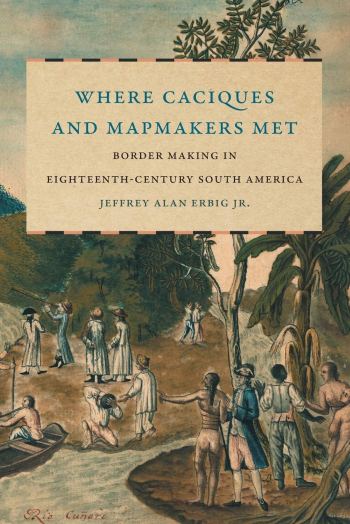 During the late eighteenth century, Portugal and Spain sent joint mapping expeditions to draw a nearly 10,000-mile border between Brazil and Spanish South America. These boundary commissions were the largest ever sent to the Americas and coincided with broader imperial reforms enacted throughout the hemisphere. Where Caciques and Mapmakers Met considers what these efforts meant to Indigenous peoples whose lands the border crossed. Moving beyond common frameworks that assess mapped borders strictly via colonial law or Native sovereignty, it examines the interplay between imperial and Indigenous spatial imaginaries. What results is an intricate spatial history of border making in southeastern South America (present-day Argentina, Brazil, and Uruguay) with global implications.
Drawing upon manuscripts from over two dozen archives in seven countries, Jeffrey Erbig traces on-the-ground interactions between Ibero-American colonists, Jesuit and Guaraní mission-dwellers, and autonomous Indigenous peoples as they responded to ever-changing notions of territorial possession. It reveals that Native agents shaped when and where the border was drawn, and fused it to their own territorial claims. While mapmakers’ assertions of Indigenous disappearance or subjugation shaped historiographical imaginations thereafter, Erbig reveals that the formation of a border was contingent upon Native engagement and authority.
Published with support provided by the William P. Clements Center for Southwest Studies at Southern Methodist University in Dallas, Texas.
Jeffrey Alan Erbig Jr. is assistant professor of Latin American and Latino studies at the University of California, Santa Cruz.
C O N T E N T S
List of Figures, Maps, and Tables
Acknowledgments
Abbreviations
Introduction
1 An Archipelago of Settlements and Tolderías
2 Projecting Possession
3 Mapping the Tolderías’ Mansion
4 Simultaneous Sovereignties
5 Where the Lines End
Conclusion
Notes
Bibliography
Call for Essays | Academic Research and the Contemporary Museum
From the Call for Articles:
Academic Research and the Contemporary Museum (working title)
Collection of essays edited by Dr Nicola Pickering, to be published by Routledge
Proposals due by 30 November 2020
This publication intends to re-establish the importance of focused and supported academic object-based research in museum practice and encourage a more robust debate within the museums sector surrounding the requirement and benefits of this work. It aims to reveal how new and creative academic research can be of value to audience-focused outcomes and public engagement work in museums, something that has not received the attention it should have up to now.
In this publication ‘academic research’ will be considered as activity of a scholarly nature, involving in- depth study of museum objects, drawing heavily on the examination of primary and secondary sources, and undertaken by subject-specialists using methodologies drawn from academic disciplines. This book will offer a unique opportunity for readers to see how new academic research can successfully inform visitor-centred practices in museums, and public outcomes for non-specialists, rather than remain the preserve of elitist curators and be produced for limited and privileged audiences.
This book will contain case studies that highlight the value of skilfully and appropriately transferring and translating academic research into public-facing projects and outcomes in the museums sector. Sympathetically integrated into public interpretation and education projects, and astutely linked to contemporary issues, new object-focused and audience-focused academic research can assist in widening access and participation and contribute to museum work in areas such as wellbeing, accessibility, social justice and sustainable funding. Thus, it can complement and bolster visitor-centred approaches, rather than work in opposition to them. It is hoped that the case studies collected in this volume will show that primary research and object-based scholarship in curatorial practice, which focuses on the needs of audiences, as well as collaborations with academics and academic organisations, can enhance the public impact and wider appeal of museums.
Case studies that feature examples of object-focussed research drawing on alternative theories (for example post-colonial, feminist, critical race, post-human and environmental theories) will highlight how museums can reinterpret objects from multiple and new perspectives. This might then show how new, or a wider range of, audiences may then be engaged in the work of the museum through the curatorial, learning, engagement and community projects that draw on this fresh research. Such activity can assist in widening access and participation and contribute to museum work in areas such as wellbeing, accessibility, social justice and sustainable funding.
Case Studies Sought
Case studies—each approximately 5,000-6,000 words—of successful and innovative methodologies, practices and projects in which new and creative academic object-based research has been employed to enhance public-facing outcomes are sought for this publication.
This book aims to discuss the controversies and extend the current debate regarding curatorial approaches. Thus, case studies should discuss new ways of thinking about the role of content specialists or expertise and academic research in museums, and highlight new and creative uses of academic research in collections-based projects. Case studies might be examples of innovative and imaginative undertakings, methodologies and practices, those highlighting the value of transferring and translating academic research into public-facing projects and outcomes in the museums and heritage sector. The case studies will come together to show why this is so important, how to approach such activities, and the benefits of pursuing such projects.
The case studies should help to show how new, or a wider range of, audiences may then be engaged in the work of the museum through the curatorial, learning, engagement and community projects that draw on this fresh research. If possible, the benefits of primary research and content-focussed scholarship to successful measurable outcomes (increased visitor numbers, greater visitor engagement, raised income through commercial activities, sponsorship or grant awards, changes in diversity of audiences) should be highlighted in the case studies.
Case studies that contribute to the current debate surrounding curatorial practice, museum management and public engagement will be positively received.
The necessity of strong partnerships and interdisciplinary working might be highlighted: successful case studies in which academic staff have worked alongside museum staff to achieve innovative outcomes are sought. In doing so it is hoped this publication will assist in showing how scholarly research can be made accessible to the general public in an effective way, and help museum professionals, academics and students to see how this might be done well. Potential ways that external partnerships and internal expertise within museum and heritage organisations might be developed and maintained could be discussed in the case studies.
We are seeking case studies from any country, from a variety of types of museum (national, trust/charity, independent, local authority, university), and it is hoped they will feature a range of collection objects, subject matters, spaces, locations and budgets. Examples from museums outside of the UK and those that have an international dimension or show engagement with source communities from around the world are actively sought.
Your case study must fall into one of the following five categories:
o University museums and academic partnerships with museums.
o Public–privatepartnerships.
o Untold stories (e.g. gender and sexuality / under-represented, disenfranchised and marginalised groups / post-colonial interpretation).
o Retold stores and contemporary issues (e.g. community stories, lost and forgotten stories, audience interest reinvigorated).
o Difficult spaces and projects undertaken on small and restricted budgets (e.g. at local authority museums, independent museums).
The case study chapters will be presented thematically, examining specific research themes as outlined above. The case studies will combine to show the variety of primary, object-focused and academic research that is being undertaken in museums in projects that have visitor-focused outcomes.
Required
• Summary of your proposed contribution (no more than one side of A4).
• A list of any suggested illustrations, tables etc.
• Author CV (and list of previous published material if applicable).
MuseumResearchContributions@gmail.com
Deadline
Midday on Monday, 30th November 2020.
More information is available here.
.
Public Lecture Course | Ceramics in Britain
The series, originally scheduled for the spring, will now take place online; from the Mellon Centre:
Public Lecture Course, Ceramics in Britain, 1750 to Now
Online, Paul Mellon Centre for Studies in British Art, London, Thursdays, 5 November — 10 December 2020
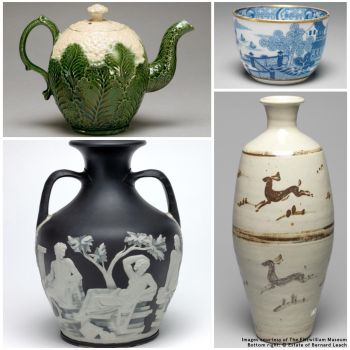 Pre-recorded lectures to be released weekly at 3pm GMT on Thursdays and a live Q&A (Zoom) on 10 December 2020 at 6pm GMT
This course, delivered by experts in the field, will explore five key influential developments in the history of British ceramics since the mid-eighteenth century, examining the multiple ways in which innovators, entrepreneurs, and artists have reinvigorated the field. While the story of ceramics is a global one, Britain has played a leading role in the last three centuries, a period in which British invention has shaped developments and brought constant renewal to the industry.
By 1750, ceramics of different types were available to all levels of society. However, the uniquely British innovation of combining print culture and ceramics, transfer-printing political propaganda, and the graphic satire of London’s leading caricaturists onto earthenware, enabled these contemporary controversial messages to be understood by all classes. During the same period, scientific experimentation by Josiah Wedgwood led to the invention of new bodies and glazes, many copying the ceramics and glass of ancient Greece and Rome. His range and ambition, summed up by his aim to become ‘Vase Maker General to the Universe’, helped to change ceramic tastes to an unprecedented degree.
The production of an abundance of styles characterised the nineteenth century. However, blue and white—one of the most distinctive visual effects in ceramics—became, and remained, more popular than any other. Heavily influenced by porcelain exported from Asia, Britain became the leading ceramic producer of this style, driving international trade and retail opportunities. ‘Chinamania’ gripped the nation; debates about taste and authenticity drove collectors, consumers, and creators.
Ceramics was largely unaffected by the first wave of anti-industrialism in England. Neither William Morris nor the Arts and Crafts movement fully established a new type of pottery. However, an urge to turn away from the industrially-produced ceramics of the late nineteenth century, combined with a renewed interest in form, earlier Chinese ceramics, and abstract art, gave rise to a wave of pioneering British potters who insisted on the importance of the handmade and established the role of the ‘artist-potter’. This philosophy was widely popularised by the influential studio potter, Bernard Leach, who spent formative periods in China and Japan and wrote that ‘all my life I have been a courier between East and West’.
While studio ceramics continue to flourish today, global economics and advanced production technology have greatly impacted the ceramics industry in Staffordshire, the traditional heartland of British ceramics production. Artists have played a key role in documenting and commentating on these changes. The course will conclude with an artist’s examination of the decline of ceramic manufacturing and its associated artisanal skills, emphasising the importance of sustaining the intangible heritage of this longstanding and important industry.
No prior art historical knowledge is necessary.
Thursday, 5 November
Patricia Ferguson (Project Curator, British Museum), Pots with Attitude: British Satire on Ceramics, 1750–1820
Thursday, 12 November
Catrin Jones (Chief Curator, Wedgwood Museum), Josiah Wedgwood: Experimentation and Innovation
Thursday, 19 November
Rebecca Wallis (Curator, National Trust, London and South East), ‘Blue and White’ in Nineteenth-Century Britain and Beyond
Thursday, 26 November
Simon Olding (Director of the Crafts Study Centre, University for the Creative Arts, Farnham), ‘Beyond East and West’: The Founding of British Studio Ceramics
Thursday, 3 December
Neil Brownsword (Artist and Professor of Ceramics, Staffordshire University), Obsolescence and Renewal: Reimagining North Staffordshire’s Ceramic Heritage
Thursday, 10 December
Ceramics in Britain: Live Q&A










 Enfilade
leave a comment