4th Annual Ricciardi Prize from Master Drawings
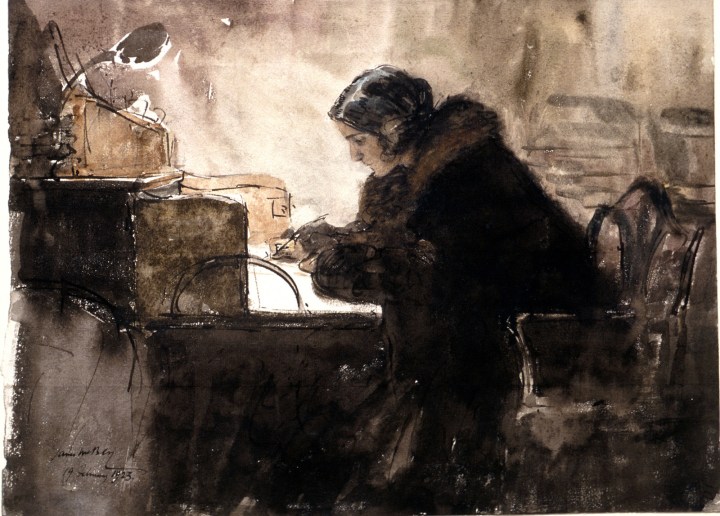
James Mcbey, Girl Writing A Letter, watercolor and pencil on paper (The Clark Art Institute, MA).
◊ ◊ ◊ ◊ ◊
From Master Drawings:
Fourth Annual Ricciardi Prize from Master Drawings
Submissions due by 15 November 2021
Master Drawings is seeking submissions by scholars under the age of 40 for our Fourth Annual Ricciardi Prize! The winning submission will be awarded $5,000, with a publication date in 2022. This year’s deadline is November 15, 2021. Remember, only essays on drawings topics will be considered. Finalists are also recognized with a prize and publication in the journal. You can read this year’s winning article in the June 2021 issue of Master Drawings. More information on how to apply is available here.
Reading Unopened Letters via X-ray Microtomography

An unopened letter, dated 31 July 1697, from Jacques Sennacques to his cousin Pierre Le Pers, virtually unfolded and read for the first time
(Photograph: Unlocking History Research Group)
◊ ◊ ◊ ◊ ◊
The latest from the Unlocking History Research Group, as published in Nature Communications:
Jana Dambrogio, Amanda Ghassaei, Daniel Starza Smith, Holly Jackson, Martin L. Demaine, Graham Davis, David Mills, Rebekah Ahrendt, Nadine Akkerman, David van der Linden, and Erik D. Demaine, “Unlocking History through Automated Virtual Unfolding of Sealed Documents Imaged by X-ray Microtomography,” Nature Communications 12 (2 March 2021), article number 1184.
Abstract: Computational flattening algorithms have been successfully applied to X-ray microtomography scans of damaged historical documents, but have so far been limited to scrolls, books, and documents with one or two folds. The challenge tackled here is to reconstruct the intricate folds, tucks, and slits of unopened letters secured shut with ‘letterlocking’, a practice—systematized in this paper—which underpinned global communications security for centuries before modern envelopes. We present a fully automatic computational approach for reconstructing and virtually unfolding volumetric scans of a locked letter with complex internal folding, producing legible images of the letter’s contents and crease pattern while preserving letterlocking evidence. We demonstrate our method on four letterpackets from Renaissance Europe, reading the contents of one unopened letter for the first time. Using the results of virtual unfolding, we situate our findings within a novel letterlocking categorization chart based on our study of 250,000 historical letters.
◊ ◊ ◊ ◊ ◊
New outlets—including The Art Newspaper, CNN, and The New York Times—have taken up the story. Here’s coverage from The Guardian:
In a world first for the study of historic documents, an unopened letter written in 1697 has been read by researchers without breaking the seal. The letter, dated 31 July 1697 and sent from French merchant Jacques Sennacques in Lille to his cousin Pierre Le Pers in The Hague, had been closed using ‘letterlocking‘, a process in which the letter is folded to become its own envelope, in effect locking it to keep it private. It is part of a collection of some 2,600 undelivered letters sent from all over Europe to The Hague between 1689 and 1706, 600 of which have never been opened.
The international team of researchers from universities including MIT, King’s College London, Queen Mary University London, Utrecht and Leiden, worked with X-ray microtomography scans of the letter, which use X-rays to see inside the document, slice by slice, and create a 3D image. They applied computational flattening algorithms to the scans to enable them to virtually unfold the letter without ever opening it, and discovered that Sennacques had been asking his cousin for a certified copy of a death notice of one Daniel Le Pers.
“It has been a few weeks since I wrote to you in order to ask you to have drawn up for me a legalised excerpt of the death of sieur Daniel Le Pers, which took place in The Hague in the month of December 1695, without hearing from you,” runs the letter. “I am writing to you a second time in order to remind you of the pains that I took on your behalf. It is important to me to have this extract & you will do me a great pleasure to procure it for me & to send me at the same time news of your health & of all the family.” . . . [as translated by the research team.]
The full article, by Alison Flood (2 March 2021), is available here»
Online Talk | Fortune and Folly in 1720
Wednesday evening on Zoom, from the BGC:
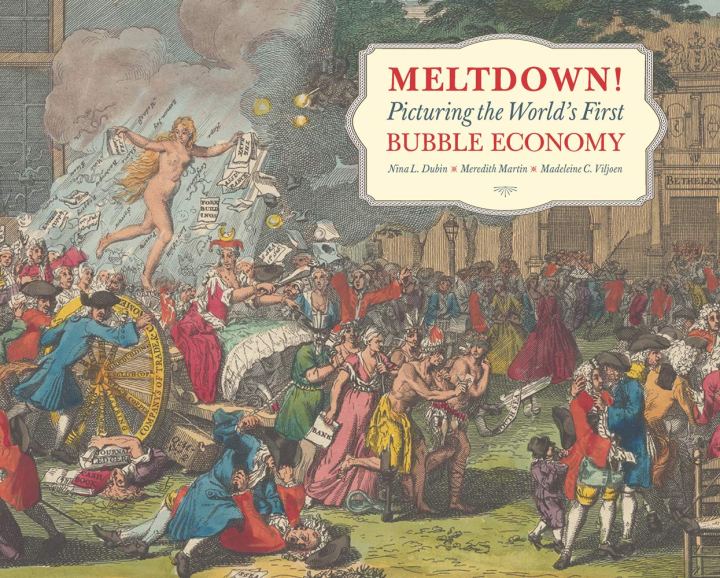
Nina Dubin, Meredith Martin, and Madeleine Viljoen | Fortune and Folly in 1720: Picturing the World’s First Bubble Economy
Françoise and Georges Selz Lectures on Eighteenth- and Nineteenth-Century French Decorative Arts and Culture
Online, Bard Graduate Center, New York, 3 March 2021, 6.00pm
This talk will explore The New York Public Library’s upcoming exhibition Fortune and Folly in 1720 (Fall 2021) and its accompanying publication Meltdown! Picturing the World’s First Bubble Economy (Harvey Miller/Brepols, 2020). Co-curated and co-authored by Dubin, Martin, and Viljoen, they tell two parallel stories: one of the spectacular rise and fall of the first bubble economy, and another of the enterprising art industry that chronicled its collapse. The Mississippi and South Sea Bubbles, spawning the invention of French banknotes as well as joint-stock companies built on fantasies of New World trade, imposed on everyday Europeans a crash course in new financial products. In turn, a bubbling print market relentlessly caricatured the meltdown of 1720, offering viewers an entertaining primer on the otherwise bewildering realities of modern economic life. Three hundred years later, our current moment offers a uniquely fitting vantage point from which to reconsider the significance of the bubbles and of the artworks that channeled the fears and desires they unleashed.
The event will be live with automatic captions. It will be held via Zoom; a link will be circulated to registrants by 3pm on the day of the event.
Nina L. Dubin is an associate professor of Art History at the University of Illinois at Chicago. Specializing in European art since 1700, she has published widely on the production of art within an economy of risk.
Meredith Martin is an associate professor of Art History at New York University and the Institute of Fine Arts. Specializing in European art of the long eighteenth century, she has published widely on gender and architectural patronage as well as maritime art, mobility, and exchange in the early modern world.
Madeleine C. Viljoen is Curator of Prints and the Spencer Collection at The New York Public Library. Responsible for the Library’s collection of prints and rare illustrated books, she has published widely on early modern printed images, with special attention to the goldsmith-engraver, the reproductive print, and ornament.
Exhibition | History in Motion: Tom Judd’s Subway Mural
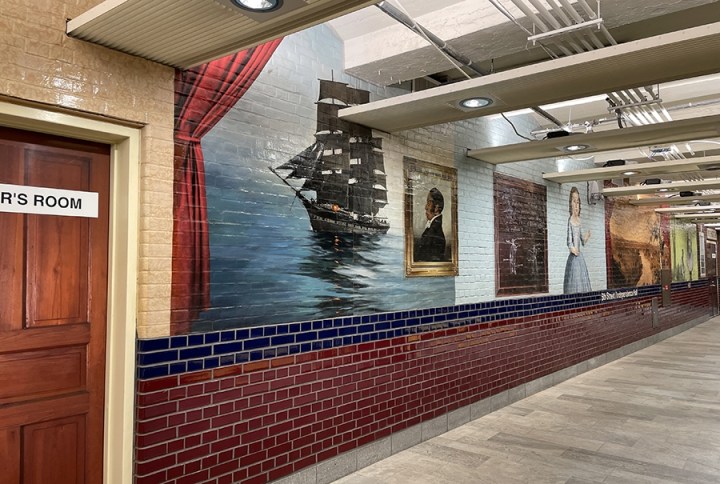
Installation photo of Tom Judd’s Portal to Discovery mural, 2020, produced for Philadelphia’s 5th Street-Independence Hall Station on the Market-Frankford Line.
◊ ◊ ◊ ◊ ◊
The Woodmere Art Museum hosts a virtual opening reception with the artist this evening (Tuesday) at 7pm, ET:
History in Motion: Tom Judd’s Subway Mural
Woodmere Art Museum, Philadelphia, 27 February — 13 June 2021
In connection with the reconstruction of Philadelphia’s 5th Street-Independence Hall Station on the Market-Frankford Line, and as part of SEPTA’s Art in Transit program, artist Tom Judd was selected to create a permanent installation for the station. Titled Portal to Discovery, Judd’s mural on the eastbound and westbound platforms presents figures who contributed to the founding of the United States as well as those who fought for “life, liberty, and the pursuit of happiness” for all. The mural includes portraits of eighteenth- and nineteenth-century Philadelphians such as Frances E. W. Harper, one of the first African American women to be published in the United States, and Absalom Jones, an African American abolitionist and clergyman who founded the Free African Society with Richard Allen in 1787. Juxtaposed with these figures are familiar landscape views of Philadelphia, windows, doors, and other architectural elements of the city. The experience is one of a great historical dreamscape that poses questions and promotes civic dialogue.
 The Museum’s exhibition includes preparatory studies for the mural as well as in-process photographs of the installation; the panels were fabricated by Ben Volta Studios and the installation was managed by James Shuster. The project was realized with help from graphic designer Wenlu Bao; David W. Seltzer, transit consultant and catalog producer; SEPTA; Burns Engineering, Inc.; Converse Winkler Architecture; and Marsha Moss, public art curator and consultant. The mural is an important addition to Philadelphia’s rich landscape of public art.
Judd grew up in Salt Lake City and attended the University of Utah from 1970 to 1972. He received his bachelor of fine arts degree in painting from the Philadelphia College of Art (now the University of the Arts). His work has been exhibited in museums and galleries across the United States, and is in the collections of numerous museums, including the Philadelphia Museum of Art, the Pennsylvania Academy of the Fine Arts, the Birmingham Museum of Art, and Woodmere Art Museum. Judd works in a variety of media, including painting, collage, photography, and installation.
Exhibition | Treasures from the Gilbert Collection

Oval green snuffbox associated with Frederick the Great, ca. 1765, Berlin; chrysoprase, gold, hardstones, and foiled diamonds
(London: V&A, The Rosalinde and Arthur Gilbert Collection)
◊ ◊ ◊ ◊ ◊
Opening this week at Antwerp’s DIVA museum for diamonds, jewellery, and silver:
Masterpieces in Miniature: Treasures from the Rosalinde and Arthur Gilbert Collection
DIVA, Antwerp, 5 March — 15 August 2021
Additional international venues to be announced
Curated by Alice Minter and Jessica Eddie
From March 5th to August 15th 2021, DIVA will host the touring exhibition Masterpieces in Miniature: Treasures from the Rosalinde and Arthur Gilbert Collection, organised by the Victoria and Albert Museum (V&A) in London. This is the first time items from all categories of the Gilbert Collection will go on display on the European continent. Some objects, such as the sixteenth-century partridge cup, are exclusive to the Antwerp exhibition. Masterpieces in Miniature is an ode to Rosalinde and Arthur Gilbert’s impressive legacy and a chance for the public to admire these treasures up close.
Visitors will make the acquaintance of Rosalinde and Arthur Gilbert and come to understand their collecting habits, traveling with them in search of exceptional craftsmanship and beauty and encountering famous historical figures such as Catharine the Great, Napoleon Bonaparte, and Queen Victoria. The showpieces include a snuffbox belonging to Frederick the Great of Prussia, made of chrysoprase, a rare gemstone mined in Silesia and set with hardstones and diamonds, the latter coloured by placing them over pale-pink, green, and lemon-coloured metal foils.
The Rosalinde and Arthur Gilbert Collection is a homage to exquisitely crafted objects, many in precious metals and often small in scale. The Gilberts spent over forty years amassing their collection of nearly 1000 items of fine silverware, gold (snuff)boxes, enamels, and mosaics made in Europe between the sixteenth and twentieth centuries. Their passion for craftsmanship and beauty resulted in a collection that is unparalleled today.
Arthur (1913–2001) and Rosalinde Gilbert (1913–1995) made their first fortune in the fashion industry in London in the 1930s. They swapped London for their newly designed villa in Beverly Hills and set up a successful property development business in America. A second success story soon followed. Their search for ‘beautiful things’ to decorate their home soon developed into a passion for collecting. The couple travelled the world looking for mosaics and the very best gold, silver, and enamel objects.
The desire to share their collection with others by putting it on public display was of real importance to the couple. In the 1970s the collection went to the Los Angeles County Museum of Art, before being transferred to Somerset House in London in 2000 and from there to its current home at the V&A. This is the first time items from all categories of the Gilbert Collection will go on display on the European continent. The collection will travel on from here to America and Asia.
Dries Otten (°1978) has been commissioned to design the set for Masterpieces in Miniature. The Antwerp-based interior architect, furniture and set designer is famous for his playful use of colour with historical references. He has already designed exhibition sets for the TextielMuseum, Bozar, and Texture.
Curators
Alice Minter, Curator of the Rosalinde and Arthur Gilbert Collection, V&A
Jessica Eddie, Assistant Curator of the Rosalinde and Arthur Gilbert Collection, V&A










 Enfilade
leave a comment