Reimagining the Ballet des Porcelaines
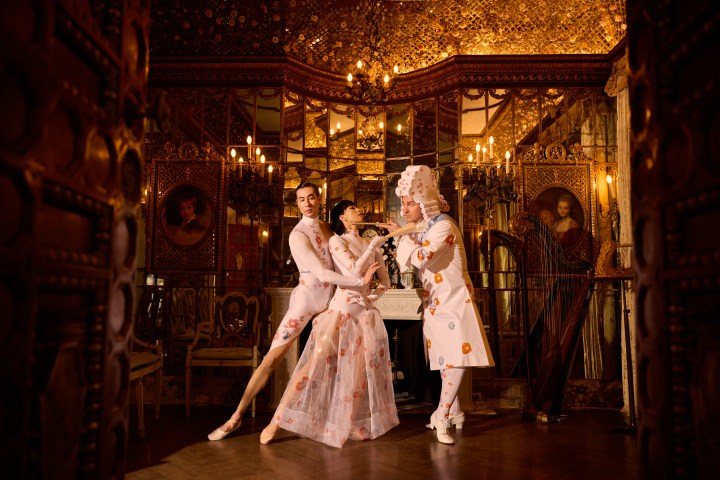
The Ballet des Porcelaines cast in the Venetian Room, Albertine Headquarters, Cultural Services of the French Embassy, NYC. From left to right: Daniel Applebaum (Prince); Georgina Pazcoguin (Princess); Tyler Hanes (Sorcerer). Photo by Joe Carrotta.
◊ ◊ ◊ ◊ ◊
As part of the media preview of the exhibition Inspiring Walt Disney: The Animation of French Decorative Arts at The Metropolitan Museum of Art, guests were given a special chance to see the first performance in centuries of the Ballet des Porcelaine. A publication, noted below, is forthcoming. Additional information about the performance, including credits, is available here.
The original Ballet des Porcelaines, written by the comte de Caylus and staged around 1740 at a château outside of Paris, was based on an Orientalist fairy tale in the same literary milieu as Beauty and the Beast (1740). The story tells of an Asian sorcerer who lives on a ‘Blue Island’ and transforms anyone who dares to trespass into porcelain cups, vases, and other wares. When the sorcerer turns a captive prince into a teapot, a princess comes to rescue her lover by stealing the sorcerer’s wand and turning him into a pagod, an eighteenth-century version of a porcelain bobblehead. Displayed today in museums like The Met, pagods were collectible trinkets that inspired Oriental caricatures in the performing arts. European choreographers mimicked the features and gestures of these porcelain figures, which persist in such iconic, problematic productions as The Nutcracker’s “Chinese Tea” dance.
Scheduled Performances
6 December 2021, The Metropolitan Museum of Art, New York
2–3 March 2022, The University of Chicago
18–19 March 2022, Princeton University
16–17 June 2022, Waddesdon Manor
19–21 June 2022, Royal Pavilion, Brighton
25–26 June 2022, Capodimonte, Naples
28–29 June 2022, Palazzo Grassi, Venice
2–3 July 2022, Sèvres Museum, Paris
Meredith Martin, with contributions by Phil Chan and Charlotte Vignon, Reimagining the Ballet des Porcelaines (Turnhout: Harvey Miller/Brepols, 2022).
In addition to the performance and the book, many readers will find this recorded conversation fascinating as well:
Phil Chan and Meredith Martin, hosted by the Center for Ballet and the Arts at NYU, “Reimagining the Ballet des Porcelaines: A Story of Magic, Desire, and Exotic Entanglement,” YouTube, posted 9 November 2021, 63 minutes.
Phil Chan and Meredith Martin have reimagined this lost Baroque work with an all-Asian American creative team, aiming to make it meaningful and relevant for a multiracial and contemporary audience. This talk explores their process and performance plans and features performances by Martha Graham Principal Dancer Xin Ying and actor, singer, dancer, choreographer Tyler Hanes.
◊ ◊ ◊ ◊ ◊
Note (added 15 December 2021) — The posting has been updated to include the cast photo by Joe Carrotta.
At Colnaghi | Naples

Presepe, made in Naples, mid-18th century to early-nineteenth century, oil painted terracotta, carved wood, painted glass, shaped wire, tin, and cork, with stitched silks and linen, 113 × 173 × 108 inches (private collection).
◊ ◊ ◊ ◊ ◊
From the press release, via Art Daily, for the exhibition at Colnaghi, London:
Naples
Colnaghi, London, 3 December 2021 — 25 February 2022
Opening in conjunction with London Art Week (3–10 December), Colnaghi presents a special exhibition showcasing the enduring creative legacy of Old Master artists and artisans from Naples, marking the first exhibition in London devoted to the Italian city and its arts in over forty years. As the centrepiece of Naples, Colnaghi, together with Dario Porcini, present a magnificent 18th-century crèche, known in Italian as a presepe, a monumental nativity scene traditional to Baroque Naples. The exhibition also features a selection of religious, landscape, and still-life paintings by some of the greatest artists who worked in the city during the 17th and 18th centuries and served as inspiration for the craftsmen of the presepe, including Jusepe de Ribera, Luca Giordano, and Massimo Stanzione. Naples is on view at Colnaghi from 3 December 2021 through the festive season, until 25 February 2022.
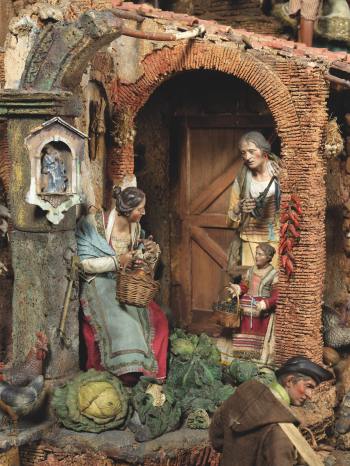 “Our winter exhibition in London transports our visitors to Baroque Naples and will feature important paintings by masters of the period, as well as a monumental presepe,” says Chloe Stead, Senior Global Director of Colnaghi. “Boldly transgressing artistic hierarchies, presepi unite different media and techniques to realise extraordinarily elaborate and exuberant nativity scenes that provide incredible glimpses into life in Naples at the time. Our presepe, created during the golden age of these works, is one of the most important examples outside Italy and reflects all the vitality and craftsmanship for which the Italian city is still known.”
The recreation of nativity scenes with modelled figures and animals during Christmastime was widespread throughout Italy in the 13th and 14th centuries. By the 18th century, what originally had been a relatively simple temporary tableaux underwent a transformation in Naples into highly dramatic and theatrical creations, often monumental in scale. These crèches combined traditional sacred elements of nativity scenes—the Holy Family, wise men, angels, and shepherds—with aspects of contemporary Neapolitan life—rowdy tavern scenes, processing musicians, and bawdy market shopkeepers—in dazzling displays of artistic techniques.
The presepe at Colnaghi, dating from the 18th century, is one of the very few and finest of these masterpieces of the Italian Baroque outside Naples. Crafted from oil painted terracotta, carved wood, painted glass, shaped wire, tin, and cork, with stitched silks and linen to recreate the detailed fashions of the time, the presepe stages the sacred scene in a true-to-life Neapolitan setting and measures a remarkable 340 × 445 cm.
Carmine Romano, translated by Gordon Pole and Caroline Paganussi, The 18th-Century Neapolitan Crèche: A Masterpiece of Baroque Spectacle (Naples: Porcini, 2021), 175 pages, ISBN: 978-8894136470. Available as a PDF file here»
Other exhibition highlights include:
• Two paintings by Jusepe de Ribera, including an Ecce Homo, signed by the artist and dated to 1644 and considered a high point of Neapolitan Baroque art; and Saint John the Baptist, 1630s, which showcases the bold gesture and a melancholic landscape typical of this artist.
• The Penitent Magdalene from the early 1640s by Massimo Stanzione, considered a great rival to Ribera. Signed with an elegant monogram, this well-preserved picture with its vivid, jewel-like sky is particularly unusual example of the artist’s work on copper.
• Two large-scale canvases by the celebrated artist of the later Baroque period, Luca Giordano, who was trained by Ribera. The Triumph of Galatea from the artist’s Roman period, ca. 1675–77, and Shepherds with their Herd (The Riches of the Earth), 1684, both reflect the artist’s ability to express the drama and pathos of religious and mythological subjects.
• Still lifes of fish, crustaceans and other seafood by Giuseppe Recco and his daughter Elena Recco from the 17th century, including two loans from the collection of Lord and Lady Rosse that have never before been presented outside of the dining room of Birr Castle.
• Landscape paintings by Antonio Joli, lent by Lord Montagu from Palace House, Beaulieu, presenting views of Naples-one depicting the Palazzo Reale and Castel Nuovo, and the other a view of the Largo di Palazzo at Carnival time. The works were commissioned by an ancestor of Lord Montagu during his Grand Tour.
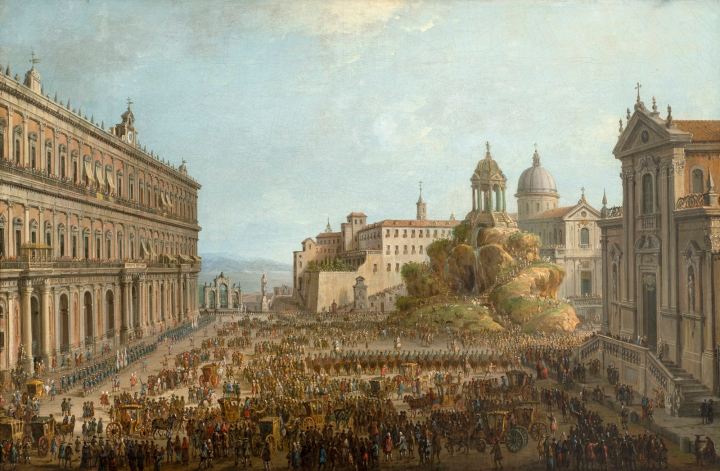
Antonio Joli, Naples, A Festival with a Cuccagna at the Largo di Palazzo, ca. 1756–58, oil on canvas, 19 x 30 inches (Collection of Lord Montagu of Beaulieu). More information on the painting and the cuccagna tradition of ephemeral architecture is available here.
Exhibition | Bordeaux-les-Bains: Les bienfaits de l’eau
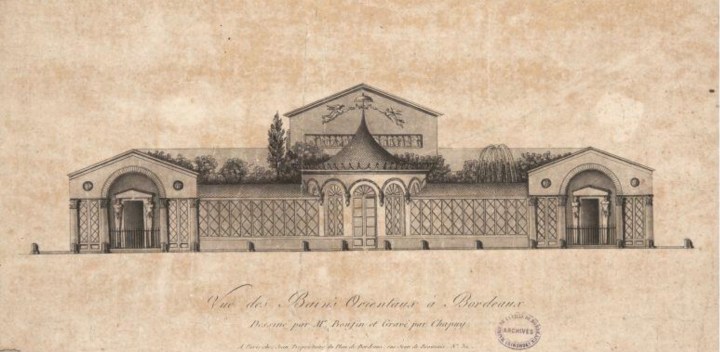
Chapuy after Bonfin, Vue des Bains Orientaux à Bordeaux, ca. 1798, engraving
(Archives Bordeaux Métropole)
◊ ◊ ◊ ◊ ◊
Now on view at the Bordeax Archives, along with this online component:
Bordeaux-les-Bains: Les bienfaits de l’eau, 18e–20e siècle
Archives Bordeaux Métropole, 19 May 2021 — 25 February 2022
Tour à tour convoitée, redoutée, maltraitée, domestiquée, l’eau—un des quatre éléments naturels de la culture occidentale—redevient au XVIIIe siècle un élément fondamental de l’hygiène. Ce bien naturel précieux multiplie les usages au fil du temps : l’eau qui lave, l’eau qui soigne, l’eau qui fortifie, l’eau qui délasse. Et si l’histoire de Bordeaux est intimement liée à celle de son fleuve, c’est bien l’eau qui en constitue l’essence même.
Depuis l’Antiquité, les Bordelais se baignent dans la Garonne. Au XVIIIe siècle, les pratiques évoluent et les techniques se développent : des bains flottants sur le fleuve aux bains-douches dans les quartiers, des établissements d’hydrothérapie à la natation en piscine. C’est à la découverte de cette histoire méconnue que vous invitent les Archives Bordeaux Métropole autour d’une sélection de documents de toutes natures, témoignages d’une incroyable aventure humaine et collective. L’artiste Laurent Valera propose un contrepoint contemporain avec une nouvelle série d’œuvres en dialogue avec les documents d’archives.
Frédéric Laux and Jean-Cyril Lopez, Bordeaux-les-Bains: Les bienfaits de l’eau, XVIIIe–XXe siècle (Archives Bordeaux Métropole, 2021), 96 pages, ISBN: 978-2360622870, 12€.
Print Quarterly, December 2021
The eighteenth century in the latest issue of Print Quarterly:
Print Quarterly 38.4 (December 2021) . . .
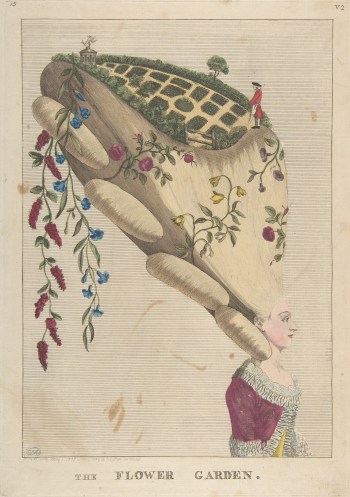
Matthew Darly, The Flower Garden, 1777, etching and engraving with watercolour, 35 × 25 cm (New York: The Metropolitan Museum of Art).
Elizabeth L. Block, Review of Luigi Amara, The Wig: A Hairbrained History, translated by Christina MacSweeney (Reaktion Books, 2020), p. 436.
Elizabeth Block gives an overview of the 33 brief chapters of Luigi Amara’s The Wig: A Hairbrained History. The chapter “Towering Hairdos” looks at the expensive and impractical styles of wigs in the years before the French Revolution, whilst “Dressing Up Justice” focuses on William Hogarth’s The Bench, 1758–64, an engraving depicting bewigged magistrates. Block praises this work for its entertaining and enjoyable qualities, but highlights its lack of academic rigour, suggesting at the end works to turn to for a more scholarly treatment of the subject.
Richard Taws, Review of the exhibition catalogue William Blake, edited by Martin Myrone and Amy Concannon (Tate, 2019), p. 438.
Reviewing the catalogue for the exhibition William Blake, held at Tate Britain in 2019–20, Richard Taws discusses the book’s five chapters covering the artist’s early artistic milieu, his career as printmaker, his relationship with patronage and display, and his reclamation by a younger generation of artists. It is noted that in the authors’ attempt to demythologise Blake, they are successful in creating a “Blake for all,” who satisfies both a specialist and popular audience.
Call for Articles | Mobility, Art and Religion in the Hispanic World
From the Call for Articles:
Special Issue of Religions (2023), Mobilization of Art and Religion in the Hispanic World: The Intersections of Race, Religion, Gender, and Objects c. 1500–1800
Guest edited by C. Cody Barteet and Alena Robin, with Iraboty Kazi
Proposals due by 30 May 2022; completed manuscripts due by 1 February 2023
In recent years, academic interest in the movement of people, objects, and ideas has risen significantly, driven by the desire to develop a fuller understanding of history and our current globalized world (Beaudry and Paron 2013, Corcoran-Tadd, Hung et. al. 2021). These interests have forced us to reconsider knowledge, art, spatial, religious, and historical formations, prior to, during, and after the colonial era, as we have recognized for several decades now that colonialism was formalized and transgressed by virtually all peoples involved (Hofman and Keehnen 2018). Further, objects, styles, concepts, and other material artifacts traversed oceans and continents (Callligaro, Chiappero et. al. 2019, Hamann 2010, Hyman 2017). We look to consider the intersections of Hispanic cultural traditions with European (whether Jewish, Islamic, Catholic, or Protestant), Indigenous/First Nations, Afro-Latin American/Afro-Caribbean, and Asian-Latin American in a developing global world. By considering the mobility of peoples, objects, themes, and other social constructs throughout the global Spanish territories, we explore the intersection of disparate religious traditions to consider the formation of new cultural knowledges and practices through the appropriation, assimilation, commodification, fetishization, marginalization, and hybridization of objects and practices.
We invite contributors to submit their research in English for consideration for publication in a special issue of the journal Religions. Please note that there is a two-stage submission procedure. We will first collect a title and short abstract (maximum 250 words), 5 keywords, and a short bio (150 words), by 1 May 2022, via email to Dr. Cody Barteet (cbarteet@uwo.ca), Iraboty Kazi (ikazi3@uwo.ca), and Dr. Alena Robin (arobin82@uwo.ca). Before 30 May 2022, we will invite selected abstracts to be submitted as 7000- to 9000-word papers for peer review by 1 February 2023. Journal publication is expected in mid- to late 2023, depending on the revision time needed after peer review. Each article will be published open access on a rolling basis after successfully passing peer review.
C. Cody Barteet
Guest Editor
Associate Professor, Department of Visual Arts, Western University, London, ON N6A 3K7, Canada
Interests: Hispanic American art and architecture; early modern visual culture; race, gender, religious art and architecture
Iraboty Kazi
Guest Editor Assistant
Department of Visual Arts, Western University, London, ON N6A 3K7, Canada
Interests: Spanish American colonial art; New Spain; religious art; heritage protection; Latin American art in Canada
Alena Robin
Guest Editor
Associate Professor, Department of Visual Arts, Western University, London, ON N6A 3K7, Canada
Interests: Spanish American colonial art; New Spain; religious art; heritage protection; Latin American art in Canada
Note (added 4 April 2022) — The posting was revised with a new deadline, extended from May 1 to May 30.
Exhibition | Dressing with Purpose in Scandinavia

From left to right: Eva Aira and Inga Lajla Aira Balto in gávttit from Jåhkåmåhkke and Kárášjohka; Sven Roos in Gagnefsdräkt and Lars-Erik Backman in Leksandsdräkt; Fatima Aakhus and Randi Myrum in Setesdalsbunader. (Photos by Carrie Hertz).
◊ ◊ ◊ ◊ ◊
From the Museum of International Folk Art:
Dressing with Purpose: Belonging and Resistance in Scandinavia
Museum of International Folk Art, Santa Fe, 12 December 2021 — 19 February 2023
Dress helps us fashion identity, history, community, and place. Dress has been harnessed as a metaphor for both progress and stability, the exotic and the utopian, oppression and freedom, belonging and resistance. Dressing with Purpose examines three Scandinavian dress traditions—Swedish folkdräkt, Norwegian bunad, and Sámi gákti—and traces their development during two centuries of social and political change across northern Europe.
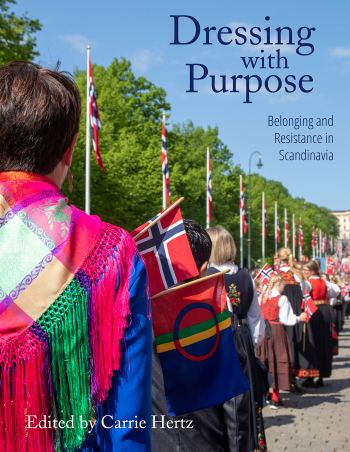 By the 20th century, many in Sweden worried about the ravages of industrialization, urbanization, and emigration on traditional ways of life. Norway was gripped in a struggle for national independence. Indigenous Sami communities—artificially divided by national borders and long resisting colonial control—rose up in protests that demanded political recognition and sparked cultural renewal. Within this context of European nation-building, colonial expansion, and Indigenous activism, traditional dress took on special meaning as folk, national, or ethnic minority costumes—complex categories that deserve reexamination today. In this exhibition, visitors will be introduced to individuals who adapt and revitalize dress traditions to articulate who they are, proclaim personal values and group allegiances, strive for sartorial excellence, reflect critically on the past, and ultimately, reshape the societies they live in.
This project is supported in part by the National Endowment for the Arts. Additional support comes from Barbro Osher Pro Suecia Foundation and Swedish Council of America.
Carrie Hertz, ed., Dressing with Purpose: Belonging and Resistance in Scandinavia (Bloomington: Indiana University Press, 2021), 258 pages, ISBN: 978-0253058577, $30.
Dedication
Acknowledgements
Map of Scandinavia
A Note on Terms and Place Names
Foreword, Khristaan Villela
Introduction: Can We Talk about Traditional Dress?, Carrie Hertz
Part I. Folkdräkt in Sweden
1 Swedish Folkdräkt, Carrie Hertz
2 They Are at Peace Here, Like Old Friends in Their Caskets: Traditional Dress Collections as Heritage-making, Lizette Gradén
Part II. Bunad in Norway
3 Norwegian Bunad, by Carrie Hertz
4 Headdress and Hijab: Bunad in Multicultural Norway, Camilla Rossing
5 The Transnational and Personalized Bunad of the Twenty-First Century, Laurann Gilbertson
Part III. Gákti in Sápmi
6 Sámi Gákti, Carrie Hertz
7 The Legacy of Ládjogahpir: Rematriating Sápmi with Foremother’s Hat of Pride, Eeva-Kristiina Harlin and Outi Pieski
Conclusion: The Future of Traditional Dress, Carrie Hertz
Bibliography
List of Contributors
Index
Call for Papers | Thinking Europe Visually
From ArtHist.net (6 December 2021), which includes the CFP in French . . .
Thinking Europe Visually / L’Europe par l’image et en images
IMAGO Center at the Ecole Normale Supérieure, Paris, 9–10 June 2022
Organized by Béatrice Joyeux-Prunel and Léa Saint-Raymond
Proposals due by 15 March 2022
“If I had to do it again, I would start with culture”: this statement, often erroneously attributed to Jean Monnet, suggests that Europe as a political and economic construct remains, in the absence of a shared culture, nothing but a hollow shell, empty and soulless. This conference aims to question the disillusioned position which holds that there is no meaningful common European culture, and to do so through images.
One way to visualize the potential existence and limits of a European cultural base is indeed to trace the circulation of images—be they works of art, press images, posters, photographs, or even motifs and patterns—in the region, from antiquity through to the present day. What are the images that have circulated most widely in Europe? Are they specific to Europe or are they already globalized? What was their visual and symbolic impact? Is there a ‘visual culture’ specific to Europe and, if so, what might be its distinctive ‘patterns’? This conference will attempt to question the existence, history, contours, and impact of this ‘Europe of images’—from an art historical and visual studies perspective, as well as in historical, anthropological, and geopolitical terms.
Interested contributors are invited to send proposals (400 words maximum) for a 20-minute presentation, along with a short CV in the same document. Proposals should be sent to Prof. Béatrice Joyeux-Prunel (Beatrice.Joyeux-Prunel@unige.ch) and Dr. Léa Saint-Raymond (lea.saint-raymond@ens.fr) by 15 March 2022. The conference will take place 9–10 June 2022 in Paris (France) and will be hosted by the Imago Center at the Ecole normale supérieure, 45 rue d’Ulm, in collaboration with the project Visual Contagions at the University of Geneva (Switzerland).
Art Bulletin of Nationalmuseum Stockholm 27.1
Published in November by the Nationalmuseum, with a selection of eighteenth-century topics listed below:
 The Art Bulletin of Nationalmuseum Stockholm is a journal devoted to art history. It is published in English twice a year with a content that ranges from older master paintings to contemporary design. This, the first part of Volume 27, focuses primarily on acquisitions in 2020. The journal is published through DiVA (a publishing system for research publications and student essays and a digital archive for long-term preservation of publications), with all articles available for free download here.
Editors: Ludvig Florén, Magnus Olausson, and Martin Olin.
Editorial Committee: Ludvig Florén, Carina Fryklund, Eva-Lena Karlsson, Helena Kåberg, Ingrid Lindell, Magnus Olausson, Martin Olin, Daniel Prytz, and Cilla Robach.
A R T I C L E S
Magnus Olausson and Martin Olin, “Two Large Covered Beakers with Filigree Ornamentation by Rudolf Wittkopf.”
The two filigree beakers with covers in silver gilt, made by Rudolf Wittkopf (d. 1722) in Stockholm in 1698, are not only notable examples of Swedish goldsmiths’ work from the end of the 17th century, their history also tells of a dramatic diplomatic episode in the history of relations between Sweden and Russia. The beakers were among the presents given to Tsar Peter I by the ambassadors of the Swedish king Charles XII, in the autumn of 1699.
Daniel Prytz, “A Seated Amour: A Drawing by Charles-Joseph Natoire Related to his Painting Apollo and Clytie for the Royal Palace in Stockholm.”
A drawing of a seated Amour by Charles-Joseph Natoire (1700–1777), recently acquired by the Nationalmuseum, can be said to underline the central role of the art of drawing in his oeuvre. In the present article it is posited that it was created as a finished work onto itself and should be viewed as an example of the possibilities Natoire found primarily in drawing.
Daniel Prytz, “The Vatican from the Road to Ponte Mola: A Drawing by the Amateur Artist and Patron of the Arts Sir George Howland Beaumont.”
Sir George Howland Beaumont (1753–1827) was one of the most prominent British amateur artists and important patrons of the arts of his time. The present article concerns a formerly anonymous 18th-century drawing acquired by the Nationalmuseum, here decisively attributed to Beaumont. The work is a concrete example of the artistic output of this influential judge of taste and perfectly reflects both his position in society and his artistic connoisseurship.
Micael Ernstell, “A Writing Bureau from Magistrate Asplind’s Workshop: A Gift from a Friend.”
A writing bureau dating from 1810–20 by the ornamental painter Johan Nils Asplind (1756–1820), has been generously donated to the Nationalmuseum by Margareta Leijonhufvud through the Friends of the Nationalmuseum. Asplind was active in Falun between 1779 and 1820. He produced ornamental paintings for various manor houses and on furniture he ordered from local cabinetmakers, to which he selected suitable designs from a range of originals. The writing bureau has united the influences of Chinese lacquerwork, the painting of the French rococo, and Gustavian furniture design.
Magnus Olausson, “In the Shadow of Horace Vernet: A Swedish Artist in 1820s Paris.”
This article is about the Swedish artist Alexander Clemens Wetterling’s (1796–1858) encounter with the art and artists of Paris in 1826–27. It introduces us to artistic training in the city, to important networks, and to Wetterling’s take on the struggle between Classicists and Romantics at the famous Salon of 1827. The article is based on a combined reading of Wetterling’s letters and several of the study drawings by him from his stay in Paris, recently acquired by the Nationalmuseum.
Daniel Prytz, “Shepherd Playing his Flute: A Proposed Attribution of a Painting Long in the Collections of the Nationalmuseum to Bernhard Keilhau, Called Monsù Bernardo.”
Bernhard Keilhau (1624–1687) must surely be viewed as one of the foremost artists hailing from Scandinavia, from any century. However, he is largely unknown in Sweden and there are no previous works in the collections of the Nationalmuseum attributed to this artist. The present article concerns a proposed attribution to Keilhau of a work long in the collections of the Museum and with the provenance of the Marshall of the Royal Court Martin von Wahrendorff (1789–1861).
Stephen Lloyd, “A Double-Sided Portrait Miniature Attributed to Sir Henry Raeburn (1756–1823).”
A striking and meticulously painted double-sided portrait miniature of an older man on one side and a younger man on the other side was gifted by the collector Consul Hjalmar Wicander to the Nationalmuseum in 1927 as being a work from the later 18th-century English School. By careful comparison with a small group of other miniatures and drawings this double-portrait is now presented as a significant work from the 1780s Scottish School and indeed a significant youthful achievement from the early career in Edinburgh of the great Enlightenment portraitist in oils, Sir Henry Raeburn (1756–1823).
Exhibition | Anna Dorothea Therbusch
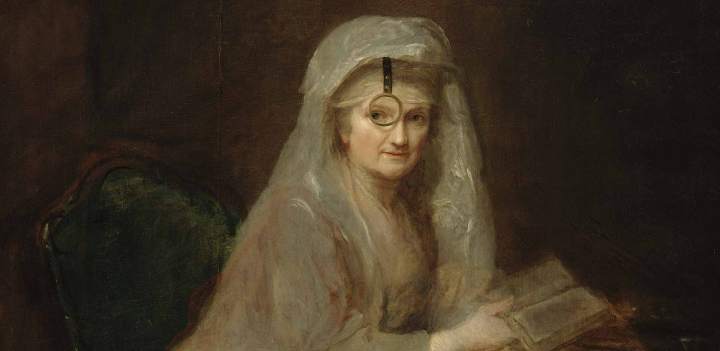
Anna Dorothea Therbusch, Self-Portrait, detail, ca. 1782, 154 × 118 cm
(Berlin: Gemäldegalerie)
◊ ◊ ◊ ◊ ◊
Now on view at the Gemäldegalerie:
Anna Dorothea Therbusch: A Berlin Woman Artist of the Age of Enlightenment / Eine Berliner Künstlerin der Aufklärungszeit
Gemäldegalerie, Berlin, 3 December 2021 — 10 April 2022
Born in Berlin three hundred years ago, Anna Dorothea Therbusch (1721–1782) went on to become one of the most important women artists of the eighteenth century. To mark the tercentenary of her birth (23 July), the Gemäldegalerie is honouring this extraordinary artist and forerunner of women’s emancipation with a special exhibition featuring key works from the Staatliche Museen zu Berlin’s own collections.
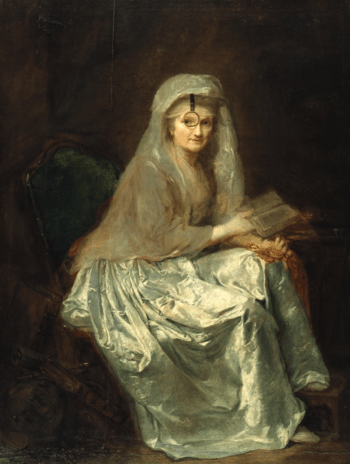 The daughter of the Prussian court painter Georg Lisiewsky, Anna Doroethea received her initial artistic instruction from her father, alongside her siblings. As the wife of an innkeeper and mother of five children, however, her artistic abilities lay idle for decades. In her forties, though, she dedicated herself to painting with great vigour, and in 1767 she was one of the few women to be accepted into Europe’s most important art school of the time, the Académie Royale de Peinture et de Sculpture in Paris. After returning to her hometown, she became a highly sought-after portrait painter, producing likenesses of figures such as Henriette Herz, Frederick the Great, and the doctor Christian Andreas Cothenius, one of the most important chroniclers of the Age of Enlightenment.
Two branches of the Staatliche Museen zu Berlin—the Gemäldegalerie and the Alte Nationalgalerie—boast works by this great local artist, and each has provided museums across the city with permanent loans, with Therbusch’s work on display at the Bode-Museum, the Kunstgewerbemuseum, and at the Jewish Museum Berlin.
One of the painter’s best-known works is a large-format self-portrait from around 1782 in which Therbusch presents herself as a scholar and elegant figure of note. She appears as an approachable and intelligent interlocutor, interested in both objects and her conversation partner, as indicated by the book in her hand and her frontal gaze. Centred around this important painting, the exhibition presents nearly all of Therbusch’s works from the Staatliche Museen zu Berlin. Complemented by key works from her contemporaries, the show provides a comprehensive overview of her oeuvre, her professional milieu, and more broadly the age in which she lived.
Online Talk | Mia Jackson on Boulle and Prints
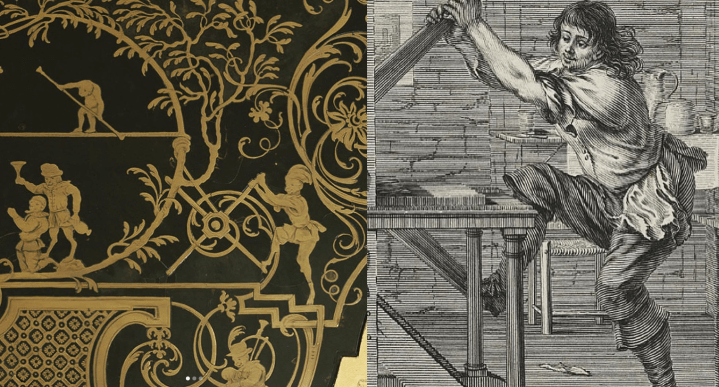
Left: André-Charles Boulle, detail of a table, veneered in turtleshell and brass, with gilt-bronze mounts, ca. 1705 (London: The Wallace Collection, F56). Right: Abraham Bosse, ‘Cette figure vous montre comme on Imprime les planches de taille douce…’, 1642, etching (London: British Museum, R,8.15).
◊ ◊ ◊ ◊ ◊
This Sunday from The Furniture History Society:
Mia Jackson | André Charles Boulle as a Maker, Designer, and Publisher of Prints
The Furniture History Society Online Lecture, 5 December 2021,7pm (GMT) / 2pm (EST)

André-Charles Boulle, table, veneered in turtleshell and brass, with gilt-bronze mounts, ca. 1705 (London: The Wallace Collection, F56).
André-Charles Boulle’s interest in print-making was not limited only to his vast collection of works on paper. The cabinet-maker also designed, made, and sold prints and used print-making techniques in the workshop. Drawing on her doctoral research, Mia Jackson will explore Boulle’s role in print-making, print-publishing, and print-selling. She will discuss Boulle’s series of prints of furniture designs, which her research into publishing history allows her to date more precisely. She will also discuss Boulle’s print design for the Confraternity of St Anne at Carmes-Billettes, and the numerous copperplates that he owned and from which he sold impressions. Dr Jackson’s talk is free to members and £5 for non-members (via this link with code AVUJEN).
Mia Jackson (@theboullelady) has been Curator of Decorative Arts at Waddesdon Manor since 2017. She studied French and Philosophy at Oxford University and then earned an MA in eighteenth-century French decorative arts at the Courtauld Insitute of Art. Her doctoral thesis entitled “André-Charles Boulle (1642–1732) and Paper: Prints and Drawings in the Workshop of an Ébéniste du Roi” was completed at Queen Mary University of London in 2016. She previously worked in the Prints and Drawings Department at The British Museum, at The Wallace Collection, and at English Heritage. She worked on the Riesener Project with The Wallace Collection and the Royal Collection, and is currently preparing a series of exhibitions on Alice de Rothschild with her colleagues at Waddesdon Manor.










 Enfilade
leave a comment