Exhibition | Thomas Gray

The exhibition closes soon, but I note it here particularly to draw your attention to the online component, mounted by Daniel McKay: it’s the most compelling virtual book exhibition I’ve ever seen.
Thomas Gray: An Anniversary Exhibition
Ward Library, Peterhouse, Cambridge, 8 November — 13 December 2021
Curated by Scott Mandelbrote
To mark the 250th anniversary of Thomas Gray’s death, the 270th anniversary of the publication of “Elegy Written in a Country Churchyard,” and the 305th anniversary of his birth.
Thomas Gray was born on 26 December 1716 and died on 30 July 1771. On 15 February 1751, one of the leading contemporary publishers of literary works, Robert Dodsley, hurried into print an edition of an Elegy wrote in a Country Church Yard, which subsequently became one of the most reprinted, anthologised, translated, and imitated poems in any language. It was one of barely more than a dozen poems that Gray allowed to be printed in his lifetime.
This exhibition considers Gray’s life and work from the perspective of the holdings of the two Cambridge Colleges with which he was associated from 1734, when he entered Peterhouse, until his death, which occurred shortly after he was taken ill at dinner in Pembroke. The exhibition focusses on three defining themes in Gray’s life and reputation: his relationship with Cambridge and the effect on him and on his work of the friends and enemies he made at the University; his activity as a reader, in particular as a user of the libraries of his two Colleges; and the publishing phenomenon of the “Elegy,” his most significant poem and one steeped in his appreciation and emulation of classical tradition, as well as his sense of place and of English history and the history of English poetry.
Call for Papers | Midwest Art History Society 2022, Houston

Work at the MFAH Sarofim Campus concluded with the opening in November 2020 of the Nancy and Rich Kinder Building (shown above). Designed by Steven Holl Architects, the structure houses art produced after 1900 and moves the MFAH up to the twelfth largest art museum in the world (in terms of gallery space). Photo: Richard Barnes, Museum of Fine Arts, Houston.
◊ ◊ ◊ ◊ ◊
From the Call for Papers:
48th Annual Conference of the Midwest Art History Society
Museum of Fine Arts, Houston and Menil Collection, 10–12 March 2022
Proposals due by 15 December 2021
Head south to Bayou City for the 48th annual conference of the Midwest Art History Society. The conference will be held in Houston, Texas, in close proximity to world-class art collections and cultural sites. Participate in engaging sessions at one of the most impressive art institutions in the nation, the Museum of Fine Arts, Houston (MFAH), on Thursday and Friday, March 10 and 11, with special sessions and visits to the Menil Collection and other area institutions on Saturday, March 12.
On Thursday evening, MAHS members are invited to a keynote lecture, “Re-presenting Afro-Atlantic Histories,” presented by Kanitra Fletcher, Associate Curator, African American and Afro-Diasporic Art, Modern and Contemporary Art at the National Gallery of Art in Washington, DC. Dr. Fletcher will examine Afro-Atlantic Histories, the largest international exhibition effort to date to treat the Black Atlantic as an area of cultural exchange and transformation between Africa and the Americas (MASP, São Paulo and MFAH).
Established in 1900, the Museum of Fine Arts, Houston holds a growing encyclopedic collection of more than 70,000 objects spanning from antiquities to the present. The museum’s Susan and Fayez S. Sarofim main campus comprises a number of important museum buildings and their collections, including the newly opened Nancy and Rich Kinder Building designed by Steven Holl Architects (2020) to house 20th- and 21st-century collections. The MFAH is also home to two house museums, a repertory cinema, two libraries, public archives, and facilities for conservation and storage, as well as the International Center for the Arts of the Americas (ICAA), a leading research institute for 20th-century Latin American and Latino art.
Conference attendees are encouraged also to explore the Lillie and Hugh Roy Sculpture Garden and the beautiful works in the Brown Foundation, Inc, Plaza, which provides views of downtown Houston. Just across the street, the Contemporary Arts Museum, Houston offers visitors an opportunity to view exemplary work by living artists. Established in 1948 and housed today in a space designed by Gunnar Birkerts in 1972, the museum exhibits work by local and global living artists and organizes thought-provoking arts programming to educate and inspire audiences.
Close to the Museum District are spectacular sites of downtown architecture and green spaces, interspersed with a vibrant collections of museum spaces including the Asia Society Texas Center, the Buffalo Soldiers National Museum, the Czech Center Museum Houston, Diverseworks, Holocaust Museum Houston, Houston Center for Contemporary Craft, Houston Museum of African American Culture, Lawndale Art Center, the Jung Center, Children’s Museum of Houston, Houston Museum of Natural Science, the Houston Zoo, and the Health Museum.
The Houston skyline is distinguished by a host of striking buildings, varying from the Houston City Hall, constructed by the Works Progress Administration following the Great Depression in the 1930s, to the 1999 postmodern ‘Skyscraper of the Century’ Williams Towers designed by Philip Johnson. Green spaces include the Discovery Green, an area famous for its restaurants, food trucks, and free community events varying from yoga to concerts and arts shows; and Herman Park, home of the Houston Zoo and trails leading to a small lake with pedal boats and a Japanese Zen Garden.
Beyond the Museum District, the nearby Montrose neighborhood developed in 1911, offers visitors diverse dining and shopping options. In the 1980s, it was the center of the gay community and today is a demographically diverse area with renovated mansions, bungalows with wide porches, and cottages located along tree-lined boulevards. More recently (in 2009), Montrose was named one of the ‘ten great neighborhoods in America’. The world-class art collections of Dominique and John de Menil are housed in the Menil Collection in the heart of Montrose. The impeccable Renzo Piano building features matchless galleries of Surrealist art, as well as later modern and contemporary art, arts of Africa, Oceania and Latin America, and important temporary exhibitions. The Menil campus also contains the Rothko Chapel, a museum building dedicated to the art of Cy Twombly, and the new Menil Drawing Institute with its own display and study spaces.
Conference presentations are expected to be under twenty minutes. Proposals of no more than 250 words and a two-page CV should be emailed to the chairs of individual sessions by Friday, 15 December 2021. Chairs are to submit finalized panels for their sessions by 10 January 2022.
◊ ◊ ◊ ◊ ◊
A selection of sessions of potential interest for eighteenth-century scholars is listed below (with the full listing available here).
Drawings and Prints, I
Chair: Cheryl Snay (Curator of European Art, Snite Museum of Art, University of Notre Dame), csnay@nd.edu
This session invites new research or perspectives on early modern American and European drawings and prints from the fifteenth to the nineteenth century.
Graduate Student / Early Career Workshop: Museum Work — Skills, Applications, Opportunities
Chairs: Rex Koontz (University of Houston) and Christine Bentley (Missouri Southern State University), rkoontz@uh.edu and bentley-c@mssu.edu
Provenance Studies
Chair: Jon Evans (University of Houston), jevans@uh.edu
Textiles / Fashion
Chair: Erica Warren (The Art Institute of Chicago), ewarren2@artic.edu
Decolonizing Art History
Chair: Lauren DeLand (Savannah College of Art and Design), delan104@umn.edu
Art History Pedagogy
Chairs: Beth Merfish and Sarah Costello (University of Houston-Clear Lake), merfish@uhcl.edu
Socially Engaged Art History Round Table
Chairs: Cindy Persinger (California University of Pennsylvania) and Azar Rejaie (University of Houston Downtown), persinger@calu.edu and rejaiea@uhd.edu
African Art and Art of the African Diaspora
Chair: Felicia Mings (Curator, Art Gallery of York University), mings@yorku.ca
Art of the Indigenous Americas: Ancient and Modern
Chair: Rex Koontz (University of Houston), rkoontz@uh.edu
Between the Local and Global: Art of the Americas
Chair: Cristina Gonzalez (Oklahoma State University), cristina.gonzalez@okstate.edu
Asian Art
Chair: Jennifer Lee (School of the Art Institute of Chicago), jlee241@saic.edu
Early Modern Art (15th–18th Centuries)
Chair: Elizabeth Carroll (San Jose State University), elizabeth.carroll@sjsu.edu
Recent Acquisitions in the Midwest
Chair: Cheryl Snay (Snite Museum of Art, University of Notre Dame), csnay@nd.edu
Technical Art History
Chair: Amy Morris (University of Nebraska at Omaha), ammorris@unomaha.edu
Undergraduate Art History Session
Chair: Paula Wisotzki (Loyola University), pwisots@luc.edu
Faculty members who have received outstanding research papers from undergraduate students within the past two academic years are invited to submit them for inclusion in our eighth annual Undergraduate Research Session. These papers should explore specific art historical research questions. In all cases, a faculty member (usually the submitter) must serve as a mentor and accompany the undergraduate student to the annual conference. Submissions should include the complete paper of no more than 2500 words, a 250-word abstract, and the student’s resume. In the event that the paper is accepted, undergraduate student presenters and faculty mentors are expected to pay membership and conference fees.
Exhibition | Afro-Atlantic Histories
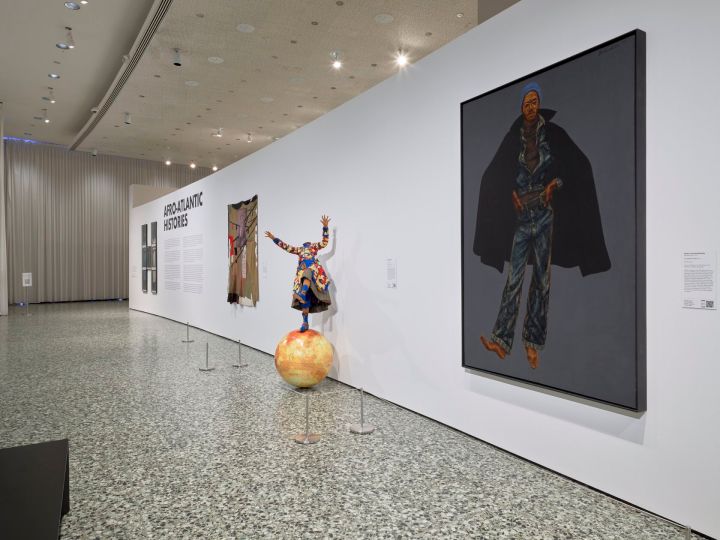
From the press release (21 October 2021) for the exhibition:
Afro-Atlantic Histories
Museu de Arte de São Paulo, 28 June — 21 October 2018
Museum of Fine Arts, Houston, 24 October 2021 — 17 January 2022
National Gallery of Art, Washington, DC, 10 April — 17 July 2022
Los Angeles County Museum of Art, TBD
U.S. Tour Curated by Kanitra Fletcher
This fall the Museum of Fine Arts, Houston, will debut the U.S. tour of Afro-Atlantic Histories, an unprecedented exhibition that visually explores the history and legacy of the transatlantic slave trade. Initially organized and presented in 2018 by the Museu de Arte de São Paulo (Histórias Afro-Atlânticas), the exhibition comprises more than 130 artworks and documents made in Africa, the Americas, the Caribbean, and Europe from the 17th to the 21st centuries.
 In collaboration with MASP and the National Gallery of Art in Washington, DC, the MFAH will present Afro-Atlantic Histories at its Caroline Wiess Law Building from Sunday, 24 October 2021, through Monday, 17 January 2022. The exhibition will then travel to the National Gallery of Art to be on view in its West Building from Sunday, 10 April, through Sunday, 17 July 2022, with the Los Angeles County Museum of Art and additional venues confirmed to follow.
“Afro-Atlantic Histories recasts the traditional telling of the colonial history of the Western hemisphere within the vast web of the transatlantic slave trade over three centuries,” commented Gary Tinterow, Director, Margaret Alkek Williams Chair, MFAH. “It is an essential reexamination, one that the MFAH and the National Gallery have distilled from its expansive, original presentation in Sao Paulo in 2018 to focus on forgotten perspectives under the theme of histórias.”
“The National Gallery is honored to partner with the Museu de Arte de São Paulo and the Museum of Fine Arts, Houston, to bring Afro-Atlantic Histories to the United States. In the nation’s capital, this exhibition will shed light on the many histories that are crucial to our understanding of the legacy of slavery across the Americas,” said Kaywin Feldman, Director of the National Gallery of Art. “Through works made by artists across five centuries, Afro-Atlantic Histories will also celebrate the ongoing influence of the African diaspora on both sides of the Atlantic.”
Afro-Atlantic Histories dynamically juxtaposes works by artists from 24 countries, representing evolving perspectives across time and geography through major paintings, drawings and prints, sculptures, photographs, time-based media art, and ephemera. The range extends from historical paintings by Frans Post, Jean-Baptiste Debret, and Dirk Valkenburg to contemporary works by Ibrahim Mahama, Kara Walker, and Melvin Edwards.
The U.S. tour further builds on the exhibition’s overarching theme of histórias—a Portuguese term that can encompass both fictional and non-fictional narratives of cultural, economic, personal, or political character. The term is plural, diverse, and inclusive, presenting viewpoints that have been marginalized or forgotten.
The exhibition unfolds through six thematic sections that explore the varied histories of the diaspora:
• Maps and Margins illustrates the beginnings of the slave trade as it unfolded across the Atlantic between Africa, the Americas, and Europe. Highlights include artworks that reference the widely reproduced British Abolitionist document Description of a Slave Ship (1789), an illustration that clinically detailed a slave ship’s cargo hold; Aaron Douglas’s painting Into Bondage (1936), a powerful portrayal of the moment when a group of Africans are taken to a slave ship bound for the Americas.
• Enslavements and Emancipations examines how the abuses of commercial slavery triggered rebellion, escape, and Abolitionist movements. Theodor Kaufmann’s On to Liberty (1867) portrays women and children fleeing through the woods—a scene that Kaufmann, who served as a Union Solider during the American Civil War, witnessed firsthand. Torturous practices are addressed in works that range from The Scourged Back, the widely published 1863 photograph by McPherson & Oliver, to the 2009 etching Restraint, a powerful image of a silhouetted figure in an iron brindle, by American artist Kara Walker. Samuel Raven’s Celebrating the Emancipation of Slaves in British Dominions, August 1834 (c. 1834) presents a romanticized tribute to emancipation; Ernest Crichlow’s portrait of Harriet Tubman honors the fearless liberator and ‘conductor’ of the Underground Railroad.
• Everyday Lives features images of daily life in Black communities during and after slavery, in realistic and romanticized views. Among 20th-century artists, American Clementine Hunter and Brazilian Heitor dos Prazeres depict field work and friendships. American Romare Bearden draws inspiration from the rhythmic and improvised staccato of jazz and the blues, using shifts in scale, breaks in color, and disarranged perspectives for his depiction of a sharecropper in the monumental collage Tomorrow I May Be Far Away (1967). The pastoral painting Landscape with Anteater (c. 1660), by the Dutch artist Frans Post, places enslaved laborers and indigenous peoples in an idyllic Brazilian landscape.
• Rites and Rhythms features works about celebrations and ceremonies in the Americas and the Caribbean. Often re-creating African traditions, these rites became channels for worship and communication. Twentieth-century Uruguayan artist Pedro Figari frequently portrayed his country’s Candombe dances, which originated with descendants of enslaved Africans. Dominican artist Jaime Colson’s lively Merengue (1938) pays homage to his country’s national dance and music, a blend of Afro-Caribbean rhythms and African movements. Other works in this section of the exhibition explore Carnival, African-based religions, and the historical Black presence in Christianity.

Dalton Paula, Zeferina, 2018.
• Portraits spotlights Black leaders of the 18th and 19th centuries who have not traditionally been memorialized in historical American and European portraiture. Dalton Paula’s Zeferina (2018), commissioned for the original presentation at MASP, provides a face to an influential slave rebellion leader who was arrested and sentenced to death before she could be commemorated. Other historical and more contemporary works feature ordinary people, invented figures, and the artists themselves, including Self-Portrait (as Liberated American Woman of the ’70s) (1997) by Cameroonian photographer Samuel Fosso, an unconventional work that challenges our understanding of self-portraiture.
• Resistances and Activism examines the continuing fight for freedoms. Banners, flags, and textiles referring to histories of resistance across the Afro-Atlantic invoke cultural, political, religious, and artistic identities. Me gritaron negra (They shouted black at me) (1978), a video by Venezuelan artist Victoria Santa Cruz, is a powerful renunciation of colorism and racism through poetry and dance inspired by the artist’s own history. Other works in this section draw attention to Black activism, including Glenn Ligon’s painting Untitled (I Am a Man) (1988), inspired by signs carried in the 1968 Memphis Sanitation Workers’ Strike, which protested unsafe working conditions and low wages; and March on Washington (1964), a rare figurative painting by Alma Thomas that recalls her experience attending the storied demonstration.
The U.S. tour is curated by Kanitra Fletcher, Associate Curator of African American and Afro-Diasporic Art at the National Gallery of Art. Adriano Pedrosa, Artistic Director; Ayrson Heráclito, Curator; Hélio Menezes, Curator; Lilia Moritz Schwarcz, Adjunct-Curator of Histories; and Tomás Toledo curated the exhibition at the Museu de Arte de São Paulo. At the National Gallery, the curatorial team also includes Molly Donovan, Curator of Contemporary Art, and Steven Nelson, Dean of the Center for the Advanced Study in the Visual Arts.
In Washington, DC, the curators are working closely with an external advisory group of local leading historians and art historians: Ana Lucia Araujo, Professor of History, Howard University; Nicole Ivy, Assistant Professor of American Studies, George Washington University; Kevin Tervala, Associate Curator of African Art, Baltimore Museum of Art; Kristine Juncker, Special Assistant to the Director, National Museum of African Art; and Michelle Joan Wilkinson, Curator, Smithsonian National Museum of African American History and Culture.
Adriano Pedrosa and Tomás Toledo, eds., with additional contributions by Ayrson Heráclito, Deborah Willis, Hélio Menezes, Kanitra Fletcher, Lilia Moritz Schwarcz, and Vivian Crockett, Afro-Atlantic Histories (New York: DelMonico Books / Museu de Arte de São Paulo, 2021), 400 pages, ISBN: 978-1636810027, $70.
Exhibition | The Abyss: Nantes and the Atlantic Slave Trade, 1707–1830

L’abîme: Nantes dans la traite atlantique et l’esclavage colonial, 1707–1830 as installed at the Musée d’histoire de Nantes (Photo by David Gallard). The graphic elements on the wall and the floor are taken from an eighteenth-century document, signed by participants in the slave trade, that depicts La Marie Séraphique, a slave ship that in 1769 transported 312 captives to Cap-Français.
◊ ◊ ◊ ◊ ◊
Now on view at the Musée d’histoire in Nantes (there is also a Google Arts & Culture site, “Nantes and the Atlantic Slave Trade,” with related objects from the museum).
The Abyss: Nantes’s Role in the Slave Trade and Colonial Slavery, 1707–1830
L’abîme: Nantes dans la traite atlantique et l’esclavage colonial, 1707–1830
Musée d’histoire de Nantes, Château des ducs de Bretagne, 16 October 2021 to 19 June 2022
Curated by Krystel Gualdé

Plan, Profile, and Layout of the Ship ‘The Séraphique Marie’ of Nantes, outfitted by Mr Gruel, for Angola, under the command of Gaugy, who dealt in Loango . . ., 1770 (Musée d’histoire de Nantes).
Still today, historians are unable to agree on the number of victims resulting from the transatlantic slave trade. With so many documents missing, it is impossible to arrive at an exact figure; and yet, the difference in final totals does not vary in terms of tens or hundreds or thousands—but in millions. How can a phenomenon so tragic and fundamental divide those who study it to such a degree? It would appear that the number, as staggering as it may be, does not explain the problem sufficiently. Moreover, what would we ultimately know if we arrived at a definite number? Would we know how many men, women, and children died during the wars and raids that led to their captivity? Would we have a better idea of how an entire city and its surrounding region could justify using the colonial system and slave trade as a means to accumulate unprecedented wealth? Would we be able to imagine the close ties between the transatlantic slave trade and the early Industrial Revolution? Would we understand, if only for an instant, how horrible it must have been to no longer be autonomous, to stop being considered human and be relegated to the status of a material good, to disappear without leaving any trace or memory? The exhibition provides an opportunity to hold the collections of the Musée d’histoire up to the light, revealing the invisible but ever-present traces of the men and women who were victims of the colonial system. Beyond the economic and commercial perspective commonly offered, this exhibition reveals the complex reality of a city so deeply involved in the slave trade.
Krystel Gualdé, est directrice scientifique du Musée d’histoire de Nantes et du Mémorial de l’esclavage. Spécialiste de la traite atlantique et de l’esclavage colonial, elle engage le musée dans de nombreux partenariats et réseaux scientifiques au niveau national comme international (Conseil d’orientation de la Fondation pour la mémoire de l’esclavage ; Projet SLAFNET – Slavery in Africa: A Dialogue between Europe and Africa). Elle est par ailleurs membre du Global Curatorial Project porté par le Center for the Study of Global Slavery at the Smithsonian’s National Museum of African American History and Culture (NMAAHC) et le Center for the Study of Slavery and Justice à l’université Brown aux Etats-Unis.
Krystel Gualdé, L’abîme: Nantes dans la traite atlantique et l’esclavage colonial, 1707–1830 (Rennes: Presses Universitaires de Rennes), 320 pages, ISBN: 978-2906519794, 30€.
A preview of the book is available here»
The dossier de presse is available here»
The Decorative Arts Trust Announces Failey Grant Recipients
From the press release (1 December 2021) . . .
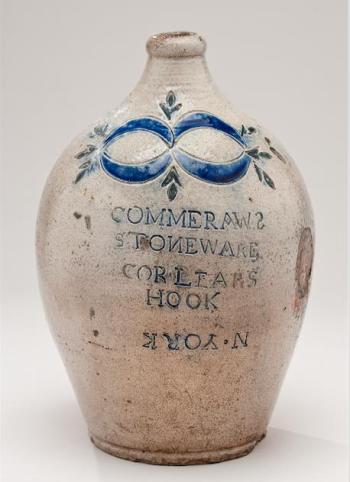
Thomas W. Commeraw, Jug, ca. 1796–1819, stoneware and cobalt oxide. Impressed on front: “COMMERAW’S/STONEWARE / CORLEARS / HOOK / N. YORK” (New-York Historical Society, 1937.820).
The Decorative Arts Trust congratulates author Caitlin Meehye Beach, Historic Rock Ford, and the New-York Historical Society on receiving Failey Grants. The Failey Grant program provides $25,000 in support for noteworthy research, exhibition, publication, and conservation projects through the Dean F. Failey Fund, named in honor of the Trust’s late Governor. Preference is given to projects that employ or are led by emerging professionals in the museum field.
Caitlin Meehye Beach, an assistant professor in the Department of Art History and affiliated faculty in the Department of African and African American Studies at Fordham University, will utilize grant funds for her forthcoming book Sculpture at the Ends of Slavery, which will be published by the University of California Press in 2022. The text will examine how a wide range of works of sculpture and decorative art—from antislavery medallions to statues of bondspeople bearing broken chains—gave visual form to narratives about abolition in the 18th and 19th centuries.
Historic Rock Ford in Lancaster, Pennsylvania, will use grant funding for further research and interpretation of the over 200 objects in their John J. Snyder, Jr. Gallery of Early Lancaster County Decorative Arts. Their goal is to uncover more about the shops, apprentices, laborers, indentured laborers, and enslaved workers who contributed to the Gallery’s collection of furniture, silver, clocks, and paintings from the mid-1700s to the early 1800s.
The New-York Historical Society receives grant funding for the groundbreaking exhibition Crafting Freedom: Uncovering the Life and Legacy of Free Black Potter Thomas Commeraw, to be presented January to June 2023 in their Pam & Scott Schafler Gallery. Crafting Freedom will be the first exhibition focused solely on Commeraw, a free Black craftsman descended from enslaved people, who was active as a master potter from the 1790s through 1819.
The Decorative Arts Trust is a non-profit membership organization that promotes and fosters the appreciation and study of the decorative arts through exchanging information through domestic and international programming; collaborating and partnering with museums and preservation organizations; and underwriting internships, research grants, and scholarships for graduate students and young professionals.
New Book | Gateways to the Book: Frontispieces and Title Pages
From Brill:
Gitta Bertram, Nils Büttner, and Claus Zittel, eds., Gateways to the Book: Frontispieces and Title Pages in Early Modern Europe (Leiden: Brill, 2021), 602 pages, ISBN: 978-9004459328, €166 / $199.
 Gateways to the Book investigates the complex image–text relationships between frontispieces and illustrated title pages on the one hand and texts on the other, in European books published between 1500 and 1800. Although interest in this broad field of research has increased in the past decades, many varieties of title pages and a great deal of printers and books remain as yet unstudied. The fifteen essays collected in this volume tackle this field with a great variety of academic approaches, asking how the images can be interpreted, how the texts and contexts shape their interpretation, and how they in turn shape the understanding of the text.
Gitta Bertram teaches art history at the State Academy of Fine Arts Stuttgart. She has published a monograph, translations and articles on early modern title pages, including Peter Paul Rubens as a Designer of Title Pages (2018).
Nils Büttner teaches art history at the State Academy of Arts Stuttgart and specialises in the visual culture of Germany and the Netherlands from the fifteenth to the seventeenth centuries. He has published monographs and articles on Hieronymus Bosch, Pieter Bruegel, Rubens, Rembrandt, and Vermeer, as well as the history of landscape painting and the history of drawings and prints. He has also written numerous catalogue essays, and has served as a curator for several museum exhibitions.
Claus Zittel teaches German literature and philosophy at the Universities of Stuttgart and Venice. He is Deputy Director of the Stuttgart Research Center for Text Studies and of the Bembo Laboratory at Ca’ Foscari University of Venice, and has published monographs, translations, and articles pertaining to early modern culture, including Theatrum Philosophicum: Descartes und die Rolle ästhetischer Formen in der Wissenschaft (Akademie 2009).
C O N T E N T S
List of Illustrations
Notes on the Editors
Notes on the Contributors
1 Gateways to the Books: Early Modern Frontispieces — Gitta Bertram, Nils Büttner, and Claus Zittel
Part 1: The Culture of the Frontispiece
2 Considerations on the History and the Analysis of Illustrated Title Pages — Gitta Bertram
3 Minerva in the Printshop: Publisher’s Advertising in Frontispieces and the Media Presence of Early Modern Printer-Publishers — Lea Hagedorn
4 The Frontispiece Portrait and Its Critics: Visual and Verbal Tactics for Undermining the Social Productivity of Printed Portraits in Early Modern Scholarly Culture — Hole Rößler
Part 2: The Frontispiece between Art and Science
5 The Poetological Frontispiece in 17th-Century German Poetry — Claus Zittel
6 Lady Music, Pythagoras, Apollo & Co.: Frontispieces and Title Woodcuts in Music Theory Prints and Musical Textbooks around 1500 — Fabian Kolb
7 Visualising the Constitution of Art: Frontispieces in ‘Kunstliteratur’ in the Early Modern Period — Constanze Keilholz
8 When Mars Meets Euclid: The Relationship between War and Mathematical Sciences in Frontispieces of Fortification Treatises — Delphine Schreuder
9 Travels towards Humankind’s Salvation, Travels through Nature Enlightened by Science: Frontispieces on Africa and the Levant, 17th–18th Centuries — Cornel Zwierlein
Part 3: Case Studies
10 A Moralistic Journey: The Tabula Cebes as an Architectural and Spatial Allegory in 16th-Century Basel — Miranda L. Elston
11 Rubens’s Legacy in Book Design — Nils Büttner
12 The Title Page of Jacob van der Gracht’s Anatomie and 17th-Century Dutch Artists’ Education in Anatomy — Alice Zamboni
13 The Role of Multiple Frontispieces in the Cultus Sancti Francisci Xaverii — Alison C. Fleming
14 Juan Ricci de Guevara’s Introduction of Wise Painting — Martijn van Beek
15 The Architectural Folios of Jeremias Wolff — Daniel Fulco
16 Monumental Elements in Early 18th-Century Book Illustration: Jacob Tonson the Younger, George Vertue, and the Illustrated Editions of the Works of Edmund Waller — Malcolm Baker
Index Nominum
New Book | François Boucher and the Art of Collecting
From Routledge (and today priced at $105 for the hardcover). . .
Jessica Priebe, François Boucher and the Art of Collecting in Eighteenth-Century France (Routledge, 2021), 270 pages, ISBN: 978-1472435835 (hardcover), $150 / ISBN 978-1003224730 (ebook), $35.
 While earlier studies have focused predominantly on artist François Boucher’s artistic style and identity, this book presents the first full-length interdisciplinary study of Boucher’s prolific collection of around 13,500 objects including paintings, sculpture, prints, drawings, porcelain, shells, minerals, and other imported curios. It discusses the types of objects he collected, the networks through which he acquired them, and their spectacular display in his custom-designed studio at the Louvre, where he lived and worked for nearly two decades. This book explores the role his collection played in the development of his art, his studio, his friendships, and the burgeoning market for luxury goods in mid-eighteenth-century France. In doing so, it sheds new light on the relationship between Boucher’s artistic and collecting practices, which attracted both praise and criticism from period observers.
Jessica Priebe is a Lecturer in the Department of Art History and Theory at the National Art School, Australia.
C O N T E N T S
List of Figures
Acknowledgments
Introduction: In Pursuit of Pleasure
Part 1: The Artist as Agent
1 Modernizing Watteau: Marketing Luxury in France and Sweden
2 Boucher and the Art of Conchyliomanie
Part 2: The Artist as Collector
3 Trading Places: Boucher as a Collector of Fine Art
4 The Business of Collecting
Part 3: The Collector as Artist
5 A New Address: Boucher at the Louvre
6 Boucher’s Cabinet of Natural History
7 The Artist Inspired: Representing Genius and the Art of Emulation
Bibliography
Index
Exhibition | Antoine Watteau: Art — Market — Trade
Now on view at Schloss Charlottenburg:
Antoine Watteau: Art — Market — Trade
Schloss Charlottenburg, Berlin, 9 October 2021 — 1 January 2022
Curated by Christoph Martin Vogtherr
 2021 marks the 300th anniversary of the death of the French painter Antoine Watteau (1684—1721). The fame of the artist, who was already celebrated during his lifetime, continues to have an effect today, and his works are coveted collector’s items. After the Louvre in Paris, the Prussian Palaces and Gardens Foundation Berlin-Brandenburg owns the most important collection of paintings by this artist. Under the motto ‘Art—Market—Trade’, a special exhibition at Charlottenburg Palace pays tribute to this outstanding painter of the 18th century. The focus of the show is one of Watteau’s major works: the Shop Sign of the Art Dealer Gersaint (L’enseigne du marchand d’art Gersaint). Acquired by Frederick the Great (1712—1786) in 1746, the painting has been considered a masterpiece ever since it was painted. Originally created as a medium of business advertising and as a ‘figurehead’ of the Parisian art trade, the painting continues to stimulate contemporary questions concerning marketing, trade, but also collecting and intellectual engagement with art.
Two protagonists of Parisian art life are presented: Edme-François Gersaint (1694—1750) and Jean de Jullienne (1686—1766). Gersaint, a young up-and-coming art dealer, used his shop on the Pont Notre Dame in Paris to market the artist’s works throughout Europe through new advertising media and formats after Watteau’s death. Together with Jullienne, a collector and patron of Watteau, they realized the idea of reproducing all of the painter’s drawings and paintings in print. This edition, the Recueil Jullienne, was the prototype of a modern illustrated collection of works, which in its aftermath was to trigger a veritable fashion wave: throughout Europe, collectors, manufactory owners, and tradesmen acquired the prints created after Watteau’s works. Watteau’s imagery also inspired court painting and arts and crafts in Prussia. Motifs á la Watteau can be found not only in painting, but also on screens, wallpaper, fans, porcelain, and tapestries of the Frederician period.
As a source of inspiration, Watteau continues to have an impact right up to the modern age. Contemporary artists such as the Swiss painter Thomas Huber (b.1955) and the British fashion designer Vivienne Westwood (b.1941) are represented in the exhibition with one work each. Their artistic positions show that Watteau is still perceived today as an innovative artist and that his work stimulates creative debate. The exhibition, under the patronage of the French ambassador Anne-Marie Descôtes, paints a multifaceted picture of Watteau as an artist and style icon, whose posthumous fame was established with the shop of the art dealer Gersaint on Notre Dame in Paris.
C. Alff, S. Evers, P. Fuhring, A. Moulinier, D. Ranftl, C. Vogtherr, F. Windt, E. Wollschläger, Antoine Watteau: Kunst — Markt — Gewerbe / Art — Marché — Commerce (Munich: Hirmer Verlag, 2021), 272 pages, ISBN: 978-3777437866 (German edition) / ISBN: 978-3777437842 (French edition), 40€.










 Enfilade
leave a comment