New Book | Villa Albani Torlonia: The Cradle of Neoclassicism
From Rizzoli:
Carlo Gasparri, Raniero Gnoli, and Alvar González-Palacios, with photographs by Massimo Listri, Villa Albani Torlonia: The Cradle of Neoclassicism (New York: Rizzoli, 2021), 336 pages, ISBN: 978-8891832146, $150.
 Villa Albani Torlonia, with its collections, the Italian garden, and the hemicycle of the Kaffeehaus, is a sublime testimony of that particular antiquarian taste which came to the fore in the mid-eighteenth century, that for which Rome became a favorite destination on the Grand Tour. The classicist dream of Cardinal Alessandro Albani (1692–1779) was preserved thanks to the Torlonia family, who purchased the villa in 1866, enlarging the collection and the gardens and restoring the most important cardinal residence of the eighteenth century.
More than 300 images by the great Italian master Massimo Listri recount the history of this extraordinary cultural heritage for the very first time. An immersive journey leads the reader between its collections of ancient masterpieces. Statues, bas-reliefs, and fountains are ensconced between the various buildings and gardens of the villa in a composition of environments, landscapes, and works of art forever waiting to be discovered.
Massimo Listri is a photographer who has published more than 70 books and has exhibited his work at numerous solo exhibitions throughout the world. Carlo Gasparri is emeritus professor at the University of Naples Federico II and has authored several books about archaeology and Greek and Roman art. Raniero Gnoli is an Orientalist and historian of religions. Alvar González-Palacios is an author and art historian and former collaborator of FMR magazine.
New Book | The Living Death of Antiquity
From Oxford UP:
William Fitzgerald, The Living Death of Antiquity: Neoclassical Aesthetics (Oxford: Oxford University Press, 2021), 288 pages, ISBN: 978-0192893963, £75 / $100.
 The Living Death of Antiquity examines the idealization of an antiquity that exhibits, in the words of Johann Joachim Winckelmann, “a noble simplicity and quiet grandeur.” Fitzgerald discusses the aesthetics of this strain of neoclassicism as manifested in a range of work in different media and periods, focusing on the late eighteenth and early nineteenth centuries. In the aftermath of Winckelmann’s writing, John Flaxman’s engraved scenes from the Iliad and the sculptors Antonio Canova and Bertel Thorvaldsen reinterpreted ancient prototypes or invented new ones. Earlier and later versions of this aesthetic in the ancient Greek Anacreontea, the French Parnassian poets, and Erik Satie’s Socrate, manifest its character in different media and periods. Looking with a sympathetic eye on the original aspirations of the neoclassical aesthetic and its forward-looking potential, Fitzgerald describes how it can tip over into the vacancy or kitsch through which a ‘remaindered’ antiquity lingers in our minds and environments. This book asks how the neoclassical value of simplicity serves to conjure up an epiphanic antiquity, and how whiteness, in both its literal and its metaphorical forms, acts as the ‘logo’ of neoclassical antiquity, and functions aesthetically in a variety of media. In the context of the waning of a neoclassically idealized antiquity, Fitzgerald describes the new contents produced by its asymptotic approach to meaninglessness, and how the antiquity that it imagined both is and is not with us.
After taking a BA in Classics at Oxford (1974) and a PhD in Comparative Literature at Princeton (1980), William Fitzgerald taught for 23 years at the University of California, San Diego and Berkeley. He returned to the UK in 2003 and taught at Cambridge University until 2007, when he became Professor of Latin Language and Literature at King’s College London. He has published books and articles on Latin literature, especially poetry, and on classical reception.
C O N T E N T S
1 Introduction: Why Neoclassicism?
2 The Iliad Backtranslated: Alexander Pope and John Flaxman
3 Sculpture between the Graceful and the Heroic: Antonio Canova and Bertel Thorvaldsen
4 Voicing Antiquity: The Anacreontea and Charles Leconte de Lisle’s Études Latines
5 Modernism, Neoclassicism, and Irony: Erik Satie’s Socrate
Conclusion
Exhibition | Paris–Athens: The Birth of Modern Greece
From the press release for the exhibition:
Paris–Athens: The Birth of Modern Greece, 1675–1919
Musée du Louvre, Paris, 30 September 2021 — 7 February 2022
Curated by Marina Lambraki Plaka, Anastasia Lazaridou, Jean-Luc Martinez, and Débora Guillon
 2021 is the bicentenary year of two events: the beginning of the Greek War of Independence, traditionally dated to 25 March 1821, and the arrival at the Louvre of the Venus de Milo in the same month of the same year—on 1 March 1821—following its discovery in April 1820. The proximity of these two events is rich in meaning, raising the question of the special place of ancient Greek art in the Louvre’s collections and the singular role of Greece in the construction of the cultural identity of Europe, and of France in particular. However, the fascination with Greek antiquity continues to obscure our knowledge of modern Greece, which the French began to rediscover from the 18th century onwards. The birth of the Greek nation in the 19th century was determined to a large extent by the development of scientific archaeology and by French and German neoclassicism. This exhibition spotlights the cultural, historical, and artistic links between the two nations—links that led to the definition of modern Greece.
The exhibition is organised chronologically and divided into eight key periods.
In the 17th and 18th centuries, ambassadors on their way to the Sublime Porte (the central government of the Ottoman Empire) in Constantinople discovered an Ottoman province, which aroused the interest of artists and intellectuals. In 1821, the Greek War of Independence received military and financial support from certain European countries and generated considerable popular enthusiasm. Following its liberation in 1829, Greece proclaimed Athens as its capital in 1834. Influenced by the German and French presence on its territory, the new Greek state drew inspiration from French and German neoclassicism to build a modern cultural identity. The European contribution to the preservation of the Greek national heritage is illustrated by the founding of archaeological institutes, such as the French School of Athens in 1846, which revolutionized knowledge of the material past of Greece. This exhibition is a first attempt to cross reference the history of archaeology with the development of the Greek state and of modern art. The excavations of Delos, Delphi and the Acropolis led to the rediscovery of a colourful Greece—a far cry from the neoclassical ideal. The great Universal Exhibitions held in Paris in the late 19th century (in 1878, 1889 and 1900) presented a modern Greek art bearing the imprint of the country’s Byzantine and Orthodox identity. Our exhibition ends with works by the Techne group, Greek artists who were close to the European avant-garde and who exhibited in Paris in 1919.
Ottoman Greece and the War of Independence
The territories that make up present-day Greece were part of the so-called Byzantine Empire, under Ottoman rule from 1071 onwards. Athens was captured by the Turks in 1456, but the Christian tradition endured and the Orthodox religion remained a central part of Greek culture. The exhibition opens with the visit to Athens in 1675 by the Marquis de Nointel, Louis XIV’s ambassador to the Sublime Porte. At that time, the French saw Greece as a rather sleepy province of the Ottoman Empire.

Eugène Delacroix, Greece on the Ruins of Missolonghi, 1826, oil on canvas, 82 × 58 inches (Museum of Fine Arts of Bordeaux).
On 25 March 1821—now a Greek national holiday—Archbishop Germanos of Patras incited the Greeks to rise against the Ottoman Empire, marking the beginning of the War of Independence. After the liberation of Athens, the Peloponnese, Missolonghi and Thebes, Greece declared its independence on 12 January 1822. The Ottoman Empire launched a fierce war against the province, destroying Souli and massacring the inhabitants of the island of Chios. Eugène Delacroix depicted this dramatic battle in his painting The Massacre at Chios. The battle of Missolonghi was also depicted by Romantic artists, inspired by the heroic pride of the Greeks and the example of Lord Byron who, after committing himself to the Greek cause in his writings, went on to participate in the military action and died in the besieged city of Missolonghi in 1824. Delacroix, who had a close artistic friendship with the English poet, paid him a vibrant tribute with his painting Greece on the Ruins of Missolonghi, which he presented at an exhibition in support of the Greeks at the Galerie Lebrun in Paris, in 1826. The philhellenic movement in Europe was nourished by this Western perception of Greece and by support for the Greeks’ aspiration to independence and freedom.
The Greek proclamation of independence on 12 January 1822 sparked a violent response from the Ottomans. After the intervention of the great European powers and the Russian declaration of war on the Ottoman Empire, the modern Greek state came into being in 1829. A European dynasty was established in Greece with the ascension to the throne of the Bavarian prince Otto in 1832, and Athens became the new capital in 1834. For the Greeks, the monuments of the ancient city were reminders of their former glory; for the Germans, they were symbols of power. The young Greek state now faced the challenge of becoming a modern nation like its European neighbours. How did the Byzantine and Ottoman past fit into this scheme of things, and how did Germany and France contribute to defining the new Greek identity?
To make a clear break with the five centuries of Ottoman occupation, the Greek state had to reinvent everything and create a new European identity. New codes of language had to be established and a new kind of urbanism (inspired by Munich) needed to be defined. This remodelling appealed to Western photographers, who soon turned their attention to Athens and Greece.
Archaeology
The discipline of archaeology was truly established in the mid-19th century with the emergence of a more scientific approach to excavation. Before then, highly qualified students of history or classics had been sent to excavate in Greece, where they attempted to locate the great ancient sites through research on ancient texts, such as those of Homer and Pausanias.
The creation of archaeological institutes, beginning with the French School of Athens in 1846, spurred the development of archaeology as a truly scientific discipline. The French School of Athens conducted its first excavations in 1870 on Santorini, bringing an unknown history of Greece to light. From then on, archaeologists turned their attention to periods predating what is now known as ‘classical Greece’. At the same time, after the War of Independence, the Greek authorities introduced protective measures for antiques, such as a ban on exports.
When the Archaeological Society of Athens was founded, excavations at the great archaeological sites were shared out among the European institutes present in Greece—mainly those of Germany and France. That is how the site of Olympia came to be excavated by the German School (from 1875 onwards), and how Delphi—and Delos in particular—came to be explored by archaeologists from the French School. Those ancient sites still attest to the strong ties between the two countries, as French archaeologists continue to work there today.
With the advent of new scientific techniques—such as photography (which facilitated documentation), casting, stratigraphic drawings, etc.—the reception and treatment of archaeological discoveries also evolved. During excavations, archaeologists began to record their finds in notebooks which they filled with diagrams and sketches. Photography also made it possible to document excavations in detail, recording both the context of finds and the excavation techniques used. Furthermore, plaster casts of the new discoveries were circulated or used for study purposes. This archaeological adventure will be illustrated in our exhibition by a mosaic from Delos and rare bronzes from the Museum of Delphi, presented for the first time. The exhibition will also feature a reconstruction of the French archaeology display at the Universal Exhibition in Paris in 1900.
Colour in Antiquity and the Construction of Greek Identity
In the 18th century, two British travellers, James Stuart and Nicholas Revett, were surprised to find traces of polychromy on fragments of Greek architecture. This discovery contradicted the accepted theory of the whiteness of Greek sculpture, associated with classical beauty. Despite more and more evidence of polychromy, the myth of whiteness in classical Greek art remained deeply rooted in people’s minds. Little by little, however, the idea that ancient sculpture may have been painted gained ground, and by the late 19th century the polychromy of ancient architecture had become an accepted fact. This is reflected in the reconstructions of polychromy on Greek monuments (notably the Parthenon) proposed by French architect Benoît Loviot, at the request of the École des Beaux-Arts in Paris.
The Gilliéron family, Swiss artists who settled in Greece in 1877, helped raise awareness in Europe of Greek archaeological finds. Émile Gilliéron set up a business creating a new national imagery, which was widely circulated on the occasion of the first modern Olympic Games, held in Athens in 1896. The images of archaeological finds he reproduced on postage stamps, bank notes, diplomas and posters contributed to awareness of the finds themselves, but also to the construction of a modern national identity.
The Rediscovery of the Byzantine Past
In their battle against the Ottoman Empire and their desire to assert their Orthodox and Byzantine identity, the Greeks endeavoured to increase their knowledge of the Christian past by expanding their collection of archives and drawings.
The Byzantine past of Greece was long overshadowed in France by the ancient classical period. Travellers to Greece in the 17th and 18th centuries and the first half of the 19th century took little interest in the Byzantine period, and it was not until the 1840s that interest developed in Byzantine Greece, with travellers such as Adolphe Napoléon Didron and Dominique Papety (who were not always accurate in their dating of monuments, some of which actually post-dated the fall of Byzantium in 1453).
The first Byzantine excavations conducted by French archaeologists, in about 1900, were led by Gabriel Millet, whose interest in Byzantine Greece led him to amass a wealth of documentation on Byzantine monuments, churches, and art objects. The material thus made available for the study of Byzantine art history in France was equivalent to the documentation on ancient Greek archaeology. The Greek architect Lysandros Kaftantzoglou also played a key role in the preservation of Byzantine art. In 1849, just after the destruction of the Byzantine church of the Prophet Elijah at the Staropazaro (the Athens wheat market), he had a mid-15th century fresco detached and sent to the École des Beaux-Arts in Paris.
The Entry into Modernity and the Construction of a European Identity
The Athens School of Fine Arts opened its doors in 1836, shortly after a Bavarian dynasty ascended to the Greek throne and Athens was chosen as capital (in 1834). There was constant exchange between Bavaria and Greece, particularly in the field of art—as reflected in the influence of Munich-style neoclassicism. Due to the political and cultural links between Greece and Germany, Munich continued to be the city of reference for Greek artists—and their favourite place to study—until the late 19th century. In the second half of the 19th century, however, the artistic centre of Europe moved from Munich to Paris, and increasing numbers of Greek artists went to study in the French capital.
The Universal Exhibitions of 1878, 1889, and 1900, each in turn, marked an important step in the development of the Greek artistic identity. The Greek artists present at the 1878 Exhibition included the most distinguished representatives of the Munich School. They asserted their presence on the European art scene with painters and sculptors who inspired comparison with their great ancient ancestors. Although the classical tendencies characteristic of the Munich School endured, some Greek artists began to study in other European capitals such as Brussels—and especially Paris. The Greek pavilion at the Universal Exhibition of 1889 was still distinctly classical in style: a triangular pediment, straight lines, and ancient Greek letters surrounding a sculpture by Leonidas Drossis based on the statue of Minerva by Phidias. The Greek presence was far stronger at the Exhibition of 1900. The great names in Greek painting (the upholders of tradition) were still represented, but other artists, such as Iakovos Rizos (aka Jacques Rizo), who had studied in Paris, distinguished themselves by their modernity. Rizo was awarded a silver medal for his painting Athenian Evening—a work strongly influenced by artists of the Parisian Belle Époque, Alexandre Cabanel in particular.
The Greece of the late 19th and early 20th centuries was strongly marked by a number of geopolitical events. At the Berlin Conference of 1878, the European powers defined new borders in the Balkan Peninsula, mainly in order to counter the Greek ‘Great Idea’ of uniting all Greeks within a single nation state, with Constantinople as its capital. This arbitrary division of territory led to the Balkan Wars of 1912 and 1913. Greece—weakened by the wars, territorial losses, and the ‘National Schism’ between the Germanophile monarchists who supported King Constantine I and the partisans of the Triple Entente who backed Prime Minister Eleftherios Venizelos— was late to enter World War I alongside the Allies. The king abdicated in 1916 after a coup d’état led by Venizelos, who took his country into war against Bulgaria.
The Treaty of Sèvres, signed in 1920 between the victors of World War I, divided up the Ottoman Empire and awarded eastern Thrace and Smyrna to Greece. However, Turkey recovered those territories as a result of the Greco-Turkish war of 1919–22, putting paid to the ‘Great Idea’ and causing the ‘Great Catastrophe’—the displacement of populations in horrendous conditions.
The Greece that emerged from these multiple conflicts was a profoundly changed country, and this transformation was reflected in its artistic output. The Techne Group, which exhibited in Paris, imposed a new vision of the Greek artistic identity: its artists, inspired by the European avant-garde, put paid to the Parisians’ clichéd view of Greece with an art that was European through and through.
◊ ◊ ◊ ◊ ◊
The exhibition is curated by Marina Lambraki Plaka, director of the National Gallery–Alexandros Soutzos Museum, Athens; Anastasia Lazaridou, Directorate of Archaeological Museums, Exhibitions and Educational Programmes of the Hellenic Ministry of Culture and Sports, Athens; Jean-Luc Martinez, Honorary President-Director of the Musée du Louvre, assisted by Débora Guillon.
Jean-Luc Martinez and Débora Guillon, eds., Paris–Athènes: Naissance de la Grèce moderne, 1675–1919 (Paris: Louvre éditions/ Hazan, 2021), 504 pages, ISBN: 978-2754112123, €39.
Call for Papers | Emerging Scholars Showcase, Fall 2021
From HECAA:
HECAA Emerging Scholars Showcase
Online, 13 November 2021
Proposals due by 3 October 2021
Building on the success of last year’s Emerging Scholars Showcase (7 November, 6 February, and 17 April)—with kudos to Dani Ezor—the Historians of Eighteenth-Century Art and Architecture (HECAA) is pleased to again invite emerging scholars studying the art, architecture, and visual culture of the long eighteenth century around the globe to participate in a virtual showcase. Our hope is to provide a platform for early career scholars to promote their own research, as well as a forum for networking opportunity and ongoing community building.
Each scholar will be given 3–5 minutes to present their work, followed by an open question and answer session. This year’s Emerging Scholars Showcase will be held on Saturday, 13 November 2021, though additional sessions may be added depending on interest. To apply, please fill out this form. Applications are due by Sunday, 3 October, at midnight (EST). Please direct any questions to Daniella Berman, daniella.berman@nyu.edu.
Emerging Scholars do not need to be current HECAA members and may be current graduate students (MAs or PhDs) and those who have received their PhDs in the past five years, so please circulate this call as appropriate. If you are interested in helping to organize the HECAA Emerging Scholars Showcase, please also contact Daniella Berman (the current HECAA graduate student board member at-large).
Call for Papers | ASECS 2022, Baltimore
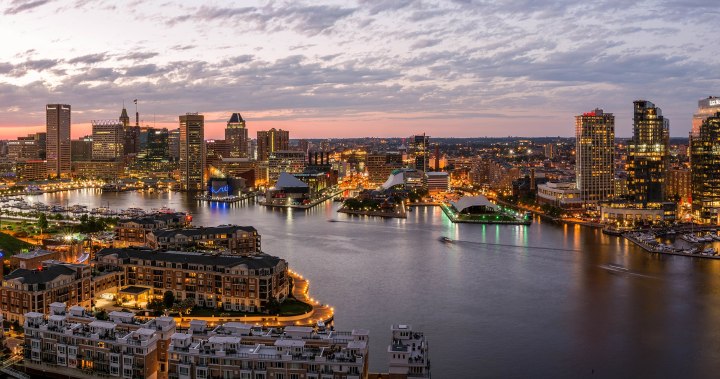
Baltimore’s Inner Harbor
(Photo by Patrick Gillespie, September 2016; Wikimedia Commons)
◊ ◊ ◊ ◊ ◊
Please note that the deadline has been extended to 8 October; you still have time!
2022 American Society for Eighteenth-Century Studies Conference
Hilton Baltimore Inner Harbor, 31 March — 2 April 2022
Proposals due by 8 October 2021 (extended from the original date of 17 September)
Proposals for papers to be presented at the annual meeting of the American Society for Eighteenth-Century Studies, in Baltimore, are now being accepted. Proposals should be sent directly to the session chairs no later than 17 September 2021. Along with our annual business meeting, HECAA will be represented with the Anne Schroder New Scholars Session, chaired by Dipti Khera and Aaron Wile (see #173). A selection of additional sessions that might be relevant for HECAA members is included here. A full list of panels is available as a PDF file here.
Call for Papers | Sequitur (Fall 2021): Aftershock
Sequitur 8.1 (Fall 2021): Aftershock
Submissions and Proposals due by 18 October 2021
The editors of Sequitur, a graduate student journal published by the Department of History of Art & Architecture at Boston University, invite current and recent graduate students to submit content on the theme of Aftershock for our Fall 2021 issue.
For some, this past year and a half was marked by painful experiences. For others, lockdown and physical distancing created opportunities to reevaluate the importance of the social bonds that compose our lives. Since the start of the pandemic, we have experienced history in the making. As we adjust to a ‘new normal’, urgent questions remain about the aftershock of the recent past on our personal and collective experiences. Is the pandemic over; is it yet a thing of the past? How will we and generations to come remember the lost lives, jobs, rituals, and routines?
At this pivotal moment in the fight against the surging Delta variant, and coming on the heels of the tumultuous exit from Afghanistan and the twentieth anniversary of 9/11, we hope to bring together emerging scholarship that considers how art, architecture, and material culture respond to and address the immediate and/or long-term consequences of distressing and traumatic events.
Possible subjects may include, but are not limited to: the after-effects of natural and man-made disasters; social upheavals, economic crises, military conflicts, and unforeseeable events; calamities, and cataclysms; experiences of disorder, trauma, and post-trauma; the fall of civilizations, ruins, decay, and decomposition; structural shifts; monuments, memorials, and forms of commemoration and reparation; pandemics; humanitarian aid and relief efforts; survival and resilience; repairs, recovery, and reconstruction; enduring legacies; rebirth and rejuvenation; reencounters, reconciliations, recomposition of social bonds, and community building; and visions of the future.
We welcome submissions from graduate students in the disciplines of art history, architecture, archaeology, material culture, visual culture, literary studies, queer and gender studies, disability studies, memory studies, and environmental studies, among others, to apply. We encourage submissions that take advantage of the digital format of the journal. Previous issues of Sequitur can be found here.
Founded in 2014, Sequitur is an online biannual scholarly journal dedicated to addressing events, issues, and personalities in art and architectural history. Sequitur engages with and expands current conversations in the field by promoting the perspectives of graduate students from around the world. It seeks to contribute to existing scholarship by focusing on valuable but often overlooked parts of art and architectural history.
We invite full submissions in the following categories:
• Featured essays (1,500 words)
Essays must be submitted in full by the deadline below to be considered for publication. Content should present original material that falls within the stipulated word limit. Please adhere to the formatting guidelines available here.
• Visual and creative essays
We invite M.Arch. or M.F.A. students to showcase a selection of original work. The work must be reproducible in a digital format. Submissions should include .jpegs of up to ten works and must be prefaced by an introduction or artist’s statement of 250 words or less. All images must be captioned and should be at least 500 DPI. We are open to expanding this field to involve various kinds of creative projects.
We invite proposals (200 words max) for the following pieces:
• Exhibition reviews (500 words)
• Exhibitions currently on display or very recently closed are especially sought.
• Book or exhibition catalogue reviews (500 words)
• Reviews of recently published books and catalogues are especially sought.
• Interviews (750 words)
Preference may be given to those who can provide audio or video recordings of the interview. The author must include a full transcript.
• Research spotlights (750 words)
Short summaries of ongoing research written in a more casual format than a formal paper.
When submitting, please remember:
• All submissions and proposals are due by 18 October 2021.
• Direct all materials to sequitur@bu.edu.
• Text must be in the form of a Word document, and images should be sent as .jpeg files. While we welcome as many images as possible, at least one must be very high resolution and large format.
• Please adhere to the formatting guidelines available here.
• Include a recent CV and a brief 50-word bio.
• Include ‘SEQUITUR Fall 2021’ and type of submission/proposal in the subject line, and your name, institution and program, year in program, and contact information in the body of the email.
Authors will be notified of the acceptance of their submission or proposal no later than 22 October 2021, for publication in January 2022. Please note that authors are responsible for obtaining all image copyright releases before publication. If you have any questions, please do not hesitate to contact the Sequitur editors at sequitur@bu.edu.
New Book | Wilton House: The Art, Architecture, and Interiors
From Rizzoli:
John Martin Robinson, with a foreword by William Pembroke, Wilton House: The Art, Architecture and Interiors of One of Britain’s Great Stately Homes (New York: Rizzoli, 2021), 264 pages, ISBN: 978-0847870073, $65.
 An unprecedented tour through the rich interiors and magnificent collections of one of the great houses of the English country landscape, and a treasure of British architectural heritage.
Wilton House in Salisbury, England, has been the ancestral home of the Earl of Pembroke for nearly 500 years and boasts one of the most fascinating and varied histories of all Britain’s historic houses. Shaped over centuries by the most significant names in architecture and interior design, Wilton is known as the finest example of Palladian architecture in England, with interiors by Inigo Jones and John Webb, furniture by William Kent and Thomas Chippendale, and unparalleled collections of both classical sculpture and Old Master paintings–with masterpieces by Raphael, Titian, Rembrandt, and Tintoretto among its rooms.
The book explores the development of the house and its collections, from the Van Dyck paintings in Jones’s remarkable Single and Double Cube state rooms to the Arundel marbles housed in James Wyatt’s Gothic-revival cloisters. With a foreword by the Earl of Pembroke, a revelatory text by the historian John Martin Robinson, and imagery drawn both from Wilton’s private archives and from eminent architectural and interiors photographers, this book lifts the veil on Wilton House and its remarkable history.
John Martin Robinson is a British architectural historian and officer of arms, and Heraldic Advisor to the National Trust. He has published many books on the architecture, interiors, and landscapes of historic British estates, and his writing has appeared in Country Life magazine.
New Book | Country House Collections
From Four Courts Press:
Terence Dooley and Christopher Ridgway, eds., Country House Collections: Their Lives and Afterlives (Dublin: Four Courts Press, 2021), 336 pages, ISBN: 978-1846829758, €50 / $70.
 Country houses have been defined by their contents as much as by their architecture, landscapes, and the families who occupied them. They have boasted assemblies ranging from antiquities, paintings, decorative arts, books and manuscripts, to antiquarian, ethnographic, and scientific collections. Outdoors their gardens were often adorned with collections of other sorts, monuments, sculpture, and horticultural specimens. Rarely have such collections survived intact—sales, destruction, fire, and theft have been repeated occurrences. Country house collecting has been about dispersal as well as acquisition.
The essays in this volume look at a range of country house collections in Ireland, the United Kingdom, the United States, and Continental Europe. They consider how and why collections were amassed and examine their break-ups, and the reasons for such dispersals, whether elective or enforced; they question how the identity of a house changes if its contents have been removed; they consider the afterlives of objects as they moved into the art market, the museum world, or elsewhere; and they deliberate on what happens to a collection once it has begun to be dismembered, and how objects are viewed and understood in new locations by different audiences. Among the other topics considered are the impact of exhibitions, auctions and tax systems, private versus institutional collectors, the range of audiences who appreciate art, and how collections are made to tell national stories.
Terence Dooley is director of the Centre for the Study of Historic Irish Houses and Estates, History Department, Maynooth University. Christopher Ridgway is curator at Castle Howard in Yorkshire.
C O N T E N T S
Foreword by Mary Heffernan
Part I: Assembling and Dispersing
• William Laffan (Independent Scholar) — ‘I thought everyone tries to get pieces out of there, not in’: Collecting for the Irish country house, c.1950–2020
• Terence Dooley (Maynooth University) — Carton House and its contents: Collection and dispersal in context, 1729–1949
• Philip Cottrell (Trinity College Dublin) — ‘A course of wandering picture hunting’: George Scharf ’s survey of English country house collections, 1856–57
• Christopher Ridgway (Castle Howard) — New walls for old pictures: The Castle Howard bequest to the National Gallery
• Elena Porter (Oxford University) — Conspiracies of silence: Contextualizing value at country house contents auctions in inter-war England
• James Miller (Sotheby’s) — The rise and decline of the country house sale, 1977–2020: From Mentmore to Chatsworth, a personal reflection
• Wendy Philips (Sotheby’s) — Checks and balances: Respecting private owners and protecting the national heritage
• Robert O’Byrne (Irish Georgian Society) — The library at Marlfield, Co. Tipperary: Its creation and destruction
Part II: Contexts and Reinterpretations
• Stephen Hague (Rowan University) — ‘It was voted to refurnish the house as far as possible’: Alternate approaches to country house collections in America
• Judith Hill (University of Limerick) — Transforming Farmleigh: From private residence to national treasure
• Christopher Warleigh-Lack (Historic Royal Palaces) — Hillsborough Castle and gardens: Creating a modern collection
• James Rothwell (National Trust) — ‘Selling the family silver’ – and returning it home: The history of plate collections and their display in National Trust houses
• Salvijus Kulevicius (Vilnius University) — Country house collections and museums in Lithuania: A tale of cultural Appropriation
• Lesley Whiteside (Independent Scholar) — Private archives in the Irish country house: A personal perspective
Call for Papers | AAH 2022, London

Sessions of potential interest for folks working on the eighteenth century (see especially the panel chaired by Emma Barker and Carla Benzan); full offersings are available here:
Association for Art Historians Annual Conference
Goldsmiths, University of London, 6–8 April 2022
Proposals due by 1 November 2021
The Association for Art History’s 2022 Annual Conference will take place in London at the world renowned art college, Goldsmiths. Over the three days of the conference, there will be up to 36 live parallel sessions with 4, 6, or 8 papers delivered in each session. All sessions are open to 25-minute paper proposals. Please email your proposal directly to the convenor, including in your proposal a clear paper title, a short abstract (max 250 words), your name, and email. The deadline for paper proposals is 1 November 2021.
◊ ◊ ◊ ◊ ◊
The Artist’s Friend
Jamin An (University of Arkansas, Fayetteville) and Anne Rana (Independent Art Historian), theartistsfriend2022@gmail.com
Being identified as a great friend of artists, or ‘artist’s friend’, often elevates ancillary art historical figures, past and present. For some collectors, critics, curators, dealers—consider broadly drawn examples like Giorgio Vasari, Alain Locke, Gertrude Stein, Daniel-Henry Kahnweiler, Okwui Enwezor or Geeta Kapur—friendship has represented a deep connection with a particular artist or signaled bonds of loyalty and support with many. Notwithstanding its assumed virtue and frequent invocation, the idea of the ‘artist’s friend’ has escaped meaningful definition.
This panel seeks to undertake a critical analysis of the ‘artist’s friend’, examining case studies that leverage friendship as a conceptual model of relation between artists and non-artists. Our inquiry aims to engage the broad theoretical terrain of friendship: its nature and value, the reciprocal self-knowledge and self-formation it cultivates, and the moral quandaries it raises. We welcome interdisciplinary contributions across geography and chronology, and encourage papers that help us consider such questions as:
• What are defining features of friendship with the artist? How is ‘friend’ distinct from positions such as muse, lover, donor, or patron?
• A friend is said to be ‘another self.’ How might we understand artistic identity or the status of the artist from the standpoint of figures who are considered the ‘artist’s friend’?
• When partiality is an essential feature of friendship, how does friendship enrich or complicate scholarship, curating, or criticism, conventionally predicated on distance and impartiality?
• How do friendship’s ethical and moral commitments intersect with the cultural field’s conditions of production, circulation, and legitimation?
◊ ◊ ◊ ◊ ◊
Critical Perspectives on Disability in Art and Visual Culture
Lynn M. Somers (Independent Scholar), lmsomers@mac.com, @lynn_somers
Critical disability studies over the last thirty years have examined systems of power that shape codes of representation within images, objects, collections, and by extension, prevailing historiographies that define the limits of acceptability among human bodies, or what Tobin Siebers calls the ideology of ability. Advancing a theory of complex embodiment, he writes that disability, as a critical social concept, “enlarges our vision of human variation and difference, and puts forward perspectives that test presuppositions dear to the history of aesthetics” (2010: 3). The materiality of art is invested in affective embodiment, and from the classical period onward, historical narratives are rife with bodies deemed beautiful, perfect, and proportionate to their built environments. Although in the 19th and 20th centuries bodily discourses began shifting toward fragmentation, prostheses, and pain, those representations were labeled degenerate by oppressive political institutions. Interdisciplinary and intersectional disability studies—for example, “crip time” (McRuer, 2018) and “misfitting” (Garland-Thomson, 2011)—posit disability as a cultural minority identity (in opposition to medical models centered on individual pathology). These analytics expand the ways artists and scholars approach embodiment as an elastic human continuum. Two volumes on art history and disability (Routledge, 2016, 2021) offer important global correctives to ideologies of agency that have devalued disparate, contingent, and nonconforming embodied subjectivities. This session welcomes transdisciplinary studies of art in all media that (re)figure disability and theoretical approaches that look to enact radical change, reparation, or reforms to sociopolitical and aesthetic constructions of disability at both historical and contemporary moments.
◊ ◊ ◊ ◊ ◊
Towards an Affective History of Art: Vision, Sensation, Emotion
Emma Barker (Open University), emma.barker@open.ac.uk; and Carla Benzan (Open University), carla.benzan@open.ac.uk
Art-historical considerations of instinctive, non-rational forms of human experience tend in two directions. On the one hand, there are contributions that examine the representation of emotion in works of art, as exemplified by the essay collection, Representing Emotions (ed. Penelope Gouk and Helen Hills, 2005). Following a broadly historicist agenda, such contributions are predicated on the assumption that emotions can only be accessed in mediated form, through representational codes. On the other hand, since the publication of David Freedberg’s The Power of Images (1989), scholars have become increasingly concerned with the intense, even visceral, experiences that works of art can elicit from the beholder. Closely associated with the so-called ‘affective turn’ in the humanities and social sciences, this type of approach asserts the primacy of the material and experiential over cultural frameworks. Attempts to bridge the gap between representation and experience by scholars working in the sub-discipline known as the history of the emotions have as yet made only limited use of visual sources (see, for example, the special issue of Cultural History, 7:2, 2018).
This session seeks to build on these various developments in order to realise the as yet unfulfilled promise of an affective history of art. It aims to bridge the gap identified above by investigating the interaction between works of art and beholders with reference not only to visual strategies and sensory experiences but also to discursive articulations and cultural formations. We especially welcome contributions that analyse such interactions with close reference to historically-specific vocabularies of affective experience in the broad period from around 1400 to 1900, such as the humours, passions, sentiments or emotions. Contributions may seek to examine claims for the compelling power of canonical works or, alternatively, to account for the emotional impact of works that no longer move the beholder as they once did. The central aim is to illuminate the changing role that art and visual culture have played in the understanding of affective experience over time.
◊ ◊ ◊ ◊ ◊
Global Anatomies
Keren Hammerschlag (Australian National University), keren.hammerschlag@anu.edu.au; and Natasha Ruiz-Gómez (University of Essex), natashar@essex.ac.uk
Spanning from Andreas Vesalius’ De humani corporis fabrica in the sixteenth century through to Henry Gray’s Anatomy of the Human Body in the nineteenth, European anatomical illustration has a venerated history that has been documented, studied and made the subject of major exhibitions. A few names dominate the historical record—Leonardo da Vinci, William Hunter, George Stubbs, Frank Netter—all men, all white. In the case of some of the most lavishly illustrated anatomical atlases, only the names of the doctors who directed the production are remembered; the men and women who produced the images are relegated to the footnotes, while the names of those pictured are entirely lost to history. The aim of this panel is to re-evaluate and decentre Western anatomical image-making traditions by bringing them into dialogue with different national, cultural and religious understandings of the inside of the human body. These may include Asian, Latin American and Islamic medical and scientific image-making traditions, among others. By developing accounts of human anatomy and its depiction that are global in outlook and scope, we hope to be able to address the following questions: what does anatomical imagery, broadly conceived, reveal about the people who produced it and about how they thought of particular bodies and body types? Is anatomy universal, local or individual? Is the anatomical body stable or shifting? Areas of inquiry may include but are not limited to anatomy and typology; mobility; geography; power; ideology; colonialism; slavery; race; gender; and (the body’s) borders.
Exhibition | Miss Clara and the Celebrity Beast in Art

Rhinoceros, called Miss Clara, bronze, ca. 1750s, 25 × 47 × 15 cm
(Birmingham: Barber Institute of Fine Arts, Purchased 1942, No.42.9)
◊ ◊ ◊ ◊ ◊
Today (22 September) is World Rhino Day. The catalogue for the upcoming exhibition is available from Paul Holberton and (in North America) from The University of Chicago Press:
Miss Clara and the Celebrity Beast in Art, 1500–1860
The Barber Institute of Fine Arts, Birmingham, 12 November 2021 – 27 February 2022
Curated by Robert Wenley
This exhibition tells the fascinating story of the rhinoceros Miss Clara, the most famous animal of the eighteenth century. It is the first ever major loan exhibition devoted to Clara and celebrity pachyderms in the UK. The latest in the Barber’s acclaimed object-in-focus series, Miss Clara focuses on a small bronze sculpture of a rhinoceros, and also considers other celebrity beasts, the emergence of menageries and zoos, and the significance of the capture and captivity of these big beasts within wider academic discussions of colonialism and empire.
‘Miss Clara’ arrived in Europe from the Dutch East Indies in 1741, brought by a retired Dutch East India Company captain, Douwe Mout van der Meer, who then toured her round Europe (including England) to huge acclaim and excitement. Jungfer Clara (so christened while visiting Würzburg in 1748) was the first rhino to be seen on mainland Europe since 1579 and the object of great wonder and affection. Her fame generated a massive industry in souvenirs and imagery from life-scale paintings by major masters to cheap popular prints; there were even Clara-inspired clocks and hairstyles.
Miss Clara is one of the most remarkable and best-loved sculptures in the Barber and was praised by the great German art historian and museum director Wilhelm von Bode as “the finest animal bronze of Renaissance”—a telling tribute to its quality, even if he misunderstood its date. The Barber’s cast is one of only two known, the other being at the V&A. There are also closely related marble versions. Other celebrity beasts featured will include the elephants Hansken, Chunee, and Jumbo; Dürer’s and various London rhinos; and the hippo Obaysch, star of London Zoo in the 1850s, and the first to be seen in Europe since the fall of the Roman Empire.
Robert Wenley, ed., with Charles Avery, Samuel Shaw, and Helen Cowie, Miss Clara and the Celebrity Beast in Art, 1500–1860 (London: Paul Holberton Publishing, 2021), 96 pages, ISBN: 978-1913645021, £17 / $25.
 The catalogue looks at the phenomenon of Clara but, unlike previous studies of the subject, focuses primarily on sculptural/3D representations of her, within the context of other celebrity pachyderms represented by artists between the 16th and 19th centuries. It is comprised of entries for the thirty exhibits—included extended texts by Dr Helen Cowie (York University) on images of Chunee and Obaysch—preceded by three essays. Robert Wenley, Deputy Director of the Barber Institute, and the curator of the exhibition, relates the story of Miss Clara (and of other celebrity rhinos) and explores the sculptural representations of her, presenting new research into their attribution and dating. The eminent sculptural historian, Dr Charles Avery, formerly of the V&A Museum and Christie’s, provides a complementary essay about celebrity elephants in Europe between 1500 and 1700. Dr Sam Shaw of the Open University, discusses private menageries and public zoos in the UK between about 1760 and 1860 and considers celebrity pachyderms as emblems of empire and colonialism.










 Enfilade
leave a comment