Frick Announces Its Most Significant Gift of Drawings and Pastels
Press release (30 August 2021) from The Frick:

Elisabeth Vigée Le Brun, Head of a Woman, 1784, pastel on paper, 12 x 10 inches (New York: Frick Collection, promised gift from the Collection of Elizabeth and Jean-Marie Eveillard; photo by Joseph Coscia Jr.).
The Frick Collection announces the largest and most significant gift of drawings and pastels in its history, thanks to the generosity of Elizabeth ‘Betty’ and Jean-Marie Eveillard. Over the past forty-five years, the Eveillards have assembled an outstanding collection of European works on paper, ranging in date from the end of the fifteenth century to the twentieth century and representing artists working in France, Britain, Italy, Spain, and the Netherlands. The Eveillards have made a promised gift to the Frick of twenty-six of these works—eighteen drawings, five pastels, two prints, and one oil sketch—among them some of their finest acquisitions. Along with preparatory figurative sketches and independent studies and portraits are two vivid landscape scenes. Fittingly for the Frick, artists represented include François Boucher, Edgar Degas, Jean-Honoré Fragonard, Francisco José de Goya y Lucientes, Thomas Lawrence, and Jean-François Millet. The group also introduces to the Frick’s holdings works by artists not yet represented in its primary collecting areas, including Gustave Caillebotte, Maurice Quentin de La Tour, Jan Lievens, John Singer Sargent, and Elisabeth Vigée Le Brun. In the fall of 2022, at its temporary Frick Madison location, the museum will present an exhibition of these extraordinary works, to be accompanied by a catalogue and public programs.
François Boucher, Reclining Shepherdess (La bergère au Coeur), ca. 1753; black, red, and white chalk and blue, light blue, red, pink, and yellow pastel with touches of grey watercolor washes and possibly some traces of graphite on paper; 16 × 19 inches (New York: Frick Collection, promised gift from the Collection of Elizabeth and Jean-Marie Eveillard; Photo by Joseph Coscia Jr.).
Comments Xavier F. Salomon, the Frick’s Deputy Director and Peter Jay Sharp Chief Curator, “It has been a pleasure studying and selecting from this remarkable collection of two longtime supporters of the Frick, assembled just as our own holdings have been, according to criteria of beauty, quality, and condition. Each of the twenty-six works either appreciably deepens our holdings of a familiar artist or brings to us the work of one who is not—but should be—represented within our core areas of European Old Master art. In adding five pastels and an oil sketch, the gift also strengthens our examples of these media. We very much look forward to sharing these works with the public next year.” Betty and Jean-Marie Eveillard have been deeply involved with the Frick for many years, both having served as Trustees. Betty is currently the Board’s Chair.
The Eveillards acquired their first important work in 1975, John Singer Sargent’s Virginie Amélie Avegno, Mme. Gautreau (Mme. X), and have been active collectors ever since. This drawing is the most modern work in the promised gift to the Frick and is a particularly satisfying addition to the museum’s holdings: It is known from archival correspondence that Henry Clay Frick desired a portrait by Sargent but did not succeed in securing a sitting with the artist. Dated to about 1884, Sargent’s Mme. Gautreau is one of some dozen studies produced for the famous painted portrait Madame X, a highlight of the collection of The Metropolitan Museum of Art. This sheet shows the artist working out the figure’s pose, representing her lithe figure kneeling on a sofa and looking out a window. Sargent was captivated by Gautreau and strived in studies like this and in the final painting to capture her “unpaintable beauty and hopeless laziness.”
Other later nineteenth-century drawings coming to the Frick are by Degas and Caillebotte, selected to complement the collection’s Impressionist paintings. While the institution owns a quintessential Degas canvas of dancers, the Eveillards’ early drawing of Adelchi Morbilli, created in Naples in 1857, will be the first work on paper by the artist in the Frick’s collection. It is one of—and arguably the best of—his series of drawings of his cousin. When it was drawn, Degas was particularly interested in the work of Jean-Auguste-Dominique Ingres, and the portrait reflects this affinity. Gustave Caillebotte is best known and perhaps most celebrated for his 1877 painting at Chicago’s Art Institute, Paris Street, Rainy Day. A man of wealth, Caillebotte was also a patron and supporter of fellow Impressionist colleagues. His works only rarely appear on the market, most still being in the possession of his descendants. The promised gift includes a preparatory drawing for the iconic Paris street scene.

François Boucher, Reclining Shepherdess (La bergère au Coeur), ca. 1753; black, red, and white chalk and blue, light blue, red, pink, and yellow pastel with touches of grey watercolor washes and possibly some traces of graphite on paper; 16 × 19 inches (New York: Frick Collection, promised gift from the Collection of Elizabeth and Jean-Marie Eveillard; photo by Joseph Coscia Jr.).
Eighteenth-century French art is one of the Frick’s strengths, with holdings by Boucher, Fragonard, Greuze, and Watteau. The gift brings to the museum works in chalk and pastel on paper by these four artists, media in which none of them is currently represented. Among these is a pastel drawing lauded by the influential writers Edmond and Jules Goncourt as one of the most beautiful by Boucher. The image of a reclining woman is associated with a pastoral painting now at the Louvre. Young Woman (La Coquette) by Fragonard is one of a series of spectacular drawings of female models standing outdoors. These were made in the early 1770s, contemporaneous with his creation of the four original canvases of The Progress of Love that today are a highlight of the Frick. The most renowned—and arguably the best—pastelist in eighteenth-century France was the eccentric Maurice Quentin de La Tour. The Eveillards have the finest pastel by him in private hands in the United States, the portrait of Madame Rouillé. It too comes to the Frick along with a sheet by De La Tour’s near contemporary Nicolas Lancret, neither of whom is currently represented at the museum in any medium. Widely traveled and celebrated during her life, Elisabeth Vigée Le Brun was a highly accomplished portraitist and writer. Her work also enters the collection with Head of a Woman, a sketch signed and dated 1784 and likely made in preparation for a history painting that was never executed. The scope of the institution’s French works is broadened further with sheets by Pierre-Paul Prud’hon and Jean-Baptiste Wicar.
Painter Eugène Delacroix was among those artists to herald French Romanticism. In 2010, former Frick Director Charles Ryskamp left to the Frick the artist’s Moroccan Interior, a delicate and personal drawing from one of the sketchbooks Delacroix made in 1832 during a visit to North Africa. The Eveillard gift includes a pastel by the artist depicting two North African figures in a landscape, based on sketches made two decades later. Of the twenty known Delacroix pastels of such subjects, only a dozen can be located today; the Eveillard sheet is the only one in private hands, making this acquisition a particularly rare occurrence.
The Frick is also celebrated for Spanish art, including five works by Goya: four paintings and one drawing, The Anglers. The Eveillards’ Tambourine Player will deepen the institution’s holdings by the artist. This depiction of a dancing Spanish man comes from the same album as the aforementioned drawing and likewise exemplifies the artist’s use of everyday people as subjects, as is also the case with the Frick’s large Goya painting of laborers, The Forge.
Other works in the gift enrich the Frick’s celebrated collection of Italian works, with sheets ranging from a rare anonymous fifteenth-century Venetian drawing to Italian Renaissance and Baroque sheets by Federico Barocci, Guido Reni, and Salvator Rosa and eighteenth-century works by Giovanni Battista Piazzetta and Giovanni Domenico Tiepolo. The group includes two remarkable portraits by Jan Lievens, the Dutch contemporary of Rembrandt, and by Sir Thomas Lawrence, the leading British portraitist of his age. As a young collector, Henry Clay Frick was particularly interested in the Barbizon school, and a drawing by Jean-François Millet, one of the movement’s founding members, will also enter the collection through this generous gift. The landscape joins a genre scene by Millet already in the collection. Crowning this remarkable group of works is an oil sketch by John Constable, made in preparation for the last of the artist’s famous series of ‘six-footer’ paintings, of which The White Horse at the Frick was the first.
Exhibition | Virginia Lee Montgomery: Sword in the Sphinx

Virginia Lee Montgomery (VLM), Sword in the Sphinx, 2018, resin, steel, rust, concrete, enamel. As installed at Socrates Sculpture Park, Queens, New York in 2018.
◊ ◊ ◊ ◊ ◊
Opening this month at Meijer Gardens and Sculpture Park:
Virginia Lee Montgomery: Sword in the Sphinx
Frederik Meijer Gardens & Sculpture Park, Grand Rapids, Michigan, 16 September — 31 October 2021
The figure of the sphinx originated as an ancient Egyptian and Greek mythological monster. The sphinx with a female head and upper body and with lion’s legs became a popular garden statue in 18th-century Europe. Its features resembled that of Madame Pompadour, the French patron of the arts and chief mistress of King Louis XV. In Sword in the Sphinx, VLM adopts the Pompadour-style sphinx with a shocking twist: her back is pierced with a steel sword. Known for combining surrealism and feminism, VLM asks provocative questions about the representation of female power in art, adding another layer of meaning to a mythical figure with a complex history. Sword in the Sphinx is VLM’s official entry in the 2021 ArtPrize competition.
Marble Ponytails, the smoothly carved and polished marble ponytails, installed in the Courtyard Level, are named after ancient deities, among them Aurora, Andromeda, and Medusa. VLM asks us to dissociate these forms from masculine phallocentric readings, shifting perspective toward what she calls “feminist metaphysics.” VLM carved these sculptures by hand at the historic West Rutland Marble Quarry, on a fellowship through The Vermont Carving Studio and Sculpture Center.
Two of VLM’s short films are also being screened in the O-A-K Theater.
◊ ◊ ◊ ◊ ◊
Virginia Lee Montgomery (VLM), CUT COPY SPHINX, 2018, digital video, 3minutes 30seconds. “A surreal, sculptural short art-film about metaphysics, myth, and destruction. A feminist twist on the classical myth of Oedipus and the Sphinx, CUT COPY SPHINX recasts the sphinx as the uncanny hero who endures ‘cuts’ across time. Shot en plein aire on a miniature prop-set with a Dewalt drill and a gallon of honey, CUT COPY SPHINX syncs philosophy, feminism, and image theory. The film is directed, edited, scored, and performed by the artist, VLM” (description from Vimeo).
◊ ◊ ◊ ◊ ◊
Responding to a 2018 installation of Sword in the Sphinx at Socrates Sculpture Park in Queens, New York, Wendy Vogel describes the video CUT COPY SPHINX:
“A video for the park’s website dramatizes how an eighteenth-century sculpture of Madame de Pompadour as a sphinx, the authorship of which is disputed, has been copied for centuries in decor and knickknacks. A response to the #MeToo movement, Montgomery’s work upends the masculine bravado of the tales of King Arthur and Oedipus. ‘In the myth, Oedipus kills the sphinx’, Montgomery says, ‘but in my version she just keeps replicating’.”
–Wendy Vogel, “First Look: Virginia Lee Montgomery,” Art in America (October 2018).
Symposium | Everyday Rococo: Madame de Pompadour and the Arts
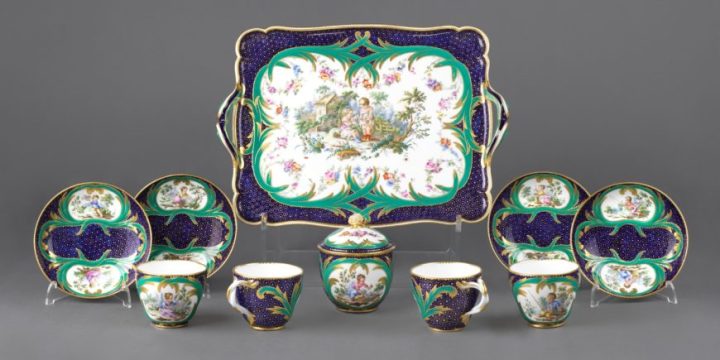
Tray and Tea Service (déjeuner ‘Courteille’, four gobelets ‘Hébert’ et soucoupes, pot à sucre ‘Bouret’), Manufacture de Sèvres, soft-paste porcelain, painted and gilded, lapis and green ground painted with children in landscapes by André-Vincent Vielliard, date letter F for 1759; probably bought by Mme de Pompadour in December 1759 (London: The Wallace Collection, C401-06).
◊ ◊ ◊ ◊ ◊
From The French Porcelain Society:
Everyday Rococo: Madame de Pompadour and the Arts
The Wallace Collection, London, 3–4 December 2021; rescheduled for 1–2 July 2022
The French Porcelain Society is pleased to announce its forthcoming symposium Everyday Rococo: Madame de Pompadour and the Arts to be held at the Wallace Collection, London, on 3–4 December 2021. With two days of papers, which we hope will also be available online, this will be the first reassessment of Jeanne-Antoinette Poisson’s artistic patronage since the landmark exhibition Madame de Pompadour et les Arts of 2002.
Commemorating the tercentenary of her birth, and marking the publication of Rosalind Savill’s book Everyday Rococo: Madame Pompadour and Sèvres Porcelain, this conference will welcome international experts discussing her interests in the fine and decorative arts from pets to porcelain and from prints to religious paintings. Further details will follow in the autumn, but please save the dates: Friday 3rd and Saturday 4th December.
New Book | Everyday Rococo
Scheduled for publication in October:
Rosalind Savill, Everyday Rococo: Madame de Pompadour and Sèvres Porcelain (London: Unicorn Press, 2021), 704 pages, ISBN: 978-1916495715, £200.
 Jeanne Antoinette Poisson (1721–1764), Marquise de Pompadour, the 300th anniversary of whose birth will be celebrated on 29 December 2021, became the official mistress of Louis XV of France in 1745, and for the rest of her life their patronage of Vincennes/Sèvres helped to make it one of the greatest porcelain factories in history. Everyday Rococo: Madame de Pompadour and Sèvres Porcelain is a year-on-year richly-illustrated chronology of her daily life and purchases. Although also partly a social history revealing Madame de Pompadour as a major player in the art and politics of eighteenth-century France, Rosalind Savill’s diligent research has concentrated on the everyday details of Madame de Pompadour’s life for which Vincennes/Sèvres catered so perfectly.
Rosalind Savill, DBE, FBA, FSA, was Director of the Wallace Collection in London from 1992 until 2011, and is a specialist in French decorative arts, especially Sèvres porcelain. Her major publication, The Wallace Collection: Catalogue of Sèvres Porcelain, 3 vols, 1988, was awarded the National Art-Collection Fund prize for Scholarship in 1990. She was appointed CBE for Services to the Study of Ceramics in 2000, won the European Woman of Achievement Award (Arts and Media) in 2005, was appointed DBE for Services to the Arts in 2009, and was appointed an Ocier dans L’Ordre des Arts et des Lettres, France, in 2014. She co-curated the exhibition The Art of Love: Madame de Pompadour at the Wallace Collection in 2002.
Online Tour | European Porcelain at Villa Cagnola
Online this Sunday from the French Porcelain Society:
Alessandro Biancalana, European Porcelain at Villa Cagnola
FPS Living Room Lecture, 5 September 2021, 18.00 (BST)
 The French Porcelain Society is delighted to continue its online lectures with a very special private tour of Villa Cagnola, north of Milan. Alessandro Biancalana will discuss some highlights from the vast collection of European porcelain in the villa, including Doccia, Meissen, and Capodimonte. He will be joined during the Q&A session by director Don Eros Monti and curator Andrea Bardelli. We hope you can join us. For free links, please email FPSmailing@gmail.com.
“I would define Villa Cagnola not as a house museum in the strictest sense of the term, but rather as a Wunderkammer. Among its numerous treasures, including naturalia, porcelain plays a leading role: it is a composite collection, which has the eighteenth century as leitmotif, bringing together pieces from different manufactories all of them of high quality. Walking along Villa Cagnola’s rooms and looking at the showcases full of objects fascinates the visitor who travels between decorative systems and shapes that are different from each other: the most important European centres of production are represented with Meissen, Doccia, and the most relevant Venetian factories. I hope our journey is stimulating and a source of curiosity.” –Alessandro Biancalana
At Sotheby’s | Oppenheimer Meissen Collection

Lot 78: A unique Meissen armorial waste bowl from the service made for Clemens August, Elector of Cologne, ca. 1735, 18 cm diameter.
Estimate: $40,000–60,000.
◊ ◊ ◊ ◊ ◊
From the press release, via Art Daily (27 August 2021) for the Oppenheimer sale:
Sammlung Oppenheimer | Important Meissen Porcelain
Sotheby’s New York, 14 September 2021
Sotheby’s announces highlights from one of the greatest pre-war collections of Meissen porcelain to appear at auction in more than 60 years. Meticulously assembled by Dr. Franz and Margarethe Oppenheimer in the early decades of the 20th century, this exquisite group of 117 lots is among the most significant ensembles of early 18th-century Meissen porcelain from Europe’s first porcelain manufactory—many of which are distinguished by illustrious royal and noble provenance, including pieces from the collection of Augustus the Strong, Elector of Saxony and King of Poland, and founder of the Meissen porcelain factory. Presented in a dedicated live auction on 14 September in New York, the collection is poised to achieve more than $2 million, with individual estimates ranging from $300 to $400,000 and approximately one third of the lots offered without reserve.
All of the works on offer will be on view in Sotheby’s York Avenue galleries beginning 7 September, ahead of the live auction.
The Collection
Franz and Margarethe Oppenheimer were connoisseur collectors, determined to build a magnificent Meissen collection at a time when it was still possible to acquire important pieces as they were being deaccessioned from the royal collections in Dresden. Dr. Franz Oppenheimer, a native of Hamburg, was a lawyer and became part owner and CEO of Emanuel Friedlaender und Co, a private company that dominated the Silesian coal industry before World War II. Margarethe, whom he married in 1902, was born in Vienna and was his partner in building their porcelain collection.

An Oppenheimer family portrait from the mid-1930s (Sotheby’s).
The couple lived in a grand apartment block on Regentenstrasse in Berlin, immediately next to the Tiergarten—the heart of Berlin’s collecting community in the early 20th century. In 1927, like many serious Berlin connoisseurs, the couple commissioned a private catalogue of their collection to be written by Professor Ludwig Schnorr von Carolsfeld, curator of the nearby Berliner Schlossmuseum. Professor von Carolsfeld catalogued 240 sets and individual pieces of porcelain, a number of which are featured in the September sale. The couple continued to collect after the 1927 catalogue and added at least 126 objects to their holdings, each of which were marked with red inventory numbers.
Once the Nazis came to power Franz Oppenheimer was persecuted because of his Jewish origins. As a consequence, in around December 1936, he and Margarethe fled from Berlin to the comparative safety of Vienna, having paid punitive emigration taxes to the Nazi Government. They rented an apartment close to the Belvedere in Vienna’s third district and were able to take some possessions, including part of their Meissen collection, with them.
The couple’s exile in Vienna did not last long. German troops entered Austria on 12 March 1938, and Adolf Hitler proclaimed the Anschluss of Austria into Germany the following day. The Oppenheimers escaped to Budapest the day before the Anschluss carrying only hand luggage. From Hungary they travelled via Sweden and Colombia before finally reaching their new home in New York three and a half years later—in December 1941. By 1941, their resources had been further eroded by another tranche of Flight Tax that they had to pay to emigrate from Austria. The couple chose to spend the remainder of their lives in an apartment on East 86th Street in Manhattan, just a few blocks from Sotheby’s present-day headquarters.
The Nazi authorities confiscated everything that they found in the Oppenheimers’ Vienna apartment but discovered that the collectors had succeeded in removing at least two crates of their most valuable porcelain before their flight. It is likely that some of the porcelain in this sale was smuggled out of Vienna to keep it out of Nazi hands. It is not known precisely when the objects in this sale were lost to the Oppenheimers, however they were with their next owner, another great connoisseur-collector and an active opponent of the Nazi regime, Fritz Mannheimer, before his premature death in 1939.
Mannheimer was born in Germany in 1890 and moved as a young man to Amsterdam where he established the Dutch branch of the Berlin based Mendelssohn Bank in 1920. In less than 20 years, he built both a thriving bank and an art collection of outstanding breadth and quality. Like the Oppenheimers, he commissioned a scholar, Otto von Falke, late director of the Berlin Kunstgewerbemuseum, to catalogue his collection. The porcelain in this sale was all acquired after von Falke completed his work in March 1936.
After Kristallnacht, on 9 November 1938, the Mendelssohn Bank was shuttered by the Nazis and Fritz Mannheimer lost its collaboration, and its balance sheet, for his Amsterdam bank. While Mannheimer kept trading, his last major deal was the refinancing of a part of the French National debt in 1939; this failed—partly due to the deteriorating political situation in Europe—and the young banker was obliged to buy back unplaced French bonds at his own expense. This triggered a severe liquidity crisis for his bank and for himself. On 8 August 1939, in the midst of the bank’s crisis, Mannheimer left for a break in France. Upon his arrival in Vaucresson, he suffered a massive heart attack and died only a few hours later.
Mannheimer’s bank stopped its operations immediately after his death. An audit showed the bank carried a large debt of over 42 million guilders, for which the collector’s personal estate was jointly liable. Experts from the Rijksmuseum were brought in and valued the art collection at six and a half million guilders and Mannheimer’s executors decided to liquidate it as a contribution to the Bank’s losses. A member of the SS based in Holland acquired the collection for Adolf Hitler in 1941.
As Allied bombing placed the Führer’s art holdings in peril, the Meissen that had been acquired from Mannheimer’s estate was moved for safe keeping first to Vyšší Brod Monastery in Bohemia and later to the salt mines in Bad Aussee. The porcelain was eventually discovered by Allied Monuments Officers and was transferred to the Central Collecting Point in Munich in 1946. The collection was sent back to the Netherlands between 1945 and 1949. After the recovery of the Mannheimer Collection, the collector’s executors did not seek restitution, as they would have been obligated to refund the price paid by the Führer’s curators, and the collection passed into Dutch State holdings. Of the porcelain, some was held as property available for restitution and some was transferred to the Rijksmuseum.
Earlier this year the Restitution Commission of the Netherlands accepted that the porcelain in this sale that had belonged to the Oppenheimers must be restituted to their heirs.
Auction Highlights
The collection of Franz and Margarethe Oppenheimer exemplifies their penchant for chinoiserie taste, an all-encompassing term from the Victorian era that was applied to pseudo-Asian forms and decorations invented in Europe from the 17th century onward, in response to the exoticism and novelty of contemporary Asian imports. The origins of many of the pieces collected by the Oppenheimers can be associated with royal commissions for Meissen porcelain to decorate the interiors of Augustus the Strong’s colossal ‘porcelain palace’, conventionally known as the Japanese Palace, on the banks of the river Elbe in Dresden-Neustadt.

Meissen mantel clock case, 1727, the gilt-bronze mount probably German, mid-18th century, the movement signed Barrey à Paris, ca. 1700, 44 cm. high.
The September auction is led by an important Documentary and Dated Meissen Mantel Clock Case from 1727 (lot 64)—undoubtedly the rarest piece in the Oppenheimer Collection and illustrative of the Chinoiserie style they so loved (estimate $200–400,000). This magnificent Meissen clock case can be counted among the most ambitious and successful of sculptural models produced at the factory at this early date. The Oppenheimers were able acquire the clock case after it had passed through two prestigious 19th-century English collections, at some point between 1923 and 1927. The present clock was originally owned by Ralph Bernal, a politician and discerning art collector, who later became president of the British Archaeological Society in 1853 and whose collection garnered the attention of prestigious museums and connoisseurs alike, including the Rothschilds, the Marquess of Hertford, Marlborough House, the South Kensington Museum, the Tower Armory, and the British Museum. Sir Anthony de Rothschild acquired this particular clock in April 1855 for £120.
At least five varying clock case models were produced at Meissen in the late 1720s and early 1730s, and one can presume that Meissen clocks from this date were intended for the royal industry’s principal client and patron, Augustus the Strong, and were to be included in the rooms of the Japanese Palace. According to the 1733 Specification von Porcilan—a listing of the Meissen porcelain ordered for the Japanese Palace, though not necessarily produced—a total of fourteen clocks were ordered. The dating of this compilation—the year of Augustus the Strong’s death—is largely a reflection of the initial orders of the late 1720s. The fourteen clocks were allocated to four rooms in the piano nobile, and it is even known exactly where on the walls the clocks were intended to be placed. Only five clocks of this model appear to have survived by the early 20th century, each with slight variations in the modeling, rendering all of them unique. Of the five, two are in museum collections: in the Hermitage in St. Petersburg and the Hetjens-Museum in Düsseldorf.
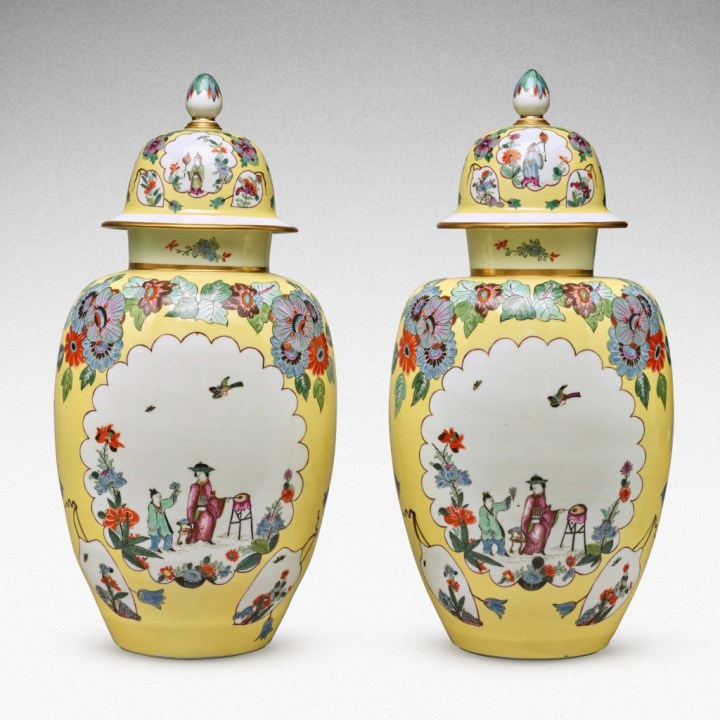
Lot 104: Pair of Meissen Augustus Rex yellow-ground baluster vases and covers, ca. 1735, 47 cm and 46.2 cm high.
Estimate $150–250,000.
◊ ◊ ◊ ◊ ◊
A Pair of Meissen Augustus Rex Yellow-Ground Baluster Vases and Covers further distinguishes the offering (estimate $150–250,000). According to the 1733 Specification, ‘Hoch-Gelb-Couleur’, or deep-yellow-color, Meissen porcelain was allocated to so-designated Room 3 of the Japanese Palace, in between rooms for seladon, a shade of green, and dark-blue-ground Meissen porcelains. This large order of yellow-ground porcelain included approximately 267 vases, bottles and beakers, including six garnitures formed of seven vases and two garnitures formed of five vases, among other pieces. A yellow-ground ogee vase decorated in the same manner and formerly in the Royal Collections of Saxony, Dresden, may once have formed a garniture with the present vases. That vase, missing since 1945, was originally installed in the tower room of the Royal Palace. In addition, the somewhat unusual leaf-form cartouches seen on the present vases are recorded on Chinese Kangxi vases, examples of which were in Augustus the Strong’s collection, now in the Porzellansammlung, Dresden.
A very rare Pair of Meissen Augustus Rex Underglaze Blue-Ground Beaker Vases are also in the sale (estimate $70,000–100,000). An unusual feature of the present pair of vases is the use of two alternating different green enamels on the cartouches, the significance of which is uncertain and invites further research. One possibility is that painters worked in their own personalized enamel palettes which could indicate two different hands painted these vases. The same feature is seen on a smaller underglaze blue-ground vase of this form, in the collection of the Porzellansammlung, Dresden.
An extremely rare and probably unique Pair of Meissen Augustus Rex Hexagonal Vases and Covers, likely to be the only pair of Meissen vases of this type recorded in literature, also highlights the September sale (estimate $80,000–120,000). While the 18th-century provenance of these vases remains unknown, the survival of at least three rare red-anchor Chelsea porcelain vases, ca. 1752–56, which appear to be direct copies, suggests a possible English ownership by the mid-18th century. Whilst it cannot be proven with certainty, it seems probable that the Chelsea porcelain factory had access to the present vases. A potential 18th-century owner of the vases is Sir Charles Hanbury Williams, who was British Envoy to the Saxon Court between 1747–49 and 1751–54.
An extremely rare Pair of Meissen Augustus Rex Underglaze-Blue-Ground Beaker Vases round out this spectacular group (estimate $80,000–120,000). After the death of Augustus the Strong, beaker vases of this type were sent to the Dresden residence to be installed in the Turmzimmer. A remarkable early series of photographs show how the Meissen porcelain was displayed in Turmzimmer and shows surviving vases of this form. A powder blue beaker vase of this form and size, which features the same painted floral band at the center, remains in the Porzellansammlung, Dresden, while another is in the Reiss-Museum, Mannheim. The Oppenheimers acquired these vases separately and only owned one by 1927.
Additional highlights from the sale include: a very rare Meissen Augustus Rex Large Seladon-Ground Vase (estimate $50,000–70,000), likely one of five large Meissen porcelain bottle vases in this color that were listed as delivered to the Japanese Palace in December 1737; a unique Meissen Armorial Waste Bowl from the Service Made for Clemens August, Elector of Cologne (estimate $40,000–60,000), a smaller version of which is now in the Museum für Angewandte Kunst, Cologne, together with other pieces from the service; and an extremely rare Meissen Famille Verte Goblet (estimate $50,000–70,000), one of only five or six pieces of Meissen porcelain painted in this distinctive style that appear to be recorded.
Sweden Nationalmuseum Acquires Louis Masreliez’s Allegory of War

Louis Masreliez, An Allegory of War, ca.1790–92, oil on canvas, 93 × 132 cm
(Stockholm: Nationalmuseum)
◊ ◊ ◊ ◊ ◊
The American war in Afghanistan ends after two decades. This painting sold at Christie’s New York in April of this year (Sale 19739, Lot 63). From the Nationalmuseum press release (26 August 2021) . . .
Nationalmuseum has acquired An Allegory of War, a painting by Louis Masreliez originally intended to be one of two overdoor pieces for King Gustav III’s bedchamber in the royal palace in Stockholm. The work is of major significance, marking a transition in the artist’s oeuvre from epic historical scenes to more decorative works.
As one of the leading painters and interior designers of the Gustavian period, Louis Masreliez (1748–1810) was equal to the task. Born in Paris, he arrived in Stockholm at the age of five when his father, the ornamental sculptor Adrien Masreliez, was hired to work on the new palace. Young Louis soon proved to be something of an artistic child prodigy. He received the best possible education, which culminated in 1769 in a travel scholarship. Via Paris he travelled to Rome, where he studied for the next 12 years. In this cosmopolitan environment Masreliez mixed with the leading artists of the time, found his niche in the emerging neoclassical style, and drew many studies of Classical and Renaissance motifs to serve as reference material.
On returning to Stockholm in 1782, Masreliez was well equipped to oversee the redecoration of Gustav III’s private apartment at the palace in keeping with contemporary neoclassical interior design trends. Neoclassicism blended the grotesque decorative style of the Renaissance with features inspired by ancient Rome. The best-known example in Sweden today is the interior decoration of Gustav III’s pavilion at Haga. Meanwhile, Masreliez also had a solid grounding in historical painting, the task he was originally destined for in the service of the crown. Here too, he combined various influences from the great masters, all packaged in an elegant neoclassical form. This can be clearly seen in An Allegory of War.
It is conceivable that Gustav III himself chose the subject matter for the two overdoor paintings in his bedchamber. The king was heavily involved and had his own ideas regarding the interior decoration of royal properties, as contemporary sources attest. An Allegory of War and its counterpart, An Allegory of Peace, would promote the image of the king as defender of the realm and ultimate guarantor of peace. The topic was highly relevant, as the works were created in the immediate aftermath of Sweden’s 1788–90 war against Russia. An Allegory of War depicts Minerva alighting from her horse-drawn chariot, holding a shield in one hand and the lightning bolt of Zeus in the other. Above her hovers Boreas, god of the north wind, accompanied by winged zephyrs with snowflakes emanating from their mouths. It is both a dramatic composition and an unusually powerful painting with its grand, sweeping lines. The somewhat explosive colour palette, dominated by earth tones and martial red, reinforces the subject matter.
From an inscription on a preliminary sketch by Masreliez, we know that this image represented the Swedish victory at the battle of Narva in 1700, an event to which Gustav III frequently alluded, since it had secured Sweden’s position as a great power for some years. If Karl XII was explicitly presented here as the warrior king, then Gustav III would implicitly be the prince of peace in the counterpart image. A preliminary study in oils for An Allegory of Peace has been in Nationalmuseum’s collection since 1917. It is believed the ensemble was never completed following the king’s death in 1792, and instead the artist retained ownership of the works.
Nationalmuseum receives no state funds with which to acquire design, applied art and artwork; instead the collections are enriched through donations and gifts from private foundations and trusts. Thanks to a generous donation from the Friends of Nationalmuseum, the museum has been able to repatriate the magnificent Masreliez work to Sweden.
New Book | Invisible Enlighteners: The Jewish Merchants of Modena
From Penn Press:
Federica Francesconi, Invisible Enlighteners: The Jewish Merchants of Modena, from the Renaissance to the Emancipation (Philadeaphia: University of Pennsylvania Press, 2021), 400 pages, ISBN: 978-0812253146, $80 / £64.
 Federica Francesconi writes the history of the Jewish merchants who lived and prospered in the northern Italian city of Modena, capital city of the Este Duchy, during the seventeenth and eighteenth centuries. Her protagonists are men and women who stood out within their communities but who, despite their cultural and economic prominence, were ghettoized after 1638. Their sociocultural transformation and eventual legal and political integration evolved through a complex dialogue between their Italian and Jewish identities, and without the traumatic ruptures or dramatic divides that led to the assimilation and conversion of many Jews elsewhere in Europe.
In Modena, male and female Jewish identities were contoured by both cultural developments internal to the community and engagement with the broader society. The study of Lurianic and Cordoverian Kabbalah, liturgical and nondevotional Hebrew poetry, and Sabbateanism existed alongside interactions with Jesuits, converts, and inquisitors. If Modenese Jewish merchants were absent from the public discourse of the Estes, their businesses lives were nevertheless located at the very geographical and economic center of the city. They lived in an environment that gave rise to unique forms of Renaissance culture, early modern female agency, and Enlightenment practice. New Jewish ways of performing gender emerged in the seventeenth century, giving rise to what could be called an entrepreneurial female community devoted to assisting, employing, and socializing in the ghetto. Indeed, the ghetto leadership prepared both Jewish men and women for the political and legal emancipation they would eventually obtain under Napoleon. It was the cultured Modenese merchants who combined active participation in the political struggle for Italian Jewish emancipation with the creation of a special form of the Enlightenment embedded in scholarly and French-oriented lay culture that emerged within the European context.
Federica Francesconi is on the faculty of History and is the Director of the Judaic Studies Program at the University at Albany, State University of New York.
C O N T E N T S
Note on Spelling, Translations, and Currency
Introduction
1 A Network of Jewish Families in the Early Modern Period: The Road Toward Ghettoization
2 Jewish Leaders, Their Circles, and Their Books Before the Inquisition: A Parallel Story
3 The Jewish Household: Family Networks, Social Control, and Gendered Spaces
4 The ‘Invisible’ Wealth of Silver: The Journey of the Formigginis from the Ghetto to the Ducal Court
5 Jewish Female Agency in the Ghetto Mercantile Elite
6 The Jewish Urban Geography of the Ghetto and Beyond
7 Moisè Formiggini Before Napoleon: Two Steps Toward Emancipation and One Step Back
List of Abbreviations
Notes
Bibliography
Index
Acknowledgments
New Book | Places of Worship in Great Britain, 1689–1829
Published earlier this year by Shaun Tyas:
P. S. Barnwell and Mark Smith, eds., Places of Worship in Great Britain, 1689–1829 (Donington, Lincolnshire: Shaun Tyas, 2021), ISBN: 978-1907730887, £40.
 This book, the sixth in a series on places of worship in Britain and Ireland, contains eleven essays on a period of relative calm after the radical changes during the previous reformations and civil wars. The dates are set by the Act of Toleration from the new government of William and Mary and the Catholic Emancipation Act of 1829. The period saw a renewed emphasis on auditory worship, preaching, and a new social conscience marked by educational and welfare initiatives and a desire to build churches in every locality. The architecture of the period is marked by simplicity, some geometrical experiments, and an eclectic mix of styles for details—mostly classical or vernacular—though the first stirrings of the Gothic Revival also appeared.
Paul Barnwell (FSA) was Director of Studies in the Historic Environment at the University of Oxford from 2006 to 2020, having previously worked for the Royal Commission on the Historical Monuments of England and then for English Heritage. Mark Smith is Director of Studies in Local History at the University of Oxford.
C O N T E N T S
• Mark Smith provides a general overview
• John Harper on worship and music
• W. M. Jacobs on Anglican churches, 1689–1790
• Christopher Webster on Anglican churches, 1790–1840
• William Roulston on Irish places of worship
• Richard Fawcett on Scottish developments
• Christopher Wakeling on chapel building in the age of Methodism
• Ann-Marie Akehurst on Quaker meeting houses
• Roderick O’Donnell on new Catholic places of worship
• Sharman Kadish on the Georgian synagogue
• P. S. Barnwell provides a conclusion
New Book | The Thing about Religion
From The University of North Carolina Press:
David Morgan, The Thing about Religion: An Introduction to the Material Study of Religions (Chapel Hill: The University of North Carolina Press, 2021), 268 pages, ISBN: 978-1469662824, $95 / ISBN: 978-1469662831 (paperback), $25.
 Common views of religion typically focus on the beliefs and meanings derived from revealed scriptures, ideas, and doctrines. David Morgan has led the way in broadening that framework to encompass the understanding that religions are fundamentally embodied, material forms of practice. This concise primer shows readers how to study what has come to be termed material religion—the ways religious meaning is enacted in the material world. Material religion includes the things people wear, eat, sing, touch, look at, create, and avoid. It also encompasses the places where religion and the social realities of everyday life, including gender, class, and race, intersect in physical ways. This interdisciplinary approach brings religious studies into conversation with art history, anthropology, and other fields. In the book, Morgan lays out a range of theories, terms, and concepts and shows how they work together to center materiality in the study of religion. Integrating visual evidence, he then applies these ideas and methods to case studies across a variety of religious traditions, modeling step-by-step analysis and emphasizing the importance of historical context.
David Morgan is professor of religious studies and art, art history, and visual studies at Duke University. His most recent book is Images at Work: The Material Culture of Enchantment.
C O N T E N T S
Acknowledgments
Introduction: How Materiality Matters to the Study of Religion
Part I. Theories and Definitions
1 How Some Theories of Religion Dematerialize It
2 What Is the Material Study of Religion?
3 How Religions Happen Materially
Part II. Studying Material Religion
4 The Power of Things: A History of Magic Wands
5 Notre-Dame de Paris: Religion and Time
6 Words and Things
Conclusion: Things, Networks, and Agents
Resources for Classroom Use
Primary Texts, Key Terms, and Online Resources
Writing Guide
Bibliography to Support Student Research
Notes
Index










 Enfilade
leave a comment