Exhibition | Slavery: Ten True Stories
Exhibition trailer by Boomerang Motion.
◊ ◊ ◊ ◊ ◊
From the press release for the exhibition now on view (an initial notice appeared here at Enfilade in September 2019, but here’s the full, updated information, including links for terrific online components). . .
Slavery: Ten True Stories
Rijksmuseum, Amsterdam, 5 June — 29 August 2021
United Nations Headquarters Visitors’ Lobby, New York, 26 February — 30 March 2023
Curated by Eveline Sint Nicolaas and Valika Smuelders
The Rijksmuseum, the national museum of arts and history of the Netherlands, presents its first ever major exhibition dedicated to the subject of slavery this summer. Slavery is inextricably bound up with Dutch history. This is the first time stories of slave trade across the Atlantic and the Indian Oceans are told together in one exhibition in the Netherlands. The exhibition presents ten true stories. Ten personal stories about enslaved people and slave owners, people who resisted, and people who were brought to the Netherlands in slavery. What were their lives like? What was their attitude to the system of slavery? Were they able to make their own decisions?
 The exhibition includes objects from national and international museums, archives, and private collections—including the Nationaal Museum voor Wereldculturen, British Museum, National Gallery of Denmark, Iziko Museums of South Africa, St Eustatius Historical Foundation, National Archeological Antropological Memory Management (NAAM) in Curaçao, the National Archives of South Africa, Indonesia and the Netherlands, and private collections in Sint Eustatius, Suriname, and the Netherlands.
Valika Smeulders, head of History Rijksmuseum: “By focusing on ten true personal stories, Slavery gives an insight into how individuals dealt with legalized injustice.”
Taco Dibbits, General Director Rijksmuseum: “The Rijksmuseum is the national museum of art and history. Slavery is an integral part of our history. By delving into it, we can form a more complete picture of our history and a better understanding of today’s society.”
Ten True Stories
During the 250-year colonial period, people were made into property and objects to be recorded in accounts. The exhibition highlights the lives of ten people who lived at the time. They each tell their own story: about living in slavery or taking advantage of it, about resistance, and—ultimately—freedom. They include enslaved people and slaveholders, as well as individuals who broke the shackles of slavery, an African servant in the Netherlands, and an Amsterdam sugar industrialist. An audio tour leads visitors through these widely differing lives. Among the narrators are Joy Delima, Remy Bonjasky and Anastacia Larmonie, who each have a connection with one of the ten people through their own background.
The exhibition includes objects, paintings, and unique archival documents. Visitors also will hear oral sources, poems, and music. To tell a more complete story, there will be exhibits that have never been shown in the Rijksmuseum before, such as objects that were cherished by people in slavery and tools that were used on plantations.
The Dutch Colonial Period on Four Continents

Alexander de Lavaux, Map of Suriname, 1737, silk, 187 × 216 cm (Amsterdam: Rijksmuseum).
The exhibition spans the Dutch colonial period from the 17th to the 19th century. It features the trans-Atlantic slavery in Suriname, Brazil, and the Caribbean, along with the part played by the Dutch West India Company (WIC) and Dutch colonial slavery in South Africa and Asia, where the Dutch East India Company (VOC) operated. The effects of the system in the Netherlands during the period are also highlighted. As a whole, it offers a geographically broad and at the same time specifically Dutch view that has never been seen before in a national museum.
Look at Me Now
The stories in the exhibition—about João, Wally, Oopjen, Paulus, Dirk, Lokhay, Van Bengalen, Surapati, Sapali and Tula—stand for millions of other stories about the slavery past of the Netherlands and its continued effects. At the end of the exhibition, the artists David Bade (Curacao, 1970) and Tirzo Martha (Curacao, 1965), both from Curacao’s Instituto Buena Bista, invite visitors to give expression to their own stories through the ten new artworks making up the Look at Me Now project. Visitors can follow the progress of this project via the website.
Online Exhibition
The Rijksmuseum is also presenting the ten stories in an online exhibition that features video and audio clips, animations, an overview of the exhibition galleries, and objects that can be viewed in exceptional detail. Visitors to the website will be able to see the Slavery exhibition in ten episodes, whenever and wherever it suits them.
Symposium
The Rijksmuseum partnered with the National Library of the Netherlands and the National Archive of the Netherlands to present an English-language online symposium on 23 April 2021, focusing on what it means to increase inclusivity in source usage by museums, archives, and libraries. What sources are available to people making presentations and conducting research on the subjects of slavery and the slave trade? Click here to view a recording of the symposium.
Rijksmuseum & Slavery
For the coming year, more than 70 objects in the permanent collection will have a second museum label that explores and highlights what has been, until now, an invisible relationship between the object and slavery. Subjects covered range from former rulers to the presence of people of colour and the way they are portrayed. Rijksmuseum & Slavery takes place concurrently with the Slavery exhibition, but it is not part of the exhibition.
Collaboration
The exhibition and accompanying events and activities are the result of collaboration with a wide variety of external experts, including historians, heritage experts, cultural entrepreneurs, artists, theatre practitioners, and performers.
Narrative advisor:
Jörgen Tjon A Fong
Think tank:
Reggie Baay, Raul Balai, Aspha Bijnaar, Mitchell Esajas, Karwan Fatah-Black, Martine Gosselink, Dienke Hondius, Wayne Modest, Ellen Neslo, Matthias van Rossum, Maurice San A Jong, Alex van Stipriaan, Jennifer Tosch, Urwin Vyent, Simone Zeefuik, and Suze Zijlstra
The exhibition design is by AFARAI, the agency led by architect Afaina de Jong. The graphic design of the exhibition and the book are by Irma Boom Office.
◊ ◊ ◊ ◊ ◊
Eveline Sint Nicolaas and Valika Smeulders, eds., Slavery: The Story of João, Wally, Oopjen, Paulus, Van Bengalen, Surapati, Sapali, Tula, Dirk, Lohkay (Amsterdam: Atlas Contact, 2021), 352 pages, ISBN: 978-9045044279, €28. (Also available in Dutch).
◊ ◊ ◊ ◊ ◊
Note (added 27 March 2023) — The posting has been updated to include the UN as a venue for a version of the exhibition.
Exhibition | Rijksmuseum & Slavery
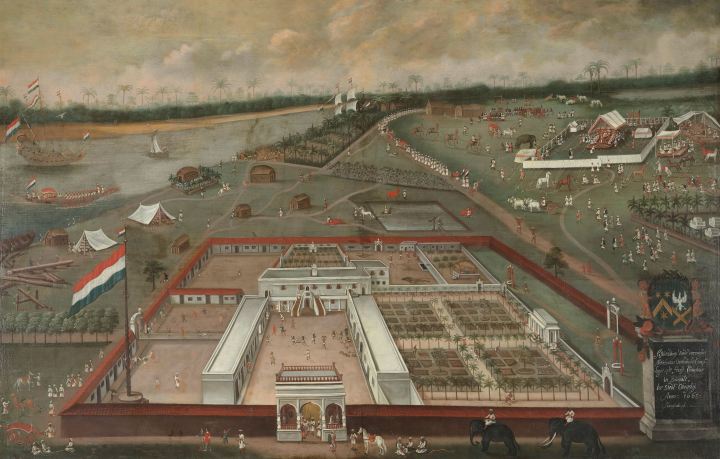
Hendrik van Schuylenburgh, The Trading Post of the Dutch East India Company in Hooghly, Bengal, 1665, oil on canvas, 203 × 316cm
(Amsterdam: Rijksmuseum)
◊ ◊ ◊ ◊ ◊
This project, aimed at reconsidering objects in the permanent collection of the Rijksmuseum, coincides with the major exhibition Slavery: Ten True Stories:
Rijksmuseum & Slavery: New Light on the Permanent Collection
Rijksmuseum, Amsterdam, 18 May 2021 — February 2022
Many of the works in the Rijksmuseum’s permanent collection have links with the Netherlands’ slavery past. It’s a relationship you probably won’t notice at first glance and one you won’t typically read about on a museum label next to an object: from the nutmeg harvested by enslaved people, to an enslaved woman shipped off to the Netherlands; from the image of a dance party on a Surinamese plantation that hides critical messages about the slaveholder, to the pulpit from which an 18th-century legal philosopher made the case for abolishing slavery.
Rijksmuseum & Slavery is adding 77 museum labels to paintings and objects in the permanent collection. The new labels will remain in place for a year, until February 2022. All of them focus on the colonial power of the Netherlands, which from the 17th century onwards was inextricably bound up with a system that included slavery. Some of the labels tell the stories of people who, under Dutch rule, were enslaved and put to work, and had their status reduced to that of objects, while others highlight people who profited from slavery, or spoke out against it.
When the Slavery exhibition and Rijksmuseum & Slavery have ended, the museum will evaluate both the pre-existing labels and the new ones. Wherever possible, the new information will be integrated into the museum in order to do greater justice to the Netherlands’ complicated history. The labels are collected in a booklet available free of charge in the museum. The booklet can also be downloaded here. In addition, all the labelled works are available online as a collection in Rijksstudio (in two parts: 1500–1650 and 1650–1960).
◊ ◊ ◊ ◊ ◊
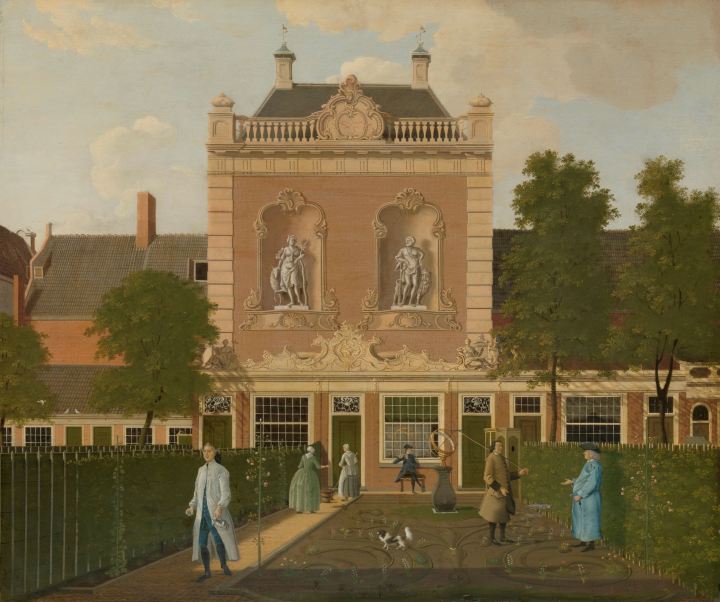
Hendrik Keun, The Garden and Coach House of 524 Keizersgracht in Amsterdam, 1772, oil on panel (Amsterdam: Rijksmuseum).
From the booklet: first the original label and then the newly added one:
Nicolaas Doekscheer, who lived at 524 Keizersgracht, built a grand, Rococo coach house on the Kerkstraat, which adjoined the back of his garden. He is here depicted conversing with the gardener, while his wife speaks to a maidservant. The two young men are Doekscheer’s nephews and heirs. The painting is still in its original Rococo frame.
The 18th-century Dutch elite benefitted greatly from the slavery-based plantation economy.[1] So did Nicolaas Doekscheer and his associate Hendrik Steenbergen, both depicted here in a garden. They financed no less than fifteen plantations in Berbice, Demerary, and Essequebo (all three part of present-day Guyana, South America).[2] Thanks to these loans, plantation owners were able to set up their coffee, cotton, and sugar plantations, while in Amsterdam Doekscheer and Steenbergen made a substantial profit from the interest.[3] See booklet for the footnotes.
New Book | Under Discussion: The Encyclopedic Museum
From The Getty:
Donatien Grau, ed., Under Discussion: The Encyclopedic Museum (Los Angeles: Getty Research Institute, 2021), 256 pages, ISBN: 978-1606067192, $35.
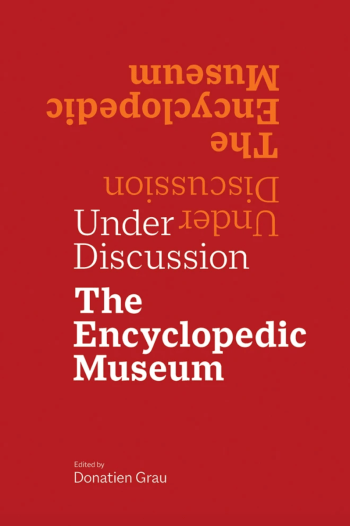 In almost thirty interviews, Donatien Grau probes some of the world’s most prominent thinkers and preeminent arts leaders on the past, present, and future of the encyclopedic museum.
Over the last two decades, the encyclopedic museum has been criticized and praised, constantly discussed, and often in the news. Encyclopedic museums are a phenomenon of Europe and the United States, and their locations and mostly Eurocentric collections have in more recent years drawn attention to what many see as bias. Debates on provenance in general, cultural origins, and restitutions of African heritage have exerted pressure on encyclopedic museums, and indeed on all manner of museums. Is there still a place for an institution dedicated to gathering, preserving, and showcasing all the world’s cultures?
Donatien Grau’s conversations with international arts officials, museum leaders, artists, architects, and journalists go beyond the history of the encyclopedic format and the last decades’ issues that have burdened existing institutions. Are encyclopedic museums still relevant? What can they contribute when the Internet now seems to offer the greater encyclopedia? How important is it for us to have in-person access to objects from all over the world that can directly articulate something to us about humanity? The fresh ideas and nuances of new voices on the core principles important to museums in Dakar, Abu Dhabi, and Mumbai complement some of the world’s arts leaders from European and American institutions—resulting in some revealing and unexpected answers. Every interviewee offers differing views, making for exciting, stimulating reading.
Includes interviews with George Abungu, National Museums of Kenya; Kwame Anthony Appiah, New York University; Homi K. Bhabha, Harvard University; Hamady Bocoum, Musée des Civilisationes Noires, Dakar; Irina Bokova, UNESCO; Partha Chatterjee, Columbia University; Thomas Campbell, Fine Arts Museum of San Francisco; James Cuno, J. Paul Getty Trust; Philippe de Montebello, New York University; Bachir Souleymane Diagne, Columbia University; Kaywin Feldman, National Gallery of Art; Marc Fumaroli, Collège de France; Massimiliano Gioni, New Museum; Michael Govan, Los Angeles County Museum of Art; Camille Henrot, artist; Max Hollein, Metropolitan Museum of Art; Henri Loyrette, Musée du Louvre; Jean Nouvel, architect; Zaki Nusseibeh, United Arab Emirates; Mikhail Piotrovsky, State Hermitage Museum; Grayson Perry, artist; Krzysztof Pomian, École des Hautes Études en Sciences Sociales; Mari Carmen Ramírez, Museum of Fine Arts, Houston; Fiammetta Rocco, The Economist; Sabyasachi Mukherjee, CSMVS Mumbai; Bénédicte Savoy; Collège de France; Kavita Singh, Jawaharlal Nehru University, New Delhi; Amit Sood, Google Arts & Culture.
Donatien Grau is head of contemporary programs at the Musée d’Orsay, Paris. He is the author of Plato in L.A. (Getty, 2018).
Exhibition | By Her Hand, Women Artists in Italy, 1500–1800
From the press release (30 July 2021) for the exhibition:
By Her Hand: Artemisia Gentileschi and Women Artists in Italy, 1500–1800
Wadsworth Atheneum Museum of Art, Hartford, 30 September 2021 — 9 January 2022
Detroit Institute of Arts, 6 February — 29 May 2022
Curated by Eve Straussman-Pflanzer and Oliver Tostmann
 The first exhibition solely dedicated to Italian women artists at the Wadsworth Atheneum Museum of Art, By Her Hand: Artemisia Gentileschi and Women Artists in Italy, 1500–1800 explores how women succeeded in the male-dominated art world of the time. From the group of eighteen artists presented, Artemisia Gentileschi (1593–1654 or later), takes center stage with outstanding portraits and images of heroines. This exhibition recognizes and celebrates the vital contributions of women to the history of art in Italy through rarely seen works, recent scholarship, and introductions to virtually unknown artists.
“Sofonisba Anguissola, Artemisia Gentileschi, and Rosalba Carriera, among others, created pathbreaking works of art, simultaneously subverting expectations and challenging norms,” said Oliver Tostmann, Susan Morse Hilles Curator of European Art at the Wadsworth. “Their works and careers are often distinguished by alternative choices and idiosyncratic methods employed within the context of the male dominated art world of the time. By Her Hand brings together a wide spectrum of works by these artists—many on view for the first time—inviting visitors to explore, reassess, and celebrate the achievements of Italian women artists.”
The exhibition features a wide array of paintings, miniatures, and works on paper from institutional and private collections in the United States, Canada, and Europe. The artists take on a range of subjects from portraiture and still life, to historical and religious stories. Many works are being shown publicly for the first time or are making their U.S. debut such as Artemisia Gentileschi’s ravishing Mary Magdalene. By Her Hand reweaves history by examining women artists’ work and careers from the 1550s to the 1750s. Despite the fundamental differences and challenges women artists faced, some achieved notable success in their lifetime. The accomplishments of this diverse and dynamic group are introduced, discussed, and reassessed. Until recently, many of these Italian women artists were overlooked by critics, scholars, collectors, and institutions alike.
Artemisia Gentileschi is arguably the best-known artist included in the exhibition. Gentileschi’s talents were widely recognized by her contemporaries, many elite patrons of her day knew of and desired her work. Important works by Gentileschi highlight her innovative ideas, use of sensuous colors, and command of the brush. The Wadsworth’s Self-Portrait as a Lute Player is compared with the recently discovered Self-Portrait as Saint Catherine of Alexandria from the National Gallery, London, as well as Portrait of Saint Catherine from the Uffizi Galleries, Florence. This will be the first opportunity to see these three celebrated paintings side by side in the United States. Additional examples of Gentileschi’s pioneering depictions of strong women, such as Judith and Her Maidservant with the Head of Holofernes from the Detroit Institute of Arts, will also be on view.
The compelling works of art on view in By Her Hand coupled with stories of their pioneering makers reveals a nuanced picture of the role Italian women artists played from the Renaissance to the Rococo. By Her Hand celebrates their long-overlooked contributions, and aims to inspire continued reexaminations of the role women artists have played throughout the history of art.
“Never before in its long history has the Wadsworth devoted an exhibition to the work of professional women artists in sixteenth through eighteenth-century Italy, despite the fame of our Italian Baroque painting collection” said Jeffrey N. Brown, Interim Director & CEO of the Wadsworth Atheneum. “By Her Hand is the first exhibition in any encyclopedic museum in the United States to focus on this subject. This ground-breaking exhibition provides our audiences with a chance to encounter the outstanding art produced by these women artists in early modern Italy and to appreciate the far-reaching consequences of Artemisia Gentileschi’s illustrious career.”
By Her Hand is a collaboration between the Wadsworth and the Detroit Institute of Arts. Curated by Eve Straussman-Pflanzer former curator at the Detroit Institute of Arts now Curator and Head of Italian and Spanish paintings at The National Gallery of Art, Washington and Oliver Tostmann, Susan Morse Hilles Curator of European Art at the Wadsworth. After its debut at the Wadsworth, it will travel to Detroit where it will be on view February 6–May 29, 2022.
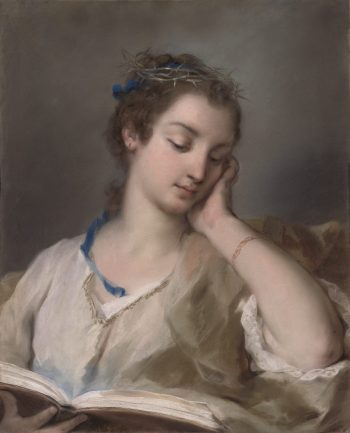
Rosalba Carriera, Allegory of Grammar, ca. 1715, pastel on paper (Private Collection).
Artists in the exhibition
Sofonisba Anguissola (c. 1535–1625)
Diana Scultori (c. 1547–1612)
Lavinia Fontana (1552–1614)
Fede Galizia (c. 1574–c. 1630)
Isabella Catanea Parasole (active 1585–1625)
Artemisia Gentileschi (1593–1654 or later)
Orsola Maddalena Caccia (1596–1676)
Giovanna Garzoni (1600–1670)
Virginia da Vezzo (1600–1638)*
Anna Maria Vaiani (1604–1655)
Elisabetta Sirani (1638–1665)
Ginevra Cantofoli (1618–1672)
Caterina de Julianis (c. 1670–c. 1742)
Rosalba Carriera (1673–1757)
Marianna Carlevarijs (1703–after 1750)
Maria Felice Tibaldi (1707–1770)*
Veronica Stern Telli (1717–1801)
Anna Bacherini Piattoli (1720–1788)
* Virginia da Vezzo and Maria Felice Tibaldi are represented in portraits painted by their husbands Simon Vouet (1590–1649) and Pierre Subleyras (1699–1749).
Eve Straussman-Pflanzer and Oliver Tostmann, with contributions by Sheila Barker, Babette Bohn, C. D. Dickerson, Jamie Gabbarelli, Hilliard T. Goldfarb, Joaneath Spicer, and Lara Roney, By Her Hand: Artemisia Gentileschi and Women Artists in Italy, 1500–1800 (New Haven: Yale University Press, 2021), 192 pages, ISBN: 978-0300256369, $40.
New Book | The Natural, Moral, and Political History of Jamaica
Today is Emancipation Day, a holiday celebrated in Jamaica and throughout the Caribbean. On 1 August 1834, slavery was legally abolished in British colonies, resulting in freedom for some 311,00 enslaved people in Jamaica. From the University of Virginia Press:
James Knight, The Natural, Moral, and Political History of Jamaica, and the Territories thereon Depending: From the First Discovery of the Island by Christopher Columbus to the Year 1746, edited by Jack Greene (Charlottesville: University of Virginia Press, 2021), 832 pages, ISBN 978-0813945576 (ebook), $49 / ISBN: 978-0813945569 (cloth), $65.
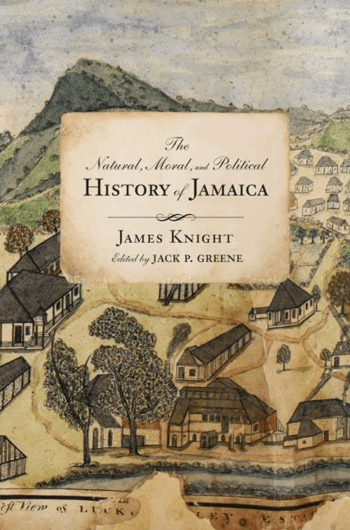 Between 1737 and 1746, James Knight—a merchant, planter, and sometime Crown official and legislator in Jamaica—wrote a massive two-volume history of the island. The first volume provided a narrative of the colony’s development up to the mid-1740s, while the second offered a broad survey of most aspects of Jamaican life as it had developed by the third and fourth decades of the eighteenth century. Completed not long before his death in the winter of 1746–47 and held in the British Library, this work is now published for the first time. Well researched and intelligently critical, Knight’s work is not only the most comprehensive account of Jamaica’s ninety years as an English colony ever written; it is also one of the best representations of the provincial mentality as it had emerged in colonial British America between the founding of Virginia and 1750. Expertly edited and introduced by Jack Greene, this volume represents a colonial Caribbean history unique in its contemporary perspective, detail, and scope.
Jack P. Greene is Andrew W. Mellon Professor in the Humanities Emeritus at Johns Hopkins University and author of Settler Jamaica in the 1750s: A Social Portrait (Virginia).
Online Symposium | Printmaking between Art and Science in Britain
From Eventbrite:
The Itinerant Image: Printmaking between Art and Science in Enlightenment Britain
Online, University of St Andrews, 12–13 August 2021

Charles Reuben Ryley, Ring-Tailed Lemurs, in George Shaw, Museum Leverianum (1792), op. p. 43.
In early modern Britain, the printed image was a major practical and conceptual tool for scientists. As recent research into the graphic practices of the Royal Society has shown, illustrations and diagrams were indispensable to communicating scientific knowledge, both collectively and by individuals. In particular printed images circulated between the Royal Society’s periodicals and the published volumes of its fellows. Some of these images, such as the flea from Robert Hooke’s Micrographia (London 1665), subsequently became widely reproduced and iconic images in the history of science. Yet these printed images were rarely confined to scientific domains; not only were they usually the result of collaboration with artisans and in some cases artists, but the most successful images would often circulate far beyond the scientific communities for which they were initially produced. Further still, images were often copied or translated into new locations, where their meaning might be altered for new audiences.
Over two days, this symposium will bring together scholars and curators of British art, science, and print culture from the seventeenth and eighteenth centuries, to interrogate the creation, use, and function of prints in the production of new scientific knowledge. It considers how the ‘epistemic’ value of an image changed as it was reprinted, adapted, and modified; and pays particular attention to how and when a reproduced image might gain or lose scientific authority.
All sessions will take place over Zoom. Please register for an online ticket. A link will be sent to all attendees in advance of each day’s event.
T H U R S D A Y , 1 2 A U G U S T 2 0 2 1
14.00–16.30 BST
Welcome and Introduction, Stephanie O’Rourke (University of St. Andrews) and Katherine Reinhart (Bibliotheca Hertziana – Max Planck Institute for Art History)
• Megan Barford (Royal Museums Greenwich), Travelling Charts and Shrinking Paper: Royal Naval Hydrography in the 1830s
• Richard Bellis (University of St. Andrews), Printing the Structures and Textures of Disease: Matthew Baillie’s A Series of Engravings … to Illustrate the Morbid Anatomy (1799–1802)
• Elaine Ayers (New York University), Drawing at a Distance: Botanical Illustration in the East India Company in the Early Nineteenth Century
Respondents: Jack Hartnell (University of East Anglia) and Katy Barrett (Science Museum)
F R I D A Y , 1 3 A U G U S T 2 0 2 1
14.00–16.30 BST
• Anna Marie Roos (University of Lincoln), Lives and Afterlives of the Lithophylacii Britannici ichnographia (1699), the First Illustrated Field Guide to English Fossils
• John Bonehill (University of Glasgow) ‘Curious and Chargeable Cuts’: Michael Burghers and the Illustration of Robert Plot’s Natural Histories
• Meghan Doherty (Berea College), The Long Life of Ephemera: (Re)Printing the Philosophical Transactions of the Royal Society
Respondents: José Marcaida (University of St. Andrews) and Aileen Fyfe (University of St. Andrews)
Call for Papers | Hidden Hands: Untold Stories of the Object

Plate 419, Silver-plating in L’Enclopédie, ou Dictionnaire Raisonné des Sciences, des Arts et des Métiers by Denis Diderot.
◊ ◊ ◊ ◊ ◊
From the Call for Papers:
Hidden Hands: Untold Stories of the Object
Rienzi Biennial Symposium
Online, Rienzi, The Museum of Fine Arts, Houston, 6 November 2021
Proposals due by 1 September 2021
Rienzi, the house museum for European decorative arts of the Museum of Fine Arts, Houston, presents the virtual symposium, Hidden Hands: Untold Stories of the Object. Geographic exploration and colonial expansion led to the introduction of new materials and technological innovation in the early modern period. These developments created an increased demand for goods made of ceramics, glass, exotic woods, textiles, and metals. The refining of raw materials and the production of these goods depended upon a diverse labor force made up of men, women, and children from across the globe. Despite the integral roles played by these workers in all of these varied enterprises, their names and contributions have often been lost to history. Who were these people? How did they interact and engage with these new materials and goods? What social, political, and economic forces contributed to the exclusion of their narratives? The symposium invites scholars to reconsider established ideas of craftsmanship and artistic authorship through the telling of these ‘hidden’ stories.
All presentations will be given Saturday, 6 November 2021, virtually via Zoom webinar organized by the Museum of Fine Arts, Houston. The symposium will be held in conjunction with the exhibition Hidden Hands: Invisible Workers in Industrial England, on view at Rienzi from 1 September 2021 to 3 January 2022.
Graduate students as well as entry-level and mid-career professionals are invited to submit a 400-word abstract outlining a 20-minute presentation, along with a CV, by 1 September 2021, to rienzisymposium@mfah.org. Selected participants will be notified by 15 September 2021 and offered a $250 honorarium. Possible themes for investigation may include, but are not limited to:
• Transatlantic trade
• Workshop traditions
• Empire and colonialism
• Technology
• Gender
• Race
• Economics
• Labor
• Class
Education programs at Rienzi receive generous funding from the Sterling-Turner Foundation, The Brown Foundation, the Carroll Sterling and Harris Masterson III Endowment, and the Caroline Wiess Law Endowment for Rienzi.
ECCO Access for N. American Members of ASECS

ASECS members will likely already have received news of this new perk, but it could be most useful for people who are not (yet) members. Please note the North American stipulation. Press release (28 July 2021) from Gale:
New partnership gives ASECS members access to the world’s largest collection on the eighteenth-century, advancing research and instruction of the period.
Gale, a Cengage company, has partnered with the American Society for Eighteenth-Century Studies (ASECS), the world’s largest organization of eighteenth-century scholars, to provide its North American members[i] with access to Gale’s Eighteenth-Century Collections Online (ECCO). Now ASECS members have access to the most comprehensive online historical archive on the eighteenth-century, enabling scholarship, enhanced teaching and advanced study of the era.
“ECCO is an essential resource for scholars of the eighteenth-century, but many people working in the field do not currently have access to it. They have to travel across the world to research libraries to view and study eighteenth-century collections, which can be very expensive,” said Mark Boonshoft, executive director at ASECS. “By providing online access to ECCO to our members in North America, we help ameliorate this inequity and better support research and teaching on the eighteenth-century. We are thrilled to partner with Gale to make this happen.”
ECCO contains every significant English-language and foreign-language title printed in the United Kingdom between the years 1701 and 1800, offering scholars full-text searching across 26 million pages of books and directories, bibles, sheet music, sermons, advertisements and works by both celebrated and lesser-known authors. Expanding the ECCO archive, the titles in Part II have an emphasis on literature, social science, and religion. It also includes nearly fifty thousand titles and seven million pages from the library holdings of the British Library, the Bodleian Library, University of Cambridge, the National Library of Scotland and the Ransom Center at the University of Texas.
With ASECS members coming from a wide range of disciplines and professions beyond academia, ECCO access will:
• Put the world’s largest archive on the eighteenth-century in the hands of hundreds of scholars, creating greater public awareness and understanding of the eighteen-century world.
• Provides access to independent scholars (those without university affiliation), making it easier for them to conduct research on the eighteenth-century.
• Expand scholarship and research to less endowed institutions and independent researchers, with continued access to eighteenth-century content outside of academia.
“As the leading provider of digital humanities learning tools and primary sources to support research, Gale is committed to promoting scholarship on the eighteenth-century,” said Roger Strong, vice president of sales for academic libraries at Gale. “This partnership with ASECS enable us to more closely align resources like ECCO to course integration and digital humanities pedagogy, including joint efforts around the sharing of research outcomes, and the continued development of primary source tools and platforms to support the future needs of ASECS and other learned societies.”
ASECS north American members can access ECCO at: https://www.asecs.org/ecco.
i. Due to pre-existing licensing arrangements, access to Eighteenth Century Collections Online is limited to ASECS members in the U.S., Canada, Mexico, and the Caribbean.
Exhibition | Fan Leaves: Between Europe and Japan
From the press release for the exhibition:
Feuilles d’éventail entre Europe et Japon
Musée d’art et d’histoire, Geneva, 1 October 2021 — 30 January 2022 (extended until 29 May 2022)
Curated by Bénédicte De Donker
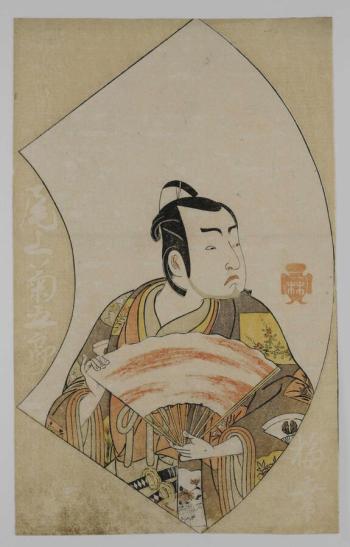
Katsukawa Shunshō 勝川 春章, Ippitsusai Bunchō 一筆斎 文調, Kariganeya Ihei 雁金屋 伊兵衛, The Actor Onoe Kikugorō, also called Kobaikō, 1770, woodblock print (Musée d’art et d’histoire de Genève, Inv. E 2013-0032). In 1770, Katsukawa Shunshō and Ippitsusai Bunchō published an illustrated book, in three volumes, of actors’ portraits on fans, introducing a new genre of portraiture known as nigao-e.
Cet automne, l’éventail est au cœur d’une présentation inédite déployée dans les trois cabinets consacrés aux arts graphiques au deuxième étage du musée. Accessoire de mode apparu dès l’Antiquité dont l’usage se retrouve de par le monde, l’éventail a également intéressé les artistes qui se sont plu à le représenter dans leurs œuvres, voire à réaliser des feuilles pour l’habiller. Feuilles d’éventails, entre Europe et Japon fait écho à la grande exposition proposée au même moment dans les salles palatines, Pour la galerie: Mode et portrait.
Cette présentation revient sur les influences croisées de l’art de l’éventail entre Europe et Asie, qui atteint son apogée au XIXe siècle avant son déclin irrémédiable. Elle témoigne surtout de l’engouement européen pour cet accessoire, dont les formes les plus répandues (brisé et plié) proviennent d’Extrême-Orient. Certains exemplaires, par le choix de matières précieuses ainsi que par la finesse et la qualité de leur travail sont de véritables œuvres d’art. Car au-delà de son utilité, un éventail présente également une dimension artistique, et même parfois politique, selon ses créateurs et les sujets représentés. Sans surprise, il rejoint le panthéon des objets avec lesquels l’on aime—et doit—se montrer. Accessoire de mode, il arbore des formes variées (brisé, plié, ballon, plein vol…) et des matériaux divers, au gré des tendances (plumes, dentelle, parchemin…).
Feuilles d’éventails, entre Europe et Japon puise sa sélection dans le fonds d’arts graphiques du MAH, ainsi que dans sa collection d’arts appliqués. Autour de quelques splendides éventails, se déploie une sélection de feuilles d’éventails provenant elles aussi d’Europe et du Japon. Dessinées ou gravées, celles-ci étaient destinées à être montées ou à servir de modèle. Cet ensemble inclut une série exceptionnelle de huit feuilles peintes au XVIIIe siècle, dévoilée pour la première fois au public. Enfin, une quinzaine de représentations de leur usage en Europe, du XVIe à l’aube du XXe siècle, côtoie des gravures japonaises mettant en scène des personnages hauts en couleurs munis d’éventails.
◊ ◊ ◊ ◊ ◊
Coordinating with the exhibition To Play to the Gallery: Fashion and Portrait, the Prints and Drawings Department has chosen to focus on a fashion accessory that is both an artistic medium and the subject of numerous representations: the fan. The three cabinets on the first floor show fan mounts, drawn or engraved, to be mounted or used as models, representations of their use in Europe from the 16th to the early 20th century, as well as a collection of Japanese engravings and fans. This presentation includes an exceptional series of eight sheets painted in the 18th century, unveiled to the public for the first time.
The full press release is available here»
Exhibition | To Play to the Gallery: Fashion and Portrait
Opening this fall at the MAH in Geneva:
Pour la Galerie: Mode et Portrait
Musée d’art et d’histoire, Geneva, 17 September — 14 November 2021
 Longtemps réservé à l’élite, aujourd’hui à portée de téléphone mobile, le portrait est le lieu de la projection et de la fabrication de l’image de soi par excellence. Le vêtement, des somptueux drapés des portraits d’apparat à la variété du vestiaire contemporain, en constitue un élément clé : il est un moyen de distinction, entre conformisme et quête d’originalité. Et au-delà de tout ce qui caractérise une époque, les codes traversent les modes comme autant de signes d’un statut affirmé ou rêvé. En confrontant les peintures et les objets du MAH à la collection d’histoire de la mode de la Fondation Alexandre Vassiliev, du XVe siècle à la période contemporaine, cette exposition invite à s’élancer dans un tourbillon de matières et de couleurs, un grand défilé déployé dans les salles palatines du musée transformées en galerie des miroirs. Instruments de pouvoir, de séduction ou d’évasion, vêtements et portraits nous entraînent dans une foire aux vanités où trouve à s’exprimer, de manière éblouissante ou dérisoire, toute la gamme des aspirations et des émotions humaines.










 Enfilade
leave a comment