National Trust Awards Grants to 40 Sites to Help Preserve Black History

The Montpelier Descendants Committee was one of 40 sites awarded grants in 2021 from the National Trust. From the MDC’s website: “On June 14, 2019, the Montpelier Descendants Community convened to establish an organization to honor the sacrifices, resilience, and brilliance of our ancestors who contributed immeasurably to the founding of this nation. On June 16, 2021, The MDC achieved structural parity with The Montpelier Foundation (TMF), establishing itself as an equal co-steward of the historic site. This milestone is the culmination of two decades of contributions by descendants to the Foundation’s research and program development, and a year and a half of intense negotiation in a polarized environment following the murder of George Floyd.”
◊ ◊ ◊ ◊ ◊
Press release from the National Trust:
On July 15, 2021, the National Trust for Historic Preservation announced more than $3 million in grants to 40 sites and organizations through its African American Cultural Heritage Action Fund. Over the past four years, the National Trust has funded 105 historic places connected to Black history and invested more than $7.3 million to help preserve landscapes and buildings imbued with Black life, humanity, and cultural heritage. This year’s funds were awarded to key places and organizations that help the Action Fund protect and restore significant historic sites. Grants are given across four categories: capacity building, project planning, capital, and programming and interpretation.
The latest grantees include:
Fort Monroe has commissioned a memorial honoring the humanity of the first captive Africans who were enslaved by the Portuguese and then taken by English privateers to the British Colonies at Point Comfort in 1619. The grant will assist Fort Monroe and its partners to design an interpretive plan that contextualizes the people and events of 1619 from a global perspective.
The Montpelier Descendants Committee will create a master project plan for their Arc of Enslaved Communities project, a descendant-led framework for the research, interpretation, physical discovery, and promotion of sites and projects centered on the contributions of the enslaved in Virginia during the Founding era.
Learn more about the full list of grantees here»
◊ ◊ ◊ ◊ ◊
An example of the sort of work undertaken by the Arc of Enslaved Communities project comes from the Montpelier Descendants Committee’s website (and, if I might interject, the nails provide an interesting example to use in talking about style with students –CH) . . .
Finding and Dating the Sites of Labor at James Madison’s Montpelier
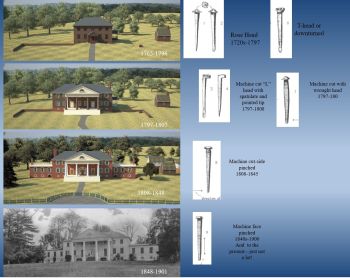 Plantations were much more than the main house and surrounding slave quarters and outbuildings. They consisted of fields, stables, barns, tobacco houses, granaries, and work areas that today, for the most part, are long gone and grown up in woods. Montpelier, like many 18th-century plantations, has witnessed its fields and work areas return to woods beginning in the 1840s. The archaeology department at Montpelier is seeking to locate these sites of labor that bear witness to the millions of hours of unpaid labor of those Americans enslaved by James Madison. . . .
Today there is little visible trace of the farm complex in Montpelier’s 500 acre East Woods. Most of the buildings were log structure set at grade with no foundation and all that remains are nails below the forest floor. The fields are completely grown over and only subtle linear mounds of plow furrows and field lines still exist in the woods today. To locate these nail clusters we use gridded metal detector surveys and the linear mounds are located through LiDAR surveys. These two data sources (metal detector surveys and LiDAR) are the physical legacy of the capital that was stolen from the Ancestors. . . .
Online Symposium | The Politics of the Portrait, in Three Parts
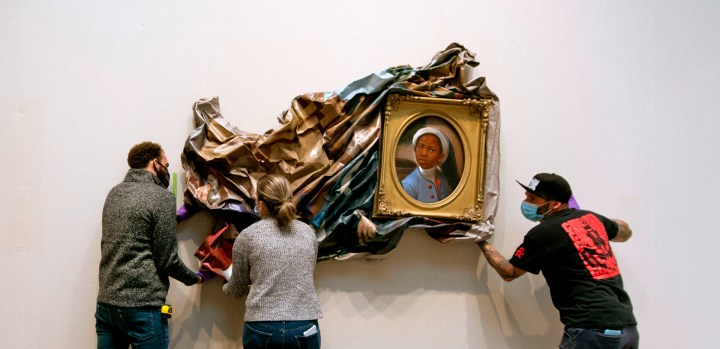
Titus Kaphar, Enough About You, 2016, oil on canvas with an antique frame, on loan from the Collection of Arthur Lewis and Hau Nguyen, Courtesy of the artist, photo by Richard Caspole. More information is available here.
◊ ◊ ◊ ◊ ◊
From the YCBA:
The Politics of the Portrait, in Three Parts
Online, Yale Center for British Art, 23 July — 17 September 2021
Featuring artists, collectors, curators, and scholars, The Politics of the Portrait is a three-part online symposium that considers potential solutions and alternatives regarding the history, display, and making of portraits and the role of representation in today’s sociopolitical climate.
In 2020 the Yale Center for British Art began a research project on Elihu Yale with Members of his Family and an Enslaved Child (ca. 1719), a painting in the collection that depicts one of Yale University’s founders with an enslaved child. This project became a springboard for this online series of conversations among artists, collectors, curators, and scholars to consider potential approaches, revisions, and additions to the canon of art history, curating, and artmaking.
◊ ◊ ◊ ◊ ◊
Part 1 | Art History: Hierarchies of Representation
Friday, 23 July 2021, 12–1:30pm
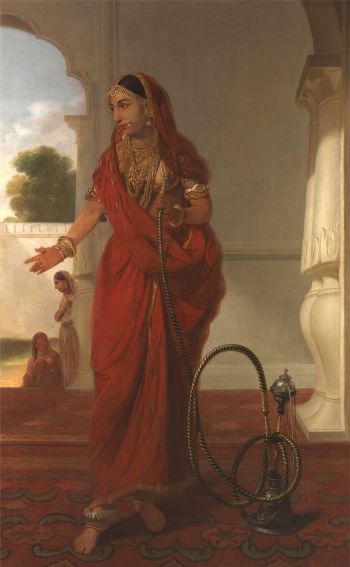
Tilly Kettle, Dancing Girl, 1772, oil on canvas (New Haven: Yale Center for British Art, Paul Mellon Collection).
Zirwat Chowdhury, Bridget R. Cooks, and Edward Town discuss potential approaches to and revisions of frameworks that are commonly used for telling the history of portraiture with a particular focus on the Black figure. How might we restructure art history to make it a more decentralized, inclusive discipline? What scholarly initiatives have been effective at countering systemic marginalization in the representation of Black and Brown bodies in Western art? How can we overcome the problem that there are few records—material, textual, or visual—of many of the Black figures represented in Western art? Notwithstanding these absences, what work is being done to center the lives of Black figures in historical portraits? What can we learn about these figures from close looking and study in museums?
Zirwat Chowdhury is Assistant Professor of 18th- and 19th-century European Art at the University of California, Los Angeles. Bridget R. Cooks is Associate Professor at the University of California, Irvine. Edward Town is Head of Collections Information and Access at the Yale Center for British Art. The conversations is moderated by Maryam Ohadi-Hamadani, Postdoctoral Research Associate at the Center.
To join us for this program, please register here.
◊ ◊ ◊ ◊ ◊
Part 2 | Curatorial Practice and the Museum: Contextualization and Narratives
Friday, 6 August 2021, 12–1:30pm
Curators Liz Andrews, Christine Y. Kim, Denise Murrell, and Keely Orgeman discuss their recent projects and upcoming exhibitions and consider the ethical, practical, and historical implications of displaying portraits and figurative artworks in museums.
Liz Andrews is Executive Director of the Spelman College Museum of Fine Art. Christine Y. Kim is Curator of Contemporary Art at the Los Angeles County Museum of Art. Denise Murrell is Associate Curator of 19th- and 20th-Century Art at The Metropolitan Museum of Art. Keely Orgeman is Associate Curator of Modern and Contemporary Art at the Yale University Art Gallery. The conversation is moderated by Maryam Ohadi-Hamadani, Postdoctoral Research Associate at the Yale Center for British Art.
To join us for this program, please register here.
◊ ◊ ◊ ◊ ◊
Part 3 | In Conversation: Titus Kaphar and Art Collectors Arthur Lewis and Hau Nguyen
Friday, September 17, 2021, 12–1pm
Titus Kaphar, Arthur Lewis, and Hau Nguyen discuss Kaphar’s practice and the importance of supporting emerging artists, artists of color, and local art communities. The conversation is moderated by Abigail Lamphier, Senior Curatorial Assistant in the Department of Paintings and Sculpture at the Yale Center for British Art.
Kaphar is an American artist whose paintings, sculptures, and installations examine the history of pictorial representation. Kaphar physically manipulates his canvases by cutting, shredding, twisting, breaking, and tearing his paintings and sculptures, reconfiguring them into works that reveal unspoken truths about the nature of history, often in an effort to consider overlooked subjects. By transforming these styles and mediums with formal innovations, he emphasizes the physicality and dimensionality of the canvas and the materials. His practice challenges art historical images and the narratives they normalize.
Kaphar received an MFA from the Yale School of Art in 2006 and is a distinguished recipient of numerous prizes and awards including a MacArthur Fellowship (2018), an Art for Justice Fund grant (2018), a Robert R. Rauschenberg Artist as Activist grant (2016), and a Creative Capital grant (2015). His work appears in the collections of the Crystal Bridges Museum in Arkansas, the Pérez Art Museum Miami, and several New York City museums, including the Brooklyn Museum, the Metropolitan Museum of Art, the Museum of Modern Art, and the Whitney Museum of American Art.
Kaphar lives and works in New Haven, Connecticut. In 2015, he cofounded NXTHVN, a 40,000-square-foot nonprofit arts incubator located in two former manufacturing plants in the Dixwell neighborhood of New Haven. NXTHVN offers fellowships, residencies, and other professional development opportunities to artists, curators, and students in the local community and beyond.
Lewis and Nguyen have built an art collection celebrated for its focus on contemporary women artists and artists of color and were named in the top 200 art collectors by ArtNews in 2020. Over the last thirteen years, the couple have intentionally focused on supporting a wide range of black artists and developing their local art community in Los Angeles. As a result, the core of Lewis and Nguyen’s collection features both emerging and established artists including Genevieve Gaignard, Jennie C. Jones, Titus Kaphar, Kerry James Marshall, Ebony G. Patterson, and Amy Sherald.
Lewis and Nguyen are further renowned for their intentional approach to collecting, which extends beyond building the market value for artworks. Seeing the role of the collector as one of guidance and care, the couple are active in the artist community and enjoy personal relationships with many artists represented in their collection. Lewis is creative director of United Talent Agency’s fine arts group and the UTA Artist Space in Beverly Hills, California. He is a member of the boards of the Hammer Museum and the Underground Museum in Los Angeles, as well as New York’s Studio Museum in Harlem. Nguyen is the owner and creative director of boutique hair salons.
In October 2020, Lewis and Nguyen lent Kaphar’s Enough About You (2016) to the Yale Center for British Art. This artwork was on view in the Center’s galleries for eight months in place of the eighteenth-century group portrait Elihu Yale with Members of his Family and an Enslaved Child. To learn more about why this change was made and a description of the ongoing research into this group portrait, visit New light on the group portrait of Elihu Yale, his family, and an enslaved child.
Online Conference | Travel and Archaeology in Ottoman Greece
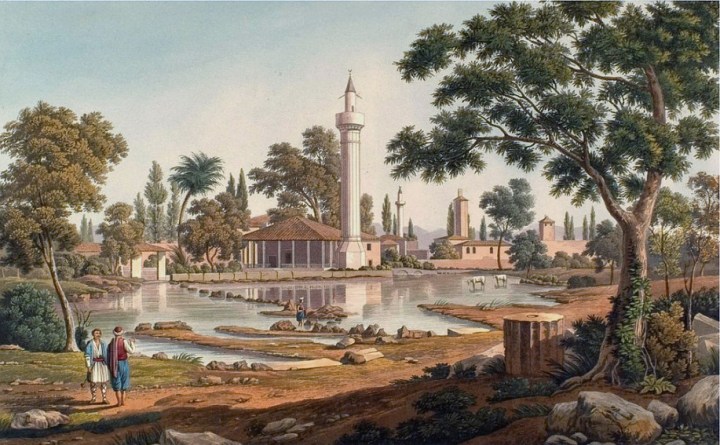
The Hyperian Fountain at Pherae, Edward Dodwell, Views in Greece (London 1821), p. 91.
◊ ◊ ◊ ◊ ◊
From the conference programme:
Travel and Archaeology in Ottoman Greece in the Age of Revolution, c.1800–1833
Online, British School at Athens, 16–17 September 2021
Organised by Alexia Petsalis-Diomidis
Registration due by 20 August 2021
The bicentenary of the Greek War of Independence of 1821 offers a timely opportunity for a re-evaluation of travel and archaeology in the age of revolution. The conference foregrounds diversity and small-scale engagements with the landscape and material past of Ottoman Greece at a time of political tension and explosive violence. The conference will explore the perspectives of both foreign travellers and local inhabitants in order to tease out diverse voices, keeping a sharp focus on the effects of ethnicity, race, gender, and social status.
Within this inclusive intellectual framework we will pose a series of questions to analyse the mediating role of the Greek landscape and its antiquities between travellers and local inhabitants in all their diversity. How did major intellectual and cultural developments of the late eighteenth century, ranging from revolutionary politics in France and America to scientific and museological developments, intersect with actual encounters ‘on the ground’ in Ottoman Greece, specifically with the landscape, local inhabitants, and small-scale objects and antiquities? How did the ethnic, cultural, and religious identities of Ottoman communities affect local perceptions of contemporary travel and the classical material past? How did status (including slave status) and gender shape encounters with the Greek landscape and its antiquities, not least with idealising white sculptured male bodies? How did archaeological-focused travel, with its emerging sophisticated discourses, intertwine with travel undertaken for scientific, military, and Romantic aims?
In this way the conference will give prominence to hitherto marginalised perspectives drawing on recent work to decolonise Ancient Mediterranean Studies, including sensory approaches to access silenced voices, and will develop a micro-cultural history of travel and archaeology in Ottoman Greece in this tumultuous period.
Hosted via Zoom, the conference is free and open to all who are interested, but registration is essential. Speakers’ full papers will be pre-circulated to registered participants at the end of August. To register for the conference, please email Dr Jenny Messenger at jenny@atomictypo.co.uk by 20 August. For Dr Alexia Petsalis-Diomidis’ lecture, registration is separate: a link to register will be available in the ‘Events’ section of the BSA website approximately one month in advance.
T H U R S D A Y , 1 6 S E P T E M B E R 2 0 2 1
13.00 John Bennet and Alexia Petsalis-Diomidis, Welcome and Introduction
13.15 Panel 1: Travel as a Kaleidoscope of Perspectives
Chair: Estelle Strazdins (University of Queensland)
• Charalampos Minaoglou (National and Kapodistrian University of Athens), Traveling in Europe, Exploring Greek Identity: Orientalism and ‘Westernism’ in Constantine Karatzas’ Diaries
• Federica Broilo (Universitá Degli Studi Urbino ‘Carlo Bo’), Simone Pomardi and the Rediscovery of the Modern Greek Landscape
• Jason König (University of St Andrews), Mineralogy, Ethnography, Antiquarianism: Images of Collecting in the Travel Writing of Edward Daniel Clarke
• Ayşe Ozil (Sabanci University), Local Greek Travel-Writing, Antiquities, and the Diverse Social Landscape in the Post-Revolutionary Ottoman Empire
14.15 Break
14.30 Panel 2: Ottoman Spaces and Identities
Chair: Edhem Eldem (Boğaziçi University and Collège de France)
• Nikos Magouliotis (ETH Zurich, Institute for the History and Theory of Architecture, PhD Candidate), Inside the Villager’s House: Views of European and Greek Authors on the Vernacular Architecture of Late-Ottoman Greece, ca. 1800–30
• Zafeirios Avgeris (Uppsala University, MA Candidate), From Text to Space: Mapping Sir William Gell and Edward Dodwell as Data Layers on an Ottoman Landscape
• Emily Neumeier (Temple University, Philadelphia), Orientalism in Ottoman Greece
• Elisabeth Fraser (University of South Florida), Louis Dupré in Ottoman Greece: Multiple Identities, Contradictory Encounters
15.30 Break
17.30 British School at Athens Public Lecture
• Alexia Petsalis-Diomidis (University of St Andrews), From Ottoman Smyrna to Georgian London: Travel, Excavation, and Collecting of Levant Company Merchant Thomas Burgon (1787–1858)
F R I D A Y , 1 7 S E P T E M B E R 2 0 2 1
13.00 Panel 3: Individuals Collecting Antiquities
Chair: Ayşe Ozil (Sabanci University)
• Estelle Strazdins (University of Queensland), Imagining Ethiopians in the Age of Revolution: Arrowheads from the Marathon Sôros and the Statue of Rhamnoussian Nemesis
• Alessia Zambon (Université Versailles Saint Quentin en Yvelines, Paris), ‘Je vois qu’à Paris on a une bien fausse idée des Grecs…’: Fauvel’s Perception of the Greeks and of the Greek Revolution
• Irini Apostolou, (National and Kapodistrian University of Athens), In Search of Antiquities: The Travels of Alexandre and Léon de Laborde during the Greek War of Independence of 1821
• Michael Metcalfe (The Syracuse Academy), Ancient Inscriptions and British Travellers to Ottoman Greece, 1800–21
14.00 Break
14.15 Panel 4: Antiquities and Official Discourses
Chair: Elisabeth Fraser (University of South Florida)
• Edhem Eldem (Boğaziçi University and Collège de France), ‘Viewing and Contemplating’ (Seyr ü Temaşa): Foreign Travelers and Antiquarians and the Sublime Porte, ca 1800–30
• Aikaterini-Iliana Rassia (King’s College London), Andreas Moustoxydes (1785–1860) and Kyriakos Pittakis (1798–1863) and the Rescue of Greek Antiquities
14.45 Break
15.15 Panel 5: Forms of Philhellenism
Chair: Jason König (University of St Andrews)
• Mélissa Bernier (Ecole Normale Supérieure de Paris, PhD candidate), Samuel Gridley Howe’s Travels: Classical, Romantic, and Philanthropic Philhellenism, 1800–30
• Fernando Valverde (University of Virginia), Greece in the Age of Revolution: An Intimate Poetics of Landscape, Travel, and Liberty
15.45 Break
16.00 Conclusions and Future Directions
• Breakout Rooms
• Roundtable Discussion
Exhibition | 1821: Before and After

Kozis Desyllas, Portrait of Athanasios Diakos, detail, ca. 1870
(Athens: Benaki Museum)
◊ ◊ ◊ ◊ ◊
Now on view at the Benaki Museum:
1821: Before and After
Benaki Museum, Athens, 3 March — 7 November 2021
Curated by Maria Dimitriadou and Tassos Sakellaropoulos
The Benaki Museum—in cooperation with the Bank of Greece, the National Bank of Greece, and Alpha Bank—presents a major anniversary exhibition to celebrate the bicentenary of the pivotal year in modern Greek history, 1821, the year when the revolution which resulted in the country’s independence was declared. 1200 objects unfold more than a century of history, from the 1770 ‘Orlov Revolt’ until the 1880s.

Map of Greece, late 17th or early 18th century, tempera on wood (Athens: Benaki Museum)
Paintings, sculpture, personal items belonging to key revolutionaries, historic documents, and heirlooms are arranged in three sections. The first part (1770–1821) brings to life the progress towards a national revolution. Section two (1821–1831) showcases the events of the War of Independence and its conclusion, and section three (1831–1870) addresses the creation of the modern Greek state and its development during its first half-century.
The show presents objects held in the collections of the three banks and the Benaki Museum, itself a rich repository created on bonds of trust with the families of those who held centre-stage in the Greek Revolution. Loans have also been secured from important museums and private collections in Greece, France, and the United Kingdom.
The exhibition is included in the National Program of Bicentennial Celebrations coordinated by the ‘Greece 2021’ Committee.
An online preview is available here»
Maria Dimitriadou and Tassos Sakellaropoulos, eds., 1821 Πριν και Μετά / 1821 Before and After (Athens: Benaki Museum, 2021), 1218 pages, ISBN: 978-9604762828 (Greek) / ISBN: 978-964762835 (English), 45€.
 More than 1200 objects gathered in the exhibition and spread across the 1218 pages of the accompanying catalogue showcase one hundred years of modern Greek history, between 1770 and 1870. The period begins with the moral and economic preparations for the liberation of the Greeks, reaches an apex with the 1821 Revolution, and concludes with the first decades of the operation and development of the new Greek state. The catalogue offer a fascinating journey of history and art, revealing why this adventurous century remains so deeply engaging, even now. These works create a meaningful assemblage that traces the enchanting story of modern Greeks and brings to the fore the reasons of their very existence, their perseverance, and how far they have travelled: all the positive elements that have shaped modern Hellenism.
Copies are available here»
New Book | Sculpture Collections in Europe and the United States
From Brill:
Malcolm Baker and Inge Reist, eds., Sculpture Collections in Europe and the United States, 1500–1930: Variety and Ambiguity (Leiden: Brill, 2021), ISBN: 978-9004458468, €62 / $75.
 Exploring the variety of forms taken by collections of sculpture, this volume presents new research by twelve internationally recognized scholars. The essays delve into the motivations of different collectors, the modes of display, and the aesthetics of viewing sculpture, bringing to light much new archival material. The book underscores the ambiguous nature of sculpture collections, variously understood as decorative components of interiors or gardens, as objects of desire in cabinets of curiosity, or as autonomous works of art in private and public collections. Emphasizing the collections and the ways in which these were viewed and described, this book addresses a significant but neglected aspect of art collecting and contributes to the literature on this branch of art and cultural history.
This book evolved from the symposium Sculpture Collecting and Display, 1600–2000, organized by the Center for the History of Collecting and held at The Frick Collection, 19–20 May 2017. The book and symposium were made possible through the generous support of the Robert H. Smith Family Foundation. The book is published in association with The Frick Collection.
Malcolm Baker is Distinguished Professor Emeritus of Art History, University of California, Riverside. As both a curator and a university teacher, he has written widely on the history of sculpture; his most recent book is The Marble Index: Roubiliac and Sculptural Portraiture in Eighteenth-Century Britain.
Inge Jackson Reist is Founding Director (now Emerita) of the Center for the History of Collecting, The Frick Collection. Reist’s edited and authored publications focus on Italian Renaissance and Baroque art and the history of art collecting.
C O N T E N T S
Foreword by Malcolm Baker and Inge Reist
Illustrations
Contributors
Malcolm Baker, Variety and Ambiguity: What Do We Mean by a ‘Sculpture Collection’?
Part 1. Sculpture in the Kunstkammer: Contexts, Formation, and Dispersal
1 Thomas DaCosta Kaufmann, Sculpture Collecting and the Kunstkammer
2 Jeremy Warren, The Collecting of Small Bronze Sculptures in Late Renaissance Italy: The Canonici Collection
3 Malcolm Baker, Shifting Perceptions and Changing Frameworks: The Case of Francis van Bossuit and the Place of Small-Scale Sculpture in Ivory in the Sculpture Collection
Part 2. Garden Sculptures as Collections
4 Julius Bryant, Gentlemen Prefer Bronze: Garden Sculpture and Sculpture Gardens in Britain, 1720–1860
5 Betsy Rosasco, The Sculpture Gardens of Versailles, Marly, and Dresden: Magnificence and Its Limits
Part 3. The Sculpture Gallery and Dedicated Spaces for Sculpture
6 Anne-Lise Desmas, The ‘Gallerie du S.r Girardon Sculpteur Ordinaire du Roy’
7 Michael Yonan, Porcelain as Sculpture: Medium, Materiality, and the Categories of Eighteenth-Century Collecting
8 Alison Yarrington, Art and Nature: The Country House Sculpture Gallery in the Post-Napoleonic Period
Part 4. The Changing Place of Sculpture in the Public Museum
9 Alex Potts, The Public Art Gallery as Arena for Modern Sculpture
10 Andrew McClellan and Marietta Cambareri, Displaying Deceit: Alceo Dossena’s Tomb of Maria Catharina Sabello at the Museum of Fine Arts, Boston
11 Alan Phipps Darr, The Legacy of William Valentiner in Shaping the Display and Collecting of European Sculpture in American Museums, 1900–Present: Case Studies
Bibliography
Index
Conserving Beckford’s Tower in Bath
From the press release (via Art Daily) . . .

Henry Goodridge, Beckford’s Tower, 1827. The tower stand 154 feet tall.
Bath Preservation Trust has announced that architects Thomas Ford & Partners and quantity surveyors Stenning & Co have been appointed to lead the design work for the £3.3 million ‘Our Tower’ project. The plan, funded by Historic England and The National Lottery Heritage Fund, will address urgent repair and conservation works required to the almost 200-year-old Grade I listed Beckford’s Tower, which stands above the UNESCO World Heritage Site of Bath. Beckford’s Tower and Museum is the world’s only museum dedicated to William Beckford (1760–1844).
Beckford was a colourful and controversial character. At just 10-years old he inherited his father’s fortune, which included the Fonthill estate and several sugar plantations in Jamaica. His wealth gave him the freedom to pursue his interests in art, architecture, writing, and music. In 1782, Beckford undertook a Grand Tour that inspired his travel writing and passion for collecting, which continued throughout his life—especially when exiled to Europe for ten years following the exposure of his relationship with William Courtenay in 1784.
In 1826 Beckford commissioned an extraordinary landscape back home in Bath: a garden between his Lansdown Crescent home and the retreat now known as Beckford’s Tower, where he could escape from the city within the natural environment. The Tower was created to house his library and art collection, and every day he would ride up from his home, accompanied by his pack of spaniels. This expanse became known as Beckford’s Ride, a mile of interlinked gardens.
Beckford’s Tower stands in an exposed location, and—like many historic buildings—almost two centuries of exposure to weather, pollution, and the challenges of climate change threaten the fabric of the building. There is now an urgent need for repair and conservation, particularly to address water ingress at high level within the belvedere and lantern. Beckford’s Tower was added to the Historic England ‘Heritage at Risk’ Register in October 2019.
‘Our Tower’ will bring new parts of the tower into use, and upgrade services and visitor infrastructure. BPT will also use the project as an opportunity to develop the visitor experience, engage wider audiences, and reconnect the Tower with its lost landscape, through new experiences, interpretation, and access. A development grant awarded by the National Lottery Heritage Fund is also enabling Bath Preservation Trust to re-examine the way in which they share the story of William Beckford’s links to the transatlantic slave trade [a glimpse of that work is available here.]
The project is scheduled to complete in winter 2023.
London based conservation architects Thomas Ford & Partners are led by Clive England, who brings over 30 years’ experience to the project. Clive is Surveyor of the Fabric to Ely Cathedral, and Cathedral Architect to Sheffield Cathedral. Stenning & Co—who are located in Bath—are led by Quantity Surveyor Adrian Stenning. Experts and specialists in building conservation work, Adrian has worked extensively with organisations including the Landmark Trust and the National Trust.
BPT Capital Works Director Simon Butler said: “We are delighted to welcome Thomas Ford & Partners and Stenning & Co to the project. Both bring huge conservation experience to this nationally important building, and we look forward to securing an exciting new future for this Bath landmark.”
Clive England said: “We are delighted to be involved with BPT’s ‘Our Tower’ project. Beckford’s Tower is a unique building, in a spectacular setting, with a fascinating history—exactly the type of project that every conservation architect dreams about!”
Adrian Stenning said: “I am very pleased to continue my relationship with the Bath Preservation Trust and in particular Beckford’s Tower with which I have been involved for over 20 years. I look forward to this opportunity to not just repair the Tower, but to also open up and show its story for a wider audience.”
Securing the Design team is just the start of this project, with urgent fundraising now needed to ensure vital conservation work to the building and landscape takes place, to ensure today’s visitors and future generations can continue to explore and enjoy this iconic Bath landmark.
Call for Articles | Colnaghi Studies Journal
From ArtHist.net:
Colnaghi Studies Journal
Articles due by 18 October 2021
Colnaghi Studies Journal is currently accepting submissions for future volumes. Articles should highlight new discoveries or current research relating to important artworks produced in—or as a direct response to—the European tradition, in the periods from Antiquity to the mid-nineteenth century. The journal welcomes articles relating to a variety of objects, including paintings, sculptures, drawings, prints, decorative arts, and textiles, as well as the history of their collection and conservation. Texts should be largely object focused and place artworks within the broader context of the culture and period in which they were produced, providing visual analysis and high-quality comparative images.
Manuscripts will be reviewed by members of the journal’s Editorial Committee, composed of specialists covering a wide range of fields, periods, and geographic areas. Texts should be between 1000 and 10,000 words (including endnotes) and include between five and fifteen illustrations, depending on the length of the article. The author of each article is responsible for obtaining all photographic material and reproduction rights. We will endeavour to help early career and independent scholars cover the cost of image licenses. Each author will receive a hard copy of the volume in which his or her article appears. Please send submissions to journal@colnaghi.com and visit the Foundation’s website for style guidelines.
Conference | Afterlife of the Mausoleum of Halicarnassus, 1500–1850
From ArtHist.net:
Re-Conceiving an Ancient Wonder: The Afterlife of the Mausoleum of Halicarnassus, 1500–1850
RWTH Aachen University (online and in-person), 9–11 September 2021
Organized by Anke Naujokat, Desmond Bryan Kraege, and Felix Martin
The importance of the Mausoleum of Halicarnassus for European culture is revealed by its very name, which—in many languages—has become a noun signifying any sufficiently monumental tomb. However, the Mausoleum was destroyed during the Middle-Ages, and many aspects of its appearance remain uncertain, even since the excavation of its foundations in the 1850s. During the Early Modern Period, the main sources of information on this building were thus ancient texts, which were the only references concerning the Mausoleum’s dimensions and appearance. Accurately reconstructing architecture according to brief written descriptions, however, is an impossible task. Yet, despite this difficulty or perhaps due to the liberty it offered the imagination, numerous artists, architects and antiquaries took a keen interest in the monument during the timeframe 1500–1856, mainly using Pliny’s description to suggest reconstructions, devise pictorial representations and seek inspiration for new funerary projects or monumental public architecture.
This workshop aims to examine the afterlife of the Mausoleum during this period. Being an invisible reference, the monument left far more leeway to the imagination than other, existing ancient buildings that also attracted scholarly and artistic attention, such as the Pantheon. The Mausoleum’s invisibility entails that it is not the monument itself that will be investigated here, but rather the ensemble of texts, images and architectural projects referring to this central but unknowable model. Drawing upon recent developments in the methodologies of intermediality and temporality, the project aims to add a new dimension to this discussion by focusing on a precise case study examining the evolution of several key themes over a long period.
The workshop will be organised as a hybrid onsite/online event. It will be possible to listen to papers and join the discussions via Zoom. All are welcome to join, we will gladly provide the event link if you write to us at halicarnassus@ages.rwth-aachen.de.
Organising Committee
• Prof. Dr. Anke Naujokat (RWTH Aachen University)
• Dr. Desmond Bryan Kraege (AHO Oslo School of Architecture and Design)
• Felix Martin M.Sc. (RWTH Aachen University)
T H U R S D A Y , 9 S E P T E M B E R 2 0 2 1
14.00 Welcome
14.15 Anke Naujokat, RWTH Aachen University, Introduction
14.30 I. Tombs and Widows
• Inmaculada Rodriguez Moya (Universitat Jaume I Castellón) and Victor Minguez (Universitat Jaume I Castellón), The Mausoleum of Halicarnassus in the Renaissance Imagination: Royal and Noble Tombs, 1384–1545
• Simone Salvatore (Sapienza Università di Roma), The Iconographic Fortune of Artemisia and the Mausoleum of Halicarnassus in Early Modern Italy, 1500–1630
• Sheila Ffolliott (George Mason University), Embodying the Mausoleum: Artemisia as Model for 16th- and 17th-Century Women and Regents
18.00 Evening Lecture
• Poul Pedersen (University of Southern Denmark / The Danish Halikarnassos Project), The Maussolleion at Halikarnassos and the Ionian Renaissance in Greek Architecture
F R I D A Y , 1 0 S E P T E M B E R 2 0 2 1
9.30 II. The Sangallo Circle
• Peter Fane-Saunders (Birkbeck, University of London), The Mausoleum, Architectural Theory, and the Renaissance Church
• Andreas Raub (Alte Pinakothek, Munich), Antonio da Sangallo the Younger: Mausolea for St. Peter and the Popes
• Fabio Colonnese (Sapienza Università di Roma), Porsenna, Mausolus, and the Pyramids of Antonio da Sangallo the Younger
• Marco Brunetti (Bibliotheca Hertziana – Max-Planck-Institut für Kunstgeschichte), Dream of a Shadow: The Mausoleum of Halicarnassus and the Accademia della Virtù
12.00 Lunch Break
13.30 III. Print Culture and the Seven Wonders
• Katharina Hiery (Universität Tübingen), Maarten van Heemskerck’s Images and the Mausoleum in Print Culture
• Ainhoa de Miguel Irureta (Universidad Católica de Murcia), The Mausoleum of Halicarnassus in 17th-Century Series of the Seven Wonders: Following in the Wake of Maarten van Heemskerck
• Marco Folin (Università degli studi di Genova) and Monica Preti (Head of Academic Programmes, Musée du Louvre, Paris), Fischer von Erlach’s Mausoleum of Halicarnassus
15.00 Coffee Break
15.30 IV. The Mausoleum and the City
• Raphaëlle Merle (Université Paris 10 Nanterre), Travellers and Topography in Early Modern Halicarnassus, 1656–1857
• Daniel Sherer (Princeton University School of Architecture), Architecture and Print Culture in the Late 17th- and Early 18th-Century English Reception of the Mausoleum of Halicarnassus: Intermedium Signification in Hawksmoor’s St George’s Bloomsbury and Hogarth’s Gin Lane, 1670–1751
S A T U R D A Y , 1 1 S E P T E M B E R 2 0 2 1
9.30 IV. The Mausoleum and the City, continued
• Stefan Hertzig (Architectural Historian and Heritage Specialist, Dresden), An Ancient Wonder for Dresden: The So-Called Pyramid Building of Augustus the Strong on the Neustadt Bridgehead as a Paraphrase of the Mausoleum à la Heemskerck
• Desmond-Bryan Kraege (AHO Oslo School of Architecture and Design), Imaginary Architecture and the Mausoleum’s Move to a Peri-Urban Environment, France, ca. 1750s–1790s
10.30 Coffee Break
11.00 V. Scholarship and a New Vision of History
• Felix Martin (RWTH Aachen University), Building for Posterity: Friedrich Weinbrenner, the Mausoleum at Halicarnassus, and the Pursuit of Permanence around 1800
• Christian Raabe (RWTH Aachen University), Karl Friedrich Schinkel’s Tomb of King Mausolus of Caria
12.00 Lunch Break
13.30 V. Scholarship and a New Vision of History, continued
• Marina Leoni (Université de Genève), Quatremère de Quincy’s Mausoleum of Halicarnassus and French Scholarship
• Lynda Mulvin (University College Dublin), Charles Robert Cockerell (1788–1863): A Pioneering Study of the Mausoleum of Halicarnassus as Part of a Wider Project to Locate Other Unknown Sites and Monuments in ‘Ionian Antiquities’
14.30 Concluding Discussion
Call for Papers | Wood: Between Natural Affordance and Cultural Values
From ArtHist.net:
Wood: Between Natural Affordance and Cultural Values in Eurasia
Ludwig Maximilian University of Munich (and online), 31 March — 2 April 2022
Organised by Aleksandra Lipińska and Ilse Sturkenboom
Proposals due by 30 September 2021
In “The Theory of Affordances” of 1977, the American psychologist James J. Gibson coined the term affordance to denote that which environment offers an animal [or a human for that matter] for good or ill. This concept resonated broadly within humanities and, more recently, especially within material culture studies. Wood can be understood as a natural affordance that is one of the most universally available materials in a vast area of the world. Wood comes with its natural and physical characteristics that determine its workability. The use of various kinds of wood is, however, not only determined by the availability and applicability of the material itself but also by cultural values and specific requirements within a society.
This conference aims at bringing together scholars from diverse fields within humanities and science to discuss similarities and differences, continuities and discontinuities in the notions surrounding wood in various cultural contexts within Eurasia until the ‘material revolution’ that followed after 1900. We would like to address the question of the relationships or tensions between the naturally determined affordances of timber and their cultural coding.
Questions addressed may include, but need not be limited to:
• The relation between the substance and the produced object as a result of the tension between natural affordances and cultural practices
• Religious, philosophical, and historical notions of wood in various cultural contexts within Eurasia and their impact on the application of wood in artefacts
• Relationships of wood with other materials within material hierarchies, as a combination in objects/architecture, or as a carrier of designs that may also occur in other materials
• The mobility of wooden objects and their impact in diverse cultural contexts
• The use of wood as a tool or medium, e.g. imprint
• The specificity of working in wood and resulting identities of woodworkers and their works
• Scientific/ dendrochronological analyses of wood and their impact on the interpretation of cultural meaning of wooden objects
The conference is planned to take place as an in-person event, but online attendance will also be made available in a hybrid format. As far as attendants cannot be reimbursed by their home institutions, travel and accommodation costs will be reimbursed by the conveners.
The conference is organised by Aleksandra Lipińska (Professor for Art of the Early Modern Period, Institute for Art History, LMU Munich) and Ilse Sturkenboom (Professor for Islamic Art History, Institute for Art History, LMU Munich).
We kindly ask interested participants to submit, by 30 September 2021, a working title, a maximum 250-word abstract, and a short CV to Ilse.Sturkenboom@LMU.de and aleksandra.lipinska@kunstgeschichte.uni-muenchen.de.
Conference | Secrets of the Bedroom and Boudoir
From Haughton International:
Secrets of the Bedroom and the Boudoir
Haughton International Seminar
The British Academy, Carlton House Terrace, London, 14–15 October 2021
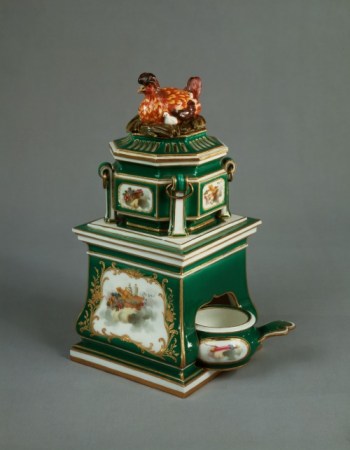
Perfume burner and egg steamer, Sèvres soft-paste porcelain, 1759 (London: The Wallace Collection).
The 2021 Haughton International Seminar provides an international tour of royal bedrooms and boudoirs over the centuries. Amongst the many and varied topics to be discussed will include intimate dining, activities, design, textiles, paintings, lighting, and items used for the toilette, hygiene, and health. They were more than bedrooms; they were the heart of the kingdom.
Cost of the two day seminar: £110 (inc VAT). Cost of the two day seminar including champagne reception and dinner at The Athenaeum (Thursday, 14th October): £190 (inc VAT). Student tickets for two-day seminar (on production of ID): £60 (inc VAT). Booking in advance through the website is essential due to limited numbers. Below is a preliminary programme (subject to change).
T H U R S D A Y , 1 4 O C T O B E R 2 0 2 1
8.45 Registration
9.15 Morning Session
• Annabel Westman
• Timothy Schroder
• Rosalind Savill
• Lisa White
12.40 Lunch Break
2.00 Afternoon Session
• Meredith Chilton
• Simon Thurley
4.30 Q&A Session
6.30 Drinks Reception (for dinner guests only) at The Athenaeum Club, 107 Pall Mall
7.15 Dinner (club dress code: smart, with ties for gentlemen, no denim and no training shoes)
F R I D A Y , 1 5 O C T O B E R 2 0 2 1
9.00 Arrival
9.30 Morning Session
• Bertrand Rondot
• Katharina Hantschmann
• Christiane Ernek-van der Goes
• Rose Kerr
12.55 Lunch Break
2.10 Afternoon Session
• Ivan Day
• Robin Emmerson
• Joanna Marschner
4.30 Q&A Session










 Enfilade
leave a comment