Christie’s Two Classic Week Evening Sales Top £64million

Lot 9: Bernardo Bellotto, View of Verona with the Ponte delle Navi, 1745-47, oil on canvas, 53 × 93 inches (133 × 235 cm). The lot essay for the painting suggests that “this justly-celebrated picture and its erstwhile companion, Verona from the Ponte Nuova looking upstream with the Castel San Pietro (Powis Castle, the National Trust), are the supreme masterpieces of Bellotto’s early career.” On 8 July 2021 the painting sold at Christie’s for over £10.5million. Slightly below its low estimate of £12million, the price was nevertheless an auction record for Bellotto.
◊ ◊ ◊ ◊ ◊
Christie’s press release, via Art Daily (9 July 2021) . . .
On 8 July 2021, the wealth of works offered across Christie’s two Classic Week Evening sales—the Exceptional Sale [with 30 lots] and the Old Masters Evening Sale [with 46 lots]—realised a combined total of £64.6million ($89 / €75million). Welcoming registered bidders from 102 countries across four continents, the top lot of the evening was Bernardo Bellotto’s View of Verona with the Ponte delle Navi, which achieved £10.6million ($14.6 / €12.3million) (estimate: £12–18million). Bringing the running total for Classic Week sales to date to £70,214,250 / $96,723,68 / €81,867,274. The auctions continue until 15 July, and with estimates starting from £500 to £18 million, this marquee week presents rare opportunities for new and established collectors across price levels.
Exceptional Sale
Christie’s, London, 8 July 2021
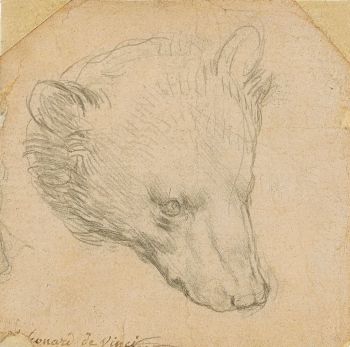
Lot 20: Leonardo da Vinci, Head of a Bear, silverpoint on pink-beige prepared paper, top corners cut, 3 × 3 inches (7 × 7 cm). The earliest provenance of the small drawing places it in the possession of Sir Thomas Lawrence.
Christie’s Exceptional Sale (No. 19443) realised £19,537,500 / $26,903,138 / €22,780,725, selling 77% by lot and 85% by value. The top lot of the sale was Head of a Bear by Leonardo da Vinci, which set a new world auction record for a drawing by the artist, achieving £8,857,500 / $12,196,778/ €10,327,845.
Stijn Alsteens, International Head of the Department of Old Master Drawings at Christie’s, comments: “Christie’s is greatly honoured to have brought this small but magnificent Old Master drawing to the market in the Exceptional Sale this evening in London. The drawing attracted attention from all around the world, and I was confident that the great quality and rarity of the work would lead to an exceptional result—the fifth highest price ever achieved for an Old Master drawing at auction.”
Giles Forster, Head of the Exceptional Sale, noted: “The breadth and depth of bidding across periods and categories in this sale is notable, highlighted by the top lots spanning Old Master drawings, decorative arts, and manuscripts. In addition to the stellar result for the record breaking top lot by Leonardo da Vinci, the price realised for the remarkable Charles I inkstand attributed to silversmith Christiaen van Vianen of £1.9million ($2.7 / €2.3million) (estimate: £1–1.5million) reflects the museum quality nature of this work, which was previously on long term loan to the Victoria and Albert Museum. The new auction record established for an Isaac Newton manuscript £1,702,500 / $2,344,343 / €1,985,115 (estimate: £600,000–900,000) highlights that autograph scientific manuscripts by Newton are of the greatest rarity on the market. We are also pleased to have established new auction records for a meteorite and for furniture by the bronzier Ferdinand Barbedienne with the remarkable ‘Japonisme’ aquarium, which show the unique ability of the Exceptional Sale to bring record prices for ‘wow factor’ works of art.”
Old Masters Evening Sale
Christie’s, London, 8 July 2021

Lot 14: Angelica Kauffman, R.A., Group Portrait of Lady Elizabeth Smith-Stanley, Countess of Derby, with Her Infant Son Edward, later 13th Earl of Derby and Her Half-Sister, Lady Augusta Campbell, Playing the Harp, oil on canvas, 50 × 40 inches (127 × 102 cm). The painting sold for £562,500, just above it its low estimate. The lot essay acknowledges Bettina Baumgärtel and Wendy Wassyng Roworth for their help in cataloguing the painting.
The Old Masters Evening Sale (No. 20053) realised £45,083,250 / $62,079,635/ €52,567,070, selling 94% by value and 78% by lot. The top lot of the sale was Bernardo Bellotto’s View of Verona with the Ponte delle Navi, which achieved £10,575,000 / $14,561,775 / €12,330,450 (estimate: £12–18million).
Clementine Sinclair, Head of the Old Masters Evening Sale, comments: “We are thrilled with the results of this Old Masters sale, which at £45million was the strongest evening sale since July 2016. Only two evening sales have exceeded this total over the past ten years. The prices realised for Bellotto’s majestic view of Verona and George de La Tour’s arresting image of Saint Andrew set new record prices for the artists at auction. The wealth of fresh material prompted competitive bidding with the exquisite cabinet picture by Frans van Mieris making more than four times the low estimate. All three works by female artists in the sale [Artemisia Gentileschi, Michaelina Wautier, and Angelica Kauffman] sold successfully, with two more than tripling their original low estimates. This evening was a real boost for the Old Masters market and underlines the continued demand for great works that are fresh to the market with exceptional provenance.”
FPS Online Lecture | Angiviller, Rambouillet, and ‘Etruscan’ Taste
From The French Porcelain Society:
Gabriel Wick and John Whitehead | Angiviller, Rambouillet, and ‘Etruscan’ Taste
Sir Geoffrey de Bellaigue Memorial Lecture
FPS, Online, Sunday, 11 July 2021, 18.00 (BST)
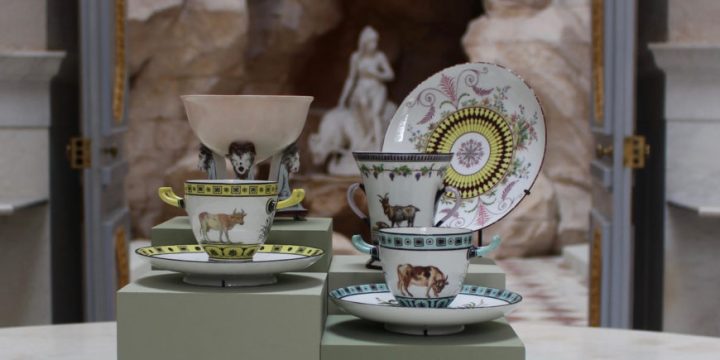
The French Porcelain Society is delighted to host the Sir Geoffrey de Bellaigue Memorial Lecture with Gabriel Wick, curator of the exhibition Vivre à l’Antique, who will explore the fascinating history of Rambouillet, a château associated with the avant-garde ‘Etruscan’ taste championed by the comte d’Angiviller. John Whitehead will discuss the Sèvres-porcelain service created for its dairy. We hope you can join us!
FPS members will receive an email invitation with instructions on how to join the online lecture. If you want to join, please contact us for more details on FPSenquiries@gmail.com. This will be the last Living Room Lecture until Sunday, 5 September 2021.
Rambouillet, 30-miles southwest of Paris, is the most recent and the least-known of France’s royal palaces. Acquired by Louis XVI as a domaine privé only six-years before the Revolution, it served successive sovereigns and presidents as a hunting lodge and rustic retreat until 2009, when it was entrusted to the care of the Centre des Monuments Nationaux and opened to the public. In the second half of the 1780s, the king’s de facto minister of the arts, the comte d’Angiviller, developed a number of remarkable projects for the domain—a proposal for the reconstruction of the château à l’antique, a model farm, extensive plantations of American trees, and the menagerie and dairy. The last of these, conceived as a theatrical evocation of the arts and rituals of the Etruscans, benefitted from contributions by Hubert Robert, Jean-Jacques Lagrenée, Georges Jacob, and the Sèvres manufacture (which Angiviller directed since 1783).
Exhibition | Vivre à l’antique: From Marie-Antoinette to Napoléon
The catalogue for the exhibition is published by Éditions Monelle Hayot:
Vivre à l’antique: de Marie-Antoinette à Napoléon 1er
Château de Rambouillet, 19 June — 9 August 2021
Curated by Gabriel Wick
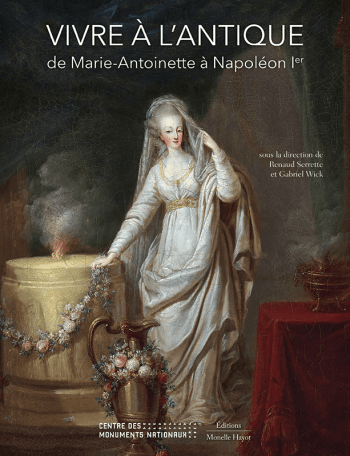 In the last three decades of the 18th century, the elites of Europe were enthralled by the constant flow of discoveries issuing forth from the excavations of buried cities, Etruscan tombs, and imperial villas in Italy. The distant past suddenly surged into the present, and architecture, furniture, and the accessories of daily life were re-imagined in its image. Nowhere in France could recount this aesthetic and cultural revolution more aptly than Rambouillet, the hunting estate and intimate retreat of the courts of Louis XVI and Napoléon I. Over the course of three months, the staterooms, intimate apartments, and dairy of Rambouillet will once again be filled with artifacts, models, and drawings from the Grand Tour and the Italian excavations, paintings by Hubert Robert, 18th– and 19th-century furnishings and decors by Jacob and Percier, and precious ceramics by Sèvres and Wedgwood. Through loans from the château of Versailles, the cité de la céramique de Sèvres, the École nationale supérieure des Beaux-Arts, the Bibliothèque des Arts décoratifs, and a number of private collections, the exhibition will explore how and why at the threshold of the modern era, distant antiquity so completely captured the imagination of the sovereigns and their courts.
Renaud Serrette and Gabriel Wick, eds., Vivre à l’antique, de Marie-Antoinette à Napoléon 1er (Saint-Remy-en-l’Eau: Éditions d’art Monelle Hayot, 2021), 200 pages, ISBN: 979-1096561315, 39€.
Online Roundtable | New Approaches to Piranesi
From the program flyer:
New Approaches to Piranesi: A Virtual Roundtable
Online, Friday, 16 July 2021
Organized by Jeanne Britton and Zoe Langer
 Join us for a roundtable of lightning talks on interdisciplinary approaches to the works of Giovanni Battista Piranesi (1720–1778). Recent scholarship by Heather Hyde Minor, Carolyn Yerkes, and Susan Dixon, as well as the current bestselling novel Piranesi by Susanna Clarke, have started to open the field of Piranesi Studies to new avenues of research and potentially wider audiences. This roundtable consists of two panels of short presentations of 5–7 minutes followed by ample time for discussion. Papers engage with a wide range of disciplinary fields and methods including globalism, reception, collecting, virtual reality, exhibition curation, book history, archaeology, history of design, and architecture. We hope the themes and format of the roundtable will encourage lively conversation and prompt new critical perspectives that will continue to broaden the interpretation of Piranesi’s works.
Organized by Jeanne Britton and Zoe Langer, Digital Piranesi, Irvin Department of Rare Books and Special Collections, University of South Carolina
Sponsored by Historians of Eighteenth Century Art and Architecture (HECAA)
Panel 1: 10.00–11.30am (EST)
• Hélène Bremer (Art Historian and Independent Curator), For the Love of the Master, 25 Artists Fascinated by Piranesi
• Erik Herrmann (Ohio State University), Another Campo Marzio
• Mireille Linck (Museum Boijmans Van Beuningen), Watermark Research: The Beginning of a Research Tool
• Ari Lipkis (Tyler School of Art & Architecture), Imprisoned in the Fold: Piranesi and the Video Artist
• Jason Porter (University of South Carolina), The Virtual Piranesi: New Methods of Immersive Literacy
• Carla Scagliosi (Galleria Nazionale dell’Umbria), Exploring ‘the Dark Brain of Piranesi’
Panel 2: 1.00–2.30pm (EST)
• George Dodds (University of Tennessee), Giambattista Piranesi, Modernity, and the Continuous Avant-Garde
• Sara Hayat (School of the Art Institute of Chicago), What We Can Learn from 18th-Century Global Histories of Architecture
• Helen Marodin (University of South Carolina), The Magnificence of Rome in the Carceri: Flashes of Light into Piranesi’s Shadowy Prisons
• Thomas Mical (India), Scanning for Duration and Intensity in Piranesi’s Carceri
• Aleksander Musial (Princeton University), Beyond the Capriccio: Piranesi’s Candelabra, Classical Transgression, and their Reception in Warsaw and St. Petersburg
• Kate Retford (Birkbeck, University of London), Piranesi and the Print Room
• Betsey Robinson (Vanderbilt University), Tunnel Visions: Rendering Conventions and Process at the Alban Lake
New Book | Monument’s of St Paul’s Cathedral, 1796–1916
From Scala:
Jason Edwards, Amy Harris, and Greg Sullivan, Monument’s of St Paul’s Cathedral, 1796–1916 (London: Scala, 2021), 48 pages, ISBN: 978-1785513602, £8 / $10.
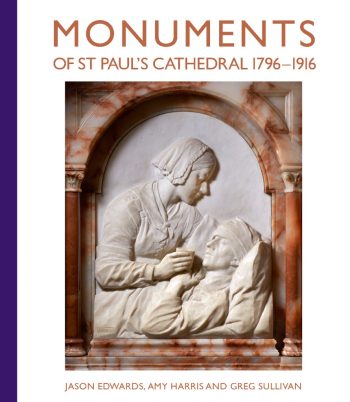 St Paul’s Cathedral is home to some of the finest sculptures by the foremost artists of the long nineteenth century. Memorials around the Cathedral represent giants of the arts, political and military figures and a range of other men and women of national importance, from Nelson to Florence Nightingale. Their memorials echo the tenor of their lives, some dramatic and impressive, others quieter and more reflective, but each story unique. The monuments of St Paul’s are also a record of 19th-century nationalist attitudes, giving this guide particular piquancy in light of current conversations about national identity and values.
Jason Edwards is a Professor of Art History at the University of York and a specialist in the global contexts of British sculpture from 1760 to 1914. Amy Harris is a sculptural historian who specialises in long-19th-century national collections of British sculpture. Greg Sullivan is a sculpture historian and co-author of the Biographical Dictionary of Sculptors in Britain 1660–1851.
Online Talks | Rubens Series

Peter Paul Rubens, The Rainbow Landscape (detail), ca. 1636
(London: The Wallace Collection)
◊ ◊ ◊ ◊ ◊
The last three talks in the series address the eighteenth- and nineteenth-century reception of Rubens. From The Wallace Collection:
Rubens Talk Series
Online, The Wallace Collection, 9 June — 21 July 2021
To accompany The Wallace Collection’s new exhibition Rubens: Reuniting the Great Landscapes, this series of seven talks will explore different aspects of Rubens’s extraordinary life and achievements, the fascinating social, cultural and economic circumstances of his age, and his enduring artistic legacy.
Series talks will be presented through Zoom Webinar. Each talk duration is 1 hour, including time for Q&A with the speaker. Tickets can be purchased for individual talks or the entire series. Ticket holders will receive their Zoom link, Webinar ID, and Passcode 24 hours in advance of each talk. Series talks, excluding 21 July, will be recorded. Following each talk, ticket holders will be emailed a link to view the recording, which will be available for one week only.
◊ ◊ ◊ ◊ ◊
John Chu | ‘Equal to the Great Masters’: Landscapes by Gainsborough and Rubens
Wednesday, 7 July 2021, 19.00 BST
Thomas Gainsborough (1727–1788) had a lifelong love of Netherlandish landscape art. As his career developed so too did the range and depth of his appreciation for the ‘Great Masters’ of the Low Countries—prominent in this pantheon was Peter Paul Rubens (1577–1640). In this talk, John Chu will consider the transformative influence of Rubens’s landscapes on Gainsborough’s art, examining what he learned from his predecessor and why these paintings became such an important model. Looking more broadly, he will also explore the reputation of Rubens’s landscapes in 18th-century Britain and establish the social and artistic conditions that shaped, and made possible, Gainsborough’s fruitful encounter with the works of the Flemish master.
Dr John Chu is Senior Curator of Pictures and Sculpture at the National Trust. He has taught and published widely on 18th-century British and French painting and specialises in the art of Thomas Gainsborough and Joshua Reynolds.
◊ ◊ ◊ ◊ ◊
Christoph Vogtherr | Flemish Painting in 18th-Century French Collections
Wednesday, 14 July 2021, 19.00 BST
Flemish painting rose to a prominent role in Parisian collections only in the late 17th century. Even Rubens started to be regarded as one of the major European painters considerably later than in territories of the German Empire or in Italy. This change in perception and taste went hand in hand with new modes of picture displays. In the first decades of the 18th century, the comparison of schools and painters became the guiding principle of art presentation. Flemish painting was introduced into Parisian collections in this context of emulation and competition between the schools. In the process, Flemish and French painting gained a prominence comparable to Italian art. In this talk, Christoph Vogtherr will trace the rise of Flemish and Dutch painting in Parisian collections, its important position in picture displays and art theory, as well as its role in the formation of French 18th-century painting.
Dr Christoph Martin Vogtherr is General Director of the Stiftung Preußische Schlösser und Gärten Berlin-Brandenburg. His main research interests are the history of the Prussian Royal palaces, French 18th-century painting, and the history of art collecting in the 18th and 19th centuries. He was previously Director of the Hamburger Kunsthalle (2016–19), and before that, Curator of paintings and then Director of the Wallace Collection from 2011 to 2016. He has published widely on 18th-century French painting.
◊ ◊ ◊ ◊ ◊
Tim Barringer | British Painters and Rubens’s Poetic Pastorals
Wednesday, 21 July 2021, 19.00 BST
Tim Barringer will explore the character of Rubens’s landscapes, which blend the legacies of classical poetry with the rough and tumble of rural life in the 17th century. Erudite references mix with rustic pastimes. While Rubens’s grand historical and religious paintings, like his portraits, commanded admiration across Europe, British artists and collectors found a special affinity with his pastoral works. Painters such as Constable, Turner, and Bonington were indelibly affected by the experience of seeing Rubens’s paintings and drawings, allowing them to see the natural world anew.
Dr Tim Barringer is Paul Mellon Professor and Chair of the Department of the History of Art at Yale University. He contributed to Rubens and his Legacy, the RA’s exhibition catalogue, and has co-curated exhibitions including American Sublime: Opulence and Anxiety; Pre-Raphaelites: Victorian Avant-Garde; Picturesque and Sublime: Thomas Cole’s Trans-Atlantic Inheritance; Unto This Last: Two Hundred Years of John Ruskin; and Victorian Radicals: From the Pre-Raphaelites to the Arts & Crafts Movement.
Exhibition | Flags and Founding Documents

13-star flag featuring a ‘Great Star’ pattern, ca. 1800–25, one of the earliest American flags known to survive
(Jeff Bridgman, American Antiques)
◊ ◊ ◊ ◊ ◊
Now on view at the Museum of the American Revolution:
Flags and Founding Documents, 1776–Today
Museum of the American Revolution, Philadelphia, 11 June — 6 September 2021
The summer exhibition Flags and Founding Documents, 1776–Today showcases dozens of rare American flags alongside historic early state constitutions and the first printing of the proposed U.S. Constitution of 1787.
The flags—many of which have never been exhibited before—trace the evolution of the Stars and Stripes through the addition and subtraction of stars as new states joined the Union and the nation battled through the Civil War. The flags serve as a visual narrative of America’s national story. The flags are showcased alongside historic documents including early printings of more than 16 different state constitutions and the Choctaw Nation Constitution of 1838 to shed light on the triumphs and tensions that the United States faced as it expanded and worked toward creating a ‘more perfect Union’. By telling stories from the nation’s revolutionary roots to its continuing struggle over equal rights, Flags and Founding Documents, 1776–Today encourages visitors to consider their role in the ongoing effort to fulfill the promise of the American Revolution.
The collection of historic flags is on loan from Jeff R. Bridgman, a leading dealer of antique flags and political textiles. The documents are on loan from the Dorothy Tapper Goldman Foundation following their presentation at the New-York Historical Society in the exhibition Colonists, Citizens, Constitutions: Creating the American Republic (February 2020 — Mary 2021), curated by Dr. James F. Hrdlicka.
James Hrdlicka, with Robert McD. Parker and a foreword by Ruth Bader Ginsburg, Colonists, Citizens, Constitutions: Creating the American Republic (London: Scala Arts Publishers, 2020), 208 pages, ISBN: 978-1785512070, $45.
Commodore Collection Now Preserved in Maryland
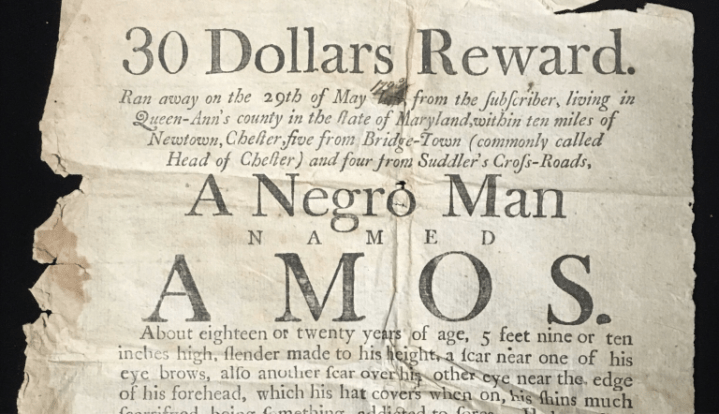
’30 Dollars Reward’ broadside for a man named Amos, detail, 11 February 1793 (Chesterton, Maryland: Commodore Collection). The full document with more information is available here.
◊ ◊ ◊ ◊ ◊
From The Washington Post:
Michael E. Ruane, “A Maryland attic hid a priceless trove of Black history. Historians and activists saved it from auction,” The Washington Post (28 June 2021). Among the artifacts is an account of escape from enslavement that is among the oldest ever found.
The 200-year-old document was torn and wrinkled. It had stains here and there. And it was sitting on a plastic table in the storeroom of an auction house near the Chester River hamlet of Crumpton, on Maryland’s Eastern Shore. Historian Adam Goodheart had seen it before, but only in a blurry website photo. Now, here it was in a simple framed box—a wanted poster for “A Negro Man named Amos” who had fled from his enslaver in Queen Anne’s County.
It was chilling. There, on cheap rag paper, was the story of American slavery. Amos was “a smart fellow,” about 20, who might be headed for his mother in Philadelphia. But in 1793 he was the property of one William Price, who wanted him caught.
The poster, or ‘broadside’, was one of hundreds of rare documents discovered earlier this year in the attic of an old house on the Eastern Shore and saved from the auction block by a group of Washington College historians and local Black activists. And the reward poster turned out to be one of the oldest known, said Goodheart, director of the college’s Starr Center for the Study of the American Experience in Chestertown, Maryland . . . .
The full article is available here»
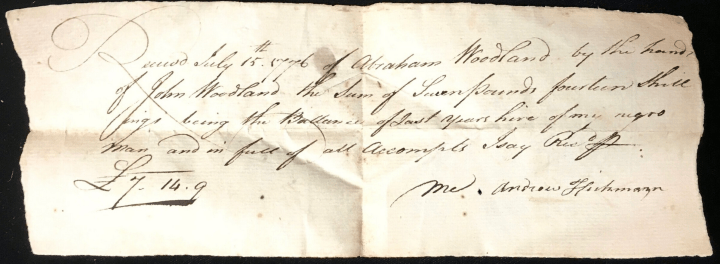
Receipt for the ‘hire’ of an enslaved man, 15 July 1776 (Chesterton, Maryland: Commodore Collection). More information is available here.
◊ ◊ ◊ ◊ ◊
From Sumner Hall:
Sumner Hall is proud to share with our supporters the successful effort to rescue and preserve a significant collection of local records.
“The Commodore Collection of original historical documents on the early experiences of African Americans in Kent and Queen Anne’s counties is a rare find,” according to Dr. Ruth Shoge, First Vice President of Sumner Hall. “The documents, which are intellectually enriching, also evoke an emotional response to the harsh reality of the lives of enslaved and freed Black people in 17th- and 18th-century America,” she continued. “It is very important to Sumner Hall that this collection has been given to us in perpetuity. The ownership of this collection is an honor and, in a special way, a homecoming for the memories of our ancestors. This collection supports our mission of promoting an understanding of the African American experience within the overall context of American history and culture.”
Thanks to the efforts of local Black residents and the Starr Center for the Study of the American Experience at Washington College, approximately 2,000 pages of documents were purchased from Dixon’s Crumpton Auction this spring. The collection, named after Washington College’s first local Black alumnus, Norris Commodore ’73, will belong to Sumner Hall but is being conserved and archived at the school’s Miller Library. Mr. Commodore, who has deep roots here, gave generously toward the acquisition cost and was joined by the Hedgelawn Foundation, the Kent Cultural Alliance and the Andrew W. Mellon Foundation. The papers are being digitized as a part of the Chesapeake Heartland Project, and several can already be viewed online here.
President of Sumner Hall’s Board of Directors, Larry Wilson, says, “The Commodore Collection is a very meaningful record of African American life and survival. I believe that it is very important to know our history and to learn from the lives of our ancestors as we work together for equal rights, justice and freedom in this county and across the country. We look forward to having exhibits at Sumner Hall based on these materials soon.”
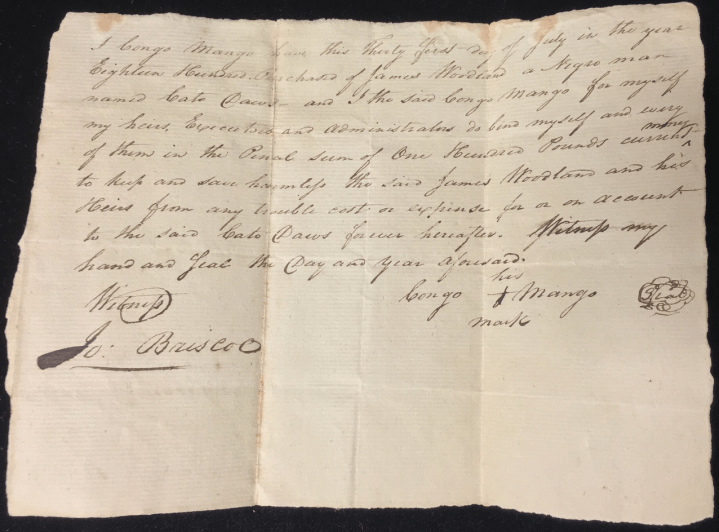
Congo Mango’s bond on behalf of Cato Daws, 31 July 1800. Mango (later known as Congo Mander), a free Black man, purchased Daws in order to grant his freedom (Chesterton, Maryland: Commodore Collection). As noted in the document description, “This small piece of paper opens a window into the life story of a man who was born in Africa, enslaved in Maryland, gained his freedom, and helped others become free. He gave rise to a Black family that can be traced to the present day.” More information is available here.
◊ ◊ ◊ ◊ ◊
Sumner Hall, located in historic Chestertown on Maryland’s Eastern Shore, is one of two existing African American Grand Army of the Republic buildings still standing in the United States. Built circa 1908 and fully restored in 2014, it serves today as a museum, educational site, performance stage, social hall, and gallery. Sumner Hall is a registered 501(c)(3) nonprofit corporation, funded by donations and memberships.
New Book | Colonial Complexions
First published in 2018, Colonial Complexions has just been released in paperback; from Penn Press:
Sharon Block, Colonial Complexions: Race and Bodies in Eighteenth-Century America (Philadelphia: University of Pennsylvania Press, 2018), 232 pages, ISBN 978-0812250060 (cloth), $45 / ISBN 978-0812224924 (paperback), $23.
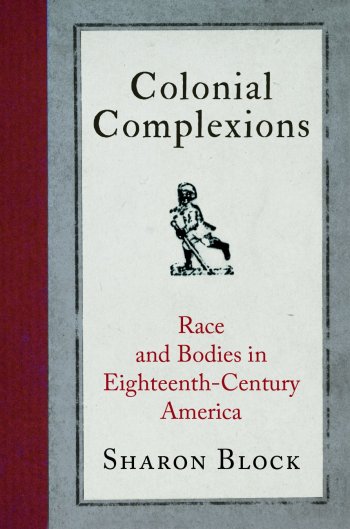 In Colonial Complexions, historian Sharon Block examines how Anglo-Americans built racial ideologies out of descriptions of physical appearance. By analyzing more than 4,000 advertisements for fugitive servants and slaves in colonial newspapers alongside scores of transatlantic sources, she reveals how colonists transformed observable characteristics into racist reality. Building on her expertise in digital humanities, Block repurposes these well-known historical sources to newly highlight how daily language called race and identity into being before the rise of scientific racism.
In the eighteenth century, a multitude of characteristics beyond skin color factored into racial assumptions, and complexion did not have a stable or singular meaning. Colonists justified a race-based slave labor system not by opposing black and white but by accumulating differences in the bodies they described: racism was made real by marking variation from a norm on some bodies, and variation as the norm on others. Such subtle systemizations of racism naturalized enslavement into bodily description, erased Native American heritage, and privileged life history as a crucial marker of free status only for people of European-based identities. Colonial Complexions suggests alternative possibilities to modern formulations of racial identities and offers a precise historical analysis of the beliefs behind evolving notions of race-based differences in North American history.
Sharon Block is Professor of History at the University of California, Irvine.
C O N T E N T S
Introduction
1 Complicating Humors and Rethinking Complexion
2 Shaping Bodies in Print: Labor and Health
3 Coloring Bodies: Naturalized Incompatibilities
4 Categorizing Bodies: Race, Place, and the Pursuit of Freedom
5 Written by and on the Body: Racialization of Affects and Effects
Epilogue
Appendices
1 Advertisements for Runaways: Sources and Methodology
2 Graphic Overview of Advertisements for Runaways
3 Newspapers with Advertisements for Runaways, 1750–75
Notes
Index
Acknowledgments
New Book | Philadelphia Stories
From Penn Press:
C. Dallett Hemphill, edited by Rodney Hessinger and Daniel Richter, Philadelphia Stories: People and Their Places in Early America (Philadelphia: University of Pennsylvania Press, 2021), 392 pages, ISBN 978-0812253184, $35 / £27.
 For the average tourist, the history of Philadelphia can be like a leisurely carriage ride through Old City. The Liberty Bell. Independence Hall. Benjamin Franklin. The grooves in the cobblestone are so familiar, one barely notices the ride. Yet there are other paths to travel, and the ride can be bumpy. Beyond the famed founders, other Americans walked the streets of Philadelphia whose lives were, in their own ways, just as emblematic of the promises and perils of the new nation.
Philadelphia Stories chronicles twelve of these lives to explore the city’s people and places from the colonial era to the years before the Civil War. This collective portrait includes men and women, Black and white Americans, immigrants and native born. If mostly forgotten today, banker Stephen Girard was one of the wealthiest men ever to have lived, and his material legacy can be seen by visiting sites such as Girard College. In a different register, but equally impressive, were the accomplishments of Sarah Thorn Tyndale. In a few short years as a widow she made enough money on her porcelain business to retire to a life as a reformer. Others faced frustration. Take, for example, Grace Growden Galloway. Born to an important family, she saw her home invaded and her property confiscated by patriot forces. Or consider the life of Francis Johnson, a Black bandleader and composer who often performed at the Musical Fund Hall, which still stands today. And yet he was barred from joining its Society. Philadelphia Stories examines their rich lives, as well as those of others who shaped the city’s past.
Many of the places inhabited by these people survive to this day. In the pages of this book and on the streets of the city, one can visit both the people and places of Philadelphia’s rich history.
C. Dallett Hemphill (1959–2015) was Professor of History at Ursinus College. Rodney Hessinger is Professor of History at John Carroll University. Daniel K. Richter is Roy F. and Jeannette P. Nichols Professor of American History at the University of Pennsylvania.
C O N T E N T S
Foreword, Daniel Richter
Introduction: Places and People, completed by Rodney Hessinger
Part I. For the Love of God: Three Colonial Men of Faith
Prologue, Daniel Richter
1 Anthony Benezet, completed by Jean Soderlund
2 Henry Muhlenberg, completed by Lisa Minardi
3 William White, completed by Sarah Barringer Gordon
Part II. Declaring Independence: Three Revolutionary Wives
Prologue, C. Dallett Hemphill
4 Grace Growden Galloway, completed by Judith Van Buskirk
5 Anne Shippen Livingston, completed by Susan Branson
6 Deborah Norris Logan, completed by Rodney Hessinger
Part III. Striving to Succeed: Three ‘Self-Made Men’ in the New Nation
Prologue, Rodney Hessinger
7 Charles Willson Peale, completed by Nenette Luarca-Shoaf
8 Stephen Girard, completed by Brenna O’Rourke Holland
9 Joseph Hemphill, completed by Sarah Rodriguez
Part IV. Pursuing an Inclusive America: Three Aspiring Antebellum Lives
Prologue, Rodney Hessinger
10 Francis Johnson, completed by Richard Newman
11 Sarah Thorn Tyndale, completed by Susan Klepp
12 William Darrah Kelley, completed by Andrew Shankman
Notes
Index
Acknowledgments










 Enfilade
leave a comment