Call for Articles | The Eighteenth Century in Comics and Graphic Novels
From ArtHist.net:
Die Aufklärung und das 18. Jh. in Comic und Graphic Novel
The Enlightenment and the 18th Century in Comics and Graphic Novels
Special Issue of Jahrbuch Der OGE 18
Jahrbuch Der Österreichischen Gesellschaft Zur Erforschung Des Achtzehnten Jahrhunderts 2022
Proposals due by 31 July 2021; completed articles will be due 31 December 2021
Anlässlich ihres 40-Jahr-Jubiläums widmet die Österreichische Gesellschaft zur Erforschung des 18. Jahrhunderts ihr Jahrbuch 2022 Repräsentationen von Aufklärung und dem 18. Jahrhundert in Comics und Graphic Novels. Zwar ist die Rezeption historischer Inhalte in der Populärkultur ein etabliertes Forschungsfeld, doch haben die Text-Bild-Narrationen dieses Mediums—verglichen etwa mit Computerspielen—bislang kaum Aufmerksamkeit gefunden. Vorliegende Arbeiten (wie C. Gundermanns Jenseits von Asterix, 2007) haben einerseits einen fachdidaktischen Schwerpunkt auf Aspekte der Vermittlung, andererseits keinen definierten Fokus auf das 18. Jahrhundert. — Dieses ist aber in mehrfacher Hinsicht interessant: Graphic Novels (etwa zu Voltaire) können Ideen der Aufklärung recht präzise auf den Punkt bringen; manche historisierenden Donald Duck-Darstellungen (etwa jene von Erika Fuchs) spiegeln dagegen durchaus tieferes Verständnis der deutschen Klassik. Dennoch hat sich bislang niemand diesem Thema wissenschaftlich angenähert. Die OGE18 will das mit ihrem Jubiläumsjahrbuch nun ändern.
Gesucht werden wissenschaftliche Aufsätze (im Umfang von rund 40.000 bis 50.000 Zeichen inkl. Leerzeichen), die die Verhandlung von Motiven, Figuren, Ereignissen und Ideen des ‚langen‘ 18. Jahrhunderts in Comics oder Graphic Novels kritisch diskutieren. Aufsätze können in deutscher, englischer oder französischer Sprache eingereicht werden. Abgabetermin ist der 31. Dezember 2021. Die Beiträge werden einem Peer-Review-Verfahren unterzogen. Bei Interesse senden Sie bitte bis spätestens 31. Juli 2021 eine knappe Skizze Ihres Beitrags an die Herausgeber_innen Thomas Assinger (thomas.assinger@sbg.ac.at), Elisabeth Lobenwein (elisabeth.lobenwein@aau.at) und Thomas Wallnig (thomas.wallnig@univie.ac.at).
Call for Papers | The Presence of America in Madrid
From ArtHist.net:
The Presence of America in Madrid
Real Academia de San Fernando, Madrid, 3–4 February 2022 (dates TBC)
Organized by Luisa Elena Alcalá and Benito Navarrete Prieto
Proposals due by 20 September 2021
Organized within the context of the research project AmerMad (América en Madrid: Patrimonios interconectados e impacto turístico en la Comunidad de Madrid / America in Madrid: Interconnected Patrimony and Touristic Impact in the Comunidad de Madrid), in collaboration with the Royal Academy of San Fernando, this colloquium seeks to analyze the current state of knowledge regarding viceregal art in Madrid. As is well known, during the early modern period, hundreds of objects, artworks, painted and illustrated documents, and manuscripts were sent from the Spanish viceroyalties in America to Iberian Spain. This circulation has been the object of renewed academic interest in recent years. In response to this trend, it seems necessary to better understand the particular place that Madrid, as both city (villa) and court (corte), occupied within this broader phenomenon.
The presence of objects with a Spanish American provenance in Madrid has mostly been studied through the lens of the monarchy since the crown was a primary patron, generator, and receiver of all kinds of objects and images, both of documentary and artistic value. Nonetheless, as Madrid grew and developed into a major city in the 17th and 18th centuries, it began to harbor many important institutions that offer other scenarios to explore: great convents, schools, academies, hospitals, and churches with their respective religious congregations, all of them places of productive encounters for many people involved and/or connected in some way with life on the other side of the Atlantic.
One of the aims of this colloquium is to refresh and update what we know about the Spanish American patrimony in Madrid between the 16th and the 18th centuries. Another objective is to consider the place that these works should or could occupy in a renewed narrative of the history of art in Spain that is more inclusive, transversal, and multicultural.
What stories about Madrid and its art have gone amiss? And, have they remained in the background because of traditional disciplinary divides, such as the one that separates Spanish art (or art in Spain) from Spanish American art? How can we think of Madrid as a crossroads where Iberian and colonial art met? How did objects that came from America interact or engage with local developments of taste, consumption, religious practice, devotion and identity, as well as artistic processes and projects taking place in the capital? What kinds of functions did these works have, and how can we characterize their social impact? In addition, we encourage consideration of how these objects were displayed, if they were more or less visible, and how they have been transformed by changing displays, their meanings becoming more or less relevant for Madrid´s society as times changed.
We invite proposals based on original research that can contribute to advancing the current state of knowledge and explore new questions and theoretical frameworks for our better understanding of these unique objects and works of art. Please send proposals (of 400–600 words) along with a short CV to elena.alcala@uam.es and benito.navarrete@uah.es.
• Proposals are due by 20 September 2021.
• Accepted participants will be notified by 1 October.
• Papers can be in Spanish, English, French, Italian, or Portuguese
The conference will coincide with the closing days of the exhibition Tornaviaje: Arte Iberoamericano en España (Museo Nacional del Prado, October 2021 — February 2022), and the colloquium will include a visit. Additional activities are planned to complement the conference, including a study session of the relevant holdings in the Real Academia de Bellas Artes de San Fernando, which will be coordinated by Juan Bordes and Itziar Arana as head of projects at the RABASF.
N.B. — The dates are still to be confirmed; the conference may be held 3–4 February or 10–11 February.
Shaker Museum Scheduled To Open in 2023
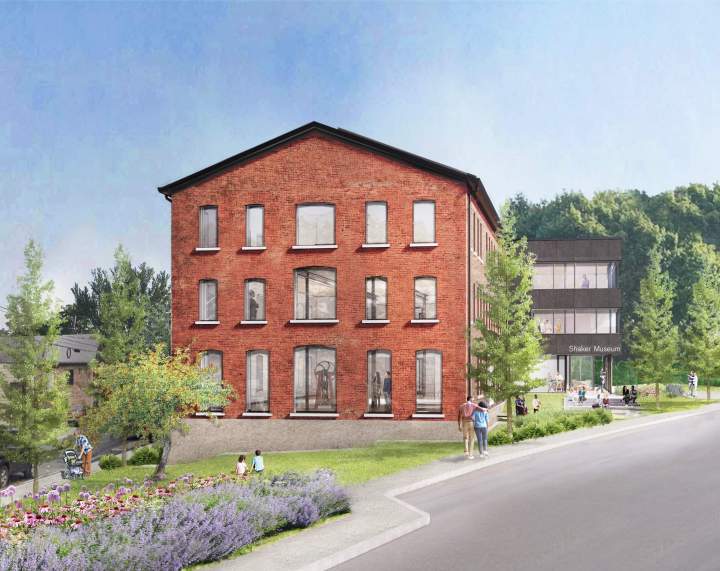
Rendering of the Shaker Museum in the village of Chatham, New York. Selldorf Architects is charged with the design of the $18million museum complex. Renderings are presented alongside select Shaker objects as part of a special pop-up exhibition The Future is a Gift, on view in downtown Chatham through August 29 (Image: Selldorf Architects/Shaker Museum). Additional views are available at The Architect’s Newspaper.
◊ ◊ ◊ ◊ ◊
From The NY Times . . .
Patricia Leigh Brown, “The Shakers Are Movers, Too,” The New York Times (20 June 2021). The country’s most significant collection of Shaker objects, out of public view for a decade, will relocate to an $18 million museum complex designed by Annabelle Selldorf.
In an earlier life, the moribund red brick Victorian at the foot of Main Street in this thriving Columbia County village [of Chatham, NY] had been a sanitarium, a hotel and tavern, a furniture store and an auto dealership. These were the warm-up acts for its latest incarnation: a permanent new home for the Shaker Museum, widely considered the country’s most significant collection of Shaker furniture, objects and archival material. The museum, set to open in 2023 and to include a new addition, is being designed by the architect Annabelle Selldorf, whose current projects include the expansion of The Frick Collection in New York and an addition for The Museum of Contemporary Art San Diego La Jolla. . . .
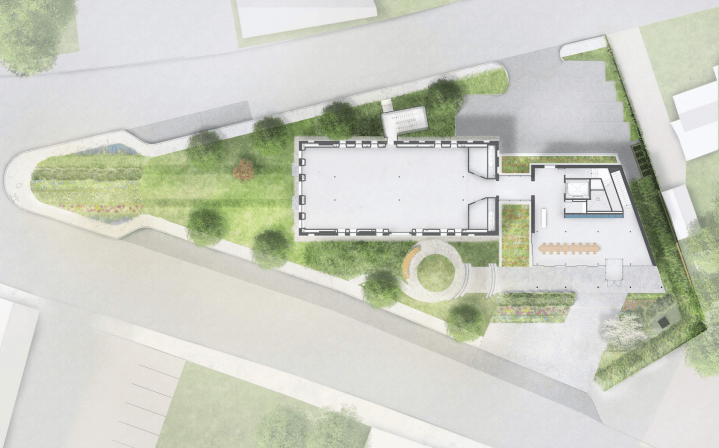
Nelson Byrd Woltz has been tasked to design a Shaker-inspired landscape for the complex, pictured here in the landscape site plan (Nelson Byrd Woltz/Courtesy Shaker Museum).
◊ ◊ ◊ ◊ ◊
The museum’s exhibitions are still in the nascent stages. Maggie Taft, a guest curator, said the permanent exhibition will address the fundamental aspects of Shakerism, which reached its Zenith in the 1840s with 18 villages from Maine to Kentucky, but also the unexpected subtexts. The sect—an international Protestant monastic community—was founded in 1774 by Mother Ann Lee, the charismatic illiterate daughter of an English blacksmith (a swatch of one of her aprons is among the museum’s most prized possessions).
Although the sect was known for gender equality, Ms. Taft noted that women and men were “divided in ways that resembled worldly labor divisions”—with men toiling outside on agriculture and other tasks while the women worked indoors. The exhibition will also explore the different generations of Shakerism, especially the third generation after Mother Ann Lee’s death in 1784, when young women’s ‘encounters’ with her were manifested in drawings and texts thought to be ‘gifts’ from the spirits. . . .
The full article is available here»
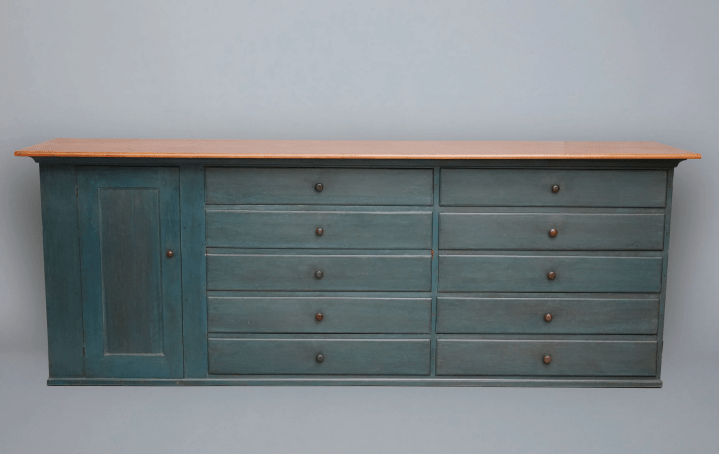
Tailor’s counter painted blue, pinewood, ca. 1815
(Shaker Museum)
Enfilade Turns Twelve! Buy an Art Book!
From the Editor
As Enfilade turns twelve (22 June), I write with wholehearted thanks! With over 1.1 million views to date—more than 3400 subscribers and 10,000 clicks each month—the site still exists because you’re still reading. And so to celebrate . . .
1) Buy an art book this week. In the world of academic art history publishing, several hundred books sold over a few days is stellar. It’s an important way to communicate that the eighteenth century is a thriving field with a vital, engaged audience. The more people who buy books addressing the eighteenth century, the easier it will be to publish your next book on the eighteenth century.
2) Renew your HECAA membership. In the normal world $30 doesn’t really count as philanthropy. For a small academic society it does. Because HECAA is registered as a 501c3, all donations are tax deductible in the United States. So send in a contribution of $100 or $5. But donate something. Student memberships are just $10. More information is here.
3) Finally, send in news you’d like to see reported! I’m glad to post announcements about conferences, forthcoming books, journal articles, exhibitions, fellowship opportunities, &c. Just about anything except job listings. The postings readers most enjoy are inevitably original content, reports of interesting collections, house museums, resources, and the like. CraigAshleyHanson@gmail.com.
-Craig Hanson
New Book | Crafting Enlightenment
The latest in the Oxford University Studies in the Enlightenment series, from Liverpool UP (with more information from this blog posting by the editors) . . .
Lauren R. Cannady and Jennifer Ferng, eds., Crafting Enlightenment: Artisanal Histories and Transnational Networks (Liverpool: Voltaire Foundation in Association with Liverpool University Press, 2021), 416 pages, ISBN 978-1800348141, £65 / $100.
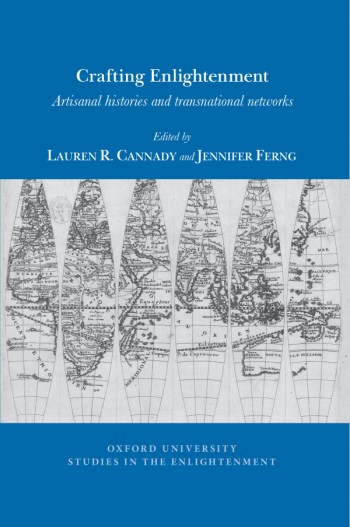 A ground-breaking volume examining the transnational conditions of the European Enlightenment, Crafting Enlightenment argues that artisans of the long eighteenth-century on four different continents created and disseminated ideas that revolutionized how we understand modern-day craftsmanship, design, labor, and technology. Starting in Europe, this book journeys through France across the Atlantic Ocean to the Americas and then on to Asia and Oceania. Highlighting diverse identities of artisans, the authors trace how these historical actors formed networks at local and global levels to assert their own forms of expertise and experience. These artisans—some anonymous, eminent, and outside the margins—translated European Enlightenment thinking into a number of disciplines and trades including architecture, botany, ceramics, construction, furniture, gardening, horology, interior design, manuscript illustration, and mining.
In each thematic section of this illustrated volume, two leading scholars present contrasting case studies of artisans in different geographic contexts. These paired chapters are also followed by shorter commentary that reflects on pertinent themes from both chapters. Emphasizing how and why artisanal histories around the world impacted civic and private life, commerce, cultural engagement, and sense of place, this book introduces new richness and depth to the conversations around the ambivalent and fragmented nature of the Enlightenment.
Lauren R. Cannady, Assistant Clinical Professor in University Honors at the University of Maryland, is a historian of early modern art and architecture with an interest in intellectual and cultural history. Her previous publications include analyses of early modern garden patterns and French aesthetic philosophy, and her current project is a book on northern European gardens as sites of knowledge production and transmission. Jennifer Ferng is Senior Lecturer in Architecture and Postgraduate Director at the University of Sydney. She received her PhD from MIT. Her second co-edited book Land Air Sea will address how architecture and environment(s) in the early modern era forecasted contemporary issues related to climate change and sustainability.
C O N T E N T S
List of Figures
Acknowledgments
Lauren R. Cannady and Jennifer Ferng, Introduction: Assembling Artisanal Identities across Geographies
I. Envisioning Artisanal Histories
• Chandra Mukerji, Sovereign Sun King
• Emine Fetvaci, Visualizing Urban Festivals in the Ottoman Empire: A Comparison of the Sixteenth and Eighteenth Centuries
• Richard Taws, Telling Artisanal Time
II. Collaborative Objects
• Frédéric Dassas, The Secret to Success: Urbanization and Luxury Decoration at the Place Louis-le-Grand
• Dennis Carr, The Spanish Colonial World in Microscosm: A Puebla Desk-and-Bookcase
• Florina H. Capistrano-Baker, Artisanal Agency, Agnonymity, and Power
III. Religion and the Commerce of Empire
• Neil Kamil, Mark of Disgrace or Matter of Politeness? Materiality, Trust, and Expectations in Early-Eighteenth-Century Virginia
• Lauren R. Cannady, Interregna: The Société des Arts and the Scale of Time
• Thomas Crow, Confessional Complications in Maritime Trade
IV. Corporeal Ecologies
• Sugata Ray, A ‘Small’ Story of the Jasmine Flower in the Age of Global Botany
• Doroty Ko, Fire Walk with Me: Tales of Artisanal Body (Parts) and Innovation in Early Modern China
• Nany Um, Grounded Terrains and Vertical Landscapes in Eighteenth-Century Asia
V. Enlightenment Technologies
• Valérie Nègre, Craft Knowledge in the Age of Enyclopedism
• Jennifer Ferng, Miniature Domination: Mining the Worlds of Goldfields Jewelry and Emu Eggs
• Kaijun Chen, Artisans as Thinkers in the Early Modern World
Summaries
Bibliography
Index
Woman’s Art Journal, Spring / Summer 2021
The eighteenth century in the latest issue of WAJ:
Woman’s Art Journal 42.1 (Spring / Summer 2021)

Marguerite Gérard, Portrait of a Man and Woman in an Interior, 1818 (Tulsa: Philbrook Museum of Art; Taber Art Fund, 2019.9). The painting sold at Christie’s in Paris on 28 October 2019, Sale 17655, Lot 751.
A R T I C L E S
• Sarah Lees, “Marguerite Gérard’s Portrait of a Man and a Woman in an Interior: Portraiture, Landscape, and Social Networks,” pp. 19–26.
• Alison M. Kettering, “Watercolor and Women in the Early Modern Netherlands: Between Mirror and Comb,” pp. 27–35.
R E V I E W S
• Rosie Razzall, Review of Angela Oberer, The Life and Work of Rosalba Carriera (1673–1757): The Queen of Pastel (Amsterdam University Press, 2020), pp. 44–46.
• Wendy Wassyng Roworth, Review of the exhibition catalogue, Angelica Kauffman, edited by Bettina Baumgärtel (Hirmer, 2020), pp. 46–48.
Exhibition | British Stories

Johan Zoffany, The Triumph of Venus (Vénus sur les eaux), ca. 1760, oil on canvas
(Musée des Beaux-Arts de Bordeaux). More information is available here.
◊ ◊ ◊ ◊ ◊
This summer the Musée des Beaux-Arts in Bordeaux, as part of ‘A British Year at the Museum’, presents two exhibitions: British Stories and Absolutely Bizarre! Strange Tales from the Bristol School of Artists, 1800–1840.
British Stories
Musée des Beaux-Arts de Bordeaux, 19 May — 19 September 2021
Organized by Sophie Barthélémy, Sandra Buratti-Hasan, and Guillaume Faroult
The British art collections held by the Bordeaux Museum of Fine Arts form a coherent corpus of thirty paintings, drawings, prints, and sculptures. This exhibition is an occasion to admire them all and compare them with works loaned by the Louvre.
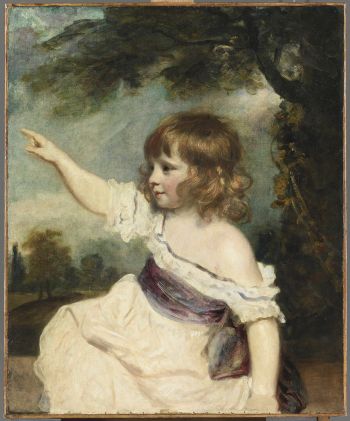
Joshua Reynolds, Portrait of Francis George Hare (1786–1842), ‘Master Hare’, ca. 1788–89, oil on canvas (Paris: Musée du Louvre, RF 1580).
A significant portion of the exhibition is dedicated to portraiture, a genre in which British painters excelled. In the 17th century, Flemish painter Anthony van Dyck was invited to stay at the Court of Charles I of England during the last decade of his career, a period that was a pivotal moment in the development of European portrait art whose conventions van Dyck reinvented (modello of the Double Portrait of the Palatinate Princes Charles Louis I and Prince Rupert, Museum of Fine Arts, Bordeaux). Among his most famous heirs we can mention Sir Joshua Reynolds, represented by his celebrated ‘Master Hare’ (Louvre) and his Portrait of Richard Robinson, Archbishop of Armagh (Museum of Fine Arts, Bordeaux). This survey of British portraiture culminates with the Portrait of John Hunter by Sir Thomas Lawrence (Museum of Fine Arts, Bordeaux).
In the history painting genre, the exhibition gives a special place to artists under-represented in French public collections, namely James Ward, with his superb Baptism of Christ (Louvre), Benjamin West (Phaeton Asking Apollo to Drive the Sun Chariot, Louvre), and Johan Zoffany (The Triumph of Venus and Venus and Adonis, Museum of Fine Arts, Bordeaux). The typically British genre, the conversation piece, is also represented, along with landscape, the latter dominated by the dramatic canvas by John Martin of Macbeth and the Three Witches (Museum of Fine Arts, Bordeaux).
The Museum of Fine Arts and its close partner the Louvre look forward to taking viewers on a fascinating journey of paintings from across the Channel, on an itinerary through the most significant works of art by generations of innovative, inquisitive, and daring artists.
Sandra Buratti-Hasan and Guillaume Faroult, British Stories: Conversations entre le musée du Louvre et des Beaux-Arts de Bordeaux (Paris: Snoeck Édition, 2021), 32 pages, ISBN: 978-9461616302, 10€.
New Book | Resounding the Sublime
From Penn Press:
Miranda Eva Stanyon, Resounding the Sublime: Music in English and German Literature and Aesthetic Theory, 1670–1850 (Philadelphia: University of Pennsylvania Press, 2020), 304 pages, ISBN: 978-0812253085, $75.
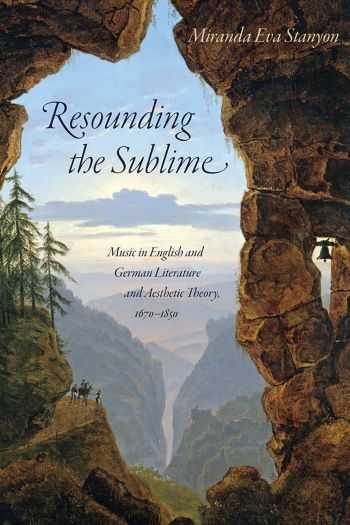 What does the sublime sound like? Harmonious, discordant, noisy, rustling, silent? Miranda Eva Stanyon rereads and resounds this crucial aesthetic category in English and German literatures of the long eighteenth century from a musical perspective and shows how sonorous sublimes lay at the heart of a central and transformative discourse. For Enlightenment and Romantic era listeners, the musical sublime represented a sonic encounter of the most extreme kind, one that tested what humans were capable of feeling, imagining, thinking, and therefore becoming.
The sublime and music have not always sung from the same hymn sheet, Stanyon observes. She charts an antagonistic intimacy between the two, from the sublime’s rise to prominence in the later seventeenth century, through the upheavals associated with Kant in the late eighteenth century, and their reverberations in the nineteenth. Offering readings of canonical texts by Longinus, Dryden, Burke, Klopstock, Herder, Coleridge, De Quincey, and others alongside lesser-known figures, she shows how the literary sublime was inextricable from musical culture, from folksongs and ballads to psalmody, polychoral sacred music, and opera. Deeply interdisciplinary, Resounding the Sublime draws literature into dialogue with sound studies, musicology, and intellectual and cultural history to offer new perspectives on the sublime as a phenomenon which crossed media, disciplines, and cultures.
An interdisciplinary study of sound in history, the book recovers varieties of the sublime crucial for understanding both the period it covers and the genealogy of modern and postmodern aesthetic discourses. In resounding the sublime, Stanyon reveals a phenomenon which was always already resonant. The sublime emerges not only as the aesthetic of the violently powerful, a-rational, or unrepresentable, but as a variegated discourse with competing dissonant, harmonious, rustling, noisy, and silent strains, one in which music and sound illustrate deep divisions over issues of power, reason, and representation.
Miranda Eva Stanyon is Lecturer in Comparative Literature at King’s College London and Research Fellow in English Literature at the University of Melbourne.
C O N T E N T S
List of Abbreviations
Note on Translations and References
Introduction
Part I. He Rais’d a Mortal to the Skies; She Drew an Angel Down: English Literature, ca. 1670–1760
1 Music as a ‘Bastard Imitation of Persuasion’? Power and Legitimacy in Dryden and Dennis
2 ‘What Passion Cannot Musick Raise and Quell!’ Passionate and Dispassionate Sublimity with the Hillarians and Handelians
Part II. Hissing Snakes and Angelic Hosts: German Literature, ca. 1720–1770
3 Reforming Aesthetics: Bodmer and Breitinger’s Anti-Musical Sublime
4 Klopstock, Rustling, and the Antiphonal Sublime
Part III. Sublime Beauty and the Wrath of the Organ: English and German Literature, ca. 1770–1850
5 The Beauty of the Infinite: Herder’s Sublimely-Beautiful, Beautifully-Sublime Music
6 The Terror of the Infinite: Thomas De Quincy’s Reverberations
Conclusion
Notes
Bibliography
Index
Acknowledgements
New Book | The Sculpted Ear
From The Pennsylvania State UP:
Ryan McCormack, The Sculpted Ear: Aurality and Statuary in the West (University Park: Penn State University Press, 2020), 224 pages, ISBN: 978-0271086927 (hardcover), $90 / ISBN: 978-0271086934 (paperback), $33.
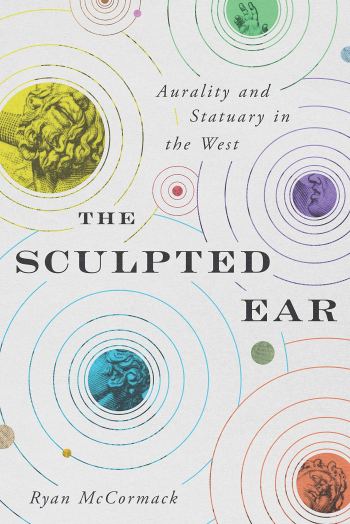 Sound and statuary have had a complicated relationship in Western aesthetic thought since antiquity. Taking as its focus the sounding statue—a type of anthropocentric statue that invites the viewer to imagine sounds the statue might make—The Sculpted Ear rethinks this relationship in light of discourses on aurality emerging within the field of sound studies. Ryan McCormack argues that the sounding statue is best thought of not as an aesthetic object but as an event heard by people and subsequently conceptualized into being through acts of writing and performance.
Constructing a history in which hearing plays an integral role in ideas about anthropocentric statuary, McCormack begins with the ancient sculpture of Laocoön before moving to a discussion of the early modern automaton known as Tipu’s Tiger and the statue of the Commendatore in Mozart’s Don Giovanni. Finally, he examines statues of people from the present and the past, including the singer Josephine Baker, the violinist Aleksandar Nikolov, and the actor Bob Newhart—with each case touching on some of the issues that have historically plagued the aesthetic viability of the sounding statue. McCormack convincingly demonstrates how sounding statues have served as important precursors and continuing contributors to modern ideas about the ontology of sound, technologies of sound reproduction, and performance practices blurring traditional divides between music, sculpture, and the other arts.
A compelling narrative that illuminates the stories of individual sculptural objects and the audiences that hear them, this book will appeal to anyone interested in the connections between aurality and statues in the Western world, in particular scholars and students of sound studies and sensory history.
Ryan McCormack is a writer and independent scholar based in Knoxville, Tennessee.
C O N T E N T S
Acknowledgments
Introduction: Elvis Leaves the Building
1 Animation Introduces Animation
2 Breathing Voice into Laocoön’s Mouth
3 Imperial Possessions
4 Hearing a Stone Man
5 Aural Skins
6 Now You Have to Go, Comrade
7 Museums of Resonance
Conclusion: I Now Present Sergei Rachmaninoff
Notes
Bibliography
Index
New Book | A Sensory History Manifesto
From The Pennsylvania State UP:
Mark Smith, A Sensory History Manifesto (University Park: Penn State University Press, 2021), 128 pages, ISBN: 978-0271090177 (hardcover), $70 / ISBN: 978-0271090184 (paperback), $22.
 A Sensory History Manifesto is a brief and timely meditation on the state of the field. It invites historians who are unfamiliar with sensory history to adopt some of its insights and practices, and it urges current practitioners to think in new ways about writing histories of the senses.
Starting from the premise that the sensorium is a historical formation, Mark Smith traces the origins of historical work on the senses long before the emergence of the field now called ‘sensory history’, interrogating, exploring, and in some cases recovering pioneering work on the topic. Smith argues that we are at an important moment in the writing of the history of the senses, and he explains the potential that this field holds for the study of history generally. In addition to highlighting the strengths of current work in sensory history, Smith also identifies some of its shortcomings. If sensory history provides historians of all persuasions, times, and places a useful and incisive way to write about the past, it also challenges current practitioners to think more carefully about the historicity of the senses and the desirability—even the urgency—of engaged and sustained debate among themselves. In this way, A Sensory History Manifesto invites scholars to think about how their field needs to evolve if the real interpretive dividends of sensory history are to be realized.
Mark M. Smith is Carolina Distinguished Professor of History at the University of South Carolina. An award-winning author of more than a dozen books, his work has been translated into Chinese, Korean, German, Danish, and Spanish.
C O N T E N T S
Acknowledgments
Introduction
1 Past
2 Present
3 Future
Notes
Bibliography
Index










 Enfilade
leave a comment